Abstract—This paper presents a Manufacturing Execution System (MES) for the composite component manufacturing workshop of an aerospace enterprise. The production planning and scheduling is the core module of the MES that described in detail. The system shows the production planning and production scheduling have diverse effect on the workshop production. The significance of the automatic scheduling is emphasized. The characteristic of the composite component manufacturing and production scheduling is analyzed in detail. An improved genetic algorithm for automatic production scheduling is emphatically described. By improving some methods to the traditional genetic algorithm, the convergence rate of the improved genetic algorithm is increased. Three-layer structure is adopted to design and develop the system. Some practical manufacturing composite components are selected to verify the validity of the improved genetic algorithm and the developed system. The developed system has been applied in the composite component manufacturing workshop. The results show that working efficiency of the production planning and scheduling has been improved.
Index Terms—Composite component, Genetic algorithm, MES, Production planning and scheduling.
I. INTRODUCTION
Because of the particularity of production in aerospace enterprises, the production managements in aerospace enterprises are distinctly different from other enterprises. After receiving the production tasks in aerospace enterprises, the departments of production planning divide the production tasks into the component production plans at the beginning of the year. Then, the production plans are issued to the workshops. The workshops subdivide the production plans again and complete the production tasks. Most of the aerospace enterprises have been using Enterprise Resource Planning (ERP) systems currently. Matching material, predicting production capacity of the enterprise, and arranging main production plans may be done simultaneously after issuing production plan. Most of the
Manuscript received June 3, 2010. This work was supported in part by National Defense Scientific Research Foundation of China.
Mei Zhongyi is with the School of Mechanical Engineering and Automation, Beijing University of Aeronautics and Astronautics, 37 Xueyuan Raod, Beijing 100191, China (telephone: 0086-010-82316833; fax: 0086-010-82317735; e-mail: [email protected]).
Muhammad Younus is with the School of Mechanical Engineering and Automation, Beijing University of Aeronautics and Astronautics, 37 Xueyuan Raod, Beijing 100191, China. (e-mail: [email protected]).
Liu Yongjin is with the School of Mechanical Engineering and Automation, Beijing University of Aeronautics and Astronautics, 37 Xueyuan Raod, Beijing 100191, China. (e-mail: [email protected]).
enterprises do not have such kind of controlling and information management in the workshops. After the production plans are issued to the workshops, the information transferring is still implemented manually by using traditional paper bills. So it’s difficult to keep the consistency between the workshop production and the enterprises production plans.
In recent years, a lot of enterprises have adopted Manufacturing Execution System (MES) to improve the level of information management in workshops. Cheng et al propose a systematic approach to develop an open, modularized, distributive, configurable, and integrated MES framework by using object-oriented technique [1]. In 2002, Chung Sheng-Leun et al present an integrated MES for Semi Conductor manufacturing on an open architecture [2]. In 2006, Walkden Michelle presents MES for a papermaking enterprise which composed of reliable delivery time, planning, and production invoicing [3]. In 2007, Qi ES et al analyze the characteristics of current shop floor's production planning and scheduling. The idea of researching on production planning and scheduling based on APS and MES integrated system is presented [4]. In 2008, Huang ZH et al implement the optimization control and management of the auto electronic parts enterprise production process [5]. In 2009, Cao Y et al introduce the scheduling optimization based on CAPP/PPC Integration. Three core modules, namely, operation planning, operation scheduling, and material tracing are presented [6].
The composite component manufacturing workshop understudy is experiencing problems in inventory control, scheduling, material flow, equipment management, and real time data collection for decision making. It is extremely complicated to carry out any production statistics analysis on the available data for decision making because manual compilation of report involves several calculations. The real time data access and information sharing for further planning and rescheduling is unavailable resulting low productivity. A suitable MES has been developed to improve the traditional working efficiency and real time process monitoring of the products. This paper mainly presents the production planning and scheduling management of the developed MES, especially focus on the automatic scheduling algorithm.
II. THE FUNCTION OF PRODUCTION PLANNING AND SCHEDULING MANAGEMENT
MES is an important part of the enterprise information management system. The main functions of the developed MES for the composite component manufacturing workshop are production planning and scheduling management, and
Production Planning and Scheduling for the
Composite Component Manufacturing Workshop
production process management. By real-time tracking the production process of the workshop, MES can harmonize all production activities. Some functions of the MES are managing material, equipment, and personnel in the composite component manufacturing workshop, and making all production resources most reasonable assignment. By integrating inventory management, personal management, file management, and other modules in the same system platform, MES improves the workshop production efficiency and management. The main function modules of the developed MES are shown in Fig.1.
Figure 1. Main function module of the developed MES
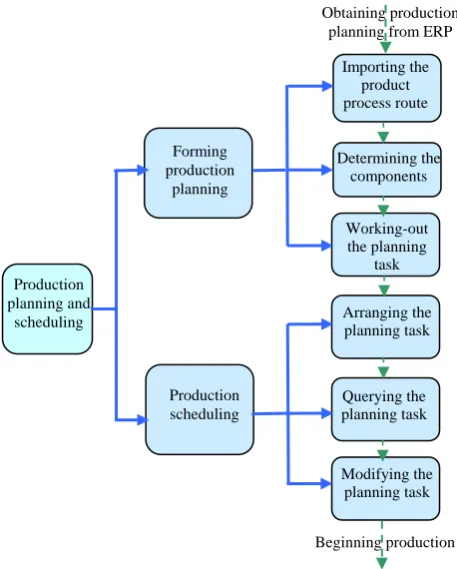
The module of planning and scheduling management is the core module of the developed MES. It’s the connecting tie between the Enterprise Resource Planning (ERP) system and the control system of the shop floor. The module of planning and scheduling management includes two aspects, namely, forming production planning and production scheduling. Production planning is mainly arranging product variety, product quality, production output, and production value which should be attained in the planning period. It’s as the guidance to the workshop production. Production scheduling is the continue work of the production planning. It’s the detailed execution process of the production planning. Based on the product variety, product quantity, and product delivery period planned by production planning, production scheduling makes up the detailed production tasks for every production unit in a determinate time period and puts the production planning into effect. Therefore, production planning and scheduling is the origination of the workshop production and the main line of the workshop process flow. Fig.2 shows the work content of production planning and scheduling in the composite component manufacturing workshop. The work flow of the production planning and scheduling is:
1) Importing the product process route from CAPP. 2) Determining the components that will be planned. 3) Working-out the planning task.
4) Arranging the planning task. 5) Querying the planning task. 6) Modifying the planning task.
[image:2.595.53.286.189.349.2]The former three contents are forming the workshop production planning. The later three contents are called the workshop production scheduling.
Figure 2. Work content of production planning and scheduling in the composite component manufacturing workshop
The workshop production planning is the subdivision of the enterprise production planning. According to the priority of the production, the workshop production planning can arrange appropriate production sequence of the orders which got from the enterprise production planning. The effect of workshop production scheduling is reasonably arranging production tasks to suitable production teams or workers at right time. The workshop production scheduling prepares all needed tools, materials, fixtures, and equipments in time. These will ensure the production tasks may be completed with high quality and right quantity.
III. THE STATUS OF THE AUTOMATIC SCHEDULING IN THE PRODUCTION PLANNING AND SCHEDULING
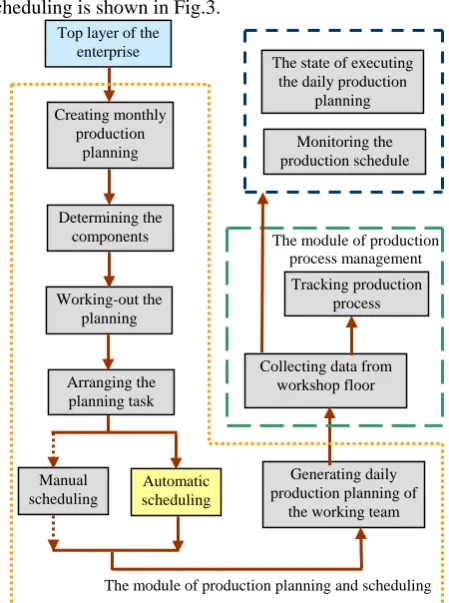
Production scheduling must consider a lot of factors, such as urgent order, production ability, the peak load of equipment, and delivery period. In actual production, these factors often restrict and conflict each other. It’s impossible to satisfy all factors to the best. So production scheduling will synthetically consider all the factors and make the outcome of the scheduling most reasonably to the appointed workshop. The scheduling decides the utilizing efficiency of the equipments and the working efficiency of the workers. It also decides product cost and the overall production efficiency of the workshop. With the production scope enlarging and the production tasks increasing, the workshop production scheduling becomes more challenging. Traditional manual scheduling is difficult to satisfy the demand of the workshop production scheduling. Developing the automatic scheduling system is for replacing the traditional manual scheduling, realizing the optimization of the scheduling, and finally improving the workshop production efficiency. The status of the automatic scheduling in the production planning and
Obtaining production planning from ERP
Beginning production Production
planning and scheduling
Forming production
planning
Production scheduling
Importing the product process route Determining the
components Working-out the planning
task Arranging the
planning task
Querying the planning task
Modifying the planning task The main function modules of
the developed MES
Planning and scheduling
Material distribution and deliver
Production process management
Quality control
Inventory management
Workshop business management
System management
scheduling is shown in Fig.3.
Figure 3. Status of the automatic scheduling in the production planning and scheduling
IV. CHARACTERISTIC OF COMPOSITE COMPONENT
PRODUCTION SCHEDULING
Aerospace composite component manufacturing workshop is differing from other component manufacturing enterprises. There are more working procedures. The working procedures of composite component manufacturing include three main portions, namely cloth cutting and lay up, curing and heat press for shaping, and painting and assembly. The production characteristic of these three working procedures is presented in TableⅠ.
TABLE I. Characteristic of composite component manufacturing
Classify Cloth cutting and lay up
Curing and heat press for shaping
Painting and assembly
The key working procedures
Cloth cutting and lay up
Curing and heat press (Necessary procedures)
Cementing and inspection (Optional procedures) Process time
Process time is short except vacuumizing
component
Curing and heat press needs nearly
four hours
Process time of all procedures is short Needed
equipments
Numerical control equipments of cloth
cutting and lay up
Curing stove and heat press pot
Most equipments are numerical control equipments
By comparing and analyzing, curing and heat press are the key procedures in the process of composite component manufacturing. Curing and heat press need more process time. All the composite component manufacturing must pass through curing and heat press procedure. There are a lot of working procedures in composite component manufacturing. So, it is more difficult to schedule for composite component manufacturing. The process flow of composite component
manufacturing is shown in Fig.4.
Figure 4. Process flow of composite component manufacturing
By investigating actual production of the composite component manufacturing workshop, there are some special characteristics in composite component manufacturing, as follows.
1) Manufacturing sequence of the composite component according to the production sequence which starts working from small procedure number to big procedure number.
2) Production processes of the composite components are generally same. The same production procedures of the different components have different process time.
3) Some components in the same batch of composite components can have the production priority.
4) Some production procedures of composite components are often finished manually. For example, lay up, honeycomb polishing, and trimming edge, etc.
On all accounts, production scheduling of composite component manufacturing workshop can be approximately regarded as scheduling problem of the flow shop. In flow shop, one production team can only finish one procedure of one component at one time. Before starting new procedure, the previous procedure must be finished.
In order to satisfy the demand of workshop production planning and scheduling, many optimal algorithms like Simulated Annealing, Genetic Algorithm, Tabu Search, and Neural Network are developed. This paper adopts improved genetic algorithm to complete automatic scheduling of the composite components manufacturing. Some improved methods are applied to the traditional genetic algorithm.
V. THE WORK FLOW OF IMPROVED GENETIC ALGORITHM
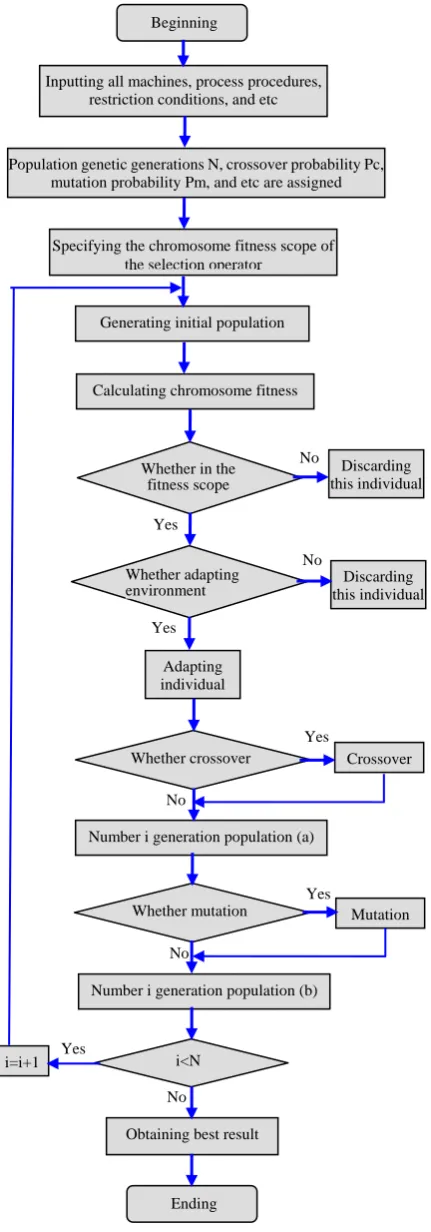
To set up traditional genetic algorithm to the workshop production scheduling is required follow two steps. The first step is to input basic data about all machines and working teams, process procedures of the components, process time of every procedure, and required machine for every procedure. Second, the basic parameters of the genetic algorithm are assigned. These parameters include population genetic generations N, crossover probability Pc, mutation probability Pm, and so on. Based on above basic information and biology principle, the genetic algorithm can randomly create chromosome gene and subsequently generate initial population. By using selection operator, the individual with machine information is judged whether adapting environment. If it does not adapt environment, this individual
Cloth cutting (10)
Honeycomb processing
(20)
Lay up (30)
Curing (40) Trimming and
drilling (50) CMM inspection
(60) NDI inspection
(70) Countersink
(80) Dimension
inspection (90) Painting
(100) Delivery to assembly (110)
The module of production planning and scheduling Top layer of the
enterprise
Creating monthly production
planning
Determining the components
Working-out the planning
Arranging the planning task
Manual scheduling
Automatic scheduling
Generating daily production planning of
the working team Collecting data from
workshop floor Tracking production
process The state of executing
the daily production planning Monitoring the production schedule
[image:3.595.308.545.53.212.2]will be discarded. Otherwise, this individual enters crossover phase. After the population suffers crossover, this population becomes the embryo of the next generation population. Afterward, this population is dealt with mutation operator and backward operator. It becomes the real next generation population. After the population undergo N times heredity, the chromosome gene becomes stable. Thereby, the best result can be obtained.
Figure 5. Work flow of improved genetic algorithm
When genetic algorithm is applied to the production scheduling of the composite workshop, based on the traditional genetic algorithm, some improved methods are adopted to adjust the convergence rate. For example, the suitable fitness scope is specified. Only the chromosome whose fitness satisfies the scope can enter into the selection operator. Otherwise, the chromosome whose fitness does not satisfy the scope will be discarded immediately. This is similar to the heredity of the biology population. The individual that does not adapt environment can not copulate and enter into next generation. This ensures that only relatively excellent individual can achieve the heredity and multiply the next generation. By using these methods, the convergence rate of this algorithm can be improved. Consequently, the influence of the bad individuals to the whole population can be eliminated. The work flow of improved genetic algorithm is shown in Fig.5.
VI. THE SOFTWARE TECHNOLOGY OF PRODUCTION PLANNING AND SCHEDULING SYSTEM
By using the core improved genetic algorithm, the production planning and scheduling system of the composite workshop has been developed. The system designing adopts three-layer structure which based on Web technology and browser/server (B/S) architecture. The developing languages are ASP.NET and C#. The application architecture of the system is divided into three layers that include user presentation layer, transaction logical layer, and data access layer. The architecture of the system is shown in Fig.6.
Figure 6. Architecture of the system
User presentation layer is the user interface of the system. This layer is used to implement human-computer interaction between the users and the developed system. Transaction logical layer is the core of the whole system. All the transaction rules and logical implementation are packaged in the logical groupware. Data access layer is used to access, store, and optimize data in database.
The client-side is the WEB browser of every computer. By using Internet or Intranet, The client-side can access the server at real time. All the transaction logical codes and data are saved in the server. So the central controlling of the system can be achieved.
VII. PRACTICAL APPLICATION OF THE IMPROVED GENETIC ALGORITHM
Some practical composite components of the workshop are selected to verify the validity of the improved genetic algorithm and the developed system. The parameter values of the improved genetic algorithm are specified, such as
Beginning
Inputting all machines, process procedures, restriction conditions, and etc
Population genetic generations N, crossover probability Pc, mutation probability Pm, and etc are assigned
Specifying the chromosome fitness scope of the selection operator
Generating initial population
Calculating chromosome fitness
Whether in the fitness scope
Discarding this individual No
Yes Whether adapting
environment this individualDiscarding No
Yes
Whether crossover Adapting individual
Yes
Crossover No
Number i generation population (a)
Whether mutation
Yes No
Mutation
Number i generation population (b)
i<N No Yes
i=i+1
Obtaining best result
Ending
Browsing
WEB server Data server Web page
invoking Web page
replying
Data invoking
Data replying
User presentation layer
Transaction logical layer
[image:4.595.313.534.412.519.2]crossover probability Pc=0.9, mutation probability Pm=0.1, the individuals of the population is 300, the population genetic generations is 150. There are two orders and three composite components. The two orders are respectively named oreder1 and order2. The part numbers of the three composite components are respectively named 193Z1001-3, 193Z1001-4, and 193Z1002-3. Order1 includes three components and order2 includes two components, as presented in TableⅡ.
TABLE II. Components in the order
Order Order1 Order2
The components in the order 193Z1001-3 193Z1001-4 193Z1002-3
193Z1001-3 193Z1001-4
All the three composite components have the same working procedures. But the process time of the same working procedure for different component is different. The working procedures and process time of the three composite components are presented in TableⅢ.
TABLE III. Working procedures and process time (hour) of the composite components
Working procedure
number
Working procedure name
Working team number
Process time of 193Z1001-3
Process time of 193Z1001-4
Process time of 193Z1002-3
10 Cloth cutting 1 2 2.5 3 20 Honeycomb 2 2.5 2.5 2.5 30 Lay up 3 4.5 5 4.5 40 Curing 4 3.5 6.5 4 50
Trimming and
drilling 5 0.5 1.5 1.5 60 CMM inspection 6 1.5 1.2 1.5 70 NDI inspection 7 1.5 2 1 80 Countersink 8 1 2 2.5 90
Dimension
inspection 9 0.5 1 1.5 100 Painting 10 1 1.2 1.5 110 Delivery 11 0.5 0.5 0.5
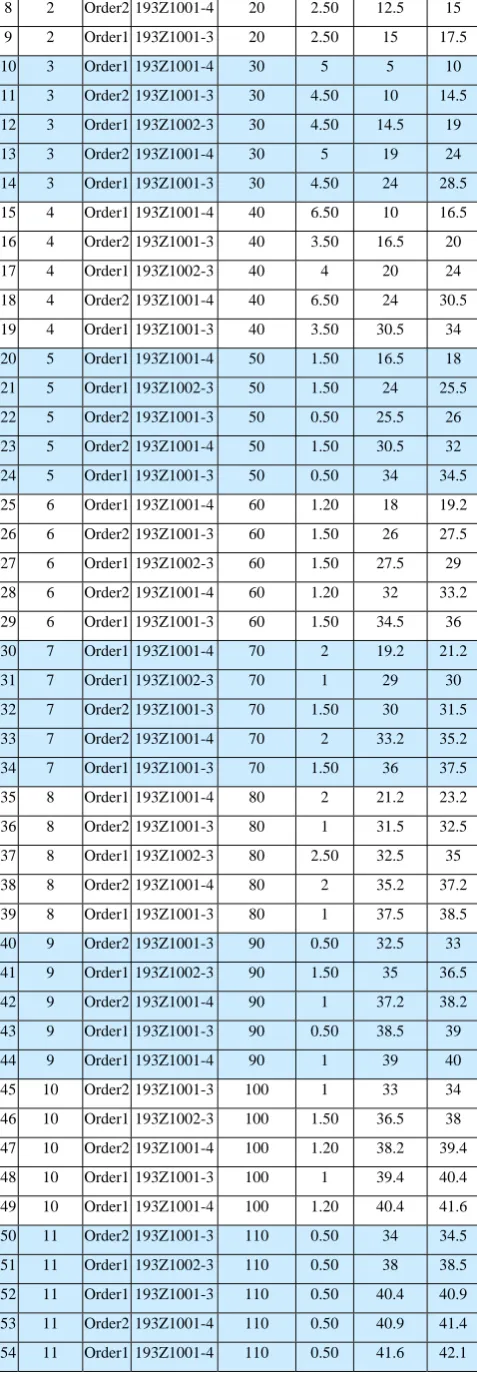
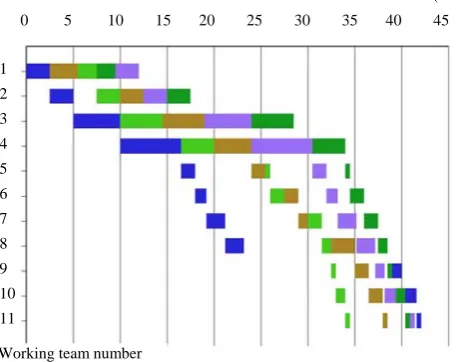
[image:5.595.307.546.52.740.2]Based on the improved genetic algorithm, the optimized process sequence of the composite components can be calculated. The starting time and end time of every procedure for the three components can be also obtained at the same time. The optimized process sequence, process time, starting time, and end time of the working procedures are presented in Table Ⅳ.
TABLE IV. The optimized process sequence, process time, starting time, and end time of the working procedures
ID Working
team number
order component
Working procedure
number
Process time (hour)
Starting time (hour)
End time (hour)
0 1 Order1 193Z1001-4 10 2.50 0 2.5 1 1 Order1 193Z1002-3 10 3 2.5 5.5 2 1 Order2 193Z1001-3 10 2 5.5 7.5 3 1 Order1 193Z1001-3 10 2 7.5 9.5 4 1 Order2 193Z1001-4 10 2.50 9.5 12 5 2 Order1 193Z1001-4 20 2.50 2.5 5 6 2 Order2 193Z1001-3 20 2.50 7.5 10 7 2 Order1 193Z1002-3 20 2.50 10 12.5
8 2 Order2 193Z1001-4 20 2.50 12.5 15 9 2 Order1 193Z1001-3 20 2.50 15 17.5 10 3 Order1 193Z1001-4 30 5 5 10 11 3 Order2 193Z1001-3 30 4.50 10 14.5 12 3 Order1 193Z1002-3 30 4.50 14.5 19 13 3 Order2 193Z1001-4 30 5 19 24 14 3 Order1 193Z1001-3 30 4.50 24 28.5 15 4 Order1 193Z1001-4 40 6.50 10 16.5 16 4 Order2 193Z1001-3 40 3.50 16.5 20 17 4 Order1 193Z1002-3 40 4 20 24 18 4 Order2 193Z1001-4 40 6.50 24 30.5 19 4 Order1 193Z1001-3 40 3.50 30.5 34 20 5 Order1 193Z1001-4 50 1.50 16.5 18 21 5 Order1 193Z1002-3 50 1.50 24 25.5 22 5 Order2 193Z1001-3 50 0.50 25.5 26 23 5 Order2 193Z1001-4 50 1.50 30.5 32 24 5 Order1 193Z1001-3 50 0.50 34 34.5 25 6 Order1 193Z1001-4 60 1.20 18 19.2 26 6 Order2 193Z1001-3 60 1.50 26 27.5 27 6 Order1 193Z1002-3 60 1.50 27.5 29 28 6 Order2 193Z1001-4 60 1.20 32 33.2 29 6 Order1 193Z1001-3 60 1.50 34.5 36 30 7 Order1 193Z1001-4 70 2 19.2 21.2 31 7 Order1 193Z1002-3 70 1 29 30 32 7 Order2 193Z1001-3 70 1.50 30 31.5 33 7 Order2 193Z1001-4 70 2 33.2 35.2 34 7 Order1 193Z1001-3 70 1.50 36 37.5 35 8 Order1 193Z1001-4 80 2 21.2 23.2 36 8 Order2 193Z1001-3 80 1 31.5 32.5 37 8 Order1 193Z1002-3 80 2.50 32.5 35 38 8 Order2 193Z1001-4 80 2 35.2 37.2 39 8 Order1 193Z1001-3 80 1 37.5 38.5 40 9 Order2 193Z1001-3 90 0.50 32.5 33 41 9 Order1 193Z1002-3 90 1.50 35 36.5 42 9 Order2 193Z1001-4 90 1 37.2 38.2 43 9 Order1 193Z1001-3 90 0.50 38.5 39 44 9 Order1 193Z1001-4 90 1 39 40 45 10 Order2 193Z1001-3 100 1 33 34 46 10 Order1 193Z1002-3 100 1.50 36.5 38 47 10 Order2 193Z1001-4 100 1.20 38.2 39.4 48 10 Order1 193Z1001-3 100 1 39.4 40.4 49 10 Order1 193Z1001-4 100 1.20 40.4 41.6 50 11 Order2 193Z1001-3 110 0.50 34 34.5 51 11 Order1 193Z1002-3 110 0.50 38 38.5 52 11 Order1 193Z1001-3 110 0.50 40.4 40.9 53 11 Order2 193Z1001-4 110 0.50 40.9 41.4 54 11 Order1 193Z1001-4 110 0.50 41.6 42.1
[image:5.595.50.290.635.782.2]working team 2. Because the process time of the later working teams is less than the process time of the former working teams, there is some waiting time in the later seven working teams.
Figure 7. Result of the production scheduling
VIII. CONCLUSION
The improved genetic algorithm is implemented and applied in the production planning and scheduling of the composite manufacturing. By improving traditional genetic algorithm, the convergence rate of the algorithm is increased. The developed system has been applied in the composite component manufacturing workshop of an aerospace enterprise. The application of the production planning schedule system has radically changed the traditional manual production planning and scheduling manner and improved the work efficiency. By using this system, the real time monitoring and feeding back of the production activities are ensured. This information system has filled up the communication gap between ERP at the higher level and shop floor at the lower level. The production planning and scheduling system is an important part of the information system in an enterprise. It provides immense amount of information support to the entire enterprise.
REFERENCES
[1] Cheng.F.T, Shen,E, Deng,j.y. and Nguyen,K, “Development of distributed object-oriented system frame work for the computer-integrated manufacturing execution system[C]”, Proc. Of 1998 IEEE Inc. Conf. on rob. and aut., Leuven, Belgium, May 1998, pp.2116-2121.
[2] Cheng sheng-leun, Jeng MuDER, “Manufacturing Execution system (MES) for semiconductor manufacturing[C]”, Proceeding of the IEEE International Conference on system, Man, Cybernetics, Oct. 6-9, 2002, Yasmine Hammamet, Tunisia, pp.7-11.
[3] Walkden Michelle, “Manufacturing execution system enable mill operation efficiency at UPM Changshu[J]”, paper Asia, January/February, Vol.22, No.1, 2006, pp.21-23.
[4] Qi ES, Chen JY, Wang YS,“The production planning and scheduling based on APS and MES[C]”, Proceedings of the 14th international conference on industrial engineering and engineering management, Vol.A and B, 2007, pp.53-57.
[5] Huang ZH, Kan SL “Based on MES for implement optimization of production scheduling of auto electronic parts manufacture[C]”, Proceeding of IEEE Congress on evolutionary computation, Vol.1-8, 2008, pp. 3992-3997.
[6] Cao Y, Liu N, Yang L, Yang YL, “MES scheduling optimization and simulation based on CAPP/PPC integration[C]”, Proceeding of sixth international symposium on neural networks, 2009, pp.613-622.
Process time (hour) 0 5 10 15 20 25 30 35 40 45 1
2 3 4 5 6 7 8 9 10 11