The University of Illinois System in the CoNLL-2013 Shared Task
Alla Rozovskaya Kai-Wei Chang Mark Sammons Dan Roth
Cognitive Computation Group University of Illinois at Urbana-Champaign
Urbana, IL 61801
{rozovska,kchang10,mssammon,danr}@illinois.edu
Abstract
The CoNLL-2013 shared task focuses on correcting grammatical errors in essays written by non-native learners of English. In this paper, we describe the University of Illinois system that participated in the shared task. The system consists of five components and targets five types of com-mon grammatical mistakes made by En-glish as Second Language writers. We de-scribe our underlying approach, which re-lates to our previous work, and describe the novel aspects of the system in more de-tail. Out of 17 participating teams, our sys-tem is ranked first based on both the orig-inal annotation and on the revised annota-tion.
1 Introduction
The task of correcting grammar and usage mis-takes made by English as a Second Language (ESL) writers is difficult for several reasons. First, many of these errors are context-sensitive mistakes that confuse valid English words and thus can-not be detected without considering the context around the word. Second, the relative frequency of mistakes is quite low: for a given type of mis-take, an ESL writer will typically make mistakes in only a small proportion of relevant structures. For example, determiner mistakes usually occur in 5% to 10% of noun phrases in various anno-tated ESL corpora (Rozovskaya and Roth, 2010a). Third, an ESL writer may make multiple mistakes in a single sentence, which may give misleading local cues for individual classifiers. In the exam-ple shown in Figure 1, the agreement error on the verb “tend” interacts with the noun number error on the word “equipments”.
Therefore , the *equipments/equipmentof bio-metric identification *tend/tends to be in-expensive .
Figure 1: Representative ESL errors in a sample sentence from the training data.
The CoNLL-2013 shared task (Ng et al., 2013) focuses on the following five common mistakes made by ESL writers:
• article/determiner • preposition • noun number
• subject-verb agreement • verb form
Errors outside this target group are present in the task corpora, but are not evaluated.
In this paper, we present a system that combines a set of statistical models, where each model spe-cializes in correcting one of the errors described above. Because the individual error types have different characteristics, we use several different approaches. The article system builds on the el-ements of the system described in (Rozovskaya and Roth, 2010c). The preposition classifier uses a combined system, building on work described in (Rozovskaya and Roth, 2011) and (Rozovskaya and Roth, 2010b). The remaining three models are all Na¨ıve Bayes classifiers trained on the Google Web 1T 5-gram corpus (henceforth, Google cor-pus, (Brants and Franz, 2006)).
We first briefly discuss the task (Section 2) and give the overview of our system (Section 3). We then describe the error-specific components (Sec-tions 3.1, 3.2 and 3.3). The sections describ-ing individual components quantify their perfor-mance on splits of the training data. In Section 4,
we evaluate the complete system on the training data using 5-fold cross-validation (hereafter, “ 5-fold CV”) and in Section 5 we show the results we obtained on test.
We close with a discussion focused on error analysis (Section 6) and our conclusions (Sec-tion 7).
2 Task Description
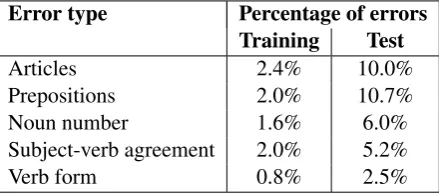
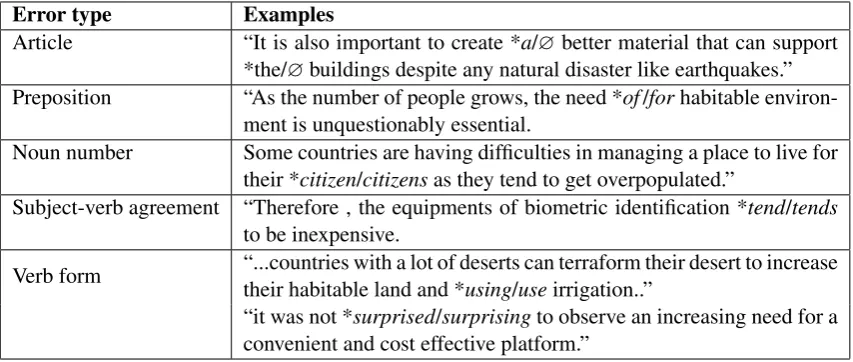
The CoNLL-2013 shared task focuses on correct-ing five types of mistakes that are commonly made by non-native speakers of English. The train-ing data released by the task organizers comes from the NUCLE corpus (Dahlmeier et al., 2013), which contains essays written by learners of En-glish as a foreign language and is corrected by English teachers. The test data for the task con-sists of an additional set of 50 student essays. Ta-ble 1 illustrates the mistakes considered in the task and Table 2 illustrates the distribution of these er-rors in the released training data and the test data. We note that the test data contains a much larger proportion of annotated mistakes. For example, while only 2.4% of noun phrases in the training data have determiner errors, in the test data 10% of noun phrases have mistakes.
Error type Percentage of errors
Training Test
Articles 2.4% 10.0%
Prepositions 2.0% 10.7%
Noun number 1.6% 6.0%
Subject-verb agreement 2.0% 5.2%
[image:2.595.74.294.430.527.2]Verb form 0.8% 2.5%
Table 2:Statistics on error distribution in train-ing and test data. Percentage denotes the erro-neous instances with respect to the total number of relevant instances in the data. For example, 10% of noun phrases in the test data have determiner errors.
Since the task focuses on five error types, only annotations marking these mistakes were kept. Note that while the other error annotations were removed, the errors still remain in the data.
3 System Components
Our system consists of five components that ad-dress individually article1, preposition, noun verb
1We will use the terms ‘article-’ and ‘determiner errors’ interchangeably: article errors constitute the majority of
de-form and subject-verb agreement errors.
Our article and preposition modules build on the elements of the systems described in Rozovskaya and Roth (2010b), Rozovskaya and Roth (2010c) and Rozovskaya and Roth (2011). The article sys-tem is trained using the Averaged Perceptron (AP) algorithm (Freund and Schapire, 1999), imple-mented within Learning Based Java (Rizzolo and Roth, 2010). The AP system is trained using the
inflationmethod (Rozovskaya et al., 2012). Our preposition system is a Na¨ıve Bayes (NB) classi-fier trained on the Google corpus and with prior parameters adapted to the learner data.
The other modules – those that correct noun and verb errors – are all NB models trained on the Google corpus.
All components take as input the corpus doc-uments preprocessed with a part-of-speech tag-ger2 and shallow parser3 (Punyakanok and Roth, 2001). Note that the shared task data already contains comparable pre-processing information, in addition to other information, including depen-dency parse and constituency parse, but we chose to run our own pre-processing tools. The article module uses the POS and chunker output to gen-erate some of its features and to gengen-erate candi-dates (likely contexts for missing articles). The other system components use the pre-processing tools only as part of candidate generation (e.g., to identify all nouns in the data for the noun classi-fier) because these components are trained on the Google corpus and thus only employ word n-gram features.
During development, we split the released train-ing data into five parts. The results in Sections 3.1, 3.2, and 3.3 give performance of 5-fold CV on the training data. In Section 4 we report the develop-ment 5-fold CV results of the complete model and the performance on the test data. Note that the per-formance reported for the overall task on the test data in Section 4 reflects the system that makes use of the entire training corpus. It is also important to remark that only the determiner system is trained on the ESL data. The other models are trained on native data, and the ESL training data is only used to optimize the decision thresholds of the models.
terminer errors, and we address only article mistakes. 2
http://cogcomp.cs.illinois.edu/page/ software view/POS
3http://cogcomp.cs.illinois.edu/page/
Error type Examples
Article “It is also important to create *a/∅better material that can support
*the/∅buildings despite any natural disaster like earthquakes.”
Preposition “As the number of people grows, the need *of/forhabitable environ-ment is unquestionably essential.
Noun number Some countries are having difficulties in managing a place to live for their *citizen/citizensas they tend to get overpopulated.”
Subject-verb agreement “Therefore , the equipments of biometric identification *tend/tends
to be inexpensive.
Verb form “...countries with a lot of deserts can terraform their desert to increase their habitable land and *using/useirrigation..”
[image:3.595.86.513.68.249.2]“it was not *surprised/surprisingto observe an increasing need for a convenient and cost effective platform.”
Table 1: Example errors. Note that only the errors exemplifying the relevant phenomena are marked in the table; the sentences may contain other mistakes. Errors marked as verb form include multiple grammatical phenomena that may characterize verbs.
3.1 Determiners
There are three types of determiner error: omitting a determiner; choosing an incorrect determiner; and adding a spurious determiner. Even though the majority of determiner errors involve article mistakes, some of these errors involve personal and possessive pronouns.4 Most of the determiner errors, however, involve omitting an article (these make up over 60% in the training data). Similar er-ror patterns have been observed in other ESL cor-pora (Rozovskaya and Roth, 2010a).
Our system focuses on article errors. The sys-tem first extracts from the data all articles, and all spaces at the beginning of a noun phrase where an article is likely to be omitted (Han et al., 2006; Ro-zovskaya and Roth, 2010c). Then we train a multi-class multi-classifier with features described in Table 3. These features were used successfully in previous tasks in error correction (Rozovskaya et al., 2012; Rozovskaya et al., 2011).
The original word choice (the source article) used by the writer is also used as a feature. Since the errors are sparse, this feature causes the model to abstain from flagging a mistake, which results in low recall. To avoid this problem, we adopt the approach proposed in (Rozovskaya et al., 2012), theerror inflationmethod, and add artificial arti-cle errors in the training data based on the error distribution on the training set. This method pre-vents the source feature from dominating the con-text features, and improves the recall of the
sys-4e.g. “Pat apologized to me for not keeping
the*/my se-crets.”
tem.
We experimented with two types of classifiers: Averaged Perceptron (AP) and an L1-generalized logistic regression classifier (LR). Since the arti-cle system is trained on the ESL data, of which we have a limited amount, we also experimented with adding a language model (LM) feature to the LR learner. This feature indicates if the correc-tion is accepted by a language model trained on the Google corpus. The performance of each clas-sifier on 5-fold CV on the training data is shown in Table 4. The results show that AP performs better than LR. We observed that adding the LM feature improves precision but results in lower F1, so we chose the AP classifier without the LM feature for our final system.
Model Precision Recall F1
[image:3.595.307.531.539.612.2]AP (inflation) 0.17 0.31 0.22 AP (inflation+LM) 0.26 0.15 0.19 LR (inflation) 0.17 0.29 0.22 LR (inflation+LM) 0.24 0.21 0.22
Table 4: Article development resultsResults on 5-fold CV. AP With Inflation achieves the best development using an inflation constant of 0.85. AP achieves higher performance without using the language model feature.
3.2 Prepositions
Feature Type Description
Word n-grams wB,w2B,w3B,wA,w2A,w3A,wBwA,w2BwB,wAw2A,w3Bw2BwB,w2BwBwA,wBwAw2A,wAw2Aw3A,
w4Bw3Bw2BwB,w3w2BwBwA,w2BwBwAw2A,wBwAw2Aw3A,wAw2Aw3w4A
POS features pB,p2B,p3B,pA,p2A,p3A,pBpA,p2BpB,pAp2A,pBwB,pAwA,p2Bw2B,p2Aw2A,p2BpBpA,pBpAp2A,
pAp2Ap3A
N P1 headW ord,npWords,NC,adj&headWord,adjTag&headWord,adj&NC,adjTag&NC,npTags&headWord,npTags&NC
N P2 headWord&headPOS,headNumber
wordsAfterNP headWord&wordAfterNP, npWords&wordAfterNP, headWord&2wordsAfterNP, npWords&2wordsAfterNP, headWord&3wordsAfterNP,
npWords&3wordsAfterNP
wordBeforeNP wB&fi∀i∈N P1
Verb verb,verb&fi∀i∈N P1
Preposition prep&fi∀i∈N P1
[image:4.595.71.543.64.182.2]Source the word used by the original writer LM a binary feature assigned by a language model
Table 3: Features used in the article error correction system.wBandwAdenote the word immediately before and after the target, respectively; andpBandpAdenote the POS tag before and after the target.headWorddenotes the head of the NP complement.N Cstands for noun compound and is active if second to last word in the NP is tagged as a noun.Verbfeatures are active if the NP is the direct object of a verb.Prepositionfeatures are active if the NP is immediately preceded by a preposition. adjfeature is active if the first word (or the second word preceded by an adverb) in the NP is an adjective.npWordsandnpTags denote all words (POS tags) in the NP.
3.2.1 Preposition Features
All features used in the preposition module are lexical: word n-grams in the 4-word window around the target preposition. The NB-priors clas-sifier, which is part of our model, can only make use of the word n-gram features; it uses n-gram features of lengths 3, 4, and 5. Note that since the NB model is trained on the Google corpus, the an-notated ESL training data is used only to replace the prior parameters of the model (see Rozovskaya and Roth, 2011 for more details).
3.2.2 Training the Preposition System
Correcting preposition errors requires more data to achieve performance comparable to article er-ror correction due to the task complexity (Gamon, 2010). We found that training an AP model on the ESL training data with more sophisticated fea-tures is not as effective as training on a native En-glish dataset of larger size. The ESL training data contains slightly over 100K preposition examples, which is several orders of magnitude smaller than the Google n-gram corpus. We use the shared task training data to replace the prior parameters of the model (see Rozovskaya and Roth, 2011 for more details). The NB-priors model does not tar-get preposition omissions and insertions: it cor-rects only preposition replacements that involve the 12 most common English prepositions. The task includes mistakes that cover 36 prepositions but we found that the model performance drops once the confusion set becomes too large. Table 5 shows the performance of the system on the 5-fold CV on the training data, where each time the classifier was trained on 80% of the documents.
Model Precision Recall F1
NB-priors 0.14 0.14 0.14
Table 5: Preposition results: NB with priors. Results on 5-fold CV. The model is trained on the Google corpus.
3.3 Correcting Nouns and Verbs
The three remaining types of errors – noun num-ber errors, subject-verb agreement, and the various verb form mistakes – are corrected using separate NB models also trained on the Google corpus. We focus here on the selection of candidates for cor-rection, as this strongly affects performance.
3.3.1 Candidate Selection
This stage selects the set of words that are pre-sented as input to the classifier. This is a crucial step because it limits the performance of any sys-tem: those errors that are missed at this stage have no chance of being detected by the later stages. This is also a challenging step as the class of verbs and nouns is open, with many English verbs and nouns being compatible with multiple parts of speech. This problem does not arise in preposi-tion and article error correcpreposi-tion, where candidates are determined by surface form (i.e. can be deter-mined using a closed list of prepositions or arti-cles).
[image:4.595.321.509.275.305.2]miss about 10% of noun errors due to POS/shallow parser errors. For verbs, we compared several candidate selection methods. Method (1) ex-tracts all verbs heading a verb phrase, as iden-tified by the shallow parser. Method (2) ex-pands this set to words tagged with one of the verb POS tags{VB,VBN,VBG,VBD,VBP,VBZ}. However, generating candidates by selecting only those tagged as verbs is not good enough, since the POS tagger performance on ESL data is known to be suboptimal (Nagata et al., 2011), especially for verbs containing errors. For example, verbs lack-ing agreement markers are likely to be mistagged as nouns (Lee and Seneff, 2008). Erroneous verbs are exactly the cases that we wish to include. Method (3) adds words that are in the lemma list of common English verbs compiled using the Giga-word corpus. The last method has the highest re-call on the candidate identification; it misses only 5% of verb errors, and also has better performance in the complete model. We thus use this method.
[image:5.595.307.531.316.406.2]3.3.2 Noun-Verb Correction Performance
Table 6 shows the performance of the systems based on 5-fold CV on the training data. Each model is trained individually on the Google cor-pus, and is individually processed to optimize the respective thresholds.
Model Precision Recall F1
Noun number 0.17 0.38 0.23 Subject-verb agr. 0.19 0.24 0.21 Verb form 0.07 0.20 0.10
Table 6: Noun, subject-verb agreement and verb form results. Results on 5-fold CV. The models are trained on the Google corpus.
4 Combined Model
In the previous sections, we described the individ-ual components of the system developed to target specific error types. The combined model includes all of these modules, which are each applied to examples individually: there is no pipeline, and the individual predictions of the modules are then pooled.
The combined system also includes a post-processing step where we remove certain correc-tions of noun and verb forms that we found oc-cur quite often but are never correct. This hap-pens when both choices – the writer’s selection
and the correction – are valid but the latter is ob-served more frequently in the native training data. For example, the phrase “developing country” is changed to “developed country” even though both are legitimate English expressions. If a correction is frequently proposed but always results in a false alarm, we add it to a list of changes that is ignored when we generate the system output. When we generate the output on Test set, 8 unique pairs of such changes are ignored (36 pairs of changes in total).
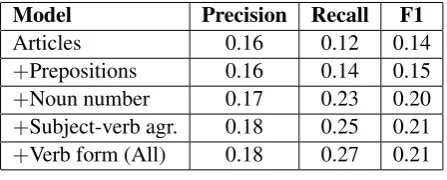
We now show the combined results on the train-ing data by conducttrain-ing 5-fold CV, where we add one component at a time. Table 8 shows that the recall and the F1 scores improve when each com-ponent is added to the system. The final system achieves an F1 score of 0.21 on the training data in 5-fold CV.
Model Precision Recall F1
Articles 0.16 0.12 0.14
+Prepositions 0.16 0.14 0.15
+Noun number 0.17 0.23 0.20
+Subject-verb agr. 0.18 0.25 0.21
[image:5.595.73.288.452.511.2]+Verb form (All) 0.18 0.27 0.21
Table 7: Results on 5-fold CV on the training data. The article model is trained on the ESL data using AP. The other models are trained on the Google corpus. The last line shows the results, when all of the five modules are included.
5 Test Results
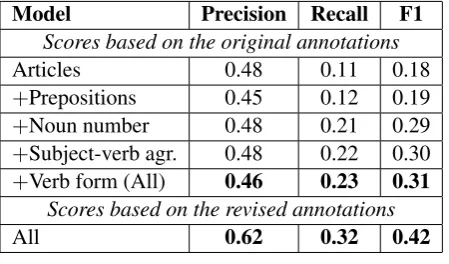
The previous section showed the performance of the system on the training data. In this section, we show the results on the test set. As previously, the performance improves when each component is added into the final system. However, we also note that the precision is much higher while the recall is only slightly lower. We attribute this in-creased precision to the observed differences in the percentage of annotated errors in training vs. test (see Section 3) and hypothesize that the train-ing data may contain additional relevant errors that were not included in the annotation.
revised annotations, both the precision and the re-call are higher. Our system achieves the highest scores out of 17 participating teams based on both the original and revised annotations.
Model Precision Recall F1
Scores based on the original annotations
Articles 0.48 0.11 0.18
+Prepositions 0.45 0.12 0.19
+Noun number 0.48 0.21 0.29
+Subject-verb agr. 0.48 0.22 0.30
+Verb form (All) 0.46 0.23 0.31
Scores based on the revised annotations
[image:6.595.72.297.130.262.2]All 0.62 0.32 0.42
Table 8: Results on Test. The article model is trained on the ESL data using AP. The other mod-els are trained on the Google corpus. Alldenotes the results of the complete model that includes all of the five modules.
6 Discussion and Error Analysis
Here, we present some interesting errors that our system makes.
6.1 Error Analysis
Incorrect verb form correction: Safety is one of the crucial problems that many countries and com-panies *concerned/concerns.
Here, the phrasing requires multiple changes; to maintain the same word order, this correction would be needed in tandem with the insertion of the auxiliary “have” to create a passive construc-tion.
Incorrect determiner insertion: In this era, Engineering designs can help to provide more habitable accommodation by designing a stronger material so it’s possible to create a taller and safer building, a better and efficient sanitation system to prevent *∅/the disease, and also by designing
a way to change the condition of the inhabitable environment.
This example requires a model of discourse at the level of recognizing when a specific disease is a focus of the text, rather than disease in gen-eral. The use of a singular construction “a taller and safer building” in this context is somewhat un-conventional and potentially makes this distinction even harder to detect.
Incorrect verb number correction:
One current human *need/needs that should be given priority is the search for renewable re-sources.
This appears to be the result of the system heuristics intended to mitigate POS tagging errors on ESL text, where the word “need” is considered as a candidate verb rather thana noun; this results in an incorrect change to make the “verb” agree in number with the phrase “one human”.
Incorrect determiner deletion: This had shown that the engineering design process is es-sential in solving problems and it ensures that the problem is thoroughly looked into and ensure that the engineers are generating ideas that target the main problem, *the/∅depletion and harmful fuel.
In this example, local context may suggest a list structure, but the wider context indicates that the comma represents an appositive structure.
6.2 Discussion
Note that the presence of multiple errors can have very negative effects on preprocessing. For exam-ple, when an incorrect verb form is used that re-sults in a word form commonly used as a noun, the outputs of the parsers tend to be incorrect. This limits the potential of rule-based approaches.
Machine learning approaches, on the other hand, require sufficient examples of each error type to allow robust statistical modeling of contex-tual features. Given the general sparsity of ESL errors, together with the additional noise intro-duced into more sophisticated preprocessing com-ponents by errors with overlapping contexts, it ap-pears hard to leverage these more sophisticated tools to generate features for machine learning ap-proaches. This motivates our use of just POS and shallow parse analysis, together with language-modeling approaches that can use counts derived from very large native corpora, to provide robust inputs for machine learning algorithms.
fo-cus may depend on the form used in the preceding sentences – for example, to distinguish between a general statement about some type of entity, and a statement about a specific entity.
These observations suggest that achieving very high performance in the task of grammar correc-tion requires sophisticated modeling of deep struc-ture in natural language documents.
7 Conclusion
We have described our system that participated in the shared task on grammatical error correction and ranked first out of 17 participating teams. We built specialized models for the five types of mis-takes that are the focus of the competition. We have also presented error analysis of the system output and discussed possible directions for future work.
Acknowledgments
This material is based on research sponsored by DARPA under agreement
num-ber FA8750-13-2-0008. The U.S. Government is authorized to reproduce and
distribute reprints for Governmental purposes notwithstanding any copyright
notation thereon. The views and conclusions contained herein are those of the
authors and should not be interpreted as necessarily representing the official
policies or endorsements, either expressed or implied, of DARPA or the U.S.
Government. This research is also supported by a grant from the U.S.
Depart-ment of Education and by the DARPA Machine Reading Program under Air
Force Research Laboratory (AFRL) prime contract no. FA8750-09-C-018.
References
T. Brants and A. Franz. 2006. Web 1T 5-gram Version 1. Linguistic Data Consortium, Philadelphia, PA.
D. Dahlmeier, H.T. Ng, and S.M. Wu. 2013. Building a large annotated corpus of learner english: The nus corpus of learner english. In Proc. of the NAACL HLT 2013 Eighth Workshop on Innovative Use of NLP for Building Educational Applications, Atlanta, Georgia, June. Association for Computational Lin-guistics.
Yoav Freund and Robert E. Schapire. 1999. Large margin classification using the perceptron algorithm. Machine Learning.
M. Gamon. 2010. Using mostly native data to correct errors in learners’ writing. InNAACL, pages 163– 171, Los Angeles, California, June.
N. Han, M. Chodorow, and C. Leacock. 2006. De-tecting errors in English article usage by non-native speakers. Journal of Natural Language Engineer-ing, 12(2):115–129.
J. Lee and S. Seneff. 2008. Correcting misuse of verb forms. InACL, pages 174–182, Columbus, Ohio, June. Association for Computational Linguistics.
R. Nagata, E. Whittaker, and V. Sheinman. 2011. Cre-ating a manually error-tagged and shallow-parsed learner corpus. InACL, pages 1210–1219, Portland, Oregon, USA, June. Association for Computational Linguistics.
H. T. Ng, S. M. Wu, Y. Wu, Ch. Hadiwinoto, and J. Tetreault. 2013. The conll-2013 shared task on grammatical error correction. In Proc. of the Seventeenth Conference on Computational Natural Language Learning.Association for Computational Linguistics.
V. Punyakanok and D. Roth. 2001. The use of classi-fiers in sequential inference. InNIPS.
N. Rizzolo and D. Roth. 2010. Learning Based Java for Rapid Development of NLP Systems. InLREC.
A. Rozovskaya and D. Roth. 2010a. Annotating ESL errors: Challenges and rewards. InProceedings of the NAACL Workshop on Innovative Use of NLP for Building Educational Applications.
A. Rozovskaya and D. Roth. 2010b. Generating con-fusion sets for context-sensitive error correction. In Proceedings of the Conference on Empirical Meth-ods in Natural Language Processing (EMNLP).
A. Rozovskaya and D. Roth. 2010c. Training paradigms for correcting errors in grammar and us-age. InNAACL.
A. Rozovskaya and D. Roth. 2011. Algorithm selec-tion and model adaptaselec-tion for esl correcselec-tion tasks. InACL.
A. Rozovskaya, M. Sammons, J. Gioja, and D. Roth. 2011. University of Illinois system in HOO text cor-rection shared task.