Sequence Effects in Crowdsourced Annotations
Nitika Mathur Timothy Baldwin Trevor Cohn
School of Computing and Information Systems The University of Melbourne
Victoria 3010, Australia
{tbaldwin,tcohn}@unimelb.edu.au
Abstract
Manual data annotation is a vital compo-nent of NLP research. When designing annotation tasks, properties of the anno-tation interface can lead to unintentional artefacts in the resulting dataset, biasing the evaluation. In this paper, we explore sequence effects where annotations of an item are affected by the preceding items. Having assigned one label to an instance, the annotator may be less (or more) likely to assign the same label to the next. Dur-ing ratDur-ing tasks, seeDur-ing a low quality item may affect the score given to the next item either positively or negatively. We see clear evidence of both types of effects us-ing auto-correlation studies over three dif-ferent crowdsourced datasets. We then recommend a simple way to minimise se-quence effects.
1 Introduction
NLP research relies heavily on annotated datasets for training and evaluation. The design of the an-notation task can influence the decisions made by annotators in subtle ways: besides the actual fea-tures of the instance being annotated, annotators are also influenced by factors such as the user in-terface, wording of the question, and familiarity with the task or domain.
When collecting NLP annotations, care is usu-ally taken to ensure that the annotations are of high quality, through careful design of label sets, anno-tation guidelines and training of annotators (Hovy et al.,2006), methods for aggregating annotations (Passonneau and Carpenter, 2014), and intuitive user interfaces (Stenetorp et al.,2012).
Crowdsourcing has emerged as a cheaper, faster alternative to expert NLP annotations (Snow et al.,
2008;Callison-Burch and Dredze,2010;Graham et al., 2017), although it entails additional effort to filter out unskilled or opportunistic workers, e.g. through the collection of redundant repeated judgements for each instance, or including some trap questions with known answers ( Callison-Burch and Dredze, 2010; Hoßfeld et al., 2014). In most annotation exercises, the order of pre-sentation of instances is randomised to remove bias due to similarities in topic, style and vocabu-lary (Koehn and Monz,2006;Bojar et al.,2016).
When crowdsourcing judgements, the normal practise (as used in the datasets we analyse) is for the item ordering to be randomised in creating a “HIT” (i.e. a single collection of items presented to a crowdworker for judgement), and then to have each HIT annotated by multiple workers, for qual-ity control purposes. The order of items is gen-erally fixed across all annotators of an individual HIT (Snow et al.,2008;Graham et al.,2017).
In this paper, we show that worker scores are affected by sequence bias, whereby the order of presentation can affect individuals’ assessment of an item. Since all workers see the instances in the same order, this affects any other inferences made from the data, including aggregated assessment or inferences about individual annotators (such as their overall quality or individual thresholds).
Possible explanations for sequence effects in-clude:
Gambler’s fallacy: Once annotators have de-veloped an idea of the distribution of scores/labels, they can come to expect even small sequences to follow the distribution. In particular, in binary annotation tasks, if they expect that True (1) and False (0) items are equally likely, then they believe the sequence 00000 (100% False and 0% True) is less likely than the sequence 01010 (50% False and 50% True). So if they assign 0 to an item,
they may approach the next item with a prior belief that it is more likely to be a 1 than a 0.Chen et al.
(2016) showed evidence for the gambler’s fallacy in decisions of loan officers, asylum judges, and baseball umpires.
Sequential contrast effects: A high quality item may raise the bar for the next item. On the other hand, a bad item may make the next item seem better in comparison (Kenrick and Gutierres,
1980;Hartzmark and Shue,to appear)
Assimilation and anchoring: The annotator uses their score of the previous item as an anchor, and adjusts the score of the current item from this anchor, based on perceived similarities and differ-ences with the previous item. If they focus on similarities between the previous and current in-stance, the annotations show an assimilation ef-fect (Geiselman et al.,1984;Damisch et al.,2006). Anchoring effects may decrease as people gain ex-perience and expertise in the task (Wilson et al.,
1996).
2 Methodology
We test whether the annotation of an instance is correlated with the annotation on previous in-stances, conditioned on control variables such as the gold standard (i.e. expert annotations1), based
on the following linear model:
Yi,t =β0+β1Yi,t−1+β2Gold+η (1)
where Yi,t is the annotation given by an annota-tor i to an instance t, and η is white Gaussian noise with zero mean. We use linear regression for continuous data and logistic regression for binary data.2 If there is no dependence between
consecu-tive instances, and annotators assign labels/scores based only on the aspects of the current instance, then the data can be explained from the gold score (learning a positiveβ2 value) and bias term (β0), withβ1 set to zero. When we use the ground truth as a control, if β1 is non-zero, it is evidence of mistakes being made by annotators due to sequen-tial bias. A positive value ofβ1 can be explained by priming or anchoring, and a negative value with sequential contrast effects or the gambler’s fallacy. Accordingly, we test the statistical significance of 1For the Machine Translation dataset described in Sec-tion3.3, we use the mean of at least fifteen crowd workers as a proxy for expert annotations.
2ηis not included in the case of logistic regression
Task All Good Moderate
RTE −0.102 −0.169∗ −0.192∗∗
TEMPORAL 0.198 −0.567∗∗∗ −0.511∗∗∗
Table 1: Autocorrelation coefficient β1 for RTE and TEMPORALdata. Stars denote statistical
sig-nificance:∗= 0.05,∗∗= 0.01, and∗∗∗= 0.001.
theβ1 6= 0 to determine whether sequencing ef-fects are present in crowdsourced text corpora.
3 Experiments
We analyse several influential datasets that have been constructed through crowdsourcing, includ-ing both binary and continuous annotation tasks: recognising textual entailment, event ordering, af-fective text analysis, and machine translation eval-uation.
3.1 Recognising Textual Entailment (RTE) and Event Temporal Ordering
First, we examine the recognising textual en-tailment (“RTE”) and event temporal ordering (“TEMPORAL”) datasets fromSnow et al.(2008).
In the RTE task, annotators are presented with two sentences, and are asked to judge whether the sec-ond text can be inferred from the first. With the TEMPORALdataset, they are shown two sentences
describing events, and asked to indicate which of the two events occurred first. Both datasets in-clude both expert annotations and crowdsourced annotations constructed using Amazon Mechani-cal Turk (“MTurk”). On MTurk, each RTE HIT contains 20 instances, and each TEMPORAL HIT
contains 10 instances, which the workers see in sequential order. For both tasks, each HIT was an-notated by 10 workers.
Results We use logistic regression on worker la-bels against lala-bels on the previous instance in the current HIT, with the expert judgements as a con-trol variable. We also add an additional concon-trol, namely the percentage of True labels assigned by the worker overall, which accounts for the overall annotator bias. To calculate this, we use scores by the worker excluding the current score, to avoid giving the model any information about the cur-rent instance.
is that this is biased by opportunistic workers who assign the same label to all instances in the HIT, for which we would not expect any sequential bias effects. When we exclude these workers (“Moder-ate”), the autocorrelation increases, and is highly statistically significant. We also show results for workers with at least 60% accuracy when com-pared to expert annotations (“Good”), and observe a similar effect.
3.2 Affective text analysis
In the affective text analysis task (“AFFECTIVE”),
annotators are asked to rate news headlines for anger, disgust, fear, joy, sadness, and surprise on a continuous scale of 0–100. Besides these emo-tions, they are asked to rate sentences for (emo-tive) valence, i.e., how strongly negative or posi-tive they are (−100to+100). In this dataset, there are 100 headlines divided into 10 HITs, with 10 workers annotating each HIT (Snow et al.,2008). We test for autocorrelation of scores of each as-pect individually, controlling for the expert scores and worker correlation with the expert scores. We also look separately at datasets of good and bad workers, based on whether the correlation with the expert annotations is greater than 0.5.
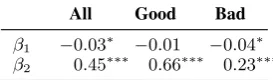
Results For individual emotions, we do not ob-serve any significant autocorrelation (p ≥ 0.05). As there are only 1000 annotations per emotion, we also look at results when combining data for all aspects. Though we find a statistically sig-nificant negative autocorrelation for scores of the full dataset, this disappears when we filter out bad workers (Table 2). Given the difficulty of this very subjective task, it is likely that many of work-ers considered ‘bad’ might have simply found this task too difficult or arbitrary, and thus become more prone to sequence effects.
3.3 Machine Translation Adequacy
When evaluating machine translation (“MT”), we tend to focus on adequacy: the extent to which the meaning of the reference translation is captured in the MT output. In the method of Graham et al.
(2015) — the current best-practise, as adopted by WMT (Bojar et al.,2016) — annotators are asked to judge the adequacy of translations using a 100-point sliding scale which is initialised at the mid point. There are 3 marks on the scale dividing it into 4 quarters to aid workers with internal cali-bration. They are given no other instructions or
All Good Bad
β1 −0.03∗ −0.01 −0.04∗
[image:3.595.349.486.64.104.2]β2 0.45∗∗∗ 0.66∗∗∗ 0.23∗∗∗
Table 2: Autocorrelation coefficientβ1for the AF -FECTIVEdataset.
guidelines.
In this paper, we base our analysis on the ade-quacy dataset ofGraham et al.(2015), on Spanish-English newswire data from WMT 2013 (Bojar et al.,2013). The dataset consists of 12 HITS of 100 sentence pairs each; each HIT is annotated by at least 15 workers.
HITs are designed to include quality control items to filter out poor quality scores. In addi-tion to 70 MT system translaaddi-tions, each HIT con-tains degraded versions of 10 of these translations, 10 reference translations by a human expert cor-responding to 10 of these translations, and repeats of another 10 translations. Good workers are as-sumed to give high scores to the references, simi-lar scores to the pair of repeats, and high scores to the MT system translations when compared to cor-responding degraded translations. Workers who submitted scores of clearly bad quality were re-jected. For the remaining workers, the Wilcoxon rank-sum test is used to test whether the score dif-ference between the repeat judgements is less than the score difference between translations and the corresponding degraded versions. We divide these workers into “good” and “moderate” based on the threshold ofp <0.05.
To eliminate differences due to different internal scales, every individual worker’s scores are stan-dardised by subtracting the mean and dividing by the standard deviation of their scores. Following
Graham et al.(2015), we use the average of stan-dardised scores of at least 15 good workers as the ground truth.
Good Moderate Bad β1 0.030∗∗∗ 0.037∗∗∗ 0.192∗∗∗
β2 0.741 0.661 0.256
[image:4.595.87.279.175.226.2]Nitems 48216 24696 17738
Table 3: MTadeq dataset: Autocorrelation
coeffi-cientβ1, showing sequence bias of good, moderate and bad workers.
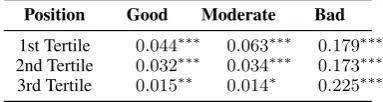
Position Good Moderate Bad
1st Tertile 0.044∗∗∗ 0.063∗∗∗ 0.179∗∗∗
2nd Tertile 0.032∗∗∗ 0.034∗∗∗ 0.173∗∗∗
3rd Tertile 0.015∗∗ 0.014∗ 0.225∗∗∗
Table 4: MTadeq dataset: Regression coefficient
β1of adequacy scores with the previous score. We also show results for translations in the first, sec-ond or third tertile based on the position of the sen-tence of the HIT
bad (rejected) workers.
An interesting question is whether the bias changes as workers annotate more data, which could be ascribed to learning through the task, cal-ibrating their internal scales, or becoming fatigued on a monotonous task. Each HIT consists of 100 sentences, and we divide the dataset into 3 equal groups based on the position of sentence in the HIT. As shown in Table4, for good and moderate workers, the bias is stronger in the first group of sentences annotated, decreases in the second, and is much smaller in the last. This could be because workers are familiarising themselves with the task earlier on, and calibrating their scale. There is no such trend with bad quality scores, possibly be-cause the workers are not putting in sufficient ef-fort to produce accurate scores.
Next we assess the impact of the bias in the worst case situation. We discretize scores into low, middle and high based on equal-frequency bin-ning, and divide the dataset into 3 groups based on the score assigned to the previous sentence. As shown in Table5we can see that the sentences in the “low” partition and the “high” partition have a difference of 0.18, which is highly significant;3
moreover, this difference is likely to be sufficiently large to alter the rankings of systems in an evalua-tion. The bias remains even when we increase the number of workers and use the average score, as all workers scored the translations in the same or-der. This shows that the mean is also affected by
3p <0.001using Welch’s two-samplet-test
N All Low Middle High H−L
1 0.01 −0.09 0.05 0.08 0.18∗∗∗
5 0.00 −0.05 −0.02 0.08 0.14∗∗∗
10 −0.00 −0.05 −0.04 0.09 0.13∗∗∗
15 −0.00 −0.05 −0.02 0.07 0.12∗∗∗
Table 5: MTadeq dataset: Translations following a
low quality translation receive a lower score than those following a good translation: “All” is the mean score of all sentences in the dataset, where each sentence score is calculated as the average ofN (standardised) worker scores. “Low”, “Mid-dle”, and “High” are mean scores of sentences where the previous sentence annotated is of low, medium and high quality, resp. “H−L” is the dif-ference between the average high and low scores.
sequence bias.
Thus, it is theoretically possible to exploit se-quence bias to artificially deflate (or inflate) a spe-cific system’s computed score by ordering a HIT such that the system’s output is seen consistently immediately after a bad (or good) output.
4 Discussion and Conclusions
We have shown significant sequence effects across several independent crowdsourced datasets: a neg-ative autocorrelation in the RTE and TEMPO -RALdatasets, and a positive autocorrelation in the
MTadeq dataset. The negative autocorrelation can
be attributed either to sequential contrast effects or the gambler’s fallacy. These effects were not sig-nificant for the AFFECTIVEdataset, perhaps due to
the nature of the annotation task, whereby annota-tions of one emotion are separated by six other an-notations, thus limiting the potential for sequenc-ing effects. It is also possible that the dataset is too small to obtain statistical significance.
in-dividual translations remain biased, which augurs poorly for the use of these annotations at the sen-tence level, such as when used in error analysis or for training automatic metrics.
Sequence problems can be easily addressed by adequate randomisation — providing each indi-vidual worker with a separate dataset that has been randomised, such that no two workers see the same ordered data. In this way sequence bias effects can be considered as independent noise sources, rather than a systematic bias, and conse-quently the aggregate results over several workers will remain unbiased.
This study has shown that sequence bias is real, and can distort evaluation and annotation exercises with crowd-workers. We limited our scope to bi-nary and continuous responses, however it is likely that sequence effects are prevalent for multinomial and structured outputs, e.g., in discourse and pars-ing, where priming is known to have a significant effect (Reitter et al., 2006). Another important question for future work is whether sequence bias is detectable in expert annotators, not just crowd workers.
Acknowledgments
We thank the anonymous reviewers for their valu-able feedback. This work was supported in part by the Australian Research Council.
References
Ondˇrej Bojar, Christian Buck, Chris Callison-Burch, Christian Federmann, Barry Haddow, Philipp Koehn, Christof Monz, Matt Post, Radu Soricut, and Lucia Specia. 2013. Findings of the 2013 Work-shop on Statistical Machine Translation. In Pro-ceedings of the Eighth Workshop on Statistical Ma-chine Translation, pages 1–44, Sofia, Bulgaria. Ondˇrej Bojar, Rajen Chatterjee, Christian Federmann,
Yvette Graham, Barry Haddow, Matthias Huck, Antonio Jimeno Yepes, Philipp Koehn, Varvara Logacheva, Christof Monz, Matteo Negri, Aure-lie Neveol, Mariana Neves, Martin Popel, Matt Post, Raphael Rubino, Carolina Scarton, Lucia Spe-cia, Marco Turchi, Karin Verspoor, and Marcos Zampieri. 2016. Findings of the 2016 Conference on Machine Translation. InProceedings of the First Conference on Machine Translation, pages 131– 198, Berlin, Germany.
Chris Callison-Burch and Mark Dredze. 2010. Creat-ing speech and language data with Amazon’s Me-chanical Turk. InProceedings of the NAACL HLT 2010 Workshop on Creating Speech and Language
Data with Amazon’s Mechanical Turk, pages 1–12, Los Angeles, USA.
Daniel Chen, Tobias J. Moskowitz, and Kelly Shue. 2016. Decision-making under the gambler’s fal-lacy: Evidence from asylum judges, loan officers, and baseball umpires. The Quarterly Journal of Economics.
Lysann Damisch, Thomas Mussweiler, and Henning Plessner. 2006. Olympic medals as fruits of com-parison? Assimilation and contrast in sequential per-formance judgments. Journal of Experimental Psy-chology: Applied, 12(3):166.
R Edward Geiselman, Nancy A Haight, and Lori G Ki-mata. 1984. Context effects on the perceived physi-cal attractiveness of faces. Journal of Experimental Social Psychology, 20(5):409–424.
Yvette Graham, Timothy Baldwin, Alistair Moffat, and Justin Zobel. 2017. Can machine translation sys-tems be evaluated by the crowd alone. Natural Lan-guage Engineering, 23(1):330.
Yvette Graham, Nitika Mathur, and Timothy Baldwin. 2015. Accurate evaluation of segment-level ma-chine translation metrics. In Proceedings of the 2015 Conference of the North American Chapter of the Association for Computational Linguistics Human Language Technologies, pages 1183–1191, Denver, USA.
Samuel M. Hartzmark and Kelly Shue. to appear. A tough act to follow: Contrast effects in financial markets. Journal of Finance.
Tobias Hoßfeld, Matthias Hirth, Judith Redi, Filippo Mazza, Pavel Korshunov, Babak Naderi, Michael Seufert, Bruno Gardlo, Sebastian Egger, and Chris-tian Keimel. 2014. Best practices and recommenda-tions for crowdsourced QoE — lessons learned from the Qualinet Task Force “Crowdsourcing”. Lessons learned from the Qualinet Task Force “Crowdsourc-ing” COST Action IC1003 European Network on Quality of Experience in Multimedia Systems and Services (QUALINET).
Eduard Hovy, Mitchell Marcus, Martha Palmer, Lance Ramshaw, and Ralph Weischedel. 2006. Ontonotes: The 90% solution. In Proceedings of the Human Language Technology Conference of the NAACL, Companion Volume: Short Papers, pages 57–60, New York, USA.
J. Rebecca Passonneau and Bob Carpenter. 2014. The benefits of a model of annotation. Transactions of the Association of Computational Linguistics, 2(1):311–326.
David Reitter, Frank Keller, and Johanna D Moore. 2006. Computational modelling of structural prim-ing in dialogue. InProceedings of the Human Lan-guage Technology Conference of the NAACL, Com-panion Volume: Short Papers, pages 121–124, New York, USA.
Rion Snow, Brendan O’Connor, Daniel Jurafsky, and Andrew Y. Ng. 2008. Cheap and fast — but is it good?: Evaluating non-expert annotations for nat-ural language tasks. In Proceedings of the Con-ference on Empirical Methods in Natural Language Processing, pages 254–263, Honolulu, USA. Pontus Stenetorp, Sampo Pyysalo, Goran Topi´c,
Tomoko Ohta, Sophia Ananiadou, and Jun’ichi Tsu-jii. 2012. BRAT: A web-based tool for NLP-assisted text annotation. InProceedings of the Demonstra-tions at the 13th Conference of the European Chap-ter of the Association for Computational Linguistics, pages 102–107, Avignon, France.