Regularization techniques for fine-tuning in neural machine translation
Antonio Valerio Miceli Barone Barry Haddow Ulrich Germann Rico Sennrich
School of Informatics, The University of Edinburgh
{amiceli, bhaddow, ugermann}@inf.ed.ac.uk [email protected]
Abstract
We investigate techniques for super-vised domain adaptation for neural ma-chine translation where an existing model trained on a large out-of-domain dataset is adapted to a small in-domain dataset. In this scenario, overfitting is a major challenge. We investigate a number of techniques to reduce overfitting and im-prove transfer learning, including regular-ization techniques such as dropout and L2-regularization towards an out-of-domain prior. In addition, we introduce tuneout, a novel regularization technique inspired by dropout. We apply these techniques, alone and in combination, to neural ma-chine translation, obtaining improvements on IWSLT datasets for English→German and English→Russian. We also inves-tigate the amounts of in-domain train-ing data needed for domain adaptation in NMT, and find a logarithmic relationship between the amount of training data and gain in BLEU score.
1 Introduction
Neural machine translation (Bahdanau et al.,
2015;Sutskever et al.,2014) has established itself as the new state of the art at recent shared transla-tion tasks (Bojar et al.,2016;Cettolo et al.,2016). In order to achieve good generalization accuracy, neural machine translation, like most other large machine learning systems, requires large amounts of training examples sampled from a distribution as close as possible to the distribution of the inputs seen during execution. However, in many applica-tions, only a small amount of parallel text is avail-able for the specific application domain, and it is
therefore desirable to leverage larger out-domain datasets.
Owing to the incremental nature of stochastic gradient-based training algorithms, a simple yet effective approach to transfer learning for neural networks is fine-tuning (Hinton and Salakhutdi-nov, 2006; Mesnil et al., 2012; Yosinski et al.,
2014): to continue training an existing model which was trained on out-of-domain data with in-domain training data. This strategy was also found to be very effective for neural machine transla-tion (Luong and Manning, 2015;Sennrich et al.,
2016b).
Since the amount of in-domain data is typically small, overfitting is a concern. A common solution is early stopping on a small held-out in-domain validation dataset, but this reduces the amount of in-domain data available for training.
In this paper, we show that we can make fine-tuning strategies for neural machine translation more robust by using several regularization tech-niques. We consider fine-tuning with varying amounts of in-domain training data, showing that improvements are logarithmic in the amount of in-domain data.
We investigate techniques where domain adap-tation starts from a pre-trained out-domain model, and only needs to process the in-domain cor-pus. Since we do not need to process the large out-domain corpus during adaptation, this is suitable for scenarios where adaptation must be performed quickly or where the original out-domain corpus is not available. Other works consider techniques that jointly train on the out-domain and in-out-domain corpora, distinguishing them using specific input features (Daume III,
2007;Finkel and Manning,2009;Wuebker et al.,
2015). These techniques are largely orthogonal to
ours1 and can be used in combination. In fact,
Chu et al.(2017) successfully apply fine-tuning in combination with joint training.
2 Regularization Techniques for Transfer Learning
Overfitting to the small amount of in-domain train-ing data that may be available is a major challenge in transfer learning for domain adaptation. We in-vestigate the effect of different regularization tech-niques to reduce overfitting, and improve the qual-ity of transfer learning.
2.1 Dropout
The first variant that we consider is fine-tuning with dropout. Dropout (Srivastava et al., 2014) is a stochastic regularization technique for neural networks. In particular, we consider "Bayesian" dropout for recurrent neural networks (Gal and Ghahramani,2016).
In this technique, during training, the columns of the weight matrices of the neural network are randomly set to zero, independently for each ex-ample and each epoch, but with the caveat that when the same weight matrix appears multiple times in the unrolled computational graph of a given example, the same columns are zeroed.
For an arbitrary layer that takes an input vector
hand computes the pre-activation vectorv (ignor-ing the bias parameter),
vi,j =W ·MW,i,j·hi,j (1)
where MW,i,j = 1pdiag(Bernoulli⊗n(p)) is the
dropout mask for matrix W and training exam-ple i seen in epoch j. This mask is a diago-nal matrix whose entries are drawn from inde-pendent Bernoulli random variables with proba-bilitypand then scaled by1/p. Gal and Ghahra-mani(2016) have shown that this corresponds to approximate variational Bayesian inference over the weight matrices considered as model-wise ran-dom variables, where the individual weights have a Gaussian prior with zero mean and small diag-onal covariance. During execution we simply set the dropout masks to identity matrices, as in the standard approximation scheme.
Since dropout is not a specific transfer learn-ing technique per se, we can apply it durlearn-ing fine-tuning, irrespective of whether or not the orig-1although in the special case of linear models, they are related
to MAP-L2 fine-tuning.
inal out-of-domain model was also trained with dropout.
2.2 MAP-L2
L2-norm regularization is widely used for ma-chine learning and statistical models. For lin-ear models, it corresponds to imposing a diago-nal Gaussian prior with zero mean on the weights.
Chelba and Acero(2006) extended this technique to transfer learning by penalizing the weights of the in-domain model by their L2-distance from the weights of the previously trained out-of-domain model.
For each parameter matrixW, the penalty term is
LW =λ·W −Wˆ 2
2 (2)
whereW is the in-domain parameter matrix to be learned andWˆ is the corresponding fixed out-of-domain parameter matrix. Bias parameters may be regularized as well. For linear models, this cor-responds to maximum a posteriori inference w.r.t. a diagonal Gaussian prior with mean equal to the out-of-domain parameters and1/λvariance.
To our knowledge this method has not been ap-plied to neural networks, except for a recent work by Kirkpatrick et al. (2017) which investigates a variant of it forcontinual learning(learning a new task while preserving performance on previously learned task) rather than domain adaptation. In this work we investigate L2-distance from out-of-domain penalization (MAP-L2) as a out-of-domain adap-tation technique for neural machine translation.
2.3 Tuneout
We also propose a novel transfer learning tech-nique which we call tuneout. Like Bayesian dropout, we randomly drop columns of the weight matrices during training, but instead of setting them to zero, we set them to the corresponding columns of the out-of-domain parameter matrices. This can be alternatively seen as learning ma-trices of parameter differences between in-domain and out-of-domain models with standard dropout, starting from a zero initialization at the beginning of fine-tuning. Therefore, equation2becomes
vi,j = ( ˆW + ∆W ·M∆W,i,j)·hi,j (3)
where Wˆ is the fixed out-of-domain parameter matrix and∆W is the parameter difference matrix to be learned andM∆W,i,j is a Bayesian dropout
3 Evaluation
We evaluate transfer learning on test sets from the IWSLT shared translation task (Cettolo et al.,
2012).
3.1 Data and Methods
Test sets consist of transcripts of TED talks and their translations; small amounts of in-domain training data are also provided. For English-to-German we use IWSLT 2015 training data, while for English-to-Russian we use IWSLT 2014 train-ing data. For the out-of-domain systems, we use training data from the WMT shared translation task,2which is considered permissible for IWSLT
tasks, including back-translations of monolingual training data (Sennrich et al., 2016b), i.e., auto-matic translations of data available only in target language “back” into the source language.3.
We train out-of-domain systems following tools and hyperparameters reported by Sennrich et al.
(2016a), using Nematus (Sennrich et al.,2017) as the neural machine translation toolkit. We dif-fer from their setup only in that we use Adam (Kingma and Ba, 2015) for optimization. Our baseline fine-tuning models use the same hyper-parameters, except that the learning rate is4times smaller and the validation frequency for early stopping4times higher. Early stopping serves an important function as the only form of regulariza-tion in the baseline fine-tuning model. We also use this configuration for the in-domain only base-lines.
After some exploratory experiments for English-to-German, we set dropout retention probabilities to 0.9for word-dropout and 0.8for all the other parameter matrices. Tuneout reten-tion probabilities are set to 0.6 (word-dropout) and 0.2 (other parameters). For MAP-L2 regu-larization, we found that a penalty of 10−3 per mini-batch performs best. For English-to-Russian, retention probabilities of 0.95 (word-dropout)
0.89 (other parameters) for both dropout and tuneout performed best.
The out-of-domain training data consists of about 7.92M sentence pairs for English-to-German and4.06M sentence pairs for English-to-Russian. In-domain training data is about 206k
sentence pairs for English-to-German and 181k
sentence pairs for English-to-Russian. Training 2http://www.statmt.org/wmt16/
3http://data.statmt.org/rsennrich/wmt16_backtranslations/
0 2 4 6 8 10
27 28 29 30 31
Training mini-batches (·104)
B
L
E
U
[image:3.595.310.523.59.236.2]fine-tune fine-tune + dropout fine-tune + L2-MAP fine-tune + tuneout
Figure 1: English→German validation BLEUover training mini-batches.
data is tokenized, truecased and segmented into subword units using byte-pair encoding (BPE) (Sennrich et al.,2016c).
For replicability and ease of adoption, we in-clude our implementation of dropout and MAP-L2 in the master branch of Nematus. Tuneout regu-larization is available in a separate code branch of Nematus.4
3.2 Results
We report the translation quality in terms of NIST-BLEU scores of our models in Table1for English-to-German and Table 2 for English-to-Russian. Statistical significance on the concatenated test sets scores is determined via bootstrap resampling (Koehn,2004).
Dropout and MAP-L2 improve translation qual-ity when fine-tuning both separately and in bination. When the two methods are used in com-bination, the improvements are significant at5%
for both language pairs, while in isolation dropout is non-significant and MAP-L2 is only significant for English-to-Russian. Tuneout does not yield improvements for English-to-German, in fact it is significantly worse, but yields a small, non-significant improvement for English-to-Russian.
In order to obtain a better picture of the train-ing dynamics, we plot traintrain-ing curves5 for
sev-eral of our English-to-German models in Figure1. 4https://github.com/EdinburghNLP/nematus/tree/
tuneout-branch
5These BLEU scores are computed using Moses
multi-bleu.perl which gives slightly different
Table 1: English-to-German translation BLEU scores
valid test
System tst2010 tst2011 tst2012 tst2013 avg
Out-of-domain only 27.19 29.65 25.78 27.85 27.76
In-domain only 25.95 27.84 23.68 25.83 25.78
Fine-tuning 30.53 32.62 28.86 32.11 31.20
Fine-tuning + dropout 30.63 33.06 28.90 32.02 31.33
Fine-tuning + MAP-L2 30.81 32.87 28.99 31.88 31.25
Fine-tuning + tuneout 30.49 32.07 28.66 31.60 30.78†
Fine-tuning + dropout + MAP-L2 30.80 33.19 29.13 32.13 31.48† †: different from the fine-tuning baseline at5%significance.
Table 2: English-to-Russian translation BLEU scores
valid test
System dev2010 tst2011 tst2012 tst2013 avg
Out-of-domain only 15.74 17.48 15.15 17.81 16.81
Fine-tuning 17.47 19.67 17.17 19.18 18.67
Fine-tuning + dropout 17.68 19.96 17.11 19.32 18.80
Fine-tuning + MAP-L2 17.77 19.91 17.34 19.49 18.91†
Fine-tuning + tuneout 17.51 19.72 17.27 19.35 18.78
Fine-tuning + dropout + MAP-L2 17.74 19.68 17.83 19.78 19.10† †: different from the fine-tuning baseline at5%significance.
Baseline fine-tuning starts to noticeably overfit be-tween the second and third epoch (1epoch≈104 mini-batches), while dropout, MAP-L2 and tune-out seem to converge withtune-out displaying notice-able overfitting.
In our experiments, all forms of regularization, including early stopping, have shown to be suc-cessful at mitigating the effect of overfitting. Still, our results suggest that there is value in not relying only on early stopping:
• our results suggest that multiple regularizers outperform a single one.
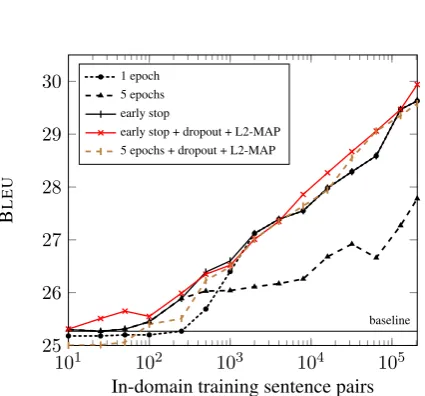
• if the amount of in-domain data is very small, we may want to use all of it for fine-tuning, and not hold out any for early stopping. To evaluate different fine-tuning streategies on varying amounts of in-domain data, we tested fine-tuning with random samples of in-domain data, ranging from 10 sentence pairs to the full data set of206ksentence pairs. Fine-tuning with low amounts of training data is of special interest for online adaptation scenarios where a system is fed back post-edited translation.6 Results are shown
6We expect even bigger gains in that scenario because we would not train on a random sample, but on translations that are conceivably from the same document.
101 102 103 104 105
25 26 27 28 29 30
baseline
In-domain training sentence pairs
B
L
E
U
1 epoch 5 epochs early stop
[image:4.595.311.524.440.638.2]early stop + dropout + L2-MAP 5 epochs + dropout + L2-MAP
in Figure2.
The results show an approximately logarithmic relation between the size of the in-domain train-ing set and BLEU. We consider three baseline ap-proaches: fine-tuning for a fixed number of epochs (1 or 5), or early stopping. All three baseline ap-proaches have their disadvantages. Fine-tuning for 1 epoch shows underfitting on small amounts of data (less than 1,000 sentence pairs); fine-tuning for 5 epochs overfits on 500-200,000 sentence pairs. Early stopping is generally a good strategy, but it requires an in-domain held-out dataset.
On the same amount of data, regularization (dropout+MAP-L2) leads to performance that is better (or no worse) than the baseline with only early stopping. Fine-tuning with regularization is also more stable, and if we have no access to a in-domain valdiation set for early stopping, can be run for a fixed number of epochs with little or no accuracy loss.
4 Conclusion
We investigated fine-tuning for domain adapta-tion in neural machine translaadapta-tion with different amounts of in-domain training data, and strategies to avoid overfitting. We found that our baseline that relies only on early stopping has a strong per-formance, but fine-tuning with recurrent dropout and with MAP-L2 regularization yield additional small improvements of the order of 0.3 BLEU points for both German and English-to-Russian, while the improvements in terms of final translation accuracy of tuneout appear to be less consistent.
Furthermore, we found that regularization tech-niques that we considered make training more ro-bust to overfitting, which is particularly helpful in scenarios where only small amounts of in-domain data is available, making early-stopping impracti-cal as it relies on a sufficiently large in-domain val-idation set. Given the results of our experiments, we recommend using both dropout and MAP-L2 regularization for fine-tuning tasks, since they are easy to implement, efficient, and yield improve-ments while stabilizing training. We also present a learning curve that shows a logarithmic relation-ship between the amount of in-domain training data and the quality of the adapted system.
Our techniques are not specific to neural ma-chine translation, and we propose that they could be also tried for other neural network architectures
and other tasks.
Acknowledgments
This project has received funding from the European Union’s Horizon 2020 re-search and innovation programme under grant agreements 644333 (TraMOOC) and 645487 (ModernMT). We also thank Booking.com for their support.
References
Bahdanau, Dzmitry, Kyunghyun Cho, and Yoshua Ben-gio. 2015. “Neural Machine Translation by Jointly
Learning to Align and Translate.” Proceedings of
the International Conference on Learning Represen-tations (ICLR).
Bojar, Ondˇrej, Rajen Chatterjee, Christian Federmann, Yvette Graham, Barry Haddow, Matthias Huck, Antonio Jimeno Yepes, Philipp Koehn, Varvara Logacheva, Christof Monz, Matteo Negri, Aure-lie Neveol, Mariana Neves, Martin Popel, Matt Post, Raphael Rubino, Carolina Scarton, Lucia Spe-cia, Marco Turchi, Karin Verspoor, and Marcos Zampieri. 2016. “Findings of the 2016 Conference
on Machine Translation (WMT16).” Proceedings of
the First Conference on Machine Translation, Vol-ume 2: Shared Task Papers, 131–198. Berlin, Ger-many.
Cettolo, Mauro, Christian Girardi, and Marcello
Fed-erico. 2012. “WIT3: Web Inventory of Transcribed
and Translated Talks.” Proceedings of the 16th
Con-ference of the European Association for Machine Translation (EAMT), 261–268. Trento, Italy. Cettolo, Mauro, Jan Niehues, Sebastian Stüker, Luisa
Bentivogli, and Marcello Federico. 2016. “Report
on the 13th IWSLT Evaluation Campaign.” IWSLT
2016. Seattle, USA.
Chelba, Ciprian and Alex Acero. 2006. “Adaptation of maximum entropy capitalizer: Little data can help
a lot.” Computer Speech & Language, 20(4):382–
399.
Chu, Chenhui, Raj Dabre, and Sadao Kurohashi. 2017. “An Empirical Comparison of Simple Domain Adaptation Methods for Neural Machine
Transla-tion.” Proceedings of the 54th Annual Meeting of
the Association for Computational Linguistics. Van-couver, Canada.
Daume III, Hal. 2007. “Frustratingly Easy Domain
Adaptation.” Proceedings of the 45th Annual
Meet-ing of the Association of Computational LMeet-inguistics, 256–263. Prague, Czech Republic.
Finkel, Jenny Rose and Christopher D. Manning. 2009.
“Hierarchical Bayesian Domain Adaptation.”
2009 Annual Conference of the North American Chapter of the Association for Computational Lin-guistics, NAACL ’09, 602–610. Stroudsburg, PA, USA.
Gal, Yarin and Zoubin Ghahramani. 2016. “A The-oretically Grounded Application of Dropout in
Re-current Neural Networks.” Advances in Neural
In-formation Processing Systems 29 (NIPS).
Hinton, Geoffrey E and Ruslan R Salakhutdinov. 2006. “Reducing the dimensionality of data with neural
networks.” Science, 313(5786):504–507.
Kingma, Diederik P. and Jimmy Ba. 2015. “Adam: A
Method for Stochastic Optimization.” The
Interna-tional Conference on Learning Representations. San Diego, California, USA.
Kirkpatrick, James, Razvan Pascanu, Neil C. Rabi-nowitz, Joel Veness, Guillaume Desjardins, An-drei A. Rusu, Kieran Milan, John Quan, Tiago Ra-malho, Agnieszka Grabska-Barwinska, Demis Has-sabis, Claudia Clopath, Dharshan Kumaran, and Raia Hadsell. 2017. “Overcoming catastrophic
for-getting in neural networks.” Proceedings of the
Na-tional Academy of Sciences, 114(13):3521–3526. Koehn, Philipp. 2004. “Statistical Significance Tests
for Machine Translation Evaluation.” Proceedings
of EMNLP 2004, 388–395. Barcelona, Spain.
Luong, Minh-Thang and Christopher D. Manning. 2015. “Stanford Neural Machine Translation
Sys-tems for Spoken Language Domains.” Proceedings
of the International Workshop on Spoken Language Translation 2015. Da Nang, Vietnam.
Mesnil, Grégoire, Yann Dauphin, Xavier Glorot, Salah Rifai, Yoshua Bengio, Ian J Goodfellow, Erick Lavoie, Xavier Muller, Guillaume Desjardins, David
Warde-Farley, et al. 2012. “Unsupervised and
Transfer Learning Challenge: a Deep Learning
Ap-proach.” ICML Unsupervised and Transfer
Learn-ing, 27:97–110.
Sennrich, Rico, Orhan Firat, Kyunghyun Cho, Alexan-dra Birch, Barry Haddow, Julian Hitschler, Marcin Junczys-Dowmunt, Samuel Läubli, Antonio Vale-rio Miceli Barone, Jozef Mokry, and Maria Nade-jde. 2017. “Nematus: a Toolkit for Neural Machine
Translation.” Proceedings of the Software
Demon-strations of the 15th Conference of the European Chapter of the Association for Computational Lin-guistics, 65–68. Valencia, Spain.
Sennrich, Rico, Barry Haddow, and Alexandra Birch. 2016a. “Edinburgh Neural Machine Translation
Systems for WMT 16.” Proceedings of the
First Conference on Machine Translation, 371–376. Berlin, Germany.
Sennrich, Rico, Barry Haddow, and Alexandra Birch. 2016b. “Improving Neural Machine Translation
Models with Monolingual Data.” Proceedings of the
54th Annual Meeting of the Association for Compu-tational Linguistics (Volume 1: Long Papers), 86– 96. Berlin, Germany.
Sennrich, Rico, Barry Haddow, and Alexandra Birch. 2016c. “Neural Machine Translation of Rare Words
with Subword Units.” Proceedings of the 54th
An-nual Meeting of the Association for Computational Linguistics (Volume 1: Long Papers), 1715–1725. Berlin, Germany.
Srivastava, Nitish, Geoffrey E Hinton, Alex Krizhevsky, Ilya Sutskever, and Ruslan Salakhut-dinov. 2014. “Dropout: a simple way to prevent
neural networks from overfitting.” Journal of
Machine Learning Research, 15(1):1929–1958. Sutskever, Ilya, Oriol Vinyals, and Quoc V. Le. 2014.
“Sequence to Sequence Learning with Neural
Net-works.” Advances in Neural Information
Process-ing Systems 27: Annual Conference on Neural Infor-mation Processing Systems 2014, 3104–3112. Mon-treal, Quebec, Canada.
Wuebker, Joern, Spence Green, and John DeNero. 2015. “Hierarchical Incremental Adaptation for
Sta-tistical Machine Translation.” Proceedings of the
2015 Conference on Empirical Methods in Natural Language Processing, 1059–1065. Lisbon, Portu-gal.
Yosinski, Jason, Jeff Clune, Yoshua Bengio, and Hod Lipson. 2014. “How transferable are features in
deep neural networks?” Advances in neural