The Impact of Modeling Overall Argumentation with Tree Kernels
Henning WachsmuthBauhaus-Universität Weimar Faculty of Media, Webis Group
Giovanni Da San Martino Qatar Computing Research Institute
Arabic Language Technologies [email protected] Dora Kiesel
Bauhaus-Universität Weimar Faculty of Media, VR Group [email protected]
Benno Stein
Bauhaus-Universität Weimar Faculty of Media, Webis Group [email protected]
Abstract
Several approaches have been proposed to model either the explicit sequential struc-ture of an argumentative text or its implicit hierarchical structure. So far, the adequacy of these models of overall argumentation remains unclear. This paper asks what type of structure is actually important to tackle downstream tasks in computational argu-mentation. We analyze patterns in the over-all argumentation of texts from three cor-pora. Then, we adapt the idea of positional tree kernels in order to capture sequential and hierarchical argumentative structure to-gether for the first time. In systematic ex-periments for three text classification tasks, we find strong evidence for the impact of both types of structure. Our results suggest that either of them is necessary while their combination may be beneficial.
1 Introduction
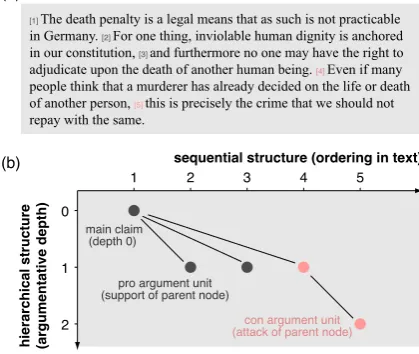
Argumentation theory has established a number of major argument models focusing on different aspects, such as the roles of an argument’s units (Toulmin,1958), the inference scheme of an argu-ment (Walton et al.,2008), or the support and attack relations between arguments (Freeman,2011). The common ground of these models is that they con-ceptualize an argument as a conclusion (in terms of a claim) inferred from a set of pro and con premises (reasons), which in turn may be the conclusions of other arguments. For the overall argumentation of a monological argumentative text such as the one in Figure1(a), this results in an implicit hierarchical structure with the text’s main claim at the lowest depth. In addition, the text has an explicit linguistic structure that can be seen as a regulated sequence of speech acts (van Eemeren and Grootendorst,2004).
hierarchical structure (argumentative depth)
main claim (depth 0)
sequential structure (ordering in text)
1 2 3 4 5
1 0
2 (attack of parent node)con argument unit
pro argument unit (support of parent node)
[1] The death penalty is a legal means that as such is not practicable
in Germany. [2] For one thing, inviolable human dignity is anchored
in our constitution, [3] and furthermore no one may have the right to
adjudicate upon the death of another human being. [4] Even if many
people think that a murderer has already decided on the life or death of another person, [5]this is precisely the crime that we should not
repay with the same.
(b)
(a)monological argumentative text
Figure 1: (a) Example text with five argument units, taken from theArg-Microtextscorpus introduced in Section3. (b) Graph visualization of the sequential and hierarchical overall argumentation of the text.
Figure1(b) illustrates the interplay of the two types of overall structure in form of a tree-like graph.
Natural language processing research has largely adopted the outlined hierarchical models for min-ing arguments from text (Stab and Gurevych,2014;
Habernal and Gurevych,2015;Peldszus and Stede,
2016). However, the adequacy of the resulting over-all structure for downstream analysis tasks of com-putational argumentation has rarely been evaluated (see Section2for details). In fact, a computational approach that can capture patterns in hierarchical overall argumentation is missing so far. Even more, our previous work indicates that a sequential model of overall structure is preferable for analysis tasks such as stance classification or quality assessment (Wachsmuth and Stein,2017).
In this paper, we ask and investigate what model of (monological) overall argumentation is impor-tant to tackle argumentation-related analysis tasks. To this end, we consider three corpora with fully
[image:1.595.310.520.231.408.2]annotated argument structure (Section 3). Each corpus allows studying one text classification task, two of which we hypothesize to benefit from mod-eling argumentation (myside bias, stance), the third not (genre). An empirical analysis of the corpora reveals class-specific patterns of how people argue (Section 4). In order to combine the explicit se-quential and the implicit hierarchical structure of an argumentative text for the first time, we then adapt the approach ofroute kernels(Aiolli et al.,
2009), modeling overall argumentation in form of a positional tree (Section5).
On this basis, we design an experiment to eval-uate the impact of the different types of argumen-tative structure (Section6). In particular, we de-compose our approach into four complementary modeling steps, both for a general model of overall argumentation and for the specific models of the given corpora. Using the structure annotated in the corpora, we systematically compare the effective-ness of all eight resulting models and two standard baselines in the three classification tasks.
Our results provide strong evidence that both sequential and hierarchical structure are important. As indicated by related work, sequential structure nearly competes with hierarchical structure, at least based on the specific argument models. Even more impressively, modeling hierarchical structure prac-tically solves the task of identifying argumentation with myside bias, achieving an outstanding accu-racy of 97.1%. For stance classification, the combi-nation captured by positional trees works best. In contrast, all types of structure fail in distinguishing genres, suggesting that they indeed capture proper-ties of argumentation. We conclude that the impact of modeling overall structure on downstream analy-sis tasks is high, while the required type may vary.
Contributions To summarize, the main contribu-tions of this paper are the following:
1. Empirical insights into how people structure argumentative texts in overall terms.
2. The first approach to model and analyze the sequential and hierarchical overall structure of argumentative texts in combination. 3. Evidence that modeling overall structure
im-pacts argumentation-related analysis tasks.
2 Related Work
The study of overall argumentation traces back to
Aristotle (2007) who outlined the impact of the
sequential arrangement of the different parts of a speech. Conceptually, theory agrees that a mono-logical argumentative text has an implicit tree-like hierarchical structure:Toulmin(1958) defines an argument as a claim supported by data that is rea-soned by a warrant, which in turn may have a back-ing. In addition, a rebuttal may be given showing exceptions to the claim. The role of support and attack relations is investigated byFreeman(2011) who models dialectical arguments that discuss both a proponent’s and an opponent’s view on the main claim argued for.Walton et al.(2008) put the focus on the inference scheme that describes how an argu-ment’s conclusion follows from its premises, which may themselves be conclusions of arguments.
In natural language processing, argumentation research deals with the mining of argument units and their relations from text (Mochales and Moens,
2011). Several corpora with annotated argument structure have been published in the last years. Many of the corpora adapt the hierarchical mod-els from theory (Reed and Rowe,2004;Habernal and Gurevych,2015;Peldszus and Stede,2016) or propose comparable models (Stab and Gurevych,
2014). Since we target monological overall argu-mentation, we use those that capture the complete structure of texts, as detailed in Section3. Corpora focusing on dialogical argumentation (Walker et al.,
2012), topic-related arguments (Rinott et al.,2015), or sequential structure (Wachsmuth et al.,2014b;
Al Khatib et al.,2016) are out of scope.
We do not mine the structure of argumentative texts, but we exploit the previously mined structure to tackle downstream tasks of computational argu-mentation, namely, to classify the myside bias and stance of texts. For myside bias,Stab and Gurevych
(2016) use features derived from discourse struc-ture, whereasFaulkner(2014) andSobhani et al.
(2015) model arguments to classify stance. Ong et al.(2014) and we ourselves (Wachsmuth et al.,
2016) do similar to assess the quality of persua-sive essays, andBeigman Klebanov et al.(2016) examine how an essay’s content and structure influ-ence quality. Other works predict the outcome of legal cases based on the applied types of reasoning (Brüninghaus and Ashley,2003) or analyze infer-ence schemes for given arguments (Feng and Hirst,
In (Wachsmuth et al.,2017), we point out that the argumentation quality of a text is affected by interactions of its content at different levels of gran-ularity, from single argument units over arguments to overall argumentation. Stede(2016) explores how different depths of overall argumentation can be identified, observing differences across genres. Unlike in our experiments, however, the genres considered there reflect diverging types of argu-mentation. Related to argumentation, Feng et al.
(2014) build upon rhetorical structure theory (Mann
and Thompson,1988) to assess the coherence of
texts, whilePersing et al.(2010) score the organi-zation of persuasive essays based on sequences of sentence and paragraph functions.
We introduced the first explicit computational model of overall argumentation in (Wachsmuth et al.,2014a). There, we compared the flow of local sentiment in a review to a set of learned flow pat-terns in order to classify global sentiment. Recently, we generalized the model in order to make flows applicable to any type of information relevant for argumentation-related analysis tasks (Wachsmuth and Stein,2017). However, flows capture only se-quentialstructure, whereas here we also model the
hierarchicalstructure of overall argumentation. To this end, we make use of kernel methods.
Kernel methods are a popular approach for learn-ing on structured data, with several applications in natural language processing (Moschitti,2006b) including argument mining (Rooney et al.,2012). They employ a similarity function defined between any two input objects that are represented in a task-specific implicit feature space. The evaluation of such a kernel function relies on the common fea-tures of the input objects (Cristianini and Shawe-Taylor,2000). The kernel function encodes knowl-edge of the task in the form of these features.
Several kernel functions have been defined for structured data. To assess the impact of sequential argumentation, we refer to the function ofMooney
and Bunescu(2006), which computes common
sub-sequences of two input sub-sequences. For trees, most existing approaches count common subtrees of a certain type (Collins and Duffy,2001;Moschitti,
2006a;Kimura and Kashima,2012), but they do not take the ordering of the nodes in the subtrees into account. In contrast,Aiolli et al.(2009) developed a kernel that combines the content of substructures with the relative positions inside trees, called the
route kernel. Similarly, the tree kernel ofDaumé III
and Marcu(2004) includes positional information
for document compression. For overall argumenta-tion, we decided to use the route kernel in Section5, as it makes the modeling of the sequential positions of an argument unit in a text straightforward. This allows us to capture both the sequential and the hierarchical structure at the same time. To our knowledge, no work has done this before.1
Neural networks denote an alternative for learn-ing on structured data. They become particularly effective when few prior knowledge about what is important to address a task at hand is available, be-cause they can learn any feature representation in principle (Goodfellow et al.,2016). Due to this flex-ibility, however, large amounts of data are required for training an effective model, making neural net-works inadequate for the small datasets that allow studying overall argumentation.
3 Tasks and Datasets
We seek to study the impact of modeling overall argumentation on downstream tasks without the noise from argument mining errors. To this end, we rely on three ground-truth argument corpora. Each corpus is suitable for evaluating one text classifica-tion task and comes with a specific model of overall argumentation, as detailed in the following.
Myside Bias on AAE-v2 The Argument Anno-tated Essayscorpus was originally been presented
byStab and Gurevych(2014). We use version 2 of
the corpus (available on the website of the authors), which consists of 402 persuasive student essays. In each essay, allmain claims,claims, andpremises
are annotated as such. Each claim has apro or
constance towards each instance of the main claim, whereas each premisesupportsorattacksa claim or another premise. Thereby, argumentation is mod-eled as one tree structure for each major claim.
Stab and Gurevych(2016) added amyside bias
class to each essay, reflecting whether its argumen-tation is one-sided considering only arguments for the own stance (251 cases) or not (151 cases).
Stance on Arg-Microtexts TheArg-Microtexts
corpus ofPeldszus and Stede(2016) contains 112 short argumentative texts. They cover 18 different controversial topics and are annotated according to
Freeman(2011): Each argument unit takes the role of theproponentoropponentof a main claim. What
1While extensions of the route kernel idea have been
AAE-v2 Arg-Microtexts Web Discourse
Argument units 6089 576 1149
Avg. units/text 15.1 5.1 3.4
Min. units/text 7 3 0
Max. units/text 28 10 16
Arguments 5687 443 560
Avg. depth 2.8 2.0 0.6
Min. depth 2 1 0
Max. depth 5 4 1
Texts 402 112 340
Table 1: Statistics of the argument units and argu-ments in the three corpora analyzed in this paper.
the main claim is follows from a tree-like overall structure emerging from four types of relations:
normalorexamplesupport from one unit to another, arebuttalof units by other units, andundercutters
where a relation is attacked by another unit. For 88 texts, thestancetowards a specified topic is labeled aspro (46) orcon(42). We use these labels for classification, but we do not access the topic. This way, stance needs to be identified only based on a text itself — a very challenging task.2 Genre on Web Discourse Finally, we consider theArgument Annotated User-Generated Web Dis-coursecorpus ofHabernal and Gurevych(2015). There, 340 texts are annotated according to a modi-fied version of the specific model ofToulmin(1958) whereclaimsare supported bypremisesor attacked byrebuttals.Rebuttalsin turn may be attacked by
refutations. Besides, emotional units not participat-ing in the actual arguments are marked aspathos. The support and attack relations build up the overall argumentation of a text.
The corpus composes argumentative texts of four
genres, namely, 5articles, 216commentsto arti-cles, 46blog posts, and 73forum posts. The genre is specified in form of a label for each text. Due to the low number, we ignore the articles below.
To give an idea of the sequential and hierarchical overall structure in each corpus, Table1presents statistics of the argument units, the arguments (in terms of relations between two or more units), and the depth of the resulting argumentation.
While the size of the given corpora and the va-riety of tasks are limited, the only other available corpus with fully annotated argument structure that we are aware of isAraucariaDB(Reed and Rowe,
2We do not include the topic, in order not to conflate the
impact of modeling argumentation with the influence of the topic. The corpus is too small to analyze topic differences.
2004). No downstream task can be tackled on Arau-cariaDB besides inference scheme classification
(Feng and Hirst,2011). As all schemes compose
a conclusion and a set of premises (without more specific roles), analyzing overall structure hardly makes sense, which is why we omit the corpus.
4 Insights into Overall Argumentation Before we approach overall argumentation com-putationally, this section analyzes the three given corpora empirically to provide insights into how people argue in overall terms. For this, we unify the specific corpus models of overall argumentation outlined above in one general model.
4.1 A Unified View of Overall Argumentation
The texts in all corpora are segmented into argu-ment units, partly with non-arguargu-mentative spans in between that we ignore here for lack of relevance. To capture the sequential ordering of the segmenta-tion, we assign a global index to each unit.
As described in Section3, the specific models of all three corpora in the end consider an argu-ment as a composition of one unit serving as the conclusion with one or more units that support or attack the conclusion (the premises). This compo-sition is defined through multiple relations from one premise to one conclusion each. There is one exception, namely, the undercutter relations in the Arg-Microtexts corpus have a relation as their tar-get. To obtain a unified form in the general model, we modify the undercutters such that they target the premise of the undercutted relation.
In all corpora, a premise may be the conclusion of another argument, while no argument unit serves as a premise in multiple arguments. This leads to a tree structure for each main claim of the associated text. A main claim corresponds to a unit that is not a premise. In AAE-v2 and in Web Discourse, more than one such unit may exist per text.
Depending on the corpus, the distinction of sup-port and attack is encoded through a specified rela-tion type, a unit’s stance, or both. We unify these alternatives by modeling the stance of each unit to-wards its parent in the associated tree. This stance can be derived in all corpora.3 All other unit and
relation types from the specific models are ignored, since there is no clear mapping between them.
3Alternatively, the stance towards the main claim could be
All texts
Texts with myside bias
Texts without myside bias
All texts
Texts with pro stance
Texts with con stance
All texts
Comments
Blog posts
Forum posts
(a) AAE-v2 (b) Arg-Microtexts (c) Web Discourse
0 1 2 3
0 1 2 3
0 1 2 3
0 1 2 3
0 1 2 3
0 1 2
0 1
0 1
0 1 0 1 1 2 3 4 5 6 7 8 9 10 11 12 13 14 15 16 17 18 19
1 2 3 4 5 6 7 8 9 10 11 12 13 14 15 16 17 18 19
1 2 3 4 5 6 7 8 9 10 11 12 13 14 15 16 17 18 19
1 2 3 4 5 6 7 1 2 3 4 5 6
1 2 3 4 5 6
1 2 3 4 5 6 7 8 1 2 3 4 5 6 7 8 1 2 3 4 5 6 7 1 2 3 4 5 6 7 8 7
20 21 22
20 21 22
[image:5.595.75.528.63.273.2]20 21 22
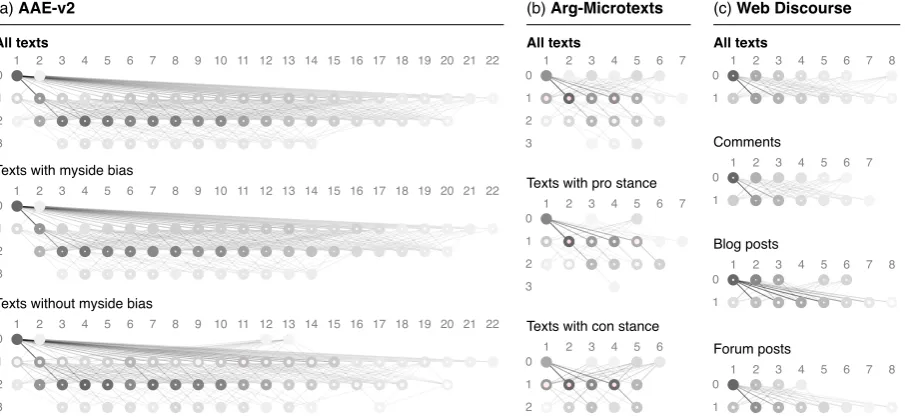
Figure 2: Visualization of the overall argumentation in the three considered corpora based on the introduced general model, averaged over all texts as well over all those texts that belong to a particular class. Left to right: Position in the text. Top to bottom: Depth in graph. Brightness: Inverse relative frequency of each position/depth combination in the corpus. Light red to gray: Proportion of argument units with con stance.
General Model As a result, we model the overall argumentation of an argumentative text as a forest of trees. Each node in a tree corresponds to an argu-ment unit. It has an assigned stance (pro or con) as well as a global index that defines its position in the text. Each edge defines a relation from a premise (the child node) to a conclusion (the parent node). Each main claim defines the root of a tree.
Figure1(b) has already illustrated an instance of the general model. The general model is slightly less expressive than the specific models. We evalu-ate in Section6to what extent this reduces its use for tackling argumentation-related analysis tasks. The advantage of the general model is that it allows a comparison of patterns of overall argumentation across corpora, as we do in the following.4 4.2 Visualization of Argumentation Patterns
Based on the general model, we empirically ana-lyze class-specific patterns of overall argumenta-tion on the three corpora. To this end, we compute one “average graph” for all texts in each complete corpus and one such graph for all texts with a par-ticular class (e.g., for all “no myside bias” texts in case of AAE-v2). In an average graph, each node is labeled with the relative frequency of the associated combination of position and depth in all texts (edges accordingly). We align positions
4Besides, although not in the focus here, we also assume
stance to be easier to detect in practice than fine-grained roles.
of different texts based on their start node, due to our observation that the first argument unit over-proportionally often represents the main claim.5 In
addition the relative frequency, we determine the proportion of con to pro stance for each node.
As we aim to provide intuitive insights into how people argue in overall terms, we discuss the graphs in an informal visual way instead of listing exact numbers.6 In the visualizations in Figure2,
bright-ness captures (inverse) frequency, so darker nodes represent more frequent argument units. The di-ameter of the inner light-red part of each node re-flects its proportion of con stance. Nodes with a relative frequency below 0.3% and/or an absolute frequency below 3 are pruned, along with all their associated edges.
AAE-v2 Figure2(a) stresses that most students state the main claim (depth 0, position 1) in a per-suasive essay first. When the first argument unit is a premise of the main claim instead, it often attacks the main claim, as the large light-red proportion of the node at depth 1 and position 1 conveys. While, on average, texts with myside bias do not differ in length from those without, the latter show more con stance, especially at depth 1. Also,
argumenta-5We also considered using the main claim as the fix point,
but the resulting graphs would be much wider than the longest argumentation, which may be misleading.
6We provide files with the exact frequencies of all nodes
tion without myside bias shows more variance, as indicated, for instance, by the nodes at depth 0 and position 12 and 13 respectively. In contrast, clear patterns in the sequential ordering of pro and con stance are not recognizable in AAE-v2.
Arg-Microtexts According to the graphs in Fig-ure2(b), the position of the main claim varies in the microtexts. While the proportion of con stance seems rather similar between pro and con texts, our visualization reveals that their overall structure is “mirror-inverted” to a limited extent: Most pro texts start with the main claim (depth 0, position 1), dis-cuss con stance later (red proportions increase to the right), and deepen the argumentation in a top-down fashion (most edges from top left to bottom right). Vice versa, con texts more often present the main claim later, attack it earlier, and seem to argue more bottom-up. This suggests that both sequential and hierarchical structure play a role here.
Web Discourse The web discourse texts, finally, comprise rather shallow argumentation across all genres. Slight structural differences can be seen, especially, the comments appear a little shorter and richer of pro stance on average. Besides, the blog posts have more con stance later. Still, the darker and thus more frequent nodes are at similar posi-tions in all graphs. So, if at all, differences may be reflected in a sequential model of argumentation, which implicitly covers length. In terms of the hier-archical structure of the frequent nodes, the graphs of all genres are rather indistinguishable.
Altogether, the visualizations give first support for the impact of modeling overall argumentation. In particular, we hypothesize that hierarchical over-all structure is decisive for myside bias, whereas a combination of sequential and hierarchical struc-ture helps to distinguish pro-stance from con-stance texts. In contrast, we expect that the impact on clas-sifying genres in the Web Discourse corpus is low. 5 Modeling Overall Argumentation This section presents our kernel-based approaches for argumentation-related analysis tasks. They rely on a tree representation of overall argumentation.
5.1 Representation of Overall Argumentation
We model the overall structure of an argumentative text in form of a positional treeT = (V, E)that, in principle, equals those exemplified in Figure1and analyzed above. Each nodev ∈V represents an argument unit and each edgee = (v1, v2) ∈E a
relation between two units. Technically, we there-for map the there-forest of trees representing a text (see Section4) to a single tree by adding a “virtual” root nodev0toV that is the parent of all tree roots.
In analysis tasks, we seek to compare sequential and hierarchical structures irrespective of the actual texts and the size of the associated trees. To this end, we represent labels and positions as follows:
Labels The tree kernel approaches in natural lan-guage processing discussed in Section 2include text (usually words) in the leaf nodes. In contrast, we label each nodev∈V with the type of the asso-ciated argument unit only. Thereby, we almost fully abstract from the content of texts, which benefits the identification of common structures. In case of the general model, the only two labels areproand
con. In case of the specific models, we combine the role of a unit with the type of the relation the unit is the source of (if any). On Arg-Microtexts, for in-stance, this creates labels such asopponent-support
oropponent-undercutter.
Positions As we adapt the route kernels ofAiolli et al.(2009) below, we follow their representation of sequential structure with one exception. In par-ticular, the authors assigned an index to each edge that numbers the child nodes of each node ascend-ing from 1. Thereby, they encoded the relative positions of sibling nodesto each other. To capture the ordering of argument units in a text from left to right, we also model positions as indices of the edges inE. UnlikeAiolli et al.(2009), however, we use indices decreasing from -1 in the left direc-tion of the parent node and ascending from 1 to the right (derived from the nodes’ global indices). While such a simple relabeling allows us to reuse their algorithm for computing kernels, it makes a decisive difference, namely, it encodes the relative positions of child nodesto their parent. This in turn implies the sequential structure of the whole tree.
Figure3(a) exemplifies the tree representation for the argument unit types of the general model, omitting the virtual rootv0for simplicity.
Analo-gously, the types of the specific models of the three considered corpora could be used.
5.2 Kernel-based Modeling Approaches
-1 1
-1 1 2
pro pro
pro pro
con
(a) Tree representation of overall argumentation
Label frequencies (a1)
pro pro pro procon
pro
con
pro
pro pro pro pro procon
proconpro
conpro pro
pro proconpro proconpro
conpro propropro pro proconpro
proconpro propropro pro proconpro pro pro
3x 5x
con
1x 1x
1x
1x 1x 1x 1x
1x 1x 1x 1x
1x 1x
Label sequences (a2)
pro
5x 1xcon
pro pro pro
pro pro
con
pro pro pro
1x 1x
1x 2x
Label tree paths (a3)
pro
pro
pro pro
con 1x
1x 1x
-1
pro1
-1
pro
pro
1x
pro1
1
pro
pro
1x
pro1
2 Positional tree paths (a4)
(b) Kernel representations of the tree
Figure 3: (a) Tree representation exemplified for the general model; node labels are unit types, edge indices relative positions of child nodes. (b) Kernel representations of the tree for all four approaches.
the associated kernel function compares the repre-sentations of the treesT, T0 of any two texts. Label Frequencies (a1) Our simplest model of
overall argumentation does not encode structure at all. Instead, it compares only the frequencies of each node label inT andT0. We represent the
model with a linear kernel, which in the end corre-sponds to a standard feature representation.
Label Sequences (a2) To encode sequential
over-all structure, we refer to the kernel ofMooney and Bunescu(2006), representing the sequential order-ing of node labels in a tree by all contiguous subse-quences. The similarity of two treesT andT0
fol-lows from the proportion of common subsequences, but longer subsequences are penalized by a decay factor. This approach can be seen as an imitation of our flow model (Wachsmuth and Stein,2017).7 Label Tree Paths (a3) We capture hierarchical
overall structure adapting the non-positional part of the route kernel ofAiolli et al.(2009),label paths.
7We use a sequence kernel instead of flows in order to
obtain a uniform setting. InWachsmuth and Stein(2017), we also analyze flow abstractions (e.g., collapsing sequences of the same label). Here, we resort only to the original sequence.
A label pathξ(vi, vj)denotes the sequence of
la-bels of the nodes in the shortest path betweenvi, vj
in a tree (includingvi, vj). FollowingAiolli et al.
(2009), we consider only label paths starting at the rootvi =v0, abbreviated here asξ(vj). Implicitly,
other paths may still be considered through the use of polynomial kernels with degreed > 1. As the authors, we compare any two paths with a function
δ whose values is 1 when the paths are identical and 0 otherwise. Given two treesT = (V, E)and
T0 = (V0, E0), we then define a normalized
poly-nomial kernelKξ(T, T0)over all label paths as:
X
v∈V
X
v0∈V0
δ(ξ(v), ξ(v0))
|V| · |V0|
d
Positional Tree Paths (a4) In addition to label
paths,Aiolli et al.(2009) define arouteπ(vi, vj)
as the sequence of edge indices on the shortest path between any two nodesvi, vj in a tree, i.e., the
se-quence of local positions. As above, they restrict their view to routes starting at the root, which we denote asπ(vj), and compare them using δ. To
combine positional information with label informa-tion, the authors build the product of a kernel based on the label paths and a kernel based on routes. As a result, sequential and hierarchical overall struc-ture are compared at the same time. For overall argumentation, we define the resulting normalized polynomial product kernelKξπ(T, T0)as:
X
v∈V
X
v0∈V0
δ(ξ(v), ξ(v0))·δ(π(v), π(v0))
(|V| · |V0|)2
d
Each approach, a1–a4, can be seen as
represent-ing one particular step of modelrepresent-ing overall argu-mentation; a4combines the complementary steps
of a2and a3, both of which implicitly include a1.
6 Evaluation
Finally, we evaluate all four approaches to model overall argumentation from Section5on the three tasks associated to the corpora from Section3.8 6.1 Experimental Set-up
Our goal is to assess the theoretical impact of each introduced step of modeling overall argumentation as far as possible. To this end, we conduct a sys-tematic experiment where we use the ground-truth argument structure in each corpus for the associated downstream task based on the following set-up:
8The Java source code for reproducing the experiment
[image:7.595.73.289.63.377.2]Myside Bias on AAE-v2 Stance on Arg-Microtexts Genre on Web Discourse # Approach General model Specific model General model Specific model General model Specific model b1 POS n-grams 63.3 63.3 58.8 58.8 74.0(99.9% >a2) 74.0(99.9% >a2)
b2 Token n-grams 70.5(95% >b1) 70.5(95% >b1) 65.2(99% >a2) 65.2 75.6(99.9% >a2) 75.6(99.9% >a2)
a1 Label frequencies 83.4(99.9% >b2) 85.7(99.9% >b2) 49.7 54.4 62.6(95% >a4) 61.4
a2 Label sequences 87.9(99.9% >b2) 94.7(99.9% >a1) 52.2 62.3 64.5(95% >a3) 64.5(99.9% >a3)
a3 Label tree paths 97.1(99.9% >a2) 97.1(95% >a2) 59.8(95% >a1) 61.9 58.1 55.5
a4 Positional tree paths 95.8(99.9% >a2) 95.6(99.9% >a1) 66.7(99% >a2) 67.8(95% >a1) 53.4 55.2 ba Best bi+ Best aj 97.1(99.9% >a2) 97.1(95% >a2) 69.8(99.9% >a2) 71.0(95% >a1) 75.7(99.9% >a2) 75.9(99.9% >a2)
Majority baseline 62.4 62.4 52.3 52.3 64.5 64.5
Table 2: Accuracy in 10-fold cross-validation (10 repetitions, fairness in training) of all evaluated approaches on each of the three task/corpus combinations, both based on ageneral modelof arguments and based on thespecific modelof the respective corpus. The highest value on each corpus is marked in bold; the best bi and aj in each column are italicized. In parenthesis: The confidence level in percent at
which the respective approach is significantly better than the specified approach and all worse approaches.
Approaches The modeling steps are reflected by the approaches a1–a4from Section5. For each task,
we measure the accuracy of all four approaches. We do this once for ourgeneral modelof overall argumentation from Section 4 and once for the
specific modelannotated in the respective corpus, in order to assess the loss of resorting to our always applicable general model.
Baselines As a basic task-intrinsic measure, we compare a1–a4to themajority baselinethat always
predicts the majority class in the given corpus. In addition, we employ two standard feature types and combine them with a1–a4, in order to roughly
as-sess the need for modeling argumentation:
b1 POS n-grams. The frequency of each
part-of-speech 1- to 3-gram found in≥5% of all texts. This style feature has been effective in argumentation-related analysis tasks (Persing and Ng,2015;Wachsmuth et al.,2016). b2 Token n-grams. The frequency of each token
1- to 3-gram found in≥5% of all texts. This content feature is strong in many text analysis tasks (Joachims,1998;Pang et al.,2002). From the tackled tasks, only myside bias has been approached on the given datasets in previous work. While we mention the respective results for com-pleteness below, a comparison is in fact unfair due to our resort to ground-truth argument structure.
Experiments The evaluation of all approaches and baselines was done using the kernel-based ma-chine learning platformKeLP(Filice et al.,2015), performing classification with the available imple-mentation ofLibSVM(Chang and Lin,2011). As
we target the theoretically possible impact of mod-eling overall argumentation, we tested a number of hyperparameter configurations.9 We performed
10-fold cross-validation on the complete corpora and repeated each experiment 10 times, with in-stance shuffling in between. Then, we averaged the accuracy of each configuration over all folds and repetitions. To prevent the classifiers from using knowledge about the class distributions, we used fairness during training, i.e., each class was given an equal weight (Filice et al., 2014). Thus, the majority baseline is not a trivial competitor.
6.2 Results
Table2presents the best obtained results of each evaluated approach for each task/corpus combina-tion. To clarify the reliability of the differences be-tween the results, the table includes the confidence level (starting at 95%) at which each approach is significantly better than all weaker approaches ac-cording to a two-tailed paired student’s t-test.10 Myside Bias on AAE-v2 The highest accuracy reported for classifying myside bias is 77.0 (Stab
and Gurevych,2016). While the comparability is
limited (see above), we see that label frequencies (a1) already achieve 83.4 and 85.7 for the general
and specific model respectively, outperforming all baselines with 99.9% confidence. Matching the in-sights from Section4, the sole proportion of attacks thus seems a good predictor of myside bias.
9SVM C parameter: 0.01, 0.1, 1, 10, 100; sequence kernel
decay factor: 0, 0.5, 1; polynomial tree kernel degree: 1, 2, 3.
10While selecting the best result a posteriori gives an upper
Label sequences (a2) further improve over a1,
which underlines that also the sequential position of con stance and attack relations has an impact. a2
is particular strong under the specific model (94.7). Unlike the general model, this model reflects some hierarchical information via the roles of argument units, such aspremise. a2performs only slightly
worse than the label tree paths (a3), indicating that
an adequate sequential model can compete with a hierarchical model, as we hypothesized in previous work (Wachsmuth and Stein,2017).
Nevertheless, a3turns out best on AAE-v2, most
likely due to its capability to capture the depth at which con stance occurs. Considering that no cor-pus annotation is perfect, the outstanding accuracy of 97.1 conveys an important finding: Modeling the tree structure of an argumentation basicallysolves
the myside bias task without requiring other fea-tures. Neither the positional tree paths (a4) nor the
combination with token n-grams (ba) can add to that. Also, there is no difference between the gen-eral and the specific model, underlining that the unit roles in AAE-v2 are implicitly covered by the hierarchical structure in the general model.
Stance on Arg-Microtexts The accuracy results for the given challenging variant of stance classi-fication (see Section 3) are much lower. Under the general model, the label frequencies (49.7) do not even compete with the majority baseline (52.3). Notable gains are achieved by the label sequences under the specific model (62.3), slightly beating the label tree paths (61.9). Putting them together in the positional tree paths (a4) yields an accuracy
of 66.7 and 67.8 respectively; more than the token n-grams (b2, 65.2). Combining a4 and b2 inba
in turn results in the best observed accuracy value (71.0 on the specific model).
We conclude that both sequential and hierarchi-cal overall structure are important for the distinc-tion of pro from con argumentadistinc-tion, supporting our hypothesis from Section4. They complement content-oriented approaches, such as b2.
More-over, the fine-grained unit and relation types of the specific model annotated in Arg-Microtexts seem useful, consistently obtaining higher accuracy than the general model. Notice, though, that due to the small size of the corpus, only few reported gains are statistically significant, as shown in Table2.
Genre on Web Discourse Although Section 4
has made minor structural differences in Web Dis-course visible, Table2shows that a1–a4all fail in
genre classification: None of them beats the ma-jority baseline (64.5), suggesting that no decisive discriminative patterns are learned. Both POS and token n-grams (b1–b2) significantly outperform a1–
a4at 99.9% confidence. While combining b2with
a2(ba) minimally increases accuracy from 75.6 to
75.9, the results reveal that overall argumentation hardly impacts genre — as hypothesized.
7 Conclusion
This paper provides answers to the question of how the overall structure of a monological argumen-tative text should be modeled in order to tackle downstream tasks of computational argumentation. We have adopted the idea of including positional in-formation in tree kernels in order to capture the ex-plicit sequential and the imex-plicit hierarchical over-all structure of the text at the same time. In system-atic experiments, we have demonstrated the strong impact of modeling overall argumentation. Most impressively, we have found that hierarchical struc-ture decides about myside bias alone, while the combination of sequential and hierarchical struc-ture has turned out beneficial for classifying stance. The missing impact on genre supports that the pre-sented approaches actually capture argumentation-related properties of a text.
So far, however, we have restricted our view to ground-truth argument structure, leaving the in-tegration of computational argument mining ap-proaches to future work. While the noise from mining errors might qualify some of our findings, we also expect that larger corpora will allow us to discover more reliable and discriminative pat-terns. After all, our results underline the general importance of modeling overall argumentation.
References
Fabio Aiolli, Giovanni Da San Martino, and
Alessan-dro Sperduti. 2009. Route kernels for trees. In
Proceedings of the 26th Annual International Con-ference on Machine Learning, pages 17–24.
Fabio Aiolli, Giovanni Da San Martino, and
Alessan-dro Sperduti. 2011. Extending tree kernels with
topological information. InProceedings of the 21th International Conference on Artificial Neural Net-works - Volume Part I, pages 142–149.
Fabio Aiolli, Giovanni Da San Martino, and
Alessan-dro Sperduti. 2015. An efficient
Khalid Al Khatib, Henning Wachsmuth, Johannes Kiesel, Matthias Hagen, and Benno Stein. 2016.
A news editorial corpus for mining argumentation strategies. In Proceedings of COLING 2016, the 26th International Conference on Computational Linguistics: Technical Papers, pages 3433–3443. The COLING 2016 Organizing Committee.
Aristotle. 2007. On Rhetoric: A Theory of Civic
Dis-course(George A. Kennedy, translator). Clarendon Aristotle series. Oxford University Press.
Beata Beigman Klebanov, Christian Stab, Jill Burstein, Yi Song, Binod Gyawali, and Iryna Gurevych. 2016.
Argumentation: Content, structure, and relationship with essay quality. In Proceedings of the Third Workshop on Argument Mining (ArgMining2016), pages 70–75. Association for Computational Lin-guistics.
Stefanie Brüninghaus and Kevin D. Ashley. 2003.
Pre-dicting outcomes of case based legal arguments. In
Proceedings of the 9th International Conference on Artificial Intelligence and Law, pages 233–242.
Chih-Chung Chang and Chih-Jen Lin. 2011.
LIB-SVM: A library for support vector machines. ACM Transactions on Intelligent Systems and Technology, 2(3):27:1–27:27.
Michael Collins and Nigel Duffy. 2001. Convolution
kernels for natural language. InAdvances in Neural Information Processing Systems 14, pages 625–632. MIT Press.
Nello Cristianini and John Shawe-Taylor. 2000. An
In-troduction to Support Vector Machines and Other Kernel-based Learning Methods, 1st edition. Cam-bridge University Press, New York, NY, USA. Hal Daumé III and Daniel Marcu. 2004. A
tree-position kernel for document compression. In
Pro-ceedings of the Fourth Document Understanding Conference.
Frans H. van Eemeren and Rob Grootendorst. 2004. A
Systematic Theory of Argumentation: The Pragma-Dialectical Approach. Cambridge University Press, Cambridge, UK.
Adam Robert Faulkner. 2014. Automated
Classifica-tion of Argument Stance in Student Essays: A Lin-guistically Motivated Approach with an Application for Supporting Argument Summarization. Disserta-tion, City University of New York.
Vanessa Wei Feng and Graeme Hirst. 2011.
Classify-ing arguments by scheme. In Proceedings of the 49th Annual Meeting of the Association for Com-putational Linguistics: Human Language Technolo-gies, pages 987–996. Association for Computational Linguistics.
Vanessa Wei Feng, Ziheng Lin, and Graeme Hirst.
2014. The impact of deep hierarchical discourse
structures in the evaluation of text coherence. In Pro-ceedings of COLING 2014, the 25th International Conference on Computational Linguistics: Techni-cal Papers, pages 940–949. Dublin City University and Association for Computational Linguistics. Simone Filice, Giuseppe Castellucci, Danilo Croce,
and Roberto Basili. 2014. Effective kernelized
on-line learning in language processing tasks. In Pro-ceedings of the 36th European Conference on IR Re-search on Advances in Information Retrieval - Vol-ume 8416, pages 347–358.
Simone Filice, Giuseppe Castellucci, Danilo Croce,
and Roberto Basili. 2015. KeLP: A kernel-based
learning platform for natural language process-ing. In Proceedings of ACL-IJCNLP 2015 System Demonstrations, pages 19–24. Association for Com-putational Linguistics and The Asian Federation of Natural Language Processing.
James B. Freeman. 2011. Argument Structure:
Repre-sentation and Theory. Springer.
Ian Goodfellow, Yoshua Bengio, and Aaron Courville.
2016.Deep Learning. MIT Press.
Ivan Habernal and Iryna Gurevych. 2015.
Exploit-ing debate portals for semi-supervised argumenta-tion mining in user-generated web discourse. In Pro-ceedings of the 2015 Conference on Empirical Meth-ods in Natural Language Processing, pages 2127– 2137. Association for Computational Linguistics.
Thorsten Joachims. 1998. Text categorization with
su-port vector machines: Learning with many relevant features. InProceedings of the 10th European Con-ference on Machine Learning, pages 137–142.
Daisuke Kimura and Hisashi Kashima. 2012.Fast
com-putation of subpath kernel for trees. InProceedings of the 29th International Conference on Machine Learning.
William C. Mann and Sandra A. Thompson. 1988. Rhetorical structure theory: Toward a functional the-ory of text organization. Text, 8(3):243–281. Raquel Mochales and Marie-Francine Moens. 2011.
Argumentation mining. Artificial Intelligence and Law, 19(1):1–22.
Raymond J. Mooney and Razvan C. Bunescu. 2006.
Subsequence kernels for relation extraction. In Ad-vances in Neural Information Processing Systems 18, pages 171–178. MIT Press.
Alessandro Moschitti. 2006a. Efficient convolution
kernels for dependency and constituent syntactic trees. InProceedings of the 17th European Confer-ence on Machine Learning, pages 318–329.
Alessandro Moschitti. 2006b. Making tree kernels
Nathan Ong, Diane Litman, and Alexandra
Brusilovsky. 2014. Ontology-based argument
min-ing and automatic essay scormin-ing. InProceedings of the First Workshop on Argumentation Mining, pages 24–28. Association for Computational Linguistics.
Bo Pang, Lillian Lee, and Shivakumar Vaithyanathan.
2002. Thumbs up? Sentiment classification using
machine learning techniques. InProceedings of the 2002 Conference on Empirical Methods in Natural Language Processing (EMNLP 2002).
Andreas Peldszus and Manfred Stede. 2016. An
anno-tated corpus of argumentative microtexts. In
Argu-mentation and Reasoned Action: 1st European Con-ference on Argumentation. College Publications.
Isaac Persing, Alan Davis, and Vincent Ng. 2010.
Mod-eling organization in student essays. InProceedings of the 2010 Conference on Empirical Methods in Natural Language Processing, pages 229–239. As-sociation for Computational Linguistics.
Isaac Persing and Vincent Ng. 2015. Modeling
argu-ment strength in student essays. In Proceedings of the 53rd Annual Meeting of the Association for Computational Linguistics and the 7th International Joint Conference on Natural Language Processing (Volume 1: Long Papers), pages 543–552. Associa-tion for ComputaAssocia-tional Linguistics.
Chris Reed and Glenn Rowe. 2004. Araucaria:
Soft-ware for argument analysis, diagramming and repre-sentation. International Journal of AI Tools, 14:961– 980.
Ruty Rinott, Lena Dankin, Carlos Alzate Perez, M. Mitesh Khapra, Ehud Aharoni, and Noam
Slonim. 2015. Show me your evidence — An
au-tomatic method for context dependent evidence de-tection. InProceedings of the 2015 Conference on Empirical Methods in Natural Language Processing, pages 440–450. Association for Computational Lin-guistics.
Niall Rooney, Hui Wang, and Fiona Browne. 2012.
Ap-plying kernel methods to argumentation mining. In
Proceedings of the 25th International FLAIRS Con-ference, pages 272–275.
Parinaz Sobhani, Diana Inkpen, and Stan Matwin. 2015.From argumentation mining to stance classifi-cation. InProceedings of the 2nd Workshop on Ar-gumentation Mining, pages 67–77. Association for Computational Linguistics.
Christian Stab and Iryna Gurevych. 2014. Annotating
argument components and relations in persuasive es-says. InProceedings of COLING 2014, the 25th In-ternational Conference on Computational Linguis-tics: Technical Papers, pages 1501–1510. Dublin City University and Association for Computational Linguistics.
Christian Stab and Iryna Gurevych. 2016.
Recogniz-ing the absence of opposRecogniz-ing arguments in persuasive essays. In Proceedings of the Third Workshop on Argument Mining (ArgMining2016), pages 113–118. Association for Computational Linguistics.
Manfred Stede. 2016. Towards assessing depth of
argumentation. In Proceedings of COLING 2016, the 26th International Conference on Computational Linguistics: Technical Papers, pages 3308–3317. The COLING 2016 Organizing Committee.
Stephen E. Toulmin. 1958. The Uses of Argument.
Cambridge University Press.
Henning Wachsmuth, Khalid Al Khatib, and Benno
Stein. 2016. Using argument mining to assess the
argumentation quality of essays. In Proceedings of COLING 2016, the 26th International Confer-ence on Computational Linguistics: Technical
Pa-pers, pages 1680–1691. The COLING 2016
Orga-nizing Committee.
Henning Wachsmuth, Nona Naderi, Yufang Hou, Yonatan Bilu, Vinodkumar Prabhakaran, Alberd-ingk Tim Thijm, Graeme Hirst, and Benno Stein.
2017. Computational argumentation quality
assess-ment in natural language. InProceedings of the 15th Conference of the European Chapter of the Associa-tion for ComputaAssocia-tional Linguistics: Volume 1, Long Papers, pages 176–187. Association for Computa-tional Linguistics.
Henning Wachsmuth and Benno Stein. 2017. A
uni-versal model for discourse-level argumentation anal-ysis.Special Section of the ACM Transactions on In-ternet Technology: Argumentation in Social Media, 17(3):28:1–28:24.
Henning Wachsmuth, Martin Trenkmann, Benno Stein,
and Gregor Engels. 2014a. Modeling review
argu-mentation for robust sentiment analysis. In Proceed-ings of COLING 2014, the 25th International Con-ference on Computational Linguistics: Technical Pa-pers, pages 553–564. Dublin City University and As-sociation for Computational Linguistics.
Henning Wachsmuth, Martin Trenkmann, Benno Stein, Gregor Engels, and Tsvetomira Palakarska. 2014b.
A review corpus for argumentation analysis. In Pro-ceedings of the 15th International Conference on Intelligent Text Processing and Computational Lin-guistics, Part II, pages 115–127.
Marilyn Walker, Jean Fox Tree, Pranav Anand, Rob
Abbott, and Joseph King. 2012. A corpus for
re-search on deliberation and debate. InProceedings of the Eighth International Conference on Language Resources and Evaluation (LREC-2012), pages 812– 817. European Language Resources Association (ELRA).
Douglas Walton, Christopher Reed, and Fabrizio
Macagno. 2008. Argumentation Schemes.