Speaking, Seeing, Understanding: Correlating semantic models with
conceptual representation in the brain
Luana Bulat, Stephen Clark and Ekaterina Shutova Computer Laboratory
University of Cambridge
{luana.bulat,stephen.clark,ekaterina.shutova}@cl.cam.ac.uk
Abstract
Research in computational semantics is in-creasingly guided by our understanding of human semantic processing. However, semantic models are typically studied in the context of natural language process-ing system performance. In this paper, we present a systematic evaluation and com-parison of a range of widely-used, state-of-the-art semantic models in their abil-ity to predict patterns of conceptual repre-sentation in the human brain. Our results provide new insights both for the design of computational semantic models and for further research in cognitive neuroscience. 1 Introduction
Recent years have witnessed many breakthroughs in data-driven semantic modelling: from the log-linear skip-gram model ofMikolov et al.(2013a) to multi-modal meaning representations (Bruni et al., 2012; Kiela and Bottou, 2014; Kiela and Clark, 2015; Kiela et al., 2015a). These models boast of a higher performance accuracy in numer-ous semantic tasks, including modeling seman-tic similarity and relatedness (Silberer and Lap-ata,2012), lexical entailment (Kiela et al.,2015b), analogy (Mikolov et al., 2013b) and metaphor (Shutova et al., 2016). However, less is known about the extent to which such models correlate with and reflect human conceptual representation. Much research in the cognitive neuroscience community has been concerned with uncovering how the brain represents conceptual knowledge, by leveraging brain activation data associated with the meanings of concepts obtained during func-tional magnetic resonance imaging (fMRI) exper-iments. In the computational linguistics commu-nity, the availability of such fMRI data provides
researchers with a benchmark for evaluating se-mantic model performance in terms of their abil-ity to represent human semantic memory.Mitchell et al. (2008) were the first to demonstrate that distributional semantic models encode some of the patterns found in the fMRI data. Other re-searchers followed in their steps, evaluating tra-ditional count-based distributional models ( Dev-ereux et al., 2010; Murphy et al., 2012), topic model-based semantic features (Pereira et al.,
2013), psycholinguistic and behavioural features (Palatucci et al., 2009; Chang et al., 2010; Fer-nandino et al., 2015) and visual representations (Anderson et al.,2013,2017). While all of these studies report correlation between the investigated semantic models and patterns found in the brain imaging data, their focus on individual models and the use of different datasets and prediction meth-ods make their results difficult to compare and to integrate into a coherent evaluation landscape. The work ofMurphy et al.(2012) is an exception, in that the authors systematically compare several distributional models with a range of parameters on the same brain imaging dataset. However, they focus on the traditional count-based distributional models only.
We take inspiration from the works ofMitchell et al. (2008) andMurphy et al. (2012); however, we conduct a more extensive study of the ability of different types of semantic models to predict the patterns of brain activity associated with con-ceptual representation. We evaluate and compare several kinds of semantic models, using different modalities and data sources: (1) traditional count-based distributional models (with word window-based and dependency-window-based contexts) learnt from text; (2) log-linear skip-gram models (with word window-based and dependency-based contexts); (3) behavioural models based on the free associ-ation task; (4) word representassoci-ations learnt from
visual data; and (5) multi-modal word repre-sentations combining linguistic and visual infor-mation. Unlike previous studies, where evalu-ations were typically conducted using a single technique, we evaluate our models using several methods: ridge regression (Hoerl and Kennard,
1970), based encoding and similarity-based decoding (Anderson et al., 2016). Such an experimental setup allows for a comprehensive evaluation and comparison of the models.
To the best of our knowledge the dependency-based skip-gram model and the free association-based model, as well as their multimodal coun-terparts, have not been previously evaluated on the brain activity prediction task. Other mod-els have been evaluated individually and have not yet been systematically compared within a sin-gle evaluation framework. Providing such a com-parison, our experiments and results demonstrate that (1) visual information is a stronger predic-tor of brain activity than the linguistic informa-tion for concrete nouns; (2) sparse text-based mod-els, whether dependency-based or built using lin-ear bag-of-words context, tend to predict neu-ral activity more accurately than dense models; (3) cognitively-motivated association-based mod-els perform on par with or better than other lin-guistic models, which suggests that they provide an interesting avenue in computational semantics research.
2 Related work
The seminal work of Mitchell et al. (2008) in-troduced a new semantic model able to predict brain activation data associated with the meanings of concrete nouns from their corpus-harvested se-mantic representations. They chose a set of 25 verbs to act as semantic features in their distri-butional model, inspired by the importance of sensory-motor features in neural representations of concepts (Cree and McRae,2003).
Since then, various studies have shown that dis-tributional semantic models encode and are able to predict neural activation patterns associated with concepts (Devereux et al., 2010; Murphy et al.,
2012;Pereira et al.,2013).Devereux et al.(2010) build on the work of Mitchell et al. (2008) and show that automatically acquired feature-norm like semantic representations can make equally powerful predictions about brain activity associ-ated with the presentation of words. Pereira et al.
(2013) use semantic features learnt from topic models on Wikipedia to predict neural activation patterns for unseen concepts.
Several other studies have demonstrated the fit of semantic models built from human behavioural data with regard to predicting neural activation patterns (Palatucci et al.,2009;Chang et al.,2010;
Fernandino et al.,2015). Chang et al. (2010) use brain region encodings as well as detailed taxo-nomic encodings of McRae et al. (2005) feature norms to predict brain activation patterns using a linear regression model. They demonstrate that learned brain activity patterns can be used to de-code mental states. Fernandino et al.(2015) use human elicited attribute salience scores based on five sensory-motor attributes (sound, color, visual motion, shape and manipulation) to derive fMRI brain activation patterns for concrete words, but are unsuccessful at modeling neural activation pat-terns for abstract words.
Recent advances in multi-modal semantics have shown that grounding semantic models in sen-sory modalities improves performance on a variety of tasks (Silberer and Lapata, 2012;Bruni et al.,
2012;Kiela and Bottou,2014;Bulat et al.,2016).
Anderson et al.(2013) show that semantic models built from visual data correlate highly with fMRI-based brain activation patterns. Anderson et al.
(2015) find that similarity in activity in the brain areas related to linguistic processing can be bet-ter predicted from text-based semantic representa-tions, whilst image-based representations perform better at predicting similarity in the visual process-ing areas of the brain. In line with the dual codprocess-ing theory,Anderson et al.(2017) demonstrate an ad-vantage in decoding brain activity patterns of ab-stract words for text-based semantic models over the image-based ones. Contrary to previous find-ings, Anderson et al.(2017) find no advantage in decoding neural activity patterns associated with concrete words for image-based models.
visual and multi-modal semantic representations. While Murphy and colleagues evaluate the mod-els using one method only — linear regression, we compare predicted neural activation patterns obtained using both regression and the similarity-based encoding and decoding methods proposed byAnderson et al.(2016).
3 Brain imaging data
We use the dataset of fMRI neural activation pat-terns associated with the meanings of nouns, cre-ated byMitchell et al.(2008) as described below.
3.1 fMRI experiment
Nine right-handed adults between the age of 18 and 32 (five female) participated in the study. They were presented with line drawings and noun labels for 60 concrete nouns from 12 semantic classes – animals, body parts, buildings, building parts, clothing, furniture, insects, kitchen items, tools, vegetables, vehicles and man-made objects – with five exemplars per class. The task for the participants during the scanning was to think about the properties of the noun stimuli they were pre-sented with. The entire set of 60 stimulus words was presented six times to every participant, in a different order for each presentation.
The fMRI images were acquired on a Siemens Allegra 3.0T scanner. The initial data was cor-rected for slice timing, motion and linear trend; spatially normalised and resampled to 3x3x6mm3
voxels. Only those voxels overlapping with the cortex were selected (approximately 20000 for ev-ery participant).
3.2 Voxel selection
We employ the same voxel selection procedure as Mitchell et al. (2008) for evaluating the sim-ilarity between actual fMRI images and model-predicted fMRI images. Similarity is computed by only taking into account 500 voxels with the most stable activation profile across words – with pro-files compared across the six presentations. The evaluation is performed using leave-two-out cross validation. Voxel selection was performed inde-pendently for each of the cross validation folds, at training time. A voxel’s stability score across the six presentations was approximated as the mean pairwise Pearson correlation between its activation profiles over the 58 training words in the cross-validation fold. The 500 voxels with the highest stability score were chosen.
3.3 Brain activity vectors
We evaluate our models on the data of each par-ticipant independently. Following Mitchell et al.
(2008), we obtain a single fMRI image per con-cept (a representative image) by first computing the mean fMRI response over its six presentations, and then subtracting the mean of all 60 of these representative images from each. In the rest of this paper we will refer to these representations as brain activity vectors.
4 Semantic models
MITCHELLAs a benchmark for all other seman-tic models, we use the publicly available1
co-occurrence based semantic vectors developed in the Mitchell et al.(2008) study. The features of this semantic space are 25 sensory-motor verbs. Co-occurrence statistics were collected using a window size of 5 words either side of the tar-get word, on a trillion-word corpus provided by Google.
4.1 Text-based semantic models
We train a variety2 of context-counting and
context-predicting text-based semantic models on the January 2016 dump of Wikipedia, which was tokenised using the Stanford NLP tools3,
lemma-tised with the Morpha lemmatiser (Minnen et al.,
2001), and parsed with the C&C parser (Clark and Curran,2007).
DISTRIBWe obtain count-based distributional se-mantic models, using the top 10K most frequent lemmatised words in the corpus (excluding stop-words) as contexts. The context window is de-fined as sentence boundaries. Counts are re-weighted using positive pointwise mutual infor-mation (PPMI) and vectors are L2-normalised.
SVD300We also construct 300-dimensional dense semantic representations by applying singular value decomposition (SVD) (Deerwester et al.,
1990) toDISTRIB.
1https://www.cs.cmu.edu/afs/cs/
project/theo-73/www/science2008/data. html
2We have experimented with different parameter settings for each type of language-based semantic space (e.g. size of the vectors, number of iterations when learning the embed-dings etc.) and found that the reported vectors with “stan-dard’ settings perform the best (or do not get significantly outperformed).
3https://nlp.stanford.edu/software/
DEPSFollowing Murphy et al. (2012), who find that dependency-based semantic vectors perform best on a neurosemantic decoding task, we also include such a semantic space in our compari-son. Vector representations are created by leverag-ing the dependency relations output by the C&C parser (Clark and Curran,2007) as features. We use both the incoming and outgoing dependency relations as features; for example, given the de-pendency relation (RUN, DOBJ, MARATHON) we extract the tuple (DOBJ, MARATHON) as a fea-ture for RUN and (!DOBJ, RUN) as a feature for MARATHON. The top 10K most frequent depen-dency features are used as contexts and counts are re-weighted using PPMI.
DEPS-SVD300 We also obtain 300-dimensional dense dependency-based semantic representations by applying SVD toDEPS.
EMBED-BOWWe train 300-dimensional embed-dings using the standard log-linear skipgram model with negative sampling of Mikolov et al.
(2013a). The embeddings were trained using lin-ear bag-of-words contexts, with the window de-fined as k = 2 (EMBED-BOW2) or k = 5 (EMBED-BOW5) words either side of the target word. We use 10 negative samples per word-context pair and 15 iterations over the corpus.
EMBED-DEPS In addition to the embeddings trained with linear bag-of-words contexts, we also obtain 300-dimensional dependency-based word embeddings using theLevy and Goldberg(2014) implementation of the generalised skip-gram with arbitrary contexts model. Using both incoming and outgoing dependency relations output by the C&C parser, we create word-context pairs using all words and contexts occurring more than 400 times in the corpus. This resulted in a vocabulary of about 92,000 words, with over 250,000 distinct syntactic contexts. We use 10 negative samples per word-context pair and 15 iterations over the corpus.
4.2 Association-based semantic model
Free word association datasets (Nelson et al.,
2004; De Deyne et al., 2016) represent a rich source of semantic information and have been suc-cessfully used in NLP, including research on se-mantic memory (Steyvers et al.,2004) and multi-modal semantics (Hill and Korhonen,2014). Re-cent studies have shown the superiority of
se-mantic models built using data collected from multiple-responsefree association tasks — where subjects are asked to list multiple associative cues for every target word rather than a sin-gle association — over the models built from single-response ones (De Deyne et al., 2013). Moreover, such association-based semantic mod-els have been shown to outperform current state-of-the-art text-based language models on concept relatedness and similarity judgments (De Deyne et al.,2016).
We make use of the word association dataset collected as part of the Small World of Words4
project, where more than 100K fluent English speakers were asked to list three associations for each target word. The dataset contains multiple-response association data for over 10K words. We use a subset of this dataset, where all target words have at least 50 primary, 50 secondary and 50 ter-tiary responses and all responses also appear as normed target words5.
ASSOC We construct a count-based semantic model of word associations (henceforth ASSOC) similarly to a count-based distributional model: the responses are treated as semantic features, and counts are replaced by the sum of primary, sec-ondary and tertiary association frequencies be-tween the target word and the responses. Counts are re-weighted using PPMI and vectors are L2-normalised. The association-based representa-tions obtained for the 60 target words in the
Mitchell et al.(2008) dataset under this model are 9854-dimensional.
4.3 Image-based semantic model
We also build state-of-the-art deep visual seman-tic representations (henceforthVISUAL) for the 60 concepts in theMitchell et al.(2008) dataset. Fol-lowing previous work in multi-modal semantics (Bergsma and Goebel, 2011; Kiela and Bottou,
2014) and the findings of a recent study of sys-tem architectures and data sources for construct-ing visual representations (Kiela et al.,2016), we retrieve 10 images per concept from Google Im-ages. We use the MMFeat toolkit6 (Kiela,2016)
to build our image representations. We extract the 4096-dimensional pre-softmax layer from a
for-4https://smallworldofwords.org/
5Total of 9854 words (appearing as both target and re-sponses) and 1092251 association pairs
ward pass through a convolutional neural network (Krizhevsky et al., 2012), which has been pre-trained on the ImageNet classification task using Caffe (Jia et al.,2014). We obtain the visual rep-resentation for a given concept by taking the mean of the 10 resulting image representations.
4.4 Multi-modal semantic models
We also included multi-modal semantic spaces in our analysis, as these are currently widely used in NLP and have been previously shown to achieve the best performance at predicting con-ceptual encodings in the brain (Anderson et al.,
2015). Multi-modal semantic spaces are con-structed by combining the visual (VISUAL) and respective linguistic (e.g. MITCHELL, DISTRIB, DEPS) or association-based (ASSOC) representa-tions into a multi-modal representation by con-catenating their respective L2-normalized vectors. 5 Methods
In this study, we use two different ways of analysing the correlation between the semantic models described in Section4and the fMRI brain activation patterns used as a proxy for human con-ceptual representation. First, we compare these se-mantic models in their predictive power, by look-ing at how well they can synthesise, i.e. predict, brain activation patterns for unseen concepts (Sec-tion 5.1). Secondly, we look at how well they are able to decode neural activation patterns by measuring their success at predicting the stimulus that produced an unlabeled (unseen) fMRI pattern (Section5.2).
5.1 Predicting brain activity patterns
The brain activity prediction task has been used in previous NLP research as a method of evaluating different semantic models in their ability to model conceptual representation. Most of these studies learn a mapping function between the semantic model of choice and the fMRI neural activity pat-terns using regression techniques (Mitchell et al.,
2008;Devereux et al.,2010;Murphy et al.,2012). Recent work byAnderson et al. (2016) introduce a new method for synthesising fMRI activity pat-terns through similarity-based encoding that does not require model fitting. We compare the predic-tion performance of the semantic models detailed in Section 4 by implementing both a regression-based model and the similarity-regression-based encoding al-gorithm ofAnderson et al.(2016).
Regression-based learning Following previous
work (Mitchell et al.,2008;Devereux et al.,2010;
Murphy et al., 2012), for every participant, we learn a mapping function between semantic model features and brain activation vectors using lin-ear regression. The llin-earned weights are used to make predictions about brain activation vectors as-sociated with concepts that were not seen during training. We implement Ridge regression (Hoerl and Kennard, 1970), a multiple linear regression model that uses a least squares loss function and L2 regularisation.
Similarity-based encoding We implement the
similarity-based encoding method introduced by
Anderson et al.(2016). This method predicts the brain activity vector for an unseen concept by ex-ploiting its similarity (with respect to a particular semantic model) to words for which we have ob-served brain activity vectors.
The first step in predicting a brain activity vec-tor for an unseen concept is to compute its se-mantic model similarity code. This is a N -dimensional7 vector of similarity scores —
com-puted using Pearson’s correlation — between the unseen concept and the N words for which we have brain activation vectors8. The predicted brain
activity vector for the unseen concept is then “syn-thesised” by using its semantic model similarity code to weight a superposition of brain activity vectors:
~b0= C1 XN
i=1
~bi·corr(~vi,~vN+1) (1)
Assuming the unseen word is indexedN+1and
~vjis the semantic model representation of wordj,
Cis a normalisation constant defined as the sum of absolute values of elements in the semantic model similarity code:
C =|XN i=1
corr(~vi,~vN+1)| (2)
5.2 Decoding neural activity patterns
We then evaluate our semantic models in terms of their ability to decode unseen fMRI activation pat-terns. The analysis in this case does not involve 7Assuming that we haveNwords for which we have both semantic model representations (e.g. DISTRIBvectors) and observed brain activation vectors.
synthesising brain activation vectors for new con-cepts, but predicting the correct label (stimulus) associated with a given fMRI pattern.
We implement the similarity-based decoding procedure as detailed in Anderson et al. (2016). The first step is to obtain thesemantic model simi-larity matrix— by computing the semantic model similarity codes for each of the 60 concepts in the
Mitchell et al.(2008) dataset (as described above) — and the brain activity similarity matrix — by computing brain activity similarity codes.
At test time, two of theN words are chosen for decoding, together with their respective semantic model similarity codes (~si,~sj) and brain activity
similarity codes (~ai,~aj). Next,~s0i,~s0j,~a0iand~a0jare
obtained by removing thei-th andj-th elements in
~si,~sj,~aiand~ajrespectively, because entries in the
similarity vectors corresponding to the test words would reveal the correct answer in the matching task. We will refer to~s0
iand~s0j asreduced
seman-tic model similarity codes, and by analogy to ~a0
i
and ~a0
j asreduced neural similarity codes.
Decoding is considered a success if the sum of Pearson’s correlations for the correct pairings ( corr(~s0
i, ~a0i) +corr(~s0j, ~a0j) ) is higher than the
sum of Pearson’s correlations for the incorrect pairings (corr(~s0
i, ~a0j) +corr(~s0j, ~a0i)).
6 Experiments
All semantic spaces presented in Section 4 have full coverage on theMitchell et al.(2008) dataset. All experiments detailed in this section were per-formed separately for every participant and evalu-ated using leave-two-out cross validation.
6.1 Regression experiments
We repeatedly train a regression model to fit brain activation vectors for each of the semantic spaces described in Section 4, using only 58 of the 60 available concept representations (leave-two-out cross validation). This resulted in 1770 cross-validation folds.9 The only hyperparameter in
the regression is λ, which controls the degree of regularisation. The λ hyperparameter was opti-mised when training each cross-validation fold, by choosing from the range 0.0001 to 100 through generalised cross validation (i.e. λwas optimised by only looking at the training items during each cross-validation fold).
9There are (60 choose 2) ways to choose two test items from the 60Mitchell et al.(2008) concepts.
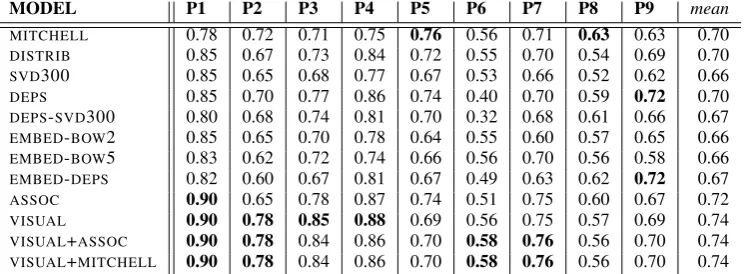
During each testing round, we used the learned mapping function to construct predicted brain acti-vation vectors for the two held out words.We eval-uated each of the semantic models by computing its accuracy of matching the two predicted brain activation vectors with the two observed ones. A matching score was computed by analysing the cosine similarity between the predicted and the observed brain activation vectors. If the sum of similarities for the correct pairing was higher than the one for the incorrect pairing the match-ing accuracy was set to 1 for this cross-validation fold, and otherwise it was set to 0. If the model was choosing the match at random, the expected accuracy is 0.50. The similarity between two brain activation vectors was computed by only taking into account the 500 most stable voxels (during each cross-validation fold) as detailed in Section 3.2. The cross-validated accuracies for each of our semantic models are presented in Ta-ble1, with selected results also shown in Figure1. We only report results on two multi-modal mod-els (VISUAL+MITCHELLandVISUAL+ASSOC), as there was no significant difference in performance between any pair of multi-modal models.
All semantic models learn to predict neu-ral activation patterns for unseen words signif-icantly above chance level. Association-based semantic models (ASSOC) significantly10 outper-form all dense semantic representations (whether embedding-based or SVD-reduced), with p <
0.05. Sparse text-based representations with linear context (DISTRIBandDEPS) significantly outper-form some dense semantic representations. How-ever, no dense semantic models significantly out-perform DISTRIB and DEPS. There is no signif-icant difference between the performance of AS -SOC,DISTRIBandDEPS. Contrary to the findings ofMurphy et al.(2012), we do not find any advan-tage in predicting brain activation patterns from dependency-based text models.
Both VISUAL and multi-modal models signifi-cantly outperform text-based models overall (p <
MODEL P1 P2 P3 P4 P5 P6 P7 P8 P9 mean
MITCHELL 0.78 0.72 0.71 0.75 0.76 0.56 0.71 0.63 0.63 0.70
DISTRIB 0.85 0.67 0.73 0.84 0.72 0.55 0.70 0.54 0.69 0.70
SVD300 0.85 0.65 0.68 0.77 0.67 0.53 0.66 0.52 0.62 0.66
DEPS 0.85 0.70 0.77 0.86 0.74 0.40 0.70 0.59 0.72 0.70
DEPS-SVD300 0.80 0.68 0.74 0.81 0.70 0.32 0.68 0.61 0.66 0.67
EMBED-BOW2 0.85 0.65 0.70 0.78 0.64 0.55 0.60 0.57 0.65 0.66
EMBED-BOW5 0.83 0.62 0.72 0.74 0.66 0.56 0.70 0.56 0.58 0.66
EMBED-DEPS 0.82 0.60 0.67 0.81 0.67 0.49 0.63 0.62 0.72 0.67
ASSOC 0.90 0.65 0.78 0.87 0.74 0.51 0.75 0.60 0.67 0.72
VISUAL 0.90 0.78 0.85 0.88 0.69 0.56 0.75 0.57 0.69 0.74
VISUAL+ASSOC 0.90 0.78 0.84 0.86 0.70 0.58 0.76 0.56 0.70 0.74
[image:7.595.114.488.62.199.2]VISUAL+MITCHELL 0.90 0.78 0.84 0.86 0.70 0.58 0.76 0.56 0.70 0.74
Table 1: Regression results. Cross-validated accuracies for models trained on participants P1 through P9, together with mean over participants.
form as well as models that encode mental repre-sentations through associations (ASSOC). There is no significant advantage for multi-modal models overVISUAL.
6.2 Similarity-based encoding experiments
We also compare performance of the semantic models when the predicted brain activation vec-tor is computed using theAnderson et al. (2016) similarity based encoding method. We use a leave-two-out cross validation strategy, to match previous work and our experiments detailed in Section 6.1. The similarity-based encoding ap-proach does not require any mapping function to be learned, hence is a robust and fast way to ob-tain synthesised brain activation vectors for un-seen words.
During each cross-validation fold, semantic model similarity codes of the two test words were computed using the procedure outlined in Sec-tion 5.1. Predicted brain activation vectors were then synthesised for the two test words by weight-ing a superposition of brain activity vectors usweight-ing their semantic model similarity codes. The match-ing score for each of the cross-validation folds was computed in the same way as in the case of the regression model (Section 6.1). The only differ-ence was that we measured the similarity between the two brain activation vectors using Pearson’s correlation coefficient, following Anderson et al.
(2016). As in the previous experiment, the ex-pected chance performance of this method is 0.5. The cross-validated accuracies for each of our se-mantic models are shown in Table2, with selected results also shown in Figure1.
All semantic models perform significantly above chance level. As in the case of the
re-gression experiments, there is a clear advantage in synthesising brain activation vectors for visu-ally grounded models (VISUAL and multi-modal models) over the language-based ones (this time including MITCHELL), as well as ASSOC. When looking at the performance of the text-based mod-els in general, there is no difference in perfor-mance when comparing context-predicting mod-els to count-based ones, or sparse semantic modmod-els to dense ones.
6.3 Brain activation pattern decoding
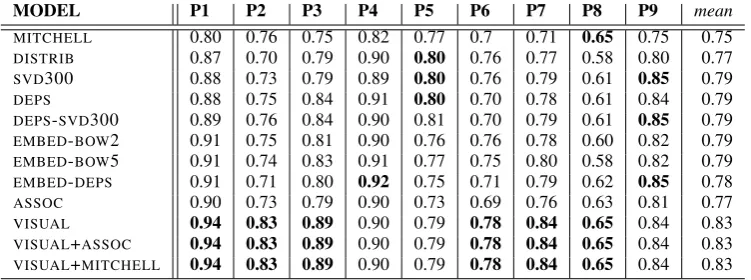
In the similarity-based decoding experiments, we assess the ability of semantic models to iden-tify the correct stimulus for a given brain activa-tion pattern, using the same leave-two-out cross-validation strategy. At test time, we obtain the duced semantic model similarity codes and the re-duced neural similarity codes for the two test items as described in Section5.2. It is important to note that these similarity code vectors do not contain any information about the true labeling, since en-tries corresponding to the test items were removed. Decoding is considered successful if the matching score (computed as the sum of Pearson’s correla-tions) is higher for the congruent pair than for the incorrect one. Again, the expected performance for a model decoding at random is 0.50. Table3
shows the performance of our semantic models, with selected results also shown in Figure1.
signifi-MODEL P1 P2 P3 P4 P5 P6 P7 P8 P9 mean
MITCHELL 0.79 0.76 0.74 0.8 0.78 0.66 0.69 0.62 0.74 0.73
DISTRIB 0.87 0.69 0.79 0.89 0.79 0.75 0.75 0.52 0.79 0.76
SVD-300 0.89 0.72 0.79 0.90 0.79 0.74 0.78 0.56 0.83 0.78
DEPS 0.88 0.74 0.83 0.91 0.81 0.68 0.76 0.58 0.83 0.78
DEPS-SVD300 0.89 0.75 0.84 0.91 0.81 0.67 0.77 0.57 0.83 0.78
EMBED-BOW2 0.92 0.74 0.81 0.91 0.75 0.75 0.77 0.59 0.81 0.78
EMBED-BOW5 0.91 0.73 0.83 0.91 0.76 0.73 0.79 0.55 0.80 0.78
EMBED-DEPS 0.91 0.71 0.80 0.92 0.75 0.71 0.79 0.62 0.85 0.78
ASSOC 0.91 0.72 0.81 0.91 0.73 0.69 0.75 0.62 0.79 0.77
VISUAL 0.94 0.82 0.88 0.90 0.78 0.76 0.83 0.65 0.82 0.82
VISUAL+ASSOC 0.94 0.82 0.88 0.90 0.79 0.76 0.83 0.65 0.83 0.82
[image:8.595.113.487.62.199.2]VISUAL+MITCHELL 0.94 0.82 0.88 0.90 0.78 0.76 0.83 0.65 0.82 0.82
Table 2: Similarity based encoding results: Cross-validated accuracies for models trained on participants P1 through P9, together with mean over participants.
MODEL P1 P2 P3 P4 P5 P6 P7 P8 P9 mean
MITCHELL 0.80 0.76 0.75 0.82 0.77 0.7 0.71 0.65 0.75 0.75
DISTRIB 0.87 0.70 0.79 0.90 0.80 0.76 0.77 0.58 0.80 0.77
SVD300 0.88 0.73 0.79 0.89 0.80 0.76 0.79 0.61 0.85 0.79
DEPS 0.88 0.75 0.84 0.91 0.80 0.70 0.78 0.61 0.84 0.79
DEPS-SVD300 0.89 0.76 0.84 0.90 0.81 0.70 0.79 0.61 0.85 0.79
EMBED-BOW2 0.91 0.75 0.81 0.90 0.76 0.76 0.78 0.60 0.82 0.79
EMBED-BOW5 0.91 0.74 0.83 0.91 0.77 0.75 0.80 0.58 0.82 0.79
EMBED-DEPS 0.91 0.71 0.80 0.92 0.75 0.71 0.79 0.62 0.85 0.78
ASSOC 0.90 0.73 0.79 0.90 0.73 0.69 0.76 0.63 0.81 0.77
VISUAL 0.94 0.83 0.89 0.90 0.79 0.78 0.84 0.65 0.84 0.83
VISUAL+ASSOC 0.94 0.83 0.89 0.90 0.79 0.78 0.84 0.65 0.84 0.83
VISUAL+MITCHELL 0.94 0.83 0.89 0.90 0.79 0.78 0.84 0.65 0.84 0.83
Table 3: Similarity based decoding results: Cross-validated accuracies for models trained on participants P1 through P9, together with mean over participants.
cant difference in performance between any of the multi-modal models andVISUAL.
6.4 Discriminating between words in the same semantic class
FollowingMitchell et al.(2008), we also compare the models in their ability to make accurate pre-dictions when the two test words are exemplars of the same semantic category11. This formulation of
the task is more difficult, since items in the same semantic class (e.g. dog andcat) are more simi-lar than items from different semantic classes (e.g. eyeanddesk).
In order to measure the performance of our models in this task, we recompute the cross-validated accuracies for all three experiments (regression-based learning, encoding and decod-ing) by only taking into account the performance on the 120 cross-validation folds where the test items share the same semantic class. The results across models and experiments show very simi-lar trends as the ones computed using all 1770
11The 60 concepts are exemplars of 12 semantic classes.
cross-validation folds. The majority of the mod-els still perform above chance level, but as ex-pected they perform worse than when evaluated using the entire dataset. Visually-grounded mod-els still perform the best in all three experiments (mean performance across participants for multi-modal models in all three tasks is in the [0.61-0.63] range).
7 Conclusion and future work
We presented the first systematic comparison of a range of widely-used, state-of-the-art seman-tic models in their ability to predict patterns of conceptual representation in the human brain. Firstly, we demonstrated that visual information is a stronger predictor of brain activity than linguis-tic information for concrete nouns. These findings provide further support to the existing hypotheses about the interplay of linguistic, conceptual and perceptual systems in the human brain (Barsalou,
[image:8.595.111.487.246.386.2](SIMILARITY-BASED ENCODING) Mean±SE accuracy of participants
0.6 0.675 0.75 0.825 0.9
MITCHELL DISTRIB SVD300 DEPS
DEPS-SVD300 EMBED-BOW2 EMBED-BOW5 EMBED-DEPS ASSOC VISUAL
VISUAL+ASSOC VISUAL+MITCHELL
(RIDGE REGRESSION) Mean±SE accuracy of participants
0.6 0.675 0.75 0.825 0.9
MITCHELL DISTRIB SVD300 DEPS
DEPS-SVD300 EMBED-BOW2 EMBED-BOW5 EMBED-DEPS ASSOC VISUAL
VISUAL+ASSOC VISUAL+MITCHELL
(SIMILARITY-BASED ENCODING) Mean±SE accuracy of participants
0.6 0.675 0.75 0.825 0.9
MITCHELL DISTRIB SVD300 DEPS
DEPS-SVD300 EMBED-BOW2 EMBED-BOW5 EMBED-DEPS ASSOC VISUAL
VISUAL+ASSOC VISUAL+MITCHELL
(RIDGE REGRESSION) Individual and mean model performance
0 0.25 0.5 0.75 1
P1 P2 P3 P4 P5 P6 P7 P8 P9 mean MITCHELL DEPS ASSOC VISUAL VISUAL+ASSOC
(SIMILARITY-BASED ENCODING) Individual and mean model performance
0 0.25 0.5 0.75 1
P1 P2 P3 P4 P5 P6 P7 P8 P9 mean MITCHELL DEPS ASSOC VISUAL VISUAL+ASSOC
(SIMILARITY-BASED DECODING) Individual and mean model performance
0 0.25 0.5 0.75 1
P1 P2 P3 P4 P5 P6 P7 P8 P9 mean MITCHELL DEPS ASSOC VISUAL VISUAL+ASSOC
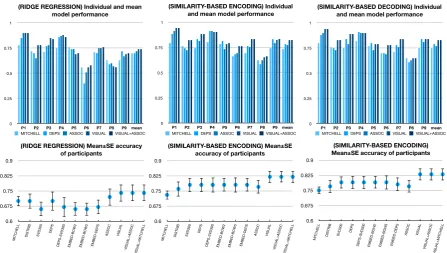
Figure 1: (TOP) Comparison of individual and mean model performance for five selected models (MITCHELL,DEPS,ASSOC,VISUAL,VISUAL+ASSOC), using results in Table1(Ridge regression), Table
2(Similarity-based encoding) and Table3(Similarity-based decoding). (BOTTOM) Mean±SE accuracy of participants for all models.
Secondly, our results suggest that sparse text-based models, whether dependency-text-based or built using linear bag-of-words context, predict neural activity more accurately than dense models. We also show that the structure of the text-based se-mantic model (sparse vs. dense) has more influ-ence on the performance than the type of informa-tion used to construct the context (linear bag-of-words vs. dependency-based).
Finally, we found that cognitively-motivated association-based models perform on par with or better than other linguistic models. These re-sults are in line with the previous findings of be-havioural research suggesting that humans repre-sent the meanings of concepts through association with other concepts (Barsalou et al.,2008) which in turn endorses the association-based semantic models as a promising direction in computational semantics research.
An interesting avenue for future work would be to investigate the variance of results amongst in-dividual participants (Figure 1). Previous stud-ies that use fMRI data always report variation across participants (Devereux et al.,2010; Ander-son et al.,2017) and most often attribute it to head motion. However, understanding how individual variations in participants can impact modeling
de-cisions would be of great value to the computa-tional semantics community.
Acknowledgments
Luana Bulat is supported by an EPSRC Doctoral Training Grant and ERC Proof of Concept Grant GroundForce (693579). Stephen Clark is sup-ported by ERC Starting Grant DisCoTex (306920) and ERC Proof of Concept Grant GroundForce (693579). Ekaterina Shutova is supported by the Leverhulme Trust Early Career Fellowship. We thank the anonymous reviewers for their helpful comments.
References
Andrew J Anderson, Elia Bruni, Ulisse Bordignon, Massimo Poesio, and Marco Baroni. 2013. Of words, eyes and brains: Correlating image-based distributional semantic models with neural represen-tations of concepts. InEMNLP, pages 1960–1970.
[image:9.595.74.522.60.313.2]Andrew J Anderson, Douwe Kiela, Stephen Clark, and Massimo Poesio. 2017. Visually grounded and tex-tual semantic models differentially decode brain ac-tivity associated with concrete and abstract nouns. Transactions of the Association for Computational Linguistics, 5:17–30.
Andrew J Anderson, Benjamin D Zinszer, and Ra-jeev DS Raizada. 2016. Representational similarity encoding for fMRI: Pattern-based synthesis to pre-dict brain activity using stimulus-model-similarities. NeuroImage, 128:44–53.
Lawrence W Barsalou. 2008. Grounded cognition. Annu. Rev. Psychol., 59:617–645.
Lawrence W Barsalou, Ava Santos, W Kyle Simmons, and Christine D Wilson. 2008. Language and sim-ulation in conceptual processing. Symbols, embodi-ment, and meaning, pages 245–283.
Shane Bergsma and Randy Goebel. 2011. Using vi-sual information to predict lexical preference. In RANLP, pages 399–405.
Elia Bruni, Gemma Boleda, Marco Baroni, and Nam-Khanh Tran. 2012. Distributional semantics in tech-nicolor. In Proceedings of the 50th Annual Meet-ing of the Association for Computational LMeet-inguis- Linguis-tics: Long Papers-Volume 1, pages 136–145. Asso-ciation for Computational Linguistics.
Luana Bulat, Douwe Kiela, and Stephen Clark. 2016. Vision and feature norms: Improving automatic fea-ture norm learning through cross-modal maps. In Proceedings of the 2016 Conference of the North American Chapter of the Association for Computa-tional Linguistics: Human Language Technologies, pages 579–588, San Diego, California. Association for Computational Linguistics.
Kai-min Kevin Chang, Tom Mitchell, and Mar-cel Adam Just. 2010. Quantitative modeling of the neural representation of objects: How semantic fea-ture norms can account for fMRI activation. Neu-roimage: Special Issue on Multi-variate Deciding and Brain Reading, 56:716–727.
Stephen Clark and James R Curran. 2007. Wide-coverage efficient statistical parsing with ccg and log-linear models. Computational Linguistics, 33(4):493–552.
George S Cree and Ken McRae. 2003. Analyzing the factors underlying the structure and computation of the meaning of chipmunk, cherry, chisel, cheese, and cello (and many other such concrete nouns). Journal of Experimental Psychology: General, 132(2):163.
Simon De Deyne, Daniel J Navarro, and Gert Storms. 2013. Better explanations of lexical and seman-tic cognition using networks derived from continued rather than single-word associations. Behavior Re-search Methods, 45(2):480–498.
Simon De Deyne, Amy Perfors, and Daniel J Navarro. 2016. Predicting human similarity judgments with distributional models: The value of word associa-tions. Proceedings of the 26th International Confer-ence on Computational Linguistics (COLING). Scott Deerwester, Susan T Dumais, George W
Fur-nas, Thomas K Landauer, and Richard Harshman. 1990. Indexing by latent semantic analysis. Jour-nal of the American society for information science, 41(6):391.
Barry Devereux, Colin Kelly, and Anna Korhonen. 2010. Using fMRI activation to conceptual stim-uli to evaluate methods for extracting conceptual representations from corpora. In Proceedings of the NAACL HLT 2010 First Workshop on Compu-tational Neurolinguistics, pages 70–78. Association for Computational Linguistics.
Leonardo Fernandino, Colin J Humphries, Mark S Sei-denberg, William L Gross, Lisa L Conant, and Jef-frey R Binder. 2015. Predicting brain activation patterns associated with individual lexical concepts based on five sensory-motor attributes. Neuropsy-chologia, 76:17–26.
Felix Hill and Anna Korhonen. 2014. Learning ab-stract concept embeddings from multi-modal data: Since you probably can’t see what I mean. Proceed-ings of the 2014 Conference on Empirical Methods in Natural Language Processing.
Arthur E Hoerl and Robert W Kennard. 1970. Ridge regression: Biased estimation for nonorthogonal problems. Technometrics, 12(1):55–67.
Yangqing Jia, Evan Shelhamer, Jeff Donahue, Sergey Karayev, Jonathan Long, Ross Girshick, Sergio Guadarrama, and Trevor Darrell. 2014. Caffe: Con-volutional architecture for fast feature embedding. In Proceedings of the ACM International Confer-ence on Multimedia, pages 675–678. ACM. Douwe Kiela. 2016. MMFEAT: A toolkit for
extract-ing multi-modal features. InProceedings of ACL. Douwe Kiela and Léon Bottou. 2014. Learning image
embeddings using convolutional neural networks for improved multi-modal semantics. InProceedings of EMNLP, volume 2014.
Douwe Kiela, Luana Bulat, and Stephen Clark. 2015a. Grounding semantics in olfactory perception. In Proceedings of the 53rd Annual Meeting of the Association for Computational Linguistics and the 7th International Joint Conference on Natural Lan-guage Processing (Volume 2: Short Papers), pages 231–236, Beijing, China. Association for Computa-tional Linguistics.
Douwe Kiela, Laura Rimell, Ivan Vuli´c, and Stephen Clark. 2015b. Exploiting image generality for lex-ical entailment detection. In Proceedings of the 53rd Annual Meeting of the Association for Compu-tational Linguistics and the 7th International Joint Conference on Natural Language Processing (Vol-ume 2: Short Papers), Beijing, China.
Douwe Kiela, Anita L. Ver˝o, and Stephen Clark. 2016. Comparing Data Sources and Architectures for Deep Visual Representation Learning in Semantics. In Proceedings of the Conference on Empirical Meth-ods in Natural Language Processing (EMNLP-16). Alex Krizhevsky, Ilya Sutskever, and Geoffrey E
Hin-ton. 2012. Imagenet classification with deep con-volutional neural networks. In Advances in neural information processing systems, pages 1097–1105. Omer Levy and Yoav Goldberg. 2014.
Dependency-based word embeddings. In ACL (2), pages 302– 308. Citeseer.
Ken McRae, George S Cree, Mark S Seidenberg, and Chris McNorgan. 2005. Semantic feature produc-tion norms for a large set of living and nonliving things. Behavior research methods, 37(4):547–559. Tomas Mikolov, Kai Chen, Greg Corrado, and Jef-frey Dean. 2013a. Efficient estimation of word representations in vector space. arXiv preprint arXiv:1301.3781.
Tomas Mikolov, Wen-tau Yih, and Geoffrey Zweig. 2013b. Linguistic regularities in continuous space word representations. InHLT-NAACL, pages 746– 751.
Guido Minnen, John Carroll, and Darren Pearce. 2001. Applied morphological processing of english. Nat-ural Language Engineering, 7(03):207–223.
Tom M Mitchell, Svetlana V Shinkareva, Andrew Carl-son, Kai-Min Chang, Vicente L Malave, Robert A Mason, and Marcel Adam Just. 2008. Predicting human brain activity associated with the meanings of nouns.Science, 320(5880):1191–1195.
Brian Murphy, Partha Talukdar, and Tom Mitchell. 2012. Selecting corpus-semantic models for neu-rolinguistic decoding. In Proceedings of the First Joint Conference on Lexical and Computational Se-mantics, pages 114–123. Association for Computa-tional Linguistics.
Douglas L Nelson, Cathy L McEvoy, and Thomas A Schreiber. 2004. The University of South Florida free association, rhyme, and word fragment norms. Behavior Research Methods, Instruments, & Com-puters, 36(3):402–407.
Mark Palatucci, Dean Pomerleau, Geoffrey E Hinton, and Tom M Mitchell. 2009. Zero-shot learning with semantic output codes. InAdvances in Neural Infor-mation Processing Systems, pages 1410–1418.
Francisco Pereira, Matthew Botvinick, and Greg Detre. 2013. Using wikipedia to learn semantic feature rep-resentations of concrete concepts in neuroimaging experiments.Artificial intelligence, 194:240–252. Ekaterina Shutova, Douwe Kiela, and Jean Maillard.
2016. Black holes and white rabbits: Metaphor identification with visual features. In NAACL HLT 2016, The 2016 Conference of the North American Chapter of the Association for Computational Lin-guistics: Human Language Technologies, San Diego California, USA, June 12-17, 2016, pages 160–170. Carina Silberer and Mirella Lapata. 2012. Grounded models of semantic representation. InProceedings of the 2012 Joint Conference on Empirical Methods in Natural Language Processing and Computational Natural Language Learning, pages 1423–1433. As-sociation for Computational Linguistics.