Feasibility of Human-in-the-loop Minimum Error Rate Training
Omar F. Zaidan and Chris Callison-Burch Dept. of Computer Science, Johns Hopkins University
Baltimore, MD 21218, USA {ozaidan,ccb}@cs.jhu.edu
Abstract
Minimum error rate training (MERT) in-volves choosing parameter values for a machine translation (MT) system that maximize performance on a tuning set as measured by an automatic evaluation met-ric, such as BLEU. The method is best when the system will eventually be eval-uated using the same metric, but in reality, most MT evaluations have a human-based component. Although performing MERT with a human-based metric seems like a daunting task, we describe a new metric, RYPT, which takes human judgments into account, but only requires human input to build a database that can be reused over and over again, hence eliminating the need for human input at tuning time. In this investigative study, we analyze the diver-sity (or lack thereof) of the candidates pro-duced during MERT, we describe how this redundancy can be used to our advantage, and show that RYPTis a better predictor of translation quality than BLEU.
1 Introduction
Many state-of-the-art machine translation (MT) systems over the past few years (Och and Ney, 2002; Koehn et al., 2003; Chiang, 2007; Koehn et al., 2007; Li et al., 2009) rely on several mod-els to evaluate the “goodness” of a given candidate translation in the target language. The MT system proceeds by searching for the highest-scoring can-didate translation, as scored by the different model components, and returns that candidate as the hy-pothesis translation. Each of these models need not be a probabilistic model, and instead corre-sponds to a feature that is a function of a (can-didate translation,foreign sentence) pair.
Treated as a log-linear model, we need to as-sign a weight for each of the features. Och (2003)
shows that setting those weights should take into account the evaluation metric by which the MT system will eventually be judged. This is achieved by choosing the weights so as to maximize the per-formance of the MT system on a development set, as measured by that evaluation metric. The other insight of Och’s work is that there exists an ef-ficient algorithm to find such weights. This pro-cess has come to be known as the MERT phase (for Minimum Error Rate Training) in training pipelines of MT systems.
A problem arises if the performance of the sys-tem is not judged by an automatic evaluation met-ric such as BLEU or TER, but instead through an evaluation process involving a human. The GALE evaluation, for instance, judges the quality of systems as measured by human-targeted TER (HTER), which computes the edit distance be-tween the system’s output and a version of the output post-edited by a human. The IWSLT and WMT workshops also have a manual evaluation component, as does the NIST Evaluation, in the form of adequacy and fluency (LDC, 2005).
In theory, one could imagine trying to optimize a metric like HTER during the MERT phase, but that would require the availability of an HTER au-tomatic scorer, which, by definition, does not ex-ist. If done manually, the scoring of thousands of candidates produced during MERT would literally take weeks, and cost a large sum of money. For these reasons, researchers resort to optimizing an automatic metric (almost always BLEU) as a proxy for human judgment.
time except when building a database of reusable judgments, and furthermore show that RYPT is a better predictor of translation quality than BLEU, making it an excellent candidate for MERT tun-ing.
The paper is organized as follows. We start by describing the core idea of MERT before intro-ducing our new metric, RYPT, and describing the data collection effort we undertook to collect the needed human judgments. We analyze a MERT run optimizing BLEU to quantify the level of re-dundancy in the candidate set, and also provide an extensive analysis of the collected judgments, before describing a set of experiments showing RYPT is a better predictor of translation quality than BLEU. Following a discussion of our findings, we briefly review related work, before pointing out future directions and summarizing.
2 Och’s Line Search Method
A common approach to translating a source sen-tencef in a foreign language is to select the can-didate translation e that maximizes the posterior probability:
P r(e|f)def= Pexp(sΛ(e, f))
e0exp(sΛ(e0, f)).
This definesP r(e|f)using alog-linear model
that associates a sentence pair (e, f) with a fea-ture vector Φ(e, f) = {φ1(e, f), ..., φM(e, f)},
and assigns a score
sΛ(e, f)= Λdef ·Φ(e, f) =
M
X
m=1
λmφm(e, f)
for that sentence pair, with the feature weights Λ = {λ1, ..., λM} being the parameters of the
model. Therefore, the system selects the transla-tionˆe:
ˆ
e= argmax
e P r(e|f) = argmaxe sΛ(e, f). (1)
Och (2003) provides evidence thatΛshould be chosen by optimizing an objective function basd on the evaluation metric of interest, rather than likelihood. Since the error surface is not smooth, and a grid search is too expensive, Och suggests an alternative, efficient, line optimization approach.
Assume we are performing a line optimiza-tion along the dth dimension. Consider a
for-eign sentence f, and let the candidate set for f
be {e1, ..., eK}. Recall from (1) that the 1-best
candidate at a given Λ is the one with maxi-mum PMm=1λmφm(ek, f). We can rewrite the
sum asλdφd(ek, f) +Pm6=dλmφm(ek, f). The
second term is constant with respect to λd, and
so is φd(ek, f). Renaming those two quantities
offestΛ(ek)andslope(ek), we get
sΛ(ek, f) =slope(ek)λd+offsetΛ(ek).
Therefore, if we plot the score for a candidate translation vs. λd, that candidate will be
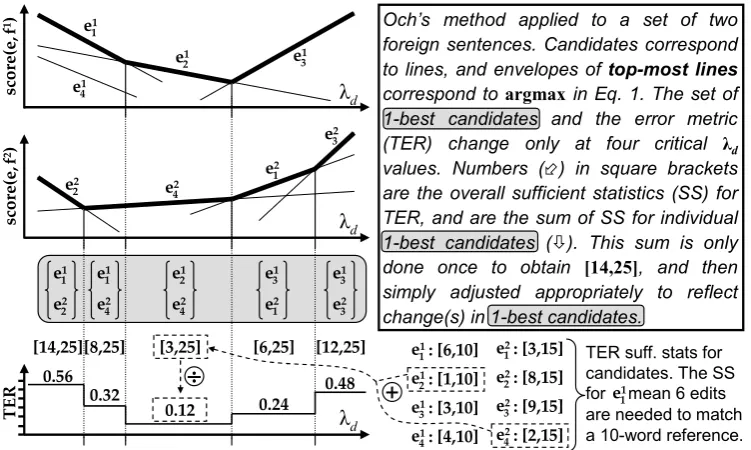
repre-sented by a line. If we plot the lines for all candi-dates (Figure 1), then the upper envelope of these lines indicates the best candidate at any value for λd.
Therefore, the objective function is piece-wise linear across any of the M dimensions1,
mean-ing we only need to evaluate it at the “critical” points corresponding to line intersection points. Furthermore, we only need to calculate the suffi-cient statistics once, at the smallest critical point, and then simply adjust the sufficient statistics to reflect changes in the set of 1-best candidates.
2.1 The BLEUMetric
The metric most often used with MERT is BLEU (Papineni et al., 2002), where the score of a candi-datecagainst a reference translationris:
BLEU =BP(len(c), len(r))·exp(X4
n=1
1
4logpn),
where pn is the n-gram precision2 and BP is a
brevity penalty meant to penalize short outputs, to discourage improving precision at the expense of recall.
There are several compelling reasons to opti-mize to BLEU. It is the most widely reported met-ric in MT research, and has been shown to cor-relate well with human judgment (Papineni et al., 2002; Coughlin, 2003). But BLEU is also partic-ularly suitable for MERT, because it can be com-puted quite efficiently, and its sufficient statistics are decomposable, as required by MERT.3,4
1Or, in fact, along any linear combination of theM
di-mensions.
2Modifed precision, to be precise, based on clipped
n-gram counts.
3Note that for the sufficient statistics to be decomposable,
the metric itself need not be – this is in fact the case with BLEU.
de-e1 e2 1 2 e1 e2 1 4 e1 e2 2 4 e1 e2 3 1 e1 2 e2 1 e1 3 e1 1 e1 4 e2 2 e2 3 e2 4
1: [6,10]
2: [1,10]
3: [3,10]
4: [4,10] e1
e1
e1
e1
1: [3,15]
2: [8,15]
3: [9,15]
[image:3.595.112.488.59.284.2]4: [2,15] e2 e2 e2 e2 e1 e2 3 3 sc o re (e ,f 1) T E R sc o re (e ,f 2) 0.48 [12,25] 0.24 [6,25] 0.56 [14,25] 0.32 [8,25] 0.12 [3,25] λ d λd λ d
÷
÷
÷
÷
+
TER suff. stats for candidates. The SS for mean 6 edits are needed to match a 10-word reference.
e1 1
Och’s method applied to a set of two foreign sentences. Candidates correspond to lines, and envelopes of top-most lines correspond to argmaxin Eq. 1. The set of 1-best candidates and the error metric (TER) change only at four critical λd values. Numbers () in square brackets are the overall sufficient statistics (SS) for TER, and are the sum of SS for individual 1-best candidates (). This sum is only done once to obtain [14,25], and then simply adjusted appropriately to reflect change(s) in 1-best candidates.
Figure 1: Och’s method applied to a set of two foreign sentences. This figure is essentially a visualization of equation (1). We show here sufficient statistics for TER for simplicity, since there are only 2 of them, but the metric optimized in MERT is usually BLEU.
In spite of these advantages, recent work has pointed out a number of problematic aspects of BLEU that should cause one to pause and recon-sider the reliance on it. Chiang et al. (2008) in-vestigate several weaknesses in BLEU and show there are realistic scenraios where the BLEUscore should not be trusted, and in fact behaves in a counter-intuitive manner. Furthermore, Callison-Burch et al. (2006) point out that it is not always appropriate to use BLEU to compare systems to each other. In particular, the quality of rule-based systems is usually underestimated by BLEU.
All this raises doubts regarding BLEU’s ade-quacy as a proxy for human judgment, which is a particularly important issue in the context of set-ting parameters during the MERT phase. But what is the alternative?
2.2 (Non-)Applicability of Och’s Method to Human Metrics
In principle, MERT is applicable to any evalua-tion metric, including HTER, as long as its suffi-cient statistics are decomposable.4 In practice, of
course, the method requires the evaluation of thou-sands of candidate translations. Whereas this is composable in MERT, as they can be recalculated at each crit-ical point. However, this would slow down the optimization process quite a bit, since one cannot traverse the dimension by simply adjusting the sufficient statistics to reflect changes in 1-best candidates.
not a problem with a metric like BLEU, for which automatic (and fast) scorers are available, such an evaluation with a human metric would require a large amount of effort and money, meaning that a single MERT run would take weeks to com-plete, and would cost thousands of dollars. As-sume a single candidate string takes 10 seconds to post-edit, at a cost of $0.10. Even with such an (overly) optimistic estimate, scoring 100 candi-dates for each of 1000 sentences would take 35 8-hour work days and cost $10,000. The cost would further grow linearly with the number of MERT it-erations and the n-best list size. On the other hand, optimizing for BLEUtakes on the order of minutes per iteration, and costs nothing.
2.3 The RYPTMetric
We suggest here a new metric that combines the best of both worlds, in that it is based on human judgment, but that is a viable metric to be used in the MERT phase. The key to the feasiblity is the reliance on adatabaseof human judgment rather than immendiate feedback for each candidate, and so human feedback is only needed once, and the collected human judgments can be reused over and over again by an automatic scorer.
sen-S{0-11}
S{0-10} X{11-11} S{0-7} X{8-10}
X{8-8}
X{10-10} X{0-7}
X{4-6} X{0-2}
X{1-1} X{4-4}
official forecasts are based on only 3 per cent reported , bloomberg . offizielle prognosen sind von nur 3 prozent ausgegangen , meldete bloomberg .
Y
N
Y Y
Y Y Y N
N
Y Y Y N
Y
ROOT
Y Y N
Y Label Yindicates
forecastsdeemed
acceptable translation
of prognosen.
Range 0-2indicates coverage of the first 3 words in the
[image:4.595.80.282.57.294.2]sourcesentence.
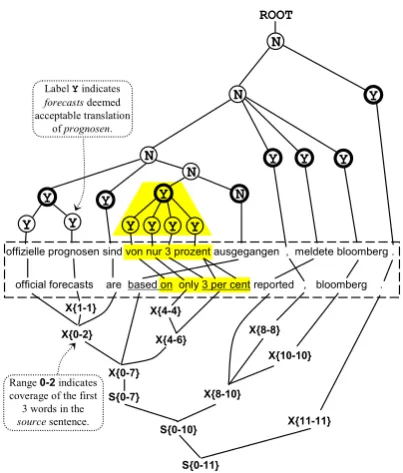
Figure 2: The source parse tree (top) and the can-didate derivation tree (bottom). Nodes in the parse tree with a thick border correspond to the frontier node set withmaxLen= 4. The human annota-tor only sees the portion surrounded by the dashed rectangle, including the highlighting (though ex-cluding the word alignment links).
tence, and penalize constituents that do not. For instance, consider the source-candidate sentence pair of Figure 2. To evaluate the candidate transla-tion, the source parse tree is first obtained (Dubey, 2005), and each subtree is matched with a string in the candidate string. If the source sub-string covered by this subtree is translated into an acceptable substring in the candidate, that node gets aYES label. Otherwise, the node gets a NO
label.
The metric we propose is taken to be the ratio of
YESnodes in the parse tree (or RYPT). The candi-date in Figure 2, for instance, would get a RYPT score of13/18 = 0.72.
To justify its use as a proxy for HTER-like met-rics, we need to demonstrate that this metric corre-lates well with human judgment. But it is also im-portant to show that we can obtain theYES/NO la-bel assignments in an efficient and affordable man-ner. At first glance, this seems to require a human to provide judgments for each candidate, much like with HTER. But we describe in the next sec-tion strategies that minimize the number of judg-ments we need to actually collect.
3 Collecting Human Judgments
The first assumption we make to minimize the number of human judgments, is that once we have a judgment for a source-candidate substring pair, that same judgment can be used across all candidates for this source sentence. In other words, we build a database for each source sen-tence, which consists of <source substring,target substring,judgment>entries. For a given source substring, multiple entries exist, each with a dif-ferent target candidate substring. The judgment field is one ofYES,NO, andNOT SURE.
Note that the entries do not store the full can-didate string, since we reuse a judgment across all the candidates of that source sentence. For in-stance, if we collect the judgment:
<der patient,the patient,YES> from the sentence pair:
der patient wurde isoliert . the patient was isolated .
then this would apply to any candidate translation of this source sentence. And so all of the following substrings are labeledYESas well:
the patient isolated .
the patient was in isolation . the patient has been isolated .
Similarly, if we collect the judgment: <der patient,of the patient,NO>
from the sentence pair:
der patient wurde isoliert . of the patient was isolated .
then this would apply to any candidate translation of the source, and the following substrings are la-beledNOas well:
of the patient isolated .
of the patient was in isolation . of the patient has been isolated .
of those nodes, it is quite reasonable to percolate existing labels up and down the parse tree: if a node is labeled NO, this likely means that all its ancestors would also be labeledNO, and if a node is labeled YES, this likely means that all its de-scendents whould also be labeledYES.
While those two strategies (using judgments across candidates, and percolating labels up and down the tree) are only approximations for the true labels, employing them considerably reduces the amount of data we need to collect.
3.1 Obtaining Source-to-Candidate Alignments
How do we determine which segment of the can-didate sentence aligns to a given source segment? Given a word alignment between the source and the candidate, we take the target substring to con-tain any word aligned with at least one word in the source segment. One could run an aligner (e.g. GIZA++) on the two sentences to obtain the word alignment, but we take a different approach.
We use Joshua (Li et al., 2009), in our experi-ments. Joshua is a hierarchical parsing-based MT system, and it can be instructed to produce deriva-tion trees instead of the candidate sentence string itself. Furthermore, each node in the derivation tree is associated with the two indices in the source sentence that indicate the segment corresponding to this derivation subtree (the numbers indicated in curly brackets in Figure 2).
Using this information, we are able to recover most of the phrasal alignments. There are other phrasal alignments that can be deduced from the structure of the tree indirectly, by system-atically discarding source words that are part of another phrasal alignment. For instance, in Figure 2, one can observe the alignment (offizielle,prognosen,sind)–(official,forecasts,are) and the alignment (prognosen)–(forecasts) to deduce (offizielle,sind)–(official,are).
Although some of the phrasal alignment are one-to-one mappings, many of them are many. By construction, any deduced many-to-many mapping has occurred in the training paral-lel corpus at least once. And so we recover the individual word alignments by consulting the par-allel corpus from which the grammar rules were extracted (which requires maintaining the word alignments obtained prior to rule extraction).5
5We incorporated our implementation of the
source-We emphasize here that our recovery of word alignment from phrasal alignment is independent from the hierarchical and parsing-based nature of the Joshua system. And so the alignment approach we suggest here can be applied to a different MT system as well, as long as that system provides phrasal alignment along with the output. In partic-ular, a phrase-based system such as Moses can be modified in a straightforward manner to provide phrasal alignments, and then apply our method.
4 Data Collection
We chose the WMT08 German-English news dataset to work with, and since this is an investiga-tive study of a novel approach, we collected judg-ments for a subset of 250 source sentences from the development set for the set of candidate sen-tences produced in the last iteration of a MERT run optimizing BLEUon the full 2051-sentence de-velopment set. The MT system we used is Joshua (Li et al., 2009), a software package that comes complete with a grammar extraction module and a MERT module, in addition to the decoder itself.
What segments of the source should be chosen to be judged? We already indicated that we limit ourselves, by definition of RYPT, to segments that are covered exactly by a subtree in the source parse tree. This has a couple of nice advantages: it al-lows us to present an annotator with a high num-ber of alternatives judged simulataneously (since the annotator is shown a source segment and sev-eral candidates, not just one), and this probably also makes judging them easier – it is reasonable to assume that strings corresponding to syntactic constituents are easier to process by a human.
Our query selection strategy attempts to max-imize the amount of YES/NO percolation that would take place. We therefore ensure that for any 2 queries, the corresponding source segments do not overlap: such overlap indicates that one sub-tree is completely contained within the other. Hav-ing both queries (in the same batch) might be re-dundant if we use the above percolation procedure. The idea is to select source segments so that they fully cover the entire source sentence, but have no overlap amongst them. In one extreme, each query would correspond to an entire parse tree. This is not ideal since the overwhelming ma-jority of the judgments will most likely be NO, candidate aligner into the Joshua software as a new
which does not help identify where the problem is. In the other extreme, each query would corre-spond to a subtree rooted at a preterminal. This is also not ideal, since it would place too much em-phasis on translations of unigrams.
So we need a middle ground. We select a maximum-source-lengthmaxLento indicate how long we’re willing to let source segments be. Then we start at the root of the parse tree, and prop-agate a “frontier” node set down the parse tree, to end up with a set of nodes that fully cover the source sentence, have no overlap amongst them, and with each covering no more than maxLen
source words. For instance, with maxLenset to 4, the frontier set of Figure 2 are the nodes with a thick border. An algorithmic description is pro-vided in Algorithm 1.
Algorithm 1Constructing the frontier node set for
a parse tree.
Input: A source parse treeTrooted atROOT, and
a maximum source lengthmaxLen.
Return: A nonempty set frontierSet,
con-taining a subset of the nodes inT.
1. InitializefrontierSetto the empty set. 2. InitializecurrNodesto{ROOT}.
3. whilecurrNodesis not emptydo
4. InitializenewNodesto the empty set. 5. foreach nodeN incurrNodesdo 6. ifN covers≤maxLensource words
then
7. AddN tofrontierSet.
8. else
9. Add children ofN tonewNodes.
10. end if
11. end for
12. SetcurrNodes=newNodes
13. end while
14. ReturnfrontierSet.
This would ensure that our queries cover be-tween 1 andmaxLensource words, and ensures they do not overlap, which would allow us to take full advantage of the downward-YESand
upward-NOpercolation. We setmaxLen= 4based on a pilot study of 10 source sentences and their candi-dates, having observed that longer segments tend to always be labeled asNO, and shorter segments tend to be so deep down the parse tree.
4.1 Amazon Mechanical Turk
We use the infrastructure of Amazon’s Mechan-ical Turk (AMT)6 to collect the labels. AMT is
a virtual marketplace that allows “requesters” to create and post tasks to be completed by “work-ers” around the world. To create the tasks (called
Human Intelligence Tasks, or HITs), a requester supplies an HTML template along with a comma-separated-values database, and AMT automati-cally creates the HITs and makes them available to workers. The queries are displayed as an HTML page (based on the provided HTML template), with the user indicating the label (YES,NO, orNOT SURE) by selecting the appropriate radio button. The instructions read, in part:7
You are shown a “source” German sentence with a highlighted segment, followed by several candidate trans-lations with corresponding highlighted segments. Your task is to decide if each highlighted English segment is an ac-ceptable translation of the highlighted German segment.
In each HIT, the worker is shown up to 10 al-ternative translations of a highlighted source seg-ment, with each itself highlighted within a full candidate string in which it appears. To aid the worker in the task, they are also shown the ref-erence translation, with a highlighted portion that corresponds to the source segment, deduced using word alignments obtained with GIZA++.8
4.2 Cost of Data Collection
The total number of HITs created was 3873, with the reward for completing a HIT depend-ing on how many alternative translations are bedepend-ing judged. On average, each HIT cost 2.1 cents and involved judging 3.39 alternatives. 115 distinct workers put in a total of 30.82 hours over a pe-riod of about 4 days. On average, a label required 8.4 seconds to determine (i.e. at a rate of 426 la-bels per hour). The total cost was $81.44: $21.43 for Amazon’s commission, $53.47 for wages, and
6AMT’s website:http://www.mturk.com. 7Template and full instructions can be viewed athttp:
//cs.jhu.edu/˜ozaidan/hmert.
8These alignments are not always precise, and we do note
$6.54 for bonuses9, for a cost per label of 0.62
cents (i.e. at a rate of 161.32 labels per dol-lar). Excluding Amazon’s commission, the effec-tive hourly ‘wage’ was $1.95.
5 Experimental Results and Analysis By limiting our queries to source segments corre-sponding to frontier nodes withmaxLen= 4, we obtain a total of 3601 subtrees across the 250 sen-tences, for an average of 14.4 per sentence. On average, each subtree has 3.65 alternative trans-lations. Only about 4.8% of the judgments were returned asNOT SURE(or, occasionally, blank), with the rest split into 35.1%YESjudgments and 60.1%NOjudgments.
The coverage we get before percolating labels up and down the trees is 39.4% of the nodes, in-creasing to a coverage of 72.9% after percolation. This is quite good, considering we only do a sin-gle data collection pass, and considering that about 10% of the subtrees do not align to candidate sub-strings to begin with (e.g. single source words that lack a word alignment into the candidate string).
The main question, of course, is whether or not those labels allow us to calculate a RYPT score that is reliably correlated with human judgment. We designed an experiment to compare the predic-tive power of RYPTvs. BLEU. Given the candidate set of a source sentence, we rerank the candidate set according to RYPT and extract the top-1 can-didate, and we rerank the candidate set according to BLEU, and extract the top-1 candidate. We then present the two candidates to human judges, and ask them to choose the one that is a more adequate translation. For reliability, we collect 3 judgments per sentence pair comparison, instead of just 1.
The results show that RYPTsignificantly outper-forms BLEU when it comes to predicting human preference, with its choice prevailing in 46.1% of judgments vs. 36.0% for BLEU, with 17.9% judged to be of equal quality (left half of Ta-ble 1). This advantage is especially true when the judgments are grouped by sentence, and we ex-amine cases of strong agreement among the three annotators (Table 2): whereas BLEU’s candidate is strongly preferred in 32 of the candidate pairs (bottom 2 rows), RYPT’s candidate is strongly pre-ferred in about double that number: 60 candidate
9We would review the collected labels and give a 20%
reward for good workers to encourage them to come back and complete more HITs.
pairs (top 2 rows).
This is quite a remarkable result, given that BLEU, by definition, selects a candidate that has significant overlap with the reference shown to the annotators to aid in their decision-making. This means that BLEU has an inherent advantage in comparisons where both candidates are more or less of equal quality, since annotators are encour-aged (in the instructions) to make a choice even if the two candidates seem of be of equal quality at first glance. Pressed to make such a choice, the annotator is likely to select the candidate that su-perficially ‘looks’ more like the reference to be the ‘better’ of the two candidates. That candidate will most likely be the BLEU-selected one.
To test this hypothesis, we repeated the experi-mentwithout showing the annotators the reference translations, and limited data collection to work-ers living in Germany, making judgments based only on the source sentences. (We only collected one judgment per source sentence, since German workers on AMT are in short supply.)
As expected, the difference is even more pro-nounced: human judges prefer the RYPT-selected candidate 45.2% of the time, while BLEU’s can-didate is preferred only 29.2% of the time, with 25.6% judged to be of equal quality (right half of Table 1). Our hypothesis is further supported by the fact that most of the gain of the “equal-quality” category comes from BLEU, which loses 6.8 percentage points, whereas RYPT’s share re-mains largely intact, losing less than a single per-centage point.
5.1 Analysis of Data Collection
Recall that we minimize data collection by per-forming label percolation and by employing a frontier node set selection strategy. While the re-sults just presented indicate those strategies pro-vide a good approximation of some ‘true’ RYPT score, label percolation was a strategy based pri-marily on intuition, and choosing maxLen = 4 for frontier set construction was based on examin-ing a limited amount of preliminary data.
References shown; Referencesnotshown; unrestricted restricted to DE workers Preferred candidate # judgments % judgments # judgments % judgments
Top-1 by RYPT 346 46.1 113 45.2
Top-1 by BLEU 270 36.0 73 29.2
Neither 134 17.9 64 25.6
[image:8.595.114.484.59.157.2]Total 750 100.0 250 100.0
Table 1: Ranking comparison results. The left half corresponds to the experiment (open to all workers) where the English reference was shown, whereas the right half corresponds to the experiment (open only to workers living in Germany) where the English reference wasnotshown.
Aggregate # sentences % sentences Aggregate # sentences % sentences
RYPT+3 45 18.0
RYPT+2 15 6.0 RYPT +any 120 48.0
RYPT+1 60 24.0
±0 42 16.8 ±0 42 16.8
BLEU+1 55 22.0
BLEU+2 5 2.0 BLEU +any 88 35.2
BLEU+3 28 11.2
Total 250 100.0 Total 250 100.0
Table 2: Ranking comparison results, grouped by sentence. This table corresponds to the left half of Table 1. 3 judgments were collected for each comparison, with the “aggregate” for a comparison calcu-lated from these 3 judgments. For instance, an aggregate of “RYPT +3” means all 3 judgments favored RYPT’s choice, and “RYPT +1” means one more judgment favored RYPTthan did BLEU.
in the source parse tree, instead of limiting our-selves to a frontier node set. (Though we did limit the length of a source segment to be≤7 words.) This would allow us to judge the validity of label percolation, and under differentmaxLenvalues.
Furthermore, we collected multiple judgments for each query in order to minimize the effet of bad/random annotations. For each of 5580 gen-erated queries, we collected five judgments, for a total of 27,900 judgments.10 As before, the
anno-tator would pick one ofYES,NO, andNOT SURE. First, collecting multiple judgments allowed us to investigate inter-annotator agreement. In 68.9% of the queries, at least 4 of the 5 annotators chose the same label, signifying a high degree of inter-annotator agreement. This is especially encourag-ing considerencourag-ing that we identified about 15% of the HITs as being of poor quality, and blocked the respective annotators from doing further HITs.11
We then examine the applicabilityandvalidity
10For a given query, the five collected judgments are from
five different annotators, since AMT ensures an annotator is never shown the same HIT twice.
11It is especially easy to identify (and then block) such
an-notators when they submit a relatively large number of HITs, since inspecting some of their annotations would indicate they are answering randomly and/or inconsistently.
of label percolation. For each of 7 different values for Algorithm 1’smaxLen, we ignore all but la-bels that would be requested under thatmaxLen
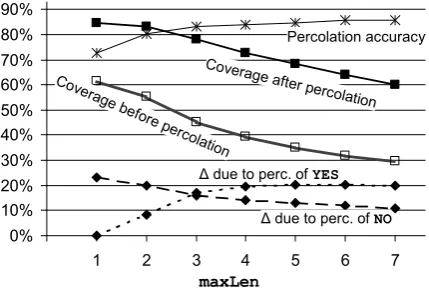
value, and percolate the labels up and down the tree. In Figure 3 we plot the coverage before and after percolation (middle two curves), and observe expansion in coverage across different values of
maxLen, peaking at about +33% formaxLen= 4 and5, with most of the benefit coming fromYES
percolation (bottom two curves).
0% 10% 20% 30% 40% 50% 60% 70% 80% 90%
0 1 2 3 4 5 6 7
maxLen
Coverage befo
re pe rcolation
Coverage after p ercolation
Percolation accuracy
∆ due to perc. of YES
∆ due to perc. ofNO
Figure 3: Label percolation under different
[image:8.595.309.524.553.697.2]We also measure the accuracy of labels deduced from percolation (top curve of Figure 3). We de-fine a percolated label to be correct if it matches the label given by a majority vote over the col-lected labels for that particular node. We find that accuracy at low maxLen values is significantly lower than at higer values (e.g. 72.6% vs. 84.1% for1vs. 4). This means a middle value such as3 or4is optimal. Higher values could be suitable if we wish to emphasize translation fluency.
6 Related Work
Nießen et al. (2000) is an early work that also con-structs a database of translations and judgments. There, a source sentence is stored along with all the translations that have already been manually judged, along with their scores. They utilize this database to carry out “semi-automatic” evaluation in a fast and convenient fashion thanks to tool they developed with a user-friendly GUI.
In their annual evaluation, the WMT work-shop has effectively conducted manual evaluation of submitted systems over the past few years by distributing the work across tens of volunteers, though they relied on a self-designed online por-tal. On the other hand, Snow et al. (2008) illus-trate how AMT can be used to collect data in a “fast and cheap” fashion, for a number of NLP tasks, such as word sense disambiguation. They go a step further and model the behavior of their annotators to reduce annotator bias. This was pos-sible as they collect multiple judgments for each query from multiple annotators.
The question of how to design an automatic metric that best approximates human judgment has received a lot of attention lately. NIST started organizing the Metrics for Machine Translation Challenge (MetricsMATR) in 2008, with the aim of developing automatic evaluation metrics that correlate highly with human judgment of transla-tion quality. The latest WMT workshop (Callison-Burch et al., 2009) also conducted a full assess-ment of how well a suite of automatic metrics cor-relate with human judgment.
7 Future Work
This pilot study has demonstrated the feasibility of collecting a large number of human judgments, and has shown that the RYPTmetric is better than BLEU at picking out the best translation. The next step is to run a complete MERT run. This
will involve collecting data for thousands of al-ternative translations for several hundreds source sentences. Based on our analysis, this it should be cost-effective to solicit these judgments using AMT. After training MERT using RYPTas an ob-jective function the, the next logical step would be to compare two outputs of a system. One output would have parameters optimized to BLEUand the other to RYPT. The hope is that the RYPT-trained system would be better under the final HTER eval-uation than the BLEU-trained system.
We are also investigating a probabilistic ap-proach to percolating the labels up and down the tree, whereby the label of a node is treated as a random variable, and inference is performed based on values of the other observed nodes, as well as properties of the source/candidate segment. Cast this way, a probabilistic approach is actually quite appealing, and one could use collected data to train a prediction model (such as a Markov ran-dom field).
8 Summary
We propose a human-based metric, RYPT, that is quite feasible to optimize using MERT, relying on the redundancy in the candidate set, and collect-ing judgments uscollect-ing Amazon’s Mechanical Turk infrastructure. We show this could be done in a quite cost-effective manner, and produces data of good quality. We show the effectiveness of the metric by illustrating that it is a better predictor of human judgment of translation quality than BLEU, the most commonly used metric in MT. We show this is the case even with a modest amount of data that does not cover the entirety of all parse trees, on which the metric is dependent. The collected data represents a database that can be reused over and over again, hence limiting human feedback to the initial phase only.
Acknowledgments
References
Chris Callison-Burch, Miles Osborne, and Philipp Koehn. 2006. Re-evaluating the role of Bleu in ma-chine translation research. InProceedings of EACL, pages 249–256.
Chris Callison-Burch, Philipp Koehn, Christof Monz, and Josh Schroeder. 2009. Findings of the 2009 Workshop on Statistical Machine Translation. In Proceedings of the Fourth Workshop on Statistical Machine Translation, pages 1–28, Athens, Greece, March. Association for Computational Linguistics.
David Chiang, Steve DeNeefe, Yee Seng Chan, and Hwee Tou Ng. 2008. Decomposability of trans-lation metrics for improved evaluation and efficient algorithms. InProceedings of EMNLP, pages 610– 619.
David Chiang. 2007. Hierarchical phrase-based trans-lation. Computational Linguistics, 33(2):201–228. Deborah Coughlin. 2003. Correlating automated and
human assessments of machine translation quality. InProceedings of MT Summit IX.
Amit Dubey. 2005. What to do when lexicaliza-tion fails: parsing German with suffix analysis and smoothing. InProceedings of ACL.
Philipp Koehn, Franz Josef Och, and Daniel Marcu. 2003. Statistical phrase-based translation. In Pro-ceedings of HLT-NAACL, pages 127–133.
Philipp Koehn, Hieu Hoang, Alexandra Birch, Chris Callison-Burch, Marcello Federico, Nicola Bertoldi, Brooke Cowan, Wade Shen, Christine Moran, Richard Zens, Chris Dyer, Ondrej Bojar, Alexan-dra Constantin, and Evan Herbst. 2007. Moses: Open source toolkit for statistical machine transla-tion. InProceedings of ACL, Demo and Poster Ses-sions, pages 177–180.
LDC. 2005. Linguistic data annotation specification: Assessment of fluency and adequacy in translations. Revision 1.5.
Zhifei Li, Chris Callison-Burch, Chris Dyer, Juri Gan-itkevitch, Sanjeev Khudanpur, Lane Schwartz, Wren Thornton, Jonathan Weese, and Omar F. Zaidan. 2009. Joshua: An open source toolkit for parsing-based machine translation. In Proceedings of the Fourth Workshop on Statistical Machine Transla-tion, pages 135–139.
Sonja Nießen, Franz Josef Och, Gregor Leusch, and Hermann Ney. 2000. An evaluation tool for ma-chine translation: Fast evaluation for mt research. InProceedings of LREC.
Franz Josef Och and Hermann Ney. 2002. Discrimina-tive training and maximum entropy models for sta-tistical machine translation. InProceedings of ACL, pages 295–302.
Franz Josef Och. 2003. Minimum error rate training in statistical machine translation. InProceedings of ACL, pages 160–167.
Kishore Papineni, Salim Poukos, Todd Ward, and Wei-Jing Zhu. 2002. Bleu: a method for automatic evaluation of machine translation. In Proceedings of ACL, pages 311–318.