Multi-Word Expression Identification Using Sentence Surface Features
Ram Boukobza School of Computer Science Hebrew University of Jerusalem [email protected]
Ari Rappoport School of Computer Science Hebrew University of Jerusalem
Abstract
Much NLP research on Multi-Word Ex-pressions (MWEs) focuses on the discov-ery of new expressions, as opposed to the identification in texts of known expres-sions. However, MWE identification is not trivial because many expressions al-low variation in form and differ in the range of variations they allow. We show that simple rule-based baselines do not perform identification satisfactorily, and present a supervised learning method for identification that uses sentence surface features based on expressions’ canonical form. To evaluate the method, we have annotated 3350 sentences from the British National Corpus, containing potential uses of 24 verbal MWEs. The method achieves an F-score of 94.86%, compared with 80.70% for the leading rule-based base-line. Our method is easily applicable to any expression type. Experiments in pre-vious research have been limited to the compositional/non-compositional distinc-tion, while we also test on sentences in which the words comprising the MWE ap-pear but not as an expression.
1 Introduction
Multi-Word Expressions (MWEs) such as ‘pull strings’, ‘make a face’ and ‘get on one’s nerves’ are very common in language. Such MWEs can be characterized as beingnon-compositional: the meaning of the expression does not transparently follow from the meaning of the words that com-prise it. Much of the work on MWEs in NLP has been in MWE extraction – the discovery of new
MWEs from a corpus, using statistical and other methods. Identification of known MWEs in text has received less attention, but is necessary for many NLP applications, for example in machine translation. The current work deals with theMWE identificationtask: deciding if a sentence contains a use of a known expression.
MWE identification is not as simple as may ini-tially appear, as will be shown by the performance of two rule-based baselines in our experiments. One source of difficulty is variations in expres-sions’ usage in text. Although MWEs generally show less variation than single words, they show enough that it cannot be ignored. In a study on V+NP idioms, Riehemann (2001) found that the idioms’ canonical form accounted for 75% of their appearances in a corpus. Additionally, expressions differ considerably in the types of variations they allow, which include passivization, nominalization and addition of modifying words (Moon, 1998).
A second source of difficulty is that expressions consisting of very frequent words will often co-occur in sentences in a non-MWE usage and in similar but distinct expressions.
MWE identification can be modeled as a two step process. Given a sentence and a known ex-pression, step (1) is to decide if the sentence con-tains a potential use of the expression. This is a relatively simple step based on the appearance in the sentence of the words comprising the MWE. Step (2) is to decide if the potential use is indeed non-compositional. Consider the following sen-tences with regard to the expressionhit the road, meaning ‘to leave on a journey’:
(a) ‘At the time,the roadwas long and difficult with few travelers daring to take it.’
(b) ‘The headlights of the taxi-van behind us
flashed as ithitbumps inthe road.’
(c) ‘The bullets werehitting the roadand I could see them coming towards me a lot faster than I was able to reverse.’
(d) ‘Lorry trailers which would have beenhitting the roadtomorrow now stand idle.’
Sentence (a) does not contain a potential use of the expression due to the missing component ‘hit’. Each of (b)-(d) does contain a potential use of the expression. In (b) all of the expression compo-nents are present, but they do not form an expres-sion. In (c), the words form an expression, but with a compositional (literal) meaning. Only (d) contains a non-compositional use of hit the road. The task we address in this paper is to identify whether or not we are in case (d), for a given ex-pression in a given sentence.
To date, most work in MWE identification has focused on manually encoding rules that identify expressions in text. The encodings, usually con-sisting of regular expressions and syntactic struc-tures, are intended to contain all the necessary in-formation for processing the MWE in text. Being manual, this is time-consuming work and requires expert knowledge of individual expressions. In terms of the above model, such encodings handle both MWE identification steps.
A second approach is to use machine learning methods to learn an expression’s behavior from a corpus. Studies taking this approach have focused on distinguishing between compositional and non-compositional uses of an expression (cases (c) and (d) above). As will be detailed in Section 2, exist-ing methods are tailored to an expression’s type, and experiment with a single MWE pattern. In ad-dition, the training and test sets they used did not contain non-expression uses as in case (b), which can be quite common in practice.
Our approach is more general. Given a set of sentences with potential MWE uses, we use sen-tence surface features to create a Support Vec-tor Machine (SVM) classifier for each expres-sion. The classifier is binary and differentiates be-tween non-compositional uses of the expression ((d) above) on the one hand, and compositional and non-expression uses ((b) and (c)) on the other. The experiments and results presented below fo-cus on verbal MWEs, since verbal MWEs are quite common in language use and have also been investigated in related MWE research (e.g., (Cook
et al., 2007)). However, the developed features are not specific to a particular type of expression.
The supervised method is compared with two simple rule-based baselines in order to test whether a simple approach is sufficient. In addi-tion, the use of surface features is compared with the use of syntactic features (based on dependency parse trees of the sentences). Averaged over ex-pressions in an independent test set, the super-vised classifiers outperform the rule-based base-lines, with F-scores of 94.86% (surface features) and 87.77% (syntactic features), compared with 80.70% for the best baseline.
Section 2 reviews previous work. Section 3 dis-cusses the features used for the supervised classi-fier. Section 4 explains the experimental setting. The results and a discussion are given in sections 5 and 6.
2 Previous Work
2.1 MWE Lexical Encoding
The approach to handling MWEs in early systems was to employ a list of expressions, each with a quasi regular expression that encodes morpho-syntactic variations. One example is Leech et al. (1994) who used this method for automatic part-of-speech tagging for the BNC. Another is a formalism called IDAREX (IDioms And Regular EXpressions) (Breidt et al., 1996).
More recent research emphasizes the integra-tion of MWE lexical entries into existing single word lexicons and grammar systems (Villavicen-cio et al., 2004; Alegria et al., 2004). There is also an attempt to take advantage of regularities in morpho-syntactic properties across MWE groups, which allows encoding the behavior of the group instead of individual expressions (Villavicencio et al., 2004; Gr´egoire, 2007). Fellbaum (1998) dis-cusses some difficulties in representing idioms, which are largely figurative in meaning, in Word-Net. More recent work (Fellbaum et al., 2006) fo-cuses on German VP idioms.
be common for some expressions. For exam-ple, in an MWE identification study, Hashimoto et al. (2006) built an identification system us-ing hand crafted rules for some 100 Japanese id-ioms. The results showed near perfect perfor-mance on expressions without compositional/non-compositional ambiguity but significantly poorer performance on expressions with ambiguity.
2.2 MWE Identification by ML
Katz and Giesbrecht (2006) used a supervised learning method to distinguish between composi-tional and non-composicomposi-tional uses of an expres-sion (in German text) by using contextual infor-mation in the form of Latent Semantic Analy-sis (LSA) vectors. LSA vectors of compositional and non-compositional meaning were built from a training set of example sentences and then a near-est neighbor algorithm was applied on the LSA vector of one tested MWE. The technique was tested more thoroughly in Cook et al. (2007).
Cook et al. (2007) devised two unsupervised methods to distinguish between compositional (lit-eral) and non-compositional (idiomatic) tokens of verb-object expressions. The first method is based on an expression’s canonical form. In a previ-ous study (Fazly and Stevenson, 2006), the authors came up with a dozen possible syntactic forms for verb-object pairs (based on passivization, deter-miner, and object pluralization) and used a corpus-based statistical measure to determine the canoni-cal form(s). The method classifies new tokens as idiomatic if they use a canonical form, and literal otherwise.
The second method uses context as well as form. Co-occurrence vectors representing the id-iomatic and literal meaning of each expression were computed based on corpus data. Idiomatic-meaning vectors were based on examples match-ing the expressions’ canonical form. Literal mean-ing vectors were based on examples that did not match the canonical form. New tokens were classified as literal/idiomatic based on their (co-occurrence) vector’s cosine similarity to the id-iomatic and literal vectors.
(Sporleder and Li, 2009) also attempted to dis-tinguish compositional from non-compositional uses of expressions in text. Their assumption was that if an expression is used literally, but not id-iomatically, its component words will be related semantically to several words in the surrounding
discourse. For example, when the expression ‘play with fire’ is used literally, words such as ‘smoke, ‘burn’, ‘fire department’, and ‘alarm’ tend to also be used nearby; when it is used idiomatically, they aren’t (indeed, other words, e.g., ‘danger’ or ‘risk’ appear nearby but they are not close semantically to ‘play’ or to ‘fire’). This property was used to distinguish literal and non-literal instances by measuring the semantic relatedness of an expres-sion’s component words to nearby words in the text. If one or more of the expression’s compo-nents were sufficiently related to enough nearby words, forming a ‘lexical chain’, the usage was classified as literal. Otherwise it was idiomatic. Two classifiers based on lexical chains were de-vised. These were compared with a supervised method that trains a classifier for each expression based on surrounding context. The results showed that the supervised classifier method did much bet-ter (90% F-score on libet-teral uses) than the lexical chain classifier methods (60% F-score).
In the above studies the focus is on the compositional/non-compositional expression dis-tinction. The sentence data used contains exam-ples of either one or the other. In (Sporleder and Li, 2009) the experimental data included only sen-tences in which the expressions were in canoni-cal form (allowing for verb inflection). In (Cook et al., 2007) a syntactic parser was used to col-lect sentences containing the MWEs in the active and passive voice using heuristics. Thus, exam-ples such as the following (from the BNC) would not be included in their sample:
1. take a chance: ‘While he still had a chance of being near Maisie, he wouldtakeit’. 2. face the consequences: ‘. . . she did not have
to face, it appears, the possible serious or even fatalconsequencesof her decision’. 3. make a distinction: ‘Logically, the
distinc-tion between the two aspects of the theory can and should bemade’.
4. break the ice: ‘The ice, if notbroken, was beginning to soften a little’.
5. settle a score: ‘Morrissey had anotherscore to settle’.
identifi-cation. Specifically, they would miss many ex-amples in which the MWE words are present but are not used as an expression (case (b) in Sec-tion 1). Moreover, their heuristics are tailored to the Verb-Direct Object MWE type. Different heuristics would need to be employed for different MWE types.
In our approach there is no pre-processing stage requiring type-specific knowledge. Specifically, the above examples are used as training sentences in our experiments.
2.3 MWE Extraction
There exists an extensive body of research on MWE extraction (see Wermter and Hahn (2004) for a review), where the only input is a corpus, and the output is a list of MWEs found in it. Most methods collect MWE candidates from the corpus, score them according to some association measure between their components, and accept candidates with scores passing some threshold. The focus of research has been on developing association mea-sures, including statistical, information-theoretic and linguistically motivated measures (e.g., Juste-son and Katz (1995), Wermter and Hahn (2006), and Deane (2005)).
3 MWE Identification Method
Our method decides if a potential use of a known expression in a given sentence is non-compositional. The input to the method, for each MWE, is a labeled training set of sentences con-taining one or more potentially non-compositional uses of the MWE. The output, for each MWE, is a binary classifier, trained on those sentences. Thus, we target step (2) of MWE identification, which is the difficult one.
The learning algorithm used is Support Vector Machine (SVM), which outputs a binary classifier, using Sequential Minimal Optimization (Platt, 1998)1 in the Weka toolkit2 (Witten and Frank, 2000).
For training, sentences are converted into fea-ture vectors. Feafea-tures depend on the assignment of the lexical components of the expression to spe-cific tokens in the sentence. In some cases, there are several tokens in the sentence that match a sin-gle component in the expression, and this leads to
1Using the PUK kernel (The Pearson VII function-based Universal Kernel), with parameters omega=1.0 and sigma=1.0.
2Weka version 3.5.6; www.cs.waikato.ac.nz/ ml/ weka/
multiple (potential) assignments. So in the gen-eral case a sentence is converted to a set of feature vectors, each corresponding to a single assignment of the MWE’s lexical components to sentence to-kens.
Training sentences are labeled positive if they contain a non-compositional use of the expression and negative if they do not (i.e., literal and other uses). If the sentence is positive, at least one of the assignments is the true assignment (there may be more than one, e.g., when an expression is used twice in the same sentence). The vector matching the true assignment is labeled positive. The others are labeled negative. If the sentence is negative, all of the vectors are labeled negative.
As mentioned, the output of the method is a distinct binary classifier for each MWE. Although having a single classifier for all expressions would seem advantageous, the wide variation exhibited by MWEs (e.g., for some the passive is common, for other not at all) precludes this option and re-quires having a separate classifier for each expres-sion.
3.1 Features
Surface features include order and distance, part-of-speech and inflection of an expression’s words in a sentence.
Use of surface features is intuitive and relatively cheap. In addition, many studies have shown the importance of order and distance in MWE extrac-tion in English (two recent examples are (Dias, 2003; Deane, 2005)). Thus, we develop a super-vised classifier based on surface features.
Many of the surface features make use of an expression’s Canonical Form (CF), thus the learn-ing algorithm assumes that it is given such a form. Formally defining the CF is difficult. Indeed, some researchers have concluded that some expressions do not have a CF (Moon, 1998). For our purposes, CF can be informally defined as the most frequent form in which the expression appears. In practice, an approximation of this definition, explained in Section 4, is used.
3.1.1 Surface Features
1. Word Distance: The number of words be-tween the leftmost and rightmost MWE to-kens in the sentence.
expression’s tokens in their canonical form order. For example, if the token locations (in canonical form order) are 10, 7 and 3, the or-dered gap list would be(10↔ 7 = 2,10 ↔
3 = 6,7↔3 = 3).
3. Word Order: A boolean value indicating whether the expression’s word order in the sentence matches the canonical form word order.
4. Word Order Permutation: The permutation of word order relative to the canonical form. For example, the permutation (1,0,2) indi-cates that component words 1 and 0 have switched order in the sentence.
5. Inflection Ratio: The fraction of words in the expression that have undergone inflection rel-ative to the canonical form.
6. Lexical Values: A list of the tokens in the sentence matching the expression’s compo-nent words, ordered according to canonical form. For example, if the expression is ‘make a distinction’, a possible lexical values list is (made,no,distinction) in the sentence ‘No possible distinction can be made between the two’.
7. POS Pattern: A boolean value indicating whether the expression’s use in the sentence has the same part-of-speech pattern as the canonical form.
Two combinations of surface features are used in the experiments below. The first, named R1, uses all of the above features. The second, R2, uses only Word Distance, Ordered Gap List and Word Order Permutation. Using R2 the learner has only word order and distance information from which to create a classifier.
3.1.2 Syntactic Features
An expression’s words may appear unrelated in a sentence, because of distance, order, part-of-speech and other surface variations. However, the words will still be closely related syntactically. Syntactic analysis of the sentence in the form of a dependency parse tree directly gives the syntac-tic relationships between the expression’s compo-nents. Thus, we also develop a classifier based on syntactic features.
Dependency Parsing. A dependency parse tree is a directed acyclic graph in which the nodes resent tokens in the sentence and the edges rep-resent syntactic dependencies between the words (e.g., direct-object, prepositional-object, noun-subject etc.). The Stanford Parser3 (Marneffe et al., 2006) was used.
Minimal Sub-Tree. To compute a syntactic fea-ture, the dependency tree is computed and then the minimal sub-tree containing the expression’s to-kens is extracted.
The features are:
1. Sub-Tree Distance Sum: The number of edges in the minimal sub-tree. A large num-ber of edges suggests a weaker dependency.
2. Sub-Tree Distance List: A list of the dis-tances of the MWE component nodes from the root of their sub-tree.
3. Descendant Relations List: A list of descen-dant relations between each pair of MWE component nodes.
A descendant relation between two nodes ex-ists if there is a directed path from one node (the ancestor) to the other (the descendant). Descendant relations are either direct (parent-child) or indirect. The list consists of the lev-els of descendant relations between the MWE component nodes, which can be none, indi-rect or diindi-rect.
4. Descendant Direction List: A list of the di-rections of the descendant relations between each pair of MWE component nodes.
If there are descendant relations between a pair of nodes, the direction of the depen-dency, indicating which is the modifying and which the modified node, is important.
5. Sibling Relations List: A list of sibling rela-tions between each pair of MWE component nodes.
Two nodes are first degree siblings if they share the same parent (which usually means they modify the same word). Two nodes are second degree siblings if they share a com-mon ancestor no more than two edges away, and so on. The list consists of the level of sibling relations for each pair of component
nodes, which can be first, second and third degree.
6. Descendant Type List: A list of the depen-dency types (e.g., subject, direct object etc.) between each pair of component nodes. If the component nodes are not direct descendants their dependency type is null.
7. Sibling Type List: A list of pairs of depen-dency types corresponding to the dependen-cies between a pair of component nodes and their common parent. If the component nodes are not first degree siblings, the type is null.
In the experiments reported below, the classifier using only the syntactic features is denoted by S, and the one using all surface and all syntactic fea-tures is denoted by C. We have experimented with additional feature combinations, with no improve-ment in results.
4 Experimental Method
Canonical form. As described, an expression’s canonical form (CF) is used in many of the learn-ing algorithm’s features. The CF is taken from Collins COBUILD Advanced Learner’s English Dictionary (2003) which is also used as our source for MWEs. COBUILD is an English-English dic-tionary based on the Bank of English (BOE) cor-pus (over 520 million words) with approximately 34,000 entries.
Traditional single-word dictionaries are a good source for expressions because they usually list, as part of single-word entries, expressions in which the word is a component. The CF is not explic-itly given in COBUILD, so an approximation is the form which appears in the expression’s defini-tion. This is a reasonable approximation since the COBUILD authors claim to have selectedtypical
uses of the expressions in their definitions. Each CF also has a matching part-of-speech (POS) pattern, which is a list of the parts-of-speech of the components in the CF. For example, ‘walking on air’ has the pattern
(V erb, P reposition, Noun). COBUILD does not include part-of-speech information for expres-sions so this information was determined using the British National Corpus (BNC) (BNC, 2001), a (mostly) automatically POS tagged corpus (using the CLAWS tagger). For each MWE, the POS pat-terns of all instances of the CF in the corpus were
counted. The most frequent pattern is the expres-sion’s POS pattern.
The expressions. A set of 17 verbal MWEs, the development set, was used for development of the surface and syntactic features described above. All of the development set MWEs had the POS pattern
(V erb, Determiner, Noun). Another set of 24 verbal MWEs, the training/test set4, was then used to test the method. Because the method is not spe-cific to the (V erb, Determiner, Noun) pattern, new POS patterns are included in the training/test set. The training/test set consists of 8 MWEs of the POS pattern (V erb, Determiner, Noun), 7(V erb, P reposition, Noun)MWEs and and 9
(V erb, Noun, P reposition)MWEs. The list of MWEs was selected randomly from the corre-sponding POS pattern types. MWEs with a pos-itive or negative percentage of under 5% in their data set were discarded5. The MWEs, in their canonical form, are:
Development set:
(V erb, Determiner, Noun) [17]: break the ice, calls the shots, catch a cold, clear the air, face the consequences, fits the bill, hit the road, make a face, make a distinction, makes an impression, raise the alarm, set an example, sound the alarm, stay the course, take a chance, take the initiative, tie the knot.
Training/test set:
(V erb, Determiner, Noun) [8]: changes the subject, get a grip, get the picture, lead the way, makes the grade, sets the scene, take a seat, take the plunge;
(V erb, P reposition, Noun) [7]: fall into place, goes to extremes, brought to justice, take to heart, gets on nerves, keep up appearances, comes to light;
(V erb, Noun, P reposition) [9]: take aim at, make allowances for, takes advantage of, keep hands off, lay claim to, take care of, make contact with, gives rise to, wash hands of.
The sentences. As mentioned, the first step of MWE identification is to identify if the sentence contains a potential non-compositional use of the expression. In order to test our method, which tar-gets step (2), a set of such sentences (for each ex-pression) was collected from the BNC corpus and
4Using 10-fold cross validation.
then labeled for use as training/test sentences6. The collection method was intended to allow a wide range of variations in expression use. In practice, for each expression sentences contain-ing all of the expression’s CF components, in any of their inflections, were collected, but excluding common auxiliary words. So for example, when targeting the MWE ‘make an impression’ we al-lowed inflections of ‘make’ and ‘impression’ and did not require ‘an’, to allow for variations such as ‘make no impression’ and ‘make some impres-sion’. For some expressions, sentences were lim-ited to those with a distance of up to 8 words be-tween each expression component. Very long sen-tences (above 80 words) were discarded. The final set of sentences was then randomly selected.
Given this method, training/test sentences al-low non-lexical variations: inflection, word or-der, part-of-speech, syntactic structure and other non-syntactic transformations. Lexical variations which involve a change in one of the expression’s components are not allowed, except for common auxiliary words.
For the development set an average of 97 (40-137) sentences were collected per MWE, giving a total of 1663 sentences, with a micro average of 49% positive labels. For the training/test set there were 139 (73-150) sentences per MWE on aver-age, totaling 3350, with a 40% average positive ratio.
The sentences were manually labeled as posi-tive if they contained a non-compositional use of the MWE and negative if they contained a compo-sitional or non-expression usage. Judgment was based on a single sentence, without wider context. Baseline methods. Two baseline methods are used to test the intuitive notion that simple rule-based methods are sufficient for MWE identifica-tion as well as for comparison with the supervised learning methods.
The first method, CanonicalForm (CF), accepts a sentence use as a non-compositional MWE use if and only if the MWE is in canonical form (there are no intervening words between the MWE com-ponents, their order matches canonical-form order, and there is an inflection in at most one component word).
The second method, DistanceOrder (DO),
ac-6The PyLucene software package, http://pylucene. os-afoundation. org/, was used for building an index to the BNC and for searching.
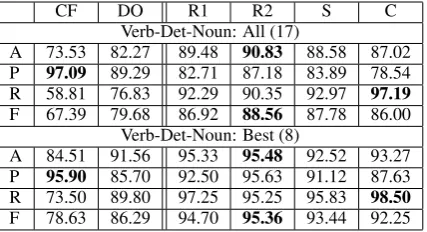
CF DO R1 R2 S C
Verb-Det-Noun: All (17)
A 73.53 82.27 89.48 90.83 88.58 87.02
P 97.09 89.29 82.71 87.18 83.89 78.54
R 58.81 76.83 92.29 90.35 92.97 97.19
F 67.39 79.68 86.92 88.56 87.78 86.00 Verb-Det-Noun: Best (8)
A 84.51 91.56 95.33 95.48 92.52 93.27
P 95.90 85.70 92.50 95.63 91.12 87.63
R 73.50 89.80 97.25 95.25 95.83 98.50
[image:7.595.310.524.62.178.2]F 78.63 86.29 94.70 95.36 93.44 92.25
Table 1: Development set: Average performance over all MWEs and best 8. Supervised classifiers outperform base-lines.A: Accuracy;P: Positive Precision;R: Positive Recall;
F: F-Score.
cepts a sentence use if and only if the number of words between the leftmost and rightmost MWE components is less than or equal to 2 (not count-ing the middle MWE component), and if the order matches the canonical form order.
5 Results
The baseline methods (CF and DO) and the super-vised methods (R1,R2,S,C) were run on the devel-opment and training/test sets. For the supervised methods, for each MWE we used 10-fold cross-validation7.
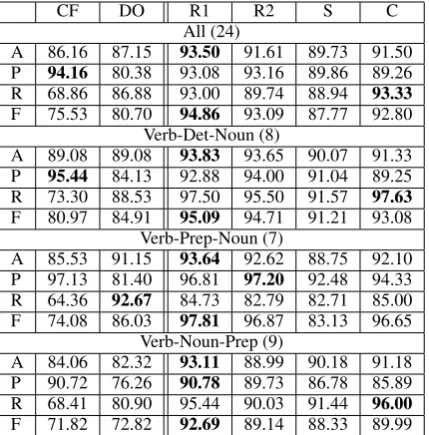
Tables 1 and 2 summarize the results for the velopment and test sets, respectively. For the de-velopment set, average results over all 17 MWEs and over the best 8 MWEs (on R1), a group size comparable to the test set, are shown. For the test set, results over all 24 MWEs and the three MWE types tested are shown.
The tables show average overall accuracy and average precision, recall and F-score on posi-tive instances, where the averages are taken over the results of the individual MWEs (i.e., micro-averaged).
Baselines. Baseline accuracy, (for DO)82.27%
on the development set and87.2%on the test set (over all groups), is probably insufficient for many NLP applications.
The baselines perform similarly in terms of av-erage accuracy. CF does this with very high preci-sion and low recall, while for DO recall improves at the expense of precision. Looking at individ-ual MWEs reveals that for expressions which al-low more variation in terms of intervening words
CF DO R1 R2 S C All (24)
A 86.16 87.15 93.50 91.61 89.73 91.50
P 94.16 80.38 93.08 93.16 89.86 89.26
R 68.86 86.88 93.00 89.74 88.94 93.33
F 75.53 80.70 94.86 93.09 87.77 92.80 Verb-Det-Noun (8)
A 89.08 89.08 93.83 93.65 90.07 91.33
P 95.44 84.13 92.88 94.00 91.04 89.25
R 73.30 88.53 97.50 95.50 91.57 97.63
F 80.97 84.91 95.09 94.71 91.21 93.08 Verb-Prep-Noun (7)
A 85.53 91.15 93.64 92.62 88.75 92.10 P 97.13 81.40 96.81 97.20 92.48 94.33 R 64.36 92.67 84.73 82.79 82.71 85.00 F 74.08 86.03 97.81 96.87 83.13 96.65
Verb-Noun-Prep (9)
A 84.06 82.32 93.11 88.99 90.18 91.18 P 90.72 76.26 90.78 89.73 86.78 85.89 R 68.41 80.90 95.44 90.03 91.44 96.00
[image:8.595.74.289.62.280.2]F 71.82 72.82 92.69 89.14 88.33 89.99
Table 2:Test set: Average performance over all MWEs and by group. The best supervised classifier outperforms base-lines in all groups.A: Accuracy;P: Precision;R: Recall;F: F-Score.
and lexical change, DO outperforms CF. To name a few, make an impression, raise the alarm, take a chanceandmake allowances for. For example, fortake a chanceintervening words are quite com-mon, as in: ‘I’m taking a real chance on you.’, or a change in determiner as in: ‘I preferred to take my chances’. Indeed, CF showed poor precision only for MWEs with a common literal usage. Two such MWEs were present in the development set (break the iceandtie the knot) and two in the test set (wash hands ofandkeep hands off).
Baselines versus supervised classifiers. As shown in the tables, R1 outperforms the best base-line in terms of accuracy in both test and devel-opment. Moreover, the supervised classifiers are more stable in their accuracy. For the develop-ment set the standard deviation of accuracy scores averages22.58 for CF and DO, and6.68 for R1, R2, S, and C. For the test set the baselines av-erage 9.07 (Verb-Det-Noun), 11.11 (Verb-Prep-Noun) and 14.26 (Verb-Noun-Prep), and the su-pervised methods average4.97 (Verb-Det-Noun),
7.66 (Verb-Prep-Noun) and 7.97. This stability means that the supervised classifiers are able to perform well on MWEs with different behavior. For example, R1 is able to perform well on ex-pressions where order is strict, as DO does (e.g.,
make a face), while also performing well on those where order varies (e.g.,make a distinction).
Supervised classifiers. R1 and R2, based on surface features, show similar accuracy values, with R1 doing somewhat better in the Verb-Prep-Noun and Verb-Verb-Prep-Noun-Prep groups. This is due to the Lexical Values feature, which accounts for a change in preposition. A change in preposi-tion (as in ‘wash hands of some matter’ versus ‘wash handsinthe sink’) is more significant than a change in determiner in the Verb-Determiner-Noun group. This improves precision on negative instances, which are rejected more precisely based on the preposition value. Nevertheless, the rela-tively simple features in R2, essentially order and distance, perform quite well.
The F-score result for R1,94.86, is an improve-ment over the F-score result of the supervised clas-sifier used in (Sporleder and Li, 2009), 90.15. Although the sentence data is different (our data includes sentences with non-expression uses) the number of sentences used is similar.
S, based on syntactic features, performs worse than R1/2. It shows better accuracy than the base-lines in all but the (Verb-Prep-Noun) group and is also more stable. C, a combination of surface and syntactic features, performs better than S and slightly worse than R1/2.
Why do the syntactic features perform worse than surface features? An analysis of the S clas-sifier errors reveals two important causes. First, there is substantial variation in the dependency tree structures of the non-compositional uses of the expressions as output by the parser. Thus, the syntactic feature classifier was more difficult to learn than the surface feature one, requiring a larger training set. This is not surprising, given that many MWEs exhibit an irregular syntactic be-havior that might even seem strange at times. For example, in the sentence fragment “and then he came to.”, ‘came to’ is an MWE. A parser might find it difficult to parse the sentence correctly, ex-pecting a noun phrase to follow the ‘to’.
6 Discussion
This study has addressed MWE identification: de-ciding if a potential use of an expression is a non-compositional one. Despite its importance in ba-sic NLP tasks, the problem has been largely over-looked in NLP research, probably due to it pre-sumed simplicity. However, as we have shown, simple methods for MWE identification, such as our baselines, do not perform consistently well across MWEs. This study serves to highlight this point and the need for more sophisticated methods for MWE identification.
We have shown that using a supervised learning method employing surface sentence features based on canonical form, it is possible to improve perfor-mance significantly. Unlike previous research, our method is not tailored to specific MWE types, and we did not ignore non-expression uses in our ex-periments.
Future research should experiment with non-verbal MWEs, since our features are not spe-cific to verbal MWE types. Another direction is a more sophisticated corpus sampling algorithm. The current work ignored MWEs which had an un-balanced training set (usually too few positives). Methods for gathering enough positive instances of such MWEs will be useful for testing the meth-ods proposed here, as well as for general MWE research.
References
I˜nki Alegria, Olatz Ansa, Xabier Artola, Nerea Ezeiza, Koldo Gojenola and Ruben Urizar. 2004. Repre-sentation and treatment of multiword expressions in Basque. ACL ’04 Workshop on Multiword Expres-sions.
The British National Corpus. 2001. The British National Corpus, version 2 (BNC World). Dis-tributed by Oxford University Computing Ser-vices on behalf of the BNC Consortium. URL: http://www.natcorp.ox.ac.uk/
Elisabeth Breidt, Frederique Segond, and Giuseppen Valetto. 1996. Local grammars for the description of multi-word lexemes and their automatic recogni-tion in texts. COMPLEX ’96. Budapest.
Paul Cook, Afsaneh Fazly, and Suzanne Stevenson. 2007. Pulling their weight: Exploiting syntactic forms for the automatic identification of idiomatic expressions in context. ACL ’07 Workshop on A Broader Perspective on Multiword Expressions.
Collins COBUILD. 2003. Collins COBUILD Ad-vanced Learner’s English Dictionary. Harper-Collins Publishers, 4th edition.
Paul Deane. 2005. A nonparametric method for ex-traction of candidate phrasal terms. ACL ’05.
Gael Dias. 2003. Multiword unit hybrid extrac-tion. ACL ’03 Workshop on Multiword Expressions: Analysis, Acquisition and Treatment.
Afsaneh Fazly and Suzanne Stevenson. 2006. Auto-matically constructing a lexicon of verb phrase id-iomatic combinations.EACL ’06.
Christiane Fellbaum, Alexander Geyken, Axel Herold, Fabian Koerner, and Gerald Neumann. 2006. Corpus-based studies of German idioms and light verbs. International Journal of Lexicography, 19(4):349–361.
Christiane Fellbaum. 1998. Towards a representation of idioms in WordNet. COLING-ACL ’98 Workshop on the Use of WordNet in Natural Language Pro-cessing Systems.
Nicole Gr´egoire. 2007. Design and implementation of a lexicon of Dutch multiword expressions. ACL ’07 Workshop on A Broader Perspective on Multiword Expressions.
Chikara Hashimoto, Satoshi Sato, and Takehito Utsuro. 2006. Japanese idiom recognition: Drawing a line between literal and idiomatic meanings. COLING-ACL ’06, Poster Sessions.
John S. Justeson and Slava M. Katz. 1995. Technical terminology: some linguistic properties and an al-gorithm for identification in text. Natural Language Engineering, 1:9–27.
Graham Katz and Eugenie Giesbrecht. 2006. Au-tomatic identification of non-compositional multi-word expressions using latent semantic analysis.
COLING-ACL ’06 Workshop on Multiword Expres-sions: Identifying and Exploiting Underlying Prop-erties..
Geoffrey Leech, Roger Garside and Michael Bryant. 1994. CLAWS4: The tagging of the British Na-tional Corpus.COLING ’94.
Marie-Catherine de Marneffe, Bill MacCartney and Christopher D. Manning. 2006. Generating typed dependency parses from phrase structure parses.
LREC ’06.
Rosamund Moon. 1998. Fixed Expressions and Id-ioms in English. Oxford: Clarendon Press.
Susanne Z. Riehemann. 2001. A Constructional Ap-proach to Idioms and Word Formation. Ph.D. Thesis. Stanford.
Caroline Sporleder and Linlin Li. 2009. Unsupervised recognition of literal and non-literal use of idiomatic expressions. EACL ’09.
Aline Villavicencio, Ann Copestake, Benjamin Wal-dron, and Fabre Lambeau. 2004. Lexical encoding of MWE. ACL ’04 Workshop on Multiword Expres-sions.
Joachim Wermter and Udo Hahn. 2004. Collocation extraction based on modifiability statistics. COL-ING ’04.