Proceedings of the 2nd Workshop on Deep Learning Approaches for Low-Resource NLP (DeepLo), pages 153–162 153
Evaluating Lottery Tickets Under Distributional Shifts
Shrey Desai∗,1,Hongyuan Zhan2, andAhmed Aly2
1The University of Texas at Austin 2Facebook Assistant
{hyzhan, ahhegazy}@fb.com
Abstract
The Lottery Ticket Hypothesis (Frankle and Carbin, 2019) suggests large, over-parameterized neural networks consist of small, sparse subnetworks that can be trained in isolation to reach a similar (or better) test ac-curacy. However, the initialization and gener-alizability of the obtained sparse subnetworks have been recently called into question. Our work focuses on evaluating the initialization of sparse subnetworks under distributional shifts. Specifically, we investigate the extent to which a sparse subnetwork obtained in a source do-main can be re-trained in isolation in a dis-similar, target domain. In addition, we exam-ine the effects of different initialization strate-gies at transfer-time. Our experiments show that sparse subnetworks obtained through lot-tery ticket training do not simply overfit to par-ticular domains, but rather reflect an inductive bias of deep neural networks that can be ex-ploited in multiple domains.
1 Introduction
Recent research has suggested deep neural net-works are dramatically over-parametrized. In nat-ural language processing alone, most state-of-the-art neural networks have computational and mem-ory complexities that scale with the size of the vocabulary. Practitioners have developed numer-ous methods to reduce the complexity of these models—either before, during, or after training— while retaining existing performance. Some of these methods include quantization (Gong et al.,
2014;Hubara et al.,2017), and different flavors of pruning (Zhu and Gupta,2017;Liu et al.,2018b;
Frankle and Carbin,2019;Gale et al.,2019). In particular, the Lottery Ticket Hypothesis (Frankle and Carbin, 2019) proposes that small, sparse subnetworks are embedded within large,
∗
Work done during an internship at Facebook.
over-parametrized neural networks. When trained in isolation, these subnetworks can achieve com-mensurate performance using the same initializa-tion as the original model. The lottery ticket train-ing procedure is formalized as an iterative three-stage approach: (1) train an over-parametrized model with initial parameters θ0; (2) prune the trained model by applying a maskm ∈ {0,1}|θ| identified by a sparsification algorithm; (3) reini-tialize the sparse subnetwork by resetting its non-zero weights to the initial values (mθ0) and re-train it. These three stages are repeated for multi-ple rounds. If the final subnetwork achieves sim-ilar (or better) test performance in comparison to the original network, a winning lottery ticket has been identified.
Evidence of the existence of winning tickets has been empirically shown on a range of tasks, including computer vision, reinforcement learn-ing, and natural language processing (Frankle and Carbin, 2019; Yu et al., 2019). However, the merits of lottery ticket training has recently been called into question. In particular, (1) whether keeping the same initialization (e.g.,θ0) is crucial for acquiring tickets (Liu et al., 2018b); and (2) if tickets can generalize across multiple datasets (Morcos et al.,2019).
Our paper investigates the efficacy of lottery tickets when the data distribution changes. We define multiple data domains such that their in-put distributions are varied. Then, we consider whether subnetworks obtained in a source domain Ds can be used to specify and train subnetworks
in a target domainDt wheres 6= t. Inspired by
dis-tributions, showing some generalization potential when distributional shifts occur. In addition, we discover a phase transition point, at which sub-networks reset to their initial values show better and more stable generalization performance when transferred to an arbitrary target domain.
In summary, our contributions are (1) contin-uing the line of work on the Lottery Ticket Hy-pothesis (Frankle and Carbin,2019), showing that tickets exist in noisy textual domains; (2) perform-ing comprehensive experiments pointperform-ing towards the transferability of lottery tickets under distribu-tional shifts in natural language processing; and (3) publicly releasing our code and datasets to pro-mote further discussion on these topics1.
2 Related Work
There is a large body of work on transfer learning for neural networks (Deng et al., 2013;Yosinski et al., 2014; Liu et al., 2017; Zoph et al., 2018;
Kornblith et al., 2019). Most of these works fo-cus on improving the transferred representation across tasks and datasets. The representation from a source dataset is fine-tuned or learned collabo-rately on a target dataset. In contrast, we focus on understanding whether thearchitecturecan be transferred and retrained, and whether transferring the initialization is required. Our work is also re-lated to Neural Architecture Search (NAS) (Zoph et al.,2018;Liu et al.,2018a;Elsken et al.,2018). The goal of NAS is to identify well-performing neural networks automatically. Network pruning can be viewed as a form of NAS, where the search space is the sparse topologies within the origi-nal over-parameterized network (Liu et al.,2018b;
Gale et al.,2019;Frankle and Carbin,2019). Iterative magnitude pruning (Frankle and Carbin, 2019; Frankle et al., 2019) is a recently proposed method for finding small, sparse subworks from large, over-parameterized neural net-works that can be trained in isolation to reach a similar (or better) test accuracy. To obtain these re-trainable sparse subnetworks,Frankle and Carbin (2019) uses an iterative pipeline that in-volves training a model, removing “redundant” network connections identified by a sparsification algorithm, training the subnetwork with the re-maining connections. In particular, the experi-ments in Frankle and Carbin (2019) show it is critical to re-initialize the subnetworks using the
1https://github.com/facebookresearch/pytext
sameinitial values after each round of the iterative pipeline.
However, the importance of re-using the orig-inal initialization is questioned in Liu et al.
(2018b), where the authors show that competi-tive performance of the sparse subnetworks can be achieved with random initialization as well.
Morcos et al. (2019) investigate the transferabil-ity of lottery tickets across multiple optimizers and datasets for supervised image classification, showing that tickets can indeed generalize ( Mor-cos et al.,2019). Beyond the differences between our domain, task, and datasets, our work carries an important distinction. InMorcos et al. (2019), the authors refer to thetransfer of initializationas both thetransfer of the sparse topologiesand the transfer of the initial values of the subnetworks. Therefore, it is unclear whether the sparse topol-ogyalone can be transferred across datasets or the topology combined with the initial values must be exploited jointly to achieve transferability. In our work, we decouple this question by investigating the influence of different initialization strategies on the sparse architecture during the process of finding the winning tickets and after the transfer to other domains.
3 Task and Datasets
Distributional Shifts Let(xsi, yis)∈ X × Y de-note a pair of training samples from domain Ds. Let f(x;θ) be a function (e.g., deep neural net-work) that maps an input fromXto the label space Y, parameterized by θ. In this work, the spar-sity of θ is induced by the lottery ticket training process (Frankle and Carbin, 2019). To model distributional shifts, we characterize each domain Dias a dataset from the Amazon Reviews corpus (McAuley and Leskovec, 2013). The differences in unigram frequencies, semantic content, and ran-dom noise mimic the type of distributional shifts that occur in machine learning.
Subword Vocabulary We ensure each domain
vo-Figure 1: Jenson-Shannon Divergence scores on sub-word unigram distributions for each domain pair
(Di,Di0). Domains include Books (B), Electronics (E), Movies (M), CDs (C), and Home (H). Values are scaled by1e5for presentation.
cabulary, balancing the out-of-vocabulary and ef-fectiveness problems introduced by the word- and character-level vocabularies, respectively. Techni-cal details for creating the shared subword vocab-ulary are presented in§4.1.
Divergence Scores Given an identical support
for all data distributions, we now quantify the distributional shifts between our domains using Jenson-Shannon Divergence (JSD). JSD is a sym-metric measure of similarity between two (con-tinuous) probability distributions p andq with a proxy, averaged distributionm= 12(p+q):
JSD(p||q) = 1
2KL(p||m) + 1
2KL(q||m) (1)
where KL(p||q) in Eq. 1 denotes the Kullback-Leibler divergence, defined as:
KL(p||q) =
Z ∞
−∞
p(x) logp(x)
q(x)dx (2)
Figure 1 displays the divergence scores be-tween our datasets. On average, there is high disagreement with respect to the preva-lence and usage of subwords in each domain, with Electronics→Home the most similar and CDs→Home the most dissimilar.
Sentiment Analysis Finally, we introduce our
base task for experimentation. Our models are evaluated on a binary sentiment analysis task con-structed from five categories in the Amazon Re-views corpus: books (B), electronics (E), movies (M), CDs (C), and home (H). The dataset orig-inally provides fine-grained sentiment labels (1
through5) so we group 1,2 as negative and4, 5 as positive. FollowingPeng et al.(2018), reviews with neutral ratings (3) are discarded. We sample 20K train, 10K validation, and 10K test samples from each category, ensuring there is an equal dis-tribution of positive and negative reviews.
4 Methods
In this section, we discuss our technical meth-ods. First, we describe the subword vocabulary creation process (§4.1). Second, we cover the un-derlying model used in the sentiment analysis task (§4.2). Third, we detail the lottery ticket training and transferring methods (§4.3).
4.1 Vocabulary
We use the SentencePiece2library to create a joint subword vocabulary for our datasets (Kudo and Richardson,2018). The subword model is trained on the concatenation of all five training datasets (100K sentences) using the byte-pair encoding al-gorithm (Sennrich et al.,2016). We set the vocab-ulary size to 8K. The final character coverage is 0.9995, ensuring minimal out-of-vocabulary prob-lems during domain transfer.
4.2 Model
We use convolutional networks (CNN) as the un-derlying model given their strong performance on numerous text classification tasks (Kim,2014;
Mou et al.,2016;Gehring et al.,2017). LetV and
nrepresent the vocabulary of the corpus and maxi-mum sequence length, respectively. Sentences are encoded as an integer sequence t1,· · ·, tnwhere ti ∈V. The embedding layer replaces each token ti with a vectorti ∈ Rd that serves as the
corre-spondingd-dimensional embedding. The vectors
t1,· · ·,tnare concatenated row-wise to form a
to-ken embedding matrixT∈Rn×d.
Our model ingests the embedding matrix T, then performs a series of convolutions to extract salient features from the input. We define a con-volutional filter W ∈ Rh×d where h represents
the height of the filter. The filter is not strided, padded, or dilated, LetT[i :j]∈Rh×drepresent
a sub-matrix ofTextracted from rowsithroughj, inclusive. The feature mapc∈Rn−h+1is induced by applying the filter to each possible window of
hwords, i.e.,
ci =f
T[i:i+h],Wfro+b
(3)
2
[image:3.595.85.280.61.206.2]for 1 ≤ i ≤ n−h+ 1, whereb ∈ R is a bias term, f is a non-linear function, and the Frobe-nius inner product is denoted by hA,Bifro =
Ph
i=1
Pd
j=1AijBij. 1-max pooling (Collobert
et al., 2011) is applied on c, defined as cˆ = max{c}. This is performed to propagate the max-imum signal throughout the network and reduce the dimensionality of the input.
The process described above createsonefeature fromoneconvolution with windowhfollowed by a pooling operation. To extract multiple features, the model uses several convolutions with varying
h to obtain features from different sizedn-grams in the sequence. The convolutional (and pooled) outputs are concatenated along the channel dimen-sion, then fed into a one-layer MLP to obtain a distribution over thecclasses.
4.3 Lottery Tickets
4.3.1 Initialization
The embedding matrix is initialized from a unit Gaussian, T ∼ N(0,1). The convolutional and MLP layers use He initialization (He et al.,2015), whose bound is defined as
b=
s
6
(1 +a2)×fan in (4)
whereaandfan inare parameters calculated for each weight. The resulting weights have values uniformly sampled fromU(−b, b).
4.3.2 Training
We use iterative pruning with alternating cycles of training and pruning to obtain the tickets (Han et al.,2015;Frankle and Carbin,2019). For clar-ity, we define a round as training a network for a fixed number of epochs. We begin with a seed round r0 where the model does not undergo any pruning, then begin to procure tickets in a series of lottery ticket training rounds.
In each successive round ri>0, a fraction p of the weights that survived round ri−1 are pruned (according to a sparsification algorithm, discussed below) to obtain a smaller, sparser subnetwork; this is denoted byf(x;miθi)wheremiandθi
represent the sparse mask and weights at roundri.
[image:4.595.354.478.63.174.2]The weightsθi of this subnetwork are set accord-ing to aninitialization strategyand the subnetwork is re-trained to convergence. We refer to the spar-sityas the fraction of weights in the network that are exactly zero. In each round, we prune p%of
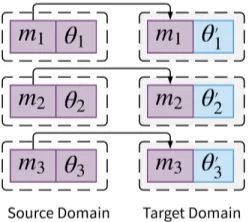
Figure 2: Visualization of the subnetwork transfer pro-cess. Purple denotes elements from the source domain, while blue denotes elements from the target domain. Tickets are composed of two elements: (1) the sparsi-fied mask (mi) and (2) the initial parameter values (θi). During transfer, we create subnetworks in the source domain with the mask borrowed from the source do-main, but with potentially different parameters. We use
θ0ito denote that these parameters are set according to someinitialization strategy, which we discuss further in our experiments (§5).
the weights in the model. Therefore, the resulting ticket has sparsity1−(1−p%)rtotal, wherertotalis the total number of lottery ticket training rounds.
Next, we discuss the sparsification algorithm used to prune weights in each round ri. Let pi
denote the vectorized collection of trainable pa-rameters in layeri≥0, with the embedding layer as layer0. After re-training the (sub-)networks in each round, we apply the`0 projection on the pa-rameters in each layer, i.e.
argmin
p
||p−pi||22 (5)
subject tocard(p) ≤ ki, wherecard(p)denotes the number of non-zeros inp. The optimization problem in Eq. 5 can be solved analytically by sorting the elements ofpiwith respect to their ab-solute values and picking the topkielements with
the largest magnitude (Jain et al., 2017;Zhu and Gupta,2017). We use the sparsity hyperparameter
pintroduced above to decidekifor each layer. Let
len(pi) denote the total number of trainable
pa-rameters in layeri. We setki=p%×len(pi)for each layer. In accordance with our training pro-cedure, once a weight is pruned, it is no longer a trainable parameter; hence, len(pi) is strictly de-creasing after each round.
4.3.3 Transferring
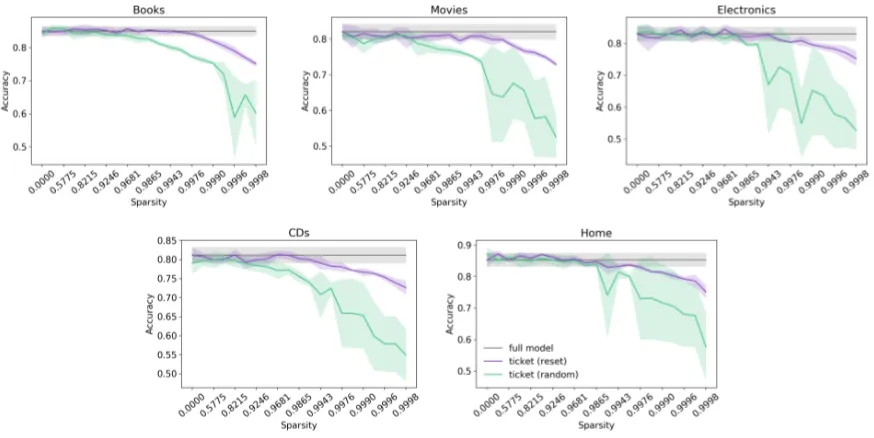
Figure 3: Results obtaining lottery tickets on the Books, Movies, Electronics, CDs, and Home categories of the Amazon Reviews dataset (McAuley and Leskovec,2013). Experiments are repeated five times, where the solid lines represent the mean and shaded regions represent the standard deviation. Note that thex-axis ticks arenot uniformly spaced.
θ),· · ·, f(xs;mnθ)wherexsrepresents the in-puts from asource domainDs andmi represents
the sparse mask used to prune weights at round
ri. During transfer, we construct a new batch of subnetworksf(xt;m1 θ0),· · ·, f(xt;mnθ0)
to be evaluated on inputs from a (non-identical) target domain Dt with masks derived from the
sourcedomain. The change in parameter notation (θ→θ0) implies that the subnetworks evaluated in a disparate domain can potentially use a different transferinitialization strategy. We clarify this pro-cess in Figure2. In contrast,Morcos et al.(2019) transfers the entire ticket (sparse masks and ini-tial values) to the target domain. Finally, using the new batch of subnetworks, we evaluate each sub-network f(xt;mi θ0) in the target domain for
rtotal rounds. Unlike the canonical ticket training
rounds, we do not (additionally) sparsify the sub-networks during transfer. All in all, our transfer task is designed to answer the following question: can thesparse masksfound in a source domain us-ing lottery ticket trainus-ing (§4.3) be transferred to a target domain with different initialization strate-giesto match the performance of a ticket obtained in same target domain?
5 Experiments
5.1 Settings
Our CNN uses three filters (h ∈ [3,4,5]), each with127channels, and ReLU activation (Nair and Hinton, 2010). We fix the maximum sequence length to500subwords. The embeddings are417 -dimensional and trained alongside the model. We opt not to use pre-trained embeddings to ensure the generalizability of our results. Additionally, we regularize the embeddings with dropout ( Sri-vastava et al., 2014), p = 0.285. The MLP con-tains one hidden layer with a dimension of 117. Hyperparameters were discovered using Bayesian hyperparameter optimization (Snoek et al.,2012) on the Books validation set. The models are trained with a batch size of32for a maximum of 15 epochs. Early stopping is used to save itera-tive model versions that perform well on a devel-opment set. We use the Adam optimizer (Kingma and Ba,2014) with a learning rate of1e−3and`2 regularization with a weight of1e−5.
5.2 Obtaining Tickets
First, we use the lottery ticket training procedure outlined in §4.3.2 to obtain tickets for our five datasets withp= 35%andrtotal = 20. We
Figure 4: Results transferring lottery tickets on nine transfer tasks constructed from the five categories of the Amazon Reviews dataset (McAuley and Leskovec,2013). Experiments are repeated five times, where the solid lines represent the mean and shaded regions represent the standard deviation. Note that thex-axis ticks arenot uniformly spaced.
• FULL-MODEL: This baseline evaluates the
performance of the original networkwithout any pruning. In other words, we train a model for a seed round r0, then record its perfor-mance.
• TICKET-RESET: The values of the
subnet-work are reset to theiroriginal valuesbefore training. This initialization strategy was used in the earliest formation of the Lottery Ticket Hypothesis (Frankle and Carbin,2019).
• TICKET-RANDOM: The values of the
subnet-work are reset torandom valuesdrawn from the initialization distribution(s) of the origi-nal network. We sample weights from the distributions outlined in §4.3.1 to initialize the subnetworks.
The results are shown in Figure 3. For all datasets, TICKET-RESET shows the best per-formance, notably outperforming FULL-MODEL
in early stages of sparsification (0-90%) for the Books, Electronics, and Home datasets. This demonstrates that deep neural networks— especially those for sentiment analysis—are highly over-parameterized, and the sparsity duced by lottery ticket training can help to in-crease performance. This observation is consis-tent withLouizos et al.(2018), which also showed sparse networks fashion a regularization effect that results in better generalization performance. In addition, we observe that TICKET-RESET and TICKET-RANDOM have similar test performance until about 96% sparsity. This casts some doubt around whether the initial values truly matter for sparse models as the randomly sampled values seem to fit sparse masks well.
-RANDOM becomes highly unstable and drops off much faster than TICKET-RESET after 96% sparsity. In contrast, TICKET-RESET remains relatively stable—even with sparsity levels over 99.9%—pointing towards the enigmatic impor-tance of original values in extreme levels of spar-sity.
5.3 Transferring Tickets
Next, we use the lottery ticket transferring proce-dure outlined in §4.3 to transfer (obtained) sub-networks from asourcedomain to a non-identical target domain. Identical to the previous experi-ment, we use rtotal = 20. We compare the test
performance of thetransferredsubnetworks using the following baselines:
• TICKET-TARGET: This baseline is com-prised of the subnetworks obtained in the tar-get domain using lottery ticket training. We borrow the values for this baseline (without modification) from the TICKET-RESET
sub-networks shown in Figure3, albeit from the domain of interest.
• MASKS-RESET: Under this initialization strategy, the masks obtained in the source do-main is used on the target dodo-main and the subnetwork is trained from the same initial values as in the source domain.
• MASKS-RANDOM: Under this initialization strategy, only the masks are used from the subnetwork obtained in the source domain. The parameters are randomly initialized from the distributions outlined in §4.3.1 before training on the target domain.
The results are shown in Figure 4. Both MASKS-RESET and MASKS-RANDOM show signs of generalization in the early stages of spar-sification. Most notably, subnetworks obtained in the CDs domain are extremely robust; both the MASKS-RESET and MASKS-RANDOM re-sults show stronger performance than TICKET
-TARGET, even in sparsity levels over 99%. This is relatively surprising as the FULL-MODEL in §5.2 achieved the worst performance in the CDs domain. Further inspection of representations learned in this domain will be required to under-stand its strong ticket performance, which may or may not be a coincidence.
We see a 3-5% dropoff in performance (up to 90% sparsity) from tickets identified from the
Books and Electronics tasks after transferring. These results together imply that tickets are not completely immune to distributional shifts, al-though the degradation in test accuracy is not sub-stantial until reaching high sparsity. Nevertheless, we notice the accuracies of MASKS-RESET and MASKS-RANDOM stay relatively stable from
0-90% sparsity; they only begin to steadily decline after this point.
Finally, we compare the performance of MASKS-RESET and MASKS-RANDOM. In the Books tasks, MASKS-RANDOM performs better overall in comparison to MASKS-RESET. Its per-formance is slightly worse in the Electronics and CDs tasks, although it is relatively comparable to MASKS-RESETup to 96%. Similar to the results in§5.2, we notice aphase transitionpoint where the initial values (e.g., MASKS-RESET) play a much bigger role in maintaining stability and per-formance in the deeper stages of sparsification.
6 Discussion
In this section, we briefly recap our findings, high-lighting key points observed through our ticket procuring and transfer experiments. For each sec-tion, we also touch on areas for future work.
Evidence of transferability of winning tickets in
natural language processing. Our experiments
show that “winning tickets” can indeed be iden-tified in a sentiment task formulated from noisy, user-generated datasets. Moreover, the “winning tickets”, up to extreme level of sparsity (e.g., 90%), can be transferred across domains without much loss in accuracy. The fact that tickets can be obtained in noisy environments shows its promi-nence across multiple data sources. However, our work only considers a binary sentiment analysis task. Future work can explore other tasks such as multi-class text classification, language modeling, and machine translation.
Randomly initialized tickets are strong
base-lines. Consistent with the observations in Liu
randomly initialized subnetworks are still able to settle in a local minima with comparable perfor-mance to that of the originally initialized subnet-works. However, our work fixes the optimizer and learning rate across experiments. It may be pos-sible that randomly initialized subnetworks using varying optimization reach better minima.
A phase transition point largely influences
ticket performance. As alluded to above, there
is almost no difference in performance when con-sidering originally and randomly initialized sub-networks. However, our experiments point to-wards a crucial turning point—the phase transi-tion—in which the initialization begins to mat-ter. In particular, especially in extreme levels of sparsity (e.g., 99.99%) originally initialized net-works exhibit less variance than randomly initial-ized tickets in test accuracy. However, the specific sparsity at which the phase transition happens is dataset-dependent. Understanding why this occurs and its relation with other models, datasets, and optimization algorithms can further unveil and ex-plain the phenomena behind lottery tickets.
7 Applications in Federated Learning
Federated learning is a scenario where a central-ized model is trained over decentralcentral-ized data, dis-tributed across millions (if not billions) of clients (e.g., electronic devices) (Konen et al., 2016;
Bonawitz et al.,2019). Crucially, the clients are not allowed to exchange data with the central server or each other. Instead, each client can fine-tune a model for a couple of iterations on their own data, then send their (encrypted) parameters or gradients to a server for aggregation. This “col-laborative learning” setup effectively maintains a level of user privacy by ensuring the data always stays on-device. However, this poses several chal-lenges for optimization; as the centralized server does not have access to the data distribution of each client, any neural architecture selection has to be done on either (a) a different data source the server has access to or (b) on each individ-ual client. Since (b) is generally quite expensive, the server usually maintains some seed data, as al-luded to in (a).
With the transferability of lottery tickets, the server can procure lottery tickets on server-accessible data, then retrain the tickets on client data under the federated learning framework. While there may be a large performance drop
when transferringextremelysparse networks, our results show that clients can still re-train moder-atelysparse networks with commensurate perfor-mance. We believe that this “sparsify and transfer” procedure has two immediate benefits: (1) past work—including the original incarnation of the lottery ticket hypothesis—has shown that sparse networks can be, under certain conditions, easier to optimize (Frankle and Carbin, 2019; Morcos et al.,2019;Gale et al.,2019); and (2) sparser sub-networks have significantly less capacity than their large, over-parameterized counterparts, which can alleviate client-server communication costs (e.g., model uploading and downloading) (Konen et al.,
2016;Sattler et al.,2019).
8 Conclusion
The Lottery Ticket Hypothesis (Frankle and Carbin, 2019) posits that large, over-parameterized networks contain small, sparse subnetworks that can be re-trained in isolation with commensurate test performance. In this paper, we examine whether these tickets are robust against distributional shifts. In particular, we set up domain transfer tasks with the Amazon Reviews dataset (McAuley and Leskovec, 2013) to obtain tickets in a sourcedomain and transfer them in a disparatetarget domain. Moreover, we experiment with the transfer initialization of the networks, determining if resetting to initial values (obtained in the source domain) are required for strong performance in the target domain. Our experiments show that tickets (under several initialization strategies) can be transferred across different text domains without much loss up to a very high level of sparsity.
Acknowledgments
Thanks to Veselin Stoyanov and our anonymous reviewers for their helpful comments.
References
Keith Bonawitz, Hubert Eichner, Wolfgang Grieskamp, Dzmitry Huba, Alex Ingerman, Vladimir Ivanov, Chloe Kiddon, Jakub Konecny, Stefano Mazzocchi, H Brendan McMahan, et al. 2019. Towards feder-ated learning at scale: System design. arXiv preprint arXiv:1902.01046.
Ronan Collobert, Jason Weston, L´eon Bottou, Michael Karlen, Koray Kavukcuoglu, and Pavel Kuksa. 2011. Natural language processing (almost) from scratch. Journal of machine learning research, 12(Aug):2493–2537.
Jun Deng, Zixing Zhang, Erik Marchi, and Bj¨orn Schuller. 2013. Sparse autoencoder-based feature transfer learning for speech emotion recognition. In 2013 Humaine Association Conference on Affective Computing and Intelligent Interaction, pages 511– 516. IEEE.
Thomas Elsken, Jan Hendrik Metzen, and Frank Hut-ter. 2018. Neural architecture search: A survey. arXiv preprint arXiv:1808.05377.
Jonathan Frankle and Michael Carbin. 2019. The lot-tery ticket hypothesis: Finding sparse, trainable neu-ral networks. InInternational Conference on Learn-ing Representations.
Jonathan Frankle, Gintare Karolina Dziugaite, Daniel M Roy, and Michael Carbin. 2019. Stabi-lizing the lottery ticket hypothesis. arXiv preprint arXiv:1903.01611v2.
Trevor Gale, Erich Elsen, and Sara Hooker. 2019. The state of sparsity in deep neural networks. arXiv preprint arXiv:1902.09574.
Jonas Gehring, Michael Auli, David Grangier, Denis Yarats, and Yann N Dauphin. 2017. Convolutional sequence to sequence learning. In Proceedings of the 34th International Conference on Machine Learning-Volume 70, pages 1243–1252. JMLR. org.
Yunchao Gong, Liu Liu, Ming Yang, and Lubomir Bourdev. 2014. Compressing deep convolutional networks using vector quantization. arXiv preprint arXiv:1412.6115.
Song Han, Jeff Pool, John Tran, and William Dally. 2015. Learning both weights and connections for efficient neural network. InAdvances in neural in-formation processing systems, pages 1135–1143.
Kaiming He, Xiangyu Zhang, Shaoqing Ren, and Jian Sun. 2015. Delving deep into rectifiers: Surpass-ing human-level performance on imagenet classifi-cation. In Proceedings of the IEEE international conference on computer vision, pages 1026–1034.
Itay Hubara, Matthieu Courbariaux, Daniel Soudry, Ran El-Yaniv, and Yoshua Bengio. 2017. Quantized neural networks: Training neural networks with low precision weights and activations. The Journal of Machine Learning Research, 18(1):6869–6898.
Prateek Jain, Purushottam Kar, et al. 2017. Non-convex optimization for machine learning. Foun-dations and TrendsR in Machine Learning, 10(3-4):142–336.
Yoon Kim. 2014. Convolutional neural networks for sentence classification. InProceedings of the 2014 Conference on Empirical Methods in Natural Lan-guage Processing (EMNLP), pages 1746–1751.
Diederik P Kingma and Jimmy Ba. 2014. Adam: A method for stochastic optimization. arXiv preprint arXiv:1412.6980.
Jakub Konen, H. Brendan McMahan, Felix X. Yu, Pe-ter Richtarik, Ananda Theertha Suresh, and Dave Bacon. 2016. Federated learning: Strategies for im-proving communication efficiency. In NIPS Work-shop on Private Multi-Party Machine Learning.
Simon Kornblith, Jonathon Shlens, and Quoc V Le. 2019. Do better imagenet models transfer better? In Proceedings of the IEEE Conference on Computer Vision and Pattern Recognition, pages 2661–2671.
Taku Kudo and John Richardson. 2018. Sentencepiece: A simple and language independent subword tok-enizer and detoktok-enizer for neural text processing. arXiv preprint arXiv:1808.06226.
Hanxiao Liu, Karen Simonyan, and Yiming Yang. 2018a. Darts: Differentiable architecture search. arXiv preprint arXiv:1806.09055.
Jiaming Liu, Yali Wang, and Yu Qiao. 2017. Sparse deep transfer learning for convolutional neural net-work. InThirty-First AAAI Conference on Artificial Intelligence.
Zhuang Liu, Mingjie Sun, Tinghui Zhou, Gao Huang, and Trevor Darrell. 2018b. Rethinking the value of network pruning.arXiv preprint arXiv:1810.05270.
Christos Louizos, Max Welling, and Diederik P. Kingma. 2018. Learning sparse neural networks through l0 regularization. InInternational
Confer-ence on Learning Representations.
Julian McAuley and Jure Leskovec. 2013. Hidden fac-tors and hidden topics: understanding rating dimen-sions with review text. In Proceedings of the 7th ACM conference on Recommender systems, pages 165–172. ACM.
Ari S Morcos, Haonan Yu, Michela Paganini, and
Yuandong Tian. 2019. One ticket to win
Lili Mou, Zhao Meng, Rui Yan, Ge Li, Yan Xu, Lu Zhang, and Zhi Jin. 2016. How transferable are neural networks in nlp applications? In Proceed-ings of the 2016 Conference on Empirical Methods in Natural Language Processing, pages 479–489.
Vinod Nair and Geoffrey E Hinton. 2010. Rectified linear units improve restricted boltzmann machines. InProceedings of the 27th international conference on machine learning (ICML-10), pages 807–814.
Minlong Peng, Qi Zhang, Yu-gang Jiang, and Xuan-jing Huang. 2018. Cross-domain sentiment classi-fication with target domain specific information. In 56th Annual Meeting of the Association for Compu-tational Linguistics (Long Papers).
Felix Sattler, Simon Wiedemann, Klaus-Robert M¨uller, and Wojciech Samek. 2019. Robust and communication-efficient federated learning from non-iid data.arXiv preprint arXiv:1903.02891.
Rico Sennrich, Barry Haddow, and Alexandra Birch. 2016. Neural machine translation of rare words with subword units. InProceedings of the 54th An-nual Meeting of the Association for Computational Linguistics (Volume 1: Long Papers), pages 1715– 1725.
Jasper Snoek, Hugo Larochelle, and Ryan P Adams. 2012. Practical bayesian optimization of machine learning algorithms. InAdvances in neural informa-tion processing systems, pages 2951–2959.
Nitish Srivastava, Geoffrey Hinton, Alex Krizhevsky, Ilya Sutskever, and Ruslan Salakhutdinov. 2014. Dropout: a simple way to prevent neural networks from overfitting. The journal of machine learning research, 15(1):1929–1958.
Jason Yosinski, Jeff Clune, Yoshua Bengio, and Hod Lipson. 2014. How transferable are features in deep neural networks? InAdvances in neural information processing systems, pages 3320–3328.
Haonan Yu, Sergey Edunov, Yuandong Tian, and Ari S. Morcos. 2019. Playing the lottery with rewards and multiple languages: lottery tickets in RL and NLP. CoRR, abs/1906.02768.
Michael Zhu and Suyog Gupta. 2017. To prune, or not to prune: exploring the efficacy of pruning for model compression. arXiv preprint arXiv:1710.01878.