Proceedings of the 2019 Conference on Empirical Methods in Natural Language Processing 6382
EDA: Easy Data Augmentation Techniques for Boosting Performance on
Text Classification Tasks
Jason Wei1,2 Kai Zou3
1Protago Labs Research, Tysons Corner, Virginia, USA 2Department of Computer Science, Dartmouth College 3Department of Mathematics and Statistics, Georgetown University
[email protected] [email protected]
Abstract
We present EDA: easy data augmentation techniques for boosting performance on text classification tasks. EDA consists of four sim-ple but powerful operations: synonym replace-ment, random insertion, random swap, and random deletion. On five text classification tasks, we show that EDA improves perfor-mance for both convolutional and recurrent neural networks. EDA demonstrates particu-larly strong results for smaller datasets; on av-erage, across five datasets, training with EDA while using only 50% of the available train-ing set achieved the same accuracy as normal training with all available data. We also per-formed extensive ablation studies and suggest parameters for practical use.
1 Introduction
Text classification is a fundamental task in natu-ral language processing (NLP). Machine learning and deep learning have achieved high accuracy on tasks ranging from sentiment analysis (Tang et al.,
2015) to topic classification (Tong and Koller,
2002), but high performance often depends on the size and quality of training data, which is often te-dious to collect. Automatic data augmentation is commonly used in computer vision (Simard et al.,
1998; Szegedy et al., 2014; Krizhevsky et al.,
2017) and speech (Cui et al.,2015;Ko et al.,2015) and can help train more robust models, particu-larly when using smaller datasets. However, be-cause it is challenging to come up with generalized rules for language transformation, universal data augmentation techniques in NLP have not been thoroughly explored.
Previous work has proposed some techniques for data augmentation in NLP. One popular study generated new data by translating sentences into French and back into English (Yu et al., 2018). Other work has used data noising as smoothing
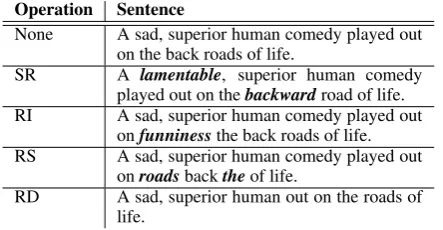
Operation Sentence
None A sad, superior human comedy played out on the back roads of life.
SR A lamentable, superior human comedy played out on thebackwardroad of life. RI A sad, superior human comedy played out
onfunninessthe back roads of life. RS A sad, superior human comedy played out
onroadsbacktheof life.
[image:1.595.306.528.222.337.2]RD A sad, superior human out on the roads of life.
Table 1: Sentences generated using EDA. SR: synonym replacement. RI: random insertion. RS: random swap. RD: random deletion.
(Xie et al.,2017) and predictive language models for synonym replacement (Kobayashi,2018). Al-though these techniques are valid, they are not of-ten used in practice because they have a high cost of implementation relative to performance gain.
In this paper, we present a simple set of univer-sal data augmentation techniques for NLP called EDA (easydataaugmentation). To the best of our knowledge, we are the first to comprehensively explore text editing techniques for data augmen-tation. We systematically evaluate EDA on five benchmark classification tasks, showing that EDA provides substantial improvements on all five tasks and is particularly helpful for smaller datasets. Code is publicly available athttp://github. com/jasonwei20/eda_nlp.
2 EDA
1. Synonym Replacement (SR): Randomly choosenwords from the sentence that are not stop words. Replace each of these words with one of its synonyms chosen at random.
2. Random Insertion (RI):Find a random syn-onym of a random word in the sentence that is not a stop word. Insert that synonym into a ran-dom position in the sentence. Do thisntimes.
3. Random Swap (RS): Randomly choose two words in the sentence and swap their positions. Do thisntimes.
4. Random Deletion (RD): Randomly remove each word in the sentence with probabilityp.
Since long sentences have more words than short ones, they can absorb more noise while maintain-ing their original class label. To compensate, we vary the number of words changed,n, for SR, RI, and RS based on the sentence lengthlwith the for-mulan=α l, whereαis a parameter that indicates the percent of the words in a sentence are changed (we usep=αfor RD). Furthermore, for each orig-inal sentence, we generate naug augmented sen-tences. Examples of augmented sentences are shown in Table1. We note that synonym replace-ment has been used previously (Kolomiyets et al.,
2011;Zhang et al.,2015;Wang and Yang,2015), but to our knowledge, random insertions, swaps, and deletions have not been extensively studied.
3 Experimental Setup
We choose five benchmark text classification tasks and two network architectures to evaluate EDA.
3.1 Benchmark Datasets
We conduct experiments on five benchmark text classification tasks: (1) SST-2: Stanford Senti-ment Treebank (Socher et al.,2013), (2)CR: cus-tomer reviews (Hu and Liu,2004;Liu et al.,2015), (3) SUBJ: subjectivity/objectivity dataset (Pang and Lee,2004), (4)TREC: question type dataset (Li and Roth,2002), and (5)PC: Pro-Con dataset (Ganapathibhotla and Liu,2008). Summary statis-tics are shown in Table5 in Supplemental Mate-rials. Furthermore, we hypothesize that EDA is more helpful for smaller datasets, so we delegate the following sized datasets by selecting a random subset of the full training set with Ntrain={500, 2,000,5,000, all available data}.
3.2 Text Classification Models
We run experiments for two popular models in text classification. (1) Recurrent neural networks (RNNs) are suitable for sequential data. We use a LSTM-RNN (Liu et al.,2016). (2)Convolutional neural networks (CNNs) have also achieved high performance for text classification. We implement them as described in (Kim, 2014). Details are in Section9.1in Supplementary Materials.
4 Results
In this section, we test EDA on five NLP tasks with CNNs and RNNs. For all experiments, we average results from five different random seeds.
4.1 EDA Makes Gains
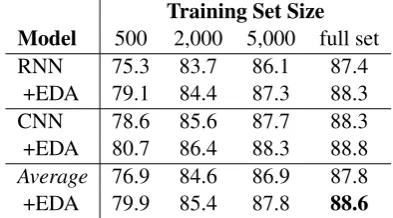
We run both CNN and RNN models with and without EDA across all five datasets for varying training set sizes. Average performances (%) are shown in Table 2. Of note, average improve-ment was 0.8% for full datasets and 3.0% for
Ntrain=500.
Training Set Size Model 500 2,000 5,000 full set
RNN 75.3 83.7 86.1 87.4
+EDA 79.1 84.4 87.3 88.3
CNN 78.6 85.6 87.7 88.3
+EDA 80.7 86.4 88.3 88.8
Average 76.9 84.6 86.9 87.8
[image:2.595.317.514.381.490.2]+EDA 79.9 85.4 87.8 88.6
Table 2: Average performances (%) across five text classification tasks for models with and without EDA on different training set sizes.
4.2 Training Set Sizing
(a)
0 20 40 60 80 100 0.4
0.6 0.8 1
Percent of Dataset (%)
Accurac
y
SST-2 (N=7,447)
Normal EDA
(b)
0 20 40 60 80 100 0.4
0.6 0.8 1
Percent of Dataset (%)
Accurac
y
CR (N=4,082)
Normal EDA
(c)
0 20 40 60 80 100 0.4
0.6 0.8 1
Percent of Dataset (%)
Accurac
y
SUBJ (N=9,000)
Normal EDA
(d)
0 20 40 60 80 100 0.4
0.6 0.8 1
Percent of Dataset (%)
Accurac
y
TREC (N=5,452)
Normal EDA
(e)
0 20 40 60 80 100 0.4
0.6 0.8 1
Percent of Dataset (%)
Accurac
y
PC (N=39,418)
Normal EDA
(f)
0 20 40 60 80 100 0.4
0.6 0.8 1
Percent of Dataset (%)
A
v
erage
Accurac
y
All Datasets
[image:3.595.76.523.63.313.2]Normal EDA
Figure 1: Performance on benchmark text classification tasks with and without EDA, for various dataset sizes used for training. For reference, the dotted grey line indicates best performances from Kim (2014) for SST-2, CR, SUBJ, and TREC, and Ganapathibhotla (2008) for PC.
average accuracy of 88.6% while only using 50% of the available training data.
4.3 Does EDA conserve true labels?
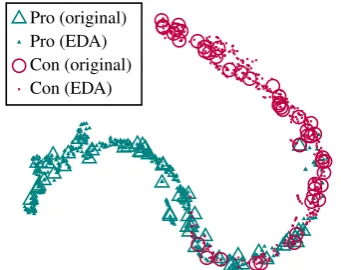
In data augmentation, input data is altered while class labels are maintained. If sentences are sig-nificantly changed, however, then original class labels may no longer be valid. We take a visu-alization approach to examine whether EDA oper-ations significantly change the meanings of aug-mented sentences. First, we train an RNN on the pro-con classification task (PC) without aug-mentation. Then, we apply EDA to the test set by generating nine augmented sentences per orig-inal sentence. These are fed into the RNN along with the original sentences, and we extract the out-puts from the last dense layer. We apply t-SNE (Van Der Maaten,2014) to these vectors and plot their 2-D representations (Figure 2). We found that the resulting latent space representations for augmented sentences closely surrounded those of the original sentences, which suggests that for the most part, sentences augmented with EDA con-served the labels of their original sentences.
4.4 Ablation Study: EDA Decomposed
So far, we have seen encouraging empirical re-sults. In this section, we perform an ablation study
Pro (original) Pro (EDA) Con (original) Con (EDA)
Figure 2: Latent space visualization of original and augmented sentences in the Pro-Con dataset. Aug-mented sentences (small triangles and circles) closely surround original sentences (big triangles and circles) of the same color, suggesting that augmented sentences maintianed their true class labels.
[image:3.595.332.503.384.519.2]oper-0 oper-0.1 0.2 0.3 0.4 0.5 −3
−2 −1 0 1 2 3
αparameter
Performance
Gain
(%) SR
0 0.1 0.2 0.3 0.4 0.5 −3
−2 −1 0 1 2 3
αparameter RI
0 0.1 0.2 0.3 0.4 0.5 −3
−2 −1 0 1 2 3
αparameter RS
0 0.1 0.2 0.3 0.4 0.5 −3
−2 −1 0 1 2 3
αparameter RD
N=500
N=2,000 N=5,000
[image:4.595.69.521.66.152.2]Full Data
Figure 3: Average performance gain of EDA operations over five text classification tasks for different training set sizes. Theαparameter roughly means “percent of words in sentence changed by each augmentation.” SR: synonym replacement. RI: random insertion. RS: random swap. RD: random deletion.
ation while varying the augmentation parameter
α={0.05,0.1,0.2,0.3,0.4,0.5}(Figure3). It turns out that all four EDA operations con-tribute to performance gain. For SR, improvement was good for small α, but high α hurt perfor-mance, likely because replacing too many words in a sentence changed the identity of the sentence. For RI, performance gains were more stable for different α values, possibly because the original words in the sentence and their relative order were maintained in this operation. RS yielded high per-formance gains at α≤0.2, but declined atα≥0.3 since performing too many swaps is equivalent to shuffling the entire order of the sentence. RD had the highest gains for lowα but severely hurt per-formance at high α, as sentences are likely un-intelligible if up to half the words are removed. Improvements were more substantial on smaller datasets for all operations, andα=0.1appeared to be a “sweet spot” across the board.
4.5 How much augmentation?
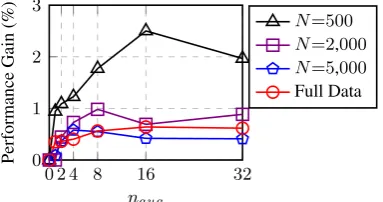
The natural next step is to determine how the num-ber of generated augmented sentences per original sentence, naug, affects performance. In Figure4, we show average performances over all datasets fornaug={1,2,4,8,16,32}. For smaller
train-0 2 4 8 16 32
0 1 2 3
naug
Performance
Gain
(%) N=500
N=2,000 N=5,000
Full Data
Figure 4: Average performance gain of EDA across five text classification tasks for various training set sizes. naug is the number of generated augmented sentences
per original sentence.
ing sets, overfitting was more likely, so generat-ing many augmented sentences yielded large per-formance boosts. For larger training sets, adding more than four augmented sentences per original sentence was unhelpful since models tend to gen-eralize properly when large quantities of real data are available. Based on these results, we recom-mend usage parameters in Table3.
Ntrain α naug
500 0.05 16
2,000 0.05 8
5,000 0.1 4
[image:4.595.366.466.346.413.2]More 0.1 4
Table 3: Recommended usage parameters.
5 Comparison with Related Work
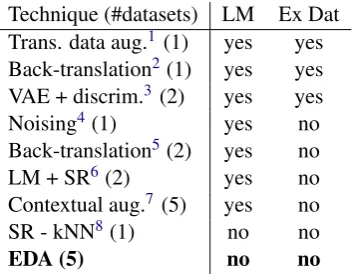
[image:4.595.88.280.608.709.2]EDA with previous literature. But there are two studies similar to ours that evaluate augmentation techniques on multiple datasets. Hu (2017) pro-posed a generative model that combines a varia-tional auto-encoder (VAE) and attribute discrim-inator to generate fake data, demonstrating a 3% gain in accuracy on two datasets. Kobayashi (2018) showed that replacing words with other words that were predicted from the sentence con-text using a bi-directional language model yielded a 0.5% gain on five datasets. However, training a variational auto-encoder or bidirectional LSTM language model is a lot of work. EDA yields re-sults on the same order of magnitude but is much easier to use because it does not require training a language model and does not use external datasets. In Table4, we show EDA’s ease of use compared with other techniques.
Technique (#datasets) LM Ex Dat Trans. data aug.1 (1) yes yes Back-translation2(1) yes yes VAE + discrim.3 (2) yes yes
Noising4(1) yes no
Back-translation5(2) yes no
LM + SR6(2) yes no
Contextual aug.7 (5) yes no
SR - kNN8(1) no no
[image:5.595.94.273.318.455.2]EDA (5) no no
Table 4: Related work in data augmentation. #datasets: number of datasets used for evaluation. Gain: reported performance gain on all evaluation datasets. LM: re-quires training a language model or deep learning. Ex Dat: requires an external dataset.9
6 Discussion and Limitations
Our paper aimed to address the lack of standard-ized data augmentation in NLP (compared to vi-sion) by introducing a set of simple operations that might serve as a baseline for future investigation. With the rate that NLP research has progressed in
1
(Fadaee et al.,2017) for translation 2(Yu et al.,2018) for comprehension 3
(Hu et al.,2017) for text classification 4
(Xie et al.,2017) for translation 5(Sennrich et al.,2016) for translation 6
(Kolomiyets et al.,2011) for temporal analysis 7
(Kobayashi,2018) for text classification 8
(Wang and Yang,2015) for tweet classification 9EDA does use a synonym dictionary, WordNet, but the cost of downloading it is far less than training a model on an external dataset, so we don’t count it as an “external dataset.”
recent years, we suspect that researchers will soon find higher-performing augmentation techniques that will also be easy to use.
Notably, much of the recent work in NLP fo-cuses on making neural models larger or more complex. Our work, however, takes the opposite approach. We introduce simple operations, the re-sult of asking the fundamental question,how can we generate sentences for augmentation without changing their true labels?We do not expect EDA to be the go-to augmentation method for NLP, ei-ther now or in the future. Raei-ther, we hope that our line of thought might inspire new approaches for universal or task-specific data augmentation.
Now, let’s note many of EDA’s limitations. Foremost, performance gain can be marginal when data is sufficient; for our five classification tasks, the average performance gain for was less than1% when training with full datasets. And while perfor-mance gains seem clear for small datasets, EDA might not yield substantial improvements when using pre-trained models. One study found that EDA’s improvement was negligible when using ULMFit (Shleifer, 2019), and we expect similar results for ELMo (Peters et al., 2018) and BERT (Devlin et al.,2018). Finally, although we evalu-ate on five benchmark datasets, other studies on data augmentation in NLP use different models and datasets, and so fair comparison with related work is highly non-trivial.
7 Conclusions
We have shown that simple data augmentation op-erations can boost performance on text classifi-cation tasks. Although improvement is at times marginal, EDA substantially boosts performance and reduces overfitting when training on smaller datasets. Continued work on this topic could ex-plore the theoretical underpinning of the EDA op-erations. We hope that EDA’s simplicity makes a compelling case for further thought.
8 Acknowledgements
References
Xiaodong Cui, Vaibhava Goel, and Brian Kingsbury. 2015. Data augmentation for deep neural net-work acoustic modeling. IEEE/ACM Trans. Audio, Speech and Lang. Proc., 23(9):1469–1477.
Jacob Devlin, Ming-Wei Chang, Kenton Lee, and Kristina Toutanova. 2018. BERT: pre-training of deep bidirectional transformers for language under-standing.CoRR, abs/1810.04805.
Marzieh Fadaee, Arianna Bisazza, and Christof Monz. 2017. Data augmentation for low-resource neural machine translation. InProceedings of the 55th An-nual Meeting of the Association for Computational Linguistics (Volume 2: Short Papers), pages 567– 573. Association for Computational Linguistics.
Murthy Ganapathibhotla and Bing Liu. 2008. Mining opinions in comparative sentences. InProceedings of the 22Nd International Conference on Computa-tional Linguistics - Volume 1, COLING ’08, pages 241–248, Stroudsburg, PA, USA. Association for Computational Linguistics.
Minqing Hu and Bing Liu. 2004. Mining and summa-rizing customer reviews. InProceedings of the Tenth ACM SIGKDD International Conference on Knowl-edge Discovery and Data Mining, KDD ’04, pages 168–177, New York, NY, USA. ACM.
Zhiting Hu, Zichao Yang, Xiaodan Liang, Ruslan Salakhutdinov, and Eric P. Xing. 2017. Toward con-trolled generation of text. InICML.
Kushal Kafle, Mohammed Yousefhussien, and Christo-pher Kanan. 2017. Data augmentation for visual question answering. InProceedings of the 10th In-ternational Conference on Natural Language Gen-eration, pages 198–202. Association for Computa-tional Linguistics.
Yoon Kim. 2014. Convolutional neural networks for sentence classification.CoRR, abs/1408.5882.
Tom Ko, Vijayaditya Peddinti, Daniel Povey, and San-jeev Khudanpur. 2015. Audio augmentation for speech recognition. InINTERSPEECH.
Sosuke Kobayashi. 2018. Contextual augmentation: Data augmentation by words with paradigmatic re-lations. InNAACL-HLT.
Oleksandr Kolomiyets, Steven Bethard, and Marie-Francine Moens. 2011. Model-portability experi-ments for textual temporal analysis. In Proceed-ings of the 49th Annual Meeting of the Association for Computational Linguistics: Human Language Technologies: Short Papers - Volume 2, HLT ’11, pages 271–276, Stroudsburg, PA, USA. Association for Computational Linguistics.
Alex Krizhevsky, Ilya Sutskever, and Geoffrey E. Hin-ton. 2017. Imagenet classification with deep convo-lutional neural networks. Commun. ACM, 60(6):84– 90.
Xin Li and Dan Roth. 2002. Learning question classi-fiers. InProceedings of the 19th International Con-ference on Computational Linguistics - Volume 1, COLING ’02, pages 1–7, Stroudsburg, PA, USA. Association for Computational Linguistics.
Pengfei Liu, Xipeng Qiu, and Xuanjing Huang. 2016. Recurrent neural network for text classification with multi-task learning. InProceedings of the Twenty-Fifth International Joint Conference on Artificial Intelligence, IJCAI’16, pages 2873–2879. AAAI Press.
Qian Liu, Zhiqiang Gao, Bing Liu, and Yuanlin Zhang. 2015. Automated rule selection for aspect extrac-tion in opinion mining. InProceedings of the 24th International Conference on Artificial Intelligence, IJCAI’15, pages 1291–1297. AAAI Press.
George A. Miller. 1995. Wordnet: A lexical database for english.Commun. ACM, 38(11):39–41.
Bo Pang and Lillian Lee. 2004. A sentimental educa-tion: Sentiment analysis using subjectivity summa-rization based on minimum cuts. InProceedings of the 42Nd Annual Meeting on Association for Com-putational Linguistics, ACL ’04, Stroudsburg, PA, USA. Association for Computational Linguistics.
Jeffrey Pennington, Richard Socher, and Christo-pher D. Manning. 2014. Glove: Global vectors for word representation. InEmpirical Methods in Nat-ural Language Processing (EMNLP), pages 1532– 1543.
Matthew E. Peters, Mark Neumann, Mohit Iyyer, Matt Gardner, Christopher Clark, Kenton Lee, and Luke Zettlemoyer. 2018. Deep contextualized word rep-resentations.CoRR, abs/1802.05365.
David Rolnick, Andreas Veit, Serge J. Belongie, and Nir Shavit. 2017. Deep learning is robust to massive label noise.CoRR, abs/1705.10694.
Rico Sennrich, Barry Haddow, and Alexandra Birch. 2016. Improving neural machine translation mod-els with monolingual data. In Proceedings of the 54th Annual Meeting of the Association for Compu-tational Linguistics (Volume 1: Long Papers), pages 86–96. Association for Computational Linguistics.
Sam Shleifer. 2019. Low resource text classifi-cation with ulmfit and backtranslation. CoRR, abs/1903.09244.
Miikka Silfverberg, Adam Wiemerslage, Ling Liu, and Lingshuang Jack Mao. 2017. Data augmentation for morphological reinflection. In Proceedings of the CoNLL SIGMORPHON 2017 Shared Task: Univer-sal Morphological Reinflection, pages 90–99. Asso-ciation for Computational Linguistics.
the Trade, This Book is an Outgrowth of a 1996 NIPS Workshop, pages 239–27, London, UK, UK. Springer-Verlag.
Richard Socher, Alex Perelygin, Jean Wu, Jason Chuang, Christopher Manning, Andrew Ng, and Christopher Potts. 2013. Parsing With Composi-tional Vector Grammars. InEMNLP.
Christian Szegedy, Wei Liu, Yangqing Jia, Pierre Ser-manet, Scott E. Reed, Dragomir Anguelov, Du-mitru Erhan, Vincent Vanhoucke, and Andrew Ra-binovich. 2014. Going deeper with convolutions. CoRR, abs/1409.4842.
Duyu Tang, Bing Qin, and Ting Liu. 2015. Document modeling with gated recurrent neural network for sentiment classification. pages 1422–1432.
Simon Tong and Daphne Koller. 2002. Support vec-tor machine active learning with applications to text classification. J. Mach. Learn. Res., 2:45–66.
Laurens Van Der Maaten. 2014. Accelerating t-sne using tree-based algorithms. J. Mach. Learn. Res., 15(1):3221–3245.
William Yang Wang and Diyi Yang. 2015. That’s so annoying!!!: A lexical and frame-semantic em-bedding based data augmentation approach to au-tomatic categorization of annoying behaviors using #petpeeve tweets. InProceedings of the 2015 Con-ference on Empirical Methods in Natural Language Processing, pages 2557–2563. Association for Com-putational Linguistics.
Ziang Xie, Sida I. Wang, Jiwei Li, Daniel Levy, Aim-ing Nie, Dan Jurafsky, and Andrew Y. Ng. 2017. Data noising as smoothing in neural network lan-guage models.
Adams Wei Yu, David Dohan, Minh-Thang Luong, Rui Zhao, Kai Chen, Mohammad Norouzi, and Quoc V. Le. 2018. Qanet: Combining local convolution with global self-attention for reading comprehen-sion.CoRR, abs/1804.09541.