85
Jeff Da at COIN - Shared Task: BIG MOOD: Relating Transformers to
Explicit Commonsense Knowledge
Jeff Da
Paul G. Allen School of Computer Science & Engineering, University of Washington, Seattle, WA, USA
Abstract
We introduce a simple yet effective method of integrating contextual embeddings with com-monsense graph embeddings, dubbed BERT Infused Graphs: Matching Over Other em-beDdings. First, we introduce a preprocess-ing method to improve the speed of querypreprocess-ing knowledge bases. Then, we develop a method of creating knowledge embeddings from each knowledge base. We introduce a method of aligning tokens between two misaligned tok-enization methods. Finally, we contribute a method of contextualizing BERT after com-bining with knowledge base embeddings. We also show BERTs tendency to correct lower accuracy question types. Our model achieves a higher accuracy than BERT, and we score fifth on the official leaderboard of the shared task and score the highest without any additional language model pretraining.
1 Introduction
Recently, wide-scale pre-training and deep con-textual representations have taken the world by storm. Peters et al. (2018) underscored the im-portance of bidirectional contextual representa-tions by using traditional neural networks trained on a large corpus of text. Devlin et al. (2018) used transformers (Vaswani et al.,2017) and word masking to pre-train on another large corpus of data, reporting human-level performance on one commonsense dataset (Zellers et al.,2018). Yang et al. (2019) achieves state-of-the-art on RACE (Lai et al., 2017) with a Transformer-XL based model (Dai et al.,2019).
The key to success in the performance of many of these models is their ability to train on ex-tremely large datasets. BERT (Devlin et al.,2018), for example, trains on the BooksCorpus (Zhu et al., 2015) and English Wikipedia, for a com-bined 3,200M words. Other iterations increased
the amount of knowledge used during pre-training, such as RoBERTa (Liu et al., 2019). Training large-scale models on these massive datasets has drawbacks, such as significantly increased carbon pollution and harm to the environment (Schwartz et al.,2019;Strubell et al.,2019).
We present a methodology of combining queries from commonsense knowledge bases with contextual embeddings, BIG MOOD - BERT Infused Graphs: Matching Over Other embeD-dings, and abbreviated for its relationship to hu-man knowledge awareness. Our methodology achieves a increase without significant additional fine-tuning or pre-training. Instead, it learns a sep-arate representation from commonsense graphical knowledge bases, and augments the BERT rep-resentation with this learned explicit representa-tion. We introduce several methods of combining and querying knowledge base embeddings to in-troduce them to the BERT embedding layers.
2 Related Work
2.1 Knowledge Graphs
Passage: I had decided that I wanted to visit my friend Paul whom lives quite a distance away. With this and my fear of air travel in mind I decided to take a train. After research-ing and findresearch-ing one online I was well on my way to going to see my friend Paul. I drive to the station and decide that I am going to purchase a round trip ticket as this would be cheaper than just buying both tickets sepa-rately. Whenever my train arrives I have to get in line as they process our tickets. After all this is done I decide to take a seat by the window. I sit and fall asleep a bit as I ride on the train for hours. After a couple hours we finally reach the destination and I get off the train, excited to see my friend.
When did they wait for their train? a) before buying the ticket
b) after buying a ticket
Table 1: Example of a prompt from the shared task dataset, an everyday commonsense reasoning dataset. Questions often require script knowledge that extends beyond referencing the text.
If −T henrelations, built for everyday common-sense reasoning.
2.2 Knowledge Integration
Knowledge graphs have been applied in various natural language processing applications, such as reading comprehension (Lin et al.,2017;Yang and Mitchell, 2017) and machine translation (Zhang et al., 2017). ERNIE: Enhanced Representation through Knowledge Integration (Sun et al.,2019) appends knowledge to the input of the model and learns via knowledge masking, as well as entity-level masking and phrase-entity-level masking. TriAN (Wang, 2018), the top public model on the MC-Script (Ostermann et al., 2018) shared task, uses ConceptNet embeddings to highlight relationships between the question, text, and answer.
3 Model
We present our model for this shared task. Our model has three major components: language model adaptation, knowledge graph embeddings, and attention for classification.
3.1 Data Preprocessing
Before model usage, we preprocess the data in two ways to make it easier for the model to
un-derstand. For language modeling, we create train-ing data similar to those in BERT (Devlin et al., 2018). For knowledge graph use, we preprocess language to create commonsense object and rela-tionship vocabulary and to match as many related commonsense objects as possible.
3.1.1 Language Model Preprocessing
We prepossess each passage for training. We use this process for each training epoch, since it allows for the most dense pretraining framework.
Commonly known as a cloze task, Devlin et al. (2018) introduced a framework that pre-trained transformers (Vaswani et al., 2017) based on masked token prediction. First, we prepro-cess the tokens with WordPiece embeddings (Wu et al.,2016). Then, we append special[CLS]and [SEP]to each datum. We append[CLS]to the beginning of each datum, and[SEP]to separate the question with the answer, as such:
[CLS]passage question[SEP]ans.[SEP]
Then, we randomly mask 15% of all WordPiece embeddings. UnlikeDevlin et al.(2018), we run the randomization script once per each training epoch. Otherwise, we follow the procedure in De-vlin et al.(2018). 80% of the time, we replace the word with the[M ASK]prediction, to be replaced through cloze task prediction. 10% of the time, we replace the word with a random word. 10% of the time, we keep the word unchanged.
Combined with the above cloze task, we pro-cess the data for next sentence prediction. We do this process after the cloze task masking, similar toDevlin et al.(2018). For each datum, we ran-domly pick either a sentence labeled correctly as the next sentence 50% of the time, or a random sentence 50% of the time. We ensure that the ran-dom sentence is not the next sentence.
3.1.2 Knowledge Graph Processing
We preprocess the data in the shared task along with knowledge graph preprocessing. The purpose of this procedure is to reduce the number of items in the knowledge graph, to speed up fine-tuning since the knowledge graphs are extremely large, and also to ensure matching between as many dif-ferent types of knowledge graph edges that are rel-evant as possible.
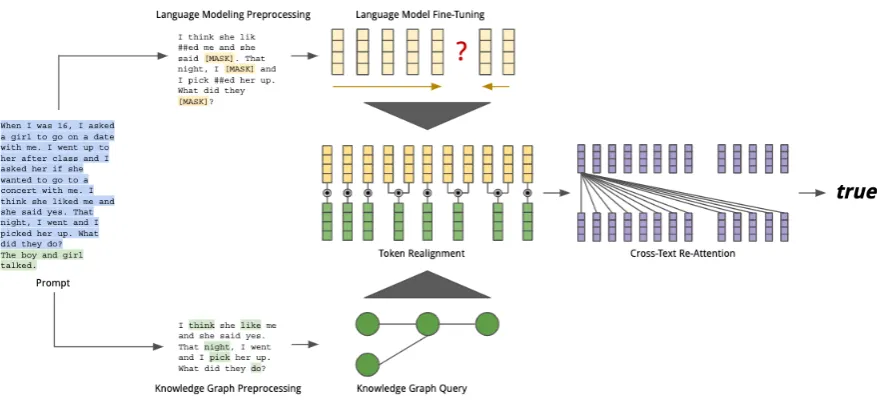
Figure 1: Our model architecture. Our design mimics (Vaswani et al.,2017). Since the queries work on whole words only, one knowledge base embeddings may be integrated with one or more language embedding. Several self-attention encoding layers are used.
Algorithm 1: Knowledge Graph Vocab Cre-ation
forprompt in datasetdo
forKG in knowledge graphsdo for(start, end, edge) in KGdo
ifstart in prompt & end in prompt
then
add((start, end, edge)) index as relationship(edge)
end if end for end for end for
check to see if there are any matching prompts in whichstartis present in the text andendis present in the text. If so, we store the(start, end, edge), and note the edge as a relationship. We also index the relationship (edge), giving an index for each unique relationship.
For longer sequences, we allow matches be-tween any trigram, and store an index for each tri-gram matched. In addition, we stem words before-hand, to ensure that the different word endings do not effect the result of the matches. We use the Porter Stemmer (Porter,1980) to stem each word in both the text and the knowledge graph. Note that we only use the stemming to match differ-ent words, and do not keep the stemmed words for later use in the process, as to keep comparability
between embedding types. We also stem words in knowledge bases, to allow for comprasion. Algo-rithm 1 shows our process for matching sequences.
3.2 Knowledge Graph Usage
We query each of three knowledge bases to cre-ate an embedding layer, for each word, for each knowledge graph. Here, we describe our proce-dure for querying each knowledge graph. We stem words beforehand, to allow for matches agnostic of linguistic postfixes (Merkhofer et al.,2018).
3.2.1 ConceptNet
ConceptNet (Speer and Havasi, 2013) represents everyday words and phrases, with edges be-tween the commonsense relationships bebe-tween them. We first preprocess ConceptNet, keep-ing only the vocabulary present in the shared task. Then, for each edge, we store a tu-ple (agent, dependent, relationship) that de-scribes the commonsense relationship mentioned in the knowledge graph.
matched, we randomly pick one.
3.2.2 WebChild
WebChild (Tandon et al.,2017) is a large collec-tion of commonsense knowledge collected from various sources on the web. The format is similar to ConceptNet, which allows us to follow a simi-lar process. WordNet instances are split into cat-egories part−whole, comparative, property,
activity, andspatial. For each category, we cap-ture the (agent, dependent, relationship) tu-ple, which is usually defined as properties such asxdisambi, ydisambi, andsub−relation, but is slightly different for each category. We ignore the WordNet (Miller,1992) relation (some categories will contain subjects such asbike#n#1, and take only the stemmed word. For fine-tuning, we fol-low the same procedure as ConceptNet, creating an additional 10-length embedding for each word.
3.2.3 ATOMIC
ATOMIC (Sap et al.,2018) is a resource that fo-cuses on inferential knowledge viaIf−T hen re-lations. ATOMIC separates its relationships into nine different types (xN eed, xIntent, xAttr,
xEf f ect, xReact, xW ant, oEf f ect, oW ant). For each of the nine categories, for each datum in the given category, we search our text for relation-ships that match the definedIf −T hen relation-ship. Since each relationship is nearly a full sen-tence, we allow a match to be any trigram matched between the given datum and the text. Then, we append an index[0,8] to the embedding layer of the first word in the selected trigram based on the type of relationship matched. For fine-tuning, we follow the same procedure as ConceptNet and We-bChild, creating an additional 10-length embed-ding for each word.
3.3 Architecture
Out modeling procedure consists of three parts. First, we query each knowledge graph, allowing us to create embeddings for each specific graph. Then, we describe our word-level knowledge fu-sion procedure, creating augmented embeddings for each word. Finally, we describe our fine-tuning procedure for the shared task dataset. We modify pytorch-transformers1.
1https://github.com/huggingface/pytorch-transformers
3.3.1 Language Model Fine-Tuning
Contrary toDevlin et al. (2018), we do language model tuning in addition to classification fine-tuning. We find that this generally provides better results, and allows for more stable accuracy since the shared task involves a small dataset. For each prompt, we use the previous preprocessed data to create tasks for our model to predict. We do this before token realignment, so this happens before any extra knowledge graph embeddings are added to the model architecture. For masked tokens, we predict that token through bidirectional context, the same asDevlin et al.(2018). For next sentence prediction, we use the unbiased method previously introduced as well as inDevlin et al.(2018).
3.3.2 Token Realignment
We do a word-level fusion to incorporate knowl-edge embeddings into the BERT model. First, we collect word embeddings from BERT. We sum the last four layer of BERT together, as suggested by ”The Illustrated BERT, ELMo, and co.”2. We fuse these embeddings with the embeddings gathered from querying each of the three databases. For each word, we take the dyadic product, or linear fusion, of the contextual BERT embeddings with the concatenation of the three graph embeddings. When there is no related embedding (if the word did not match any edges during querying, or if the word is a BERT-specific token such as[CLS], we do not do any dyadic fusion. Finally, to get a sin-gle linear layer, we concatenate each dimension of the result of the dyadic fusion with the original BERT embedding. Algorithm 2 shows a detailed explanation of our token realignment process.
3.3.3 Re-Attention
To get a final result, we do a few more neces-sary steps. First, we do a single layer of self-attention over the text, allowing each of the word-level embeddings to interact with one another. For this self-attention, we follow the same pro-cess as in (Vaswani et al., 2017). We compare each token with each other and do token-level fu-sion with each other to learn an attention ding layer. Then, we use the sequence embed-ding for classification. We add a simple linear layer over the sequence embedding for classifica-tion, and softmax over the given choices. Note that we do not freeze any weights along the pro-cess, allowing the transformer and perceptron to
Algorithm 2:Psuedocode for the token realignment algorithm, a method of finding token alignments between two different sequences.
token realignment(seq 1, seq 2):
alignment dict = dict seq 1 i = 0
seq 2 i = 0
whileseq 1 i<len(seq 1) & seq 2 i<len(seq 2)do ifseq 1[seq 1 i] is seq 2[seq 2 i]then
alignment dict[seq 1 i].append(seq 2 i) seq 1 i++
seq 2 i++
end if
ifseq 1[seq 1 i] in seq 2[seq 2 i]then
alignment dict[seq 1 i].append(seq 2 i) seq 1 i++
end if
ifseq 2[seq 2 i] in seq 1[seq 1 i]then
alignment dict[seq 1 i].append(seq 2 i) seq 2 i++
end if end while
returnalignment dict
be fine-tuned during this process. We also allow the knowledge embeddings to be modified through this back-propagation. Hyperparameters are noted in Section 4.1. We also ablate our use of this extra attention layer, showing that it is important to learn comparisons between knowledge embed-dings. For BERT baselines, we use the process inDevlin et al.(2018), and use the[CLS]token, without attention, for classification.
4 Analysis
4.1 Hyperparameter Tuning
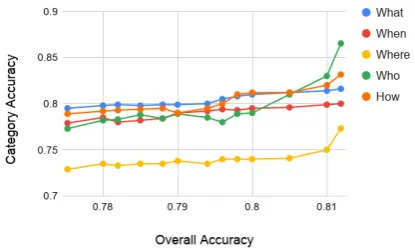
For hyperparameter tuning with BERT, we find that grid search is the best method. We tune var-ious hyperparameters, including batch size, learn-ing rate, warmup, and epoch count (for hyperpa-rameter details, see appendix). Graph 2 shows the results of several hyperparameters on BERT with our additional knowledge bases. We find that B. MOOD seems to correct its deficiencies as it gets closer to the maxima. Interestingly, B. MOOD seems to be naturally good “What” ques-tions, which commonly require commonsense in-ference. This could be explained by the effect of the commonsense knowledge graphs, showing that is picking up on commonsense attributes.
How-Figure 2: Example of B. MOOD accuracy across cat-egories during hyperparameter turning. Values to the right are closer to the maxima.
ever, for “Where” questions, which it requires more information from the text, B. MOOD needs to learn and thus experiences a greater gain as the accuracy gets closer to its maxima.
[image:5.595.313.521.400.524.2]System Accuracy Dev Test
Human 97.4 98.0
Logistic Baseline - 60.8 TriAN (Wang,2018) 76.1
-BERTLARGE 82.3
[image:6.595.77.287.61.212.2]-B. MOOD (with ConceptNet) 83.1 -B. MOOD (with WebChild) 82.7 -B. MOOD (with ATOMIC) 82.5 -B. MOOD (w/o final attention) 82.4 -B. MOOD (with all KB) 83.3 80.7
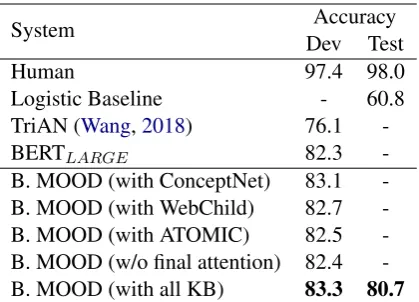
Table 2: Results with B. MOOD on task dev and test set. “with all KB” describes results using all Concept-Net, WebChild, and ATOMIC embeddings. “Human” and “Regression Baseline” accuracy is from the shared task paper (Ostermann et al., 2018). TriAN (Wang,
2018) uses ConceptNet as features.
Category System Accuracy TriAN BERT B. MOOD What 79.3 81.6 84.5 When 69.4 80.0 81.3 Where 75.1 77.3 78.3
Who 79.4 86.5 86.6
How 76.8 83.2 83.4
Overall 76.1 82.3 83.3
Table 3: Question type comparison between different models on the shared task: previous state-of-the-art TriAN (Wang, 2018), BERTLARGE, and B. MOOD
(with all 3 knowledge bases).
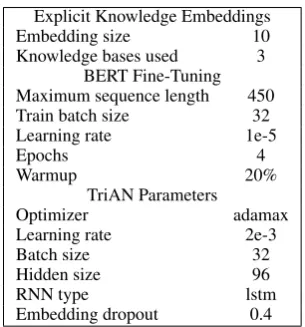
embeddings, we use a size of 10 for each knowl-edge graph, combining for a size 30 knowlknowl-edge graph embedding. We randomly init each embed-ding, and if there is more than one embedding for token, we pick one at random (Wang,2018). For BERT fine-tuning, we use a maximum sequence length of 450, a train batch size of 32, four epochs, 1e−5learning rate, and a 20% warmup.
4.2 Results
We show our results and give analysis for MOOD. We show that each of the knowledge bases help the accuracy of our model, and our strongest model involves the union of all three knowledge bases. ConceptNet gives the largest increase, likely be-cause there are the most matches between the prompts and ConceptNet, since ConceptNet cov-ers everyday concepts that are relatively more common. WebChild gives a boost also, but not as large as ConceptNet. ATOMIC gives the
small-est boost, likely because 1)ATOMIC queries are the longest, and thus, least likely to match, and 2)there is not as much inferential commonsense present.
We also note that the base B. MOOD accuracy is higher than the base TriAN (Wang,2018) accu-racy, the previous state of the art. By appending similar knowledge embeddings, we find that we can bring the TriAN accuracy up to 77.8%, which is more comparable with MOOD. This shows that the additional knowledge bases (ATOMIC, We-bChild) contribute to the overall accuracy even without the contextual embeddings. However, we find that the knowledge bases combined with TriAN still do not provide an improvement above that of MOOD, and thus, the knowledge bases alone are not enough to capture the necessary in-formation. Instead, the knowledge graphs must be used through combination with contextual embed-dings for the most effective model. This shows that BERT may lack the complete amount of infor-mation needed to understand this dataset. We also show that the attention is needed to understand the knowledge graphs alongside BERT, showing the importance of learning the different knowledge base embeddings within the text. This highlights the fact that using the knowledge base embeddings is helpful, and also comparisons between different sections of text is helpful for reading comprehen-sion tasks.
5 Conclusion
hope that this investigation motivates and furthers additional research in combining commonsense knowledge awareness with transformers.
Acknowledgments
The author thanks Maxwell Forbes, as well as the anonymous reviewers, for their helpful and insightful feedback. The author also thanks the shared task organizers for evaluation on the test set. JD is supported by NSF Multimodal.
References
Luis von Ahn, Mihir Kedia, and Manuel Blum. 2006. Verbosity: a game for collecting common-sense facts. InCHI.
S¨oren Auer, Christian Bizer, Georgi Kobilarov, Jens Lehmann, Richard Cyganiak, and Zachary G. Ives. 2007. Dbpedia: A nucleus for a web of open data. InISWC/ASWC.
Jim Breen. 2004. Jmdict: A japanese-multilingual dic-tionary.
Nathanael Chambers and Daniel Jurafsky. 2008. Unsu-pervised learning of narrative event chains. InACL.
Zihang Dai, Zhilin Yang, Yiming Yang, Jaime G. Carbonell, Quoc V. Le, and Ruslan Salakhutdi-nov. 2019. Transformer-xl: Attentive language models beyond a fixed-length context. ArXiv, abs/1901.02860.
Jacob Devlin, Ming-Wei Chang, Kenton Lee, and Kristina Toutanova. 2018. Bert: Pre-training of deep bidirectional transformers for language understand-ing. ArXiv, abs/1810.04805.
Catherine Havasi, R. Speer, Kenneth C. Arnold, Henry Lieberman, Jason B. Alonso, and Jesse Moeller. 2010. Open mind common sense: Crowd-sourcing for common sense. InCollaboratively-Built Knowl-edge Sources and AI.
Guokun Lai, Qizhe Xie, Hanxiao Liu, Yiming Yang, and Eduard H. Hovy. 2017. Race: Large-scale read-ing comprehension dataset from examinations. In EMNLP.
Douglas B. Lenat and Ramanathan V. Guha. 1989. Building large knowledge-based systems; represen-tation and inference in the cyc project.
Hongyu Lin, Le Sun, and Xianpei Han. 2017. Rea-soning with heterogeneous knowledge for common-sense machine comprehension. InEMNLP.
Yinhan Liu, Myle Ott, Naman Goyal, Jingfei Du, Mandar S. Joshi, Danqi Chen, Omer Levy, Mi-randa Paige Linscott Lewis, Luke S. Zettlemoyer, and Veselin Stoyanov. 2019. Roberta: A ro-bustly optimized bert pretraining approach. ArXiv, abs/1907.11692.
Elizabeth M. Merkhofer, John C. Henderson, David Bloom, Laura Strickhart, and Guido Zarrella. 2018. Mitre at semeval-2018 task 11: Commonsense reasoning without commonsense knowledge. In SemEval@NAACL-HLT.
Christian M. Meyer and Iryna Gurevych. 2012. Wik-tionary: A new rival for expert-built lexicons? ex-ploring the possibilities of collaborative lexicogra-phy.
George A. Miller. 1992. Wordnet: A lexical database for english. Commun. ACM, 38:39–41.
Simon Ostermann, Ashutosh Modi, Michael Roth, Ste-fan Thater, and Manfred Pinkal. 2018. Mcscript: A novel dataset for assessing machine comprehension using script knowledge. ArXiv, abs/1803.05223.
Matthew E. Peters, Mark Neumann, Mohit Iyyer, Matt Gardner, Christopher Clark, Kenton Lee, and Luke S. Zettlemoyer. 2018. Deep contextualized word representations.ArXiv, abs/1802.05365.
Martin F. Porter. 1980. An algorithm for suffix strip-ping. Program, 40:211–218.
Maarten Sap, Ronan Le Bras, Emily Allaway, Chan-dra Bhagavatula, Nicholas Lourie, Hannah Rashkin, Brendan Roof, Noah A. Smith, and Yejin Choi. 2018. Atomic: An atlas of machine commonsense for if-then reasoning.ArXiv, abs/1811.00146.
Roy Schwartz, Jesse Dodge, Noah A. Smith, and Oren Etzioni. 2019. Green ai.
R. Speer and Catherine Havasi. 2013. Conceptnet 5: A large semantic network for relational knowledge. In The People’s Web Meets NLP.
Emma Strubell, Ananya Ganesh, and Andrew McCal-lum. 2019. Energy and policy considerations for deep learning in nlp. ArXiv, abs/1906.02243.
Yu Sun, Shuohuan Wang, Yukun Li, Shikun Feng, Xuyi Chen, Han Zhang, Xin Tian, Danxiang Zhu, Hao Tian, and Hua Wu. 2019. Ernie: Enhanced rep-resentation through knowledge integration. ArXiv, abs/1904.09223.
Niket Tandon, Gerard de Melo, and Gerhard Weikum. 2017. WebChild 2.0 : Fine-grained commonsense knowledge distillation. In Proceedings of ACL 2017, System Demonstrations, pages 115–120, Van-couver, Canada. Association for Computational Lin-guistics.
Ashish Vaswani, Noam Shazeer, Niki Parmar, Jakob Uszkoreit, Lawrence Jones, Aidan N. Gomez, Lukasz Kaiser, and Illia Polosukhin. 2017. Atten-tion is all you need. InNIPS.
Yonghui Wu, Mike Schuster, Zhifeng Chen, Quoc V. Le, Mohammad Norouzi, Wolfgang Macherey, Maxim Krikun, Yuan Cao, Qin Gao, Klaus Macherey, Jeff Klingner, Apurva Shah, Melvin Johnson, Xiaobing Liu, Lukasz Kaiser, Stephan Gouws, Yoshikiyo Kato, Taku Kudo, Hideto Kazawa, Keith Stevens, George Kurian, Nishant Patil, Wei Wang, Cliff Young, Jason Smith, Jason Riesa, Alex Rudnick, Oriol Vinyals, Gregory S. Corrado, Macduff Hughes, and Jeffrey Dean. 2016. Google’s neural machine translation system: Bridg-ing the gap between human and machine translation. ArXiv, abs/1609.08144.
Bishan Yang and Tom M. Mitchell. 2017. Leverag-ing knowledge bases in lstms for improvLeverag-ing machine reading. InACL.
Zhilin Yang, Zihang Dai, Yiming Yang, Jaime G. Carbonell, Ruslan Salakhutdinov, and Quoc V. Le. 2019. Xlnet: Generalized autoregressive pretraining for language understanding. ArXiv, abs/1906.08237.
Rowan Zellers, Yonatan Bisk, Roy Schwartz, and Yejin Choi. 2018. Swag: A large-scale adversar-ial dataset for grounded commonsense inference. ArXiv, abs/1808.05326.
Jiacheng Zhang, Yang Liu, Huanbo Luan, Jingfang Xu, and Maosong Sun. 2017. Prior knowledge integra-tion for neural machine translaintegra-tion using posterior regularization.ArXiv, abs/1811.01100.
Yukun Zhu, Jamie Ryan Kiros, Richard S. Zemel, Rus-lan Salakhutdinov, Raquel Urtasun, Antonio Tor-ralba, and Sanja Fidler. 2015. Aligning books and movies: Towards story-like visual explanations by watching movies and reading books. 2015 IEEE In-ternational Conference on Computer Vision (ICCV), pages 19–27.
A Appendices
A.1 Hyperparameters
Seen in Table4is a list of hyperparameters for our experiments. We use the same parameters for both uses of explicit knowledge embeddings.
Explicit Knowledge Embeddings
Embedding size 10
Knowledge bases used 3 BERT Fine-Tuning Maximum sequence length 450
Train batch size 32
Learning rate 1e-5
Epochs 4
Warmup 20%
TriAN Parameters
Optimizer adamax
Learning rate 2e-3
Batch size 32
Hidden size 96
RNN type lstm
Embedding dropout 0.4
[image:8.595.340.493.150.314.2]