Proceedings of the 2019 Conference on Empirical Methods in Natural Language Processing and the 9th International Joint Conference on Natural Language Processing, pages 4579–4589,
4579
Coupling Global and Local Context for Unsupervised Aspect Extraction
Ming Liao1,2∗, Jing Li3,†, Haisong Zhang4, Lingzhi Wang1,2, Xixin Wu1, Kam-Fai Wong1,2 1The Chinese University of Hong Kong, Hong Kong, China
2MOE Laboratory of High Confidence Software Technologies, China
3Department of Computing, The Hong Kong Polytechnic University, Hong Kong, China 4Tencent AI Lab, Shenzhen, China
1,2{mliao,lzwang,wuxx,kfwong}@se.cuhk.edu.hk
3[email protected], 4[email protected]
Abstract
Aspect words, indicating opinion targets, are essential in expressing and understanding hu-man opinions. To identify aspects, most pre-vious efforts focus on using sequence tag-ging models trained on human-annotated data. This work studiesunsupervisedaspect extrac-tion and explores how words appear inglobal context(on sentence level) andlocal context
(conveyed by neighboring words). We pro-pose a novel neural model, capable of cou-pling global and local representation to dis-cover aspect words. Experimental results on two benchmarks, laptop and restaurant re-views, show that our model significantly out-performs the state-of-the-art models from pre-vious studies evaluated with varying metrics. Analysis on model output show our ability to learn meaningful and coherent aspect repre-sentations. We further investigate how words distribute in global and local context, and find that aspect and non-aspect words do exhibit different context, interpreting our superiority in unsupervised aspect extraction.
1 Introduction
Opinion, one of the main factors shaping human behavior, is crucial to our daily activities (Liu,
2012). Every choice we make in our life, rang-ing from where to go for a Friday dinner to which job offer to pick up, is largely influenced by what other people think. To help individuals navigate decision-making processes, there exists growing attentions on opinion mining algorithms that dis-till massive opinion-rich texts — such as digital product reviews (Poddar et al., 2017) and social media discussions (Dusmanu et al.,2017) — into the opinionated information we need.
∗
This work was partially done when Ming Liao was an intern at Tencent AI Lab, Shenzhen, China.
†
Jing Li is the corresponding author and conducted most of the work at Tencent AI Lab, Shenzhen, China.
[R1]: It’s truly a greatlaptop:::for::the:::::price.
[R2]: If you have the money, I suggest goingfor::::the::i7
Table 1: Two sample laptop review sentences. Aspect wordsare in boldface and blue. Wavy underlines indi-cate local context words indicating aspect word “i7”.
Towards human opinion understanding, it is es-sential to figure out what target the opinion cen-ters around. After all, previous studies have long pointed out that human language mostly conveys opinion with aspect and sentiment words (Liu,
2012). In this work, we focus on aspect extrac-tion, targeting at the recognition of words indi-cating opinion aspects (henceforthaspect words). We believe developing effective aspect extraction models will benefit a broad range of compelling applications, such as aspect-based sentiment clas-sification (Tang et al.,2016), opinion summariza-tion (Wu et al., 2016), trending event tracking (Feng et al.,2016), and so forth.
To date, most progress made in aspect extrac-tion has focused on training sequence tagging models on human-annotated data (Li and Lam,
2017;Xu et al.,2018;Wang and Pan,2018). How-ever, acquiring manual labels will inevitably un-dergo an expensive data annotation process and is hence difficult to scale for datasets from new do-main or language. In this work, we explore how aspect words can be discovered in a fully
unsu-pervised manner. We are inspired by the
linguis-tic phenomenon that aspect words generally dis-tinguish themselves from other words in their
oc-currence patterns within global and local context.
Hereglobal contextrefers to how pairs of words
co-occur with each other at sentence level (with-out considering word order and can be extended to capture document-level context), whilelocal con-textmeans what neighbors a word has.
shows two sentences from laptop review bench-mark (Pontiki et al.,2016). As can be seen from R1, aspect words “price” and “laptop” tend to appear together in R1-like sentences concerning “laptop price”. As for R2, its aspect words “i7”, though not co-occurring with other aspects, have similar neighbors “for the” in local context with “price”, which reveals its high likelihood of being aspect words, the same as “price”.
Inspired by the phenomenon above, we propose a novel unsupervised model capable of coupling global and local context to discover aspect word clusters. Our model is built on the success of topic models in aspect extraction (Lin and He, 2009;
Brody and Elhadad,2010;Zhao et al., 2010). It is attributed to their ability to form latent topics with words likely to co-occur in a subset of sen-tences instead of widely appearing in the entire corpus (Blei et al.,2003). These words happen to exhibit similar patterns of how aspect words occur on sentence level (Lin and He, 2009). However, the above methods, only exploiting global context, are arguably suboptimal for largely ignoring the rich information delivered by local context. Some recent work (He et al., 2017), on the other way around, focus on using local context, yet ignore its coupled effects with global context.
Our work, to the best of our knowledge, is the first to explorehow global and local context jointly
indicate aspect words. Moreover, taken
advan-tage of the recent advances in neural topic models (Miao et al., 2017;Srivastava and Sutton, 2017), we enable end-to-end learning of global and lo-cal representation, where the interaction between them contributed to aspect recognition can be au-tomatically captured.
In experiments, we first compare our model with existing unsupervised models on aspect ex-traction. The results on restaurant and laptop re-views show that our model outperforms state-of-the-art approaches using global or local context only. For example, we achieve 36.1 F1 on lap-top dataset, compared with 32.9produced byHe et al.(2017). Further discussions demonstrate our capability of capturing meaningful representations from global and local context, which interprets our superiority in aspect extraction. In addition, we empirically analyze global and local word context on our datasets. The results confirm that aspect words indeed vary in their global and local context compared with non-aspect ones, hence providing
useful clues for aspect identification.
2 Related Work
Our work is mainly in the line with aspect extrac-tion research. On this task, early studies mostly focus on the design of hand crafted rules (Hu and Liu, 2004; Zhuang et al., 2006; Qiu et al.,
2011) or features (Jin et al.,2009;Li et al.,2010). Recently, the propose of neural models enables automatic representation learning without labor-intensive feature engineering (Wang et al.,2016,
2017;Li and Lam, 2017; Xu et al., 2018; Wang and Pan,2018). These supervised models, rely on manually annotated data, thus restricted in their scaling ability for new domain or language. In-stead, our work, focusing onunsupervisedaspect extraction, can discover aspect words via exploit-ing how words occur in global and local context.
Our work is inspired by the unsupervised meth-ods capturing latent aspect factors with LDA-style topic models (Lin and He, 2009; Brody and Elhadad, 2010; Zhao et al., 2010). We are also related with non-neural models incorporat-ing word embeddincorporat-ings (encodincorporat-ing local context) to learn latent topics (discovered from global con-text) (Nguyen et al., 2015; Li et al., 2016; Shi et al.,2017). Compared with them — relying on expertise to customize inference algorithms, our model — in a neural architecture — does not re-quire model-specific derivation, and enables inter-actions between global and local representations to be automatically learned. Though some neural models were recently proposed for our task (Wang et al., 2015; He et al., 2017), they focus on lo-cal context, unable to leverage global information. Distinguishing from them, we examine how the coupled effects of global and local context can
sig-nal aspect words, which have never been studied
before in previous work.
3 Our Neural Model Coupling Global and Local Context
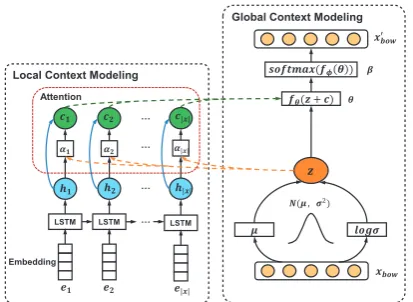
This section describes our neural model coupling the force of global and local context for aspect ex-traction. Figure1shows our overall architecture. There are two modules composed, one for local context modeling and the other for global.
LSTM LSTM
• •!
LSTM
•| |
…
!"
!# !| |
$%&' (
)
*# *" *| |
+# +" +| |
… … …
,-() + +) Attention
Local Context Modeling
• !"
#!$%&'•($)* )
* ,
• !" -Global Context Modeling
Embedding
[image:3.595.78.285.62.213.2]•( ͫ!")
Figure 1: Our overall architecture with one module for local context modeling (on the left) and the other for global (on the right).
3.1 Input and Output
Before touching details to reveal how our model works, we first describe our input and output.
Formally, given a corpus C with |C| sen-tences, {x1,x2, ...,x|C|}, we process each
sen-tencexinto two forms: word sequence formxseq
and bag-of-words (BoW) form xbow. xseq = hw1, w2, ..., w|x|i, wherewnindicates word index
of the n-th word and |x| denotes the number of words. xbow is the BoW term vector over the
vo-cabulary V. Herexseq (considering word order)
is fed for modeling local context and learning how words co-occur with their neighbors, while xbow
(following the bag-of-words assumption in most topic models (Blei et al.,2003;Miao et al.,2017)) serves as the input for global context modeling and capture sentence-level word co-occurrence.
Our goal is to output distributional clusters of aspect words. Then followingQiu et al.(2011)’s practice, the top N nouns (N as a hyperparam-eter) from each cluster (ranked by likelihood) are selected as the extracted aspect words, considering most aspects are nouns.
3.2 Local Context Modeling
As mentioned above, local context modeling mod-ule takes word sequence form, xseq, as its
in-put. In this module, each word wn ∈ xseq is
first processed with an embedding layer and con-verted into an embedding vectoren. Then we
em-ploy long short-term memory (LSTM) (Hochreiter and Schmidhuber,1997) network to explore local context. Word embeddingse1,e2, ...,e|x|are
pro-cessed into hidden states via recurrently exploring word co-occurrence with left neighbors. Specifi-cally, for wordwn, its hidden stateshnis:
hn=fLST M(en,hn−1) (1)
wherefLST M(·)refers to an LSTM unit. The hid-den stateshh1,h2, ...,h|x|i are considered as the
local representation, further leveraged in global context modeling and described later.
3.3 Global Context Modeling
Our global context modeling module is inspired by previous practice that discovers aspect words with LDA-fashion Bayesian graphical models (Lin and He, 2009). We assume there are K latent aspect factors embedded in the the given corpusC. Each factor φk (k = 1,2, ..., K) is represented with a distributional word cluster over the vocabularyV. Also Inspired by neural topic models (Miao et al.,2017), we adopt a variational auto-encoder (VAE) (Kingma and Welling, 2013), with an en-coder and a deen-coder, to resemble the topic model-style data generation process. In doing so, we en-able latent aspects, capturing word co-occurrence in both global and local context, to be learned in neural architecture. There are two main steps in-volved: First, the input sentencex(in BoW form xbow) is encoded to global representationz.
Con-ditioned on z, together with local representation hn (defined in Section 3.2 andn = 1,2, ...,|x|),
decoder further generatesx0bow, the BoW-form re-construction of xbow. In the rest of this section,
we first introduce how global representationz is learned by encoder from global context. Then we introduce how global and local representations are coupled to work together for data generation.
Global Representation Encoding. The encoder
is employed to learn global representation,z, from xbow. Following Miao et al. (2017), words in
global context are assumed to satisfy Gaussian dis-tribution, prior on meanµand standard deviation
σ. Their estimation formula are defined as:
µ=fµ(fe(xbow)), log σ=fσ(fe(xbow)) (2)
where f∗(·) is a neural perceptron performing a
linear transformation operation followed by a non-linear ReLU activation (Nair and Hinton,2010).
Coupling Global and Local Context. Recall
we obtain the hidden stateshn(n = 1,2, ...,|x|)
of global information, aims to identify words in x that can usefully indicate its aspect factors. We design attention weight αn to measure the similarity between the semantic meaning of word
wnandx’s global representationz:
αn=zTfh(hn) (3)
where fh(·) is a ReLU activation function. The
context vector of this attention, namely
globally-scoped local representation, is defined as:
c=
|x|
X
n
αnhn (4)
In the next step, the decoder will usecfor learn-ing corpus-level aspect factors and reproduclearn-ing xbow. Below comes more details.
Decoding Process. Given the global
representa-tionzand the globally-scoped local representation c, the decoder carries out the data generation pro-cess conditioned on both of them. For each input sentence x, we assume each wordwn ∈ xbow is
sampled conditioned on its aspect mixture,θ, aK -dim distribution reflectingx’s composition of as-pect factors.θis then estimated with bothzandc, conveying global and local context ofx’s words. The story describingx’s generation process is:
• Draw global representationz∼ N(µ, σ2).
• Obtain globally-scoped local representationc with Eq.4.
• Aspect mixtureθ=sof tmax(fθ(z+c)).
• For then-th word inx:
– βn=sof tmax(fφ(θ)).
– Draw the wordwn∼M ulti(βn).
Heref∗(·)is a ReLU-activated neural perceptron
described above. Particularly, the weight matrix offφ(·)(with the softmax normalization) are em-ployed as the aspect-word distributions (distribu-tional word clusters), φ, used to represent the la-tent aspect factors and serves as our main output.
Learning Objective. We design the learning
ob-jective of our entire framework as:
L=DKL(p(z)||q(z|x))−Ep(z)[p(x|z)] (5)
wherep(z)is a standard Gaussian prior. The first term reflects encoding loss while the second es-timation likelihood (for decoding). We refer the readers toMiao et al.(2017) for more details.
4 Experimental Setup
Datasets. We conduct experiments on two
benchmark datasets constructed for the SemEval
# of sen |Voc| Avg len per sen |Apt|
# of apt per sen
Laptop
Train 6,355 3,374 14.51 837 2.35
Test 800 1,866 13.17 430 2.52
Rest
Train 6,359 5,166 13.20 1,404 2.36
[image:4.595.306.533.62.147.2]Test 2,161 3,800 13.51 948 2.41
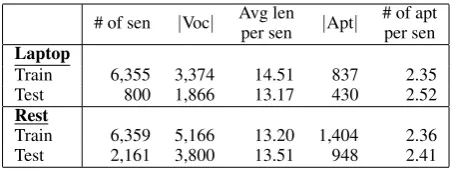
Table 2: Statistics of laptop and restaurant (rest) datasets. |Voc|: the vocabulary size (including stop words). Avg len: average number of tokens.|Apt|: the number of distinct aspects. # of apt per sen: average number of aspects in a sentence.
aspect-based sentiment analysis (ABSA) chal-lenge (Pontiki et al.,2014, 2015, 2016) with hu-man annotated aspects — one gathers restaurant reviews (henceforth restaurant) and the other consists of laptop reviews (henceforth laptop). For model training and evaluation, we combine the training and test datasets for 2014-2016 ABSA (except for 2015 without laptop data released). Following common practice (Wagner et al.,2014), a review sentence is considered as a data sentence for input. The statistics of our datasets are dis-played in Table 2. We can see that aspect words take around25.0% of the vocabulary, yet less than 19.1% of the words per sentence. It is indicated the sparsity and diversity of aspect words, further suggesting the challenging of our task.
Preprocessing. Here are our preprocessing
steps. First, we adopted NLTK toolkit for text tokenization.1 Then, we normalized all letters into their lower cases. Next, we removed words appearing less than five times. Finally, for BoW-form input, we removed all stop words and punctuation following common practice in topic models (Blei et al.,2003).
Parameter Setting. We applied pre-trained
GloVe embedding (Pennington et al., 2014) for initialization in local context modeling.2 The em-bedding dimension is set to300, and batch size to 128. For the number of latent aspect factors, K, we tuned it on training data with five-fold valida-tion and set it to 40. As for N, the number of nouns to be selected from each aspect word clus-ter, we set it to 30 following Qiu et al. (2011). In model training, we employ Adam optimizer (Kingma and Ba,2015), with learning rate set to
1
https://www.nltk.org
2https://nlp.stanford.edu/projects/
1e−3, and run20epochs with early stop strategy adopted. Dropout strategy (Srivastava et al.,2014) is also adopted to avoid overfitting.
Evaluation Metrics. To ensure comparable
per-formance, for clustering-based approaches, we se-lect the top30nouns from40aspect clusters, same as our set up. For the rest, the top1,200nouns are extracted. Here we adopt two sets of evaluation metrics. First, we followQiu et al.(2011) to test sentence-level aspect extraction, where the inter-section of our selection and the words appear in a review sentence are considered as the extracted aspects. In this evaluation, we report precision, recall, and F1 scores. Second, we evaluate our ability to build aspect lexicon (a.k.a. corpus-level extraction) followingHamilton et al. (2016). We consider all the annotated aspects as gold standard lexicon and adopt accuracy for evaluation.
Comparisons. We first consider a simple
base-line that randomly selects nouns as aspect words (henceforth RANDOM). We also compare with extracting- and clustering-based baselines — TF -IDF (Bahdanau et al., 2015), K-MEANS (Lloyd,
1982) (implemented with sklearn toolkit3and tak-ing Glove embeddtak-ing for similarity measure), and BTM4 (Yan et al.,2013), state-of-the-art in short text topic modeling and well-performed in aspect extraction (He et al.,2017).
In addition, we consider the following recently proposed unsupervised models in comparison: LF-LDA (Nguyen et al.,2015), LDA topic model incorporating word embeddings (GloVe is applied here), and ABAE (He et al., 2017), the state-of-the-art attention-based model for unsupervised as-pect extraction. Besides the existing models, we also compare with our variant that only models global context with neural topic model (henceforth GBC ONLY). The full model coupling global and local context is hence referred to as LCC+GBC.
5 Experimental Result
In this section, we first discuss comparison re-sults with unsupervised aspect extraction models in Section5.1. Section5.2shows what our model learns and interprets why it can discover aspect words. Next, in Section5.3, we carry out an em-pirical study over how global and local context in-dicate aspect words. Last, we further discuss our
3
https://scikit-learn.org/stable/
4https://github.com/xiaohuiyan/BTM
Models Pre RestaurantRec F1 Acc Pre RecLaptopF1 Acc
Comparisons
RANDOM 24.9 20.4 22.4 17.3 24.1 39.0 29.8 20.8 TF-IDF 28.6 24.8 26.6 24.3 22.5 18.3 20.2 21.9 K-MEANS 28.1 40.0 33.0 19.0 23.0 35.6 27.9 23.5
BTM 30.6 56.4 39.7 21.2 25.8 48.8 33.7 31.3
LF-LDA 30.2 60.3 40.2 24.8 26.3 50.1 34.4 28.4
ABAE 30.9 57.8 40.2 23.6 25.4 46.5 32.9 32.0
Our models
GBCONLY 30.5 57.9 39.9 24.2 25.6 49.8 33.8 29.8
[image:5.595.308.526.61.157.2]LCC+GBC 31.2 60.5 41.2 26.0 28.0 50.2 36.1 33.7
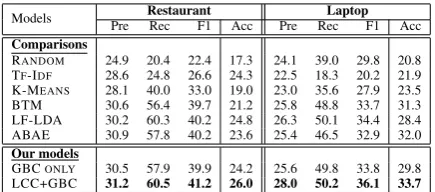
Table 3: Precision (pre), Recall (rec), F1, and Ac-curacy (Acc) produced by various unsupervised mod-els. Acc measures corpus-level extraction while oth-ers sentence-level. Our model significantly outperform others in F1 and Acc measure (paired t-test,p <0.05).
parameter effects and main error in Section5.4.
5.1 Aspect Extraction Results
Main Comparison Results. In Table3, we
re-port the aspect extraction results on two datasets. Several interesting observations can be drawn:
• All models tend to yield better F1 on
restau-rant yet better Acc on laptop.We find that
restau-rant exhibits generally worse model performance on corpus-level extraction than that on sentence level. The opposite findings is whereas drawn on laptop. It might be because restaurant contains more distinct aspects (shown with the larger|Apt|
in Table2). It is possibly due to the prominence of rare aspects, which is challenging to be discov-ered.
• Simple baselines do not work well. Both
RANDOMand TF-IDFperform poorly, indicating the challenge of unsupervised aspect extraction.
•Global context can well indicate aspects. We
observe that approaches based on topic models (BTM, LF-LDA, and our models) perform bet-ter than others. The results indicate that aspect words do vary from other words in global context distributions. Topic model-based approaches, via exploiting sentence-level word co-occurrence, can thus effectively identify aspect words.
•Coupling global and local context is effective.
By combining topic models (global context) with word embeddings (local context), LF-LDA pro-duces the second best F1. Also, our full model LCC+GBC outperforms its variant GBC ONLY in F1. These observations indicate the benefit of joint modeling of global and local context to dis-cover aspect words.
GBCONLY LCC+GBC
good, menu, little, kind,
noise, play, daniel, fare,
jelly, much, details,
fa-ther,neighborhood,wine, door, possible, murray, keep, vagan, heaviness,
cool, wins, angel, upper,
romantic, takes, avenue,
fruit, pink, strips
value,wine,date, evening,
food,block,avenue,line,
fun, years,love, yes, hang, knows, must, cheese,
favorite,course,romantic,
tip, jeans, servers, cold,
pastrami, atmosphere,
fine,counter, word,sauce,
phone crash, keyboard,
en-counter, 39, battery,
wires, memory,
pho-tographs,sooner, fits,feel, things, steve, overheat, would, seem, pro, touch,
cpu, mouse, figure, user,
better, users, ran, days, question, apple, worth, sit
needed, skype, advise,
keyboard, remote, daily,
matches, high, love, originally, wife, loud,
excellent, macbook,
freezes,well, anytime, got, friend, weird, even, gui, weeks, recently, internet,
8.1, laptops, tapping,
[image:6.595.71.293.57.270.2]speakers, noon
Table 4: Top30words of sample latent aspects learned by our variant GBCONLY(on the left) and full model LCC+GBC (on the right). The top displays the outputs on restaurant dataset and the bottom laptop. Aspect wordsare in boldface and blue (annotated in least one sentence), whilesentiment wordsare in italic and red.
range of aspects (e.g., screens, battery, etc.), while restaurant reviews tend to be centered around gen-eral aspects (e.g., food and service). Aspect words thus exhibit sparse occurrence patterns in laptop reviews, rendering generally worse model perfor-mance. Section5.3, we will discuss more. For the same reason, local context helps LCC+GBC ob-tain larger margin on laptop, compared with mod-els relying on global word co-occurrence.
5.2 Model Interpretation
Here we probe into our output and study why LCC+GBC model works.
Topic Coherence. We first analyze the
coher-ence of our latent aspects, where CV metrics, a
widely-applied automatic topic coherence mea-sure (R¨oder et al.,2015) is adopted. LCC+GBC’s latent aspects achieves CV coherence scores of 0.401and0.393on restaurant and laptop dataset, respectively, compared to 0.382 and 0.377 pro-duced by GBCONLY. It hence suggests the joint effects of global and local context also helps pro-duce coherent aspects.
Sample Latent Aspects. We further conduct a
qualitative analysis on the produced latent aspects. Table4shows the top30words (ranked by likeli-hood) of the sample latent aspects. LCC+GBC’s output aspects look more coherent, with words
it 's
truly a grea
t
laptop for the price
(a)
if you have the
mo
ney
i
[image:6.595.322.514.61.182.2]sug
gestgoin
g for the i7
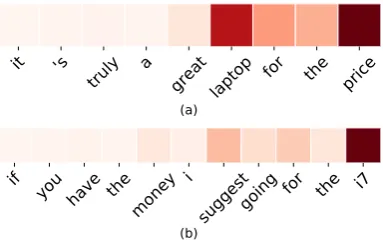
(b)Figure 2: The globally-scoped local attention weights learned by our LCC+GBC model for the sample sen-tences in Table1. Darker colors indicate higher values.
having similar semantics clustered together, such as “course”, “romantic”, and “date” learned from restaurant dataset, and “skype”, “remote”, and “
in-ternet” from laptop. The possible reason is that
words conveying similar semantic meanings tend to appear in similar local context. LCC+GBC, via coupling local context with global one, is thus able to capture such semantic representations.
We also notice that LCC+GBC discovers more rare aspects, such as “pastrami” (from restaurant) and “gui” (from laptop). These words, though may exhibit sparse occurrence and unable to be discov-ered purely with global context, might be effec-tively indicated by their local context. This reveals the benefit of combining the effects of global and local context for aspect extraction.
In addition, we notice that our output aspect clusters include some sentiment words. It is pos-sibly because aspect words tend to co-occur with sentiment ones in both global and local context. Thus without supervision, it is likely our models discover them together. These findings suggest our potential benefit on extracting sentiment words — which can be easily separated from aspects by their POS tags (Qiu et al.,2011)). Such extension is beyond the scope of this paper but worth explor-ing in future work.
Case Study. To understand what LCC+GBC
inter-1 2 3 4 5 6 7 8 9 inter-10 (10, 20] (20, 30] (30, 40] (40, 100] (100 ,500 ] (500 ,100 0] >10 00 0.00 0.05 0.10 0.15 0.20 0.25 0.30 0.35 aspects non aspects (a) Restaurant
1 2 3 4 5 6 7 8 (8,2 0] (20, 30] (30, 40] (40, 100] (100 ,500 ] (500 ,100 0] >10 00 0.00 0.10 0.20 0.30 0.40 0.50 0.60 aspects non aspects (b) Laptop
Figure 3: Sentence-level co-occurrence of aspect (in blue line) and non-aspect (in red line) word pairs distri-bution from two datasets. X-axis: word pair frequency. Y-axis: proportion of pairs. Aspect and non-aspect words exhibit diverse distributions.
actions between global and local representation.
5.3 Analysis of Global and Local Context
To extensively understand the effects of global and local context on aspect identification, we carry out an empirical study on our datasets.
Aspects vs. Non-aspects. We first compare the
global and local word occurrence statistics in con-text of aspect and non-aspect words. This is to em-pirically analyze why LCC+GBC can effectively distinguish aspect and non-aspect words.
To examine global context, Figure 3 presents distributions of word pair co-occurrence in sen-tences, with two lines corresponding to aspect and non-aspect pairs. It is seen different dis-tribution are exhibited by aspect and non-aspect pairs, with non-aspect ones flatly distributed over varying frequency while the aspect pairs are more sparse. This indicates global context, capturing how words co-appear in sentences, can indeed help distinguish aspect and non-aspect words.
We also notice that aspect pair distributions are slightly different on two datasets. On restaurant dataset, we observe a pulse on pairs occurring 10−20times, while the distribution on laptop is a long tail. This demonstrates the sparse aspect oc-currence patterns in laptop dataset (probably ow-ing to the broad range of aspects discussed there), also explains the general worse performance on it (compared to restaurant and shown in Table3).
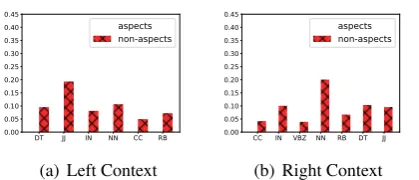
We then analyze local context and show the distribution of POS tags (predicted with NLTK toolkit) in left and right neighbors. We take lap-top dataset as an example to discuss, and similar observations are drawn from restaurant. For better displays, from34POS tags in total, we pick up the top5tags in aspects’ and non-aspects’ neighbors respectively. Distributions are shown over their
DT JJ IN NN CC RB 0.00 0.05 0.10 0.15 0.20 0.25 0.30 0.35 0.40 0.45 aspects non-aspects
(a) Left Context
CC IN VBZ NN RB DT JJ 0.00 0.05 0.10 0.15 0.20 0.25 0.30 0.35 0.40 0.45 aspects non-aspects
(b) Right Context
Figure 4: The distribution of neighboring POS tags in left and right context ( laptop dataset). Aspect bors are in red and non-aspects’ in blue. X-axis: neigh-boring POS tags. Y-axis: POS proportions. Aspects’ and non-aspects’ neighbors have different POS tags.
union set in Figure4. In both left and right context, we observe aspects and non-aspects exhibit differ-ent distributions for their neighboring POS tags. For example, aspect words are likely to have “DT” (e.g.,an,this) appearing as left while “RB” (e.g.,
highly, barely) frequently acting as non-aspects’
left neighbors while rarely in aspects’.
In addition, we display in Table 5 the top 10 neighboring bigrams in left context. Although it is merely a qualitative human judgement at this point, we can draw some interesting observations from the results. For example, some opinioned bi-grams, such as “a great” and “love the”, are likely to appear on the left local context of aspects (opin-ion targets). Such patterns may usefully indicate aspect words and help distinguish them from non-aspect ones. As for right bigram neighbors, they exhibit sparse occurrence patterns, hence might provide less useful clues. We will analyze the ef-fects of left and right local context next.
Aspects Non-aspects
easy to, and the, of the, for the, with the, a great, that the, it ’s, all the, love the
[image:7.595.312.522.61.151.2]of the, it is, and the, is a, battery life, to use, it ’s, with the, i have, for the
Table 5: Top10neighboring bigrams in left context of aspects and non-aspects (laptop dataset).
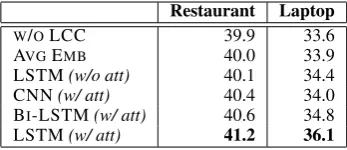
Local Context Modeling. We then compare and
[image:7.595.79.281.67.155.2]Restaurant Laptop
W/OLCC 39.9 33.6
AVGEMB 40.0 33.9
[image:8.595.312.522.59.149.2]LSTM(w/o att) 40.1 34.4 CNN(w/ att) 40.4 34.0 BI-LSTM(w/ att) 40.6 34.8 LSTM(w/ att) 41.2 36.1
Table 6: F1 score of our variants with varying encoders for local context modeling. Hereatt refers to the at-tention to capture globally-scoped local representation (shown in Eq.3and4). In the first column,W/OLCC refers to GBCONLYvariant. AVGEMBmeans average embedding. LSTM (w/ att) is our LCC+GBC model.
It is possibly because, in local context, left neigh-bors convey more useful clues for indicating as-pect words, compared with right ones. As a result, CNN and BI-LSTM, equally considering left and right context, might be somehow affected by the noise in right context. They are thus outperformed by LSTM, which only models local context in left-to-right direction.
0~20% 20%~40% 40%~60% 60%~80% 80%~100%
0.0 0.1 0.2 0.3 0.4 0.5 0.6 0.7 0.8
ABAE GBC ONLY LCC+GBC
(a) Restaurant
0~20% 20%~40% 40%~60% 60%~80% 80%~100%
0.0 0.1 0.2 0.3 0.4 0.5 0.6 0.7 0.8
ABAE GBC ONLY LCC+GBC
[image:8.595.94.268.62.137.2](b) Laptop
Figure 5: Recall scores for discovering varying quin-tiles (20%) of aspects (ranked by frequency). X-axis: quintiles of aspect frequency. Y-axis: recall scores.
Varying Aspect Frequency. Recall that the
sample aspects in Table 4 suggest more rare as-pects discovered by LCC+GBC compared with GBC ONLY. We conduct an analysis on model performance to discover aspects with varying fre-quency. Figure5 compares the recall scores pro-duced by ABAE, GBC ONLY, and LCC+GBC when retrieving varying aspect quintiles (5 -quantile) (ranked by frequency). It shows ABAE performs better in discovering low-frequency as-pects while GBC ONLYbetter at recognizing fre-quent ones. It suggests global context is more use-ful to indicate common aspects while local context better at signaling rare ones. LCC+GBC, captur-ing the coupled effects of global and local context, can identify both common and rare aspects, and thus yield superior performance.
20 30 40 50 60 70 39.00
39.50 40.00 40.50 41.00
GBC ONLY LCC+GBC
(a) Restaurant
20 30 40 50 60 70 32.50
33.00 33.50 34.00 34.50 35.00 35.50
36.00 GBC ONLY
LCC+GBC
(b) Laptop
Figure 6: F1 scores of our models (in y-axis) given varying aspect numberK(in x-axis). LCC+GBC per-forms consistently better than GBCONLY.
5.4 Further Discussion
Parameter Analysis In main results, we fix the
number of latent aspects toK = 40. In Figure6, we further examine how our models (GBCONLY and LCC+GBC) perform given varying number of K. Here to ensure comparable performance, we setN = 1200/K. It is seen that LCC+GBC yields consistently better F1 than GBC ONLY. We also observe that both models do not exhibit monotomic curves, where LCC+GBC obtains the best performance givenK = 40, consistent with the validation results.
Error Analysis. Here we analyze our main
er-rors types. One major type is caused by wrongly identifying aspect phrases, such as “windows 7”, where “7” is missed possibly ascribed to its sparse occurrence. We have such errors owning to mod-eling context in word level and sometimes fail to capture semantics in coarser grain. One possible solution is to extend our global context model-ing module to learn phrase-level semantics (He,
2016). Another main errors occur when process-ing context-sensitive aspect words. For exam-ple, “hard” indicates aspect in “The hard drive is fast.”, rather than “It is hard to use that lap-top.”. Our model, failing to distinguish “hard” in varying context, considers it as aspect for both sentences. To deal with such error, we can adopt context-aware decoders, such asHu et al. (2017), to distinguish word semantics in different context.
6 Conclusion
[image:8.595.75.288.371.464.2]We find out three interesting points in empirical analysis over global and local context: First, as-pects and non-asas-pects exhibit distinguishing distri-butions in either global and local context; Second, in local context, left neighbors can better indicate aspect words compared with the right; Third, lo-cal context can better indicate rare aspects while global signals common aspects better.
Acknowledgments
This work is partially supported by the follow-ing HK grants: RGC-GRF (14232816, 14209416, 14204118, 3133237), NSFC (61877020) & ITF (ITS/335/18). We thank the three anonymous re-viewers for the insightful suggestions on various aspects of this work.
References
Dzmitry Bahdanau, Kyunghyun Cho, and Yoshua Bengio. 2015. Neural machine translation by jointly learning to align and translate. CoRR, abs/1409.0473.
David M. Blei, Andrew Y. Ng, and Michael I. Jordan. 2003. Latent dirichlet allocation. J. Mach. Learn. Res., 3:993–1022.
Samuel Brody and Noemie Elhadad. 2010. An unsu-pervised aspect-sentiment model for online reviews.
In Human Language Technologies: The 2010
An-nual Conference of the North American Chapter
of the Association for Computational Linguistics,
pages 804–812, Los Angeles, California. Associa-tion for ComputaAssocia-tional Linguistics.
Mihai Dusmanu, Elena Cabrio, and Serena Villata. 2017. Argument mining on twitter: Arguments, facts and sources. InProceedings of the 2017 Con-ference on Empirical Methods in Natural Language
Processing, pages 2317–2322, Copenhagen,
Den-mark. Association for Computational Linguistics.
Xiaocheng Feng, Lifu Huang, Duyu Tang, Heng Ji, Bing Qin, and Ting Liu. 2016. A language-independent neural network for event detection. In
Proceedings of the 54th Annual Meeting of the As-sociation for Computational Linguistics (Volume 2:
Short Papers), pages 66–71, Berlin, Germany.
Asso-ciation for Computational Linguistics.
William L. Hamilton, Kevin Clark, Jure Leskovec, and Dan Jurafsky. 2016. Inducing domain-specific senti-ment lexicons from unlabeled corpora. In Proceed-ings of the 2016 Conference on Empirical Methods
in Natural Language Processing, pages 595–605,
Austin, Texas. Association for Computational Lin-guistics.
Ruidan He, Wee Sun Lee, Hwee Tou Ng, and Daniel Dahlmeier. 2017. An unsupervised neural attention model for aspect extraction. InProceedings of the 55th Annual Meeting of the Association for
Compu-tational Linguistics (Volume 1: Long Papers), pages
388–397, Vancouver, Canada. Association for Com-putational Linguistics.
Yulan He. 2016. Extracting topical phrases from clinical documents. In Proceedings of the
Thir-tieth AAAI Conference on Artificial Intelligence,
AAAI’16, pages 2957–2963. AAAI Press.
Sepp Hochreiter and J¨urgen Schmidhuber. 1997. Long short-term memory. Neural Comput., 9(8):1735– 1780.
Minqing Hu and Bing Liu. 2004. Mining and summa-rizing customer reviews. InProceedings of the Tenth ACM SIGKDD International Conference on Knowl-edge Discovery and Data Mining, Seattle,
Washing-ton, USA, August 22-25, 2004, pages 168–177.
Zhiting Hu, Zichao Yang, Xiaodan Liang, Ruslan Salakhutdinov, and Eric P. Xing. 2017. Toward con-trolled generation of text. InProceedings of the 34th
International Conference on Machine Learning,
vol-ume 70 of Proceedings of Machine Learning
Re-search, pages 1587–1596, International Convention
Centre, Sydney, Australia. PMLR.
Wei Jin, Hung Hay Ho, and Rohini K Srihari. 2009. A novel lexicalized hmm-based learning framework for web opinion mining. InProceedings of the 26th annual international conference on machine learn-ing, pages 465–472. Citeseer.
Diederick P Kingma and Jimmy Ba. 2015. Adam: A method for stochastic optimization. InInternational
Conference on Learning Representations (ICLR).
Diederik P. Kingma and Max Welling. 2013. Auto-encoding variational bayes.CoRR, abs/1312.6114.
Chenliang Li, Haoran Wang, Zhiqian Zhang, Aixin Sun, and Zongyang Ma. 2016. Topic modeling for short texts with auxiliary word embeddings. In Pro-ceedings of the 39th International ACM SIGIR con-ference on Research and Development in Informa-tion Retrieval, SIGIR 2016, Pisa, Italy, July 17-21, 2016, pages 165–174.
Fangtao Li, Chao Han, Minlie Huang, Xiaoyan Zhu, Yingju Xia, Shu Zhang, and Hao Yu. 2010. Structure-aware review mining and summarization.
InCOLING 2010, 23rd International Conference on
Computational Linguistics, Proceedings of the
Con-ference, 23-27 August 2010, Beijing, China, pages
653–661.
Xin Li and Wai Lam. 2017. Deep multi-task learning for aspect term extraction with memory interaction.
In Proceedings of the 2017 Conference on
Empiri-cal Methods in Natural Language Processing, pages
Chenghua Lin and Yulan He. 2009. Joint senti-ment/topic model for sentiment analysis. In Pro-ceedings of the 18th ACM Conference on
Informa-tion and Knowledge Management, CIKM ’09, pages
375–384, New York, NY, USA. ACM.
Bing Liu. 2012. Sentiment Analysis and Opinion Min-ing. Synthesis Lectures on Human Language Tech-nologies. Morgan & Claypool Publishers.
Stuart P. Lloyd. 1982. Least squares quantization in
pcm. IEEE Transactions on Information Theory,
28:129–137.
Yishu Miao, Edward Grefenstette, and Phil Blunsom. 2017. Discovering discrete latent topics with neural variational inference. InProceedings of the 34th
In-ternational Conference on Machine Learning,
vol-ume 70 of Proceedings of Machine Learning
Re-search, pages 2410–2419, International Convention
Centre, Sydney, Australia. PMLR.
Vinod Nair and Geoffrey E. Hinton. 2010. Rectified linear units improve restricted boltzmann machines.
InProceedings of the 27th International Conference
on International Conference on Machine Learning,
ICML’10, pages 807–814, USA. Omnipress.
Dat Quoc Nguyen, Richard Billingsley, Lan Du, and Mark Johnson. 2015. Improving topic models with latent feature word representations. Transactions
of the Association for Computational Linguistics,
3:299–313.
Jeffrey Pennington, Richard Socher, and Christo-pher D. Manning. 2014. Glove: Global vectors for word representation. InEmpirical Methods in
Nat-ural Language Processing (EMNLP), pages 1532–
1543.
Lahari Poddar, Wynne Hsu, and Mong Li Lee. 2017. Author-aware aspect topic sentiment model to re-trieve supporting opinions from reviews. In Pro-ceedings of the 2017 Conference on Empirical
Meth-ods in Natural Language Processing, pages 472–
481, Copenhagen, Denmark. Association for Com-putational Linguistics.
Maria Pontiki, Dimitris Galanis, Haris Papageorgiou, Ion Androutsopoulos, Suresh Manandhar, Moham-mad AL-SMoham-madi, Mahmoud Al-Ayyoub, Yanyan Zhao, Bing Qin, Orphee De Clercq, Veronique Hoste, Marianna Apidianaki, Xavier Tannier, Na-talia Loukachevitch, Evgeniy Kotelnikov, N´uria Bel, Salud Mar´ıa Jim´enez-Zafra, and G¨uls¸en Eryi˘git. 2016. Semeval-2016 task 5: Aspect based sentiment analysis. In Proceedings of the 10th International
Workshop on Semantic Evaluation (SemEval-2016),
pages 19–30, San Diego, California. Association for Computational Linguistics.
Maria Pontiki, Dimitris Galanis, Haris Papageorgiou, Suresh Manandhar, and Ion Androutsopoulos. 2015. Semeval-2015 task 12: Aspect based sentiment anal-ysis. InProceedings of the 9th International
Work-shop on Semantic Evaluation (SemEval 2015), pages
486–495, Denver, Colorado. Association for Com-putational Linguistics.
Maria Pontiki, Dimitris Galanis, John Pavlopoulos, Harris Papageorgiou, Ion Androutsopoulos, and Suresh Manandhar. 2014. Semeval-2014 task 4: As-pect based sentiment analysis. InProceedings of the 8th International Workshop on Semantic Evaluation
(SemEval 2014), pages 27–35, Dublin, Ireland.
As-sociation for Computational Linguistics and Dublin City University.
Guang Qiu, Bing Liu, Jiajun Bu, and Chun Chen. 2011. Opinion word expansion and target extraction through double propagation. Computational
Lin-guistics, 37(1):9–27.
Michael R¨oder, Andreas Both, and Alexander Hinneb-urg. 2015. Exploring the space of topic coherence measures. InProceedings of the Eighth ACM Inter-national Conference on Web Search and Data Min-ing, WSDM ’15, pages 399–408, New York, NY, USA. ACM.
Bei Shi, Wai Lam, Shoaib Jameel, Steven Schockaert, and Kwun Ping Lai. 2017. Jointly learning word embeddings and latent topics. InProceedings of the 40th International ACM SIGIR Conference on Re-search and Development in Information Retrieval,
Shinjuku, Tokyo, Japan, August 7-11, 2017, pages
375–384.
Akash Srivastava and Charles Sutton. 2017. Autoen-coding variational inference for topic models. In
International Conference on Learning
Representa-tions (ICLR).
Nitish Srivastava, Geoffrey Hinton, Alex Krizhevsky, Ilya Sutskever, and Ruslan Salakhutdinov. 2014. Dropout: A simple way to prevent neural networks from overfitting. J. Mach. Learn. Res., 15(1):1929– 1958.
Duyu Tang, Bing Qin, Xiaocheng Feng, and Ting Liu. 2016. Effective lstms for target-dependent senti-ment classification. In Proceedings of COLING 2016, the 26th International Conference on
Compu-tational Linguistics: Technical Papers, pages 3298–
3307. The COLING 2016 Organizing Committee.
Joachim Wagner, Piyush Arora, Santiago Cortes, Utsab Barman, Dasha Bogdanova, Jennifer Foster, and Lamia Tounsi. 2014. Dcu: Aspect-based polarity classification for semeval task 4. InProceedings of the 8th International Workshop on Semantic
Evalu-ation (SemEval 2014), pages 223–229, Dublin,
Ire-land. Association for Computational Linguistics and Dublin City University.
Processing of the Asian Federation of Natural Lan-guage Processing, ACL 2015, July 26-31, 2015,
Bei-jing, China, Volume 1: Long Papers, pages 616–625.
Wenya Wang and Sinno Jialin Pan. 2018. Recursive neural structural correspondence network for cross-domain aspect and opinion co-extraction. In Pro-ceedings of the 56th Annual Meeting of the Associa-tion for ComputaAssocia-tional Linguistics (Volume 1: Long
Papers), pages 2171–2181. Association for
Compu-tational Linguistics.
Wenya Wang, Sinno Jialin Pan, Daniel Dahlmeier, and Xiaokui Xiao. 2016. Recursive neural conditional random fields for aspect-based sentiment analysis.
In Proceedings of the 2016 Conference on
Empiri-cal Methods in Natural Language Processing, pages
616–626, Austin, Texas. Association for Computa-tional Linguistics.
Wenya Wang, Sinno Jialin Pan, Daniel Dahlmeier, and Xiaokui Xiao. 2017. Coupled multi-layer atten-tions for co-extraction of aspect and opinion terms.
InProceedings of the Thirty-First AAAI Conference
on Artificial Intelligence, February 4-9, 2017, San
Francisco, California, USA., pages 3316–3322.
H. Wu, Y. Gu, S. Sun, and X. Gu. 2016. Aspect-based opinion summarization with convolutional neural networks. In 2016 International Joint Conference
on Neural Networks (IJCNN), pages 3157–3163.
Hu Xu, Bing Liu, Lei Shu, and Philip S. Yu. 2018. Double embeddings and cnn-based sequence label-ing for aspect extraction. InProceedings of the 56th Annual Meeting of the Association for
Computa-tional Linguistics (Volume 2: Short Papers), pages
592–598. Association for Computational Linguis-tics.
Xiaohui Yan, Jiafeng Guo, Yanyan Lan, and Xueqi Cheng. 2013. A biterm topic model for short texts.
In Proceedings of the 22Nd International
Confer-ence on World Wide Web, WWW ’13, pages 1445–
1456, New York, NY, USA. ACM.
Wayne Xin Zhao, Jing Jiang, Hongfei Yan, and Xiaom-ing Li. 2010. Jointly modelXiaom-ing aspects and opin-ions with a maxent-lda hybrid. In Proceedings of the 2010 Conference on Empirical Methods in Nat-ural Language Processing, EMNLP 2010, 9-11 Oc-tober 2010, MIT Stata Center, Massachusetts, USA, A meeting of SIGDAT, a Special Interest Group of
the ACL, pages 56–65.
Li Zhuang, Feng Jing, and Xiaoyan Zhu. 2006. Movie review mining and summarization. InProceedings of the 2006 ACM CIKM International Conference on Information and Knowledge Management,
Arling-ton, Virginia, USA, November 6-11, 2006, pages 43–