Proceedings of the 2019 Conference on Empirical Methods in Natural Language Processing and the 9th International Joint Conference on Natural Language Processing, pages 3741–3751,
3741
How to Write Summaries with Patterns?
Learning towards Abstractive Summarization through Prototype Editing
Shen Gao♠∗, Xiuying Chen♠♣∗, Piji Li♦, Zhangming Chan♠♣, Dongyan Zhao♠♣, Rui Yan♠♣†
♠Wangxuan Institute of Computer Technology, Peking University, Beijing, China, ♦Tencent AI Lab, Shenzhen, China
♣Center for Data Science, Peking University, Beijing, China
{shengao, xy-chen, zhangming.chan, zhaody, ruiyan}@pku.edu.cn [email protected]
Abstract
Under special circumstances, summaries should conform to a particular style with pat-terns, such as court judgments and abstracts in academic papers. To this end, the prototype document-summary pairs can be utilized to generate better summaries. There are two main challenges in this task: (1) the model needs to incorporate learned patterns from the prototype, but (2) should avoid copying contents other than the patternized words— such as irrelevant facts—into the generated summaries. To tackle these challenges, we design a model named Prototype Editing based Summary Generator (PESG). PESG firstlearns summary patternsand prototype facts by analyzing the correlation between a prototype document and its summary. Pro-totype facts are then utilized to helpextract factsfrom the input document. Next, an edit-ing generator generates new summary based on thesummary patternor extracted facts. Finally, to address the second challenge, a fact checker is used to estimate mutual information between the input document and generated summary, providing an additional signal for the generator. Extensive experiments conducted on a large-scale real-world text summarization dataset1 show that PESG achieves the state-of-the-art performance in terms of both automatic metrics and human evaluations.
1 Introduction
Abstractive summarization can be regarded as a sequence mapping task that maps the source text to the target summary (Rush et al.,2015;Li et al.,
2017;Cao et al.,2018;Gao et al.,2019a). It has drawn significant attention since the introduction
∗
Equal contribution. Ordering is decided by a coin flip.
†
Corresponding author.
1https://github.com/gsh199449/proto-summ
prototype
summary
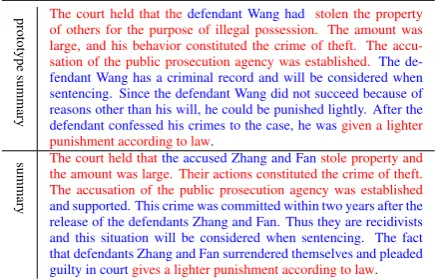
The court held that thedefendant Wang had stolen the property of others for the purpose of illegal possession. The amount was large, and his behavior constituted the crime of theft. The accu-sation of the public prosecution agency was established. The de-fendant Wang has a criminal record and will be considered when sentencing. Since the defendant Wang did not succeed because of reasons other than his will, he could be punished lightly. After the defendant confessed his crimes to the case, he wasgiven a lighter punishment according to law.
[image:1.595.307.527.223.363.2]summary The court held thatthe accused Zhang and Fanstole property and the amount was large. Their actions constituted the crime of theft. The accusation of the public prosecution agency was established and supported. This crime was committed within two years after the release of the defendants Zhang and Fan. Thus they are recidivists and this situation will be considered when sentencing. The fact that defendants Zhang and Fan surrendered themselves and pleaded guilty in courtgives a lighter punishment according to law.
Table 1: An example of patternized summary genera-tion. The text in red denotes patternized words shared in different summaries, and text in blue denotes specific facts.
of deep neural networks to natural language pro-cessing. Under special circumstances, the gen-erated summaries are required to conform to a specific pattern, such as court judgments, diagno-sis certificates, abstracts in academic papers, etc. Take the court judgments for example, there is al-ways a statement of the crime committed by the accused, followed by the motives and the results of the judgment. An example case is shown in
Ta-ble1, where the summary shares the same writing
style and has words in common with the prototype summary (retrieved from the training dataset).
Existing prototype based generation models
such as (Wu et al., 2018) are all applied on short
text, thus, cannot handle long documents sum-marization task. Another series of works focus
on template-based methods such as (Oya et al.,
2014). However, template-based methods are too
rigid for our patternized summary generation task. Hence, in this paper, we propose a summarization
framework namedPrototype Editing based
summa-rization performance when generating summaries with pattern. First, we calculate the cross depen-dency between the prototype document-summary pair to obtain a summary pattern and prototype
facts (explained in§ 4.2). Then, we extract facts
from the input document with the help of the
pro-totype facts (explained in§4.3). Next, a recurrent
neural network (RNN) based decoder is used to generate a new summary, incorporating both the summary pattern and extracted facts (explained in
§4.4). Finally, a fact checker is designed to
pro-vide mutual information between the generated summary and the input document to prevent the generator from copying irrelevant facts from the
prototype (explained in§4.5). To evaluate PESG,
we collect a large-scale court judgment dataset, where each judgment is a summary of the case
description with a patternized style. Extensive
experiments conducted on this dataset show that PESG outperforms the state-of-the-art summariza-tion baselines in terms of ROUGE metrics and hu-man evaluations by a large margin.
Our contributions can be summarized as fol-lows:
• We propose to use prototype information to
help generate better summaries with patterns.
•Specifically, we propose to generate the
sum-mary incorporating the prototype sumsum-mary pattern and extracted facts from input document.
•We provide mutual information signal for the
generator to prevent copying irrelevant facts from the prototype.
•We release a large-scale prototype based
sum-marization dataset that is beneficial for the com-munity.
2 Related Work
We detail related work on text summarization and prototype editing.
Text summarization can be classified into ex-tractive and absex-tractive methods. Exex-tractive meth-ods (Narayan et al.,2018b;Chen et al.,2018) di-rectly select salient sentences from an article to compose a summary. One shortcoming of these models is that they tend to suffer from redundancy. Recently, with the emergence of neural network models for text generation, a vast majority of the
literature on summarization (Ma et al.,2018;Zhou
et al.,2018;Gao et al.,2019a;Chen et al.,2019) is dedicated to abstractive summarization, which aims to generate new content that concisely
para-phrases a document from scratch.
Another line of research focuses on prototype editing. (Guu et al.,2018) proposed the first pro-totype editing model, which samples a propro-totype sentence from training data and then edits it into
a new sentence. Following this work, (Wu et al.,
2018) proposed a new paradigm for response
gen-eration, which first retrieves a prototype response from a pre-defined index and then edits the
pro-totype response. (Cao et al., 2018) applied this
method on summarization, where they employed existing summaries as soft templates to gener-ate new summary without modeling the depen-dency between the prototype document, summary
and input document. Different from these soft
attention methods, (Cai et al., 2018) proposed a
hard-editing skeleton-based model to promote the coherence of generated stories. Template-based
summarization is also a hard-editing method (Oya
et al.,2014), where a multi-sentence fusion algo-rithm is extended in order to generate summary templates.
Different from all above works, our model fo-cuses on patternized summary generation, which is more challenging than traditional news summa-rization and short sentence prototype editing.
3 Problem Formulation
For an input documentX = {x1, x2, . . . , xTm},
we assume there is a ground truth summaryY =
{y1, y2, . . . , yTn}. In our prototype
summariza-tion task, a retrieved prototype document Xˆ =
{xˆ1,xˆ2, . . . ,xˆTm}with a corresponding prototype summaryYˆ = {yˆ1,yˆ2, . . . ,yˆTn} is also attached
according to their similarities withX.
For a given document X, our model extracts
salient facts from X guided by a prototype
doc-umentXˆ, and then generates the summaryY0 by
referring to the prototype summaryYˆ. The goal
is to generate a summaryY0 that not only follows
a patternized style (as defined by prototype
sum-mary Yˆ) but also is consistent with the facts in
documentX.
4 Model
4.1 Overview
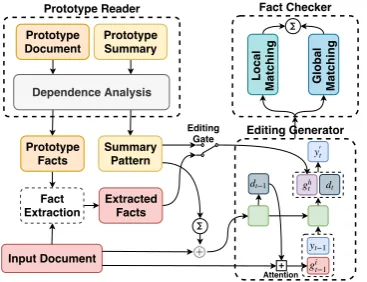
In this section, we propose ourprototype editing
based summary generator, which can be split into
two main parts, as shown in Figure1:
• Summary Generator. (1) Prototype Reader
de-Fact Checker
Editing Generator Prototype Reader
Prototype Document
Prototype Summary
Input Document Dependence Analysis
Summary Pattern
Fact Extraction
Extracted Facts
Local
Ma
tc
h
in
g
Global
Ma
tc
h
in
g
Editing Gate
Attention
[image:3.595.91.275.62.203.2]Prototype Facts
Figure 1: Overview of PESG. We divide our model into four parts: (1)Prototype Reader; (2)Fact Extraction; (3)Editing Generator; (4)Fact Checker.
termine the summary pattern and prototype facts. (2) Fact Extraction module extracts facts from the input document under the guidance of the
pro-totype facts. (3)Editing Generatormodule
gen-erates the summaryY0 of document X by
incor-porating summary pattern and facts.
• Fact Checker estimates the mutual
informa-tion between the generated summaryY0 and input
documentX. This information provides an
addi-tional signal for the generation process, preventing irrelevant facts from being copied from the proto-type document.
4.2 Prototype Reader
To begin with, we use an embedding matrix eto
map a one-hot representation of each word inX,
ˆ
X, Yˆ into a high-dimensional vector space. We
then employ a bi-directional recurrent neural net-work (Bi-RNN) to model the temporal interactions between words:
hxt =Bi-RNNx(e(xt), hxt−1), (1)
ˆ
hxt =Bi-RNNx(e(ˆxt),hˆxt−1), (2)
ˆ
hyt =Bi-RNNy(e(ˆyt),ˆhyt−1), (3)
wherehxt,hˆtxandhˆyt denote the hidden state oft
-th step in Bi-RNN forX,Xˆ andYˆ, respectively.
Following (Tao et al.,2018;Gao et al.,2019b;Hu et al.,2019), we choose long short-term memory (LSTM) as the cell for Bi-RNN.
On one hand, the sections in the prototype sum-mary that are not highly related to the prototype document are the universal patternized words and should be emphasized when generating the new summary. On the other hand, the sections in the prototype document that are highly related to the
prototype summary are useful facts that can guide the process of extracting facts from input docu-ment. Hence, we employ a bi-directional attention mechanism between a prototype document and summary to analyze the cross-dependency, that is, from document to summary and from summary to document. Both of these attentions are derived
from a shared similarity matrix, S ∈ RTm×Tn,
calculated by the hidden states of prototype
doc-umentXˆ and prototype summaryYˆ.Sij indicates
the similarity between thei-th document wordxˆi
andj-th summary wordyˆj and is computed as:
Sij =α(ˆhxi,hˆ y j),
α(x, y) =w|[x⊕y⊕(x⊗y)], (4)
where α is a trainable scalar function that
cal-culates the similarity between two input vectors.
⊕denotes a concatenation operation and⊗is an
element-wise multiplication.
We use ast = mean(S:t) ∈ Rto represent the
attention weight on the t-th prototype summary
word by document words, which will learn to as-sign high weights to highly related universal patt-ernized words when generating a summary. From
ast, we obtain the weighted sum of the hidden
states of prototype summary as “summary
pat-tern”l={l1, . . . , lTn}, whereliis:
li =asihˆ y
i. (5)
Similarly, adt = mean(St:) ∈ R assigns high
weights to the words in a prototype document that are relevant to the prototype summary. A
convo-lutional layer is then applied to extract “prototype
facts”rˆtfrom the prototype document:
ˆ
rt=CNN(adtˆhxt). (6)
We sum the prototype facts to obtain the overall representation of these facts:
q=PTm
t rˆt. (7)
4.3 Fact Extraction
In this section, we discuss how to extract useful facts from an input document with the help of pro-totype facts.
We first extract the facts from an input docu-ment by calculating their relevance to prototype
facts. The similarity matrixE is then calculated
between the weighted prototype document adiˆhxi
and input document representationhxj:
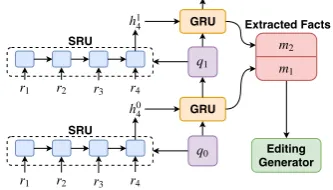
SRU
SRU
GRU
GRU
Extracted Facts
[image:4.595.97.264.65.160.2]Editing Generator
Figure 2: Framework of fact extraction module.
where α is the similarity function introduced in
Equation4. Then, we sum upEij along the length
of the prototype document to obtain the weight
Ej = PTtimEtj for j-th word in the document.
Next, similar to Equation6, a convolutional layer
is applied on the weighted hidden statesEthxt to
obtain the fact representation rt from the input
document:
rt=CNN(Ethxt). (9)
Inspired by the polishing strategy in extractive
summarization (Chen et al.,2018), we propose to
use the prototype facts to polish the extracted facts
rt and obtain the final fact representation m., as
shown in Figure2. Generally, the polishing
pro-cess consists of two hierarchical recurrent layers. The first recurrent layer is made up of Selective
Recurrent Units (SRUs), which take facts r· and
polished fact qk as input, outputting the hidden
statehkT
m. The second recurrent layer consists of
regular Gated Recurrent Units (GRUs), which are
used to update the polished fact fromqk toqk+1
usinghkT
m.
SRU is a modified version of the original GRU introduced in (Chen et al.,2018), details of which
can be found in AppendixA. Its difference from
GRU lies in that the update gate in SRU is decided by both the polished factqkand original factrt
to-gether. Thet-th hidden state of SRU is calculated
as:
hkt =SRU(rt, qk). (10)
We takehkT
mas the overall representation of all
in-put factsr·. In this way, SRU can decide to which
degree each unit should be updated based on its relationship with the polished factqk.
Next, hkT
m is used to update the polished fact
qk using the second recurrent layer, consisting of
GRUs:
mk+1, qk+1 =GRU(hkTm, qk), (11)
where qk is the cell state, hkTm is the input and
mk+1 is the output hidden state. q0 is initialized
using q in Equation 7. This iterative process is
conductedKtimes, and each outputmk is stored
asextracted facts M = {m1, m2, . . . , mK}. In
this way, M stores facts with different polished
levels.
4.4 Editing Generator
The editing generator aims to generate a summary based on the input document, prototype summary and extracted facts. As with the settings of proto-type reader, we use LSTM as the RNN cell. We first apply a linear transformation on the
summa-tion of the summary patternl0 =PTn
i liand input
document representations hxT
m, and then employ
this vector as the initial stated0 of the RNN
gen-erator as shown in Equation12. The procedure of
t-th generation is shown in Equation13:
d0 =We[hxTm⊕l
0
] +be, (12)
dt=LSTM(dt−1,[gti−1⊕e(yt−1)]), (13)
where We, be are trainable parameters, dt is the
hidden state of thet-th generating step, andgit−1
is the context vector produced by the standard
at-tention mechanism (Bahdanau et al.,2015).
To take advantage of the extracted factsM and
prototype summary l, we incorporate them both
into summary generation using a dynamic
atten-tion. More specifically, we utilize a matching
functionf to model the relationship between the
current decoding statedtand eachvi(vi can be a
extracted factmior summary patternli):
δit =
exp(f(vi, dt))
PK
j exp(f(vj, dt))
, (14)
gt∗ =PK
i δitvi, (15)
wheregt∗can begtmorgstfor attending to extracted facts or a summary pattern, respectively. We use a simple but efficient bi-linear layer as the matching
functionf =miWfdt. As for combininggmt and
gst, we propose to use an “editing gate”γ, which is
determined by the decoder statedt, to decide the
importance of the summary pattern and extracted facts at each decoding step.
γ =σ(Wgdt+bg), (16)
where σ denotes the sigmoid function. Using
combines information from the extracted facts and
summary pattern with the editing gateγ, as:
gth= [γgtm⊕(1−γ)gst]. (17)
Finally, the context vectorght is concatenated with
the decoder statedtand fed into a linear layer to
obtain the generated word distributionPv:
dot =Wo[dt⊕gth] +bo, (18)
Pv =softmax(Wvdot+bv). (19)
The loss is the negative log likelihood of the target wordyt:
Ls =−PTt=1n logPv(yt). (20)
In order to handle the out-of-vocabulary (OOV) problem, we equip our decoder with a pointer
net-work (Gu et al., 2016; Vinyals et al., 2015; See
et al.,2017). This process is the same as the model described in (See et al., 2017), thus, is omit here due to limited space.
What’s more, previous work (Holtzman et al.,
2018) has found that using a cross entropy loss
alone is not enough for generating coherent text.
Similarly, in our task, usingLsalone is not enough
to distinguish a good summary with accurate facts from a bad summary with detailed facts from the
prototype document (see§6.2). Thus, we propose
a fact checker to determine whether the generated summary is highly related to the input document.
4.5 Fact Checker
To generate accurate summaries that are consistent with the detailed facts from the input document rather than facts from the prototype document, we add a fact checker to provide additional training
signals for the generator. Following (Hjelm et al.,
2018), we employ the neural mutual information
estimator to estimate the mutual information
be-tween the generated summary Y0 and its
corre-sponding document X, as well as the prototype
document Xˆ. Generally, mutual information is
estimated from a local and global level, and we expect the matching degree to be higher between the generated summary and input document than the prototype document. An overview of the fact
checker is shown in Figure3.
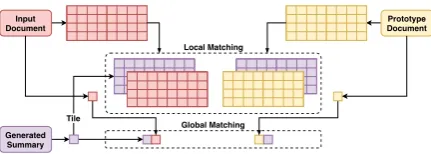
To begin, we use a local matching network to calculate the matching degree, for local features, between the generated summary and the input, as well as prototype document. Remember that, in
Global Matching Input
Document
Prototype Document
Generated Summary
Tile
[image:5.595.308.524.60.137.2]Local Matching
Figure 3: Framework of fact checker module.
§4.3, we obtain the fact representation of an input
document ri and prototype facts rˆi. Combining
these with the final hidden statedTnof the
genera-tor RNN (in Equation13), yields the local features
of input extracted facts and the prototype facts:
Cr={dTn⊕r1, . . . , dTn⊕rTm}, (21)
Cf ={dTn⊕ˆr1, . . . , dTn⊕rˆTm}. (22)
A1×1convolutional layer and a fully-connected
layer are applied to score these two features:
τlr =CNNl(Cr), τlf =CNNl(Cf), (23)
whereτlr ∈ R,τlf ∈Rrepresent the local match-ing degree between the generated summary and input document and prototype document, respec-tively. We want the generated summary to be more similar to the input document than the prototype document. Thus, the optimization objective of the
local matching network is to minimizeLl:
Ll=−
log(τlr) + log(1−τlf)
. (24)
We also have a global matching network to mea-sure the matching degree, for global features, be-tween the generated summary and the input doc-ument, as well as prototype document. To do so, we concatenate the representation of the generated summary with the final hidden state of the input documenthxTmand final state of the prototype doc-umentˆhxT
m, respectively, and apply a linear layer
to these:
τgr =relu(Wm[dTn⊕h
x
Tm] +bm), (25)
τgf =relu(Wm[dTn⊕ˆh
x
Tm] +bm), (26)
whereWm, bm are trainable parameters andτgr ∈
Randτgf ∈ Rrepresent the matching degree
be-tween the generated summary and the input docu-ment, and prototype docudocu-ment, respectively. The objective of this global matching network, similar to the local matching network, is to minimize:
Lg=−
log(τgr) + log(1−τgf)
Acronym Gloss
PESG-FC PESG w/o Fact Checker PESG-PR PESG w/o Prototype Reader PESG-SS PESG w/o Summary Pattern PESG-FG PESG w/o FGRU
Table 2: Ablation models for comparison.
Finally, we combine the local and global loss
func-tions to obtain the final lossL, which we useLto
calculate the gradients for all parameters:
L=Lg+ηLl+Ls, (28)
where, ηare both hyper parameters. To optimize
the trainable parameters, we employ the gradient
descent method Adagrad (Duchi et al., 2010) to
update all parameters.
5 Experimental Setup
5.1 Dataset
We collect a large-scale prototype based
summa-rization dataset2, which contains 2,003,390 court
judgment documents. In this dataset, we use a case description as an input document and the court judgment as the summary. The average lengths of the input documents and summaries are 595.15 words and 273.57 words respectively. The per-centage of words common to a prototype sum-mary and the reference sumsum-mary is 80.66%, which confirms the feasibility and necessity of prototype summarization. Following other summarization
datasets (Grusky et al., 2018; Kim et al., 2019;
Narayan et al.,2018a), we also count the novel n-grams in a summary compared with the n-n-grams in the original document, and the percentage of novel n-grams are 51.21%, 84.59%, 91.48%, 94.83% for novel 1-grams to 4-grams respectively. The
coverage, compression and density (Grusky et al.,
2018) are commonly used as metrics to
evalu-ate the abstractness of a summary. For the sum-maries in our dataset, the coverage percentage is 48.78%, compression is 2.28 and density is 1.31. We anonymize entity tokens into special tags, such as using “PERS” to replace a person’s name.
5.2 Comparisons
In order to prove the effectiveness of each mod-ule of PESG, we conduct several ablation studies,
shown in Table 2. We also compare our model
with the following baselines: (1) Lead-3 is a
2https://github.com/gsh199449/proto-summ
commonly used summarization baseline (
Nallap-ati et al., 2017; See et al., 2017), which selects the first three sentences of document as the
sum-mary. (2)S2S is a sequence-to-sequence
frame-work with a pointer netframe-work, proposed by (See
et al., 2017). (3) Protois a context-aware pro-totype editing dialog response generation model
proposed by (Wu et al.,2018). (4)Re3Sum,
pro-posed by (Cao et al.,2018), uses an IR platform to retrieve proper summaries and extends the seq2seq framework to jointly conduct template-aware
sum-mary generation. (5)Uni-modelwas proposed
by (Hsu et al., 2018), and is the current state-of-the-art abstractive summarization approach on the CNN/DailyMail dataset. (6) We also directly concatenate the prototype summary with the orig-inal document as input for S2S and Uni-model,
named asConcat-S2S andConcat-Uni,
re-spectively.
5.3 Evaluation Metrics
For the court judgment dataset, we evaluate standard 1, 2 and
ROUGE-L (Lin, 2004) on full-length F1 following
pre-vious works (Nallapati et al., 2017; See et al.,
2017;Paulus et al.,2018), where ROUGE-1 (R1), ROUGE-2 (R2), and ROUGE-L (RL) refer to the matches of unigram, bigrams, and the longest common subsequence respectively.
(Schluter, 2017) notes that only using the ROUGE metric to evaluate summarization quality can be misleading. Therefore, we also evaluate our model by human evaluation. Three highly edu-cated participants are asked to score 100 randomly sampled summaries generated by three models: Uni-model, Re3Sum and PESG. The statisti-cal significance of observed differences between the performance of two runs is tested using a two-tailed paired t-test and is denoted usingN(orH) for
strong (or weak) significance forα= 0.01.
5.4 Implementation Details
We implement our experiments in
Tensor-Flow (Abadi et al., 2016) on an NVIDIA GTX
1080 Ti GPU. The word embedding dimension is 256 and the number of hidden units is 256. The
batch size is set to 64. We padded or cut
in-put document to contain exactly 250 words, and
the decoding length is set to 100. and η from
the Equation28 are both set to 1.0. We initialize
all of the parameters randomly using a Gaussian
The court held that the defendant PERS was drunk driving a motor vehicle on the road, and his behavior constituted a dangerous driving offence and should be punished according to law.
[image:7.595.107.500.69.147.2]The courtheld that the defendant on the road was drunkdrivingmotor vehicle his behavior constituteddangerousdriving according to lawshould be punished
Figure 4: Visualizations of editing gate.
R1 R2 RL
Lead-3 32.9 13.3 30.0 Re3Sum 36.3 24.0 36.0 S2S 37.6 24.6 37.3 Uni-model 37.9 25.0 37.6 Concat-S2S 34.2 20.3 34.3 Concat-Uni 37.4 24.3 36.9 PESG 40.2 28.1 39.9
[image:7.595.116.247.211.319.2]Proto – – –
Table 3: ROUGE scores comparison with baselines.
Protodirectly copies from the prototype summary as generated summary.
Fluency Consistency
Uni-model 1.61 1.53 Re3Sum 1.53 1.14
PESG 1.86N 1.73N
Table 4: Fluency and consistency comparison by hu-man evaluation.
et al.,2010) as our optimizing algorithm and em-ploy beam search with size 5 to generate more fluency summary sentence. We also apply
gra-dient clipping (Pascanu et al., 2013) with range
[−5,5]during training. We use dropout (
Srivas-tava et al.,2014) as regularization with keep prob-abilityp= 0.7.
6 Experimental Result
6.1 Overall Performance
We compare our model with the baselines listed
in Table3. Our model performs consistently
bet-ter than other summarization models including the state-of-the-art model with improvements of 6%, 12% and 6% in terms of ROUGE-1, ROUGE-2 and ROUGE-L. This demonstrates that prototype document-summary pair provides strong guidance for summary generation that cannot be replaced by other complicated baselines without prototype in-formation. Meanwhile, directly concatenating the
prototype summary with the original input does not increase performance, instead leading to drops of 9%, 17%, 8% and 1%, 3%, 2% in terms of ROUGE 1,2,L on the S2S and Unified models,
respectively. As for the baseline model Proto,
we found that it directlycopiesfrom the prototype
summary as generated summary, which leads to a totally useless and incorrect summary.
For the human evaluation, we asked annotators to rate each summary according to its consistency and fluency. The rating score ranges from 1 to 3,
with 3 being the best. Table 4 lists the average
scores of each model, showing that PESG outper-forms the other baseline models in both fluency and consistency. The kappa statistics are 0.33 and 0.29 for fluency and consistency respectively, and that indicates the moderate agreement between an-notators. To prove the significance of these re-sults, we also conduct the paired student t-test
be-tween our model andRe3Sum (row with shaded
background). We obtain a p-value of 2 ×10⁻⁷
and9×10−12for fluency and consistency,
respec-tively.
We also analyze the effectiveness of
perfor-mance by the two hyper-parameters: η and .
It turns out that our model has a consistently good performance, with ROUGE-1, ROUGE-2, ROUGE-L scores above 39.5, 27.5, 39.4, which demonstrates that our model is very robust.
6.2 Ablation Study
The ROUGE scores of different ablation models
are shown in Table5. All ablation models perform
worse than PESG in terms of all metrics, which demonstrates the preeminence of PESG. More im-portantly, by this controlled experiment, we can verify the contributions of each modules in PESG.
6.3 Analysis of Editing Generator
We visualize the editing gate (illustrated in
39
40 court
26 28
Rouge Score
rouge-1 rouge-L rouge-2
1 2 3 4 5 6
Hop Number
[image:8.595.309.537.63.415.2]38 39 40
Figure 5: Visualizations of ROUGE score with different hop numbers.
R1 R2 RL PESG-FC 38.7 26.2 38.6 PESG-PR 37.3 24.6 37.0 PESG-SS 38.6 25.6 38.3 PESG-FG 38.8 25.9 38.5
Table 5: ROUGE scores of different ablation models of PESG.
shown in Figure4. A lower weight (lighter color)
means that the word is more likely to be copied from the summary pattern; that is to say, this word is a universal patternized word. We can see that the
phrase本院认为(the court held that) has a lower
weight than the name of the defendant (PERS), which is consistent with the fact that (the court held that) is a patternized word and the name of the defendant is closely related to the input docu-ment.
We also show a case study in Table6, which
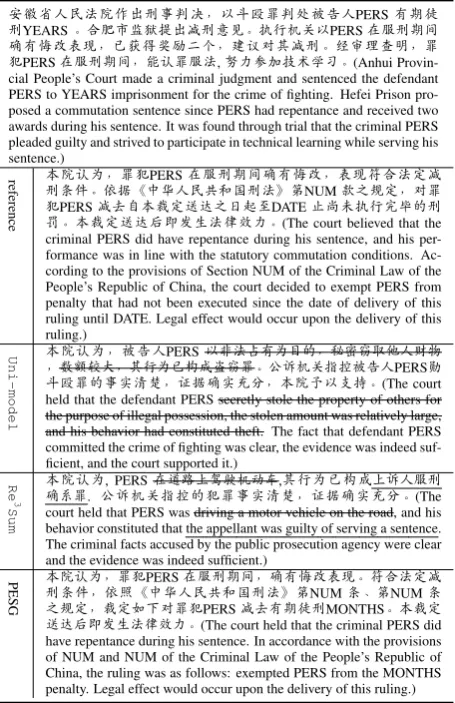
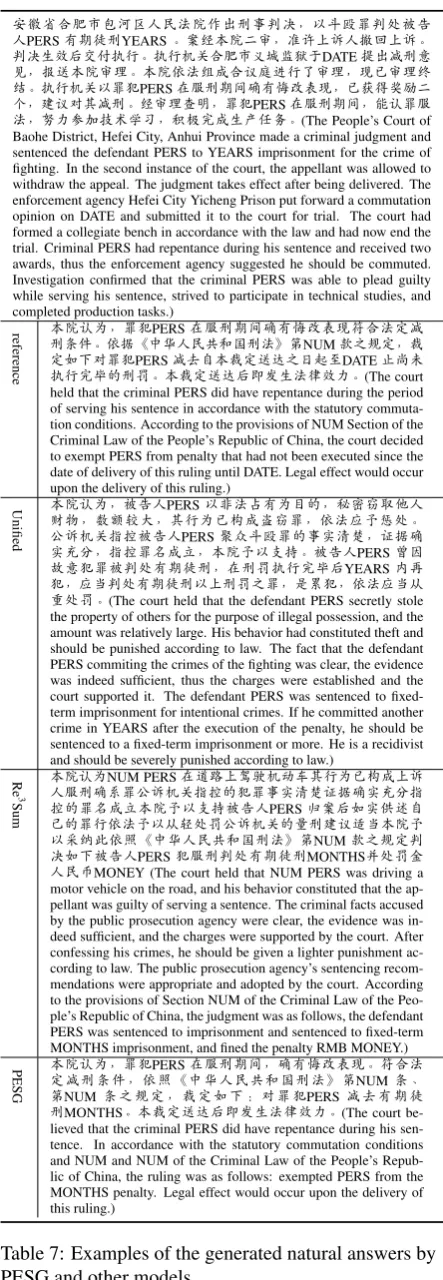
in-cludes the input document and reference summary with the generated summaries. Underlined text notes a grammar error and a strike-through line de-notes a fact contrary to the input document. We only show part of the document and summary due to limited space; the full version is shown in Ap-pendix. As can be seen, the summary generated by Uni-modelfaces an inconsistency problem and
the summary generated byRe3Sumis contrary to
the facts described in the input document. How-ever, PESG overcomes both of these problems and generates an accurate summary with good gram-mar and logic.
6.4 Analysis of Fact Extraction Module
We investigate the influence of the iteration
num-ber when facts are extracted. Figure5 illustrates
the relationship between iteration number and the f-value of the ROUGE score. The results show that the ROUGE scores first increases with the number of hops. After reaching an upper limit it then be-gins to drop. This phenomenon demonstrates that the fact extraction module is effective by polishing the facts representation.
7 Conclusion
In this paper, we propose a framework named
Pro-totype Editing based Summary Generator(PESG), which aims to generate summaries in formal
安徽省人民法院作出刑事判决,以斗殴罪判处被告人PERS有期徒
刑YEARS。合肥市监狱提出减刑意见。执行机关以PERS在服刑期间
确有悔改表现,已获得奖励二个,建议对其减刑。经审理查明,罪 犯PERS在服刑期间,能认罪服法,努力参加技术学习。(Anhui Provin-cial People’s Court made a criminal judgment and sentenced the defendant PERS to YEARS imprisonment for the crime of fighting. Hefei Prison pro-posed a commutation sentence since PERS had repentance and received two awards during his sentence. It was found through trial that the criminal PERS pleaded guilty and strived to participate in technical learning while serving his sentence.)
reference 本院认为,罪犯PERS在服刑期间确有悔改,表现符合法定减 刑条件。依据《中华人民共和国刑法》第NUM款之规定,对罪 犯PERS减去自本裁定送达之日起至DATE止尚未执行完毕的刑 罚。本裁定送达后即发生法律效力。(The court believed that the criminal PERS did have repentance during his sentence, and his per-formance was in line with the statutory commutation conditions. Ac-cording to the provisions of Section NUM of the Criminal Law of the People’s Republic of China, the court decided to exempt PERS from penalty that had not been executed since the date of delivery of this ruling until DATE. Legal effect would occur upon the delivery of this ruling.)
Uni-model 本院认为,被告人PERS以非法占有为目的,秘密窃取他人财物
,数额较大,其行为已构成盗窃罪。公诉机关指控被告人PERS勋
斗殴罪的事实清楚,证据确实充分,本院予以支持。(The court held that the defendant PERS secretly stole the property of others for the purpose of illegal possession, the stolen amount was relatively large, and his behavior had constituted theft. The fact that defendant PERS committed the crime of fighting was clear, the evidence was indeed suf-ficient, and the court supported it.)
Re
3
Sum
本院认为, PERS在道路上驾驶机动车,其行为已构成上诉人服刑 确系罪. 公诉机关指控的犯罪事实清楚,证据确实充分。(The court held that PERS was driving a motor vehicle on the road, and his behavior constituted that the appellant was guilty of serving a sentence. The criminal facts accused by the public prosecution agency were clear and the evidence was indeed sufficient.)
PESG 本院认为,罪犯PERS在服刑期间,确有悔改表现。符合法定减 刑条件,依照《中华人民共和国刑法》第NUM条、第NUM条 之规定,裁定如下对罪犯PERS减去有期徒刑MONTHS。本裁定 送达后即发生法律效力。(The court held that the criminal PERS did have repentance during his sentence. In accordance with the provisions of NUM and NUM of the Criminal Law of the People’s Republic of China, the ruling was as follows: exempted PERS from the MONTHS penalty. Legal effect would occur upon the delivery of this ruling.)
Table 6: Examples of the generated natural answers by PESG and other models.
writing scenarios, where summaries should
con-form to a patternized style. Given a prototype
document-summary pair, our model first calcu-lates the cross dependency between the prototype document-summary pair. Next, a fact extraction module is employed to extract facts from the docu-ment, which are then polished. Finally, we design an editing-based generator to produce a summary by incorporating the polished fact and summary pattern. To ensure that the generated summary is consistent with the input document, we pro-pose a fact checker to estimate the mutual infor-mation between the input document and generated summary. Our model outperforms state-of-the-art methods in terms of ROUGE scores and human evaluations by a large margin, which demonstrates the effectiveness of PESG.
Acknowledgments
[image:8.595.72.286.64.191.2]like to thank Anna Hennig in Inception Institute of Artificial Intelligence for her help on this paper. This work was supported by the National Key Re-search and Development Program of China (No. 2017YFC0804001), the National Science Founda-tion of China (NSFC No. 61876196 and NSFC No. 61672058)
A SRU Cell
Gated recurrent unit (GRU) (Cho et al., 2014) is
a gating mechanism in recurrent neural networks, which incorporate an update gate in an RNN. We first give the details of the original GRU here.
ui =σ(W(u)xi+U(u)hi−1+b(u)), (29)
ri =σ(W(r)xi+U(r)hi−1+b(r)), (30)
˜
hi =tanh(W(h)xi+ri◦U hi−1+b(h)), (31)
hi =ui◦h˜i+ (1−ui)◦hi−1, (32)
where σ is the sigmoid activation function,
W(u), W(r), W(h) ∈ RnH×nI, U(u), U(r), U ∈ RnH×nH, n
H is the hidden size, andnI is the size
of input xi. In the original version of GRU, the
update gate ui in Equation 29 is used to decide
how much of the hidden state should be retained and how much should be updated. In our case, we want to decide which facts are salient accord-ing to the polished factsqk−1 at thek-th hop. To
achieve this, we replace the calculation ofuiwith
the newly computed update gategi:
fi = [xi◦qk−1;xi;qk−1], (33)
zi =W(2)tanh(W(1)fi+b(1)) +b(2), (34)
gi =
exp(zi)
Pns
j=1exp(zj)
, (35)
where W(2), W(1), b(1), b(2) are all trainable
pa-rameters andkis the hop number in the multi-hop
situation which is a hyper-parameter manually set. The effectiveness of this hyper-parameter is
ver-ified in the experimental results shown in § 6.4.
Equation32now becomes:
hi =gi◦h˜i+ (1−gi)◦hi−1. (36)
We use the name “SRU” to denote this modified version of an GRU cell.
B Case Study
安徽省合肥市包河区人民法院作出刑事判决,以斗殴罪判处被告
人PERS有期徒刑YEARS。案经本院二审,准许上诉人撤回上诉。 判决生效后交付执行。执行机关合肥市义城监狱于DATE提出减刑意 见,报送本院审理。本院依法组成合议庭进行了审理,现已审理终 结。执行机关以罪犯PERS在服刑期间确有悔改表现,已获得奖励二 个,建议对其减刑。经审理查明,罪犯PERS在服刑期间,能认罪服 法,努力参加技术学习,积极完成生产任务。(The People’s Court of Baohe District, Hefei City, Anhui Province made a criminal judgment and sentenced the defendant PERS to YEARS imprisonment for the crime of fighting. In the second instance of the court, the appellant was allowed to withdraw the appeal. The judgment takes effect after being delivered. The enforcement agency Hefei City Yicheng Prison put forward a commutation opinion on DATE and submitted it to the court for trial. The court had formed a collegiate bench in accordance with the law and had now end the trial. Criminal PERS had repentance during his sentence and received two awards, thus the enforcement agency suggested he should be commuted. Investigation confirmed that the criminal PERS was able to plead guilty while serving his sentence, strived to participate in technical studies, and completed production tasks.)
reference 本院认为,罪犯PERS在服刑期间确有悔改表现符合法定减 刑条件。依据《中华人民共和国刑法》第NUM款之规定,裁
定如下对罪犯PERS减去自本裁定送达之日起至DATE止尚未
执行完毕的刑罚。本裁定送达后即发生法律效力。(The court held that the criminal PERS did have repentance during the period of serving his sentence in accordance with the statutory commuta-tion condicommuta-tions. According to the provisions of NUM Seccommuta-tion of the Criminal Law of the People’s Republic of China, the court decided to exempt PERS from penalty that had not been executed since the date of delivery of this ruling until DATE. Legal effect would occur upon the delivery of this ruling.)
Unified 本院认为,被告人PERS以非法占有为目的,秘密窃取他人
财物,数额较大,其行为已构成盗窃罪,依法应予惩处。
公诉机关指控被告人PERS聚众斗殴罪的事实清楚,证据确
实充分,指控罪名成立,本院予以支持。被告人PERS曾因 故意犯罪被判处有期徒刑,在刑罚执行完毕后YEARS内再 犯,应当判处有期徒刑以上刑罚之罪,是累犯,依法应当从
重处罚。(The court held that the defendant PERS secretly stole the property of others for the purpose of illegal possession, and the amount was relatively large. His behavior had constituted theft and should be punished according to law. The fact that the defendant PERS commiting the crimes of the fighting was clear, the evidence was indeed sufficient, thus the charges were established and the court supported it. The defendant PERS was sentenced to fixed-term imprisonment for intentional crimes. If he committed another crime in YEARS after the execution of the penalty, he should be sentenced to a fixed-term imprisonment or more. He is a recidivist and should be severely punished according to law.)
Re
3
Sum
本院认为NUM PERS在道路上驾驶机动车其行为已构成上诉 人服刑确系罪公诉机关指控的犯罪事实清楚证据确实充分指 控的罪名成立本院予以支持被告人PERS归案后如实供述自 己的罪行依法予以从轻处罚公诉机关的量刑建议适当本院予 以采纳此依照《中华人民共和国刑法》第NUM款之规定判 决如下被告人PERS犯服刑判处有期徒刑MONTHS并处罚金
人民币MONEY (The court held that NUM PERS was driving a motor vehicle on the road, and his behavior constituted that the ap-pellant was guilty of serving a sentence. The criminal facts accused by the public prosecution agency were clear, the evidence was in-deed sufficient, and the charges were supported by the court. After confessing his crimes, he should be given a lighter punishment ac-cording to law. The public prosecution agency’s sentencing recom-mendations were appropriate and adopted by the court. According to the provisions of Section NUM of the Criminal Law of the Peo-ple’s Republic of China, the judgment was as follows, the defendant PERS was sentenced to imprisonment and sentenced to fixed-term MONTHS imprisonment, and fined the penalty RMB MONEY.) PESG 本院认为,罪犯PERS在服刑期间,确有悔改表现。符合法
定减刑条件,依照《中华人民共和国刑法》第NUM条、
[image:9.595.307.529.83.724.2]第NUM条之规定,裁定如下:对罪犯PERS减去有 期徒 刑MONTHS。本裁定送达后即发生法律效力。(The court be-lieved that the criminal PERS did have repentance during his sen-tence. In accordance with the statutory commutation conditions and NUM and NUM of the Criminal Law of the People’s Repub-lic of China, the ruling was as follows: exempted PERS from the MONTHS penalty. Legal effect would occur upon the delivery of this ruling.)
References
Mart´ın Abadi, Paul Barham, Jianmin Chen, Zhifeng Chen, Andy Davis, Jeffrey Dean, Matthieu Devin, Sanjay Ghemawat, Geoffrey Irving, Michael Isard, et al. 2016. Tensorflow: a system for large-scale machine learning. InOSDI, volume 16, pages 265– 283.
Dzmitry Bahdanau, Kyunghyun Cho, and Yoshua Ben-gio. 2015. Neural machine translation by jointly learning to align and translate. InICLR.
Deng Cai, Yan Wang, Victoria Bi, Zhaopeng Tu, Xiaojiang Liu, Wai Lam, and Shuming Shi. 2018. Skeleton-to-response: Dialogue genera-tion guided by retrieval memory. arXiv preprint arXiv:1809.05296.
Ziqiang Cao, Wenjie Li, Sujian Li, and Furu Wei. 2018. Retrieve, rerank and rewrite: Soft template based neural summarization. InACL, pages 152–161. As-sociation for Computational Linguistics.
Xiuying Chen, Zhangming Chan, Shen Gao, Meng-Hsuan Yu, Dongyan Zhao, and Rui Yan. 2019. Learning towards abstractive timeline summariza-tion. In Proceedings of the Twenty-Eighth In-ternational Joint Conference on Artificial Intelli-gence, IJCAI-19, pages 4939–4945. International Joint Conferences on Artificial Intelligence Organi-zation.
Xiuying Chen, Shen Gao, Chongyang Tao, Yan Song, Dongyan Zhao, and Rui Yan. 2018. Iterative docu-ment representation learning towards summarization with polishing. InEMNLP, pages 4088–4097.
Kyunghyun Cho, Bart van Merrienboer, C¸ aglar G¨ulc¸ehre, Dzmitry Bahdanau, Fethi Bougares, Hol-ger Schwenk, and Yoshua Bengio. 2014. Learning phrase representations using rnn encoder-decoder for statistical machine translation. InEMNLP.
John C. Duchi, Elad Hazan, and Yoram Singer. 2010. Adaptive subgradient methods for online learning and stochastic optimization. JMLR, 12:2121–2159.
Shen Gao, Xiuying Chen, Piji Li, Zhaochun Ren, Li-dong Bing, Dongyan Zhao, and Rui Yan. 2019a. Abstractive text summarization by incorporating reader comments. InAAAI.
Shen Gao, Zhaochun Ren, Yihong Eric Zhao, Dongyan Zhao, Dawei Yin, and Rui Yan. 2019b. Product-aware answer generation in e-commerce question-answering. InWSDM.
Max Grusky, Mor Naaman, and Yoav Artzi. 2018. Newsroom: A dataset of 1.3 million summaries with diverse extractive strategies. InNAACL-HLT.
Jiatao Gu, Zhengdong Lu, Hang Li, and Victor O. K. Li. 2016. Incorporating copying mech-anism in sequence-to-sequence learning. CoRR, abs/1603.06393.
Kelvin Guu, Tatsunori B. Hashimoto, Yonatan Oren, and Percy Liang. 2018. Generating sentences by editing prototypes. TACL, 6:437–450.
R. Devon Hjelm, Alex Fedorov, Samuel Lavoie-Marchildon, Karan Grewal, Adam Trischler, and Yoshua Bengio. 2018. Learning deep representa-tions by mutual information estimation and maxi-mization. CoRR, abs/1808.06670.
Ari Holtzman, Jan Buys, Maxwell Forbes, Antoine Bosselut, David Golub, and Yejin Choi. 2018. Learning to write with cooperative discriminators. InACL.
Wan-Ting Hsu, Chieh-Kai Lin, Ming-Ying Lee, Kerui Min, Jing Tang, and Min Sun. 2018. A unified model for extractive and abstractive summarization using inconsistency loss. InACL.
Wenpeng Hu, Zhangming Chan, Bing Liu, Dongyan Zhao, Jinwen Ma, and Rui Yan. 2019. Gsn: A graph-structured network for multi-party dialogues. In Proceedings of the Twenty-Eighth International Joint Conference on Artificial Intelligence, IJCAI-19, pages 5010–5016. International Joint Confer-ences on Artificial Intelligence Organization.
Byeongchang Kim, Hyunwoo Kim, and Gunhee Kim. 2019. Abstractive Summarization of Reddit Posts with Multi-level Memory Networks. In NAACL-HLT.
Piji Li, Wai Lam, Lidong Bing, and Zihao Wang. 2017. Deep recurrent generative decoder for abstractive text summarization. InEMNLP, pages 2091–2100.
Chin-Yew Lin. 2004. Rouge: A package for auto-matic evaluation of summaries. Text Summarization Branches Out.
Shuming Ma, Xu Sun, Junyang Lin, and Houfeng Wang. 2018. Autoencoder as assistant supervisor: Improving text representation for chinese social me-dia text summarization. InACL.
Ramesh Nallapati, Feifei Zhai, and Bowen Zhou. 2017. Summarunner: A recurrent neural network based se-quence model for extractive summarization of docu-ments. InAAAI.
Shashi Narayan, Shay B. Cohen, and Mirella Lapata. 2018a. Don’t give me the details, just the summary! topic-aware convolutional neural networks for ex-treme summarization. InEMNLP.
Shashi Narayan, Shay B. Cohen, and Mirella Lapata. 2018b. Ranking sentences for extractive summa-rization with reinforcement learning. In NAACL-HLT.
Razvan Pascanu, Tomas Mikolov, and Yoshua Bengio. 2013. On the difficulty of training recurrent neural networks. InICML.
Romain Paulus, Caiming Xiong, and Richard Socher. 2018. A deep reinforced model for abstractive sum-marization. InICLR.
Alexander M Rush, Sumit Chopra, and Jason Weston. 2015. A neural attention model for abstractive sen-tence summarization. InEMNLP, pages 379–389.
Natalie Schluter. 2017. The limits of automatic sum-marisation according to rouge. In Proceedings of the 15th Conference of the European Chapter of the Association for Computational Linguistics: Volume 2, Short Papers, pages 41–45. Association for Com-putational Linguistics.
Abigail See, Peter J. Liu, and Christopher D. Manning. 2017. Get to the point: Summarization with pointer-generator networks. InACL.
Nitish Srivastava, Geoffrey E. Hinton, Alex Krizhevsky, Ilya Sutskever, and Ruslan Salakhutdi-nov. 2014. Dropout: a simple way to prevent neural networks from overfitting. Journal of Machine Learning Research, 15:1929–1958.
Chongyang Tao, Shen Gao, Mingyue Shang, Wei Chung Wu, Dongyan Zhao, and Rui Yan. 2018. Get the point of my utterance! learning to-wards effective responses with multi-head attention mechanism. InIJCAI.
Oriol Vinyals, Meire Fortunato, and Navdeep Jaitly. 2015. Pointer networks. InNIPS, pages 2692–2700.
Yu Ping Wu, Furu Wei, Shaohan Huang, Zhoujun Li, and Ming Zhou. 2018. Response genera-tion by context-aware prototype editing. CoRR, abs/1806.07042.