Proceedings of the 2019 Conference on Empirical Methods in Natural Language Processing 5112
Phrase Grounding by Soft-Label Chain Conditional Random Field
Jiacheng Liu Julia Hockenmaier
University of Illinois at Urbana-Champaign, Urbana, IL, USA 61801 {jl25, juliahmr}@illinois.edu
Abstract
The phrase grounding task aims to ground each entity mention in a given caption of an image to a corresponding region in that im-age. Although there are clear dependencies between how different mentions of the same caption should be grounded, previous struc-tured prediction methods that aim to capture such dependencies need to resort to approxi-mate inference or non-differentiable losses. In this paper, we formulate phrase grounding as a sequence labeling task where we treat candi-date regions as potential labels, and use neu-ral chain Conditional Random Fields (CRFs) to model dependencies among regions for ad-jacent mentions. In contrast to standard se-quence labeling tasks, the phrase grounding task is defined such that there may be mul-tiple correct candidate regions. To address this multiplicity of gold labels, we define so-called Soft-Label Chain CRFs, and present an algorithm that enables convenient end-to-end training. Our method establishes a new state-of-the-art on phrase grounding on the Flickr30k Entities dataset. Analysis shows that our model benefits both from the entity dependencies captured by the CRF and from the soft-label training regime. Our code is available at github.com/liujch1998/ SoftLabelCCRF
1 Introduction
Given an image and a corresponding caption, the phrase grounding task aims to ground each en-tity mentioned by a noun phrase in the caption to a region in the image. Phrase grounding has at-tracted much research interest due to its applica-tion in downstream tasks including image capapplica-tion- caption-ing (Karpathy et al.,2014;Fang et al.,2015; Don-ahue et al.,2017;Xu et al.,2015), image retrieval (Chen et al.,2017a;Radenovic et al., 2016), and visual question answering (Agrawal et al., 2017; Yu et al.,2017,2018a).
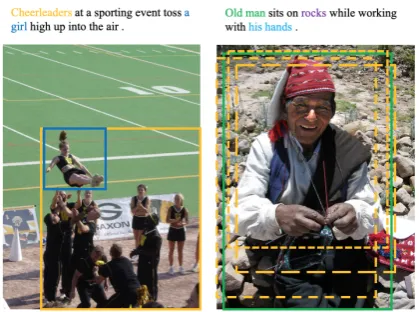
(a) Dependency between en-tities. The visual relation-ship between grounding re-gions for“cheerleaders”and “a girl” should agree with context “toss ... high up into the air”.
[image:1.595.312.522.223.379.2](b) Gold label multiplicity. The green box is the an-notated gold grounding re-gion for entity phrase “Old man”, while theorange dash boxes are region proposals with IoU≥0.5with gold.
Figure 1: Example image-caption pairs from Flickr30k Entities, illustrating entity dependencies and gold label multiplicity.
Phrase grounding systems typically work by ranking a set of candidate regions (Chen et al., 2017b; Yu et al., 2018b). Region proposals are generated from the image by a vision backbone model, without conditioning on the caption. Fea-tures of the phrase to be grounded are extracted, and subsequently interact with features of candi-date regions, to determine phrase-region compat-ibility. Candidate regions are then ranked based on this compatibility metric, and the highest-scored candidate region is selected as the predicted grounding of the phrase.
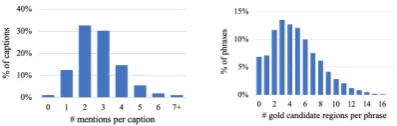
op-(a) Distribution of number of entity phrases per caption.
[image:2.595.79.278.67.130.2](b) Distribution of number of gold labels per entity phrase.
Figure 2: Validation set statistics for Flickr30k Entities.
timize each individual phrase-region assignment), but jointly (to optimize the global phrase-region assignment for the entire caption). Figure 1a il-lustrates this phenomenon. The caption contains a sequence of two entity phrases, “cheerleaders” and “a girl”, and the task is to label each phrase with a candidate region that best grounds it. Since there are several women present in the image, “a girl” has ambiguous grounding by itself, but it can be disambiguated by encouraging the visual relation-ship between “a girl” and “cheerleaders” to con-form with context provided in the caption.
Some works are aware that dependencies be-tween entities in the same caption play an impor-tant role in building more accurate phrase ground-ing systems (Wang et al., 2016; Plummer et al., 2017a;Chen et al.,2017b). The success of these structured prediction methods shows the advan-tage of considering entity dependencies in learn-ing and prediction. However, these approaches capture certain relations in anad hocmanner, and resort to approximate inference (Wang et al.,2016; Plummer et al.,2017a) or non-differentiable losses (Chen et al.,2017b).
To obtain models and inference algorithms that facilitate more globally consistent phrase ground-ing predictions, we propose to formulate phrase grounding as a sequence labeling task where we treat candidate regions as potential labels for the phrases in the input sequence. This allows us to build phrase grounding models based on Con-ditional Random Fields (CRFs) (Lafferty et al., 2001) that capture entity dependencies in a uni-versal and differentiable manner. Our results in-dicate that systems that capture dependencies be-tween phrases in the same caption in a principled manner outperform systems that ignore these de-pendencies.
A second problem lies in the use of region proposals, which distinguishes phrase grounding from other sequence labeling tasks where CRFs
are directly applicable. Following the metrics of object detection, in phrase grounding the correct-ness of a predicted region is judged by its over-lap by Intersection-over-Union (IoU) with the gold region (Plummer et al.,2017b). To cover poten-tial regions with high enough IoU, it is common to generate a myriad of region proposals and for these candidate regions to contain or substantially overlap with each other. As a result, there could be more than one candidate region with high IoU with the gold region, and they should all be consid-ered as correct grounding for the phrase. This phe-nomenon of gold label multiplicity is illustrated in Figure 1b. We hypothesize that it is impor-tant to consider gold label multiplicity and iden-tify all correct region proposals during training, since the model would receive contradictory train-ing signals if some correct proposals were marked as incorrect. With region proposals generated by a Bottom-Up Attention (Anderson et al.,2018) vi-sual backbone, in Flickr30k Entities each phrase has an average of 4.75 gold labels, and detailed statistics are presented in Figure 2b. To address this problem, we adopt the soft-label target dis-tribution proposed by Yu et al. (2018b), and our experiments show that models trained with this regime significantly outperform those trained with one-hot target regime.
To combine the benefits brought by structured prediction from CRFs and by soft-label training regime, we define Soft-Label Chain CRFs, a varia-tion of standard chain CRFs that allows us to work with gold label multiplicity. We adapt learning and inference algorithms from chain CRFs and de-velop an end-to-end training algorithm for our pro-posed model.
2 Related Work
Phrase Grounding. The phrase grounding task was first postulated by Karpathy and Fei-Fei (2017) andPlummer et al.(2017b), both of which moved from the holistic image captioning to the finer-grained task of matching regions with phrases in the caption. Datasets for this task in-clude Flickr30k Entities (Plummer et al.,2017b), RefCOCO (Yu et al., 2016), and Visual Genome (Krishna et al.,2017). The general framework of proposal-generation-ranking has become adopted by most approaches to phrase grounding, and re-search in this area has focused on improving spe-cific components of this framework. Our work can be viewed as an improvement to the training and prediction aspects.
Structured Prediction in Phrase Grounding.
We summarize some works that consider entity dependencies by structured prediction. Structured Matching (Wang et al., 2016) formulates phrase grounding as a bipartite matching process be-tween phrases and candidate regions, and encour-ages the spatial relationship between two ground-ing regions to conform to an extracted partial coreference relation between their corresponding phrases. The resulting discrete optimization prob-lem is then relaxed into a linear program to enable end-to-end training. Phrase-Region CCA ( Plum-mer et al., 2017a) mines frequent patterns of se-mantically related paired phrases and trains a sep-arate model for each pattern. The addition of this pairwise score makes the optimization a quadratic programming problem that requires approximate inference. QRC Net (Chen et al.,2017b) assumes that phrases in a caption refer to distinct entities, and thus predicted grounding regions are penal-ized for spatial overlapping. However, overlap-ping regions can be penalized only after predic-tion, so this loss is not differentiable, and one has to resort to reinforcement learning. In these works, partial coreference extraction, frequent pat-terns mining and spatial overlap penalties are ad hocentity dependency capturing, while we aim to universally encompass the spectrum of such de-pendencies.
Soft-Label Training Regime. Conventionally, region proposal ranking is done by predicting a probability distribution over all candidate regions for grounding a given entity phrase, which is learned to match a target distribution. Chen et al. (2017b) andRohrbach et al.(2016) define the
tar-get distribution as a one-hot vector which only gives credit to the candidate region with highest IoU with the gold region, and cross-entropy loss is used as training objective. Under this hard-label training regime, the model is trained to pick only the best candidate region while rejecting all the inferior-than-best candidate regions, which is intu-itively not a good behavior. Yu et al.(2018b) pro-poses a soft-label target distribution which gives weighted credit to all good candidate regions (i.e. those with above-threshold IoU with the gold re-gion), and uses Kullback-Leibler (KL) divergence loss as training objective.
Conditional Random Fields. CRFs (Lafferty et al.,2001) are discriminative probabilistic mod-els that have been found useful in sequence label-ing tasks by capturlabel-ing label dependencies (Ma and Hovy, 2016; Lample et al., 2016). We summa-rize some works relevant to CRFs learned in soft-label or multi-soft-label settings. Multi-CRFs (Dredze et al.,2009) learn CRFs with noisy annotated data, where annotators may disagree on the label for in-put tokens. The assumption is that there is always only one gold label for each token, so the model favors single label while conforming to the prior distribution of labels set by annotators. To work with soft-label targets, it employs a mode-seeking, exclusive KL divergence definition, which does not imply moment-matching, a desired property of CRFs (and in general, exponential family models) that we show in Section3.1and3.2for the mean-seeking, inclusive KL divergence definition in our model. Rodrigues et al.(2014) models the latent reliability of individual annotators, and use this in-formation to guide the selection of trustworthy an-notation sources and estimation of real gold labels. Note that both works always assume one gold la-bel per input token, where the ambiguity comes from unreliability of annotations, while our work focuses on cases where there may be multiple gold labels per input token by the nature of the task.
3 Soft-Label Chain CRF
CRFs model the probability of a label sequence
y=y1:T conditioned on an input sequence x= x1:T in terms of a score functions(x,y):
p(y|x) = Pexps(y,x) y0exps(y0,x)
w.r.t. a one-hot target distribution that gives credit to the gold label only) is
L=−logp(y|x) =−s(y,x) + logZ(x)
whereZ(x) =P
y0exps(y0,x). The gradient of
this loss w.r.t. score function is ∂L
∂s(y0,x) =−I(y
0 =y) +p(y0|x)
which is known as moment-matching. This allows us to train CRFs with gradient methods and conve-niently connect to backpropagation when the score function is modeled by a neural architecture.
3.1 Soft-Label CRF
In the standard CRF above, each input xt corre-sponds to a single gold label yt. To account for gold label multiplicity in training stage, we replace the sequence of gold labels ywith a sequence of distributionsq =q1:T whereqt ∈RKis the gold
label distribution over allKpossible labels for in-put xt. Note that this distribution should not be interpreted as the confidence of each label being correct; rather, it should be understood as a proba-bilistic gold label model: if we randomly choose a gold label, how likely is each label to be selected. With independence assumption, the gold probabil-ity of an arbitrary label sequenceyis
q(y|x) =Y t
q(yt|x) =Y t
q(yt|xt) =Y t
qytt
It is easy to see thatq(y|x)is a distribution:
X
y
q(y|x) =X y
Y
t qtyt =
Y
t X
yt
qytt = 1
And our goal is to learn this target distribution. Since this target distribution is no longer degen-erate, we use Kullback-Leibler (KL) divergence to measure the discrepancy between the model and the target distribution. Our training objective is the KL divergence loss (in mean-seeking, inclu-sive form):
L=X y
n
q(y|x) logq(y|x) p(y|x)
o
which also gives gradients that demonstrate moment-matching:
∂L
∂s(y0,x) =−q(y
0|x) +p(y0|x)
Note that if we had defined the KL diver-gence loss in its mode-seeking, exclusive form
P
yp(y|x) log p(y|x)
q(y|x), we would have lost this de-sired moment-matching property.
3.2 Factorization of Soft-Label Chain CRF
Learning CRFs of general graphs requires infer-ence in unit of cliques, which is usually computa-tionally intractable. By restricting to local, pair-wise potentials, we reduce the model to a first-order linear chain CRF, whose scoring function factorizes as
s(y,x) =X t
s(yt, yt−1,x)
=X
t n
τ(yt, yt−1,x) +ε(yt,x) o
whereτ(·,·,·) is the transition score between la-bels att−1andtthat captures the dependency be-tween labels for adjacent input tokens, andε(·,·)
is the emission score between label and input att. Combining this factorization with soft-label tar-gets gives the formal definition of Soft-Label Chain CRF. The loss can be written as
L=X y
n
q(y|x) logq(y|x) p(y|x) o
=X
y n
q(y|x)logq(y|x)−s(y,x)+logZ(x) o
(Expandp(y|x)by CRF modeling)
=X
y n
q(y|x)logq(y|x)−s(y,x) o
+logZ(x)
(Marginalizeq(y|x))
=X
t X
yt
n
q(yt|x) logq(yt|x) o
−X
y n
q(y|x)s(y,x)o+logZ(x)
(Independence ofq(yt|x)acrosst)
=X
t X
yt
n
q(yt|x) logq(yt|x) o
−X
y n
q(y|x)X t
s(yt,yt−1,x)o+logZ(x)
(Factorization ofs(y,x))
=X
t X
yt
n
q(yt|x) logq(yt|x)o
−X
t X
yt,yt−1 n
s(yt,yt−1,x) X y|yt,yt−1
q(y|x) o
+logZ(x)
(Reorganize sums bys(yt,yt−1,x))
=X
t X
yt
n
Algorithm 1Modified forward algorithm to compute the KL divergence loss for Soft-Label Chain CRFs
procedureSOFTLABELCHAINCRFLOSS(q, ε(yt,x), τ(yt, yt−1,x))
for alllabely0 do
α0y0 ←0 gy00 ←0
fort= 1. . . T do for alllabelytdo
αytt ←
P yt−1
n
αty−t−11exp
τ(yt, yt−1,x) +ε(yt,x) o
gtyt ←
P yt−1
n
gty−t−11 +τ(yt, yt−1,x)
qty−t−11 +
ε(yt,x)−logqtyt
o
Z ←P yTαTyT G←P
yTgyTTqTyT L← −G+ logZ
returnL
−X
t X
yt,yt−1 n
q(yt,yt−1|x)s(yt,yt−1,x)o
+logZ(x)
which gives moment-matching gradients
∂L
∂s(yt, yt−1,x) =−q(y
t, yt−1|x) +p(yt, yt−1|x)
∂L
∂τ(yt, yt−1,x) =−q(y
t, yt−1|x) +p(yt, yt−1|x)
∂L
∂ε(yt,x) =−q(y
t|x) +p(yt|x)
where
q(yt|x) =qtyt
q(yt, yt−1|x) =qtytqty−t−11
are the probability of local label(s) marginalized over all possible non-local labels. Smoothing in-ference p(yt|x) and p(yt, yt−1|x) can be com-puted with forward-backward algorithm.
3.3 As an Extension of Soft-Label Model
Note that if we omit all transition terms in Soft-Label Chain CRF, the loss reduces to
L0 =X t
X
yt
n
q(yt|x)−ε(yt,x) + logq(yt|x)o
+ logZ(x)
=X
t X
yt
n
q(yt|x) logq(y t|x)
p(yt|x) o
which is a total factorization over time. This is as if each label is predicted independently us-ing a soft-label trainus-ing regime, which is exactly
the KL divergence loss proposed by Yu et al. (2018b). Therefore, our Soft-Label Chain CRF can be viewed as an extension of this soft-label discriminative model.
3.4 Modified Forward Algorithm
For chain CRFs, computing the loss only re-quires forward algorithm, while computing the gradients requires a full forward-backward algo-rithm. It can be proved that backpropagation on the loss gives the same result as running forward-backward. This is a commonly used trick in mod-ern deep learning frameworks to eliminate the need of implementing the backward pass. Al-gorithm1 presents a modified forward algorithm that computes the loss for Soft-Label Chain CRF. In Section 1 and 2 of the Supplementary Mate-rials, we prove the correctness of this algorithm, and that its backpropagation is also equivalent to forward-backward.
4 Phrase Grounding as Sequence Labeling
4.1 Task Formulation
We formulate phrase grounding as a sequence la-beling task. Given an image I, a caption sen-tence[c1. . . cL]whereclis a word token, and a set of non-overlapping noun phrase spans[p1. . . pT]
where pt = (st, et) denotes that the t’th phrase covers tokens cst to cet (inclusive), we generate a set of region proposals {r1. . . rK}, label each
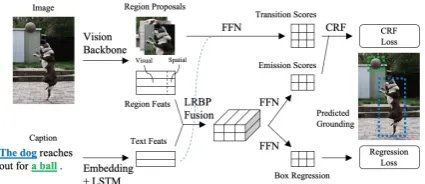
Figure 3: Our model for phrase grounding as a se-quence labeling task. TheK×Ktransition score matrix is derived from the features ofKregion proposals. The T×K emission score matrix is derived from a joint representation of phrase-region pairs, which is fused from features of region proposals andTentity phrases. Bounding box regression is applied to the sequence of regions predicted by the CRF.Cyan dashed line: con-textualized transition score prediction (Section4.2).
Figure 4: Text feature extraction for phrases in a cap-tion. Shaded regions are entity phrase spans; circles represent LSTM cells. For phrasethidden states at its span boundaries are concatenated to form its text fea-turespt, which is used in fusion with region features. For the contextualized transition score between phrases t−1andt, hidden states at the boundaries of the context between them are concatenated into a context feature vectorpt−1,t, which can be further extended by phrase featurespt−1andptas well as global text featurespG.
4.2 Model Specification
Figure3outlines our phrase grounding model. K region proposals and their visual and spatial fea-tures are extracted from an object detection vi-sion backbone. We feed the token embeddings of the caption into a bi-directional LSTM (Hochreiter and Schmidhuber,1997), and then concatenate the forward hidden state at the ending boundary of the phrase with the backward hidden state at the start-ing boundary of the phrase (see Figure 4). This phrase representation captures context both pre-ceding and following the phrase in the caption.
(
−−→
h1:L,
←−−
h1:L) =BiLSTM(Embed([c1. . . cL]))
pt= [
−→
het|| ←−
hst]
We use low-rank bilinear pooling (LRBP) (Kim et al., 2017) to fuse text and region features. Compared to simple concatenation, LRBP sup-ports pairwise interaction between bimodal feature channels while keeping a reasonable computation overhead. Given a text feature vectorpt ∈ Rdtext
and a region feature vectorrk∈Rdvis, LRBP fuses
them into a joint representationfkt∈Rdjoint:
fkt=P>(U>pt◦V>rk) +b
where U ∈ Rdtext×r, V ∈ Rdvis×r, pooling
ma-trix P ∈ Rr×djoint, bias b ∈
Rdjoint, and ◦ is the
Hadamard (i.e. element-wise) product.
As discussed in Section 3.2, the CRF score function consists of emission score and transition score. The emission score ε(rk, pt) models the
compatibility between each phrase and each can-didate region. We feed the joint representation to a single-layer feed-forward neural network:
ε(rk, pt) =FFN(fkt)
The transition score τ(rk, rk0, p1:T) is modeled
by a two-layer feed-forward neural network with ReLU activation for the hidden layer:
τ(rk, rk0, p1:T) =FFN(σ(FFN([rk||rk0])))
To condition the transition scores on local and global context from the caption, we can extend the input[rk||rk0]with the following text features:
context in between the two phrases (feature vector
pt−1,t), context from phrase featurespt−1andpt, and global contextpG.
[image:6.595.77.288.298.395.2]4.3 Training Objectives
For each image-caption instance, the loss is a lin-ear combination of the labeling and bounding box regression loss:
L=Llabel+γLreg
Llabel is the CRF loss defined in Section3.2. Lreg
(Ren et al.,2017) is defined as
Lreg = (β,βˆ) =
X
i∈{x,y,w,h}
SmoothL1( ˆβi−βi)
with the ground truth regression parameterization
β = [x−xa wa
,y−ya ha
,log w wa
,log h ha
]
and
SmoothL1(x) = (
0.5x2 if|x|<1
|x| −0.5 otherwise
5 Experiments
5.1 Experiment Setup
Dataset. We train and evaluate our models on the Flickr30k Entities dataset (Plummer et al.,2017b), which contains 31,783 images, each accompa-nied by 5 captions. In keeping with previous work on this dataset, we assume that entity phrase boundaries are given, so inferring which phrases to ground is not part of our task. Following Plum-mer et al. (2017b), we merge all regions that are ground to the same phrase into one larger bound-ing box, and split the dataset into29,783training images,1kvalidation images and1ktest images.
We do not apply our method to RefCOCO (Yu et al., 2016) or Visual Genome (Krishna et al.,2017) because they consist of independently grounded entity phrases without any entity depen-dencies that CRFs could leverage.
Implementation details. For text feature ex-traction, we use the 1024-d contextualized word embeddings from the last layer of ELMo (Peters et al., 2018), followed by a bi-directional LSTM (Hochreiter and Schmidhuber,1997) encoder with hidden dimensiondhidden= 512for each direction,
so that the text feature vector has dimension dtext = 1024. We use the Bottom-Up Attention
model (Anderson et al.,2018) to generate region proposals and extract visual features, as in the state-of-the-art BAN (Kim et al., 2018) and DDPN (Yu et al.,2018b) models. K= 100region
proposals are generated for each image. Each candidate region with coordinates (xmin, ymin),
(xmax, ymax) is represented by a dvis = 2053
feature vector that consists of 2048-d visual features concatenated with 5-d spatial features
[xmin/W, ymin/H, xmax/W, ymax/H, wh/W H].
The low-rank bilinear pooling (LRBP) layer used for text-region bimodal feature fusion has rank r= 1024and output dimensiondjoint= 1024. We
train with a mini-batch size of16 image-caption instances. Each instance contains all entity phrases to be grounded in the caption. Weights are initialized with Xavier (Glorot and Bengio,2010). We apply a dropout rate ofp= 0.2after the word embedding layer, LSTM layer, and LRBP fusion layer. The loss weighting parameter γ is 10.0. All gradients are clipped by ∞-norm of 10.0 to prevent gradient explosion. We do not fine-tune ELMo or the Bottom-Up Attention model. All models are trained for50kiterations using Adam (Kingma and Ba,2015) with learning rate5e−5
and β1 = 0.9, β2 = 0.98. Model snapshots are taken every5k iterations and the model with the highest validation set accuracy is selected.
Metrics.We predict one grounded region for each entity phrase. FollowingPlummer et al.(2017b), a prediction is deemed accurate if it has at least 0.5 IoU overlap with the gold region. We report the percentage of accurately grounded phrases.
5.2 Quantitative Results
We compare our Soft-Label Chain CRF model against three baselines: a Hard-Label non-CRF model, a Hard-Label CRF, and a Soft-Label non-CRF model. The non-non-CRF models ground each phrase independently with a loglinear model. The Hard-Label models are trained with a standard one-hot training regime. The Soft-Label models use the soft-label training regime described above. The Soft-Label non-CRF model corresponds to the reduced form of the Soft-Label Chain CRF in Section3.3.
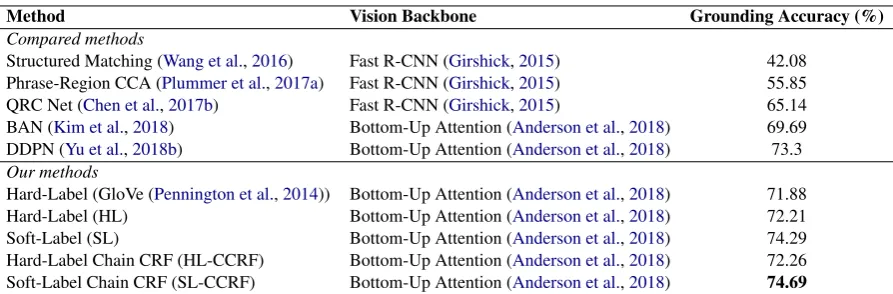
Method Vision Backbone Grounding Accuracy (%)
Compared methods
Structured Matching (Wang et al.,2016) Fast R-CNN (Girshick,2015) 42.08 Phrase-Region CCA (Plummer et al.,2017a) Fast R-CNN (Girshick,2015) 55.85
QRC Net (Chen et al.,2017b) Fast R-CNN (Girshick,2015) 65.14
BAN (Kim et al.,2018) Bottom-Up Attention (Anderson et al.,2018) 69.69 DDPN (Yu et al.,2018b) Bottom-Up Attention (Anderson et al.,2018) 73.3 Our methods
Hard-Label (GloVe (Pennington et al.,2014)) Bottom-Up Attention (Anderson et al.,2018) 71.88
Hard-Label (HL) Bottom-Up Attention (Anderson et al.,2018) 72.21
Soft-Label (SL) Bottom-Up Attention (Anderson et al.,2018) 74.29
[image:8.595.76.523.60.207.2]Hard-Label Chain CRF (HL-CCRF) Bottom-Up Attention (Anderson et al.,2018) 72.26 Soft-Label Chain CRF (SL-CCRF) Bottom-Up Attention (Anderson et al.,2018) 74.69
Table 1: Performance of different phrase grounding methods on Flickr30k Entities (test set). Our CRF models has transition scores conditioned on features of context in between the two phrases (“M” in Table2). Our methods, unless explicitly specified, uses ELMo (Peters et al.,2018) as word embeddings.
Model Transition Context Accuracy (%)
SL-CCRF – 74.28
SL-CCRF M 74.69
SL-CCRF M+LR 74.45
SL-CCRF M+LR+G 74.48
Table 2: Performance of Soft-Label Chain CRF mod-els by conditioning transition scores on different sets of context features. –: input to transition score pre-diction is[rk||rk0]. M: input extended by features of contextpt−1,tin between the two phrases. M+LR: in-put further extended by features of LHS phrasept−1 and RHS phrasept. M+LR+G: input further extended by features of global contextpG.
Decoding Algorithm HL-CCRF SL-CCRF
Viterbi (MAP) 72.26 74.69
Smoothing 72.30 74.73
Table 3: Decoding algorithms’ impact on performance.
improves accuracy by a further 2.08%. On top of that, Soft-Label Chain CRF improves accuracy by another 0.40%, which shows the effectiveness of treating phrase grounding as a sequence label-ing task and uslabel-ing CRFs to capture entity depen-dencies. We also observe that the Hard-Label Chain CRF outperforms the hard-label baseline by a mere margin of 0.05%, so our conjecture is that using chain CRFs works well only with a suitable choice of training regime. Soft-Label Chain CRF gives an overall improvement of 2.48% over the hard-label baseline; it significantly outperforms previous structured prediction models including Structured Matching (Wang et al.,2016), Phrase-Region CCA (Plummer et al., 2017a) and QRC Net (Chen et al., 2017b), and surpasses the
state-of-the-art BAN (Kim et al.,2018) and DDPN (Yu et al., 2018b) models by a margin of 5.00% and about 1.4%, respectively.
We conduct an ablation study to find the most appropriate combination of context features for the transition scores in the SL-CCRF model. Ta-ble2shows that we obtain the best results by in-cluding the context in between the two phrases, which gives an improvement of 0.41%. We did not see any benefit from adding further text fea-tures from the left and right side of the phrases, or from the entire caption.
Besides the Viterbi decoding algorithm used in prediction in CRFs, we also experiment with a smoothing decoding algorithm. While Viterbi finds the MAP label sequence conditioned on the input sequence arg maxyp(y|x), smoothing de-coding finds the best label for each input xt: arg maxytp(yt|x). This makes sense in some scenarios where we want to refine the predicted grounding of one entity by referring to the context instead of attempting to ground all entities men-tioned in the description. Table 3 shows that in both Hard-Label Chain CRF and Soft-Label Chain CRF, smoothing decoding gives a prediction accu-racy 0.04% higher than Viterbi decoding.
Without bounding box regression, the Soft-Label Chain CRF model has an accuracy of 69.85%, a 4.84% reduction compared to the set-ting with bounding box regression.
5.3 Qualitative Results
posi-Figure 5: Selected visualization of phrase grounding results in the validation set of Flickr30k Entities. Solid boxes are correct predicted groundings, while dashed boxes are incorrect predicted groundings. Gold regions are not shown. Each entity phrase and its predicted grounding are marked with same color. Best viewed in color.
tion to “a man”. In (b), although it may not have learned to distinguish “headband” and “hat”, the CRF constrains the spatial position of “headband” to agree with the ownership dependency provided in context. In (c), it avoids the error in ground-ing “skirt” by spatially discriminatground-ing it from “a blouse”. In (d), it avoids the error in ground-ing “a cleanser” by constrainground-ing its relative size w.r.t. “a child”. These examples indicate that the CRF model may avoid grounding errors made by non-CRF models by leveraging entity dependen-cies, including relative position, spatial overlap-ping, and relative size.
6 Conclusion
In this paper, we formulate phrase grounding as a sequence labeling task and propose the Soft-Label Chain CRF model that successfully combines the benefits brought by global structured prediction and soft-label training regime that addresses the gold label multiplicity problem. Experimental re-sults show that we achieve an overall improvement of 2.48% on grounding accuracy compared to a strong baseline, and that our model outperforms previous methods on phrase grounding.
7 Acknowledgements
This material is based upon work supported by the National Science Foundation under Grants No. 1405883 and 1563727. Any opinions, findings, and conclusions or recommendations expressed in this material are those of the author(s) and do not
necessarily reflect the views of the National Sci-ence Foundation.
References
Aishwarya Agrawal, Jiasen Lu, Stanislaw Antol, Mar-garet Mitchell, C. Lawrence Zitnick, Devi Parikh, and Dhruv Batra. 2017. VQA: visual question an-swering - www.visualqa.org. International Journal of Computer Vision, 123(1):4–31.
Peter Anderson, Xiaodong He, Chris Buehler, Damien Teney, Mark Johnson, Stephen Gould, and Lei Zhang. 2018. Bottom-up and top-down attention for image captioning and visual question answering. In 2018 IEEE Conference on Computer Vision and Pat-tern Recognition, CVPR 2018, Salt Lake City, UT, USA, June 18-22, 2018, pages 6077–6086.
Kan Chen, Trung Bui, Chen Fang, Zhaowen Wang, and Ram Nevatia. 2017a. AMC: attention guided multi-modal correlation learning for image search. In 2017 IEEE Conference on Computer Vision and Pat-tern Recognition, CVPR 2017, Honolulu, HI, USA, July 21-26, 2017, pages 6203–6211.
Kan Chen, Rama Kovvuri, and Ram Nevatia. 2017b.
Query-guided regression network with context pol-icy for phrase grounding. In IEEE Interna-tional Conference on Computer Vision, ICCV 2017, Venice, Italy, October 22-29, 2017, pages 824–832.
Jeff Donahue, Lisa Anne Hendricks, Marcus Rohrbach, Subhashini Venugopalan, Sergio Guadarrama, Kate Saenko, and Trevor Darrell. 2017.Long-term recur-rent convolutional networks for visual recognition and description. IEEE Trans. Pattern Anal. Mach. Intell., 39(4):677–691.
[image:9.595.74.524.61.245.2]mul-tiple labels. In ECMLPKDD 2009 workshop on learning from multi-label data, page 39.
Hao Fang, Saurabh Gupta, Forrest N. Iandola, Ru-pesh Kumar Srivastava, Li Deng, Piotr Doll´ar, Jian-feng Gao, Xiaodong He, Margaret Mitchell, John C. Platt, C. Lawrence Zitnick, and Geoffrey Zweig. 2015.From captions to visual concepts and back. In IEEE Conference on Computer Vision and Pattern Recognition, CVPR 2015, Boston, MA, USA, June 7-12, 2015, pages 1473–1482.
Ross B. Girshick. 2015. Fast R-CNN. In 2015 IEEE International Conference on Computer Vision, ICCV 2015, Santiago, Chile, December 7-13, 2015, pages 1440–1448.
Xavier Glorot and Yoshua Bengio. 2010. Understand-ing the difficulty of trainUnderstand-ing deep feedforward neu-ral networks. InProceedings of the Thirteenth In-ternational Conference on Artificial Intelligence and Statistics, AISTATS 2010, Chia Laguna Resort, Sar-dinia, Italy, May 13-15, 2010, pages 249–256.
Sepp Hochreiter and J¨urgen Schmidhuber. 1997.
Long short-term memory. Neural Computation, 9(8):1735–1780.
Andrej Karpathy and Li Fei-Fei. 2017. Deep visual-semantic alignments for generating image descrip-tions. IEEE Trans. Pattern Anal. Mach. Intell., 39(4):664–676.
Andrej Karpathy, Armand Joulin, and Fei-Fei Li. 2014.
Deep fragment embeddings for bidirectional image sentence mapping. In Advances in Neural Infor-mation Processing Systems 27: Annual Conference on Neural Information Processing Systems 2014, December 8-13 2014, Montreal, Quebec, Canada, pages 1889–1897.
Jin-Hwa Kim, Jaehyun Jun, and Byoung-Tak Zhang. 2018. Bilinear attention networks. In Advances in Neural Information Processing Systems 31: An-nual Conference on Neural Information Processing Systems 2018, NeurIPS 2018, 3-8 December 2018, Montr´eal, Canada., pages 1571–1581.
Jin-Hwa Kim, Kyoung Woon On, Woosang Lim, Jeonghee Kim, Jung-Woo Ha, and Byoung-Tak Zhang. 2017. Hadamard product for low-rank bi-linear pooling. In 5th International Conference on Learning Representations, ICLR 2017, Toulon, France, April 24-26, 2017, Conference Track Pro-ceedings.
Diederik P. Kingma and Jimmy Ba. 2015. Adam: A method for stochastic optimization. In 3rd Inter-national Conference on Learning Representations, ICLR 2015, San Diego, CA, USA, May 7-9, 2015, Conference Track Proceedings.
Ranjay Krishna, Yuke Zhu, Oliver Groth, Justin John-son, Kenji Hata, Joshua Kravitz, Stephanie Chen, Yannis Kalantidis, Li-Jia Li, David A. Shamma,
Michael S. Bernstein, and Li Fei-Fei. 2017. Vi-sual genome: Connecting language and vision us-ing crowdsourced dense image annotations. Inter-national Journal of Computer Vision, 123(1):32–73.
John D. Lafferty, Andrew McCallum, and Fernando C. N. Pereira. 2001. Conditional random fields: Probabilistic models for segmenting and labeling se-quence data. InProceedings of the Eighteenth Inter-national Conference on Machine Learning (ICML 2001), Williams College, Williamstown, MA, USA, June 28 - July 1, 2001, pages 282–289.
Guillaume Lample, Miguel Ballesteros, Sandeep Sub-ramanian, Kazuya Kawakami, and Chris Dyer. 2016.
Neural architectures for named entity recognition. In NAACL HLT 2016, The 2016 Conference of the North American Chapter of the Association for Computational Linguistics: Human Language Tech-nologies, San Diego California, USA, June 12-17, 2016, pages 260–270.
Xuezhe Ma and Eduard H. Hovy. 2016.End-to-end se-quence labeling via bi-directional lstm-cnns-crf. In Proceedings of the 54th Annual Meeting of the As-sociation for Computational Linguistics, ACL 2016, August 7-12, 2016, Berlin, Germany, Volume 1: Long Papers.
Jeffrey Pennington, Richard Socher, and Christo-pher D. Manning. 2014. Glove: Global vectors for word representation. In Proceedings of the 2014 Conference on Empirical Methods in Natural Lan-guage Processing, EMNLP 2014, October 25-29, 2014, Doha, Qatar, A meeting of SIGDAT, a Special Interest Group of the ACL, pages 1532–1543.
Matthew E. Peters, Mark Neumann, Mohit Iyyer, Matt Gardner, Christopher Clark, Kenton Lee, and Luke Zettlemoyer. 2018. Deep contextualized word rep-resentations. In Proceedings of the 2018 Confer-ence of the North American Chapter of the Associ-ation for ComputAssoci-ational Linguistics: Human Lan-guage Technologies, NAACL-HLT 2018, New Or-leans, Louisiana, USA, June 1-6, 2018, Volume 1 (Long Papers), pages 2227–2237.
Bryan A. Plummer, Arun Mallya, Christopher M. Cer-vantes, Julia Hockenmaier, and Svetlana Lazebnik. 2017a. Phrase localization and visual relationship detection with comprehensive image-language cues. InIEEE International Conference on Computer Vi-sion, ICCV 2017, Venice, Italy, October 22-29, 2017, pages 1946–1955.
Bryan A. Plummer, Liwei Wang, Chris M. Cervantes, Juan C. Caicedo, Julia Hockenmaier, and Svetlana Lazebnik. 2017b. Flickr30k entities: Collecting region-to-phrase correspondences for richer image-to-sentence models. International Journal of Com-puter Vision, 123(1):74–93.
Com-puter Vision - ECCV 2016 - 14th European Confer-ence, Amsterdam, The Netherlands, October 11-14, 2016, Proceedings, Part I, pages 3–20.
Shaoqing Ren, Kaiming He, Ross B. Girshick, and Jian Sun. 2017. Faster R-CNN: towards real-time ob-ject detection with region proposal networks. IEEE Trans. Pattern Anal. Mach. Intell., 39(6):1137– 1149.
Filipe Rodrigues, Francisco C. Pereira, and Bernardete Ribeiro. 2014. Sequence labeling with multiple an-notators.Machine Learning, 95(2):165–181.
Anna Rohrbach, Marcus Rohrbach, Ronghang Hu, Trevor Darrell, and Bernt Schiele. 2016. Ground-ing of textual phrases in images by reconstruction. In Computer Vision - ECCV 2016 - 14th European Conference, Amsterdam, The Netherlands, October 11-14, 2016, Proceedings, Part I, pages 817–834.
Mingzhe Wang, Mahmoud Azab, Noriyuki Kojima, Rada Mihalcea, and Jia Deng. 2016. Structured matching for phrase localization. InComputer Vi-sion - ECCV 2016 - 14th European Conference, Amsterdam, The Netherlands, October 11-14, 2016, Proceedings, Part VIII, pages 696–711.
Kelvin Xu, Jimmy Ba, Ryan Kiros, Kyunghyun Cho, Aaron C. Courville, Ruslan Salakhutdinov, Richard S. Zemel, and Yoshua Bengio. 2015. Show, attend and tell: Neural image caption generation with visual attention. InProceedings of the 32nd In-ternational Conference on Machine Learning, ICML 2015, Lille, France, 6-11 July 2015, pages 2048– 2057.
Licheng Yu, Patrick Poirson, Shan Yang, Alexander C. Berg, and Tamara L. Berg. 2016. Modeling con-text in referring expressions. InComputer Vision -ECCV 2016 - 14th European Conference, Amster-dam, The Netherlands, October 11-14, 2016, Pro-ceedings, Part II, pages 69–85.
Zhou Yu, Jun Yu, Jianping Fan, and Dacheng Tao. 2017. Multi-modal factorized bilinear pooling with co-attention learning for visual question answer-ing. InIEEE International Conference on Computer Vision, ICCV 2017, Venice, Italy, October 22-29, 2017, pages 1839–1848.
Zhou Yu, Jun Yu, Chenchao Xiang, Jianping Fan, and Dacheng Tao. 2018a. Beyond bilinear: General-ized multimodal factorGeneral-ized high-order pooling for visual question answering. IEEE Trans. Neural Netw. Learning Syst., 29(12):5947–5959.