Who is “You”?
Combining Linguistic and Gaze Features to Resolve
Second-Person References in Dialogue
∗Matthew Frampton1, Raquel Fern´andez1, Patrick Ehlen1, Mario Christoudias2, Trevor Darrell2 and Stanley Peters1
1Center for the Study of Language and Information, Stanford University
{frampton, raquelfr, ehlen, peters}@stanford.edu
2International Computer Science Institute, University of California at Berkeley
[email protected], [email protected]
Abstract
We explore the problem of resolving the second person English pronoun you in multi-party dialogue, using a combination of linguistic and visual features. First, we distinguish generic and referential uses, then we classify the referential uses as ei-ther plural or singular, and finally, for the latter cases, we identify the addressee. In our first set of experiments, the linguistic and visual features are derived from man-ual transcriptions and annotations, but in the second set, they are generated through entirely automatic means. Results show that a multimodal system is often prefer-able to a unimodal one.
1 Introduction
The English pronoun youis the second most fre-quent word in unrestricted conversation (after I
and right before it).1 Despite this, with the ex-ception of Gupta et al. (2007b; 2007a), its re-solution has received very little attention in the lit-erature. This is perhaps not surprising since the vast amount of work on anaphora and reference resolution has focused on text or discourse - medi-ums where second-person deixis is perhaps not as prominent as it is in dialogue. For spoken di-alogue pronoun resolution modules however, re-solvingyouis an essential task that has an impor-tant impact on the capabilities of dialogue summa-rization systems.
∗
We thank the anonymous EACL reviewers, and Surabhi Gupta, John Niekrasz and David Demirdjian for their com-ments and technical assistance. This work was supported by the CALO project (DARPA grant NBCH-D-03-0010).
1See e.g.
http://www.kilgarriff.co.uk/BNC_lists/
Besides being important for computational im-plementations, resolvingyouis also an interesting and challenging research problem. As for third person pronouns such asit, some uses ofyouare not strictly referential. These include discourse marker uses such asyou knowin example (1), and generic uses like (2), whereyoudoes not refer to the addressee as it does in (3).
(1) It’s not just, you know, noises like something hitting.
(2) Often, you need to know specific button se-quences to get certain functionalities done.
(3) I think it’s good. You’ve done a good review.
However, unlikeit,youis ambiguous between sin-gular and plural interpretations - an issue that is particularly problematic in multi-party conversa-tions. Whileyou clearly has a plural referent in (4), in (3) the number of its referent is ambigu-ous.2
(4) I don’t know if you guys have any questions.
When an utterance contains a singular referen-tialyou, resolving theyouamounts to identifying the individual to whom the utterance is addressed. This is trivial in two-person dialogue since the cur-rent listener is always the addressee, but in conver-sations with multiple participants, it is a complex problem where different kinds of linguistic and vi-sual information play important roles (Jovanovic, 2007). One of the issues we investigate here is
2In contrast, the referential use of the pronoun
how this applies to the more concrete problem of resolving the second person pronounyou.
We approach this issue as a three-step prob-lem. Using the AMI Meeting Corpus (McCowan et al., 2005) of multi-party dialogues, we first dis-criminate between referential and generic uses of
you. Then, within the referential uses, we dis-tinguish between singular and plural, and finally, we resolve the singular referential instances by identifying the intended addressee. We use multi-modal features: initially, we extract discourse fea-tures from manual transcriptions and use visual in-formation derived from manual annotations, but then we move to a fully automatic approach, us-ing 1-best transcriptions produced by an automatic speech recognizer (ASR) and visual features auto-matically extracted from raw video.
In the next section of this paper, we give a brief overview of related work. We describe our data in Section 3, and explain how we extract visual and linguistic features in Sections 4 and 5 respectively. Section 6 then presents our experiments with man-ual transcriptions and annotations, while Section 7, those with automatically extracted information. We end with conclusions in Section 8.
2 Related Work
2.1 Reference Resolution in Dialogue
Although the vast majority of work on reference resolution has been with monologic text, some re-cent research has dealt with the more complex scenario of spoken dialogue (Strube and M¨uller, 2003; Byron, 2004; Arstein and Poesio, 2006; M¨uller, 2007). There has been work on the iden-tification of non-referential uses of the pronounit: M¨uller (2006) uses a set of shallow features au-tomatically extracted from manual transcripts of two-party dialogue in order to train a rule-based classifier, and achieves an F-score of 69%.
The only existing work on the resolution ofyou
that we are aware of is Gupta et al. (2007b; 2007a). In line with our approach, the authors first disam-biguate between generic and referential you, and then attempt to resolve the reference of the ref-erential cases. Generic uses of you account for 47% of their data set, and for the genericvs. ref-erential disambiguation, they achieve an accuracy of 84% on two-party conversations and 75% on multi-party dialogue. For the reference resolution task, they achieve 47%, which is 10 points over a baseline that always classifies the next speaker
as the addressee. These results are achieved with-out visual information, using manual transcripts, and a combination of surface features and manu-ally tagged dialogue acts.
2.2 Addressee Detection
Resolving the referential instances ofyouamounts to determining the addressee(s) of the utterance containing the pronoun. Recent years have seen an increasing amount of research on automatic addressee detection. Much of this work focuses on communication between humans and computa-tional agents (such as robots or ubiquitous com-puting systems) that interact with users who may be engaged in other activities, including interac-tion with other humans. In these situations, it is important for a system to be able to recognize when it is being addressed by a user. Bakx et al. (2003) and Turnhout et al. (2005) studied this issue in the context of mixed human-human and human-computer interaction using facial orienta-tion and utterance length as clues for addressee detection, while Katzenmaier et al. (2004) inves-tigated whether the degree to which a user utter-ance fits the language model of a conversational robot can be useful in detecting system-addressed utterances. This research exploits the fact that hu-mans tend to speak differently to systems than to other humans.
Generic Referential Ref Sing. Ref Pl. 49.14% 50.86% 67.92% 32.08%
Table 1:Distribution ofyouinterpretations
3 Data
Our experiments are performed using the AMI Meeting Corpus (McCowan et al., 2005), a collec-tion of scenario-driven meetings among four par-ticipants, manually transcribed and annotated with several different types of information (including dialogue acts, topics, visual focus of attention, and addressee). We use a sub-corpus of 948 utterances containingyou, and these were extracted from 10 different meetings. Theyou-utterances are anno-tated as eitherdiscourse marker,genericor refer-ential.
We excluded thediscourse markercases, which account for only 8% of the data, and of the refer-entialcases, selected those with an AMI addressee annotation.3 The addressee of a dialogue act can be unknown, a single meeting participant, two participants, or the whole audience (three partici-pants in the AMI corpus). Since there are very few instances of two-participant addressee, we distin-guish only between singular and plural addressees. The resulting distribution of classes is shown in Table 1.4
We approach the reference resolution task as a two-step process, first discriminating between plu-ral and singular references, and then resolving the reference of the singular cases. The latter task re-quires a classification scheme for distinguishing between the three potential addressees (listeners) for the givenyou-utterance.
In their four-way classification scheme, Gupta et al. (2007a) label potential addressees in terms of the order in which they speak after the
you-utterance. That is, for a givenyou-utterance, the potential addressee who speaks next is labeled 1, the potential addressee who speaks after that is 2, and the remaining participant is 3. Label 4 is used for group addressing. However, this results in a very skewed class distribution because the next speaker is the intended addressee 41% of the time, and 38% of instances are plural - the
3Addressee annotations are not provided for some
dia-logue act types - see (Jovanovic et al., 2006b).
4Note that the percentages of the referential singular and
referential plural are relative to the total of referential in-stances.
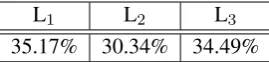
L1 L2 L3
35.17% 30.34% 34.49%
Table 2:Distribution of addressees for singularyou
remaining two classes therefore make up a small percentage of the data.
We were able to obtain a much less skewed class distribution by identifying the potential addressees in terms of their position in relation to the current speaker. The meeting setting includes a rectangu-lar table with two participants seated at each of its opposite longer sides. Thus, for a givenyou -utterance, we label listeners as either L1, L2 or
L3depending on whether they are sitting opposite,
diagonally or laterally from the speaker. Table 2 shows the resulting class distribution for our data-set. Such a labelling scheme is more similar to Jo-vanovic (2007), where participants are identified by their seating position.
4 Visual Information
4.1 Features from Manual Annotations
We derived per-utterance visual features from the Focus Of Attention (FOA) annotations provided by the AMI corpus. These annotations track meet-ing participants’ head orientation and eye gaze during a meeting.5 Our first step was to use the FOA annotations in order to compute what we re-fer to as Gaze Duration Proportion (GDP) values for each of the utterances of interest - a measure similar to the “Degree of Mean Duration of Gaze” described by (Takemae et al., 2004). Here a GDP value denotes the proportion of time in utteranceu for which subjectiis looking at targetj:
GDPu(i, j) =
X
j
T(i, j)/Tu
were Tu is the length of utterance u in
millisec-onds, and T(i, j), the amount of that time that i spends looking atj. The gazerican only refer to one of the four meeting participants, but the tar-get j can also refer to the white-board/projector screen present in the meeting room. For each utter-ance then, all of the possible values ofiandjare used to construct a matrix of GDP values. From this matrix, we then construct “Highest GDP” fea-tures for each of the meeting participants: such
5A description of the FOA labeling scheme is
For each participant Pi
– target for whole utterance – target for first third of utterance – target for second third of utterance – target for third third of utterance – target for -/+ 2 secs fromyoustart time – ratio 2nd hyp. target / 1st hyp. target – ratio 3rd hyp. target / 1st hyp. target – participant in mutual gaze with speaker
Table 3:Visual Features
features record the target with the highest GDP value and so indicate whom/what the meeting par-ticipant spent most time looking at during the ut-terance.
We also generated a number of additional fea-tures for each individual. These include firstly, three features which record the candidate “gazee” with the highest GDP during each third of the ut-terance, and which therefore account for gaze tran-sitions. So as to focus more closely on where par-ticipants are looking around the time when you
is uttered, another feature records the candidate with the highest GDP -/+ 2 seconds from the start time of the you. Two further features give some indication of the amount of looking around that the speaker does during an utterance - we hypoth-esized that participants (especially the speaker) might look around more in utterances with plu-ral addressees. The first is the ratio of the sec-ond highest GDP to the highest, and the secsec-ond is the ratio of the third highest to the highest. Fi-nally, there is a highest GDPmutual gazefeature for the speaker, indicating with which other indi-vidual, the speaker spent most time engaged in a mutual gaze.
Hence this gives a total of 29 features: seven features for each of the four participants, plus one mutual gaze feature. They are summarized in Ta-ble 3. These visual features are different to those used by Jovanovic (2007) (see Section 2). Jo-vanovic’s features record the number of times that each participant looks at each other participant during the utterance, and in addition, the gaze di-rection of the current speaker. Hence, they are not highest GDP values, they do not include a mutual gaze feature and they do not record whether par-ticipants look at the white-board/projector screen.
4.2 Automatic Features from Raw Video
To perform automatic visual feature extraction, a six degree-of-freedom head tracker was run over each subject’s video sequence for the utterances
containingyou. For each utterance, this gave 4 se-quences, one per subject, of the subject’s 3D head orientation and location at each video frame along with 3D head rotational velocities. From these measurements we computed two types of visual information: participant gaze and mutual gaze.
The 3D head orientation and location of each subject along with camera calibration information was used to compute participant gaze information for each video frame of each sequence in the form of a gaze probability matrix. More precisely, cam-era calibration is first used to estimate the 3D head orientation and location of all subjects in the same world coordinate system.
The gaze probability matrix is a 4×5 matrix where entryi, jstores the probability that subject iis looking at subjectj for each of the four sub-jects and the last column corresponds to the white-board/projector screen (i.e., entryi, jwherej= 5
is the probability that subject i is looking at the screen). Gaze probabilityG(i, j)is defined as
G(i, j) =G0e−αi,j2/γ2
where αi,j is the angular difference between the
gaze of subjectiand the direction defined by the location of subjectsiandj.G0is a normalization
factor such thatP
jG(i, j) = 1and γ is a
user-defined constant (in our experiments, we chose γ = 15degrees).
Using the gaze probability matrix, a4×1 per-frame mutual gaze vector was computed that for entryistores the probability that the speaker and subjectiare looking at one another.
In order to create features equivalent to those described in Section 4.1, we first collapse the frame-level probability matrix into a matrix of bi-nary values. We convert the probability for each frame into a binary judgement of whether subject iis looking at targetj:
H(i, j) =βG(i, j)
βis a binary value to evaluateG(i, j)> θ, where θis a high-pass thresholding value - or “gaze prob-ability threshold” (GPT) - between 0 and 1.
youstart time, and in addition, we compute a can-didate participant for mutual gaze with the speaker for the utterance overall.
We sought to use the GPT threshold which pro-duces automatic visual features that agree best with the features derived from the FOA annota-tions. Hence we experimented with different GPT values in increments of 0.1, and compared the re-sulting features to the manual features using the
kappa statistic. A threshold of 0.6 gave the best
kappascores, which ranged from 20% to 44%.6
5 Linguistic Information
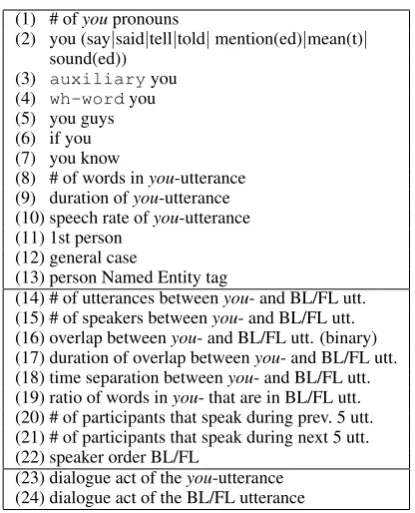
Our set of discourse features is a simplified ver-sion of those employed by Galley et al. (2004) and Gupta et al. (2007a). It contains three main types (summarized in Table 4):
—Sentential features(1 to 13) encode structural, durational, lexical and shallow syntactic patterns of the you-utterance. Feature 13 is extracted us-ing the AMI “Named Entity” annotations and in-dicates whether a particular participant is men-tioned in theyou-utterance. Apart from this fea-ture, all other sentential features are automatically extracted, and besides 1, 8, 9, and 10, they are all binary.
—Backward Looking (BL)/Forward Looking (FL) features (14 to 22) are mostly extracted from ut-terance pairs, namely the you-utterance and the BL/FL (previous/next) utterance by each listener Li (potential addressee). We also include a few
extra features which are not computed in terms of utterance pairs. These indicate the number of par-ticipants that speak during the previous and next 5 utterances, and the BL and FL speaker order. All of these features are computed automatically. —Dialogue Act (DA) features (23 to 24) use the manual AMI dialogue act annotations to represent the conversational function of the you-utterance and the BL/FL utterance by each potential ad-dressee. Along with the sentential feature based on the AMI Named Entity annotations, these are the only discourse features which are not com-puted automatically.7
6
The fact that our gaze estimator is getting any useful agreement with respect to these annotations is encouraging and suggests that an improved tracker and/or one that adapts to the user more effectively could work very well.
7
Since we use the manual transcripts of the meetings, the transcribed words and the segmentation into utterances or di-alogue acts are of course not given automatically. A fully automatic approach would involve using ASR output instead of manual transcriptions— something which we attempt in
(1) # ofyoupronouns
(2) you (say|said|tell|told|mention(ed)|mean(t)| sound(ed))
(3) auxiliaryyou (4) wh-wordyou (5) you guys (6) if you (7) you know
(8) # of words inyou-utterance (9) duration ofyou-utterance (10) speech rate ofyou-utterance (11) 1st person
(12) general case
(13) person Named Entity tag
(14) # of utterances betweenyou- and BL/FL utt. (15) # of speakers betweenyou- and BL/FL utt. (16) overlap betweenyou- and BL/FL utt. (binary) (17) duration of overlap betweenyou- and BL/FL utt. (18) time separation betweenyou- and BL/FL utt. (19) ratio of words inyou- that are in BL/FL utt. (20) # of participants that speak during prev. 5 utt. (21) # of participants that speak during next 5 utt. (22) speaker order BL/FL
[image:5.595.313.521.58.315.2](23) dialogue act of theyou-utterance (24) dialogue act of the BL/FL utterance
Table 4:Discourse Features
6 First Set of Experiments & Results
In this section we report our experiments and re-sults when using manual transcriptions and anno-tations. In Section 7 we will present the results obtained using ASR output and automatically ex-tracted visual information. All experiments (here and in the next section) are performed using a Bayesian Network classifier with 10-fold cross-validation.8 In each task, we give raw overall ac-curacy results and then F-scores for each of the classes. We computed measures of information gainin order to assess the predictive power of the various features, and did some experimentation with Correlation-based Feature Selection (CFS) (Hall, 2000).
6.1 Genericvs.Referential Uses ofYou
We first address the task of distinguishing between generic and referential uses ofyou.
Baseline. A majority class baseline that classi-fies all instances ofyouas referential yields an ac-curacy of 50.86% (see Table 1).
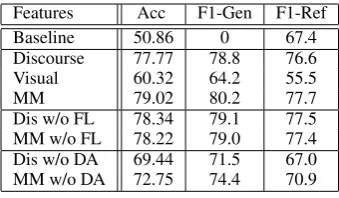
Results. A summary of the results is given in Ta-ble 5. Using discourse features only we achieve an accuracy of 77.77%, while using multimodal
Section 7.
8We use the the BayesNet classifier implemented in the
Features Acc F1-Gen F1-Ref
Baseline 50.86 0 67.4
Discourse 77.77 78.8 76.6
Visual 60.32 64.2 55.5
MM 79.02 80.2 77.7
Dis w/o FL 78.34 79.1 77.5
MM w/o FL 78.22 79.0 77.4
Dis w/o DA 69.44 71.5 67.0
[image:6.595.96.266.61.160.2]MM w/o DA 72.75 74.4 70.9
Table 5:Genericvs.referential uses
(MM) yields 79.02%, but this increase is not sta-tistically significant.
In spite of this, visual features do help to distinguish between generic and referential uses -note that the visual features alone are able to beat the baseline (p < .005). The listeners’ gaze is more predictive than the speaker’s: if listeners look mostly at the white-board/projector screen in-stead of another participant, then theyouis more likely to be referential. More will be said on this in Section 6.2.1 in the analysis of the results for the singularvs.plural referential task.
We found sentential features of the you -utterance to be amongst the best predictors, es-pecially those that refer to surface lexical proper-ties, such as features 1, 11, 12 and 13 in Table 4. Dialogue act features provide useful information as well. As pointed out by Gupta et al. (2007b; 2007a), a you pronoun within a question (e.g. an utterance tagged as elicit-assess or elicit-inform) is more likely to be referen-tial. Eliminating information about dialogue acts (w/o DA) brings down performance (p < .005), although accuracy remains well above the baseline (p < .001). Note that the small changes in perfor-mance when FL information is taken out (w/o FL) are not statistically significant.
6.2 Reference Resolution
We now turn to the referential instances of you, which can be resolved by determining the ad-dressee(s) of the given utterance.
6.2.1 Singularvs.Plural Reference
We start by trying to discriminate singularvs. plu-ral interpretations. For this, we use a two-way classification scheme that distinguishes between individual and group addressing. To our knowl-edge, this is the first attempt at this task using lin-guistic information.9
9But see e.g. (Takemae et al., 2004) for an approach that
uses manually extracted visual-only clues with similar aims.
Baseline. A majority class baseline that consid-ers all instances ofyouas referring to an individual addressee gives 67.92% accuracy (see Table 1).
Results. A summary of the results is shown in Table 6. There is no statistically significant differ-ence between the baseline and the results obtained when visual features are used alone (67.92% vs.
66.28%). However, we found that visual informa-tion did contribute to identifying some instances of plural addressing, as shown by the F-score for that class. Furthermore, the visual features helped to improve results when combined with discourse in-formation: using multimodal (MM) features pro-duces higher results than the discourse-only fea-ture set (p < .005), and increases from 74.24% to 77.05% with CFS.
As in the genericvs.referential task, the white-board/projector screen value for the listeners’ gaze features seems to have discriminative power -when listeners’ gaze features take this value, it is often indicative of a plural rather than a singular
you. It seems then, that in our data-set, the speaker often uses the white-board/projector screen when addressing the group, and hence draws the listen-ers’ gaze in this direction. We should also note that the ratio features which we thought might be useful here (see Section 4.1) did not prove so.
Features Acc F1-Sing. F1-Pl.
Baseline 67.92 80.9 0
Discourse 71.19 78.9 54.6
Visual 66.28 74.8 48.9
MM* 77.05 83.3 63.2
Dis w/o FL 72.13 80.1 53.7
MM w/o FL 72.60 79.7 58.1
Dis w/o DA 68.38 78.5 40.5
[image:7.595.316.516.61.158.2]MM w/o DA 71.19 78.8 55.3
Table 6:Singularvs.plural reference; * = with Correlation-based Feature Selection (CFS).
6.2.2 Detection of Individual Addressees
We now turn to resolving the singular referential uses ofyou. Here we must detect the individual addressee of the utterance that contains the pro-noun.
Baselines. Given the distribution shown in Ta-ble 2, a majority class baseline yields an accu-racy of 35.17%. An off-line system that has access to future context could implement a next-speaker baseline that always considers the next speaker to be the intended addressee, so yielding a high raw accuracy of 71.03%. A previous-speaker base-line that does not require access to future context achieves 35% raw accuracy.
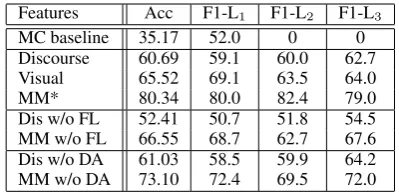
Results. Table 7 shows a summary of the re-sults, and these all outperform the majority class (MC) and previous-speaker baselines. When all discourse features are available, adding visual in-formation does improve performance (74.48%vs.
60.69%,p < .005), and with CFS, this increases further to 80.34% (p < .005). Using discourse or visual features alone gives scores that are below the next-speaker baseline (60.69% and 65.52%vs.
71.03%). Taking all forward-looking (FL) infor-mation away reduces performance (p < .05), but the small increase in accuracy caused by taking away dialogue act information is not statistically significant.
When we investigated individual feature contri-bution, we found that the most predictive features were the FL and backward-looking (BL) speaker order, and the speaker’s visual features (including mutual gaze). Whomever the speaker spent most time looking at or engaged in a mutual gaze with was more likely to be the addressee. All of the vi-sual features had some degree of predictive power apart from the ratio features. Of the other BL/FL discourse features, features 14, 18 and 19 (see Ta-ble 4) were more predictive. These indicate that utterances spoken by the intended addressee are
Features Acc F1-L1 F1-L2 F1-L3
MC baseline 35.17 52.0 0 0
Discourse 60.69 59.1 60.0 62.7
Visual 65.52 69.1 63.5 64.0
MM* 80.34 80.0 82.4 79.0
Dis w/o FL 52.41 50.7 51.8 54.5
MM w/o FL 66.55 68.7 62.7 67.6
Dis w/o DA 61.03 58.5 59.9 64.2
[image:7.595.95.268.61.158.2]MM w/o DA 73.10 72.4 69.5 72.0
Table 7: Addressee detection for singular references; * = with Correlation-based Feature Selection (CFS).
often adjacent to the you-utterance and lexically similar.
7 A Fully Automatic Approach
In this section we describe experiments which use features derived from ASR transcriptions and automatically-extracted visual information. We used SRI’s Decipher (Stolcke et al., 2008)10in or-der to generate ASR transcriptions, and applied the head-tracker described in Section 4.2 to the relevant portions of video in order to extract the visual information. Recall that the Named Entity features (feature 13) and the DA features used in our previous experiments had been manually an-notated, and hence are not used here. We again divide the problem into the same three separate tasks: we first discriminate between generic and referential uses of you, then singular vs. plural referential uses, and finally we resolve the ad-dressee for singular uses. As before, all exper-iments are performed using a Bayesian Network classifier and 10-fold cross validation.
7.1 Results
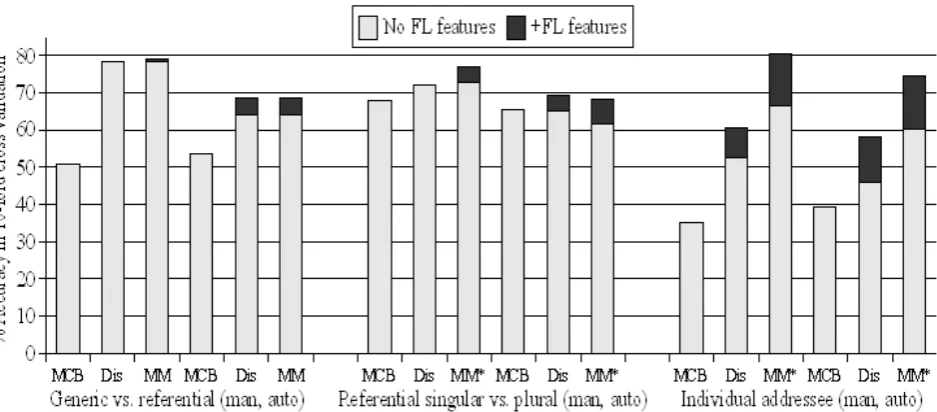
For each of the three tasks, Figure 7 compares the accuracy results obtained using the fully-automatic approach with those reported in Section 6. The figure shows results for the majority class baselines (MCBs), and with discourse-only (Dis), and multimodal (MM) feature sets. Note that the data set for the automatic approach is smaller, and that the majority class baselines have changed slightly. This is because of differences in the ut-terance segmentation, and also because not all of the video sections around theyouutterances were processed by the head-tracker.
In all three tasks we are able to significantly outperform the majority class baseline, but the vi-sual features only produce a significant
improve-10Stolcke et al. (2008) report a word error rate of 26.9% on
Figure 1: Results for the manual and automatic systems; MCB = majority class baseline, Dis = discourse features, MM = multimodal, * = with Correlation-based Feature Selection (CFS), FL = forward-looking, man = manual, auto = automatic.
ment in the individual addressee resolution task. For the genericvs. referential task, the discourse and multimodal classifiers both outperform the majority class baseline (p < .001), achieving accuracy scores of 68.71% and 68.48% respec-tively. In contrast to when using manual transcrip-tions and annotatranscrip-tions (see Section 6.1), removing forward-looking (FL) information reduces perfor-mance (p < .05). For the referential singular
vs.plural task, the discourse and multimodal with CFS classifier improve over the majority class baseline (p < .05). Multimodal with CFS does not improve over the discourse classifier - indeed without feature selection, the addition of visual features causes a drop in performance (p < .05). Here, taking away FL information does not cause a significant reduction in performance. Finally, in the individual addressee resolution task, the discourse, visual (60.78%) and multimodal clas-sifiers all outperform the majority class baseline (p < .005, p < .001 and p < .001 respec-tively). Here the addition of visual features causes the multimodal classifier to outperform the dis-course classifier in raw accuracy by nearly ten per-centage points (67.32%vs.58.17%,p < .05), and with CFS, the score increases further to 74.51% (p < .05). Taking away FL information does cause a significant drop in performance (p < .05).
8 Conclusions
We have investigated the automatic resolution of the second person English pronounyouin
multi-party dialogue, using a combination of linguistic and visual features. We conducted a first set of experiments where our features were derived from manual transcriptions and annotations, and then a second set where they were generated by entirely automatic means. To our knowledge, this is the first attempt at tackling this problem using auto-matically extracted multimodal information.
Our experiments showed that visual informa-tion can be highly predictive in resolving the ad-dressee of singular referential uses ofyou. Visual features significantly improved the performance of both our manual and automatic systems, and the latter achieved an encouraging 75% accuracy. We also found that our visual features had predictive power for distinguishing between generic and ref-erential uses ofyou, and between referential sin-gulars and plurals. Indeed, for the latter task, they significantly improved the manual system’s performance. The listeners’ gaze features were useful here: in our data set it was apparently the case that the speaker would often use the white-board/projector screen when addressing the group, thus drawing the listeners’ gaze in this direction.
References
Ron Arstein and Massimo Poesio. 2006. Identifying reference to abstract objects in dialogue. In Pro-ceedings of the 10th Workshop on the Semantics and Pragmatics of Dialogue (Brandial’06), pages 56– 63, Potsdam, Germany.
Ilse Bakx, Koen van Turnhout, and Jacques Terken. 2003. Facial orientation during multi-party inter-action with information kiosks. InProceedings of INTERACT, Zurich, Switzerland.
Donna Byron. 2004. Resolving pronominal refer-ence to abstract entities. Ph.D. thesis, University of Rochester, Department of Computer Science.
Michel Galley, Kathleen McKeown, Julia Hirschberg, and Elizabeth Shriberg. 2004. Identifying agree-ment and disagreeagree-ment in conversational speech: Use of Bayesian networks to model pragmatic de-pendencies. In Proceedings of the 42nd Annual Meeting of the Association for Computational Lin-guistics (ACL).
Surabhi Gupta, John Niekrasz, Matthew Purver, and Daniel Jurafsky. 2007a. Resolving “you” in multi-party dialog. In Proceedings of the 8th SIGdial Workshop on Discourse and Dialogue, Antwerp, Belgium, September.
Surabhi Gupta, Matthew Purver, and Daniel Jurafsky. 2007b. Disambiguating between generic and refer-ential “you” in dialog. InProceedings of the 45th Annual Meeting of the Association for Computa-tional Linguistics (ACL).
Mark Hall. 2000. Correlation-based Feature Selection for Machine Learning. Ph.D. thesis, University of Waikato.
Natasa Jovanovic, Rieks op den Akker, and Anton Ni-jholt. 2006a. Addressee identification in face-to-face meetings. In Proceedings of the 11th Confer-ence of the European Chapter of the ACL (EACL), pages 169–176, Trento, Italy.
Natasa Jovanovic, Rieks op den Akker, and Anton Ni-jholt. 2006b. A corpus for studying addressing behaviour in multi-party dialogues. Language Re-sources and Evaluation, 40(1):5–23. ISSN=1574-020X.
Natasa Jovanovic. 2007. To Whom It May Concern -Addressee Identification in Face-to-Face Meetings. Ph.D. thesis, University of Twente, Enschede, The Netherlands.
Michael Katzenmaier, Rainer Stiefelhagen, and Tanja Schultz. 2004. Identifying the addressee in human-human-robot interactions based on head pose and speech. In Proceedings of the 6th International Conference on Multimodal Interfaces, pages 144– 151, State College, Pennsylvania.
Iain McCowan, Jean Carletta, W. Kraaij, S. Ashby, S. Bourban, M. Flynn, M. Guillemot, T. Hain, J. Kadlec, V. Karaiskos, M. Kronenthal, G. Lathoud, M. Lincoln, A. Lisowska, W. Post, D. Reidsma, and P. Wellner. 2005. The AMI Meeting Corpus. In Proceedings of Measuring Behavior, the 5th Inter-national Conference on Methods and Techniques in Behavioral Research, Wageningen, Netherlands.
Christoph M¨uller. 2006. Automatic detection of non-referential Itin spoken multi-party dialog. In Pro-ceedings of the 11th Conference of the European Chapter of the Association for Computational Lin-guistics (EACL), pages 49–56, Trento, Italy.
Christoph M¨uller. 2007. Resolving it, this, and that in unrestricted multi-party dialog. In Proceedings of the 45th Annual Meeting of the Association for Computational Linguistics, pages 816–823, Prague, Czech Republic.
Andreas Stolcke, Xavier Anguera, Kofi Boakye, ¨Ozg¨ur C¸ etin, Adam Janin, Matthew Magimai-Doss, Chuck Wooters, and Jing Zheng. 2008. The icsi-sri spring 2007 meeting and lecture recognition system. In Proceedings of CLEAR 2007 and RT2007. Springer Lecture Notes on Computer Science.
Michael Strube and Christoph M¨uller. 2003. A ma-chine learning approach to pronoun resolution in spoken dialogue. InProceedings of ACL’03, pages 168–175.
Yoshinao Takemae, Kazuhiro Otsuka, and Naoki Mukawa. 2004. An analysis of speakers’ gaze behaviour for automatic addressee identification in multiparty conversation and its application to video editing. InProceedings of IEEE Workshop on Robot and Human Interactive Communication, pages 581– 586.
Koen van Turnhout, Jacques Terken, Ilse Bakx, and Berry Eggen. 2005. Identifying the intended addressee in mixed humand and human-computer interaction from non-verbal features. In Proceedings of ICMI, Trento, Italy.