Predicting Strong Associations on the Basis of Corpus Data
Yves Peirsman
Research Foundation – Flanders & QLVL, University of Leuven
Leuven, Belgium
Dirk Geeraerts
QLVL, University of Leuven Leuven, Belgium
Abstract
Current approaches to the prediction of associations rely on just one type of in-formation, generally taking the form of either word space models or collocation measures. At the moment, it is an open question how these approaches compare to one another. In this paper, we will investigate the performance of these two types of models and that of a new ap-proach based on compounding. The best single predictor is the log-likelihood ratio, followed closely by the document-based word space model. We will show, how-ever, that an ensemble method that com-bines these two best approaches with the compounding algorithm achieves an in-crease in performance of almost 30% over the current state of the art.
1 Introduction
Associations are words that immediately come to mind when people hear or read a given cue word. For instance, a word like pepper calls up salt, and wave calls up sea. Aitchinson (2003) and Schulte im Walde and Melinger (2005) show that such associations can be motivated by a number of factors, from semantic similarity to colloca-tion. Current computational models of associa-tion, however, tend to focus on one of these, by us-ing either collocation measures (Michelbacher et al., 2007) or word space models (Sahlgren, 2006; Peirsman et al., 2008). To this day, two gen-eral problems remain. First, the literature lacks a comprehensive comparison between these gen-eral types of models. Second, we are still looking for an approach that combines several sources of information, so as to correctly predict a larger va-riety of associations.
Most computational models of semantic rela-tions aim to model semantic similarity in
particu-lar (Landauer and Dumais, 1997; Lin, 1998; Pad´o and Lapata, 2007). In Natural Language Process-ing, these models have applications in fields like query expansion, thesaurus extraction, informa-tion retrieval, etc. Similarly, in Cognitive Science, such models have helped explain neural activa-tion (Mitchell et al., 2008), sentence and discourse comprehension (Burgess et al., 1998; Foltz, 1996; Landauer and Dumais, 1997) and priming patterns (Lowe and McDonald, 2000), to name just a few examples. However, there are a number of appli-cations and research fields that will surely bene-fit from models that target the more general phe-nomenon of association. For instance, automat-ically predicted associations may prove useful in models of information scent, which seek to ex-plain the paths that users follow in their search for relevant information on the web (Chi et al., 2001). After all, if the visitor of a web shop clicks on music to find the prices of iPods, this behaviour is motivated by an associative relation different from similarity. Other possible applica-tions lie in the field of models of text coherence (Landauer and Dumais, 1997) and automated es-say grading (Kakkonen et al., 2005). In addition, all research in Cognitive Science that we have re-ferred to above could benefit from computational models of association in order to study the effects of association in comparison to those of similarity.
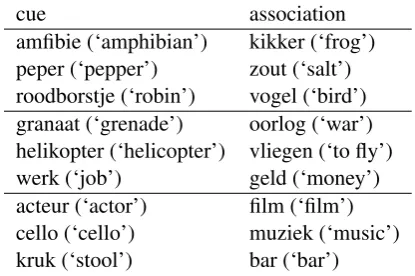
cue association amfibie (‘amphibian’) kikker (‘frog’) peper (‘pepper’) zout (‘salt’) roodborstje (‘robin’) vogel (‘bird’) granaat (‘grenade’) oorlog (‘war’) helikopter (‘helicopter’) vliegen (‘to fly’)
werk (‘job’) geld (‘money’)
[image:2.595.70.278.62.200.2]acteur (‘actor’) film (‘film’) cello (‘cello’) muziek (‘music’) kruk (‘stool’) bar (‘bar’)
Table 1: Examples of cues and their strongest as-sociation.
2 Associations
There are several reasons why a word may be asso-ciated to its cue. According to Aitchinson (2003), the four major types of associations are, in or-der of frequency, co-ordination (co-hyponyms like
pepper and salt), collocation (like salt and wa-ter), superordination (insectas a hypernym of but-terfly) and synonymy (like starved and hungry). As a result, a computational model that is able to predict associations accurately has to deal with a wide range of semantic relations. Past systems, however, generally use only one type of informa-tion (Wettler et al., 2005; Sahlgren, 2006; Michel-bacher et al., 2007; Peirsman et al., 2008; Wand-macher et al., 2008), which suggests that they are relatively restricted in the number of associations they will find.
In this article, we will focus on a set of Dutch cue words and their single strongest association, collected from a large psycholinguistic experi-ment. Table 1 gives a few examples of such cue– association pairs. It illustrates the different types of linguistic phenomena that an association may be motivated by. The first three word pairs are based on similarity. In this case, strong associ-ations can be hyponyms (as in amphibian–frog), co-hyponyms (as inpepper–salt) or hypernyms of their cue (as in robin–bird). The next three pairs represent semantic links where no relation of sim-ilarity plays a role. Instead, the associations seem to be motivated by a topical relation to their cue, which is possibly reflected by their frequent co-occurrence in a corpus. The final three word pairs suggest that morphological factors might play a role, too. Often, a cue and its association form the building blocks of a compound, and it is possi-ble that one part of a compound calls up the other.
The examples show that the process of compound-ing can go in either direction: the compound may consist of cue plus association (as incellomuziek
‘cello music’), or of association plus cue (as in
filmacteur ‘film actor’). While it is not clear if it is the compounds themselves that motivate the as-sociation, or whether it is just the topical relation between their two parts, they might still be able to help identify strong associations.
3 Approaches
Motivated by the three types of cue–association pairs that we identified in Table 1, we study three sources of information (two types of distributional information, and one type of morphological infor-mation) that may provide corpus-based evidence for strong associatedness: collocation measures, word space models and compounding.
3.1 Collocation measures
Probably the most straightforward way to pre-dict strong associations is to assume that a cue and its strong association often co-occur in text. As a result, we can use collocation measures like point-wise mutual information (Church and Hanks, 1989) or the log-likelihood ratio (Dunning, 1993) to predict the strong association for a given cue. Point-wise mutual information(PMI) tells us if two wordsw1 andw2occur together more or less often than expected on the basis of their indi-vidual frequencies and the independence assump-tion:
P M I(w1, w2) = log2
P(w1, w2)
P(w1)∗P(w2)
The log-likelihood ratio compares the like-lihoods L of the independence hypothesis (i.e.,
p = P(w2|w1) = P(w2|¬w1)) and the de-pendence hypothesis (i.e., p1 = P(w2|w1) 6=
P(w2|¬w1) = p2), under the assumption that the words in a text are binomially distributed:
logλ= log L(P(w2|w1);p)∗L(P(w2|¬w1);p)
L(P(w2|w1);p1)∗L(P(w2|¬w1);p2)
3.2 Word Space Models
antonyms. Collocation measures, however, are not specifically targeted towards the discovery of se-mantic similarity. Instead, they model similarity mainly as a side effect of collocation. Therefore we also investigated a large set of computational models that were specifically developed for the discovery of semantic similarity. These so-called word space models or distributional models of lex-ical semantics are motivated by the distributional hypothesis, which claims that semantically simi-lar words appear in simisimi-lar contexts. As a result, they model each word in terms of its contexts in a corpus, as a so-calledcontext vector. Distribu-tional similarity is then operaDistribu-tionalized as the sim-ilarity between two such context vectors. These models will thus look for possible associations by searching words with a context vector similar to the given cue.
Crucial in the implementation of word space models is their definition of context. In the cur-rent literature, there are basically three popular ap-proaches.Document-based modelsuse some sort of textual entity as features (Landauer and Du-mais, 1997; Sahlgren, 2006). Their context vec-tors note what documents, paragraphs, articles or similar stretches of text a target word appears in. Without dimensionality reduction, in these mod-els two words will be distributionally similar if they often occur together in the same paragraph, for instance. This approach still bears some simi-larity to the collocation measures above, since it relies on the direct co-occurrence of two words in text. Second, syntax-based models focus on the syntactic relationships in which a word takes part (Lin, 1998). Here two words will be sim-ilar when they often appear in the same syntac-tic roles, likesubject of fly. Third, word-based models simply use as features the words that appear in the context of the target, without considering the syntactic relations between them. Context is thus defined as the set of n words around the target (Sahlgren, 2006). Obviously, the choice of context size will again have a major in-fluence on the behaviour of the model. Syntax-based and word-Syntax-based models differ from collo-cation measures and document-based models in that they do not search for words that co-occur directly. Instead, they look for words that often occur together with the same context words or syntactic relations. Even though all these models were originally developed to model semantic
sim-ilarity relations, syntax-based models have been shown to favour such relations more than word-based and document-word-based models, which might capture more associative relationships (Sahlgren, 2006; Van der Plas, 2008).
3.3 Compounding
As we have argued before, one characteristic of cues and their strong associations is that they can sometimes be combined into a compound. There-fore we developed a third approach which dis-covers for every cue the words in the corpus that in combination with it lead to an existing com-pound. Since in Dutch compounds are generally written as one word, this is relatively easy. We at-tached each candidate association to the cue (both in the combination cue+association and associ-ation+cue), following a number of simple mor-phological rules for compounding. We then de-termined if any of these hypothetical compounds occurred in the corpus. The possible associa-tions that led to an observed compound were then ranked according to the frequency of that com-pound.1 Note that, for languages where com-pounds are often spelled as two words, like En-glish, our approach will have to recognize multi-word units to deal with this issue.
3.4 Previous research
In previous research, most attention has gone out to the first two of our models. Sahlgren (2006) tries to find associations with word space mod-els. He argues that document-based models are better suited to the discovery of associations than word-based ones. In addition, Sahlgren (2006) as well as Peirsman et al. (2008) show that in word-based models, large context sizes are more effec-tive than small ones. This supports Wandmacher et al.’s (2008) model of associations, which uses a context size of 75 words to the left and right of the target. However, Peirsman et al. (2008) find that word-based distributional models are clearly out-performed by simple collocation measures, par-ticularly the log-likelihood ratio. Such colloca-tion measures are also used by Michelbacher et al. (2007) in their classification of asymmetric associ-ations. They show the chi-square metric to be a ro-bust classifier of associations as either symmetric or asymmetric, while a measure based on condi-tional probabilities is particularly suited to model
●
●
●
●
● ● ● ● ● ●
2 4 6 8 10
2
5
10
20
50
100
context size
median rank of most frequent association
● word−based no stoplist word−based stoplist pmi statistic
[image:4.595.80.508.97.326.2]log−likelihood statistic compound−based syntax−based document−based
Figure 1: Median rank of the strong associations.
the magnitude of asymmetry. In a similar vein, Wettler et al. (2005) successfully predict associa-tions on the basis of co-occurrence in text, in the framework of associationist learning theory. De-spite this wealth of systems, it is an open question how their results compare to each other. More-over, a model that combines several of these sys-tems might outperform any basic approach.
4 Experiments
Our experiments were inspired by the association prediction task at theESSLLI-2008 workshop on distributional models. We will first present this precise setup and then go into the results and their implications.
4.1 Setup
Our data was the Twente Nieuws Corpus (TwNC), which contains 300 million words of Dutch news-paper articles. This corpus was compiled at the University of Twente and subsequently parsed by the Alpino parser at the University of Gronin-gen (van Noord, 2006). The newspaper arti-cles in the corpus served as the contextual fea-tures for the document-based system; the depen-dency triples output by Alpino were used as in-put for the syntax-based approach. These syntactic
features of the typesubject of flycovered eight syntactic relations — subject, direct object, prepositional complement, adverbial prepositional phrase, adjective modification, PP postmodifica-tion, apposition and coordination. Finally, the col-location measures and word-based distributional models took into account context sizes ranging from one to ten words to the left and right of the target.
be-similar related, not similar
models mean med rank1 mean med rank1
pmi context 10 16.4 4 23% 25.2 9 10%
log-likelihood ratio context 10 12.8 2 41% 18.0 3 31%
syntax-based 16.3 4 22% 61.9 70 2%
word-based context 10 stoplist 10.7 3 27% 36.9 17 12%
document-based 10.1 3 26% 20.2 4 26%
[image:5.595.122.476.66.174.2]compounding 80.7 101 5% 51.9 26 12%
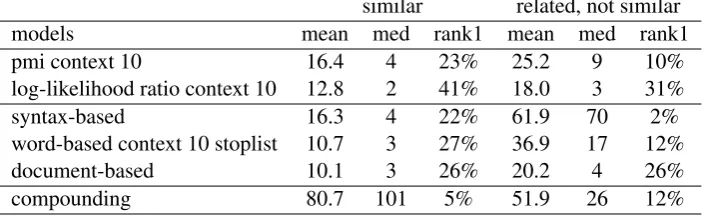
Table 2: Performance of the models on semantically similar cue-association pairs and related but not similar pairs.
med = median; rank1 = number of associations at rank 1
tween them. This measure is more or less stan-dard in the literature and leads to state-of-the-art results (Sch¨utze, 1998; Pad´o and Lapata, 2007; Bullinaria and Levy, 2007). While the cosine is a symmetric measure, however, association strength is asymmetric. For example, snelheid (‘speed’) triggered auto (‘car’) no fewer than 55 times in the experiment, whereas auto evoked snelheid a mere 3 times. Like Michelbacher et al. (2007), we solve this problem by focusing not on the similar-ity score itself, but on the rank of the association in the list of nearest neighbours to the cue. We thus expect that autowill have a much higher rank in the list of nearest neighbours tosnelheidthan vice versa.
Our Gold Standard was based on a large-scale psycholinguistic experiment conducted at the Uni-versity of Leuven (De Deyne and Storms, 2008). In this experiment, participants were asked to list three different associations for all cue words they were presented with. Each of the 1425 cues was given to at least 82 participants, resulting in a to-tal of 381,909 responses. From this set, we took only noun cues with a single strong association. This means we found the most frequent associ-ation to each cue, and only included the pair in the test set if the association occurred at least 1.5 times more often than the second most frequent one. This resulted in a final test set of 593 cue-association pairs. Next we brought together all the associations in a set of candidate associations, and complemented it with 1000 random words from the corpus with a frequency of at least 200. From these candidate words, we had each model select the 100 highest scoring ones (the nearest neigh-bours). Performance was then expressed as the median and mean rank of the strongest association in this list. Associations absent from the list
auto-matically received a rank of 101. Thus, the lower the rank, the better the performance of the system. While there are obviously many more ways of as-sembling a test set and scoring the several systems, we found these all gave very similar results to the ones reported here.
4.2 Results and discussion
The median ranks of the strong associations for all models are plotted in Figure 1. The means show the same pattern, but give a less clear indication of the number of associations that were suggested in the topn most likely candidates. The most suc-cessful approach is the log-likelihood ratio (me-dian 3 with a context size of 10, mean 16.6), followed by the document-based model (median 4, mean 18.4) and point-wise mutual informa-tion (median 7 with a context size of 10, mean 23.1). Next in line are the word-based distribu-tional models with and without a stoplist (high-est medians at 11 and 12, high(high-est means at 30.9 and 33.3, respectively), and then the syntax-based word space model (median 42, mean 51.1). The worst performance is recorded for the compound-ing approach (median 101, mean 56.7). Overall, corpus-based approaches that rely on direct co-occurrence thus seem most appropriate for the pre-diction of strong associations to a cue. This is probably a result of two factors. First, collocation itself is an important motivation for human asso-ciations (Aitchinson, 2003). Second, while col-location approaches in themselves do not target semantic similarity, semantically similar associa-tions are often also collocates to their cues. This is particularly the case for co-hyponyms, likepepper
andsalt, which score very high both in terms of collocation and in terms of similarity.
●
●
●
cue frequency
Index
median rank of strongest association
high mid low
1
2
5
10
20
50
100
●
●
●
association frequency
Index
median rank of strongest association
high mid low
1
2
5
10
20
50
100 ● pmi context 10
log−likelihood context 10 syntax−based
word−based context 10 stoplist document−based
[image:6.595.73.477.66.238.2]compounding
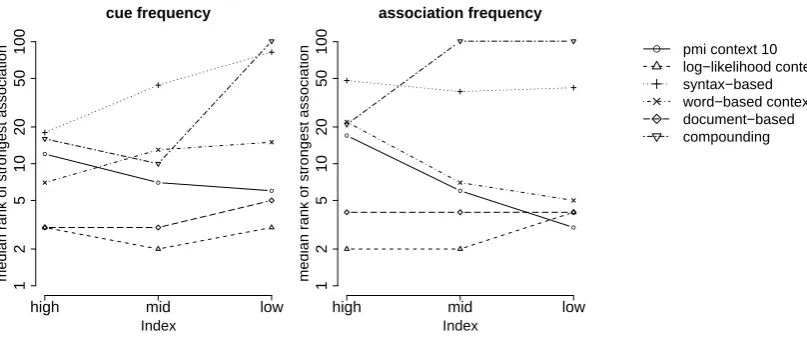
Figure 2: Performance of the models in three cue and association frequency bands.
more detail. A first factor of interest is the dif-ference between associations that are similar to their cue and those which are related but not simi-lar. Most of our models show a crucial difference in performance with respect to these two classes. The most important results are given in Table 2. The log-likelihood ratio gives the highest number of associations at rank 1 for both classes. Par-ticularly surprising is its strong performance with respect to semantic similarity, since this relation is only a side effect of collocation. In fact, the log-likelihood ratio scores better at predicting se-mantically similar associations than related but not similar associations. Its performance moreover lies relatively close to that of the word space mod-els, which were specifically developed to model semantic similarity. This underpins the observa-tion that even associaobserva-tions that are semantically similar to their cues are still highly motivated by direct co-occurrence in text. Interestingly, only the compounding approach has a clear preference for associations that are related to their cue, but not similar.
A second factor that influences the performance of the models is frequency. In order to test its precise impact, we split up the cues and their as-sociations in three frequency bands of compara-ble size. For the cues, we constructed a band for words with a frequency of less than 500 in the corpus (low), between 500 and 2,500 (mid) and more than 2,500 (high). For the associations, we had bands for words with a frequency of less than 7,500 (low), between 7,500 and 20,000 (mid) and more than 20,000 (high). Figure 2 shows the performance of the most important models in
these frequency bands. With respect to cue fre-quency, the word space models and compound-ing approach suffer most from low frequencies and hence, data sparseness. The log-likelihood ratio is much more robust, while point-wise mu-tual information even performs better with low-frequency cues, although it does not yet reach the performance of the document-based system or the log-likelihood ratio. With respect to asso-ciation frequency, the picture is different. Here the word-based distributional models andPMI per-form better with low-frequency associations. The document-based approach is largely insensitive to association frequency, while the log-likelihood ra-tio suffers slightly from low frequencies. The per-formance of the compounding approach decreases most. What is particularly interesting about this plot is that it points towards an important differ-ence between the log-likelihood ratio and point-wise mutual information. In its search for nearest neighbours to a given cue word, the log-likelihood ratio favours frequent words. This is an advanta-geous feature in the prediction of strong associa-tions, since people tend to give frequent words as associations.PMI, like the syntax-based and word-based models, lacks this characteristic. It therefore fails to discover mid- and high-frequency associa-tions in particular.
be-model cue–association pairs
document-based model cue–billiards,amphibian–frog,fair–doughnut ball,sperm whale–sea,
map–trip,avocado–green,carnivore–meat,one-wheeler–circus,
wallet–money,pinecone–wood
log-likelihood ratio top–toy,oven–hot,sorbet–ice cream,rhubarb–sour,poppy–red,
knot–rope,pepper–red,strawberry–red,massage–oil,raspberry–red
Table 3: A comparison of the document-based model and the log-likelihood ratio on the basis of the cue–target pairs with the largest difference in log ranks between the two approaches.
tween the models in the logarithm of the rank of the association. The log-likelihood ratio seems to be biased towards “characteristics” of the tar-get. For instance, it finds the strong associative relation betweenpoppy,pepper,strawberry, rasp-berryand their shared colourredmuch better than the document-based model, just like it finds the re-latedness betweenovenandhotandrhubarband
sour. The document-based model recovers more associations that display a strong topical connec-tion with their cue word. This is thanks to its re-liance on direct co-occurrence within a large con-text, which makes it less sensitive to semantic sim-ilarity than word-based models. It also appears to have less of a bias toward frequent words than the log-likelihood ratio. Note, for instance, the pres-ence ofdoughnut ball(orsmoutebolin Dutch) as the third nearest neighbour tofair, despite the fact it occurs only once (!) in the corpus. This com-plementarity between our two most successful ap-proaches suggests that a combination of the two may lead to even better results. We therefore in-vestigated the benefits of a committee-based or en-semble approach.
5 Ensemble-based prediction of strong associations
Given the varied nature of cue–association rela-tions, it could be beneficial to develop a model that relies on more than one type of information. En-semble methods have already proved their effec-tiveness in the related area of automatic thesaurus extraction (Curran, 2002), where semantic similar-ity is the target relation. Curran (2002) explored three ways of combining multiple ordered sets of words: (1) mean, taking the mean rank of each word over the ensemble; (2)harmonic, taking the harmonic mean; (3)mixture, calculating the mean similarity score for each word. We will study only the first two of these approaches, as the different metrics of our models cannot simply be combined
in a mean relatedness score. More particularly, we will experiment with ensembles taking the (har-monic) mean of the natural logarithm of the ranks, since we found these to perform better than those working with the original ranks.2
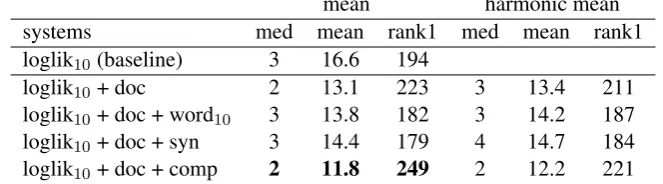
Table 4 compares the results of the most im-portant ensembles with that of the single best ap-proach, the log-likelihood ratio with a context size of 10. By combining the two best approaches from the previous section, the log-likelihood ra-tio and the document-based model, we already achieve a substantial increase in performance. The mean rank of the association goes from 3 to 2, the mean from 16.6 to 13.1 and the number of strong associations with rank 1 climbs from 194 to 223. This is a statistically significant increase (one-tailed paired Wilcoxon test, W = 30866,
p = .0002). Adding another word space model to the ensemble, either a word-based or syntax-based model, brings down performance. However, the addition of the compound model does lead to a clear gain in performance. This ensemble finds the strongest association at a median rank of 2, and a mean of 11.8. In total, 249 strong associations (out of a total 593) are presented as the best candidate by the model — an increase of 28.4% compared to the log-likelihood ratio. Hence, despite its poor performance as a simple model, the compound-based approach can still give useful information about the strong association of a cue word when combined with other models. Based on the origi-nal ranks, the increase from the previous ensem-ble is not statistically significant (W = 23929,
p = .31). If we consider differences at the start of the neighbour list more important and compare the logarithms of the ranks, however, the increase becomes significant (W = 29787.5,p= 0.0008). Its precise impact should thus further be investi-gated.
mean harmonic mean
systems med mean rank1 med mean rank1
loglik10(baseline) 3 16.6 194
loglik10+ doc 2 13.1 223 3 13.4 211
loglik10+ doc + word10 3 13.8 182 3 14.2 187
loglik10+ doc + syn 3 14.4 179 4 14.7 184
[image:8.595.132.464.67.159.2]loglik10+ doc + comp 2 11.8 249 2 12.2 221
Table 4: Results of ensemble methods.
loglik10= log-likelihood ratio with context size 10; doc = document-based model;
word10= word-based model with context size 10 and a stoplist; syn = syntax-based model;
comp = compound-based model;
med = median; rank1 = number of associations at rank 1
Let us finally take a look at the types of strong associations that still tend to receive a low rank in this ensemble system. The first group consists of adjectives that refer to an inherent characteristic of the cue word that is rarely mentioned in text. This is the case fortennis ball–yellow,cheese–yellow,
grapefruit–bitter. The second type brings together polysemous cues whose strongest association re-lates to a different sense than that represented by its corpus-based nearest neighbour. This applies to Dutchkant, which is polysemous betweenside
and lace. Its strongest association, Bruges, is clearly related to the latter meaning, but its corpus-based neighbours ballandwater suggest the for-mer. The third type reflects human encyclopaedic knowledge that is less central to the semantics of the cue word. Examples arepolice–blue,love–red, ortriangle–maths. In many of these cases, it ap-pears that the failure of the model to recover the strong associations results from corpus limitations rather than from the model itself.
6 Conclusions and future research
In this paper, we explored three types of basic ap-proaches to the prediction of strong associations to a given cue. Collocation measures like the log-likelihood ratio simply recover those words that strongly collocate with the cue. Word space mod-els look for words that appear in similar contexts, defined as documents, context words or syntac-tic relations. The compounding approach, finally, searches for words that combine with the target to form a compound. The log-likelihood ratio with a large context size emerged as the best predic-tor of strong association, followed closely by the
document-based word space model. Moreover, we showed that an ensemble method combining the log-likelihood ratio, the document-based word space model and the compounding approach, out-performed any of the basic methods by almost 30%.
In a number of ways, this paper is only a first step towards the successful modelling of cue– association relations. First, the newspaper cor-pus that served as our data has some restrictions, particularly with respect to diversity of genres. It would be interesting to investigate to what degree a more general corpus — a web corpus, for in-stance — would be able to accurately predict a wider range of associations. Second, the mod-els themselves might benefit from some additional features. For instance, we are curious to find out what the influence of dimensionality reduction would be, particularly for document-based word space models. Finally, we would like to extend our test set from strong associations to more asso-ciations for a given target, in order to investigate how well the discussed models predict relative as-sociation strength.
References
Jean Aitchinson. 2003. Words in the Mind. An Intro-duction to the Mental Lexicon. Blackwell, Oxford.
John A. Bullinaria and Joseph P. Levy. 2007. Ex-tracting semantic representations from word co-occurrence statistics: A computational study. Be-haviour Research Methods, 39:510–526.
Ed H. Chi, Peter Pirolli, Kim Chen, and James Pitkow. 2001. Using information scent to model user infor-mation needs and actions on the web. In Proceed-ings of the ACM Conference on Human Factors and Computing Systems (CHI 2001), pages 490–497.
Kenneth Ward Church and Patrick Hanks. 1989. Word association norms, mutual information and lexicog-raphy. InProceedings of ACL-27, pages 76–83.
James R. Curran. 2002. Ensemble methods for au-tomatic thesaurus extraction. InProceedings of the Conference on Empirical Methods in Natural Lan-guage Processing (EMNLP-2002), pages 222–229.
Simon De Deyne and Gert Storms. 2008. Word asso-ciations: Norms for 1,424 Dutch words in a contin-uous task. Behaviour Research Methods, 40:198– 205.
Ted Dunning. 1993. Accurate methods for the statis-tics of surprise and coincidence. Computational Linguistics, 19:61–74.
Peter W. Foltz. 1996. Latent Semantic Analysis for text-based research. Behaviour Research Methods, Instruments, and Computers, 29:197–202.
Tuomo Kakkonen, Niko Myller, Jari Timonen, and Erkki Sutinen. 2005. Automatic essay grading with probabilistic latent semantic analysis. In Proceed-ings of the 2nd Workshop on Building Educational Applications Using NLP, pages 29–36.
Thomas K. Landauer and Susan T. Dumais. 1997. A solution to Plato’s problem: The Latent Semantic Analysis theory of acquisition, induction and rep-resentation of knowledge. Psychological Review, 104(2):211–240.
Dekang Lin. 1998. Automatic retrieval and cluster-ing of similar words. In Proceedings of COLING-ACL98, pages 768–774, Montreal, Canada.
Will Lowe and Scott McDonald. 2000. The di-rect route: Mediated priming in semantic space. In Proceedings of COGSCI 2000, pages 675–680. Lawrence Erlbaum Associates.
Lukas Michelbacher, Stefan Evert, and Hinrich Sch¨utze. 2007. Asymmetric association measures. In Proceedings of the International Conference on Recent Advances in Natural Language Processing (RANLP-07).
Tom M. Mitchell, Svetlana V. Shinkareva, An-drew Carlson, Kai-Min Chang, Vicente L. Malva, Robert A. Mason, and Marcel Adam Just. 2008. Predicting human brain activity associated with the meanings of nouns.Science, 320:1191–1195.
Sebastian Pad´o and Mirella Lapata. 2007.
Dependency-based construction of semantic space models. Computational Linguistics, 33(2):161–199.
Yves Peirsman, Kris Heylen, and Dirk Geeraerts. 2008. Size matters. Tight and loose context defini-tions in English word space models. InProceedings of the ESSLLI Workshop on Distributional Lexical Semantics, pages 9–16.
Magnus Sahlgren. 2006. The Word-Space Model. Using Distributional Analysis to Represent Syntag-matic and ParadigSyntag-matic Relations Between Words in High-dimensional Vector Spaces. Ph.D. thesis, Stockholm University, Stockholm, Sweden.
Sabine Schulte im Walde and Alissa Melinger. 2005. Identifying semantic relations and functional prop-erties of human verb associations. InProceedings of the conference on Human Language Technology and Empirical Methods in Natural Language Pro-cessing, pages 612–619.
Hinrich Sch¨utze. 1998. Automatic word sense dis-crimination. Computational Linguistics, 24(1):97– 124.
Lonneke Van der Plas. 2008. Automatic Lexico-Semantic Acquisition for Question Answering. Ph.D. thesis, University of Groningen, Groningen, The Netherlands.
Gertjan van Noord. 2006. At last parsing is now oper-ational. In Piet Mertens, C´edrick Fairon, Anne Dis-ter, and Patrick Watrin, editors,Verbum Ex Machina. Actes de la 13e Conf´erence sur le Traitement Au-tomatique des Langues Naturelles (TALN), pages 20–42.
Tonio Wandmacher, Ekaterina Ovchinnikova, and Theodore Alexandrov. 2008. Does Latent Seman-tic Analysis reflect human associations? In Pro-ceedings of the ESSLLI Workshop on Distributional Lexical Semantics, pages 63–70.