PROSODIC INHERITANCE AND MORPHOLOGICAL GENERALISATIONS
Sabine ReinhardDafydd Gibbon UniversitSt Bielefeld
FakultSt fflr Linguistik und Literaturwissensohaft P8640
D J,800 Bielefeld 1
email: reinhard@lilil 1 .uni-bielefeld.de gibbon@lilil 1 .uni-bielefeld.de
ABSTRACT
Prosodic Inheritance (PI) morphology pro- vides uniform treatment of both concatenative and non-concatenative morphological and phonological generalisations using default inheri- tance. Models of an extensive range of German
Umlaut and Arabic intercalation facts, imple-
mented in DATR, show that the PI approach also covers 'hard cases' more homogeneously and more extensively than previous computational treatments.
1,
INTRODUCTION
Computational models of sentence syntax are increasingly based on well-defined linguistic theories and implemented using general formal- isms; by contrast, morphology and phonology in the lexicon tend to be handled with tailor-made hybrid formalisms selected for properties such as finite state compilability, object orientation, default inheritance, or procedural efficiency. The linguistically motivated Prosodic Inheritance (PI) model with defaults captures morphotactic and morphophonological generalisations in a unified declarative formalism, and has broad linguistic coverage of both concatenative morphology and the notorious 'hard cases' of non-concatenative morphology. This paper integrates the PI con- cepts underlying previous descriptions of Ger-
man Umlaut (Reinhard 1990a, 1990b), Bantu tone
morphology and Arabic C-V intercalation (Gibbon 1990); Umlaut and intercalation are treated here. PI descriptions are currently Imple- mented in a DATR dialect (Gibbon 1989; for DATR cf. Evans & Gazdar 1989, 1990, 1989a, 1989b); DATR was chosen for its syntactic simplicity and its explicit formal semantics.
2. INHERITANCE AND NON-CONCATENATIVE
MORPHOLOGY
Morphological generalisations are of three basic kinds: morphotactic, the combinatorial principles of word composition in terms of immediate dominance (ID) relations, morpho-
semantic, interpretation functions from morpho-
tactic structures to semantic representations,
and morphophonologica/ ( or ' morphograph ic') ,
interpretation functions from morphotactic structures to surface phonological or ortho- graphic representations. This paper is mainly concerned with modelling morphotactic and morphophonological generalisations.
Simple abstract morphotactic combinations (denoted by the operator '*') may be repre- sented as follows:
Ger.: [Rad * singular], [Rad * plural]
Eng.: [cat * plural], [dog * plural], [horse * plural]
Morpheme ID combinations receive a composi- tional morphophonological interpretation based on the forms of the component morphemes and the kind of construction involved. Phonological interpretations are composed primarily by means of concatenation, with phonological feature variation at morpheme boundaries:
Get.: Rad-Rades,/ra:t/-/ra:des/
(Voicing specification of stem final C)
Eng.: cats-dogs-horses,/keets/-/dogz/-/ho:siz/
(Voicing specification of C and epenthetic V in
suffix)
Non-concatenative morphophonological composition (which we will here refer to as
morphoprosody) deals specifically with temporal
feature overlap phenomena such as infixing, vowel gradation, consonant mutation, morpho- logical tone and stress patterning, involving the structural 'association' of temporally coextensive categories such as features and autosegmental tiers:
Eng.: telephone, telephony, telephonic
(stress, vowel quality) Ger.: Fuchs, F~ichse, fuchsig
(Umlaut)
Arab.: ktb, kutib, aktabib
(intercalation)
Kikuyu: hmahmolrorlihra, hmahmoltomhihre
(tone)
by " and ,o, respectively. QLP representations are intermediate specifications of morphotactic detail between abstract ID and concrete phono- logical representations.
Morphophonological generalisations thus
require three levels of abstraction:
L 1 , Morphotactic ID: L 2, Morphotactic QLP: L 3, Phonological:
Orthographic:
[telephone * ADJ-ic]
[[telephone o final-stress] " ic] /t E I @ I O n I k/(SAMPA com- puter phonetic notation) "telephonic"
Details of phonological feature structure will not be dealt with here.
The only explicit computational treatment of association operations is by Kay (1987; but cf. also the formal account by Bird & Klein, 1990), who models autosegmental phonological associ- ation with a multi-tape finite state transducer. Like autosegmental descriptions, Kay's finite state tranducers explicitly operate with direc- tional (leff-to-right or right-to-left) algorithms. Other approaches rely on lists of stem variants, string permutations, or string position indices (Cahill 1990).
By contrast, the Pi approach to morpho- prosody does not rely on algorithmic conditions such as leff-right rule application, but on a general default principle:
Assign a default value everywhere in a given context unless a) a designated value, and b) a designated position are otherwise specified in an explicit constraint.
E.g. Get.: Assign non-umlaut everywhere in a stem
unless
a) an umlauting stem, and
b) an umlaut-triggering affix cooccur. Arab.: Assign the default vowel of a vocal-
ism (default consonant of a radical) everywhere in a word unless
a) a designated vowel (designated con- sonant), and
b) a designated position in stem syllable structure are explicitly specified.
In the PI approach, lexemes are treated as individual (or 'most specific') nodes in an inheri- tance net. They are underspecified and inherit their full representations from semantic, syntac- tic, and phonological default inheritance hierar- chies. Each node in these hierarchies represents a morphophonological generalisation and is associated with a set of special cases (relative exceptions) over which a default priority order- ing in terms of relative specificity is defined. Fully specified phonological and orthographic lexeme representations are inherited from a hierarchy of general templates representing word, syllable and segment structures, and marked with QLP operators. The template slots are instantiated with properties inherited from
specific lexemes. In the DATR implementation,
inheritance of representations is implemented by local inheritance, and inheritance of specific exceptions and template instantiations is imple- mented by global inheritance,
. MORPHOLOGICAL GENERAUSATIONS: UMLAUT AND INTERCALATION
Two superficially related cases of non-concat-
enative morphology are Umlaut in German and
vowel-consonant-intercalation in Arabic. They are similar in respect of the QLP operation of stem vowel variation in different morphological contexts, though the Arabic case is more com- plex, with additional variation of syllable struc-
ture and consonant position; in German, Umlaut
primarily affects the vowel fronting feature.
3 . 1 . GERMAN UMLAUT
Current computational descriptions of German
vowel fronting (Umlaut) are linguistically inade-
quate, in that they do not take into account the complexity of mutual conditioning between stem classes and inflectional and derivational affixes: either they ignore the complexities of deriva- tional morphology (Schiller & Steffens 1990), or overgeneralise, with lists of absolute exceptions Frost t990).
In the PI model of German Umlaut, a wide
range of 'exceptions' turn out to be important subregularities. The inflectional properties of stems are taken as defaults for both inflection and derivation; and captured in an inheritance hierarchy. Lexemes inherit fully specified stem forms, inflectional and derivational affixes, and
Umlaut specification, via this hierarchy. The
hierarchy for nouns specifies that Umlaut with
zero-suffix plurals depends on gender, is arbi- trarily specified for each lexeme with e-suffix
plurals (Umlaut being the default case), always
occurs with er-suffix plurals, never with e._nn-, s-, and exotic plurals. Derivational suffixes are also
specified for their Umlaut-triggering properties,
but different subregularities hold for different derivational suffixes in non-default cases.
stem p!ur. infl, -isch deriv. -ig deriv,
Fuchs Fi.ichs-e_ fi.ichs-isch fuchs-i.q.
Hund Hund-e_ h/.ind-isch hund-i.q
Consequently, Umlaut conditions must be
inherited from several sources.
The three levels of morphophonological generalisation for an umlauted plural form like F(jchse have the following representations:
L 1 , Morphotactic ID: [Fuchs * Plural]
L 2, Morphotactic QLP: [[Fuchs ° Umlaut] ^ e]
L 3, Phonological: /f Y k s @/
Orthographic: "fi~chse"
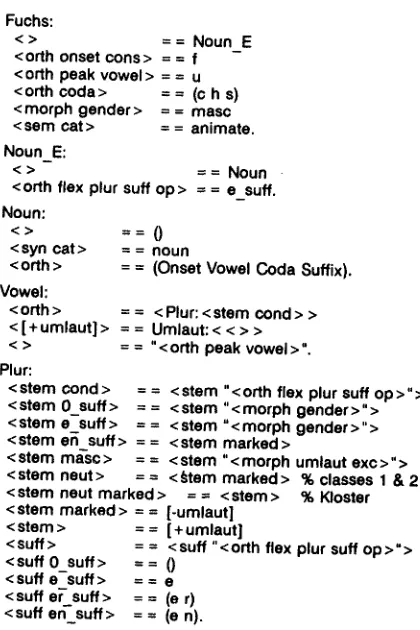
The DATR implementation fragment shown below can be interpreted fairly straightforwardly as a representation of a semantic inheritance
net, in which the 'most specific' node is Fuchs,
which has some typed properties of its own and
starting node and an attribute path. The left hand side of an equation is required to match a prefix of the query path; if there is more than one match for a node, the longest matching path overrides any others. Inheritance from more general nodes on the right hand side of an equation is explicitly constrained by associating them with a path. This path replaces the match- ing prefix of the query path in any further inheri- tance. If node or path are not specified, the node or path from the current local (or global) query environment is transferred.
In this implementation, the lexeme .Fuchs inherits a full morphologically conditioned phonological/orthographic representation. In the lexical representation of Fuchs, the vowel is not specified for orthographic or phonological
Umlaut. The vowel representation is inherited
from a template with a vowel slot which condi- tionally inherits a [+ umlaut] or [- umlaut] morphological subcategory by multiple inheri- tance from the stem and affix concerned. The condition is implemented in DATR as nested inheritance:
e.g. V o w e h < o r t h > = = < P l u r : < s t e m c o n d > > w h i c h c o n d i t i o n a l l y specifies either Vowel: < orth • = = < [ + u m l a u t ] >
o r
V o w e l : < orth > = = < [ - u m l a u t ] •
d e p e n d i n g o n t h e v a l u e o f Plur: < s t e m c o n d > f o r t h e l e x e m e c o n c e r n e d .
A fragment of the PI implementation in DATR is stated below.
Fuchs:
< > = = N o u n E
< o r t h o n s e t c o n s > = = f - < orth p e a k v o w e l > = = u
< o r t h c o d a • = = (c h s)
< m o r p h g e n d e r • = = m a s c
< s e r e c a t > = = a n i m a t e .
N o u n E:
< • = = N o u n
< o r t h flex p l u r surf o p > = = e surf.
N o u n :
< > ---= 0
< s y n c a t > = = n o u n
< o r t h • = = ( O n s e t V o w e l C o d a Suffix).
Vowel:
< o r t h > = = < P l u r : < s t e m c o n d > > < [ + u m l a u t ] • = = U m l a u t : < < > • < > = = " < o r t h p e a k v o w e l • " . Plur:
< s t e m c o n d > = = < s t e m " < o r t h f l e x p l u r surf o p > " >
< s t e m 0 s u r f > = = < s t e m " < m o r p h g e n d e r • " •
< s t e m e - s u r f > = = < s t e m " < m o r p h g e n d e r • " • < s t e m e n s u r f • = = < s t e m m a r k e d >
< s t e m m a ' s c > = = < s t e m " < m o r p h u m l a u t e x c > " >
< s t e m n e u t • = = < ~;tem m a r k e d • % classes 1 & 2
< stern n e u t m a r k e d • = = < s t e m > % Kloster
< s t e m m a r k e d > = = [ - u m l a u t ]
< s t e m • = = [ + u m l a u t ]
< s u r f • = = < s u r f " < o r t h f l e x p l u r surf o p > " > < s u r f 0 s u r f • = = 0
< surf e - s u r f • = = e
<surfeFsurf• == (er)
< s u r f en-_suff> = = (e n).
Typical PI mappings in DATR notation arf~: ,
F u c h s : < o r t h infl p l u r > = (F iJ c h s e).
F u c h s : < o r t h d e r i v i g - a f • = (f u c h . s i g).
A detailed account of the linguistic basis for
the PI Umlaut model and the DATR implemen-
tation are given in Reinhard (1990a, 1990b).
3.2.
INTERCALATION IN ARABIC VERB MORPHOLOGYA number of linguistic descriptions and com- putational implementations have treated various aspects of Arabic verb conjugation (McCarthy 1982, Hudson 1984, Kay 1987, Calder 1989, Cahill 1990, Bird 1990, Gibbon 1990).
The full range of generalisations is dealt with in the PI model in an integrated morphological hierarchy, which is shown in the feature structure in Figure 1. The generalisations cover stem type (CV-skeleton) exceptions and sub-
regularities, interactions between different
morphological categories, and the relations between intercalation, prefixation and suf- fixation.
Arabic morphology has an agglutinative
(concatenative) verb inflectional structure (cf.
Table 1). It is combined with a radical (consisting only of consonants) and a vocalism (determined by three morphological categories: aspect, voice, and stem type) which are both
intercalated in complex consonant-vowel
skeletons, which are themselves derivational morphemes (cf. the DATR theorems in Table 2). These different stem types in Arabic verb morphology modify the meaning of the radical in partially predictable ways (e.g. as causative, reflexive). Morphophonological intercalation involves association of marked vowels and consonants to fixed skeleton positions, and "spreading" of the initial vowel and the final consonant, e.g. imperfective active in stem type
xi: [qtl ° < a , i > ° VCCWCVC] = "aqtaalil".
Spreading is represented in feature structures by coindexing, and is implemented in DATR by treating the spreading vowel and consonant as defaults.
The categories involved in a word like vanoatilna with radical g~, as in yanqatilna min halaaU al-harbi 'they (fern) are being killed in tile war', are:
3-pers, p l - n u m , f e m - g e n c i r c u m f i x (PNG): y ... na
A s p e c t u a l prefix: d e f a u l t V
S t e m t y p e prefix: n
A s p e c t / v o i c e / s t e m t y p e v o c a l i s m (Voc): <a,i>
R e f l e x i v e s t e m t y p e , vii (Skel): C V C V C
[image:3.596.54.264.436.751.2]Thus the morphological generalisations are the following:
L 1, Morphotactic ID:
[PNG * Aspect * Voice * Binyan * Radical],
i.e. [3-pl-fem * imperf * active * vii * qtl]
L 2, Morphotactic QLP:
[PNG 1 ^ [Voc ° [Aspect prefix ^ Stem type prefix ^ [Skel ° Cons]]] ^ PNG2],
i.e. [y ^ [<a, i> ° IV " n ^ [CVCVC ° qt/]]] ^ na]
I. 3, Orthographic (Roman): "yanqatilna"
The fully specified representation for vanaatilnal at level 2 is shown in a conventional feature notation in Figure 1. The attribute "surf = (= "sur- face") subsumes phonology and orthography. The QLP operators of concatenation and asso. clation are represented by Prefix and Suffix attributes and by re-entrancy indexing, respec- tively.
=
rVerb: Infh
Figure 1.
Stem:
Morph:
Surf:
=
Asp:
Voice:
Stem type:
Radical:
GPers: 3 1 Num: plur
en: fem
Pref: [Orth: [Roman: y]] 1 [Orth: [Roman: a]]
Morph:
impe~
Surf: [11 [Pref: IV: [2i~ ] 1
Voc: V: [2] [Orth: [Roman: a]]
*: [2*] [Orth: [Roman: i]]
Morph:
active
Surf: [1]
]
. = =
Morph: reflexive
~Urf: Pref: [Orth: [Roman: n]]
Type number: vii
Skeleton:
[i~:1:
[3]]
: [2] / :[4] l [2*] 1
: [s] j
I Sem: 'kill'
]
at: verb
urf: ICI:~. [3] [Orth: [Roman: ql] 1 ~: [4] [Orth: [Roman: t]]
[5] [Orth: [Roman: I]]
1
PI generalisation hierarchy for Arabic verbs summarised as a re-entrant feature structure.
Table 1.
1-per s 2-pers-masc 2..pers-fem 3-pers-masc ~-pers-fe~n
Singular ? t- t- ,.. -i y- t-
Dual - t- ... -aa t- .,. -aa y- ... -aa t- ... -aa
Plural n- t- :.. -uu t- ... -na y- ... -uu y- ... -na
[image:4.596.30.538.68.765.2]QU: <perf act surf orth r o m a n > = Qth <imperf act surf orth r o m a n > = i q a t a l i a q t u l - * a q a t i l
ii q a t t a l ii u q a t t i l iii q a a t a I iii u q a a t i I iv ? a q t a l iv u ? a q t i l v t a q a t t a l v a t a q a t t a l vi t a q a a t a l vi a t a q a a t a l vii n q a t a l vii a n q a t i l viii q t a t a I viii a q t a t i I ix q t a l a l ix a q t a l i l x s t a q t a l x a s t a q t i l xi q t a a l a l xi a q t a a l i l xii q t a w t a l xii a q t a w t i l xlii q t a w w a l xiii a q t a w w l l xiv q t a n l a l xiv a q t a n l i l xv q t a n l a y , xv a q t a n l i y .
Qth < perf pass surf orth roman > = QU: < imperf pass surf orth roman > = i q u t i l i u q t a l - * u q a t a l
ii q u t t i l ii u q a t t a l iii q u u t i l iii u q a a t a l iv ? u q t t l iv u ? a q t a l v t u q u t t i l v u t a q a t t a l vi t u q u u t i l vi u t a q a a t a l vii n q u t i l vii u n q a t a l viii q t u t i I viii u q t a t a I ix ~ ' q t u l i l ix * u q t a l a l x s t a q t i l x u s t a q t a l xi * q t u u l i l xi * u q t a a l a l xii * q t u w t i l xii * u q t a w t a l xiii * q t u w w i l xiii * u q t a w w a l xiv * q t u n l i l xiv * u q t a n l a l xv * q t u n l i y . xv * u q t a n l a y .
Dhrj: < perf act surf orth roman > = Dhrj: < imperf act surf orth roman > = qi d a h r a j qi u d a h r i j
qii t a d a h r a j qii a t a d a h r a j qiii d h a n r a j qiii a d h a n r i j qiv d h a r j a j , qiv a d h a r j i j .
Dhrj: < perf pass surf orth roman > = Dhrj: < Imperf pass surf orth roman > = qi d u h r i j qi u d a h r a j
qi t u d u h r i j qii u t a d a h r a j qiii d h u n r i j qiii u d h a n r a j qiv d h u r j i j , qiv u d h a r j a j .
Table 2.
Otl: <part act surf orth roman > = i q a a t i l - * m u q a t i l ii m u q a t t i l iii m u q a a t i l iv m u ? a q t i l v m u t a q a t t i l vi m u t a q a a t i l vii m u n q a t i l viii m u q t a t i l ix m u q t a l i l x m u s t a q t i l xi m u q t a a l l l xli m u q t a w t i l xiii m u q t a w w i l xiv m u q t a n l i l xv m u q t a n l i y .
Qth <part pass surf orth roman > = i m a q t u u l - * m u q a t a l ii m u q a t t a l
iii m u q a a t a l iv m u ? a q t a l v m u t a q a t t a l
vi m u t a q a a t a l
vii m u n q a t a l viii m u q t a t a I ix * m u q t a l a l x m u s t a q t a l xi * m u q t a a l a l xii * m u q t a w t a l xiii * m u q t a w w a l xiv * m u q t a n l a l xv * m u q t a n l a y .
Dhrj: <part act surf orth roman > = qi m u d a h r i j
qii m u t a d a h r i j qiii m u d h a n r i j qiv m u d h a r j i j .
Dhrj: < part pass surf orth roman > = qi m u d a h r a j
qli m u t a d a h r a j qiii m u d h a n r a j qiv m u d h a r j a j .
PI-mapping in DATR for all Arabic triliteral and quadriliteral verb stem types for radicals g~J ('to kill') and dhrj ('to roll'). (Asterisks denote overgenerated unacceptable forms; unacceptability is due to morphophonological Irregularity in stem type i and to semantic subreguladties in the other stem types. Idiosyncratic unacceptability is not marked.) The compact lexeme representation in DATR
notation is simply the following:
Qth < > = = M o r p h o l o g y < g l o s s > = = kill
< c 1> = = q
< ¢ 2 > = = t < c > = = I.
The default root consonant (in this example T) spreads over all C positions in skeleton consti-
tuents which are unspecified for C 1 or C 2 radical tional class: consonants (e.g. in CVCVC, stem type vii, only Aspect_prefix;
the last consonant). The main generalisations < > about the skeleton template hierarchy are shown <lmperf> in the following excerpt from the DATR imple- <part>
mentation (note the resemblance to context-free
phrase structure rules; the concatenation opera- S t e m t y p e _ p r e f i x :
tion is implicit in DATR list ordering): < > : = 0 < i v >
< v >
< vii >
< X >
Stem templates:
Stem:
< > = = (Aspect_prefix
S t e m t y p e :
< > = = ( S t e m _ t y p e p r e f i x
S t e m _ t y p e b o d y :
< > = = (Rrst syllable Second_syllable).
Stem constituents with morphotactic conditions for inflac-
==0
= = Mu affix
= = Vocalic affix.
Stem_type).
Stem_type_body).
= = Glottal affix = = T affix- = = N-affix = = S{" af.
% m u imperfective % affix
% voc. participle % prefix
[image:5.596.82.520.75.485.2]Syllable templates with morphotactic conditions for deriva- tionel class and instantiation from global root node:
Firstsyllable:
< > = = ("<c 1>" Vocalism:<> Geminate)
< i x > = = ("<c 1>" " < c 2 > " Vocalism:<>).
Second_syllable:
< > = = ( " < c g > " V o c a l i s m : < * > " < c > " )
< i x > = = ( " < c > " Vocalism: < * > "<c>") <xiii> = = ON affix Vocalism:<=> " < c > " )
<xiv> = = ("<-c 3 > " V o c a l i s m : < * > " < c > " ) < x v > = = ( " < c > = V o c a l i s m : < * > Y affix). % '*' denotes a non-default designated terminal:.
All other information about morphological composition and phonological QLP and feature structure is predictable, and derived from consti- tuent node constraints. Coverage of the verb system is fairly complete, with all 15 triliteral and 4 quadriliteral stem types, including subregu- larities, stem type and aspect prefixes, and other inflectional prefixes and suffixes for person, number and gender.
4. CONCLUSION
The PI approach to morphologically con- ditioned phonological and orthographic variation relates linguistically to word grammar (Hudson 1984), word syntax (Selkirk 1982) and to proso- dic phonologies, and derives its computational features from DATR (Evans & Gazdar 1989); formally it relates closely to object-oriented morphology (Daelemans 1987), paradigmatic morphology (Calder 1989), and Bird's constraint- based phonology (1990).
PI models use a unified formalism throughout, and thus differ radically from computational morphological systems with hybrid formalisms. These include two-level morphology with conti- nuation lexica and two-level rules (Koskenniemi 1983), its derivates with feature-based lexicon and two-level rules (Karttunen 1987, Bear 1986, Trost 1990), and Cahill's DATR-driven morpho- logy with phonological descriptions in MOLUSC (1990).
Finally, PI models have broad linguistic cover- age, capture significant generalisations over a wide range of typologically interesting morpho- logical systems without ad hoc diacritics, and have a straightforward and well-defined imple- mentation in DATR.
5. REFERENCES
Bear, John. 1986. A Morphological Recognizer with Syntactic and Phonological Rules. COLING-86, Bonn, 272-276.
• Bird, Steven. 1990. Prosodic Morphology & Constraint-Based Phonology. Edinburgh Research Papers in CognitiveScience RP-38, June 1990.
Steven & Ewan Klein. 1990. Phonological Events.
Journal of Linguistics 26, 33-56.
CahUl, Lynne. 1990. Syllable-Based Morphology. COLING-90, Helsinki. VOl. 3, 48-53.
Calder, Jonathan. 1989. Paradigmatic Morpho- logy. Proc. 4th ACL, Eur. Chap., Manchester, 233-240.
Daelemans, Walter. 1987. Studies in Language Technology. An Object-Oriented Computer Model of Morphophonological Aspects of Dutch. Ph.D. thesis, U Leuven.
Evans, Roger & Gerald Gazdar (eds.). 1989, 1990. The DATR Papers (May 1989, February 1990). U Sussex, CSR Reports.
Evans, Roger & Gerald Gazdar. 1989a. Infer- ence In DATR. Proc. 4th ACL, Eur. Chap., Manchester, 66-71.
Evans, Roger & Gerald Gazdar. 1989b. The Semantics of DATR. In: Anthony G. Cohn (ed.). Proc. of the 7th Conf. of the AISB, London: Pitman/Morgan Kaufmann, 79-87. Gibbon, Dafydd. 1989. PCS-DATR: A DATR
implementation in PC-Scheme. U Bielefeld, English/Linguistics Interim Report 3.
Gibbon, Dafydd. 1990. Prosodic Association by Template Inheritance. In: Walter Daelemans & Gerald Gazdar, eds., Inheritance in Natural Language Processing. U Tilburg, ILTAI. Hudson, Richard. 1984. Word Grammar. Oxford:
Basil Blackwell.
Kaplan, Ronald & Laud Karttunen. 1987. Com- putational Morphology. Xerox Palo Alto Research Center, Stanford University.
Kay, Martin. 1987. Nonconcatenative Finite-State :Morphology. Proc. 3rd ACL Eur. Chap., Copenhagen, 2-10.
Koskenniemi, Kimmo. 1983. Two-Level Morpho- logy: A Genera/ Computational Model for Wordform Recognition and Production. Ph.D. thesis, U Helsinki.
McCarthy, John J. 1982. Formal Problems in ,Semitic Phonology and Morphology. Mimeo,
Indiana University Linguistics Club.
Reinhard, Sabine. 1990a. Verarbeitungs- probleme nichtlinearer Morphologien. To
appear in: Burghard Rieger & Burkhard Schaeder, eds., Lexikon und Lexikographie.
Hildesheim: Olms Verlag.
Reinhard, Sabine. 1990b. Ad&quatheitsprobleme automatenbasierter Morphologiemodelle am Beispiel der deutschen Umlautung. M.A. thesis, U Trier.
Schiller, Anne & Petra Steffens. 1990. A Two- Level Morphology for a German Natural Lan- guage Understanding System. IBM Stuttgart Report.
Selkirk, Elisabeth O. 1982. The Syntaxof Words. Cambridge, Mass.: MIT Press.