Abstract— Pursuit of globalization strategy for both market penetration and cost reduction is a common trend. This paper is addressing some of the implications and management of cost reduction strategies. As the market becomes more competitive, manufacturers are taking steps to move sourcing and manufacturing to Low Cost Countries (LCCs). A global telecommunications company sources almost 90% of the total purchases from Asia, and China contributes to 90% of the Asian procurement bill. While this reduces the per-piece price of the product, it increases the planning and logistical complexities in-terms of increased lead-times and planning horizons. At the same time, for similar reasons, customers have become more demanding and are increasingly looking out for shorter delivery lead times. Presently, outsourcing is a norm for some of the core functions like Manufacturing, Planning, Procurement, Customer Fulfillment and Postponement activities, which were executed only by the specialist in the organizations. Though these measures help reducing the total cost of the product, managing these outsourced partners becomes an important task, almost core to the operations of the company. Increased globalization also adds another dimension to the competitive landscape, which is, how effectively the organization handles disruptions in the supply chain flow. The ability to effectively work with and manage suppliers in a global supply chain is an element of growing importance in creating and sustaining the competitive edge. This paper attempts to detail the increased complexity of supply disruptions because of globalization. It also provides an insight to how the authors have helped their clients in optimizing their planning and logistics function to minimize such disruptions.
Index Terms— Supply Chain Disruption, Global Supply
Network, Global Sourcing, Lean Supply Chain
Manuscript received July 19, 2007. This work was supported by Manufacturing Industry Practice of Tata Consultancy Services Limited.
Lakshminarayanan Parthasarathy CPIM, CSCP is with Tata Consultancy Services Limited and has working and consulting experience in the supply chain processes of Manufacturing industries such as Automotive OEM, Tier1. (ph: 812 390 0066, email: [email protected],).
Dr. Suresh Varadarajan. CPIM , is with Tata Consultancy Services Limited and has working and consulting experience in supply chain processes of Manufacturing industries such as Automotive Light Engineering, and Electronic equipment (email : [email protected]) Yogesh Amraotkar, is with Tata Consultancy Services Limited and has working and consulting experience in the supply chain processes of Manufacturing industries (e-mail: [email protected])
S S Prasad Satyavolu , is with Tata Consultancy Services Limited and has deep working and consulting expertise in Global Sourcing architecture and transformation of the organizations across Discrete and Process
Manufacturing Industries (e-mail: [email protected])
1. INTRODUCTION
In the current era of global sourcing, most of the organizations have started determining strategies to handle the impact of supply disruptions. Handfield et al [1] have discussed in detail the factors and events responsible for the disruptions, and the various mitigation strategies to minimize the negative impact of the disruptions in the supply chain.
It is also well understood that the disruptions cannot be removed completely in the order fulfillment process. However, most global organizations have mitigation plans embedded in the processes, along with appropriate systems and technologies to minimize the impact of disruptions on the key metrics of the organization. The mitigation strategies that are put in place to handle the supply chain disruptions are dependent on a number of factors such as the nature of the global supply chain (Multi echelon), product complexity, order decoupling points, logistics enablers, and compliance procedures. Additionally, organizations have separate strategies to handle disruptions in the short and long terms of the fulfillment cycle.
For a long time organizations have been attempting to minimize supply disruptions and long lead-times by padding-up their raw material and inventory of critical items. Although organizations have seen a reduction in per-piece cost by moving to low cost countries, the increased level of indirect cost of global purchases have gone unnoticed. On the whole, global sourcing can help U.S. companies reduce their costs by 10% to 35%. [2].
This paper analyzes the planning processes and lead times for a global sourcing scenario. It also provides a solution frame work for managing supply disruptions.
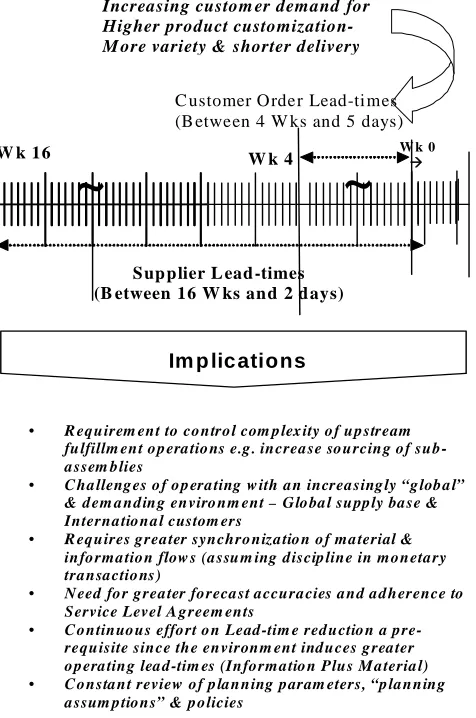
As depicted in fig-1, the customer order lead time varies from 5 days to 4 weeks. The procurement lead times however range from 2 days to 16 weeks. To manage this mismatch of the demand and supply lead times, the company must plan for the long lead time items more effectively and accurately than those with shorter lead times. Also, to take care of the disruptions in the in bound logistics, the long lead time items must have higher safety stock norms. Unlike JIT components which arrive at the manufacturing facility on the day or hour of the production schedule, the long lead time items must be planned to be in the stock at least a day in advance. Though this is principally accepted, the company would not add one or two days worth to the inventory of components and face shortage of components on the production line incurring losses of expediting and premium freight, assembly line stoppage and loss of customer business.
Managing Supply Disruptions In Global Supply Chains
Fig 1: Implications of Global Sourcing
Disruptions in the Supply chain are caused by both internal and external factors. Factors internal to the organization are as follows:
• Poor Procurement Planning
Procurement planning
Material Resource Planning (MRP) parameters planning
Lead time and Safety stockmiscalculations
• Poor Demand Planning and Forecasting
Mismanagement of high number of options in the BOM
Improper demand conversion to material forecast
Lack of reviews of demand and supply such as Sales and Operations Planning (S&OP) planning• Changes in customer demand within procurement lead times
• Lack of flexibility in the supply chain network planning
Inadequate buffer in the supply chains (to enhance operating efficiency)
Focus on lower transportation cost than total cost of procurement from the source to the destinationThese factors come into play as explained in the Fig. 1. The factors which are extraneous to the organization can also cause disruptions in the supply chain. These factors are as follows:
• Over dependency on single source for LCC procurement
• Dependency on Logistics service providers without tight control on their operations across the value chain
• Synchronization or lack of it, in the IT systems managing the different components of the supply chain network
• Outsourcing of key operations to various agencies without verifying their inter dependence and compatibility
• Other extraneous factors such as Social and Political scenarios, Administrative procedures, weather, terrorism and acts of God.
According to Vinod R Singhal, Professor at Georgia Institute of Technology, the effects of disruptions start to show up in the key performance areas even before they are actually reported in the news. In his research work, Professor Singhal [3] has quantified the impact of the disruptions and the average effect of disruptions in the supply chain over the forthcoming year is reported as
• 107 % drop in operating income
• 114 % drop in return on sales
• 93 % drop in return on assets
• 7 % lower sales growth
• 11 % growth in cost
• 14 % growth in inventories
Many companies consider inventory as an asset on the balance sheet, and it is judged to be cheap insurance. Most companies also assume low cost to carry inventory in their calculations. Recent research and publications, however, indicate that the direct and indirect costs of carrying inventory are much higher than has been believed [4]. Research indicates that an equitable cost to carry inventory ranges between 50 and 75 percent of the purchase price per year [5],[6].
Ballooning inventories and their associated costs results in increased overhead costs, low inventory turns, poor cash flow, and high obsolescence inventories. These costs might be appropriately associated with increased lead times throughout the supply chain.
2. LEAN SUPPLY CHAIN PLANNING
The adoption of Lean principles within the factory floor has yielded substantial benefits for a number of manufacturing organizations. Lean is a philosophy driven by a compilation of
~
Sup plier L ead -times (B etween 16 W ks an d 2 d ays)
C ustomer O rder Lead-times (B etween 4 W ks and 5 days)
W k 16 W k 4 W k 0 Æ
Increasing custom er demand for Higher product customization- M ore variety & shorter delivery
~
Im p lic ations
• R eq uirem ent to control com p lex ity o f up stream fulfillm ent o p era tio ns e.g . increa se sourcing of sub -a ssem blies
• C ha lleng es o f o p era ting w ith an increa sing ly “g lob a l” & d em a nding enviro nm ent – G lo ba l supply base & Interna tiona l custom ers
• R eq uires greater synchro niza tio n o f ma terial & info rma tion flow s (a ssum ing discip line in m onetary transactio ns)
• N eed fo r grea ter foreca st accura cies and ad herence to Service Level A g reem ents
• C ontinuo us effo rt o n Lead-tim e red uctio n a pre-requisite since the environm ent ind uces g rea ter o pera ting lea d-tim es (Inform atio n Plus M a teria l)
operational techniques supported by research and practice. Elimination of waste and identification of value added activities are the key drivers for the Lean culture. This philosophy applies to any part of the value stream. Womack and Jones conceptualize the ‘Lean Enterprise’ in their book, ‘Lean Thinking’. This concept extends ‘lean thinking’ across the value stream, thereby integrating the techniques for value addition and waste elimination. This extension reaches back to raw material and forward to the ultimate customer [7].
It has been reported that reduction of non value added manufacturing and supply chain cost is one of the top actions for lean supply chain adopted by best in class companies. [8].The emphasis on total costs rather than price is complementary to the Lean philosophy. Total Cost of Ownership (TCO) adds all the cost inside the value stream. It is easy to identify the TCO in the value stream map. The cost of each element can be calculated and summed up to arrive at the ‘total cost’. By eliminating the unnecessary steps and the cost associated with that step, the total cost of the value stream is reduced. Reduction in the customer price would result in a potential increase in market share. Summing the total cost before and after the elimination of those tasks or activities that do no add any value provides a measurement of the effective elimination of waste in the value stream.
To drive performance and manage the growing risks of global and complex supply bases, companies must develop strong people and processes that are enabled by technology [9]. Lean processes and optimization technologies that provide advanced forecasting and global planning models allow organizations to predict certain amount of disruptions and take corrective action rather than pad-up inventory. Supply Chain wide visibility to demand as well as inventory at all locations provides the necessary capability for global planning at the supply chain level. Increasingly, organizations have visibility to inventory that is in-transit, as well as supplier location inventories, which is used by planning engines to predict disruptions.
3. AN INNOVATION IN LEAN PLANNING
The following example demonstrates the application of innovative lean principles to planning using advanced planning algorithms to reduce supply disruptions, caused by internal factors mentioned above and increase on-time delivery to customers. The authors were engaged by a leading auto component manufacturer to assess the problems relating to supply disruptions and deploy a lean planning solution to one of their product portfolio.
The organization found it difficult to respond to low volume orders placed infrequently on the plant. Without a proper forecast data from the distributor, the organization was forced to keep components in inventory to build the product on receiving the order, thus fulfilling the on-time delivery to the customer.
The Organization lacked the business process to support order profiling. Planning, manufacturing and delivery was more
[image:3.612.315.568.187.347.2]reactive and the plant used the MRP system to procure materials once the order was placed. Components were sourced from LCC countries, thus increasing the lead-time to about 8-12 weeks. For low volume orders, it was very difficult for both the plant and the supplier to meet stated lead-times causing the organization to miss committed dates. The inventory planning methods that were adopted were not suitable to maintain appropriate inventory levels to meet such low volume orders. All components irrespective of the component category (ABC classification, Usage and so on) were planned using the same method.
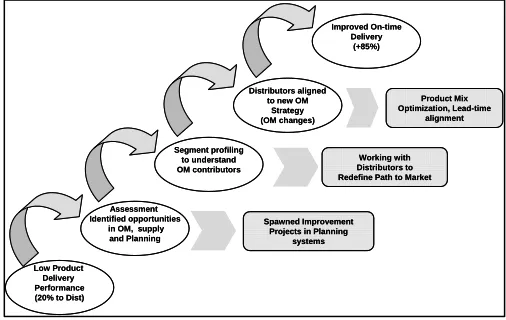
Fig 2: Lean Planning Deployment Approach
Figure 2 depicts the program approach, which involved the following:
• Localized Supply Chain diagnostics to define key metrics and identify problems
• OM and SCM Profiling to identify opportunities
• Customer segment profiling to identify different streams of Order patterns
• Differentiated OM strategies and alignment of planning policies to match the same
• Continuous measurement and tracking of key metrics The program also spawned related programs for planning systems and material planning policies alignment.
The solution that was implemented used customer order patterns to profile the SKU demand and categorize them as ‘Preferred’, ‘Standard’ and ‘Quote’ SKU products. These were driven by the low level components (options) that go into these SKUs as well as profitability to the organization. The components are categorized as High, Medium and Low usage. These SKU statuses were updated on a weekly basis into the order management or configurator, which is used by customers globally to configure and place orders. The organization guarantees much shorter lead-time on Preferred SKU due to a combination of high usage, fast moving components as well as manufacturing readiness, and longer lead-times on Standard and Made to Order (MTO) SKU’s due to low volume components and manufacturing disturbances caused by low volume orders.
The proposed solution which included changes in planning strategy and use of advanced planning systems was implemented to enable the organization to support Preferred
Low Product Delivery Performance (20% to Dist)
Assessment Identified opportunities
in OM, supply and Planning
Segment profiling to understand OM contributors
Distributors aligned to new OM
Strategy (OM changes) Improved On-time Delivery (+85%) Working with Distributors to Redefine Path to Market
Spawned Improvement Projects in Planning
systems Product Mix Optimization, Lead-time alignment Low Product Delivery Performance (20% to Dist)
Assessment Identified opportunities
in OM, supply and Planning
Segment profiling to understand OM contributors
Distributors aligned to new OM
Strategy (OM changes) Improved On-time Delivery (+85%) Working with Distributors to Redefine Path to Market
Spawned Improvement Projects in Planning
systems
Product Mix Optimization, Lead-time
and Standard SKU orders through optimized inventory and planning capability. A series of communication sessions were conducted to educate the customer base on this capability. On order placement by the customer, apart from providing the current status of the SKU (preference priority) to the customer the solution also drives the customer with recommendations on different options (technically compatible as well as suit application needs) that could move the customer order to a Preferred SKU with appropriate pricing differences.
The motivation for the customer is shorter lead-time. Planning systems in the Plant are enabled to drive materials to support these SKU demands. The SKU statuses were published on-line through the customer or distributor interface applications, which ensure high visibility. Benefits to the organization include a much leaner manufacturing capability, low demands on inventory, high on-time delivery and assembly line stability. The success of this solution is reflected through a gradual increase in the percentage of ‘Preferred’ SKU order category and a gradual reduction in the low volume, infrequent ‘Quote’ category.
4. GLOBAL VISIBILTY AND LOGISTICS
INNOVATION
In another engagement with the same client, the authors enabled setting-up of a global logistic network and direct-ship model to provide seamless visibility across the supply chain and minimize disruptions through event-based logistics tracking. The customer had a business model for sourcing manufactured products from LCC countries and shipping them directly to customers globally.
While the product itself never physically entered the facility of the customer, there were enormous touch-points all through the process starting with the customer placing orders on the supplier, supplier’s logistics provider, shipping agents, steam liners, customs in the end-customer’s country, local logistics and the end-customer itself. The client did not have any visibility to this entire global supply chain, which resulted in high overheads and process inefficiency.
Key supply chain challenges faced by this organization were as follows:
• The processes followed were modeled on the traditional processes for the in-house manufactured SKU. The sourcing of finished goods and shipping them directly to the customer needed a paradigm shift in the way the processes were handled and there was a high proportion of ‘touch factor’, which made this a ‘heavy process’ as against a truly lean process.
• The systems that were used to support the processes were the same as those used for the regular manufacturing business
• The process as-is lacked visibility
As part of the engagement the entire supply chain was mapped by the authors using value stream mapping to identify
non-value steps as well as potential sweet spots that could cause supply disruptions. The solution involved implementing lean planning and logistics processes and tagging potential disruption points as events for exception management. The highlights of the solution include the following:
• End to end visibility of products throughout the supply chain
• Low-Touch and High-value based processes
• Exception based management
• Service Level Agreement (SLA) based collaborative organization of parties involved in the supply chain The benefits included the following:
• End to End visibility for the Direct Ship Supply Chain
• Better Customer Relationship Management through reduced disruptions in supply
• Tighter Management Control over the suppliers and Third Party Logistics (3PL) providers
• Dynamic Sales and Operations Planning and analytical capability
• Reduced cost, Highest value Supply Chain Management
5. CONCLUSION
In the global competitive supply chain landscape, supply disruptions have taken a new dimension. Today increasingly the sources and markets have both become global. Most organizations are pursuing globalization strategies for Growth and Lower Costs. Innovative planning and logistics strategies deployed effectively can help minimize such disruptions by providing seamless integration and visibility across various supply chain entities. Supply Disruption Management is as important in global supply chain planning as cost reduction in the overall procurement process. This fact is often missed or misunderstood by most of the companies as disaster recovery and cost reduction may conflict at some time and cost reduction would get precedence over disaster planning.
6. REFERENCES
1. Robert B. Handfield, Jennifer Blackhurst, Christopher W. Craighead, Debra Elkins, A Managerial Framework for Reducing the Impact of
Disruptions to the Supply Chain. Available:
http://scm.ncsu.edu/public/risk/index.html
2. Tim Minahan, Aberdeen Group Global Sourcing:
What You Need To Know To Make It Work,
SearchCIO.com, May 2003
3. Thomas A Foster, Risky Business, The True Cost of
Supply Chain Disruptions, SupplyChainBrain.com,
May 2005
4. Calculating the Impact of Increased Lead Times of Foreign Purchases, 92nd Annual International Supply Management Conference, May 2007
5. Cavinato, Flynn, Kauffman, Supplier Performance
Evaluation-The Supply Management Handbook, (7th
6. Moody, P.E., Profitable Purchasing - Leading
Manufacturing Excellence, (John Wiley & Sons,
New York, 1997)
7. J P Womack, D T Jones and D Roos, The machine that Changed the World The story of Lean
Production (Harper Perennial, 1991)
8. The Lean Supply Chain Report, Aberdeen group, September 2006
9. Douglas A. Smock, Robert A. Rudzki, Steve C. Rogers, On Demand Supply Management: World
Class Strategies, Practices and Technology (J. Ross