Beyond Parallel Data: Joint Word Alignment and Decipherment
Improves Machine Translation
Qing Dou , Ashish Vaswani, and Kevin Knight
Information Sciences Institute
Department of Computer Science
University of Southern California
{
qdou,avaswani,knight
}
@isi.edu
Abstract
Inspired by previous work, where decipher-ment is used to improve machine translation, we propose a new idea to combine word align-ment and decipheralign-ment into a single learning process. We use EM to estimate the model pa-rameters, not only to maximize the probabil-ity of parallel corpus, but also the monolingual corpus. We apply our approach to improve Malagasy-English machine translation, where only a small amount of parallel data is avail-able. In our experiments, we observe gains of 0.9 to 2.1 Bleuover a strong baseline.
1 Introduction
State-of-the-art machine translation (MT) systems ap-ply statistical techniques to learn translation rules au-tomatically from parallel data. However, this reliance on parallel data seriously limits the scope of MT ap-plication in the real world, as for many languages and domains, there is not enough parallel data to train a de-cent quality MT system.
However, compared with parallel data, there are much larger amounts of non parallel data. The abil-ity to learn a translation lexicon or even build a ma-chine translation system using monolingual data helps address the problems of insufficient parallel data. Ravi and Knight (2011) are among the first to learn a full MT system using only non parallel data through deci-pherment. However, the performance of such systems is much lower compared with those trained with par-allel data. In another work, Klementiev et al. (2012) show that, given a phrase table, it is possible to esti-mate parameters for a phrase-based MT system from non parallel data.
[image:1.595.352.479.204.389.2]Given that we often have some parallel data, it is more practical to improve a translation system trained on parallel data by using additional non parallel data. Rapp (1995) shows that with a seed lexicon, it is possi-ble to induce new word level translations from non par-allel data. Motivated by the idea that a translation lexi-con induced from non parallel data can be used to trans-late out of vocabulary words (OOV), a variety of prior research has tried to build a translation lexicon from non parallel or comparable data (Fung and Yee, 1998; Koehn and Knight, 2002; Haghighi et al., 2008; Garera
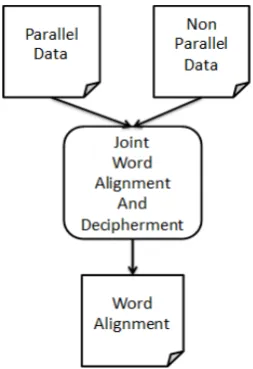
Figure 1: Combine word alignment and decipherment into a single learning process.
et al., 2009; Bergsma and Van Durme, 2011; Daum´e and Jagarlamudi, 2011; Irvine and Callison-Burch, 2013b; Irvine and Callison-Burch, 2013a; Irvine et al., 2013).
Lately, there has been increasing interest in learn-ing translation lexicons from non parallel data with de-cipherment techniques (Ravi and Knight, 2011; Dou and Knight, 2012; Nuhn et al., 2012; Dou and Knight, 2013). Decipherment views one language as a cipher for another and learns a translation lexicon that pro-duces fluent text in the target (plaintext) language. Pre-vious work has shown that decipherment not only helps find translations for OOVs (Dou and Knight, 2012), but also improves translations of observed words (Dou and Knight, 2013).
We find that previous work using monolingual or comparable data to improve quality of machine transla-tion separates two learning tasks: first, translatransla-tion rules are learned from parallel data, and then the information learned from parallel data is used to bootstrap learning with non parallel data. Inspired by approaches where joint inference reduces the problems of error propaga-tion and improves system performance, we combine the two separate learning processes into a single one, as shown in Figure 1. The contributions of this work are:
• We propose a new objective function for word alignment that combines the process of word alignment and decipherment into a single learning task.
• In experiments, we find that the joint process out-performs the previous pipeline approach, and ob-serve Bleugains of 0.9 and 2.1 on two different test sets.
• We release 15.3 million tokens of monolingual Malagasy data from the web, as well as a small Malagasy dependency tree bank containing 20k tokens.
2 Joint Word Alignment and
Decipherment
2.1 A New Objective Function
In previous work that uses monolingual data to im-prove machine translation, a seed translation lexicon learned from parallel data is used to find new transla-tions through either word vector based approaches or decipherment. In return, selection of a seed lexicon needs to be careful as using a poor quality seed lexi-con could hurt the downstream process. Evidence from a number of previous work shows that a joint inference process leads to better performance in both tasks (Jiang et al., 2008; Zhang and Clark, 2008).
In the presence of parallel and monolingual data, we would like the alignment and decipherment models to benefit from each other. Since the decipherment and word alignment models contain word-to-word transla-tion probabilitiest(f |e), having them share these pa-rameters during learning will allow us to pool infor-mation from both data types. This leads us to de-velop a new objective function that takes both learn-ing processes into account. Given our parallel data, (E1,F1), . . . ,(Em,Fm), . . . ,(EM,FM), and monolingual dataF1
mono, . . . ,Fnmono, . . . ,FmonoN , we seek to maximize
the likelihood of both. Our new objective function is defined as:
Fjoint= M
X
m=1
logP(Fm|Em)+αXN n=1
logP(Fn
mono) (1)
The goal of training is to learn the parameters that maximize this objective, that is
θ∗=arg max
θ Fjoint (2)
In the next two sections, we describe the word align-ment and decipheralign-ment models, and present how they are combined to perform joint optimization.
2.2 Word Alignment
Given a source sentence F = f1, . . . ,fj, . . . ,fJ and a
target sentenceE = e1, . . . ,ei, . . . ,eI, word alignment
models describe the generative process employed to produce the French sentence from the English sentence through alignmentsa=a1, . . . ,aj, . . . ,aJ.
The IBM models 1-2 (Brown et al., 1993) and the HMM word alignment model (Vogel et al., 1996) use two sets of parameters, distortion probabilities and
translation probabilities, to define the joint probabil-ity of a target sentence and alignment given a source sentence.
P(F,a|E)=YJ j=1
d(aj|aj−1,j)t(fj|eaj). (3)
These alignment models share the same translation probabilitiest(fj | eaj), but differ in their treatment of
the distortion probabilities d(aj | aj−1,j). Brown et al. (1993) introduce more advanced models for word alignment, such as Model 3 and Model 4, which use more parameters to describe the generative process. We do not go into details of those models here and the reader is referred to the paper describing them.
Under the Model 1-2 and HMM alignment models, the probability of target sentence given source sentence is:
P(F|E)=X a
J
Y
j=1
d(aj|aj−1,j)t(fj|eaj).
Letθ denote all the parameters of the word align-ment model. Given a corpus of sentence pairs (E1,F1), . . . ,(Em,Fm), . . . ,(EM,FM), the standard ap-proach for training is to learn the maximum likelihood estimate of the parameters, that is,
θ∗=arg max
θ
M
X
m=1
logP(Fm|Em)
=arg max
θ log
X
a
P(Fm,a|Em)
.
We typically use the EM algorithm (Dempster et al., 1977), to carry out this optimization.
2.3 Decipherment
Given a corpus of N foreign text sequences (cipher-text),F1
mono, . . . ,Fnmono, . . . ,FNmono, decipherment finds
word-to-word translations that best describe the cipher-text.
Dou and Knight, 2012; Nuhn et al., 2012; Dou and Knight, 2013; Nuhn et al., 2013).
In order to speed up decipherment, Dou and Knight (2012) suggest that a frequency list of bigrams might contain enough information for decipherment. Accord-ing to them, a monolAccord-ingual ciphertext bigramFmonois
generated through the following generative story:
• Generate a sequence of two plaintext tokense1e2 with probability P(e1e2) given by a language model built from large numbers of plaintext bi-grams.
• Substitutee1with f1ande2withf2with probabil-ityt(f1|e1)·t(f2|e2).
The probability of any cipher bigramFis:
P(Fmono)=
X
e1e2
P(e1e2)·t(f1|e1)·t(f2|e2) (4)
And the probability of the corpus is:
P(corpus)=YN n=1
P(Fn
mono) (5)
Given a plaintext bigram language model, the goal is to manipulatet(f|e) to maximize P(corpus). Theoret-ically, one can directly apply EM to solve the problem (Knight et al., 2006). However, EM has time complex-ityO(N·V2
e) and space complexityO(Vf·Ve), whereVf, Veare the sizes of ciphertext and plaintext vocabularies respectively, andNis the number of cipher bigrams.
There have been previous attempts to make decipher-ment faster. Ravi and Knight (2011) apply Bayesian learning to reduce the space complexity. However, Bayesian decipherment is still very slow with Gibbs sampling (Geman and Geman, 1987). Dou and Knight (2012) make sampling faster by introducing slice sam-pling (Neal, 2000) to Bayesian decipherment. Besides Bayesian decipherment, Nuhn et al. (2013) show that beam search can be used to solve a very large 1:1 word substitution cipher. In subsection 2.4.1, we describe our approach that uses slice sampling to compute ex-pected counts for decipherment in the EM algorithm.
2.4 Joint Optimization
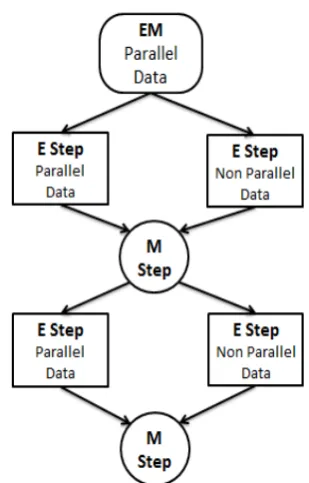
We now describe our EM approach to learn the param-eters that maximizeFjoint(equation 2), where the dis-tortion probabilities, d(aj | aj−1,j) in the word align-ment model are only learned from parallel data, and the translation probabilities,t(f | e) are learned using both parallel and non parallel data. The E step and M step are illustrated in Figure 2.
[image:3.595.335.490.59.301.2]Our algorithm starts with EM learning only on par-allel data for a few iterations. When the joint inference starts, we first compute expected counts from parallel data and non parallel data using parameter values from the last M step separately. Then, we add the expected counts from both parallel data and non parallel data to-gether with different weights for the two. Finally we
Figure 2: Joint Word Alignment and Decipherment with EM
renormalize the translation table and distortion table to update parameters in the new M step.
The E step for parallel part can be computed effi -ciently using the forward-backward algorithm (Vogel et al., 1996). However, as we pointed out in Section 2.3, the E step for the non parallel part has a time com-plexity ofO(V2) with the forward-backward algorithm, whereV is the size of English vocabulary, and is usu-ally very large. Previous work has tried to make de-cipherment scalable (Ravi and Knight, 2011; Dou and Knight, 2012; Nuhn et al., 2013; Ravi, 2013). How-ever, all of them are designed for decipherment with ei-ther Bayesian inference or beam search. In contrast, we need an algorithm to make EM decipherment scalable. To overcome this problem, we modify the slice sam-pling (Neal, 2000) approach used by Dou and Knight (2012) to compute expected counts from non parallel data needed for the EM algorithm.
2.4.1 Draw Samples with Slice Sampling
To start the sampling process, we initialize the first sample by performing approximate Viterbi decoding using results from the last EM iteration. For each for-eign dependency bigram f1,f2, we find the top 50 can-didates for f1and f2ranked byt(e|f), and find the En-glish sequencee1,e2that maximizest(e1|f1)·t(e2|f2)·
P(e1,e2).
Suppose the derivation probability for current sam-plee currentisP(e current), we use slice sampling to draw a new sample in two steps:
• Select a threshold T uniformly between 0 and
P(e current).
of candidates:{e new|P(e new)>T}.
The first step is straightforward to implement. How-ever, it is not trivial to implement the second step. We adapt the idea from Dou and Knight (2012) for EM learning.
Suppose our current samplee currentcontains En-glish tokensei−1,ei, andei+1 at positioni−1,i, and
i+1 respectively, andfibe the foreign token at position i. Using point-wise sampling, we draw a new sample by changing tokeneito a new tokene0. Since the rest of the sample remains the same, only the probability of the trigramP(ei−1e0ei+1) (The probability is given by a
bigram language model.), and the channel model prob-abilityt(fi|e0) change. Therefore, the probability of a sample is simplified as shown Equation 6.
P(ei−1e0ei+1)·t(fi|e0) (6) Remember that in slice sampling, a new sample is drawn in two steps. For the first step, we choose a threshold T uniformly between 0 and P(ei−1eiei+1) ·
t(fi|ei). We divide the second step into two cases based on the observation that two types of samples are more likely to have a probability higher than T (Dou and Knight, 2012): (1) those whose trigram probability is high, and (2) those whose channel model probability is high. To find candidates that have high trigram proba-bility, Dou and Knight (2012) build a topksorted lists ranked by P(ei−1e0ei+1), which can be pre-computed off-line. Then, they test if the last item ek in the list satisfies the following inequality:
P(ei−1ekei+1)·c<T (7)
wherecis a small constant and is set to priorin their work. In contrast, we choosecempirically as we do not have a prior in our model. When the inequality in Equation 7 is satisfied, a sample is drawn in the fol-lowing way: Let set A = {e0|e
i−1e0ei+1·c > T} and setB ={e0|t(f
i|e0)>c}. Then we only need to sample e0uniformly fromA∪BuntilP(e
i−1e0ei+1)·t(fi|e0) is greater thanT. It is easy to prove that all other candi-dates that are not in the sorted list and witht(fi|e0)≤c have a upper bound probability:P(ei−1ekei+1)·c. There-fore, they do not need to be considered.
Second, when the last item ek in the list does not meet the condition in Equation 7, we keep drawing samplese0randomly until its probability is greater than
the thresholdT.
As we mentioned before, the choice of the small con-stantcis empirical. A largecreduces the number of items in setB, but makes the conditionP(ei−1ekei+1)·
c<T less likely to satisfy, which slows down the sam-pling. On the contrary, a smallcincreases the number of items in setBsignificantly as EM does not encour-age a sparse distribution, which also slows down the sampling. In our experiments, we setcto 0.001 based on the speed of decipherment. Furthermore, to reduce the size of setB, we rank all the candidate translations
[image:4.595.327.507.62.100.2]Spanish English Parallel 10.3k 9.9k Non Parallel 80 million 400 million
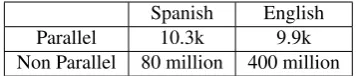
Table 1: Size of parallel and non parallel data for word alignment experiments (Measured in number of tokens)
of fi byt(e0|fi), then we add maximum the first 1000 candidates whoset(fi|e0) >=cinto set B. For the rest of the candidates, we sett(fi|e0) to a value smaller than c(0.00001 in experiments).
2.4.2 Compute Expected Counts from Samples
With the ability to draw samples efficiently for deci-pherment using EM, we now describe how to compute expected counts from those samples. Let f1,f2 be a specific ciphertext bigram, N be the number of sam-ples we want to use to compute expected counts, and
e1,e2 be one of theN samples. The expected counts for pairs (f1,e1) and (f2,e2) are computed as:
α·count(f1,f2) N
wherecount(f1,f2) is count of the bigram, andαis the weight for non parallel data as shown in Equation 1. Expected counts collected for f1,f2 are accumulated from each of its N samples. Finally, we collect ex-pected counts using the same approach from each for-eign bigram.
3 Word Alignment Experiments
In this section, we show that joint word alignment and decipherment improves the quality of word alignment. We choose to evaluate word alignment performance for Spanish and English as manual gold alignments are available. In experiments, our approach improves alignment F score by as much as 8 points.
3.1 Experiment Setup
As shown in Table 1, we work with a small amount of parallel, manually aligned Spanish-English data (Lam-bert et al., 2005), and a much larger amount of mono-lingual data.
The parallel data is extracted from Europarl, which consists of articles from European parliament plenary sessions. The monolingual data comes from English and Spanish versions of Gigaword corpra containing news articles from different news agencies.
3.1.1 Results
We align all 500 sentences in the parallel corpus, and tune the decipherment weight (α) for Model 1 and HMM using the last 100 sentences. The best weights are 0.1 for Model 1, and 0.005 for HMM. We start with Model 1 with only parallel data for 5 iterations, and switch to the joint process for another 5 iterations with Model 1 and 5 more iterations of HMM. In the end, we use the first 100 sentence pairs of the corpus for evalu-ation.
Figure 3 compares the learning curve of alignment F-score between EM without decipherment (baseline) and our joint word alignment and decipherment. From the learning curve, we find that at the 6th iteration, 2 iterations after we start the joint process, alignment F-score is improved from 34 to 43, and this improvement is held through the rest of the Model 1 iterations. The alignment model switches to HMM from the 11th iter-ation, and at the 12th iteriter-ation, we see a sudden jump in F-score for both the baseline and the joint approach. We see consistent improvement of F-score till the end of HMM iterations.
4 Improving Low Density Languages
Machine Translation with Joint Word
Alignment and Decipherment
In the previous section, we show that the joint word alignment and decipherment process improves quality of word alignment significantly for Spanish and En-glish. In this section, we test our approach in a more challenging setting: improving the quality of machine translation in a real low density language setting.
In this task, our goal is to build a system to trans-late Malagasy news into English. We have a small amount of parallel data, and larger amounts of mono-lingual data collected from online websites. We build a dependency parser for Malagasy to parse the monolin-gual data to perform dependency based decipherment (Dou and Knight, 2013). In the end, we perform joint word alignment and decipherment, and show that the joint learning process improves Bleu scores by up to 2.1 points over a phrase-based MT baseline.
4.1 The Malagasy Language
Malagasy is the official language of Madagascar. It has around 18 million native speakers. Although Mada-gascar is an African country, Malagasy belongs to the Malayo-Polynesian branch of the Austronesian lan-guage family. Malagasy and English have very dif-ferent word orders. First of all, in contrast to En-glish, which has a subject-verb-object (SVO) word or-der, Malagasy has a verb-object-subject (VOS) word order. Besides that, Malagasy is a typical head ini-tial language: Determiners precede nouns, while other modifiers and relative clauses follow nouns (e.g. ny “the” boky “book” mena “red”). The significant dif-ferences in word order pose great challenges for both
Source Malagasy English Parallel
Global Voices 2.0 million 1.8 million
Web News 2.2k 2.1k
Non Parallel
[image:5.595.322.513.61.160.2]Gigaword N/A 2.4 billion allAfrica N/A 396 million Local News 15.3 million N/A
Table 2: Size of Malagasy and English data used in our experiments (Measured in number of tokens)
machine translation and decipherment.
4.2 Data
Table 2 shows the data available to us in our experi-ments. The majority of parallel text comes from Global Voices1(GV). The website contains international news translated into different foreign languages. Besides that, we also have a very small amount of parallel text containing local web news, with English translations provided by native speakers at the University of Texas, Austin. The Malagasy side of this small parallel corpus also has syntactical annotation, which is used to train a very basic Malagasy part of speech tagger and depen-dency parser.
We also have much larger amounts of non paral-lel data for both languages. For Malagasy, we spent two months manually collecting 15.3 million tokens of news text from local news websites in Madagascar.2 We have released this data for future research use. For English, we have 2.4 billion tokens from the Gigaword corpus. Since the Malagasy monolingual data is col-lected from local websites, it is reasonable to argue that those data contain significant amount of information re-lated to Africa. Therefore, we also collect 396 million tokens of African news in English from allAfrica.com.
4.3 Building A Dependency Parser for Malagasy
Since Malagasy and English have very different word orders, we decide to apply dependency based decipher-ment for the two languages as suggested by Dou and Knight (2013). To extract dependency relations, we need to parse monolingual data in Malagasy and En-glish. For English, there are already many good parsers available. In our experiments, we use Turbo parser (Martins et al., 2013) trained on the English Penn Tree-bank (Marcus et al., 1993) to parse all our English monolingual data. However, there is no existing good parser for Malagasy.
The quality of a dependency parser depends on the amount of training data available. State-of-the-art En-glish parsers are built from Penn Treebank, which con-tains over 1 million tokens of annotated syntactical
1globalvoicesonline.org
2aoraha.com, gazetiko.com, inovaovao.com,
Figure 3: Learning curve showing our joint word alignment and decipherment approach improves word alignment quality over the traditional EM without decipherment (Model 1: Iteration 1 to 10, HMM: Iteration 11 to 15)
trees. In contrast, the available data for training a Mala-gasy parser is rather limited, with only 168 sentences, and 2.8k tokens, as shown in Table 2. At the very be-ginning, we use the last 120 sentences as training data to train a part of speech (POS) tagger using a toolkit provided by Garrette et al. (2013) and a dependency parser with the Turbo parser. We test the performance of the parser on the first 48 sentences and obtain 72.4% accuracy.
One obvious way to improve tagging and parsing ac-curacy is to get more annotated data. We find more data with only part of speech tags containing 465 sentences and 10k tokens released by (Garrette et al., 2013), and add this data as extra training data for POS tagger. Also, we download an online dictionary that contains POS tags for over 60k Malagasy word types from mala-gasyword.org. The dictionary is very helpful for tag-ging words never seen in the training data.
It is natural to think that creation of annotated data for training a POS tagger and a parser requires large amounts of efforts from annotators who understand the language well. However, we find that through the help of parallel data and dictionaries, we are able to create more annotated data by ourselves to improve tagging and parsing accuracy. This idea is inspired by previ-ous work that tries to learn a semi-supervised parser by projecting dependency relations from one language (with good dependency parsers) to another (Yarowsky and Ngai, 2001; Ganchev et al., 2009). However, we find those automatic approaches do not work well for Malagasy.
To further expand our Malagasy training data, we
first use a POS tagger and parser with poor perfor-mance to parse 788 sentences (20k tokens) on the Malagasy side of the parallel corpus from Global Voices. Then, we correct both the dependency links and POS tags based on information from dictionaries3 and the English translation of the parsed sentence. We spent 3 months to manually project English dependen-cies to Malagasy and eventually improve test set pars-ing accuracy from 72.4% to 80.0%. We also make this data available for future research use.
4.4 Machine Translation Experiments
In this section, we present the data used for our MT experiments, and compare three different systems to justify our joint word alignment and decipherment ap-proach.
4.4.1 Baseline Machine Translation System
We build a state-of-the-art phrase-based MT system, PBMT, using Moses (Koehn et al., 2007). PBMT has 3 models: a translation model, a distortion model, and a language model. We train the other models using half of the Global Voices parallel data (the rest is re-served for development and testing), and build a 5-gram language model using 834 million tokens from AFP section of English Gigaword, 396 million tokens from allAfrica, and the English part of the parallel cor-pus for training. For alignment, we run 10 iterations of Model 1, and 5 iterations of HMM. We did not run Model 3 and Model 4 as we see no improvements in Bleuscores from running those models. We do word
3an online dictionary from malagasyword.org, as well as
alignment in two directions and use grow-diag-final-and heuristic to obtain final alignment. During decod-ing, we use 8 standard features in Moses to score a can-didate translation: direct and inverse translation proba-bilities, direct and inverse lexical weighting, a language model score, a distortion score, phrase penalty, and word penalty. The weights for the features are learned on the tuning data using minimum error rate training (MERT) (Och, 2003).
To compare with previous decipherment approach to improve machine translation, we build a second base-line system. We follow the work by Dou and Knight (2013) to decipher Malagasy into English, and build a translation lexiconTdecipherfrom decipherment. To im-prove machine translation, we simply useTdecipher as an additional parallel corpus. First, we filterTdecipher by keeping only translation pairs (f,e), where f is ob-served in the Spanish part andeis observed in the En-glish part of the parallel corpus. Then we append all the Spanish and English words in the filteredTdecipher to the end of Spanish part and English part of the paral-lel corpus respectively. The training and tuning process is the same as the baseline machine translation system PBMT. We call this systemDecipher-Pipeline.
4.4.2 Joint Word Alignment and Decipherment for Machine Translation
When deciphering Malagasy to English, we extract Malagasy dependency bigrams using all available Malagasy monolingual data plus the Malagasy part of the Global Voices parallel data, and extract English dependency bigrams using 834 million tokens from English Gigaword, and 396 million tokens from al-lAfrica news to build an English dependency language model. In the other direction, we extract English de-pendency bigrams from English part of the entire paral-lel corpus plus 9.7 million tokens from allAfrica news 4, and use 17.3 million tokens Malagasy monolingual data (15.3 million from the web and 2.0 million from Global Voices) to build a Malagasy dependency lan-guage model. We require that all dependency bigrams only contain words observed in the parallel data used to train the baseline MT system.
During learning, we run Model 1 without decipher-ment for 5 iterations. Then we perform joint word alignment and decipherment for another 5 iterations with Model 1 and 5 iterations with HMM. We tune decipherment weights (α) for Model 1 and HMM us-ing grid search against Bleuscore on a development set. In the end, we only extract rules from one di-rectionP(English|Malagasy), where the decipherment weights for Model 1 and HMM are 0.5 and 0.005 re-spectively. We chose this because we did not find any benefits to tune the weights on each direction, and then use grow-diag-final-end heuristic to form final align-ments. We call this systemDecipher-Joint.
4We do not find further Bleugains by using more English
monolingual data.
Parallel
Malagasy English Train (GV) 0.9 million 0.8 million Tune (GV) 22.2k 20.2k
Test (GV) 23k 21k
Test (Web) 2.2k 2.1k Non Parallel
Malagasy English Gigaword N/A 834 million
[image:7.595.324.507.60.187.2]Web 15.3 million 396 million
Table 3: Size of training, tuning, and testing data in number of tokens (GV: Global Voices)
4.5 Results
We tune each system three times with MERT and choose the best weights based on Bleuscores on tuning set.
Table 4 shows that while using a translation lexicon learnt from decipherment does not improve the quality of machine translation significantly, the joint approach improves Bleuscore by 0.9 and 2.1 on Global Voices test set and web news test set respectively. The results show that the parsing quality correlates with gains in Bleuscores. Scores in the brackets in the last row of the table are achieved using a dependency parser with 72.4% attachment accuracy, while scores outside the brackets are obtained using a dependency parser with 80.0% attachment accuracy.
We analyze the results and find the gain mainly comes from two parts. First, adding expected counts from non parallel data makes the distribution of trans-lation probabilities sparser in word alignment models. The probabilities of translation pairs favored by both parallel data and decipherment becomes higher. This gain is consistent with previous observation where a sparse prior is applied to EM to help improve word alignment and machine translation (Vaswani et al., 2012). Second, expected counts from decipherment also help discover new translation pairs in the paral-lel data for low frequency words, where those words are either aligned to NULL or wrong translations in the baseline.
5 Conclusion and Future Work
We propose a new objective function for word align-ment to combine the process of word alignalign-ment and decipherment into a single task. In, experiments, we find that the joint process performs better than previous pipeline approach, and observe Bleugains of 0.9 and 2.1 point on Global Voices and local web news test sets, respectively. Finally, our research leads to the release of 15.3 million tokens of monolingual Malagasy data from the web as well as a small Malagasy dependency tree bank containing 20k tokens.
in-Decipherment System Tune (GV) Test (GV) Test (Web)
None PBMT (Baseline) 18.5 17.1 7.7
Separate Decipher-Pipeline 18.5 17.4 7.7 Joint Decipher-Joint 18.9 (18.7) 18.0 (17.7) 9.8 (8.5)
Table 4: Pipeline does not show significant improvement over the baseline system. In contrast, Decipher-Joint using joint word alignment and decipherment approach achieves a Bleugain of 0.9 and 2.1 on the Global Voices test set and the web news test set, respectively. The results in brackets are obtained using a parser trained with only 120 sentences. (GV: Global Voices)
spired to apply this approach to help find translations for out of vocabulary words, and to explore other pos-sible ways to improve machine translation with deci-pherment.
Acknowledgments
This work was supported by NSF Grant 0904684 and ARO grant W911NF-10-1-0533. The authors would like to thank David Chiang, Malte Nuhn, Victoria Fos-sum, Ashish Vaswani, Ulf Hermjakob, Yang Gao, and Hui Zhang (in no particular order) for their comments and suggestions.
References
Shane Bergsma and Benjamin Van Durme. 2011. Learning bilingual lexicons using the visual similar-ity of labeled web images. In Proceedings of the Twenty-Second International Joint Conference on Artificial Intelligence - Volume Three. AAAI Press. Peter F. Brown, Stephen A. Della Pietra, Vincent J.
Della Pietra, and Robert L. Mercer. 1993. The math-ematics of statistical machine translation: Parameter estimation.Computational Linguistics, 19:263–311. Hal Daum´e, III and Jagadeesh Jagarlamudi. 2011. Do-main adaptation for machine translation by mining unseen words. InProceedings of the 49th Annual Meeting of the Association for Computational Lin-guistics: Human Language Technologies. Associa-tion for ComputaAssocia-tional Linguistics.
Arthur Dempster, Nan Laird, and Donald Rubin. 1977. Maximum likelihood from incomplete data via the EM algorithm. Computational Linguistics, 39(4):1– 38.
Qing Dou and Kevin Knight. 2012. Large scale deci-pherment for out-of-domain machine translation. In
Proceedings of the 2012 Joint Conference on Empir-ical Methods in Natural Language Processing and Computational Natural Language Learning. Asso-ciation for Computational Linguistics.
Qing Dou and Kevin Knight. 2013. Dependency-based decipherment for resource-limited machine translation. InProceedings of the 2013 Conference on Empirical Methods in Natural Language Process-ing. Association for Computational Linguistics.
Pascale Fung and Lo Yuen Yee. 1998. An IR approach for translating new words from nonparallel, compa-rable texts. InProceedings of the 36th Annual Meet-ing of the Association for Computational LMeet-inguis- Linguis-tics and 17th International Conference on Computa-tional Linguistics - Volume 1. Association for Com-putational Linguistics.
Kuzman Ganchev, Jennifer Gillenwater, and Ben Taskar. 2009. Dependency grammar induction via bitext projection constraints. InProceedings of the Joint Conference of the 47th Annual Meeting of the ACL and the 4th International Joint Conference on Natural Language Processing of the AFNLP: Vol-ume 1 - VolVol-ume 1. Association for Computational Linguistics.
Nikesh Garera, Chris Callison-Burch, and David Yarowsky. 2009. Improving translation lexicon in-duction from monolingual corpora via dependency contexts and part-of-speech equivalences. In Pro-ceedings of the Thirteenth Conference on Computa-tional Natural Language Learning. Association for Computational Linguistics.
Dan Garrette, Jason Mielens, and Jason Baldridge. 2013. Real-world semi-supervised learning of pos-taggers for low-resource languages. In Proceed-ings of the 51st Annual Meeting of the Association for Computational Linguistics (Volume 1: Long Pa-pers). Association for Computational Linguistics. Stuart Geman and Donald Geman. 1987.
Stochas-tic relaxation, Gibbs distributions, and the Bayesian restoration of images. InReadings in computer vi-sion: issues, problems, principles, and paradigms. Morgan Kaufmann Publishers Inc.
Aria Haghighi, Percy Liang, Taylor Berg-Kirkpatrick, and Dan Klein. 2008. Learning bilingual lexicons from monolingual corpora. InProceedings of ACL-08: HLT. Association for Computational Linguis-tics.
Ann Irvine and Chris Callison-Burch. 2013a. Com-bining bilingual and comparable corpora for low re-source machine translation. InProceedings of the Eighth Workshop on Statistical Machine Transla-tion. Association for Computational Linguistics, Au-gust.
[image:8.595.139.462.60.114.2]Conference of the North American Chapter of the Association for Computational Linguistics: Human Language Technologies. Association for Computa-tional Linguistics.
Ann Irvine, Chris Quirk, and Hal Daume III. 2013. Monolingual marginal matching for translation model adaptation. InProceedings of the Conference on Empirical Methods in Natural Language Process-ing. Association for Computational Linguistics. Wenbin Jiang, Liang Huang, Qun Liu, and Yajuan L¨u.
2008. A cascaded linear model for joint Chinese word segmentation and part-of-speech tagging. In
Proceedings of ACL-08: HLT. Association for Com-putational Linguistics.
Alexandre Klementiev, Ann Irvine, Chris Callison-Burch, and David Yarowsky. 2012. Toward statisti-cal machine translation without parallel corpora. In
Proceedings of the 13th Conference of the European Chapter of the Association for Computational Lin-guistics. Association for Computational Linguistics. Kevin Knight, Anish Nair, Nishit Rathod, and Kenji Yamada. 2006. Unsupervised analysis for decipher-ment problems. InProceedings of the COLING/ACL 2006 Main Conference Poster Sessions. Association for Computational Linguistics.
Philipp Koehn and Kevin Knight. 2002. Learning a translation lexicon from monolingual corpora. In
Proceedings of the ACL-02 Workshop on Unsuper-vised Lexical Acquisition. Association for Computa-tional Linguistics.
Philipp Koehn, Hieu Hoang, Alexandra Birch, Chris Callison-Burch, Marcello Federico, Nicola Bertoldi, Brooke Cowan, Wade Shen, Christine Moran, Richard Zens, Chris Dyer, Ondˇrej Bojar, Alexandra Constantin, and Evan Herbst. 2007. Moses: open source toolkit for statistical machine translation. In
Proceedings of the 45th Annual Meeting of the ACL on Interactive Poster and Demonstration Sessions. Association for Computational Linguistics.
Patrik Lambert, Adri´a De Gispert, Rafael Banchs, and Jos´e B. Mari˜no. 2005. Guidelines for word align-ment evaluation and manual alignalign-ment. Language Resources and Evaluation, 39(4):267–285.
Mitchell Marcus, Beatrice Santorini, and Mary Ann Marcinkiewicz. 1993. Building a large annotated corpus of English: The Penn Treebank. Computa-tional Linguistics, 19(2).
Andre Martins, Miguel Almeida, and Noah A. Smith. 2013. Turning on the Turbo: Fast third-order non-projective Turbo parsers. InProceedings of the 51st Annual Meeting of the Association for Computa-tional Linguistics (Volume 2: Short Papers). Asso-ciation for Computational Linguistics.
Radford Neal. 2000. Slice sampling. Annals of Statis-tics, 31.
Malte Nuhn, Arne Mauser, and Hermann Ney. 2012. Deciphering foreign language by combining lan-guage models and context vectors. InProceedings of the 50th Annual Meeting of the Association for Computational Linguistics: Long Papers - Volume 1. Association for Computational Linguistics. Malte Nuhn, Julian Schamper, and Hermann Ney.
2013. Beam search for solving substitution ciphers. In Proceedings of the 51st Annual Meeting of the Association for Computational Linguistics. Associ-ation for ComputAssoci-ational Linguistics.
Franz Josef Och. 2003. Minimum error rate training in statistical machine translation. InProceedings of the 41st Annual Meeting of Association for Compu-tational Linguistics. Association for Computational Linguistics.
Reinhard Rapp. 1995. Identifying word translations in non-parallel texts. InProceedings of the 33rd an-nual meeting of Association for Computational Lin-guistics. Association for Computational Linguistics. Sujith Ravi and Kevin Knight. 2011. Deciphering for-eign language. InProceedings of the 49th Annual Meeting of the Association for Computational Lin-guistics: Human Language Technologies. Associa-tion for ComputaAssocia-tional Linguistics.
Sujith Ravi. 2013. Scalable decipherment for machine translation via hash sampling. InProceedings of the 51th Annual Meeting of the Association for Compu-tational Linguistics. Association for Computational Linguistics.
Ashish Vaswani, Liang Huang, and David Chiang. 2012. Smaller alignment models for better trans-lations: Unsupervised word alignment with the l0-norm. InProceedings of the 50th Annual Meeting of the Association for Computational Linguistics: Long Papers - Volume 1. Association for Computational Linguistics.
Stephan Vogel, Hermann Ney, and Christoph Tillmann. 1996. HMM-based word alignment in statistical translation. InProceedings of the 16th Conference on Computational Linguistics - Volume 2. Associa-tion for ComputaAssocia-tional Linguistics.
David Yarowsky and Grace Ngai. 2001. Inducing mul-tilingual POS taggers and NP bracketers via robust projection across aligned corpora. InProceedings of the Second Meeting of the North American Chap-ter of the Association for Computational Linguistics on Language Technologies. Association for Compu-tational Linguistics.