An I-vector Based Approach to Compact Multi-Granularity Topic Spaces
Representation of Textual Documents
Mohamed Morchid†, Mohamed Bouallegue†, Richard Dufour†,
Georges Linar`es†, Driss Matrouf†and Renato de Mori†‡ †LIA, University of Avignon, France
‡McGill University, School of Computer Science, Montreal, Quebec, Canada
{firstname.lastname}@univ-avignon.fr [email protected]
Abstract
Various studies highlighted that topic-based approaches give a powerful spo-ken content representation of documents. Nonetheless, these documents may con-tain more than one main theme, and their automatic transcription inevitably contains errors. In this study, we propose an orig-inal and promising framework based on a compact representation of a textual docu-ment, to solve issues related to topic space granularity. Firstly, various topic spaces are estimated with different numbers of classes from a Latent Dirichlet Allocation. Then, this multiple topic space representa-tion is compacted into an elementary seg-ment, calledc-vector, originally developed in the context of speaker recognition. Ex-periments are conducted on the DECODA corpus of conversations. Results show the effectiveness of the proposed multi-view compact representation paradigm. Our identification system reaches an accuracy of 85%, with a significant gain of 9 points compared to the baseline (best single topic space configuration).
1 Introduction
Automatic Speech Recognition (ASR) systems frequently fail on noisy conditions and high Word Error Rates (WER) make the analysis of the au-tomatic transcriptions difficult. Speech analyt-ics suffer from these transcription issues that may be overcome by improving the ASR robustness and/or the tolerance of speech analytic systems to ASR errors. This paper proposes a new method to improve the robustness of speech analytics by combining a semantic multi-model approach and a noise reduction technique based on thei-vector paradigm.
This method is evaluated in the application framework of the RATP call centre (Paris Public Transportation Authority), focusing on the theme identification task (Bechet et al., 2012).
Telephone conversations are a particular case of human-human interaction whose automatic processing raises problems, especially due to the speech recognition step required to obtain the transcription of the speech contents. First, the speaker’s behavior may be unexpected and the training/test mismatch may be very large. Second, the speech signal may be strongly impacted by various sources of variability: environment and channel noises, acquisition devices, etc.
Telephone conversation issues
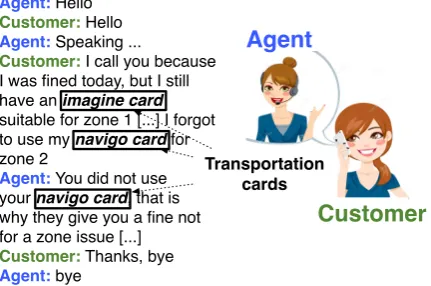
Topics are related to the reason why the customer called. Various classes corresponding to the main customer’s requests are considered (lost and founds, traffic state, timelines, etc). In addition to classical issues in such adverse conditions, the topic-identification system should deal with problems related to class proximity. For example, a lost & found request is related to itinerary (where was the object lost?) or timeline (when?), that could appear in most of the classes. In fact, these conversations involve a relatively small set of basic concepts related to transportation issues. Figure 1 shows an example of a dialogue which is manually labeled by the agent as an issue related to an infraction. However, words in bold suggest that this conversation could be related to atransportation card. Thus, we assume that a dialogue representation should be seen as a multi-view problem to substantiate the claims regarding the multi-theme representation of a given dialogue.
On the other hand, multi-view approaches in-troduce additional variability due to the diversity of the views. This variability is also due to the vocabulary used by both agent and customer
Agent: Hello Customer: Hello
Agent: Speaking ...
Customer: I call you because I was fined today, but I still have an imagine card
suitable for zone1[...] I forgot to use my navigocard for zone 2
Agent: You did not use your navigocard, that is why they give you a fine not for a zone issue [...] Customer: Thanks, bye
Agent: bye
Agent
Customer Transportation
[image:2.595.76.292.71.214.2]cards
Figure 1: Example of a dialogue from the DE-CODA corpus labeled by the agent as aninfraction issue which contains more than one theme ( infrac-tion+transportation cards).
during a telephone conversation. Indeed, an agent have to follow an predefined scenario of conversation. Thus, the agent can find the main reason for the call which corresponds to the theme.
Proposed solutions
An efficient way to tackle both ASR robustness and class ambiguity could be to map dialogues into a topic space abstracting the ASR outputs. Then, dialogue categorization is achieved in this topic space. Numerous unsupervised methods for topic-space estimation were proposed in the past. Latent Dirichlet Allocation (LDA) (Blei et al., 2003) has been largely used for speech analytics; one of its main drawbacks is the tuning of the model, that involves various meta-parameters such as the number of classes (that determines the model granularity), word distribution meth-ods, temporal spans. . . If the decision process is highly dependent on these features, the system’s performance could be quite unstable.
Classically, this abstract representation involves selecting the right number of classes composing the topic space. This decision is crucial since topic model perplexity, which expresses its qual-ity, is highly dependent on this feature. Further-more, the multi-theme context of the study (see Figure 1) involves a more complex dialogue rep-resentation. In this paper, we propose to deal with these two drawbacks by using a compact represen-tation from multiple topic spaces. This model is based on a robust multi-view representation of the textual documents.
A multi-view representation of a dialogue intro-duces both arelevantvariability needed to repre-sent different contexts of the dialogue, and anoisy variability related to topic space processing. Thus, a topic-based representation of a dialogue is built from the dialogue content itself. For this reason, the mapping process of a dialogue into several topic spaces generates a noisy variability related to the difference between the dialogue and the con-tent of each class. In the same way, the relevant variability comes from the common content be-tween the dialogue and the classes composing the topic space.
(vocabulary) and topic space characteristics (word distributions among the topics). Thus, the speaker is represented by a theme, and the speaker session is a set of topic-based representations (frames) of a dialogue (session).
The paper is organized as follows. Section 2 presents previous related works. The dialogue rep-resentation is described in Section 3. Section 4 in-troduces the i-vector compact representation and presents its application to text documents. Sec-tions 5 and 6 report experiments and results. The last section concludes and proposes some perspec-tives.
2 Related work
In the past, several approaches considered a text document as a mixture of latent topics. These methods, such as Latent Semantic Analysis (LSA) (Deerwester et al., 1990; Bellegarda, 1997), Probabilistic LSA (PLSA) (Hofmann, 1999) or Latent Dirichlet Allocation (LDA) (Blei et al., 2003), build a higher-level representation of the document in a topic space. ¿ Document is then considered as a bag-of-words (Salton, 1989) where the word order is not taken into account. These methods have demonstrated their perfor-mance on various tasks, such as sentence (Belle-garda, 2000) or keyword (Suzuki et al., 1998) ex-traction.
In opposition to a multinomial mixture model, LDA considers that a theme is associated to each occurrence of a word composing the document, rather than associate a topic to the complete doc-ument. Therefore, a document can change topics from a word to another one. However, word oc-currences are connected by a latent variable which controls the global match of the distribution of the topics in the document. These latent topics are characterized by a distribution of associated word probabilities. PLSA and LDA models have been shown to generally outperform LSA on IR tasks (Hofmann, 2001). Moreover, LDA provides a direct estimate of the relevance of a topic given a word set. In this paper, probabilities of hidden topic features, estimated with LDA, are considered for possibly capturing word dependencies express-ing the semantic contents of a given conversation. Topic-based approaches involve defining a number of topics composing the topic space. The choice of the “right” number of topics is a crucial step, especially when the documents may contain
multiple themes. Many studies have tried to find a relevant method to deal with this issue. (Arun et al., 2010) proposed to use a Singular Value De-composition (SVD) to represent the separability between the words contained in the vocabulary. Then, if the singular values of the topic-word ma-trixMequal the norm of the rows ofM, this means that the vocabulary is well separated among the topics. This method has to be evaluated with the Kullback-Liebler divergence metric for each topic space. However, this process would be time con-suming for thousands of representations of a dia-logue.
(Teh et al., 2004) proposed the Hierarchical Dirichlet Process (HDP) method to find the “right” number of topics by assuming that the data has a hierarchical structure. The HDP models were then compared to the LDA ones on the same dataset. (Zavitsanos et al., 2008) presented a method tolearnthe right depth of an ontology de-pending of the number of topics of LDA models. The study presented by (Cao et al., 2009) is quite similar to (Teh et al., 2004). The authors consider the average correlation between pairs of topics at each stage as the right number of topics.
All these methods assume that a document can have only one representation since they consider that finding the optimal topic model is the best so-lution. Another solution would be to consider a set of topic models to represent a document. Nonethe-less, a multi-topic-based representation of a dia-logue can involve a noisy variability due to the mapping of a dialogue in each topic space. Indeed, a dialogue does not share its content (i.e. words) with each class composing the topic space. Thus, a variability is added during the mapping pro-cess. Another weakness of the multi-view repre-sentation is the relation between classes in a topic space. (Blei and Lafferty, 2006) show that classes into a LDA topic space are correlated. More-over, (Li and McCallum, 2006) consider a class as a node of an acyclic graph and as a distribu-tion over other classes contained in the same topic space.
3 Multi-view representation of automatic dialogue transcriptions in a
homogeneous space
care service (CCS) of the RATP Paris transporta-tion system. The approach considered in this pa-per focuses on modeling the variability between different dialogues expressing the same theme t. For this purpose, it is important to select relevant features that represent semantic contents for the theme of a dialogue. An attractive set of features for capturing possible semantically relevant word dependencies is obtained with Latent Dirichlet Al-location (LDA) (Blei et al., 2003), as described in section 2.
Given a training set of conversationsD, a hid-den topic space is derived and a conversation d
is represented by its probability in each topic of the hidden space. Estimation of these probabili-ties is affected by a variability inherent to the es-timation of the model parameters. If many hidden spaces are considered and features are computed for each hidden space, it is possible to model the estimation variability together with the variability of the linguistic expression of a theme by different speakers in different real-life situations. Even if the purpose of the application is theme identifica-tion and a training corpus annotated with themes is available, supervised LDA (Griffiths and Steyvers, 2004) is not suitable for the proposed approach. LDA is used only for producing different feature sets used involved in statistical variability models. In order to estimate the parameters of differ-ent hidden spaces, a set of discriminative words
V is constructed as described in (Morchid et al., 2014a). Each theme t contains a set of specific words. Note that the same word may appear in several discriminative word sets. All the selected words are then merged without repetition to form
V.
Several techniques, such as Variational Meth-ods (Blei et al., 2003), Expectation-propagation (Minka and Lafferty, 2002) or Gibbs Sam-pling (Griffiths and Steyvers, 2004), have been proposed for estimating the parameters describ-ing a LDA hidden space. Gibbs Sampldescrib-ing is a special case of Markov-chain Monte Carlo (MCMC) (Geman and Geman, 1984) and gives a simple algorithm for approximate inference in high-dimensional models such as LDA (Heinrich, 2005). This overcomes the difficulty to directly and exactly estimate parameters that maximize the likelihood of the whole data collection defined as:
p(W|−→α ,−→β) =Qw∈W p(−→w|−→α ,−→β)for the whole data collectionW knowing the Dirichlet
parame-ters−→α and−→β.
Gibbs Sampling allows us both to estimate the LDA parameters in order to represent a new dia-loguedwith therth topic space of sizen, and to
obtain a feature vectorVzr
d of the topic
representa-tion ofd. ThejthfeatureVzjr
d =P(zjr|d)(where
1 ≤ j ≤ n) is the probability of topic zr j to be
generated by the unseen dialoguedin therthtopic
space of sizen(see Figure 2) andVw zr
j =P(w|z r j)
is the vector representation of a word intor.
Agent: Hello
Customer: Hello
Agent: Speaking ...
Customer: I call you because I was fined today, but I still have an imaginecardsuitable for zone1 [...] I forgot to use my navigo card for zone 2
Agent: You did not use your navigo card, that is why they give you a fine not for a zone issue [...]
Customer: Thanks, bye
Agent: bye
Agent
Customer
Conversations agent/customer
customer care service of the
Paris transportation system
TOPIC 1 P(w|z) w
0.03682338236708009 card
0.026680126910873955 month 0.026007114700509565 navigo
0.01615229304874531 old 0.015527353139121238 agency 0.014229401019132776 euros 0.013123738102105566 imagine
TOPIC n
P(w|z) w
0.06946564885496183 card
0.04045801526717557 fine
0.016793893129770993 transport 0.01603053435114504 woman 0.01450381679389313 fined
0.013740458015267175 aïe 0.012977099236641221 infraction
...
P(z |d)
1...
P(z |d)
nAgent: Hello Customer: Hello Agent: Speaking ... Customer: I call you because I was fined today, but I still have an imaginecardsuitable for zone1 [...] I forgot to use my navigo card for zone 2
Agent: You did not use your navigo card, that is why they give you a fine not for a zone issue [...] Customer: Thanks, bye Agent: bye
Agent
Customer
Conversations agent/customer customer care service of the
Paris transportation system
TOPIC 1 P(w|z) w
0.03682338236708009 card 0.026680126910873955 month 0.026007114700509565 navigo 0.01615229304874531 old 0.015527353139121238 agency 0.014229401019132776 euros 0.013123738102105566 imagine
TOPIC n
P(w|z) w
0.06946564885496183 card 0.04045801526717557 fine 0.016793893129770993 transport 0.01603053435114504 woman 0.01450381679389313 fined 0.013740458015267175 aïe 0.012977099236641221 infraction
...
P(z |d)1
...
P(z |d)nFigure 2: Example of a dialoguedmapped into a topic space of sizen.
In the LDA technique, topic zj, j is drawn
from a multinomial over θ which is drawn from a Dirichlet distribution over −→α. Thus, a set of
ptopic spaces are learned using LDA by varying the number of topicsnto obtainptopic spaces of sizen. The number of topicsnvaries from10 to
3,010. Thus, a set of3,000topic spaces is esti-mated. This is high enough to generate, for each dialogue, many feature sets for estimating the pa-rameters of a variability model.
The next process allows us to obtain a homo-geneous representation of transcription d for the
rth topic space r. The feature vector Vzm d of d is mapped to the common vocabulary space
V composed with a set of |V| discriminative words (Morchid et al., 2014a) of size166, to ob-tain a new feature vector Vw
of size|V|for therthtopic spacerof sizenwhere
theith(0≤i≤ |V|) feature is:
Vwi
d,r =P(wi|d)
=Xn
j=1
P(wi|zjr)P(zrj|d)
=Xn
j=1 Vwi
zr j ×V
zr j d
=
−−→ Vwi zr ,
−−→
Vzr d
whereh·,·iis the inner product,δbeing the fre-quency of the termwi ind,Vzwri
j =P(wi|zj)and Vzjr
d = P(zj|d) evaluated using Gibbs Sampling
in the topic spacer.
4 Compact multi-view representation In this section, an i-vector-based method to represent automatic transcriptions is presented. Initially introduced for speaker recognition, i -vectors (Kenny et al., 2008) have become very popular in the field of speech processing and re-cent publications show that they are also reli-able for language recognition (Martınez et al., 2011) and speaker diarization (Franco-Pedroso et al., 2010). I-vectors are an elegant way of ducing the imput space dimensionality while re-taining most of the relevant information. The technique was originally inspired by the Joint Factor Analysis framework (Kenny et al., 2007). Hence, i-vectors convey the speaker characteris-tics among other information such as transmission channel, acoustic environment or phonetic content of speech segments. The next sections describe thei-vector extraction process, the application of this compact representation to textual documents (called c-vector), and the vector transformation with the EFR method and the Mahalanobis met-ric.
4.1 Total variability space definition
I-vector extraction could be seen as a probabilistic compression process that reduces the dimension-ality of speech super-vectors according to a linear-Gaussian model. The speech (of a given speech recording) super-vectormsof concatenated GMM
means is projected in a low dimensionality space, named Total Variability space, with:
m(h,s)=m+Tx(h,s), (1)
wherem is the mean super-vector of the UBM1.
T is a low rank matrix(MD×R), where M is the number of Gaussians in the UBM andDis the cepstral feature size, which represents a basis of the reduced total variability space.Tis named To-tal Variability matrix; the components ofx(h,s)are
the total factors which represent the coordinates of the speech recording in the reduced total variabil-ity space calledi-vector (iforidentification).
4.2 Fromi-vector speaker identification to
c-vector textual document classification The proposed approach uses i-vectors to model transcription representation through each topic space in a homogeneous vocabulary space. These short segments are considered as basic semantic-based representation units. Indeed, vectorVw
d
rep-resents a segment or a session of a transcriptiond. In the following, (d, r)will indicate the dialogue representationdin the topic spacer. In our model, the segment super-vectorm(d,r)of a transcription
dknowing a topic spaceris modeled:
m(d,r)=m+Tx(d,r) (2)
wherex(d,r)contains the coordinates of the
topic-based representation of the dialogue in the re-duced total variability space calledc-vector (cfor
classification).
LetN(d,r)andX(d,r)be two vectors containing the zero order and first order dialogue statistics re-spectively. The statistics are estimated against the UBM:
Nr[g] = X
t∈r
γg(t); {X(d,r)}[g]= X
t∈(d,r)
γg(t)·t
(3) whereγg(t)is thea posterioriprobability of
Gaus-sian g for the observation t. In the equation,
P
t∈(d,r)represents the sum over all the frames
be-longing to the dialogued.
Let X(d,r) be the state dependent statistics de-fined as follows:
{X(d,r)}[g]={X(d,r)}[g]−m[g]·X
(d,r)
N(d,r)[g]
(4)
LetL(d,r) be aR×Rmatrix, andB(d,r) a vector
1The UBM is a GMM that represents all the possible
Algorithm 1: Estimation algorithm of Tand latent variablex.
For each dialoguedmapped into the topic spacer:x(d,r)←0,T←random; Estimate statistics: N(d,r),X(d,r)(eq.3); fori= 1tonb iterationsdo
foralldandrdo
Center statistics:X(d,r)(eq.4);
EstimateL(d,r)andB(d,r)(eq.5);
Estimatex(d,r)(eq.6);
end
Estimate matrixT(eq. 7 and 8) ; end
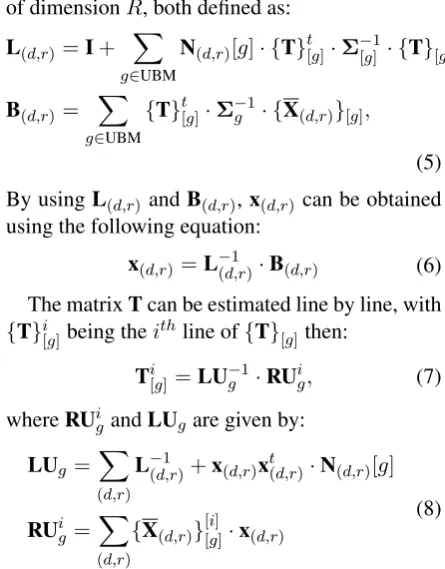
of dimensionR, both defined as: L(d,r)=I+
X
g∈UBM
N(d,r)[g]· {T}[g]t ·Σ−[g]1· {T}[g]
B(d,r)= X
g∈UBM
{T}t[g]·Σ−g1· {X(d,r)}[g],
(5) By usingL(d,r)andB(d,r),x(d,r) can be obtained
using the following equation:
x(d,r)=L−(d,r)1 ·B(d,r) (6) The matrixTcan be estimated line by line, with
{T}i
[g]being theithline of{T}[g]then:
Ti[g]=LU−g1·RUig, (7) whereRUi
g andLUgare given by:
LUg = X
(d,r)
L−1
(d,r)+x(d,r)xt(d,r)·N(d,r)[g]
RUi g =
X
(d,r)
{X(d,r)}[i][g]·x(d,r) (8)
Algorithm 1 presents the method adopted to es-timate the multi-view variability dialogue matrix with the above developments where the standard likelihood function can be used to assess the con-vergence. One can refer to (Matrouf et al., 2007) to find out more about the implementation of the factor analysis.
C-vector representation suffers from 3 raisedc -vector issues: (i) the c-vectors x of equation 2 have to be theoretically distributed among the nor-mal distribution N(0, I), (ii) the “radial” effect should be removed, and (iii) the full rank total factor space should be used to apply discriminant transformations. The next section presents a solu-tion to these 3 problems.
4.3 C-vector standardization
A solution to standardize c-vectors has been de-veloped in (Bousquet et al., 2011). The authors proposed to apply transformations for training and test transcription representations. The first step is to evaluate the empirical meanx and covariance matrixVof the trainingc-vector. Covariance ma-trixVis decomposed by diagonalization into:
PDPT (9)
wherePis the eigenvector matrix ofVandDis the diagonal version ofV. A trainingi-vectorx(d,r)is
transformed inx0
(d,r)as follows:
x0
(d,r)= D
−1
2PT(x(d,r)−x)
q
(x(d,r)−x)TV−1(x
(d,r)−x)
(10)
The numerator is equivalent by rotation to V−12(x
(d,r)−x)and the Euclidean norm ofx0(d,r)
[image:6.595.69.292.273.558.2]is equal to 1. The same transformation is applied to the testc-vectors, using the training set parame-tersxand mean covarianceVas estimations of the test set of parameters.
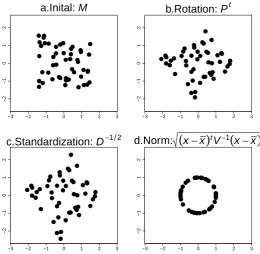
Figure 3 shows the transformation steps: Fig-ure (a) is the original training set; FigFig-ure 3-(b) shows the rotation applied to the initial train-ing set around the principal axes of the total vari-ability when PT is applied; Figure 3-(c) shows
the standardization of c-vectors when D−1 2 is applied; and finally, Figure 3-(d) shows the c -vectorx0
(d,r)on the surface area of the unit
hyper-sphere after a length normalization by a division ofq(x(d,r)−x)TV−1(x(d,r)−x).
5 Experimental Protocol
The proposedc-vector representation of automatic transcriptions is evaluated in the context of the theme identification of a human-human telephone conversation in the customer care service (CCS) of the RATP Paris transportation system. The met-ric used to identify of the best theme is the Maha-lanobis metric.
5.1 Theme identification task
● ● ● ● ● ● ● ● ● ● ● ● ● ● ● ● ● ● ● ● ● ● ● ● ● ● ● ● ● ● ● ● ● ● ● ● ● ● ● ● ● ● ● ● ● ● ● ● ● ●
−3 −2 −1 0 1 2 3
−2 −1 0 1 2 a.Inital: M ● ● ● ● ● ● ● ● ● ● ● ● ● ● ● ●● ● ● ● ● ● ● ● ● ● ● ● ● ● ● ● ● ● ● ● ● ● ● ● ● ● ● ● ● ● ● ● ● ●
−3 −2 −1 0 1 2 3
−2
−1
0
1
2
b.Rotation: Pt
● ● ● ● ● ● ● ● ● ● ● ● ● ● ● ● ● ● ● ● ● ● ● ●● ● ● ● ● ● ● ● ● ● ● ● ● ● ● ● ● ● ● ● ● ● ● ● ● ●
−3 −2 −1 0 1 2 3
−2
−1
0
1
2
c.Standardization: D−1 2
● ● ● ● ● ● ● ● ●● ● ● ● ● ● ● ● ● ● ● ● ● ● ● ● ● ● ● ● ● ● ● ● ● ● ● ● ● ● ● ● ● ● ● ● ● ● ● ● ●
−3 −2 −1 0 1 2 3
−2
−1
0
1
2
[image:7.595.171.432.63.317.2]d.Norm:
(
x−x)
tV−1(
x−x)
Figure 3: Effect of the standardization with the EFR algorithm.
set (740 dialogues), a development set (175 dia-logues) and a test set (327 diadia-logues), and manu-ally annotated with 8 conversation themes: prob-lems of itinerary,lost and found,time schedules, transportation cards,state of the traffic,fares, in-fractionsandspecial offers.
An LDA model allowed us to elaborate 3,000 topics spaces by varying the number of topics from 10 to 3,010. A topic space having less than 10 topics is not suitable for a corpus of more than 700 dialogues (training set). For each theme{Ci}8i=1,
a set of 50 specific words is identified. All the selected words are then merged without repetition to composeV, which is made of 166 words. The topic spaces are made with the LDA Mallet Java implementation2.
The LIA-Speeral ASR system (Linar`es et al., 2007) is used for the experiments. Acoustic model parameters were estimated from 150 hours of speech in telephone conditions. The vocabulary contains 5,782 words. A 3-gram language model (LM) was obtained by adapting a basic LM with the training set transcriptions. A “stop list” of 126 words3 was used to remove unnecessary words
(mainly function words), which results in a Word Error Rate (WER) of 33.8% on the training, 45.2% on the development, and 49.5% on the test. These
2http://mallet.cs.umass.edu/
3http://code.google.com/p/stop-words/
high WER are mainly due to speech disfluencies and to adverse acoustic environments (for exam-ple, calls from noisy streets with mobile phones).
5.2 Mahalanobis metric
Given a new observationx, the goal of the task is to identify the theme belonging tox. Probabilistic approaches ignore the process by whichc-vectors were extracted and they pretend instead they were generated by a prescribed generative model. Once a c-vector is obtained from a dialogue, its repre-sentation mechanism is ignored and it is regarded as an observation from a probabilistic generative model. The Mahalanobis scoring metric assigns a dialogue dwith the most likely theme C. Given a training dataset of dialogues, letW denote the within dialogue covariance matrix defined by:
W=XK
k=1 nt
nWk
= n1
K X k=1 nt X i=0
xki −xk xki −xk t
(11)
where Wk is the covariance matrix of the kth themeCk,nt is the number of utterances for the
Each dialogue does not contribute to the co-variance in an equivalent way. For this reason, the term nt
n is introduced in equation 11. If
ho-moscedasticity (equality of the class covariances) and Gaussian conditional density models are as-sumed, a new observation xfrom the test dataset can be assigned to the most likely themeCkBayes us-ing the classifier based on the Bayes decision rule:
CkBayes = arg maxk {N(x|xk,W)}
= arg max
k
−12(x−xk)tW−1(x−xk) +ak
where W is the within theme covariance ma-trix defined in eq. 11;N denotes the normal dis-tribution andak = log (P(Ck)). It is noted that,
with these assumptions, the Bayesian approach is similar to Fisher’s geometric approach: x is as-signed to the class of the nearest centroid, accord-ing to the Mahalanobis metric (Xaccord-ing et al., 2002) ofW−1:
CkBayes = arg maxk
−12||x−xk||2W−1+ak
6 Experiments and results
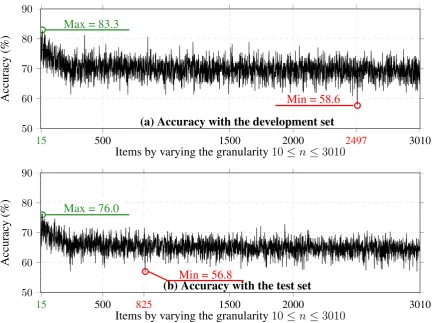
The proposed c-vector approach is applied to the same classification task and corpus proposed in (Morchid et al., 2014a; Morchid et al., 2014b; Morchid et al., 2013) (state-of-the-art in text clas-sification in (Morchid et al., 2014a)). Experiments are conducted using the multiple topic spaces esti-mated with an LDA approach. From these mul-tiple topic spaces, a classical way is to find the one that reaches the best performance. Figure 4 presents the theme classification performance ob-tained on the development and test sets using vari-ous topic-based representation configurations with the EFR normalization algorithm (baseline).
For sake of comparison, experiments are con-ducted using the automatic transcriptions only (ASR) only. The conditions indicated by the ab-breviations between parentheses are considered for the development (Dev) and the test (Test) sets. Only homogenous conditions (ASR for both training and validations sets) are considered in this study. Authors in (Morchid et al., 2014a) notice that results collapse dramatically when heteroge-nous conditions are employed (TRS or TRS+ASR for training set and ASR for validation set).
First of all, we can see that this baseline ap-proach reached a classification accuracy of 83% and 76%, respectively on the development and the test sets. However, we note that the classifica-tion performance is rather unstable, and may com-pletely change from a topic space configuration to another. The gap between the lower and the higher classification results is also important, with a dif-ference of 25 points on the development set (the same trend is observed on the test set). As a result, finding the best topic space size seems crucial for this classification task, particularly in the context of highly imperfect automatic dialogue transcrip-tions containing more than one theme.
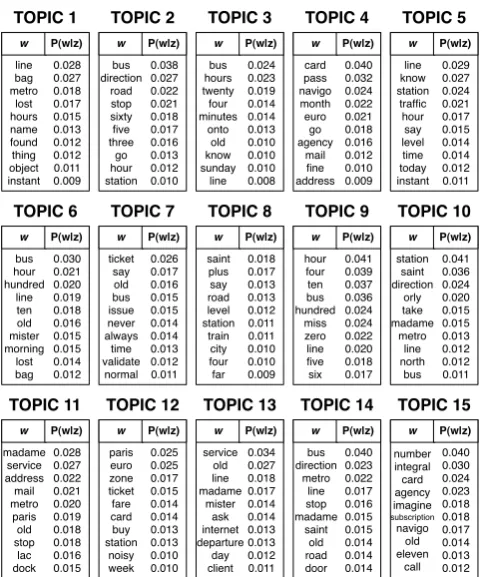
The topic space that yields the best accuracy with the baseline method (n = 15topics) is pre-sented in Figure 5. This figure presents each of the 15 topics and their 10 most representative words (highestP(w|z)). Several topics contain more or less the same representative words, such as topics 3, 6 and 9. This figure points out some interesting topics that allow us to distinguish a theme from the others. For example:
• topics 2, 10 and 15 represent some words re-lated toitinerary problems,
• thetransportation cardstheme is mostly rep-resented in topic 4 and 15 (Imagineand Nav-igoare names of transportation cards),
• the words which represent thetime schedules theme are contained in topic 5,6,7 and less in topic 9,
• state of the traffic could be discussed with words such as: departure, line, service, day. These words and others are contained in topic 13,
• topics 4 and 12 are related to theinfractions theme with to wordsfine,pass,zoneorticket,
• but topic 12 could be related to themefares orspecial offersas well .
15 500 1500 2000 2497 3010
50 60 70 80 90
Max = 83.3
Min = 58.6 (a) Accuracy with the development set
Items by varying the granularity10≤n ≤3010
Accurac
y
(%)
15 500 825 1500 2000 3010
50 60 70 80 90
Max = 76.0
Min = 56.8
(b) Accuracy with the test set
Items by varying the granularity10≤n ≤3010
Accurac
y
(%)
Figure 4: Theme classification accuracies using various topic-based representations with EFR normal-ization (baseline) on the development and test sets (X-coordinates start at 10 indeed, but to show the best configuration point (15), the origine (10) has been removed).
Table 1: Theme classification accuracy (%) with differentc-vectors and GMM-UBM sizes.
DEV TEST
c-vector Number of Gaussians in GMM-UBM
size 32 64 128 256 32 64 128 256
60 88.8 86.5 91.2 90.6 85.0 82.6 83.5 84.7
100 91.2 92.4 92.4 87.7 86.0 85.0 83.5 84.7
[image:9.595.77.512.61.384.2]120 89.5 92.2 89.5 87.7 85.0 83.5 85.4 84.1
Table 2: Maximum (Max), minimum (Min) and Difference (Max−Min) theme classification accu-racies (%) using the baseline and the proposedc-vector approaches.
Max Min Difference
Method DEV TEST DEV TEST DEV TEST
baseline 83.3 76.0 58.6 56.8 14.7 20.8
c-vector 92.4 85.0 86.5 82.6 5.9 2.4
and test sets, the gap between accuracies is much smaller: classification accuracy does not go be-low 82.6%, while it reached 56% for the worst topic-based configuration. Indeed, as shown in Ta-ble 2, the difference between the maximum and
the minimum theme classification accuracies is of 20% using the baseline approach while it is only of 2.4% using thec-vector method.
w P(w|z) TOPIC 1 line bag metro lost hours name found thing object instant 0.028 0.027 0.018 0.017 0.015 0.013 0.012 0.012 0.011 0.009 w P(w|z) TOPIC 2 bus direction road stop sixty five three go hour station 0.038 0.027 0.022 0.021 0.018 0.017 0.016 0.013 0.012 0.010 w P(w|z) TOPIC 3 bus hours twenty four minutes onto old know sunday line 0.024 0.023 0.019 0.014 0.014 0.013 0.010 0.010 0.010 0.008 w P(w|z) TOPIC 4 card pass navigo month euro go agency mail fine address 0.040 0.032 0.024 0.022 0.021 0.018 0.016 0.012 0.010 0.009 w P(w|z) TOPIC 5 line know station traffic hour say level time today instant 0.029 0.027 0.024 0.021 0.017 0.015 0.014 0.014 0.012 0.011 w P(w|z) TOPIC 6 bus hour hundred line ten old mister morning lost bag 0.030 0.021 0.020 0.019 0.018 0.016 0.015 0.015 0.014 0.012 w P(w|z) TOPIC 7 ticket say old bus issue never always time validate normal 0.026 0.017 0.016 0.015 0.015 0.014 0.014 0.013 0.012 0.011 w P(w|z) TOPIC 8 saint plus say road level station train city four far 0.018 0.017 0.013 0.013 0.012 0.011 0.011 0.010 0.010 0.009 w P(w|z) TOPIC 9 hour four ten bus hundred miss zero line five six 0.041 0.039 0.037 0.036 0.024 0.024 0.022 0.020 0.018 0.017 w P(w|z) TOPIC 10 station saint direction orly take madame metro line north bus 0.041 0.036 0.024 0.020 0.015 0.015 0.013 0.012 0.012 0.011 w P(w|z) TOPIC 11 madame service address mail metro paris old stop lac dock 0.028 0.027 0.022 0.021 0.020 0.019 0.018 0.018 0.016 0.015 w P(w|z) TOPIC 12 paris euro zone ticket fare card buy station noisy week 0.025 0.025 0.017 0.015 0.014 0.014 0.013 0.013 0.010 0.010 w P(w|z) TOPIC 13 service old line madame mister ask internet departure day client 0.034 0.027 0.018 0.017 0.014 0.014 0.013 0.013 0.012 0.011 w P(w|z) TOPIC 14 bus direction metro line stop madame saint old road door 0.040 0.023 0.022 0.017 0.016 0.015 0.015 0.014 0.014 0.014 w P(w|z) TOPIC 15 number integral card agency imagine subscription navigo old eleven call 0.040 0.030 0.024 0.023 0.018 0.018 0.017 0.014 0.013 0.012
Figure 5: Topic space (15 topics) that obtains the best accuracy with the baseline system (see Fig. 4).
contained in dialogue conversations: in a classi-fication context, better accuracy can be obtained and the results can be more consistent when vary-ing thec-vector size and the number of Gaussians. 7 Conclusions
This paper presents an original multi-view repre-sentation of automatic speech dialogue transcrip-tions, and a fusion process with the use of a factor analysis method calledi-vector. The first step of the proposed method is to represent a dialogue in multiple topic spaces of different sizes (i.e. num-ber of topics). Then, a compact representation of the dialogue from the multiple views is pro-cessed to compensate the vocabulary and the vari-ability of the topic-based representations. The ef-fectiveness of the proposed approach is evaluated in a classification task of theme dialogue identifi-cation. Thus, the architecture of the system iden-tifies conversation themes using the i-vector ap-proach. This compact representation was initially developed for speaker recognition and we showed that it can be successfully applied to a text clas-sification task. Indeed, this solution allowed the system to obtain better classification accuracy than with the use of the classical best topic space
con-figuration. In fact, we highlighted that this original compact version of all topic-based representations of dialogues, calledc-vector in this work, coupled with the EFR normalization algorithm, is a better solution to deal with dialogue variabilities (high word error rates, bad acoustic conditions, unusual word vocabulary, etc). This promising compact representation allows us to effectively solve both the difficult choice of the right number of topics and the multi-theme representation issue of partic-ular textual documents. Finally, the classification accuracy reached 85% with a gain of 9 points com-pared to usual baseline (best topic space configu-ration). In a future work, we plan to evaluate this new representation of textual documents in other information retrieval tasks, such as keyword ex-traction or automatic summarization systems. Acknowledgements
References
R. Arun, Venkatasubramaniyan Suresh, C.E. Veni Madhavan, and Musti Narasimha Murty. 2010. On finding the natural number of topics with latent dirichlet allocation: Some observations. In Advances in Knowledge Discovery and Data Mining, pages 391–402. Springer.
Frederic Bechet, Benjamin Maza, Nicolas Bigouroux, Thierry Bazillon, Marc El-Beze, Renato De Mori, and Eric Arbillot. 2012. Decoda: a call-centre human-human spoken conversation corpus. LREC’12.
Jerome R. Bellegarda. 1997. A latent semantic analy-sis framework for large-span language modeling. In Fifth European Conference on Speech Communica-tion and Technology.
Jerome R. Bellegarda. 2000. Exploiting latent se-mantic information in statistical language modeling. Proceedings of the IEEE, 88(8):1279–1296. David M. Blei and John Lafferty. 2006. Correlated
topic models. Advances in neural information pro-cessing systems, 18:147.
David M. Blei, Andrew Y. Ng, and Michael I. Jordan. 2003. Latent dirichlet allocation. The Journal of Machine Learning Research, 3:993–1022.
Pierre-Michel Bousquet, Driss Matrouf, and Jean-Franc¸ois Bonastre. 2011. Intersession compensa-tion and scoring methods in the i-vectors space for speaker recognition. InInterspeech, pages 485–488. Juan Cao, Tian Xia, Jintao Li, Yongdong Zhang, and Sheng Tang. 2009. A density-based method for adaptive lda model selection. Neurocomputing, 72(7):1775–1781.
Scott Deerwester, Susan T. Dumais, George W. Fur-nas, Thomas K. Landauer, and Richard Harshman. 1990. Indexing by latent semantic analysis. Jour-nal of the American society for information science, 41(6):391–407.
Najim Dehak, Patrick J. Kenny, R´eda Dehak, Pierre Dumouchel, and Pierre Ouellet. 2011. Front-end factor analysis for speaker verification. IEEE Trans-actions on Audio, Speech, and Language Process-ing, 19(4):788–798.
Javier Franco-Pedroso, Ignacio Lopez-Moreno, Doro-teo T Toledano, and Joaquin Gonzalez-Rodriguez. 2010. Atvs-uam system description for the audio segmentation and speaker diarization albayzin 2010 evaluation. InFALA VI Jornadas en Tecnologa del Habla and II Iberian SLTech Workshop, pages 415– 418.
Daniel Garcia-Romero and Carol Y Espy-Wilson. 2011. Analysis of i-vector length normalization in speaker recognition systems. InInterspeech, pages 249–252.
Stuart Geman and Donald Geman. 1984. Stochas-tic relaxation, gibbs distributions, and the bayesian restoration of images. IEEE Transactions on Pattern Analysis and Machine Intelligence, (6):721–741.
Thomas L. Griffiths and Mark Steyvers. 2004. Find-ing scientific topics. Proceedings of the National academy of Sciences of the United States of Amer-ica, 101(Suppl 1):5228–5235.
Gregor Heinrich. 2005. Parameter estimation for text analysis. Web: http://www. arbylon. net/publications/text-est. pdf.
Thomas Hofmann. 1999. Probabilistic latent semantic analysis. InProc. of Uncertainty in Artificial Intelli-gence, UAI ’ 99, page 21. Citeseer.
Thomas Hofmann. 2001. Unsupervised learning by probabilistic latent semantic analysis. Machine Learning, 42(1):177–196.
Patrick Kenny, Gilles Boulianne, Pierre Ouellet, and Pierre Dumouchel. 2007. Joint factor analysis ver-sus eigenchannels in speaker recognition. IEEE Transactions on Audio, Speech, and Language Pro-cessing, 15(4):1435–1447.
Patrick Kenny, Pierre Ouellet, Najim Dehak, Vishwa Gupta, and Pierre Dumouchel. 2008. A study of in-terspeaker variability in speaker verification. IEEE Transactions on Audio, Speech, and Language Pro-cessing, 16(5):980–988.
Wei Li and Andrew McCallum. 2006. Pachinko allo-cation: Dag-structured mixture models of topic cor-relations.
Georges Linar`es, Pascal Noc´era, Dominique Massonie, and Driss Matrouf. 2007. The lia speech recogni-tion system: from 10xrt to 1xrt. InText, Speech and Dialogue, pages 302–308. Springer.
David Martınez, Oldrich Plchot, Luk´as Burget, On-drej Glembek, and Pavel Matejka. 2011. Language recognition in ivectors space. Interspeech, pages 861–864.
Driss Matrouf, Nicolas Scheffer, Benoit G.B. Fauve, and Jean-Francois Bonastre. 2007. A straightfor-ward and efficient implementation of the factor anal-ysis model for speaker verification. InInterspeech, pages 1242–1245.
Thomas Minka and John Lafferty. 2002. Expectation-propagation for the generative aspect model. In Proceedings of the Eighteenth conference on Uncer-tainty in artificial intelligence, pages 352–359. Mor-gan Kaufmann Publishers Inc.
Mohamed Morchid, Richard Dufour, Pierre-Michel Bousquet, Mohamed Bouallegue, Georges Linar`es, and Renato De Mori. 2014a. Improving dialogue classification using a topic space representation and a gaussian classifier based on the decision rule. In ICASSP. IEEE.
Mohamed Morchid, Richard Dufour, and Georges Linar`es. 2014b. A LDA-Based Topic Classification Approach from Highly Imperfect Automatic Tran-scriptions. InLREC.
Douglas A. Reynolds and Richard C. Rose. 1995. Robust text-independent speaker identification using gaussian mixture speaker models. IEEE Transac-tions on Speech and Audio Processing, 3(1):72–83. Gerard Salton. 1989. Automatic text processing: the
transformation. Analysis and Retrieval of Informa-tion by Computer.
Yoshimi Suzuki, Fumiyo Fukumoto, and Yoshihiro Sekiguchi. 1998. Keyword extraction using term-domain interdependence for dictation of radio news. In 17th international conference on Computational linguistics, volume 2, pages 1272–1276. ACL. Yee Whye Teh, Michael I. Jordan, Matthew J. Beal,
and David M. Blei. 2004. Sharing clusters among related groups: Hierarchical dirichlet processes. In NIPS.
Eric P. Xing, Michael I. Jordan, Stuart Russell, and Andrew Ng. 2002. Distance metric learning with application to clustering with side-information. In Advances in neural information processing systems, pages 505–512.