Knowledge Graph and Text Jointly Embedding
Zhen Wang†§, Jianwen Zhang†, Jianlin Feng§ , Zheng Chen†
†{v-zw,jiazhan,zhengc}@microsoft.com
§{wangzh56@mail2,fengjlin@mail}.sysu.edu.cn
†Microsoft Research §Sun Yat-sen University
Abstract
We examine the embedding approach to reason new relational facts from a large-scale knowledge graph and a text corpus. We propose a novel method of jointly em-bedding entities and words into the same continuous vector space. The embedding process attempts to preserve the relations between entities in the knowledge graph and the concurrences of words in the text corpus. Entity names and Wikipedia an-chors are utilized to align the embeddings of entities and words in the same space. Large scale experiments on Freebase and a Wikipedia/NY Times corpus show that jointly embedding brings promising improvement in the accuracy of predicting facts, compared to separately embedding knowledge graphs and text. Particularly, jointly embedding enables the prediction of facts containing entities out of the knowledge graph, which cannot be han-dled by previous embedding methods. At the same time, concerning the quality of the word embeddings, experiments on the analogical reasoning task show that jointly embedding is comparable to or slightly better than word2vec (Skip-Gram).
1 Introduction
Knowledge graphs such as Freebase (Bollacker et al., 2008) and WordNet (Miller, 1995) have be-come important resources for many AI & NLP ap-plications such as Q & A. Generally, a knowledge graph is a collection of relational facts that are of-ten represented in the form of a triplet (head en-tity, relation, tail entity), e.g., “(Obama, Born-in, Honolulu)”. An urgent issue for knowledge graph-s igraph-s the coverage, e.g., even the largegraph-st knowledge graph of Freebase is still far from complete.
Recently, targeting knowledge graph comple-tion, a promising paradigm of embedding was pro-posed, which is able to reason new facts only from the knowledge graph (Bordes et al., 2011; Bor-des et al., 2013; Socher et al., 2013; Wang et al., 2014). Generally, in this series of methods, each
entity is represented as ak-dimensional vector and
each relation is characterized by an operation in
<kso that a candidate fact can be asserted by
sim-ple vector operations. The embeddings are usually learnt by minimizing a global loss function of all the entities and relations in the knowledge graph. Thus, the vector of an entity may encode global information from the entire graph, and hence scor-ing a candidate fact by designed vector operations plays a similar role to long range “reasoning” in the graph. However, since this requires the vectors of both entities to score a candidate fact, this type of methods can only complete missing facts for which both entities exist in the knowledge graph. However, a missing fact often contains entities out
of the knowledge graph (calledout-of-kbfor short
in this paper), e.g., one or both entities are phras-es appearing in web text but not included in the knowledge graph yet. How to deal with these fact-s ifact-s a fact-significant obfact-stacle to widely applying the embedding paradigm.
In addition to knowledge embedding, anoth-er intanoth-eresting approach is the word embedding method word2vec (Mikolov et al., 2013b), which shows that learning word embeddings from an unlabeled text corpus can make the vectors con-necting the pairs of words of some certain
relation almost parallel, e.g., vec(“China”) −
vec(“Beijing”) ≈ vec(“Japan”)−vec(“Tokyo”).
However, it does not know the exact relation be-tween the pairs. Thus, it cannot be directly applied to complete knowledge graphs.
The capabilities and limitations of knowledge embedding and word embedding have inspired us to design a mechanism to mosaic the knowledge
graph and the “word graph” together in a vector space so that we can score any candidate
relation-al facts between entities and words1. Therefore,
we propose a novel method to jointly embed enti-ties and words into the same vector space. In our solution, we define a coherent probabilistic model for both knowledge and text, which is composed of three components: the knowledge model, text model, and alignment model. Both the knowledge model and text model use the same core transla-tion assumptransla-tion for the fact modeling: a candidate
fact(h, r, t)is scored based onkh+r−tk. The
only difference is, in the knowledge model the
re-lationr is explicitly supervised and the goal is to
fit the fact triplets, while in the text model we
as-sume any pair of wordshandtthat concur in some
text windows are of certain relationrbutris a
hid-den variable, and the goal is to fit the concurring pairs of words. The alignment model guarantees the embeddings of entities and words/phrases lie in the same space and impels the two models to en-hance each other. Two mechanisms of alignment are introduced in this paper: utilizing names of en-tities and utilizing Wikipedia anchors. This way of jointly embedding knowledge and text can be con-sidered to be semi-supervised knowledge embed-ding: the knowledge graph provides explicit su-pervision of facts while the text corpus provides much more “relation-unlabeled” pairs of words.
We conduct extensive large scale experiments on Freebase and Wikipedia corpus, which show jointly embedding brings promising improve-ments to the accuracy of predicting facts, com-pared to separately embedding the knowledge graph and the text corpus, respectively. Particu-larly, jointly embedding enables the prediction of a candidate fact with out-of-kb entities, which can not be handled by any existing embedding meth-ods. We also use embeddings to provide a prior score to help fact extraction on the benchmark da-ta set of Freebase+NYTimes and also observe very promising improvements. Meanwhile, concerning the quality of word embeddings, experiments on the analogical reasoning task show that jointly em-bedding is comparable to or slightly better than word2vec (Skip-Gram).
1We do not distinguish between “words” and “phrases”, i.e., “words” means “words/phrases”.
2 Related Work
Knowledge Embedding. A knowledge graph is embedded into a low-dimensional continuous vec-tor space while certain properties of it are pre-served (Bordes et al., 2011; Bordes et al., 2013; Socher et al., 2013; Chang et al., 2013; Wang et al., 2014). Generally, each entity is represented as a point in that space while each relation is inter-preted as an operation over entity embeddings. For instance, TransE (Bordes et al., 2013) interprets a
relation as atranslationfrom the head entity to the
tail entity. The embedding representations are usu-ally learnt by minimizing a global loss function in-volving all entities and relations so that each entity embedding encodes both local and global connec-tivity patterns of the original graph. Thus, we can reason new facts from learnt embeddings.
Word Embedding. Generally, word embeddings are learned from a given text corpus without su-pervision by predicting the context of each word or predicting the current word given its contex-t (Bengio econtex-t al., 2003; Collobercontex-t econtex-t al., 2011; Mikolov et al., 2013a; Mikolov et al., 2013b). Al-though relations between words are not explicitly modeled, continuous bag-of-words (CBOW) and Skip-gram (Mikolov et al., 2013a; Mikolov et al., 2013b) learn word embeddings capturing many syntactic and semantic relations between words
where a relation is also represented as the
trans-lationbetween word embeddings.
3 Jointly Embedding Knowledge and Text
We will first describe the notation used in this
pa-per. A knowledge graph∆ is a set of triplets in
the form(h, r, t), h, t ∈ E andr ∈ RwhereEis
the entity vocabulary andRis a collection of
pre-defined relations. We use bold lettersh,r,tto
de-note the corresponding embedding
representation-s ofh, r, t. A text corpus is a sequence of words
drawn from the word vocabularyV. Note that we
perform some preprocessing to detect phrases in the text and the vocabulary here already includes the phrases. For simplicity’s sake, without spe-cial explanation, when we say “word(s)”, it means “word(s)/phrase(s)”. Since we consider triplets in-volving not only entities but also words, we denote
I =E ∪V. Additionally, we denote anchors byA.
3.1 Modeling
Our model is composed of three components: the knowledge model, text model, and alignment model.
Before defining the component models, we first define the element model for a fact triplet.
In-spired by TransE, we also represent a relation r
as a vectorr∈ <kand score a fact triplet(h, r, t)
by z(h,r,t) = b− 1
2kh+r−tk2 where bis a
constant for bias designated for adjusting the scale
for better numerical stability andb= 7is a
sensi-ble choice. z(h,r,t)is expected to be large if the
triplet is true. Based on the same element model of fact, we define the component models as follows.
3.1.1 Knowledge Model
We define the following conditional probability of
a fact(h, r, t)in a knowledge graph:
Pr(h|r, t) = P exp{z(h,r,t)} ˜
h∈Iexp{z(˜h,r,t)}
(1)
and we have named our model pTransE
(Proba-bilistic TransE) to show respect to TransE. We also
define Pr(r|h, t) andPr(t|h, r) in the same way
by choosing corresponding normalization terms respectively. We define the likelihood of observ-ing a fact triplet as:
Lf(h, r, t) = log Pr(h|r, t)+ log Pr(t|h, r)
+ log Pr(r|h, t) (2)
The goal of the knowledge model is to maximize the conditional likelihoods of existing fact triplets
in the knowledge graph:
LK =
X
(h,r,t)∈∆
Lf(h, r, t) (3)
3.1.2 Text Model
We propose the following key assumption for modeling text, which connects word embedding and knowledge embedding: there are relations between words although we do not know what they are.
Relational Concurrence Assumption. If two wordswandvconcur in some context, e.g., a win-dow of text, then there is a relation rwv between
the two words. That is, we can state the triplet of
(w, rwv, v)is a fact.
We define the conditional probability
Pr(w|rwv, v) following the same formulation
of Eq.(1) to model why two words concur in some context. In contrast to knowledge embedding,
hererwvis a hidden variable rather than explicitly
supervised.
The challenge is to deal with the hidden variable
rwv. Obviously, without any more
assumption-s, the number of distinctrwv is around|V| ×N¯,
whereN¯ is the average number of unique
word-s concurred with each word. Thiword-s number iword-s ex-tremely large. Thus it is almost impossible to
esti-mate a vector for eachrwv. And the problem is
ac-tually ill-posed. We need to constrain the freedom
degree ofrwv. Here we use auxiliary variables to
reduce the size of variables we need to estimate:
letw0 =w+rwv, then
z(w,rwv,v),z(w0,v) =b−12kw0−vk2 (4)
and
Pr(w|rwv, v),Pr(w|v) = exp{z(w 0,v)}
P ˜
w∈Vexp{z(w˜0,v)}
(5)
In this way we need to estimate vectorswandw0
for each wordw, and a total of2× |V|vectors.
The goal of the text model is to maximize the likelihood of the concurrences of pairs of words in text windows:
LT =
X
(w,v)∈C
nwvlog Pr(w|v). (6)
In the above equation,Cis all the distinct pairs of
words concurring in text windows of a fixed size.
Andnwvis the number of concurrences of the pair
(w, v). Interestingly, as explained in Sec.(3.3),
3.1.3 Alignment Model
If we only have the knowledge model and text model, the entity embeddings and word embed-dings will be in different spaces and any comput-ing between them is meancomput-ingless. Thus we need mechanisms to align the two spaces into the same one. We propose two mechanisms in this paper: u-tilizing Wikipedia anchors, and uu-tilizing names of entities.
Alignment by Wikipedia Anchors. This mod-el is based on the connection between Wikipedia and Freebase: for most Wikipedia (English) pages, there is an unique corresponding entity in Free-base. As a result, for most of the anchors in Wikipedia, each of which refers to a
Wikipedi-a pWikipedi-age, we know thWikipedi-at the surfWikipedi-ace phrWikipedi-ase v of an
anchor actually refers to the Freebase entity ev.
Thus, we define a likelihood for this part of
an-chors as Eq.(6) but replace the word pair (w, v)
with the word-entity pair (w, ev), i.e., using the
corresponding entity ev rather than the surface
wordvin Eq.(5):
LAA =
X
(w,v)∈C,v∈A
log Pr(w|ev) (7)
whereAdenotes the set of anchors.
In addition to Wikipedia anchors, we can also use an entity linking system with satisfactory per-formance to produce the pseudo anchors.
Alignment by Names of Entities. Another way is to use the names of entities. For a fact triplet
(h, r, t)∈∆, ifhhas a namewhandwh ∈ V, then
we will generate a new triplet of(wh, r, t)and add
it to the graph. Similarly, we also add (h, r, wt)
and (wh, r, wt) into the graph if the names exist
and belong to the word vocabulary. We call this
sub-graph containing names thename graph and
define a likelihood for the name graph by observ-ing its triplets:
LAN =
X
(h,r,t)∈∆
I[wh∈V ∧wt∈V]·Lf(wh, r, wt)+
I[wh∈V]· Lf(wh, r, t) +I[wt∈V]· Lf(h, r, wt)
(8)
Both alignment models have advantages and disadvantages. Alignment by names of entities is straightforward and does not rely on additional da-ta sources. The number of triplets generated by the names is also large and can significantly change the results. However, this model is risky. On the
one hand, the name of an entity is ambiguous be-cause different entities sometimes have the same name so that the name graph may contaminate the knowledge embedding. On the other hand, an en-tity often has several different aliases when men-tioned in the text but we do not have the complete set, which will break the semantic balance of word embedding. For example, for the entity Apple In-c., suppose we only have the standard name “Ap-ple Inc.” but do not have the alias “ap“Ap-ple”. And for the entity Apple that is fruit, suppose we have the name ”apple” included in the name graph. Then the vector of the word “apple” will be biased to the concept of fruit rather than the company. But if no name graph intervenes, the unsupervised word embedding is able to learn a vector that is closer to the concept of the company due to the polarities. Alignment by anchors relies on the additional data source of Wikipedia anchors. Moreover, the
num-ber of matched Wikipedia anchors (∼40M) is
rela-tively small compared to the total number of word
pairs (∼2.0B in Wikipedia) and hence the
contri-bution is limited. However, the advantage is that the quality of the data is very high and there are no ambiguity/completeness issues.
Considering the above three component models together, the likelihood we maximize is:
L=LK+LT +LA (9)
whereLAcould beLAAorLANorLAA+LAN.
3.2 Training
3.2.1 Approximation to the Normalizers
It is difficult to directly compute the normalizers in
Pr(h|r, t)(orPr(t|h, r), Pr(r|h, t)) andPr(w|v)
as the normalizers sum over|I|or|V|terms where
both |I| and |V| reach tens of millions. To
pre-vent having to exactly calculate the normalizer-s, we use negative sampling (NEG) (Mikolov et al., 2013b) to transform the original objective, i.e., Eq.(9) to a simple objective of the binary classifi-cation problem—differentiating the observed data from noise.
First, we define: (i) the probability of a given
triplet (h, r, t) to be true (D = 1); and (ii) the
probability of a given word pair(w, v)to co-occur
(D= 1):
Pr(D= 1|h, r, t) =σ(z(h,r,t)) (10)
Pr(D= 1|w, v) =σ(z(w0,v)) (11)
whereσ(x) = 1
Instead of maximizing log Pr(h|r, t)in Eq.(2), we maximize:
log Pr(1|h, r, t)
+ c
X
i=1
E˜hi∼Prneg(˜hi)[Pr(0|˜hi, r, t)] (12)
where c is the number of negative examples to
be discriminated for each positive example. NEG guarantees that maximizing Eq.(12) can
approxi-mately maximizelog Pr(h|r, t). Thus, we also
re-placelog Pr(r|h, t), log Pr(t|r, h) in Eq.(2), and
log Pr(w|v)in Eq.(6) in the same way by choosing corresponding negative distributions respectively. As a result, the objectives of both the knowledge
modelLK(Eq.(3)) and text modelLT (Eq.(6)) are
free from cumbersome normalizers.
3.2.2 Optimization
We use stochastic gradient descent (SGD) to max-imize the simplified objectives.
Knowledge model. ∆ is randomly tra-versed multiple times. When a positive example
(h, r, t) ∈ ∆is considered, to maximize (12), we
constructcnegative triplets by sampling elements
from an uniform distribution overI and replacing
the head of(h, r, t). The transformed objective of
log Pr(r|h, t) is maximized in the same manner, but by sampling from a uniform distribution over
Rand corrupting the relation of(h, r, t). After a
mini-batch, computed gradients are used to update the involved embeddings.
Text model. The text corpus is traversed one or
more times. When current word v and a context
wordware considered,cwords are sampled from
the unigram distribution raised to the 3/4rd power
and regarded as negative examples( ˜w, v)that are
never concurrent. Then we compute and update the related gradients.
Alignment model.LAAandLAN are absorbed
by the text model and knowledge model respec-tively, since anchors are considered to predict con-text given an entity and the name graph are homo-geneous to the original knowledge graph.
Joint. All three component objectives are si-multaneouslyoptimized. To deal with large-scale data, we implement a multi-thread version with shared memory. Each thread is in charge of a por-tion of the data (either knowledge or text corpus), and traverses through them, calculates gradients and commits the update to the global model and is stored in a block of shared memory. For the
Table 1:Data: triplets used in our experiments.
#R #E #Triplet (Train/Valid/Test)
4,490 43,793,608 123,062,855 40,528,963 40,528,963
sake of efficiency, no lock is used on the shared memory.
3.3 Connections to Related Models
TransE. (Bordes et al., 2013) proposed to
mod-el a rmod-elation r as a translation vector r ∈ <k
which is expected to connect h and t with low
error if (h, r, t) ∈ ∆. We also follow it.
How-ever, TransE uses a margin based ranking loss
{kh+r−tk2+γ−k˜h+r−˜tk2}
+. It is not a
proba-bilistic model and hence it needs to restrict the nor-m of either entity enor-mbedding and/or relation enor-m- em-bedding. Bordes et al. (2013) intuitively addresses this problem by simply normalizing the entity em-beddings to the unit sphere before computing gra-dients at each iteration. We define pTransE as a probabilistic model, which doesn’t need addition-al constraints on the norms of embeddings of en-tities/words/relations, and thus eliminates the nor-malization operations.
Skip-gram. (Mikolov et al., 2013a; Mikolov et al., 2013b) defines the probability of the concurrence of two words in a window as:
Pr(w|v) = P exp{w0Tv} ˜
w∈Vexp{w˜0Tv} (13)
which is based on the inner product, while our text model (Eqs. (4), (5)) is based on distance. If we
constrain kwk = 1 for each w, then w0Tv =
1− 1
2kw0 −vk2. It is easy to see that our text
model is equivalent to Skip-gram in this case. Our distance-based text model is directly derived from the triplet fact model, which clearly explains why it is able to make the pairs of entities of a certain relation parallel in the vector space.
4 Experiments
Table 2: Data: the number ofe−e, w−e, e−
w, w −w triplets/analogies where w represents
the out-of-kb entity, which is regarded as word and replaced by its corresponding entity name.
Type #Triplet (Valid/Test) #Analogy
e−e 12,305,200 12,305,200 71,441
w−e 3,655,164 3,654,404 70,878
e−w 3,643,914 3,642,978 70,442
w−w 460,762 451,381 40,980
knowledge and text, we use “respectively” to re-fer to the embeddings learnt by TransE/pTransE and Skip-gram, respectively, “jointly” to refer to our jointly embedding method, in which “anchor” and “name” refer to “Alignment by Wikipedia An-chors” and “Alignment by Names of Entities”, re-spectively.
4.1 Data
To learn the embedding representations of entities and words, we use a knowledge graph, a text cor-pus, and some connections between them.
Knowledge. We adopt Freebase as our knowl-edge graph. First, we remove the user profiles, version control, and meta data, leaving 52,124,755 entities, 4,490 relations, and 204,120,782
triplet-s. We call this graph main facts. Then we held
out 8,331,147 entities from main facts and regard them as out-of-kb entities. Under such a setting, from main facts, we held out all the triplets in-volving out-of-kb entities, as well as 24,610,400 triplets that don’t contain out-of-kb entities. Held-out triplets are used for validation and testing; the remaining triplets are used for training. See Table 1 for the statistics.
We regard out-of-kb entities as words/phrases and thus divide the held-out triplets into four
type-s: no out-of-kb entity (e−e), the head is out-of-kb
entity but the tail is not (w−e), the tail is
out-of-kb entity but the head is not (e−w), and both the
head and tail are out-of-kb entities (w−w). Then
we replace the out-of-kb entities among the held-out triplets by their corresponding entity names. The mapping from a Freebase entity identifier to its name is done through the Freebase predicate— “/type/object/name”. Since some entity names
are not present in our vocabulary V, we remove
[image:6.595.83.276.125.187.2]triplets involving these names (see Table 2). In such a way, besides the missing edges between ex-isting entities, the related models can be evaluated on triplets involving words/phrases as their head
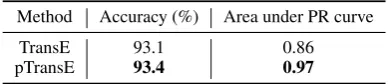
Table 3: Triplet Classification: comparison
be-tween TransE and pTransE overe−etriplets.
Method Accuracy (%) Area under PR curve
TransE 93.1 0.86
pTransE 93.4 0.97
and/or tail.
Text. We adopt the Wikipedia (English)
cor-pus. After removing pages designated for nav-igation, disambiguation, or discussion purpos-es, there are 3,469,024 articles left. We ap-ply sentence segmentation, tokenization, Part-of-Speech (POS) tagging, and named entity recog-nition (NER) to these articles using Apache
OpenNLP package2. Then we conduct some
sim-ple chunking to acquire phrases: if several con-secutive tokens are identically tagged as ”Loca-tion”/”Person”/”Organization”, or covered by an anchor, we combine them as a chunk. After the preprocessing, our text corpus contain 73,675,188 sentences consisting of 1,522,291,723 chunks. A-mong them, there are around 20 millions distinct chunks, including words and phrases. We filter out punctuation and rare words/phrases that occur less
than three times in the text corpus, reducing|V|to
5,240,003.
Alignment. One of our alignment models need-s Wikipedia anchorneed-s. There are around 45 million such anchors in our text corpus and 41,970,548 of
them refer to entities inE. Another mechanism
u-tilizes the name graph constructed through names of entities. Specifically, for each training triplet
(h, r, t), suppose h and t have entity names wh
and wt, respectively and wh, wt ∈ V, the
train-ing triplet contributes (wh, r, wt), (wh, r, t), and
(h, r, wt)to the name graph. There are 81,753,310
triplets in our name graphs. Note that there is no overlapping between the name graph and held-out
triplets ofe−w,w−e, andw−wtypes.
4.2 Triplet Classification
This task judges whether a triplet(h, r, t)is true
or false, i.e., binary classification of a triplet.
Evaluation protocol. Following the same pro-tocol in NTN (Socher et al., 2013), for each true triplet, we construct a false triplet for it by
ran-domly sampling an element fromI to corrupt its
head or tail. Since|E|is significantly larger than
|V| in our data, sampling from a uniform
Table 4:Triplet classification: accuracy (%) over various types of triplets.
Type e−e w−e e−w w−w all
respectively 93.4 52.1 51.4 71.0 77.5
jointly (anchor) 94.4 67.0 66.7 79.8 81.9 jointly (name) 94.5 80.5 80.0 89.0 87.7 jointly (anchor+name) 95.0 82.0 81.5 90.0 88.8
bution over I will let triplets involving no word
dominate the false triplets. To avoid that, when we
corrupt the head of(h, r, t), ifh ∈ E, h0 is
sam-pled fromEwhile ifh∈ V,h0is sampled fromV.
The same rule is applied when we corrupt the tail
of(h, r, t). In this way, for each of the four types
of triplets, we ensure the number of true triplets is equal to that of false ones.
To classify a triplet(h, r, t), we first use the
con-sidered methods to score it. TransE scores it by
−|h +r−t|. Our models score it byPr(D =
1|h, r, t)(see Eq.(10)). Then the considered
meth-ods label a triplet (h, r, t) as true if its score is
larger than the relation-specific threshold of r, as
false otherwise. The relation-specific thresholds are chosen to maximize the classification accura-cy over the validation set.
We report the classification accuracy. Addition-ally, we rank all the testing triplets by their scores in descending order. Then we draw a precision-recall (PR) curve based on this ranking and report the area under the PR curve.
Implementation. We implement TransE (Bor-des et al., 2013), Skip-gram (Mikolov et al., 2013a), and our models.
First, we train TransE and pTransE over our
training triplets with embedding dimension k
in {50,100,150}. Adhering to (Bordes et al.,
2013), we use the fixed learning rate α in
{0.005,0.01,0.05} for TransE during its 300
e-pochs. For pTransE, we use the number of
neg-ative examples per positive example c among
{5,10}, the learning rate α among{0.01,0.025}
whereαdecreases along with its 40 epochs. The
optimal configurations of TransE are: k = 100,
α = 0.01. The optimal configurations of pTransE
are:k= 100,c= 10, andα= 0.025.
Then we train Skip-gram with the embedding
dimensionkin{50,100,150}, the max skip-range
sin{5,10}, the number of negative examples per
positive example c in {5,10}, and learning rate
α = 0.025linearly decreasing along with the 6
epochs over our text corpus. Popular words whose
frequencies are larger than 10−5 are subsampled
according to the trick proposed in (Mikolov et al., 2013b). The optimal configurations of Skip-gram are:k= 150,s= 5, andc= 10.
Combining entity embeddings and word em-beddings learnt by pTransE and Skip-gram respec-tively, “respectively” model can score all types of held-out triplets. For our jointly embedding mod-el, we consider various alignment mechanisms and use equal numbers of threads for knowledge mod-el and text modmod-el. The best configurations of
“jointly” model are: k= 150,s= 5,c= 10, and
α= 0.025which linearly decreases along with the
6 epochs of traversing text corpus.
Results. We first illustrate the comparison
be-tween TransE and pTransE overe−etype
triplet-s in Table 3. Obtriplet-serving the triplet-scoretriplet-s atriplet-striplet-signed to true triplets by TransE, we notice that triplets of popular relations generally have larger scores than those of rare relations. In contrast, pTransE, as a probabilistic model, assigns comparable scores to true triplets of both popular and rare relations. When we use a threshold to separate true triplets from false triplets of the same relation, there is no obvious difference between the two models. How-ever, when all triplets are ranked together, assign-ing scores in a more uniform scale is definitely an advantage. Thus, the contradiction stems from the different training strategies of the two models and the consideration of relation-specific thresholds.
com-0.0 0.2 0.4 0.6 0.8 1.0 Recall
0.75 0.80 0.85 0.90 0.95 1.00 1.05
pr
ecision
Mintz (0.864752658197) Mintz+Jointly (0.891043673778) Mintz+Knowledge (0.917260610051)
0.0 0.2 0.4 0.6 0.8 1.0 Recall
0.3 0.4 0.5 0.6 0.7 0.8 0.9 1.0
pr
ecision
Mintz (0.512956668019) Mintz+Jointly (0.636313453126)
0.0 0.2 0.4 0.6 0.8 1.0 Recall
0.4 0.5 0.6 0.7 0.8 0.9 1.0
pr
ecision
Mintz (0.662641417434) Mintz+Jointly (0.695062505333)
0.0 0.2 0.4 0.6 0.8 1.0 Recall
0.00 0.05 0.10 0.15 0.20 0.25 0.30 0.35
pr
ecision
Mintz (0.0914506877334) Mintz+Jointly (0.0993184342972)
0.0 0.2 0.4 0.6 0.8 1.0 Recall
0.1 0.2 0.3 0.4 0.5 0.6 0.7 0.8 0.9 1.0
pr
ecision
[image:8.595.87.509.65.292.2]Mintz (0.363969399646) Mintz+Jointly (0.480909766665) Mintz+Knowledge (0.418875519101)
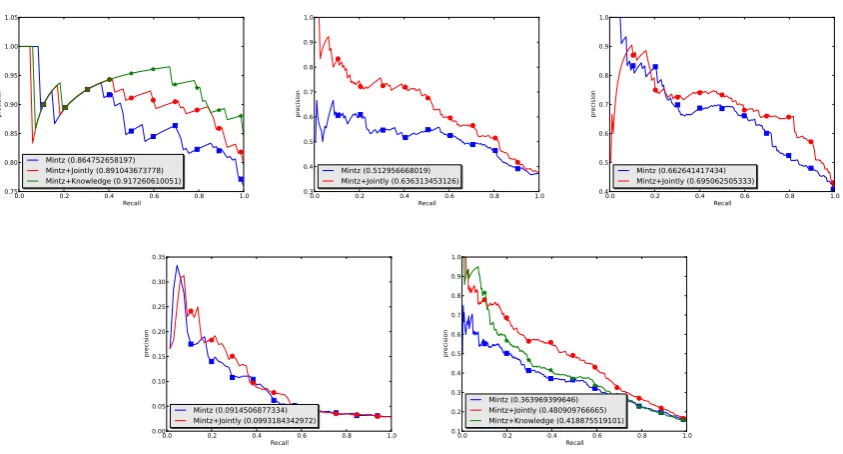
Figure 1: Improving Relation Extraction: PR curves of Mintz alone or combined with knowledge
(pTransE) / jointly model over (a)e−e, (b)w−e, (c)e−w, (d)w−w, and (e) all triplets.
pared with |E|. Thus, interactions brought in by
anchors are not as significant as that of the name graph.
4.3 Improving Relation Extraction
It has been shown that embedding models are very complementary to extractors (Weston et al., 2013). However, some entities detected from text are out-of-kb entities. In such a case, triplets involving these entities cannot be handled by any existing knowledge embedding method, but our jointly em-bedding model can score them. As our model can cover more candidate triplets provided by extrac-tors, it is expected to provide more significant im-provements to extractors than any other embed-ding model. We confirm this point as follow.
Evaluation protocol. For relation extraction, we use a public dataset—NYT+FB (Riedel et al.,
2010)3, which distantly labels the NYT corpus by
Freebase facts. We consider (Mintz et al., 2009) and Sm2r (Weston et al., 2013) as our extractors to provide candidate triplets as well as their plau-sibilities estimated according to text features.
For embedding, we first held out triplets from our training set that appear in the test set of NYT+FB. Then we train TransE, pTransE and the “jointly” model on the remaining training triplets as well as on our text corpus. Then we use these models to score each candidate triplet in the same
3http://iesl.cs.umass.edu/riedel/ecml/
way as the previous triplet classification experi-ment.
For combination, we first divide each candidate
triplet into one of these categories: e−e,e−w,
w − e, w − w, and “out-of-vocabulary”.
Be-cause there is no embedding model that can score triplets involving out-of-vocabulary word/phrase, we just ignore these triplets.Please note that, for our jointly embedding model, there are no “out-of-vocabulary” triplets if we include the NYT cor-pus for training. We use the embedding models to score candidate triplets and combine the scores given by the embedding model with scores given
by the extractors. For each typee−e,e−w,w−e,
w−wand their union (i.e.all), we rank the
candi-date triplets by their revisited scores and draw PR curve to observe which embedding method pro-vides the most significant improvements to the ex-tractors.
Implementation. For (Mintz et al., 2009), we
use the implementation in (Surdeanu et al., 2012)4.
We implement Sm2r by ourselves with the best hy-perparameters introduced in (Weston et al., 2013). For TransE, pTransE, and the “jointly” model, we use the same implementations, scoring schemes, and optimal configurations as the triplet classifica-tion experiment.
To combine extractors with embedding
0.0 0.2 0.4 Recall 0.6 0.8 1.0 0.55
0.60 0.65 0.70 0.75 0.80 0.85 0.90 0.95 1.00
precision
Sm2r (0.773014296476) Sm2r+Jointly (0.858251870864) Sm2r+Knowledge (0.858251870864)
0.0 0.2 0.4 Recall0.6 0.8 1.0 0.86
0.88 0.90 0.92 0.94 0.96 0.98 1.00
precision
Sm2r (0.908752270146) Sm2r+Jointly (0.966914103913)
0.0 0.2 0.4 Recall 0.6 0.8 1.0 0.82
0.84 0.86 0.88 0.90 0.92 0.94 0.96 0.98 1.00
precision
Sm2r (0.875810724647) Sm2r+Jointly (0.966676169402)
0.0 0.2 0.4 Recall 0.6 0.8 1.0 0.2
0.3 0.4 0.5 0.6 0.7 0.8 0.9 1.0
precision
Sm2r (0.431460754321) Sm2r+Jointly (0.536200901997)
0.0 0.2 0.4 Recall 0.6 0.8 1.0 0.50
0.55 0.60 0.65 0.70 0.75 0.80 0.85 0.90
precision
[image:9.595.86.509.65.291.2]Sm2r (0.67446140565) Sm2r+Jointly (0.802071230237) Sm2r+Knowledge (0.697899016348)
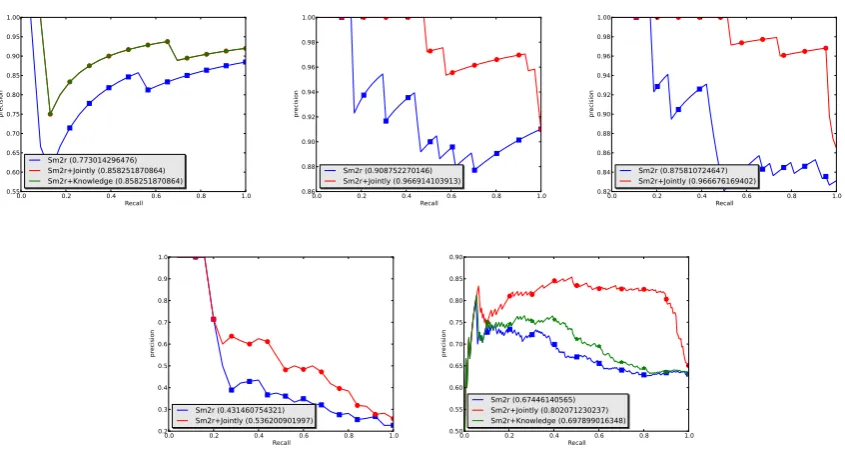
Figure 2: Improving Relation Extraction: PR curves of Sm2r alone or combined with knowledge
(TransE) / jointly model over (a)e−e, (b)w−e, (c)e−w, (d)w−w, and (e) all triplets.
els, we consider two schemes. Since Mintz s-cores candidate triplets in a probabilistic man-ner, we linearly combine its scores with the s-cores given by pTransE or the “jointly” mod-el: βPrMintz+(1−β) PrpTransE/Jointly where β is
enumerated from 0 to 1 with 0.025 as a search step. On the other hand, neither Sm2r nor TransE
is a probabilistic model. Thus, we combine
Sm2r with TransE or the “jointly” model ac-cording to the scheme proposed in (Weston et
al., 2013) where for each candidate (h, r, t), if
P
r06=rδ(Score(h, r, t) < Score(h, r0, t)) is less
than τ, we increase ScoreSm2r(h, r, t) by p. We
search for the bestβ,τ, andpon another dataset—
Wikipedia corpus distantly labeled by Freebase.
Result. We present the PR curves in Fig. (1, 2). Over candidate triplets provided by either Mintz or Sm2r, the “jointly” model is consis-tently comparable with the “knowledge” model
(TransE/pTransE) overe−etriplets while it
[image:9.595.307.524.372.433.2]out-performs the “knowledge” model by a consider-able margin over triplets of other types. These results confirm the advantage of jointly embed-ding and are actually straightforward results of our triplet classification experiment because the only difference is that the triplets here are provided by the extractor.
Table 6:Phrases Analogical Reasoning Task.
Method Accuracy (%) Hits@10 (%)
Skip-gram 18.0 56.1
Jointly (anchor) 27.6 65.0
Jointly (name) 11.3 40.6
Jointly (anchor+name) 18.3 54.0
Table 7: Constructed Analogical Reasoning
Task.
Method Accuracy (%) Hits@10 (%)
Skip-gram 10.5 14.1
Jointly (anchor) 10.5 14.3
Jointly (name) 11.5 16.2
Jointly (anchor+name) 11.6 16.5
4.4 Analogical Reasoning Task
We compare our method with Skip-gram on this task to observe and study the influences of both knowledge embedding and alignment mechanisms on the quality of word embeddings.
Evaluation protocol. We use the same pub-lic datasets as in (Mikolov et al., 2013b): 19,544
word analogies5; 3,218 phrase analogies6. We
al-so construct analogies from our held-out triplet-s (triplet-see Table 2) by firtriplet-st concatenating two entity pairs of the same relation to form an analogy and
5code.google.com/p/word2vec/source/ browse/trunk/questions-words.txt
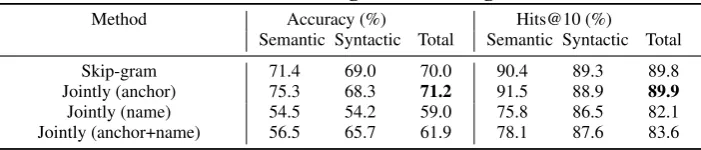
[image:9.595.308.524.478.540.2]Table 5:Words Analogical Reasoning Task.
Method Accuracy (%) Hits@10 (%)
Semantic Syntactic Total Semantic Syntactic Total
Skip-gram 71.4 69.0 70.0 90.4 89.3 89.8
Jointly (anchor) 75.3 68.3 71.2 91.5 88.9 89.9
Jointly (name) 54.5 54.2 59.0 75.8 86.5 82.1
Jointly (anchor+name) 56.5 65.7 61.9 78.1 87.6 83.6
then replacing the entities by corresponding entity names, e.g., “(Obama, Honolulu, David Beckham, London)” where the relation is “Born-in”.
Following (Mikolov et al., 2013b), we only
con-sider analogies that consist of the top-Kmost
fre-quent words/phrases in the vocabulary. For each
analogy denoted by (h1, t1, h2, t2), we
enumer-ate all the top-K most frequent words/phrasesw
except for h1, t1, h2, and calculate the distance
(Cosine/Euclidean according to specific model)
between h2 + (t1 − h1) and w. Ordering all
these words/phrases by their distances in ascend-ing order, we obtain the rank of the correct
an-swert2. Finally, we reportHits@10(i.e., the
pro-portion of correct answers whose ranks are not
larger than 10) and accuracy(i.e., Hits@1). For
word analogies and constructed analogies, we set
K = 200,000; while for phrase analogies, we set
K = 1,000,000to recall sufficient analogies.
Implementation. For Skip-gram and the “Jointly” (anchor/name/anchor+name) model, we use the same implementations and optimal config-urations as the triplet classification experiment.
Results. Jointly embedding using Wikipedi-a Wikipedi-anchors for Wikipedi-alignment consistently outperforms Skip-gram (Table 5, 6, 7) showing that the influ-ence of knowledge embedding, injected into word embedding through Wikipedia anchors, is benefi-cial. The vector of an ambiguous word is often a mixture of its several meanings but, in a specific context, the word is disambiguated and refers to a specific meaning. Using global word embedding to predict words within a specific context may pol-lute the embeddings of surrounding words. Align-ment by anchors enables entity embeddings to al-leviate the propagation of ambiguities and thus im-proves the quality of word embeddings.
Using entity names for alignment hurts the per-formance of analogies of words and phrases (Ta-ble 5, 6). The main reason is that these analo-gies are popular facts frequently mentioned in tex-t while a name graph forces word embeddings tex-to satisfy both popular and rare facts. Another
rea-son stems from the versatility of mentioning an entity. Consider “(Japan, yen, Europe, euro)” for example. Knowledge embedding is supposed to give significant help to completing this analogy as
“/location/country/currency”∈ R. However, the
entity of Japanese currency is named “Japanese yen” rather than “yen” and thus the explicit trans-lation learnt from knowledge embedding is not di-rectly imposed on the word embedding of “yen”. In contrast, using entity names for alignment im-proves the performances on constructed analogies
(Table 7). Since there is a relation r ∈ R for
each constructed analogy(wh1, wt1, wh2, wt2),
al-though neither (wh1, r, wt1) nor (wh2, r, wt2) is
present in the name graph, other facts involving these words act on the vectors of these words, in the same manner of traditional knowledge embed-ding.
Overall, any high-quality entity linking system can be used to further improve the performance.
5 Conclusions
In this paper, we introduced a novel method of jointly embedding knowledge graphs and a text corpus so that entities and words/phrases are rep-resented in the same vector space. In such a way, our method can perform prediction on any can-didate facts between entities/words/phrases, going beyond previous knowledge embedding methods, which can only predict facts whose entities exist in knowledge graph. Extensive, large-scale exper-iments show that the proposed method is very ef-fective at reasoning new facts. In addition, we also provides insights into word embedding, especially on the capability of analogical reasoning. In this aspect, we empirically observed some hints that jointly embedding also helps word embedding.
References
Yoshua Bengio, R´ejean Ducharme, Pascal Vincent, and Christian Jauvin. 2003. A neural probabilistic lan-guage model. Journal of Machine Learning
Kurt Bollacker, Colin Evans, Praveen Paritosh, Tim S-turge, and Jamie Taylor. 2008. Freebase: a collab-oratively created graph database for structuring hu-man knowledge. In Proceedings of the 2008 ACM SIGMOD International Conference on Management
of Data, pages 1247–1250. ACM.
Antoine Bordes, Jason Weston, Ronan Collobert, and Yoshua Bengio. 2011. Learning structured embed-dings of knowledge bases. In Proceedings of the Twenty-Fifth AAAI Conference on Artificial
Intelli-gence, pages 301–306.
Antoine Bordes, Nicolas Usunier, Alberto Garcia-Duran, Jason Weston, and Oksana Yakhnenko. 2013. Translating embeddings for modeling multi-relational data. InAdvances in Neural Information
Processing Systems, pages 2787–2795.
Kai-Wei Chang, Wen-tau Yih, and Christopher Meek. 2013. Multi-relational latent semantic analysis. In
Proceedings of the 2013 Conference on Empirical
Methods in Natural Language Processing, pages
1602–1612, Seattle, Washington, USA, October. Association for Computational Linguistics.
Ronan Collobert, Jason Weston, L´eon Bottou, Michael Karlen, Koray Kavukcuoglu, and Pavel Kuksa. 2011. Natural language processing (almost) from scratch. Journal of Machine Learning Research, 12:2493–2537.
Miao Fan, Deli Zhao, Qiang Zhou, Zhiyuan Liu, Thomas Fang Zheng, and Edward Y. Chang. 2014. Distant supervision for relation extraction with ma-trix completion. InProceedings of the 52nd Annual Meeting of the Association for Computational
Lin-guistics (Volume 1: Long Papers), pages 839–849,
Baltimore, Maryland, June. Association for Compu-tational Linguistics.
Raphael Hoffmann, Congle Zhang, Xiao Ling, Luke Zettlemoyer, and Daniel S Weld. 2011. Knowledge-based weak supervision for information extraction of overlapping relations. InProceedings of the 49th Annual Meeting of the Association for Computa-tional Linguistics: Human Language
Technologies-Volume 1, pages 541–550. Association for
Compu-tational Linguistics.
Tomas Mikolov, Kai Chen, Greg Corrado, and Jeffrey Dean. 2013a. Efficient estimation of word rep-resentations in vector space. arXiv preprint
arX-iv:1301.3781.
Tomas Mikolov, Ilya Sutskever, Kai Chen, Greg S Cor-rado, and Jeff Dean. 2013b. Distributed representa-tions of words and phrases and their compositional-ity. InAdvances in Neural Information Processing
Systems 26, pages 3111–3119.
George A Miller. 1995. Wordnet: a lexical database for english. Communications of the ACM, 38(11):39–41.
Mike Mintz, Steven Bills, Rion Snow, and Dan Ju-rafsky. 2009. Distant supervision for relation ex-traction without labeled data. InProceedings of the Joint Conference of the 47th Annual Meeting of the ACL and the 4th International Joint Conference on Natural Language Processing of the AFNLP:
Vol-ume 2-VolVol-ume 2, pages 1003–1011. Association for
Computational Linguistics.
Sebastian Riedel, Limin Yao, and Andrew McCal-lum. 2010. Modeling relations and their mention-s without labeled text. In Machine Learning and
Knowledge Discovery in Databases, pages 148–163.
Springer.
Richard Socher, Danqi Chen, Christopher D Manning, and Andrew Ng. 2013. Reasoning with neural ten-sor networks for knowledge base completion. In
Ad-vances in Neural Information Processing Systems,
pages 926–934.
Mihai Surdeanu, Julie Tibshirani, Ramesh Nallapati, and Christopher D Manning. 2012. Multi-instance multi-label learning for relation extraction. In Pro-ceedings of the 2012 Joint Conference on Empirical Methods in Natural Language Processing and
Com-putational Natural Language Learning, pages 455–
465. Association for Computational Linguistics. Zhen Wang, Jianwen Zhang, Jianlin Feng, and Zheng
Chen. 2014. Knowledge graph embedding by trans-lating on hyperplanes. InProceedings of the
Twenty-Eighth AAAI Conference on Artificial Intelligence,
pages 1112–1119.
Jason Weston, Antoine Bordes, Oksana Yakhnenko, and Nicolas Usunier. 2013. Connecting language and knowledge bases with embedding models for re-lation extraction. InProceedings of the 2013 Con-ference on Empirical Methods in Natural Language
Processing, pages 1366–1371, Seattle, Washington,
USA, October. Association for Computational Lin-guistics.
Xingxing Zhang, Jianwen Zhang, Junyu Zeng, Jun Yan, Zheng Chen, and Zhifang Sui. 2013. Towards accurate distant supervision for relational facts ex-traction. In Proceedings of the 51st Annual Meet-ing of the Association for Computational LMeet-inguistic-
Linguistic-s (Volume 2: Short PaperLinguistic-s), pages 810–815,