Towards Decoding as Continuous Optimisation in
Neural Machine Translation
Cong Duy Vu Hoang† and Gholamreza Haffari‡ and Trevor Cohn† †University of Melbourne
Melbourne, VIC, Australia Clayton, VIC, Australia‡Monash University
[email protected], [email protected], [email protected]
Abstract
We propose a novel decoding approach for neural machine translation (NMT) based on continuous optimisation. We refor-mulate decoding, a discrete optimization problem, into a continuous problem, such that optimization can make use of efficient gradient-based techniques. Our powerful decoding framework allows for more ac-curate decoding for standard neural ma-chine translation models, as well as en-abling decoding in intractable models such as intersection of several different NMT models. Our empirical results show that our decoding framework is effective, and can leads to substantial improvements in translations, especially in situations where greedy search and beam search are not fea-sible. Finally, we show how the technique is highly competitive with, and comple-mentary to, reranking.
1 Introduction
Sequence to sequence learning with neural net-works (Graves,2013;Sutskever et al.,2014; Lip-ton et al., 2015) is typically associated with two phases: training and decoding (a.k.a. inference). Model parameters are learned by optimising the training objective, in order that the model can produce good translations when decoding unseen sentences. The majority of research has focused on the training paradigm or network architec-ture, however effective means of decoding have been under-investigated. Conventional heuristic-based approaches for approximate inference in-clude greedy, beam, and stochastic search. Greedy and beam search have been empirically proved to be adequate for many sequence to sequence tasks, and are the standard methods for NMT decoding.
However, these inference approaches have sev-eral drawbacks. Firstly, although NMT models use a left-to-right generation which would appear to facilitate efficient search, the models themselves use a recurrent architecture, and accordingly are non-Markov. This prevents exact dynamic pro-gramming solutions, and moreover, limits the po-tential to incorporate additional global features or constraints. Global factors can be highly useful in producing better and more diverse translations. Secondly, the sequential decoding of symbols in the target sequence, the inter-dependencies among the target symbols are not fully exploited. For example, when decoding the words of the target sentence in a left-to-right manner, the right con-text is not exploited leading potentially to inferior performance (see Watanabe and Sumita (2002a) who apply this idea in traditional statistical MT). A natural way to capture this is to intersect left-to-right and right-to-left models, however the re-sulting model has no natural generation order, and thus standard decoding methods are unsuitable.
We introduce a novel decoding framework (§3) that relaxes thisdiscreteoptimisation problem into a continuous optimisation problem. This is akin to linear programming relaxation approach for ap-proximate inference in graphical models with dis-crete random variables, where the exact inference is NP-hard (Sontag, 2010; Belanger and McCal-lum,2016). The resulting continuous optimisation problem is challenging due to the non-linearity and non-convexity of the relaxed decoding ob-jective. We make use of stochastic gradient de-scent (SGD) and exponentiated gradient (EG) al-gorithms for decoding based on our relaxation ap-proach.1Our decoding framework is powerful and
flexible, as it enables us to decode with global con-straints involving intersection of multiple NMT
1Both methods are mainly used for training in prior work.
models (§4). We present experimental results on Chinese-English and German-English translation tasks, confirming the effectiveness of our relaxed optimisation method for decoding (§5).
2 Neural Machine Translation
We briefly review the attentional neural transla-tion model proposed byBahdanau et al.(2015) as a sequence-to-sequence neural model onto which we apply our decoding framework.
In neural machine translation (NMT), the prob-ability of the target sentenceygiven a source sen-tencexis written as:
PΘ(y|x) = |y|
X
i=1
log PΘ(yi|y<i,x) (1)
yi|y<i,x ∼ softmax (fff(Θ,y<i,x))
wheref is a non-linear function of the previously generated sequence of wordsy<i, the source
sen-tencex, and the model parametersΘ. In this pa-per, we realisefffas follows:
fff(Θ,y<i,x) =Wo·MLP ci,EEEyi−1 T ,gi
+bo gi = RNNφdec ci,EEETyi−1,gi−1
where MLP is a single hidden layer neural net-work withtanhactivation function, andEEEyi−1
T is
the embedding of the target wordyi−1 in the
em-bedding matrixEEET ∈ Rne×|VT|of the target
lan-guage vocabularyVT andneis the embedding
di-mension. The state gi of the decoder RNN is a
function of yi−1, its previous state gi−1, and the contextci=P|jx=1| αijhjsummarises parts of the
source sentence which areattendedto, where
αi = softmax(ei) ; eij = MLP (gi−1,hj) hj = biRNNθenc
E E Exj
S ,−→hj−1,←h−j+1
In above,−→hi and←h−i are the states of the
left-to-right and left-to-right-to-left RNNs encoding the source sentence, andEEExj
S is the embedding of the source
wordxj in the embedding matrixEEES ∈ Rn0e×|VS|
of the source language vocabularyVSandn0
eis the
embedding dimension.
Given a bilingual corpusD, the model param-eters are learned by maximizing the conditional log-likelihood,
Θ∗:= argmaxΘ X
(x,y)∈D
log PΘ(y|x). (2)
The model parametersΘinclude the weight ma-trix Wo ∈ R|VT|×nh and the bias bo ∈ R|VT|
– with nH denoting the hidden dimension size – as well as the RNN encoder biRNNθ
enc /
de-coder RNNφdec parameters, word embedding ma-trices, and the parameters of the attention mecha-nism. The model is trained end-to-end by optimis-ing the trainoptimis-ing objective usoptimis-ing stochastic gradient descent (SGD) or its variants. In this paper, we fo-cus on the decoding problem, which we turn to in the next section.
3 Decoding as Continuous Optimisation
In decoding, we are interested in finding the high-est probability translation for a given source sen-tence:
minimisey −PΘ(y|x) s.t. y∈ Yx (3) where Yx is the space of possible translations for the source sentence x. In general, search-ing Yx to find the highest probability translation is intractable due to the recurrent nature of eqn (1) which prevents dynamic programming for ef-ficient search. This is problematic, as the space of translations is exponentially large with respect to the output length|y|.
We now formulate this discrete optimisation problem as a continuous one, and then use stan-dard algorithms for continuous optimisation for decoding. Let us assume that the maximum length of a possible translation for a source sentence is known and denote it as`. The best translation for a given source sentence solves the following opti-misation problem:
y∗= arg min
y1,...,y`
` X
i=1
−log PΘ(yi|y<i,x) (4)
s.t. ∀i∈ {1. . . `}:yi ∈VT.
where we allow the translation to be padded with sentinel symbols to the right, which are ignored in computing the model probability. Equivalently, we can rewrite the above discrete optimisation problem as follows:
arg min
˜
y1,...,y˜` −
` X
i=1
˜
yi·log softmax (fff(Θ,y<i,˜ x))
s.t. ∀i∈ {1. . . `}: ˜yi∈I|VT| (5)
Algorithm 1The EG Algorithm for Decoding by Optimisation 1: For alliinitialiseyˆ0i ∈∆|VT|
2: for t= 1, . . . ,MaxIterdo . Q(.)is defined as eqn (6)
3: For alli, w:calculate∇ti,w−1 = ∂Q( ˆyt1−1,...,yˆt`−1)
∂yˆi(w) . using back-propagation
4: For alli, w:updateyˆit(w)∝yˆit−1(w)·exp−η∇ti,w−1 . ηis the step size 5: returnarg mintQ(ˆyt1, . . . ,yˆ`t)
We now convert the optimisation problem (5) to a continuous one by dropping the integrality con-straintsy˜i ∈I|V|and require the variables to take
values from the probability simplex:
arg min
ˆ
y1,...,yˆ`
−X`
i=1
ˆ
yi·log softmax (fff(Θ,yˆ<i,x))
s.t. ∀i∈ {1. . . `}: ˆyi∈∆|VT|
where ∆|VT| is the |VT|-dimensional probability
simplex, i.e., {yˆi∈[0,1]|VT|:kyˆik1 = 1}.
Intu-itively, this amounts to replacing EEEyi
T with the expected embedding of target language words Eyˆi(w)[EEEwT]under the distributionyˆi.
After solving the above constrained continuous optimisation problem, there is no guarantee that the resulting solution{yˆ∗
i}`i=1 will comprise
one-hot vectors, i.,e., target language words. Instead it can find fractionalsolutions, that require ‘round-ing’ in order to to resolve them to lexical items. To solve this problem, we take thearg max,2i.e.,
take the highest scoring word for each positionyˆ∗
i.
We leave exploration of more elaborate projection techniques to the future work.
In the context of graphical models, the above relaxation technique gives rise to linear program-ming for approximate inference (Sontag, 2010; Belanger and McCallum,2016). However, our de-coding problem is much harder due to the non-linearity and non-convexity of the objective func-tion operating on high dimensional space for deep models. We now turn our attention to optimisation algorithms to effectively solve the decoding opti-misation problem.
3.1 Exponentiated Gradient (EG)
Exponentiated gradient (Kivinen and Warmuth, 1997) is an elegant algorithm for solving optimisa-tion problems involving simplex constraints.
Re-2Ties are broken arbitrarily.
call our constrained optimisation problem:
arg min
ˆ
y1,...,yˆ`Q(ˆy1, . . . ,yˆ`) s.t. ∀i∈ {1. . . `}: ˆyi ∈∆|VT|
whereQ(ˆy1, . . . ,yˆ`)is defined as
−
` X
i=1
ˆ
yi·log softmax (fff(Θ,y<i,ˆ x)). (6)
EG is an iterative algorithm, which updates each distributionyˆt
i in the current time-steptbased on
the distributions of the previous time-step as fol-lows:
∀w∈VT : yˆit(w) = Z1t
iyˆ t−1
i (w) exp
−η∇ti,w−1
whereηis the step size, ∇ti,w−1 = ∂Q( ˆy1t−1,...,yˆt`−1)
∂yˆi(w)
andZt
i is the normalisation constant
Zit= X
w∈VT
ˆ
yit−1(w) exp−η∇ti,w−1.
The partial derivatives ∇i,w are calculated using
the back propagation algorithm treating {yˆi}`i=1
asparameters and the original parameters of the modelΘas constants. Adapting EG to our decod-ing problem leads to Algorithm1.
It can be shown that the EG algorithm is a gra-dient descent algorithm for minimising the follow-ing objective function subject to the simplex con-straints:
Q(ˆy1, . . . ,yˆ`)−γ ` X
i=1
X
w∈VT
ˆ
yi(w) logyiˆ(1w)
=Q(ˆy1, . . . ,yˆ`)−γ ` X
i=1
Entropy(ˆyi) (7)
log likelihood under the model. There are intrigu-ing parallels with the maximum entropy formula-tion of log-linear models (Berger et al.,1996). In our setting, the entropy term acts as a prior which discourages overly-confident estimates in the ab-sence of sufficient evidence.
3.2 Stochastic Gradient Descent (SGD)
To be able to apply SGD to our optimisation prob-lem, we need to make sure that the simplex con-straints are enforced. One way to achieve this is by reparameterising using the softmax transfor-mation, i.e. yiˆ = softmax (ˆri). The resulting
unconstrainedoptimisation problem, now overrˆi,
becomes
arg min ˆ
r1,...,rˆ`
−
`
X
i=1
softmax (ˆri)·log softmax (f (Θ,yˆ<i,x))
whereEEEyi
T is replaced with the expected
embed-ding of the target words under the distribution re-sulted from theEsoftmax(ˆri)[EEEwT]in the model.
To apply SGD updates, we need the gradient of the objective function with respect to the new variablesrˆi which can be derived with the
back-propagation algorithm based on the chain rule:
∂Q ∂riˆ(w) =
X
w0∈VT
∂Q(.)
∂yiˆ(w0)
∂yˆi(w0) ∂riˆ(w)
The resulting SGD algorithm is summarized in Al-gorithm2.
4 Decoding in Extended NMT
Our decoding framework allows us to effectively and flexibly add additional global factors over the output symbols during inference. This en-ables decoding for richer global models, for which there is no effective means of greedy decoding or beam search. We outline several such models, and their corresponding relaxed objective functions for optimisation-based decoding.
Bidirectional Ensemble. Standard NMT gener-ates the translation in a left-to-right manner, condi-tioning each target word on its left context. How-ever, the joint probability of the translation can be decomposed in a myriad of different orders; one compelling alternative would be to condition each target word on its right context, i.e., generating the target sentence from right-to-left. We would not expect a right-to-left model to outperform a left-to-right, however, as the left-to-right ordering
reflects the natural temporal order of spoken lan-guage. However, the right-to-left model is likely to provide a complementary signal in translation, as it will be bringing different biases and making largely independent prediction errors to those of the left-to-right model. For this reason, we pro-pose to use both models, and seek to find trans-lations that have high probability according both models (this mirrors work on bidirectional decod-ing in classical statistical machine translation by Watanabe and Sumita (2002b).) Decoding un-der the ensemble of these models leads to an in-tractable search problem, not well suited to tradi-tional greedy or beam search algorithms, which re-quire a fixed generation order of the target words. This ensemble decoding problem can be formu-lated simply in our linear relaxation approach, us-ing the followus-ing objective function:
C+bidir:=−αlog PΘ←(y|x)
−(1−α) log PΘ→(y|x) ; (8)
where α is an interpolation hyper-parameter, which we set to 0.5; Θ→ and Θ← are the ptrained left-to-right and right-to-left models, re-spectively. This bidirectional agreement may also lead to improvement in translation diversity, as shown in Li and Jurafsky (2016) in a re-ranking evaluation.
Bilingual Ensemble. Another source of com-plementary information is in terms of the transla-tion directransla-tion, that is forward translatransla-tion from the source to the target language, and reverse trans-lation in the target to source direction. Decod-ing must find a translation which scores well un-der both the forward and reverse translation mod-els. This is inspired by the direct and reverse feature functions commonly used in classical dis-criminative SMT (Och and Ney,2002) which have been shown to offer some complementary bene-fits (although seeLopez and Resnik(2006)). More specifically, we decode for the best translation in the intersection of the source-to-target and target-to-source models by minimizing the following ob-jective function:
C+biling:=−αlog PΘs→t(y|x)
−(1−α) log PΘs←t(x|y) ; (9)
Algorithm 2The SGD Algorithm for Decoding by Optimisation 1: For alliinitialiserˆ0i
2: for t= 1, . . . ,MaxIterdo . Q(.)is defined in eqn (6) andyˆi= softmax(ˆri)
3: For alli, w:calculate∇ti,w−1 =Pw0∈VT ∂Q( ˆy
t−1
1 ,...,yˆt`−1)
∂yˆi(w0)
∂yˆi(w0)
∂rˆi(w) . using backpropagation
4: For alli, w:updaterˆit(w) = ˆrit−1(w)−η∇ti,w−1 . ηis the step size 5: returnarg mintQ(softmax(ˆrt1), . . . ,softmax(ˆrt`))
# tokens # types # sents
BTEC zh→en
train 422k / 454k 3k / 3k 44,016
dev 10k / 10k 1k / 1k 1,006
test 5k / 5k 1k / 1k 506
TED Talks de→en
train 4m / 4m 26k / 19k 194,181
dev-test2010 33k / 35k 4k / 3k 1,565 test2014 26k / 27k 4k / 3k 1,305
WMT 2016 de→en
train 107m / 108m 90k / 78k 4m dev-test2013&14 154k / 152k 20k / 13k 6003 test2015 54k / 54k 10k / 8k 2169 Table 1: Statistics of the training and evalua-tion sets; token and types are presented for both source/target languages.
source-to-target and target-to-source models, re-spectively. Decoding for the best translation under the above objective function leads to an intractable search problem, as the reverse model is global over the target language, meaning there is no obvious means of search with a greedy algorithm or simi-lar.
Discussion. There are two important considera-tions on how best to initialise the relaxed optimisa-tion in the above settings, and how best to choose the step size. As the relaxed optimisation prob-lem is, in general, non-convex, finding a plausible initialisation is likely to be important for avoiding local optima. Furthermore, a proper step size is a key in the success of the EG-based and SGD-based optimisation algorithms, and there is no obvious method how to best choose its value. We may also adaptively change the step size using (scheduled) annealing or via the line search. We return to this considerations in the experimental evaluation.
5 Experiments
5.1 Setup
Datasets. We conducted our experiments on datasets with different scales, translating between Chinese→English using the BTEC corpus, and German→English using the IWSLT 2015 TED
Talks(Cettolo et al.,2014) and WMT 20163
cor-pora. The statistics of the datasets can be found in Table1.
NMT Models. We implemented our continuous-optimisation based decoding method on top of the Mantidae toolkit4 (Cohn et al.,
2016), and using thedynetdeep learning library5
(Neubig et al.,2017). All neural network models were configured with 512 input embedding and hidden layer dimensions, and 256 alignment dimension, with 1 and 2 hidden layers in the source and target, respectively. We used a LSTM recurrent structure (Hochreiter and Schmidhuber, 1997) for both source and target RNN sequences. For the vocabulary, we use word frequency cut-off of 5, and words rarer than this were mapped to a sentinel. For the large-scale WMT dataset, we applied byte-pair encoding (BPE) method (Sennrich et al.,2016) to better handle unknown words.6 For training our neural models, we use
early stopping based on development perplexity, which usually occurs after 5-8 epochs.
Evaluation Metrics. We evaluated in terms of search error, measured using the model score of the inferred solution (either continuous or dis-crete), as well as measuring the end transla-tion quality with case-insensitive BLEU (Pap-ineni et al.,2002). The continuous cost measures − 1
|yˆ|logPΘ(ˆy|x) under the model Θ; the
dis-crete model score has the same formulation, al-beit using the discrete rounded solutiony(see§3). Note the cost can be used as a tool for selecting the best inference solution, as well as assessing con-vergence, as we illustrate below.
3http://www.statmt.org/wmt16/ translation-task.html
4https://github.com/duyvuleo/Mantidae 5https://github.com/clab/dynet
6With BPE, the out of vocabulary rates on heldout data
●
●
● ●●●●●●●●●●●●● ● ● ● ●● ● ● ●
●
●
● ●●●●●●●●●●●●● ● ● ● ● ● ● ● ●
1 10
1 5 20 50 100 200 400
iterations
CCost
●
● ● ●●●●●●●●●●●●● ● ● ● ● ● ● ● ●
●
● ● ●●●●●●●●●●●●● ● ● ● ● ● ● ● ●
1 10
1 5 20 50 100 200 400
iterations
DCost
● ● ● ●●●●●●●●●●●●● ● ● ● ● ● ● ● ●
● ● ● ●●●●●●●●●●●●● ● ● ● ● ● ● ● ●
0 10 20 30 40
1 5 20 50 100 200 400
iterations
BLEU
[image:6.595.85.516.70.216.2]Initialisation ● beam greedy uniform Method ● EG ● EG−400 ● EG−MOM
Figure 1: Analysis on effects of initialisation states (uniform vs. greedy vs. beam), step size annealing, momentum mechanism from BTEC zh→en translation. EG-400: EG algorithm with step sizeη = 400 (otherwiseη= 50);EG-MOM: EG algorithm with momentum.
5.2 Results and Analysis
Initialisation and Step Size. As our relaxed op-timisation problems are non-convex, local optima are likely to be a problem. We test this empiri-cally, focusing on the effect that initialisation and step size,η, have on the inference quality.
For plausible initialisation states, we evaluate different strategies: uniformin which the relaxed variables yˆ are initialised to 1
|VT|; and greedy or
beam whereby yˆ are initialised based on an al-ready good solution produced by a baseline de-coder with greedy (gdec) or beam (bdec). Instead of using the Viterbi outputs as a one-hot represen-tation, we initialise to the probability prediction vectors,7which serves to limit attraction of the
ini-tialisation condition, which is likely to be a local (but not global) optima.
Figure1illustrates the effect of initialisation on the EG algorithm, in terms of search error (left and middle) and translation quality (right), as we vary the number of iterations of inference. There is clear evidence of non-convexity: all initialisation methods can be seen to converge using all three measures, however they arrive at highly different solutions. Uniform initialisation is clearly not a viable approach, while greedy and beam initial-isation both yield much better results. The best initialisation, beam, outperforms both greedy and beam decoding in terms of BLEU.
Note that the EG algorithm has fairly slow con-vergence, requiring at least 100 iterations, irre-spective of the initialisation. To overcome this,
7Here, EG uses softmax normalization whereas SGD
uses the pre-softmaxvector.
we use momentum (Qian,1999) to accelerate the convergence by modifying the term∇t
i,win
Algo-rithm 1 with a weighted moving average of past gradients:
∇ti,w−1 =γ∇ti,w−2+η∂Q(ˆyt1−1, . . . ,yˆt`−1) ∂yˆi(w)
where we set the momentum term γ = 0.9. The EG with momentum (EG-MOM) converges after fewer iterations (about 35), and results in marginally better BLEU scores. The momentum technique is usually used for SGD involving addi-tive updates; it is interesting to see it also works in EG with multiplicative updates.
The step size, η, is another important hyper-parameter for gradient based search. We tune the step size using line search over[10,400]over the development set. Figure1illustrates the effect of changing step size from 50 to 400 (compare EG
and EG-400 with uniform), which results in a marked difference of about 10 BLEU points, un-derlining the importance of tuning this value. We found that EG with momentum had less of a re-liance on step size, with optimal values in[10,50]; we use this setting hereafter.
● ● ● ● ● ● ● ● ● ● ● ● ● ●● ● ● ● ● ● ●● ● ● ● ● ● ● ● ● ● ● ● ● ● ● ● ● ● ● ● ● ● ● ● ● ● ● ● ● ● ● ● ● ● ● ● ●● ● ● ● ● ● ● ● ● ● ● ● ● ● ● ● ● ● ● ● ● ● ● ● ● ● ● ● ● ● ●● ● ●● ● ● ● ● ● ● ● ● ● ● ● ● ● ● ● ● ● ● ● ● ● ● ● ● ● ●●● ●● ● ● ● ● ● ● ● ● ● ● ● ● ● ● ● ● ● ● ● ● ● ● ● ●● ●● ● ● ● ● ● ● ● ●● ● ● ● ● ● ● ● ● ● ● ● ● ● ● ● ● ● ● ● ● ● ● ● ● ● ● ● ● ● ● ● ● ● ● ● ● ● ● ● ● ● ● ● ● ● ● ● ● ● ● ● ●● ● ● ● ● ● ● ● ● ● ●● ● ● ●● ● ● ● ● ● ● ● ● ● ● ● ● ● ● ● ● ● ● ● ● ● ● ● ● ● ● ● ● ● ● ● ● ● ● ● ● ●● ● ● ● ● ● ● ● ● ● ●●● ●● ● ● ● ●● ●● ● ●● ● ● ● ● ● ● ● ● ●●● ● ● ● ● ● ● ● ● ● ● ● ● ● ● ● ●● ● ● ● ● ● ● ● ● ● ● ● ● ● ● ● ● ● ● ● ●● ● ● ●●●● ● ● ● ● ● ● ● ● ● ● ● ● ● ● ● ● ● ● ● ● ● ●●● ● ● ● ● ● ● ● ● ● ● ● ● ● ● ● ● ● ● ● ● ● ● ● ● ● ● ● ● ● ● ● ● ● ● ● ● ● ● ● ● ● ● ● ● ● ● ● ● ● ● ● ● ● ● ● ● ●● ● ●● ●● ● ● ● ● ● ● ● ● ● ● ● ● ●● ● ● ● ● ● ● ● ● ● ● ● ● ●● ● ● ● ● ● ● ● ●● ● ● ● ● ● ● ● ● ● ● ● ● ● ● ● ●●● ●● ● ● ● ● ● ● ● ● ● ● ● ● ● ● ● ● ● ● 0.0 0.5 1.0 1.5 2.0 2.5
0.0 0.3 0.6 0.9
CCost
[image:7.595.310.523.63.259.2]DCost
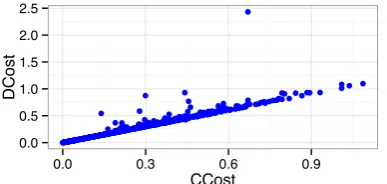
Figure 2: Comparing discrete vs continuous costs from BTEC zh→en translation, using the EG al-gorithm with momentum,η = 50. Each point cor-responds to a sentence.
BLEU AvgLen bdecleft-to-right 26.69 20.73
[image:7.595.86.280.64.156.2]filtered rerank 26.84 20.66 EGdec w/ beam init 27.34 20.73 full rerank 27.34 21.76 EGdec w/ rerank init 27.78 21.70
Table 2: The BLEU evaluation results with EG al-gorithm against 100-best reranking on WMT eval-uation dataset.
scores do show improvements Figure1centre and right.) Figure2illustrates the relation between the two cost measures, showing that in most cases the discrete and continuous costs are identical. Linear relaxation fails only for a handful of cases, where the nearest discrete solution is significantly worse than it would appear using the continuous cost.
EG vs SGD. Both the EG and SGD algorithms are iterative methods for solving the relaxed op-timisation problem with simplex constraints. We measure empirically their difference in terms of quality of inference and speed of convergence, as illustrated in Figure3. Observe that SGD requires 150 iterations for convergence, whereas EG re-quires many fewer (50). This concurs with pre-vious work on learning structured prediction mod-els with EG (Globerson et al.,2007). Further, the EG algorithm consistently produces better results in terms of both model cost and BLEU.
EG vs Reranking. Reranking is an alternative method for integrating global factors into the ex-isting NMT systems. We compare our EG decod-ing algorithm against the rerankdecod-ing approach with bidirectional factor where the N-best outputs of a left-to-right decoder is re-scored with the forced decoder operating in a right-to-left fashion. The
● ● ● ● ● ● ●●●●● ● ● ● ● ● ● ● ● ● ● ● ● ● ● ● ● ● ● ●●●●●● ● ● ● ● ● ● ● ● ● ● ● ● ● 37.6 37.8 38.0 38.2 38.4 0.3 0.4 0.5 0.6 0.8 1.0 BLEU CCost
1 5 10 20 50 100 200 400
iterations
[image:7.595.86.278.232.325.2]Method ● EG SGD
Figure 3: Analysis on convergence and perfor-mance comparing SOFTMAX and EG algorithms from BTEC zh→en translation. Both algorithms use momentum and step size 50.
results are shown in Table2. Our EG algorithm initialised with the reranked output achieves the best BLEU score. We also compare reranking with EG algorithm initialised with the beam de-coder, where for direct comparison we filter out sentences with length greater than that of the beam output in the k-best lists. These results show that the EG algorithm is capable of effectively exploit-ing the search space.
Beyond achieving similar or better translations to re-ranking, note that EG is simpler in imple-mentation, as it does not requirekbest lists, weight tuning and so forth. Instead this is replaced with iterative gradient descent. The run-time of the two methods are comparable, when reranking uses modestk, however EG can be considerably faster whenkis large, as is typically done to extract the full benefit from re-ranking. This performance dif-ference is a consequence of GPU acceleration of the dense vector operations in EG inference.
imple-BTEC TEDTalks WMT zh→en de→en de→en gdecleft-to-right 35.98 23.16 24.41 gdecright-to-left 35.86 21.95 23.59 EGdecgreedy init 36.34 23.28 24.63
+bidir. 36.67 23.91 25.37† +bilingual 36.88† 24.01† 25.21 bdecleft-to-right 38.02 23.95 26.69
bdecright-to-left 37.38 23.13 26.11
EGdecbeam init 38.38 24.02 26.66
[image:8.595.74.290.64.244.2]+bidir. 39.13† 24.72† 27.34† +bilingual 38.25 24.60 26.82
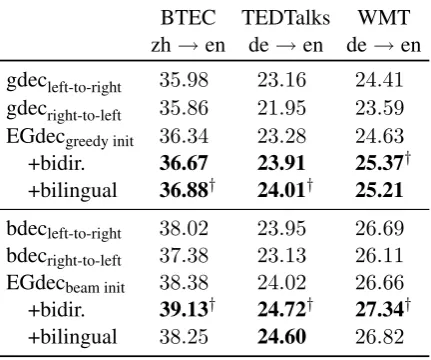
Table 3: The BLEU evaluation results across eval-uation datasets for EG algorithm variants against the baselines; bold: statistically significantly bet-ter than the best greedy or beam baseline,†: best performance on dataset.
mentation was not optimised thoroughly, and it is likely that it could be made significantly faster, which we defer to future research.
Main Results. Table3 shows our experimental results across all datasets, evaluating the EG al-gorithm and its variants.8 For the EG algorithm
with greedy initialisation (top), we see small but consistent improvements in terms of BLEU. Beam initialisation led to overall higher BLEU scores, and again demonstrating a similar pattern of im-provements, albeit of a lower magnitude, over the initialisation values.
Next we evaluate the capability of our infer-ence method with extended NMT models, where approximate algorithms such as greedy or beam search are infeasible. With thebidirectional en-semble, we obtained the statistically significant BLEU score improvements compared to the uni-directional models, for either greedy or beam ini-tialisation. This is interesting in the sense that the unidirectional right-to-left model always per-forms worse than the left-to-right model. How-ever, our method with bidirectional ensemble is capable of combining their strengths in a unified setting. For thebilingualensemble, we see similar effects, with better BLEU score improvements in most cases, albeit of a lower magnitude, over the bidirectional one. This is likely to be due to a dis-parity with the training condition for the models,
8Due to the space constraints, we report results for the EG
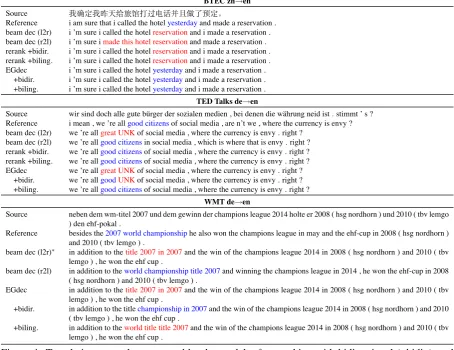
algorithm only. See also translation examples in Figure4.
which were learned independently of one another. Overall, decoding in extended NMT models leads to performance improvements compared to baseline methods. This is one of the main findings in this work, and augurs well for its extension to other global model variants.
6 Related Work
Decoding (inference) for neural models is an im-portant task; however, there is limited research in this space perhaps due to the challenging na-ture of this task, with only a few works exploring some extensions to improve upon them. The most widely-used inference methods include sampling (Cho,2016), greedy and beam search (Sutskever et al.,2014;Bahdanau et al.,2015,inter alia), and reranking (Birch,2016;Li and Jurafsky,2016).
Cho (2016) proposed to perturb the neural model by injecting noise(s) in the hidden transi-tion functransi-tion of the conditransi-tional recurrent neural language model during greedy or beam search, and execute multiple parallel decoding runs. This strategy can improves over greedy and beam search; however, it is not clear how, when and where noise should be injected to be beneficial. Recently, Wiseman and Rush (2016) proposed beam search optimisation while training neural models, where the model parameters are updated in case the gold standard falls outside of the beam. This exposes the model to its past incorrect pre-dicted labels, hence making the training more ro-bust. This is orthogonal to our approach where we focus on the decoding problem with a pre-trained model.
Reranking has also been proposed as a means of global model combination: Birch (2016) and Li and Jurafsky(2016) re-rank the left-to-right de-coded translations based on the scores of a right-to-left model, learning to more diverse transla-tions. Related,Li et al.(2016) learn to adjust the beam diversity with reinforcement learning.
BTEC zh→en
Source 我确定我昨天给旅馆打过电话并且做了预定。
Reference i am sure that i called the hotelyesterdayand made a reservation .
beam dec (l2r) i ’m sure i called the hotelreservationand i made a reservation .
beam dec (r2l) i ’m sure imade this hotel reservationand made a reservation .
rerank +bidir. i ’m sure i called the hotelreservationand i made a reservation .
rerank +biling. i ’m sure i called the hotelreservationand i made a reservation .
EGdec i ’m sure i called the hotelyesterdayand i made a reservation .
+bidir. i ’m sure i called the hotelyesterdayand i made a reservation .
+biling. i ’m sure i called the hotelyesterdayand i made a reservation .
TED Talks de→en
Source wir sind doch alle gute bürger der sozialen medien , bei denen die währung neid ist . stimmt ’ s ?
Reference i mean , we ’re allgood citizensof social media , are n’t we , where the currency is envy ?
beam dec (l2r) we ’re allgreat UNKof social media , where the currency is envy . right ?
beam dec (r2l) we ’re allgood citizensin social media , which is where that is envy . right ?
rerank +bidir. we ’re allgood citizensof social media , where the currency is envy . right ?
rerank +biling. we ’re allgood citizensof social media , where the currency is envy . right ?
EGdec we ’re allgreat UNKof social media , where the currency is envy . right ?
+bidir. we ’re allgoodUNKof social media , where the currency is envy . right ?
+biling. we ’re allgood citizensof social media , where the currency is envy . right ?
WMT de→en
Source neben dem wm-titel 2007 und dem gewinn der champions league 2014 holte er 2008 ( hsg nordhorn ) und 2010 ( tbv lemgo
) den ehf-pokal .
Reference besides the2007 world championshiphe also won the champions league in may and the ehf-cup in 2008 ( hsg nordhorn )
and 2010 ( tbv lemgo ) .
beam dec (l2r)∗ in addition to thetitle 2007 in 2007and the win of the champions league 2014 in 2008 ( hsg nordhorn ) and 2010 ( tbv lemgo ) , he won the ehf cup .
beam dec (r2l) in addition to theworld championship title 2007and winning the champions league in 2014 , he won the ehf-cup in 2008
( hsg nordhorn ) and 2010 ( tbv lemgo ) .
EGdec in addition to thetitle 2007 in 2007and the win of the champions league 2014 in 2008 ( hsg nordhorn ) and 2010 ( tbv
lemgo ) , he won the ehf cup .
+bidir. in addition to the titlechampionship in 2007and the win of the champions league 2014 in 2008 ( hsg nordhorn ) and 2010
( tbv lemgo ) , he won the ehf cup .
+biling. in addition to theworld title title 2007and the win of the champions league 2014 in 2008 ( hsg nordhorn ) and 2010 ( tbv
[image:9.595.71.526.69.419.2]lemgo ) , he won the ehf cup .
Figure 4: Translation examples generated by the models. ∗: reranking with bidirectional (+bidir.) and bilingual (+biling.) produced the same translation string.
encoder-decoder. Moreover, we demonstrate the utility of related optimisation for inference over global ensembles of models, resulting in consis-tent improvements in search error and end transla-tion quality.
Recently, relaxation techniques have been ap-plied to deep models for training and inference in text classification (Belanger and McCallum, 2016; Belanger et al., 2017), and fully differ-entiable training of sequence-to-sequence models with scheduled-sampling (Goyal et al.,2017). Our work has applied the relaxation technique specifi-cally fordecodingin NMT models.
7 Conclusions
This work presents the first attempt in formulat-ing decodformulat-ing in NMT as a continuous optimisation problem. The core idea is to drop the integrality (i.e. one-hot vector) constraint from the predic-tion variables and allow them to have soft assign-ments within the probability simplex while min-imising the loss function produced by the neural
model. We have provided two optimisation algo-rithms – exponentiated gradient (EG) and stochas-tic gradient descent (SGD) – for optimising the resulting contained optimisation problem, where our findings show the effectiveness of EG com-pared to SGD. Thanks to our framework, we have been able to decode when intersecting left-to-right and right-to-left as well as source-to-target and target-to-source NMT models. Our results show that our decoding framework is effective and leads to substantial improvements in translations gener-ated from the intersected models, where the typi-cal greedy or beam search algorithms are not ap-plicable.
This work raises several compelling possibili-ties which we intend to address in future work, such as improving decoding speed, integrating ad-ditional constraints such as word coverage and fer-tility intodecoding,9 and applying our method to
other intractable structured prediction problems.
9These constraints have only been used for training in the
Acknowledgments
We thank the reviewers for valuable feedbacks and discussions. Cong Duy Vu Hoang is supported by Australian Government Research Training Pro-gram Scholarships at the University of Melbourne, Australia. This work was supported by the Aus-tralian Research Council through their Discovery and Future Fellowship programmes.
References
Dzmitry Bahdanau, Kyunghyun Cho, and Yoshua Ben-gio. 2015. Neural Machine Translation by Jointly
Learning to Align and Translate. In Proc. of 3rd
International Conference on Learning Representa-tions (ICLR2015).
D. Belanger, B. Yang, and A. McCallum. 2017.
End-to-End Learning for Structured Prediction Energy Networks. In Proceedings of the 34th Interna-tional Conference on InternaInterna-tional Conference on Machine Learning - Volume 48, ICML’17.
David Belanger and Andrew McCallum. 2016.
Struc-tured prediction energy networks. InProceedings of the 33rd International Conference on Interna-tional Conference on Machine Learning - Volume 48, ICML’16, pages 983–992. JMLR.org.
Adam L. Berger, Vincent J. Della Pietra, and Stephen
A. Della Pietra. 1996. A maximum entropy
ap-proach to natural language processing. Comput. Linguist., 22(1):39–71.
Rico Sennrich; Barry Haddow; Alexandra Birch. 2016. Edinburgh Neural Machine Translation Systems for
WMT 16. InProceedings of the First Conference
on Machine Translation, Volume 2: Shared Task Pa-pers. Berlin, Germany.
M. Cettolo, J. Niehues, S. Stuker, L. Bentivogli, and M. Federico. 2014. Report on the 11th IWSLT
Evaluation Campaign. In Proc. of The
Interna-tional Workshop on Spoken Language Translation (IWSLT).
K. Cho. 2016. Noisy Parallel Approximate Decoding
for Conditional Recurrent Language Model. ArXiv e-prints.
Trevor Cohn, Cong Duy Vu Hoang, Ekaterina Vy-molova, Kaisheng Yao, Chris Dyer, and Gholam-reza Haffari. 2016. Incorporating Structural Align-ment Biases into an Attentional Neural Translation
Model. InProceedings of the 2016 Conference of
the North American Chapter of the Association for Computational Linguistics: Human Language Tech-nologies, pages 876–885, San Diego, California. As-sociation for Computational Linguistics.
Amir Globerson, Terry Y. Koo, Xavier Carreras, and Michael Collins. 2007. Exponentiated Gradient Al-gorithms for Log-linear Structured Prediction. In
Proceedings of the 24th International Conference on Machine Learning, ICML ’07, pages 305–312, New York, NY, USA. ACM.
Kartik Goyal, Chris Dyer, and Taylor
Berg-Kirkpatrick. 2017. Differentiable scheduled
sampling for credit assignment. In Proceedings of the 55th Annual Meeting of the Association for Computational Linguistics (Volume 2: Short Papers), ACL’17, Vancouver, Canada.
A. Graves. 2013. Generating Sequences With
Recur-rent Neural Networks.ArXiv e-prints.
Sepp Hochreiter and Jurgen Schmidhuber. 1997. Long
Short-Term Memory. Neural Comput., 9(8):1735–
1780.
Jyrki Kivinen and Manfred K. Warmuth. 1997. Expo-nentiated Gradient Versus Gradient Descent for Lin-ear Predictors. Inf. Comput., 132(1):1–63.
J. Li and D. Jurafsky. 2016. Mutual Information and
Diverse Decoding Improve Neural Machine Trans-lation.ArXiv e-prints.
J. Li, W. Monroe, and D. Jurafsky. 2016. A Simple,
Fast Diverse Decoding Algorithm for Neural Gener-ation.ArXiv e-prints.
Z. C. Lipton, J. Berkowitz, and C. Elkan. 2015.A Crit-ical Review of Recurrent Neural Networks for Se-quence Learning.ArXiv e-prints.
Adam Lopez and Philip Resnik. 2006. Word-based alignment, phrase-based translation: Whats the link. InProceedings of 7th Biennial Conference of the As-sociation for Machine Translation in the Americas (AMTA).
Haitao Mi, Baskaran Sankaran, Zhiguo Wang, and Abe Ittycheriah. 2016. Coverage Embedding Models for
Neural Machine Translation. InProceedings of the
2016 Conference on Empirical Methods in Natu-ral Language Processing, pages 955–960, Austin, Texas. Association for Computational Linguistics.
G. Neubig, C. Dyer, Y. Goldberg, A. Matthews, W. Ammar, A. Anastasopoulos, M. Ballesteros, D. Chiang, D. Clothiaux, T. Cohn, K. Duh, M. Faruqui, C. Gan, D. Garrette, Y. Ji, L. Kong, A. Kuncoro, G. Kumar, C. Malaviya, P. Michel, Y. Oda, M. Richardson, N. Saphra, S. Swayamdipta,
and P. Yin. 2017. DyNet: The Dynamic Neural
Net-work Toolkit. ArXiv e-prints.
Franz Josef Och and Hermann Ney. 2002. Discrimina-tive training and maximum entropy models for sta-tistical machine translation. In Proceedings of the 40th Annual Meeting on Association for Computa-tional Linguistics, pages 295–302.
Kishore Papineni, Salim Roukos, Todd Ward, and Wei-Jing Zhu. 2002. BLEU: A Method for Automatic
of the 40th Annual Meeting on Association for Com-putational Linguistics, ACL ’02, pages 311–318, Stroudsburg, PA, USA. Association for Computa-tional Linguistics.
Ning Qian. 1999. On the momentum term in
gradi-ent descgradi-ent learning algorithms . Neural Networks,
12(1):145 – 151.
Rico Sennrich, Barry Haddow, and Alexandra Birch. 2016. Neural Machine Translation of Rare Words
with Subword Units. InProceedings of the 54th
An-nual Meeting of the Association for Computational Linguistics (Volume 1: Long Papers), pages 1715– 1725, Berlin, Germany. Association for Computa-tional Linguistics.
Emanuel Snelleman. 2016. Decoding neural machine translation using gradient descent. Master’s the-sis, Chalmers University of Technology, Gothen-burg, Sweden.
David Sontag. 2010.Approximate Inference in
Graph-ical Models using LP Relaxations. Ph.D. thesis, Massachusetts Institute of Technology, Department of Electrical Engineering and Computer Science. Ilya Sutskever, Oriol Vinyals, and Quoc V. Le. 2014.
Sequence to sequence learning with neural
net-works. In Proceedings of the 27th International
Conference on Neural Information Processing Sys-tems, NIPS’14, pages 3104–3112, Cambridge, MA, USA. MIT Press.
Taro Watanabe and Eiichiro Sumita. 2002a. Bidirec-tional Decoding for Statistical Machine Translation. InProceedings of the 19th International Conference on Computational Linguistics - Volume 1, COLING ’02, pages 1–7, Stroudsburg, PA, USA. Association for Computational Linguistics.
Taro Watanabe and Eiichiro Sumita. 2002b. Bidirec-tional decoding for statistical machine translation. InProceedings of the 19th international conference on Computational linguistics-Volume 1, pages 1–7. Sam Wiseman and Alexander M. Rush. 2016.
Sequence-to-Sequence Learning as Beam-Search
Optimization. In Proceedings of the 2016