A Linear Programming Formulation for Global Inference in Natural
Language Tasks
Dan Roth
Wen-tau Yih
Department of Computer Science
University of Illinois at Urbana-Champaign
{danr, yih}@uiuc.edu
Abstract
Given a collection of discrete random variables representing outcomes of learned local predic-tors in natural language, e.g., named entities and relations, we seek an optimal global as-signment to the variables in the presence of general (non-sequential) constraints. Examples of these constraints include the type of argu-ments a relation can take, and the mutual activ-ity of different relations, etc. We develop a lin-ear programming formulation for this problem and evaluate it in the context of simultaneously learning named entities and relations. Our ap-proach allows us to efficiently incorporate do-main and task specific constraints at decision time, resulting in significant improvements in the accuracy and the “human-like” quality of the inferences.
1
Introduction
Natural language decisions often depend on the out-comes of several different but mutually dependent predic-tions. These predictions must respect some constraints that could arise from the nature of the data or from do-main or task specific conditions. For example, in part-of-speech tagging, a sentence must have at least one verb, and cannot have three consecutive verbs. These facts can be used as constraints. In named entity recognition, “no entities can overlap” is a common constraint used in var-ious works (Tjong Kim Sang and De Meulder, 2003).
Efficient solutions to problems of these sort have been given when the constraints on the predictors are
sequen-tial (Dietterich, 2002). These solutions can be cate-gorized into the following two frameworks. Learning
global models trains a probabilistic model under the
con-straints imposed by the domain. Examples include tions of HMMs, conditional models and sequential
varia-tions of Markov random fields (Lafferty et al., 2001). The other framework, inference with classifiers (Roth, 2002), views maintaining constraints and learning classifiers as separate processes. Various local classifiers are trained without the knowledge of constraints. The predictions are taken as input on the inference procedure which then finds the best global prediction. In addition to the concep-tual simplicity of this approach, it also seems to perform better experimentally (Tjong Kim Sang and De Meulder, 2003).
Typically, efficient inference procedures in both frame-works rely on dynamic programming (e.g., Viterbi), which works well in sequential data. However, in many important problems, the structure is more general, result-ing in computationally intractable inference. Problems of these sorts have been studied in computer vision, where inference is generally performed over low level measure-ments rather than over higher level predictors (Levin et al., 2002; Boykov et al., 2001).
This work develops a novel inference with classifiers approach. Rather than being restricted on sequential data, we study a fairly general setting. The problem is defined in terms of a collection of discrete random variables rep-resenting binary relations and their arguments; we seek an optimal assignment to the variables in the presence of the constraints on the binary relations between variables and the relation types.
The key insight to this solution comes from re-cent techniques developed for approximation algo-rithms (Chekuri et al., 2001). Following this work, we model inference as an optimization problem, and show how to cast it as a linear program. Using existing numer-ical packages, which are able to solve very large linear programming problems in a very short time1, inference
can be done very quickly.
Our approach could be contrasted with other
ap-1
proaches to sequential inference or to general Markov random field approaches (Lafferty et al., 2001; Taskar et al., 2002). The key difference is that in these approaches, the model is learned globally, under the constraints im-posed by the domain. In our approach, predictors do not need to be learned in the context of the decision tasks, but rather can be learned in other contexts, or incorpo-rated as background knowledge. This way, our approach allows the incorporation of constraints into decisions in a dynamic fashion and can therefore support task specific inferences. The significance of this is clearly shown in our experimental results.
We develop our models in the context of natural lan-guage inferences and evaluate it here on the problem of
simultaneously recognizing named entities and relations
between them.
1.1 Entity and Relation Recognition
This is the problem of recognizing the kill (KFJ,
Os-wald) relation in the sentence “J. V. Oswald was murdered at JFK after his assassin, R. U. KFJ...” This task requires making several local decisions, such as identifying named entities in the sentence, in order to support the relation identification. For example, it may be useful to identify that Oswald and KFJ are people, and JFK is a location. This, in turn, may help to identify that the kill action is described in the sentence. At the same time, the relation kill constrains its arguments to be people (or at least, not to be locations) and helps to enforce that Oswald and KFJ are likely to be people, while JFK is not.
In our model, we first learn a collection of “local” pre-dictors, e.g., entity and relation identifiers. At decision time, given a sentence, we produce a global decision that optimizes over the suggestions of the classifiers that are active in the sentence, known constraints among them and, potentially, domain or tasks specific constraints rel-evant to the current decision.
Although a brute-force algorithm may seem feasible for short sentences, as the number of entity variable grows, the computation becomes intractable very quickly. Givennentities in a sentence, there areO(n2)possible
relations between them. Assume that each variable (en-tity or relation) can takel labels (“none” is one of these labels). Thus, there areln2
possible assignments, which is too large even for a smalln.
When evaluated on simultaneous learning of named entities and relations, our approach not only provides a significant improvement in the predictors’ accuracy; more importantly, it provides coherent solutions. While many statistical methods make “stupid” mistakes (i.e., inconsistency among predictions), that no human ever makes, as we show, our approach improves also the
qual-ity of the inference significantly.
The rest of the paper is organized as follows. Section 2 formally defines our problem and section 3 describes the computational approach we propose. Experimental re-sults are given in section 4, followed by some discussion and conclusion in section 5.
2
The Relational Inference Problem
We consider the relational inference problem within the
reasoning with classifiers paradigm, and study a
spe-cific but fairly general instantiation of this problem, moti-vated by the problem of recognizing named entities (e.g., persons, locations, organization names) and relations be-tween them (e.g. work for, located in, live in). We con-sider a setVwhich consists of two types of variablesV= E ∪ R. The first set of variablesE ={E1, E2,· · ·, En} rangesLE. The value (called “label”) assigned toEi∈ E is denoted fEi ∈ LE. The second set of variables
R = {Rij}{1≤i,j≤n;i6=j} is viewed as binary relations overE. Specifically, for each pair of entitiesEiandEj,
i6=j, we useRijandRjito denote the (binary) relations (Ei, Ej)and(Ej, Ei)respectively. The set of labels of relations isLRand the label assigned to relationRij∈ R isfRij ∈ LR.
Apparently, there exists some constraints on the labels of corresponding relation and entity variables. For in-stance, if the relation is live in, then the first entity should be a person, and the second entity should be a location. The correspondence between the relation and entity vari-ables can be represented by a bipartite graph. Each rela-tion variableRij is connected to its first entityEi , and second entityEj. We useN1andN2to denote the entity
variables of a relationRij. Specifically,Ei =N1(Rij) andEj =N2(Rij).
In addition, we define a set of constraints on the out-comes of the variables inV. C1 : LE × LR → {0,1}
constraint values of the first argument of a relation. C2
is defined similarly and constrains the second argument a relation can take. For example, (born in, person) is in C1 but not in C2 because the first entity of relation
born in has to be a person and the second entity can only
be a location instead of a person. Note that while we define the constraints here as Boolean, our formalisms in fact allows for stochastic constraints. Also note that we can define a large number of constraints, such as CR : LR× LR → {0,1} which constrain types of re-lations, etc. In fact, as will be clear in Sec. 3 the language for defining constraints is very rich – linear (in)equalities overV.
a learning mechanism that can recognize the semantic re-lation between two given phrases in a sentence.
We seek an inference algorithm that can produce a co-herent labeling of entities and relations in a given sen-tence. Furthermore, it follows, as best as possible the recommendation of the entity and relation classifiers, but also satisfies natural constraints that exist on whether spe-cific entities can be the argument of spespe-cific relations, whether two relations can occur together at the same time, or any other information that might be available at the inference time (e.g., suppose it is known that enti-ties A and B represent the same location; one may like to incorporate an additional constraint that prevents an in-ference of the type: “C lives in A; C does not live in B”). We note that a large number of problems can be mod-eled this way. Examples include problems such as chunk-ing sentences (Punyakanok and Roth, 2001), coreference resolution and sequencing problems in computational bi-ology. In fact, each of the components of our problem here, the separate task of recognizing named entities in sentences and the task of recognizing semantic relations between phrases, can be modeled this way. However, our goal is specifically to consider interacting problems at different levels, resulting in more complex constraints among them, and exhibit the power of our method.
The most direct way to formalize our inference prob-lem is via the formalism of Markov Random Field (MRF) theory (Li, 2001). Rather than doing that, for compu-tational reasons, we first use a fairly standard transfor-mation of MRF to a discrete optimization problem (see (Kleinberg and Tardos, 1999) for details). Specifically, under weak assumptions we can view the inference prob-lem as the following optimization probprob-lem, which aims to minimize the objective function that is the sum of the following two cost functions.
Assignment cost: the cost of deviating from the assign-ment of the variablesV given by the classifiers. The spe-cific cost function we use is defined as follows: Letlbe the label assigned to variableu∈ V. If the marginal prob-ability estimation isp=P(fu=l), then the assignment costcu(l)is−logp.
Constraint cost: the cost imposed by breaking con-straints between neighboring nodes. The specific cost function we use is defined as follows: Consider two en-tity nodesEi, Ejand its corresponding relation nodeRij; that is, Ei = N1(Rij)andEj = N2(Rij). The con-straint cost indicates whether the labels are consistent with the constraints. In particular, we use:d1(f
Ei, fRij)
is 0 if(fRij, fEi)∈ C
1; otherwise,d1(f
Ei, fRij)is∞
2.
Similarly, we used2to force the consistency of the
sec-ond argument of a relation.
2
In practice, we use a very large number (e.g.,915
).
Since we are seeking the most probable global assign-ment that satisfies the constraints, therefore, the overall cost function we optimize, for a global labelingf of all variables is:
C(f) = X
u∈V
cu(fu)
+ X
Rij∈R
£
d1(fRij, fEi) +d2(fRij, fEj)¤ (1)
3
A Computational Approach to
Relational Inference
Unfortunately, it is not hard to see that the combinatorial problem (Eq. 1) is computationally intractable even when placing assumptions on the cost function (Kleinberg and Tardos, 1999). The computational approach we adopt is to develop a linear programming (LP) formulation of the problem, and then solve the corresponding integer
lin-ear programming (ILP) problem. Our LP formulation is
based on the method proposed by (Chekuri et al., 2001). Since the objective function (Eq. 1) is not a linear func-tion in terms of the labels, we introduce new binary vari-ables to represent different possible assignments to each original variable; we then represent the objective function as a linear function of these binary variables.
Letx{u,i}be a {0,1}-variable, defined to be1 if and only if variableuis labeledi, where u ∈ E, i ∈ LE or
u ∈ R, i ∈ LR. For example,x{E1,2} = 1when the
label of entityE1is 2;x{R23,3}= 0when the label of
re-lationR23is not 3. Letx{Rij,r,Ei,e1}be a{0,1}-variable
indicating whether relationRij is assigned label rand its first argument,Ei, is assigned labele1. For instance,
x{R12,1,E1,2} = 1means the label of relation R12 is 1
and the label of its first argument, E1, is 2. Similarly,
x{Rij,r,Ej,e2} = 1indicates thatRij is assigned labelr
and its second argument,Ej, is assigned labele2. With
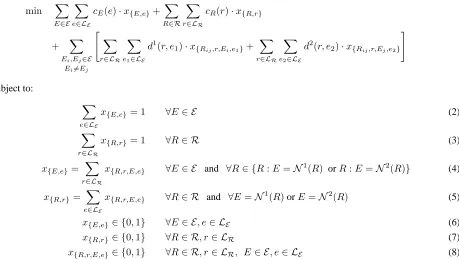
these definitions, the optimization problem can be repre-sented as the following ILP problem (Figure 1).
Equations (2) and (3) require that each entity or rela-tion variable can only be assigned one label. Equarela-tions (4) and (5) assure that the assignment to each entity or relation variable is consistent with the assignment to its neighboring variables. (6), (7), and (8) are the integral constraints on these binary variables.
min X E∈E
X
e∈LE
cE(e)·x{E,e}+
X
R∈R
X
r∈LR
cR(r)·x{R,r}
+ X
Ei,Ej∈E
Ei6=Ej "
X
r∈LR
X
e1∈LE d1(r, e
1)·x{Rij,r,Ei,e1}+
X
r∈LR
X
e2∈LE d2(r, e
2)·x{Rij,r,Ej,e2}
#
subject to:
X
e∈LE
x{E,e}= 1 ∀E∈ E (2)
X
r∈LR
x{R,r}= 1 ∀R∈ R (3)
x{E,e}=
X
r∈LR
x{R,r,E,e} ∀E∈ E and ∀R∈ {R:E=N1(R) orR:E=N2(R)} (4)
x{R,r}=
X
e∈LE
x{R,r,E,e} ∀R∈ R and ∀E=N1(R)orE=N2(R) (5)
x{E,e}∈ {0,1} ∀E∈ E, e∈ LE (6)
x{R,r}∈ {0,1} ∀R∈ R, r∈ LR (7)
[image:4.612.80.539.80.339.2]x{R,r,E,e}∈ {0,1} ∀R∈ R, r∈ LR, E∈ E, e∈ LE (8)
Figure 1: Integer Linear Programming Formulation
3.1 Linear Programming Relaxation (LPR)
To solve an ILP problem, a natural idea is to relax the integral constraints. That is, replacing (6), (7), and (8) with:
x{E,e}≥0 ∀E∈ E, e∈ LE (9)
x{R,r}≥0 ∀R∈ R, r∈ LR (10)
x{R,r,E,e}≥0 ∀R∈ R, r∈ LR,
E∈ E, e∈ LE (11)
If LPR returns an integer solution, then it is also the optimal solution to the ILP problem. If the solution is non integer, then at least it gives a lower bound to the value of the cost function, which can be used in modi-fying the problem and getting closer to deriving an op-timal integer solution. A direct way to handle the non integer solution is called rounding, which finds an inte-ger point that is close to the non inteinte-ger solution. Un-der some conditions of cost functions, which do not hold here, a well designed rounding algorithm can be shown that the rounded solution is a good approximation to the optimal solution (Kleinberg and Tardos, 1999; Chekuri et al., 2001). Nevertheless, in general, the outcomes of the rounding procedure may not even be a legal solution to the problem.
3.2 Branch & Bound and Cutting Plane
Branch and bound is the method that divides an ILP
prob-lem into several LP subprobprob-lems. It uses LPR as a sub-routine to generate dual (upper and lower) bounds to re-duce the search space, and finds the optimal solution as well. When LPR finds a non integer solution, it splits the problem on the non integer variable. For example, sup-pose variablexiis fractional in an non integer solution to the ILP problemmin{cx:x∈S, x∈ {0,1}n}, whereS is the linear constraints. The ILP problem can be split into two sub LPR problems,min{cx:x∈S∩{xi= 0}}and min{cx:x∈S∩ {xi= 1}}. Since any feasible solution provides an upper bound and any LPR solution generates a lower bound, the search tree can be effectively cut.
Another strategy of dealing with non integer points, which is often combined with branch & bound, is called
cutting plane. When a non integer solution is given by
exam-ple is (Wang and Regan, 2000), which only focuses on binary ILP problems.
Although in theory, a search based strategy may need several steps to find the optimal solution, LPR always generates integer solutions in our experiments. This phe-nomenon may link to the theory of unimodularity.
3.3 Unimodularity
When the coefficient matrix of a given linear program in its standard form is unimodular, it can be shown that the optimal solution to the linear program is in fact inte-gral (Schrijver, 1986). In other words, LPR is guaranteed to produce an integer solution.
Definition 3.1 A matrixAof rankmis called
unimodu-lar if all the entries ofAare integers, and the determinant of every square submatrix ofAof ordermis in 0,+1,-1.
Theorem 3.1 (Veinott & Dantzig) LetAbe an(m, n) -integral matrix with full row rank m. Then the polyhe-dron{x|x ≥ 0;Ax = b}is integral for each integral vectorb, if and only ifAis unimodular.
Theorem 3.1 indicates that if a linear programming problem is in its standard form, then regardless of the cost function and the integral vectorb, the optimal so-lution is an integer if and only if the coefficient matrixA
is unimodular.
Although the coefficient matrix in our problem is not unimodular, LPR still produces integer solutions for all the (thousands of cases) we have experimented with. This may be due to the fact that the coefficient matrix shares many properties of a unimodular matrix. As a result, most of the vertices of the polyhedron are integer points. An-other possible reason is that given the cost function we have, the optimal solution is always integer. Because of the availability of very efficient LP/ILP packages, we de-fer the exploration of this direction for now.
4
Experiments
We describe below two experiments on the problem of simultaneously recognizing entities and relations. In the first, we view the task as a knowledge acquisition task – we let the system read sentences and identify entities and relations among them. Given that this is a difficult task which may require quite often information beyond the sentence, we consider also a “forced decision” task, in which we simulate a question answering situation – we ask the system, say, “who killed whom” and evaluate it on identifying correctly the relation and its arguments, given that it is known that somewhere in this sentence this relation is active. In addition, this evaluation exhibits the ability of our approach to incorporate task specific constraints at decision time.
Our experiments are based on the TREC data set (which consists of articles from WSJ, AP, etc.) that we
annotated for named entities and relations. In order to effectively observe the interaction between relations and entities, we picked 1437 sentences that have at least one active relation. Among those sentences, there are 5336 entities, and 19048 pairs of entities (binary relations). En-tity labels include 1685 persons, 1968 locations, 978
or-ganizations and 705 others. Relation labels include 406 located in, 394 work for, 451 orgBased in, 521 live in,
268 kill, and 17007 none. Note that most pairs of entities have no active relations at all. Therefore, relation none significantly outnumbers others. Examples of each rela-tion label and the constraints between a relarela-tion variable and its two entity arguments are shown as follows.
Relation Entity1 Entity2 Example located in loc loc (New York, US)
work for per org (Bill Gates, Microsoft) orgBased in org loc (HP, Palo Alto)
live in per loc (Bush, US) kill per per (Oswald, JFK)
In order to focus on the evaluation of our inference procedure, we assume the problem of segmentation (or
phrase detection) (Abney, 1991; Punyakanok and Roth,
2001) is solved, and the entity boundaries are given to us as input; thus we only concentrate on their classifications. We evaluate our LP based global inference procedure against two simpler approaches and a third that is given more information at learning time. Basic, only tests our entity and relation classifiers, which are trained indepen-dently using only local features. In particular, the relation classifier does not know the labels of its entity arguments, and the entity classifier does not know the labels of rela-tions in the sentence either. Since basic classifiers are used in all approaches, we describe how they are trained here.
For the entity classifier, one set of features are ex-tracted from words within a size 4 window around the target phrase. They are: (1) words, part-of-speech tags, and conjunctions of them; (2) bigrams and trigrams of the mixture of words and tags. In addition, some other features are extracted from the target phrase, including:
symbol explanation
icap the first character of a word is capitalized acap all characters of a word are capitalized incap some characters of a word are capitalized suffix the suffix of a word is “ing”, “ment”, etc. bigram bigram of words in the target phrase
len number of words in the target phrase place3 the phrase is/has a known place’s name
prof3 the phrase is/has a professional title (e.g. Lt.) name3 the phrase is/has a known person’s name
For the relation classifier, there are three sets of fea-tures: (1) features similar to those used in the entity clas-sification are extracted from the two argument entities of
3
Pattern Example arg1, arg2 San Jose, CA
arg1,· · ·a· · ·arg2prof John Smith, a Starbucks manager· · ·
in/at arg1in/at/, arg2 Officials in Perugia in Umbria province said· · ·
arg2prof arg1 CNN reporter David McKinley· · ·
arg1· · ·native of· · ·arg2 Elizabeth Dole is a native of Salisbury, N.C.
[image:6.612.101.509.72.159.2]arg1· · ·based in/at arg2 Leslie Kota, a spokeswoman for K mart based in Troy, Mich. said· · ·
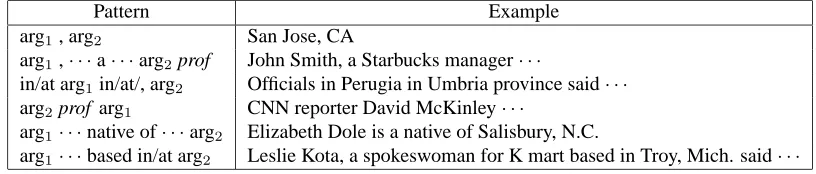
Table 1: Some patterns used in relation classification
the relation; (2) conjunctions of the features from the two arguments; (3) some patterns extracted from the sentence or between the two arguments. Some features in category (3) are “the number of words between arg1 and arg2 ”,
“whether arg1and arg2are the same word”, or “arg1is
the beginning of the sentence and has words that consist of all capitalized characters”, where arg1 and arg2
rep-resent the first and second argument entities respectively. In addition, Table 1 presents some patterns we use.
The learning algorithm used is a variation of the Win-now update rule incorporated in SNoW (Roth, 1998; Roth and Yih, 2002), a multi-class classifier that is specif-ically tailored for large scale learning tasks. SNoW learns a sparse network of linear functions, in which the targets (entity classes or relation classes, in this case) are repre-sented as linear functions over a common feature space. While SNoW can be used as a classifier and predicts us-ing a winner-take-all mechanism over the activation value of the target classes, we can also rely directly on the raw activation value it outputs, which is the weighted linear sum of the active features, to estimate the posteriors. It can be verified that the resulting values are monotonic with the confidence in the prediction, therefore provide a good source of probability estimation. We use softmax (Bishop, 1995) over the raw activation values as condi-tional probabilities. Specifically, suppose the number of classes is n, and the raw activation values of class iis
acti. The posterior estimation for classiis derived by the following equation.
pi=
eacti P
1≤j≤neactj
Pipeline, mimics the typical strategy in solving
com-plex natural language problems – separating a task into several stages and solving them sequentially. For exam-ple, a named entity recognizer may be trained using a dif-ferent corpus in advance, and given to a relation classifier as a tool to extract features. This approach first trains an entity classifier as described in the basic approach, and then uses the prediction of entities in addition to other local features to learn the relation identifier. Note that although the true labels of entities are known here when training the relation identifier, this may not be the case
in general NLP problems. Since only the predicted en-tity labels are available in testing, learning on the predic-tions of the entity classifier presumably makes the rela-tion classifier more tolerant to the mistakes of the entity classifier. In fact, we also observe this phenomenon em-pirically. When the relation classifier is trained using the true entity labels, the performance is much worse than using the predicted entity labels.
LP, is our global inference procedure. It takes as
in-put the constraints between a relation and its entity argu-ments, and the output (the estimated probability distribu-tion of labels) of the basic classifiers. Note that LP may change the predictions for either entity labels or relation labels, while pipeline fully trusts the labels of entity clas-sifier, and only the relation predictions may be different from the basic relation classifier. In other words, LP is able to enhance the performance of entity classification, which is impossible for pipeline.
The final approach, Omniscience, tests the conceptual upper bound of this entity/relation classification problem. It also trains the two classifiers separately as the basic approach. However, it assumes that the entity classifier knows the correct relation labels, and similarly the rela-tion classifier knows the right entity labels as well. This additional information is then used as features in training and testing. Note that this assumption is totally unrealis-tic. Nevertheless, it may give us a hint that how much a global inference can achieve.
4.1 Results
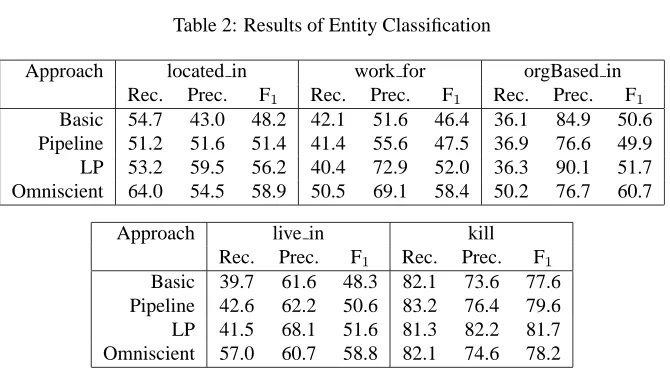
Tables 2 & 3 show the performance of each approach in
Fβ=1using 5-fold cross-validation. The results show that
LP performs consistently better than basic and pipeline,
both in entities and relations. Note that LP does not apply learning at all, but still outperforms pipeline, which uses entity predictions as new features in learning. The results of the omniscient classifiers reveal that there is still room for improvement. One option is to apply learning to tune a better cost function in the LP approach.
in-Approach person organization location Rec. Prec. F1 Rec. Prec. F1 Rec. Prec. F1
[image:7.612.135.476.72.145.2]Basic 89.4 89.2 89.3 86.9 91.4 89.1 68.2 90.9 77.9 Pipeline 89.4 89.2 89.3 86.9 91.4 89.1 68.2 90.9 77.9 LP 90.4 90.0 90.2 88.5 91.7 90.1 71.5 91.0 80.1 Omniscient 94.9 93.5 94.2 92.3 96.5 94.4 88.3 93.4 90.8
Table 2: Results of Entity Classification
Approach located in work for orgBased in Rec. Prec. F1 Rec. Prec. F1 Rec. Prec. F1
Basic 54.7 43.0 48.2 42.1 51.6 46.4 36.1 84.9 50.6 Pipeline 51.2 51.6 51.4 41.4 55.6 47.5 36.9 76.6 49.9 LP 53.2 59.5 56.2 40.4 72.9 52.0 36.3 90.1 51.7 Omniscient 64.0 54.5 58.9 50.5 69.1 58.4 50.2 76.7 60.7
Approach live in kill
Rec. Prec. F1 Rec. Prec. F1
Basic 39.7 61.6 48.3 82.1 73.6 77.6 Pipeline 42.6 62.2 50.6 83.2 76.4 79.6 LP 41.5 68.1 51.6 81.3 82.2 81.7 Omniscient 57.0 60.7 58.8 82.1 74.6 78.2
Table 3: Results of Relation Classification
teresting to investigate how often such mistakes happen without global inference, and see how effectively the global inference enhances this.
For this purpose, we define the quality of the decision as follows. For an active relation of which the label is classified correctly, if both its argument entities are also predicted correctly, we count it as a coherent prediction.
Quality is then the number of coherent predictions
di-vided by the sum of coherent and incoherent predictions. Since the basic and pipeline approaches do not have a global view of the labels of entities and relations, 5% to 25% of the predictions are incoherent. Therefore, the quality is not always good. On the other hand, our global inference procedure, LP, takes the natural constraints into account, so it never generates incoherent predictions. If the relation classifier has the correct entity labels as fea-tures, a good learner should learn the constraints as well. As a result, the quality of omniscient is almost as good as
LP.
Another experiment we did is the forced decision test, which boosts the F1 of “kill” relation to 86.2%. Here
we consider only sentences in which the “kill” relation is active. We force the system to determine which of the possible relations in a sentence (i.e., which pair of en-tities) has this relation by adding a new linear equality. This is a realistic situation (e.g., in the context of ques-tion answering) in that it adds an external constraint, not present at the time of learning the classifiers and it eval-uates the ability of our inference algorithm to cope with
it. The results exhibit that our expectations are correct. In fact, we believe that in natural situations the number of constraints that can apply is even larger. Observing the algorithm performs on other, specific, forced deci-sion tasks verifies that LP is reliable in these situations. As shown in the experiment, it even performs better than
omniscience, which is given more information at learning
time, but cannot adapt to the situation at decision time.
5
Discussion
We presented an linear programming based approach for global inference where decisions depend on the out-comes of several different but mutually dependent classi-fiers. Even in the presence of a fairly general constraint structure, deviating from the sequential nature typically studied, this approach can find the optimal solution effi-ciently.
[image:7.612.140.475.147.331.2]help of constraints.
Our experiments have demonstrated these advantages by considering the interaction between entity and rela-tion classifiers. In fact, more classifiers can be added and used within the same framework. For example, if coref-erence resolution is available, it is possible to incorporate it in the form of constraints that force the labels of the co-referred entities to be the same (but, of course, allowing the global solution to reject the suggestion of these clas-sifiers). Consequently, this may enhance the performance of entity/relation recognition and, at the same time, cor-rect possible coreference resolution errors. Another ex-ample is to use chunking information for better relation identification; suppose, for example, that we have avail-able chunking information that identifies Subj+Verb and Verb+Object phrases. Given a sentence that has the verb “murder”, we may conclude that the subject and object of this verb are in a “kill” relation. Since the chunking in-formation is used in the global inference procedure, this information will contribute to enhancing its performance and robustness, relying on having more constraints and overcoming possible mistakes by some of the classifiers. Moreover, in an interactive environment where a user can supply new constraints (e.g., a question answering situa-tion) this framework is able to make use of the new in-formation and enhance the performance at decision time, without retraining the classifiers.
As we show, our formulation supports not only im-proved accuracy, but also improves the ‘human-like” quality of the decisions. We believe that it has the poten-tial to be a powerful way for supporting natural language inferences.
Acknowledgements This research has been supported
by NFS grants CAREER IIS-9984168, ITR IIS-0085836, EIA-0224453, an ONR MURI Award, and an equipment donation from AMD. We also thank the anonymous ref-erees for their useful comments.
References
S. Abney. 1991. Parsing by chunks. In S. Abney R. Berwick and C. Tenny, editors, Principle-based
parsing: Computation and Psycholinguistics, pages
257–278. Kluwer, Dordrecht.
C. Bishop, 1995. Neural Networks for Pattern
Recogni-tion, chapter 6.4: Modelling conditional distributions,
page 215. Oxford University Press.
Y. Boykov, O. Veksler, and R. Zabih. 2001. Fast ap-proximate energy minimization via graph cuts. IEEE
Transactions on Pattern Analysis and Machine Intelli-gence, 23(11):1222–1239, November.
C. Chekuri, S. Khanna, J. Naor, and L. Zosin. 2001. Ap-proximation algorithms for the metric labeling prob-lem via a new linear programming formulation. In
Symposium on Discrete Algorithms, pages 109–118.
CPLEX. 2003. ILOG, Inc. CPLEX. http://www.ilog.com/products/cplex/.
T. Dietterich. 2002. Machine learning for sequential data: A review. In Structural, Syntactic, and Statistical
Pattern Recognition, pages 15–30. Springer-Verlag.
J. Kleinberg and E. Tardos. 1999. Approximation algo-rithms for classification problems with pairwise rela-tionships: Metric labeling and markov random fields. In IEEE Symposium on Foundations of Computer
Sci-ence, pages 14–23.
J. Lafferty, A. McCallum, and F. Pereira. 2001. Con-ditional random fields: Probabilistic models for seg-menting and labeling sequence data. In Proc. 18th
International Conf. on Machine Learning, pages 282–
289. Morgan Kaufmann, San Francisco, CA.
A. Levin, A. Zomet, and Yair Weiss. 2002. Learning to perceive transparency from the statistics of natu-ral scenes. In NIPS-15; The 2002 Conference on
Ad-vances in Neural Information Processing Systems.
S. Li. 2001. Markov Random Field Modeling in Image
Analisys. Springer-Verlag.
V. Punyakanok and D. Roth. 2001. The use of classifiers in sequential inference. In NIPS-13; The 2000
Confer-ence on Advances in Neural Information Processing Systems, pages 995–1001. MIT Press.
D. Roth and W. Yih. 2002. Probabilistic reasoning for entity & relation recognition. In COLING 2002, The
19th International Conference on Computational Lin-guistics, pages 835–841.
D. Roth. 1998. Learning to resolve natural language am-biguities: A unified approach. In Proc. of AAAI, pages 806–813.
D. Roth. 2002. Reasoning with classifiers. In Proc. of
the European Conference on Machine Learning, pages
506–510.
A. Schrijver. 1986. Theory of Linear and Integer
Pro-gramming. Wiley Interscience series in discrete
math-matics. John Wiley & Sons, December.
B. Taskar, A. Pieter, and D. Koller. 2002. Discrimina-tive probabilistic models for relational data. In Proc. of
Uncertainty in Artificial Intelligence, pages 485–492.
E. Tjong Kim Sang and F. De Meulder. 2003. Intro-duction to the CoNLL-2003 shared task: Language-independent named entity recognition. In Proc. of
CoNLL-2003, pages 142–147. Edmonton, Canada.
X. Wang and A. Regan. 2000. A cutting plane method for integer programming problems with binary vari-ables. Technical Report UCI-ITS-WP-00-12, Univer-sity of California, Irvine.
L. Wolsey. 1998. Integer Programming. John Wiley & Sons, Inc.