2644
Multi-task Learning with Sample Re-weighting
for Machine Reading Comprehension
Yichong Xu1∗, Xiaodong Liu2, Yelong Shen2, Jingjing Liu2 and Jianfeng Gao2 1 Carnegie Mellon University
2 Microsoft Research
{xiaodl, yeshen, jingjl,jfgao}@microsoft.com
Abstract
We propose a multi-task learning framework to learn a joint Machine Reading Compre-hension (MRC) model that can be applied to a wide range of MRC tasks in different do-mains. Inspired by recent ideas of data se-lection in machine translation, we develop a novel sample re-weighting scheme to assign sample-specific weights to the loss. Empiri-cal study shows that our approach can be ap-plied to many existing MRC models. Com-bined with contextual representations from pre-trained language models (such as ELMo), we achieve new state-of-the-art results on a set of MRC benchmark datasets. We re-lease our code athttps://github.com/ xycforgithub/MultiTask-MRC.
1 Introduction
Machine Reading Comprehension (MRC) has gained growing interest in the research commu-nity (Rajpurkar et al., 2016; Yu et al., 2018). In an MRC task, the machine reads a text passage and a question, and generates (or selects) an answer based on the passage. This requires the machine to possess strong comprehension, inference and reasoning capabilities. Over the past few years, there has been much progress in building end-to-end neural network models (Seo et al., 2016) for MRC. However, most public MRC datasets (e.g., SQuAD, MS MARCO, TriviaQA) are typically small (less than 100K) compared to the model size (such as SAN (Liu et al., 2018c,b) with around 10M parameters). To prevent over-fitting, recently there have been some studies on using pre-trained word embeddings (Pennington et al., 2014) and contextual embeddings in the MRC model train-ing, as well as back-translation approaches (Yu et al., 2018) for data augmentation.
∗
Most of this work was performed when the author was interning at Microsoft.
Multi-task learning (Caruana, 1997) is a widely studied area in machine learning, aiming at bet-ter model generalization by combining training datasets from multiple tasks. In this work, we explore a multi-task learning (MTL) framework to enable the training of one universal model across different MRC tasks for better generaliza-tion. Intuitively, this multi-task MRC model can be viewed as an implicit data augmentation tech-nique, which can improve generalization on the target task by leveraging training data from aux-iliary tasks.
We observe that merely adding more tasks can-not provide much improvement on the target task. Thus, we propose two MTL training algorithms to improve the performance. The first method sim-ply adopts a sampling scheme, which randomly selects training data from the auxiliary tasks con-trolled by a ratio hyperparameter; The second al-gorithm incorporates recent ideas of data selection in machine translation (van der Wees et al., 2017). It learns the sample weights from the auxiliary tasks automatically through language models.
To the best of our knowledge, this is the first work that systematically explores multi-task learn-ing for MRC. In previous methods that use lan-guage models and word embedding, the external embedding/language models are pre-trained sepa-rately and remain fixed during the training of the MRC model. Our model, on the other hand, can be trained with more flexibility on various MRC tasks. MTL is also faster and easier to train than embedding/LM methods: our approach requires no pre-trained models, whereas back translation and ELMo both rely on large models that would need days to train on multiple GPUs (Jozefowicz et al., 2016; Peters et al., 2018).
We validate our MTL framework with two state-of-the-art models on four datasets from dif-ferent domains. Experiments show that our meth-ods lead to a significant performance gain over single-task baselines on SQuAD (Rajpurkar et al., 2016), NewsQA (Trischler et al., 2017) and Who-Did-What (Onishi et al., 2016), while achieving state-of-the-art performance on the latter two. For example, on NewsQA (Trischler et al., 2017), our model surpassed human performance by13.4
(46.5 vs 59.9) and 3.2 (72.6 vs 69.4) absolute points in terms of exact match and F1.
The contribution of this work is three-fold. First, we apply multi-task learning to the MRC task, which brings significant improvements over single-task baselines. Second, the performance gain from MTL can be easily combined with ex-isting methods to obtain further performance gain. Third, the proposed sampling and re-weighting scheme can further improve the multi-task learn-ing performance.
2 Related Work
Studies in machine reading comprehension mostly focus on architecture design of neural networks, such as bidirectional attention (Seo et al., 2016), dynamic reasoning (Xu et al., 2017), and paral-lelization (Yu et al., 2018). Some recent work has explored transfer learning that leverages out-domain data to learn MRC models when no train-ing data is available for the target domain (Golub et al., 2017). In this work, we explore multi-task learning to make use of the data from other do-mains, while we still have access to target domain training data.
Multi-task learning (Caruana, 1997) has been widely used in machine learning to improve
gen-eralization using data from multiple tasks. For nat-ural language processing, MTL has been success-fully applied to low-level parsing tasks (Collobert et al., 2011), sequence-to-sequence learning (Lu-ong et al., 2015), and web search (Liu et al., 2015). More recently, (McCann et al., 2018) proposes to cast all tasks from parsing to translation as a QA problem and use a single network to solve all of them. However, their results show that multi-task learning hurts the performance of most tasks when tackling them together. Differently, we focus on applying MTL to the MRC task and show signifi-cant improvement over single-task baselines.
Our sample weighting scheme bears some re-semblance to previous MTL techniques that assign weights to tasks (Kendall et al., 2018). However, our method gives a more granular score for each sample and provides better performance for multi-task learning MRC.
3 Model Architecture
We call our model Multi-Task-SAN (MT-SAN), which is a variation of SAN (Liu et al., 2018c) model with two main differences: i) we add a highway network layer after the embedding layer, the encoding layer and the attention layer; ii) we use exponential moving average (Seo et al., 2016) during evaluation. The SAN architecture and our modifications are briefly described below and in Section 5.2, and detailed description can be found in (Liu et al., 2018c).
3.1 Input Format
For most tasks we consider, our MRC model takes a triplet (Q, P, A) as input, where Q = (q1, ..., qm), P = (p1, ..., pn) are the word index
representations of a question and a passage, re-spectively , andA = (abegin, aend)is the index of
the answer span. The goal is to predict A given
(Q, P).
3.2 Lexicon Encoding Layer
We map the word indices of P and Q into their 300-dim Glove vectors (Pennington et al., 2014). We also use the following additional in-formation for embedding words: i) 16-dim part-of-speech (POS) tagging embedding; ii) 8-dim named-entity-recognition (NER) embedding; iii) 3-dim exact match embedding: fexact match(pi) = I(pi ∈ Q), where matching is determined based
respectively; iv) Question enhanced passage word embeddings: falign(pi) = Pjγi,jh(GloVe(qj)),
where
γ
i,j=
exp(h(GloVe(pj)),h(GloVe(qi)))
P
j0exp(h(GloVe(pj0)),h(GloVe(qi))) (1)
is the similarity between wordpj andqi, andg(·)
is a 300-dim single layer neural net with Recti-fied Linear Unit (ReLU)g(x) =ReLU(W1x); v)
Passage-enhanced question word embeddings: the same as iv) but computed in the reverse direction. To reduce the dimension of the input to the next layer, the 624-dim input vectors of passages and questions are passed through a ReLu layer to re-duce their dimensions to 125.
After the ReLU network, we pass the 125-dim vectors through a highway network (Srivastava et al., 2015), to adapt to the multi-task setting:
gi = sigmoid(W2pti), pit = ReLU(W3pti)gi + gipti, wherepti is the vector after ReLU
trans-formation. Intuitively, the highway network here provides a neuron-wise weighting, which can po-tentially handle the large variation in data intro-duced by multiple datasets.
3.3 Contextual Encoding Layer
Both the passage and question encodings go through a 2-layer Bidirectional Long-Short Term Memory (BiLSTM, Hochreiter and Schmidhuber, 1997) network in this layer. We append a 600-dim CoVe vector (McCann et al., 2017) to the output of the lexicon encoding layer as input to the con-textual encoders. For the experiments with ELMo, we also append a 1024-dim ELMo vector. Similar to the lexicon encoding layer, the outputs of both layers are passed through a highway network for multi-tasking. Then we concatenate the output of the two layers to obtainHq ∈R2d×mfor the
ques-tion andHp =R2d×nthe passage, wheredis the
dimension of the BiLSTM.
3.4 Memory/Cross Attention Layer
We fuse Hp and Hq through cross attention and generate a working memory in this layer. We adopt the attention function from (Vaswani et al., 2017) and compute the attention matrix as C = dropout
fattention( ˆHq,Hˆp)
∈ Rm×n.
We then useC to compute a question-aware pas-sage representation as Up = concat(Hp, HqC).
Since a passage usually includes several hun-dred tokens, we use the method of (Lin et al.,
2017) to apply self attention to the represen-tations of passage to rearrange its informa-tion: Uˆp = Updropdiag(fattention(Up, Up)),where
dropdiag means that we only drop diagonal el-ements on the similarity matrix (i.e., attention with itself). Then, we concatenate Up and
ˆ
Up and pass them through a BiLSTM: M =
BiLSTM([Up]; ˆUp]). Finally, output of the BiL-STM (after concatenating two directions) goes through a highway layer to produce the memory.
3.5 Answer Module
The base answer module is the same as SAN, which computes a distribution over spans in the passage. Firstly, we compute an initial state s0 by self attention on Hq: s0 ←
Highway
P
j
exp(w4Hjq) P
j0expw4Hjq0 ·H
q j
. The final
an-swer is computed through T time steps. At step
t ∈ {1, ..., T − 1}, we compute the new state using a Gated Recurrent Unit (GRU, Cho et al., 2014) st = GRU(st−1, xt), where xt is
com-puted by attention between M and st−1: xt = P
jβjMj, βj = softmax(st−1W5M). Then each
step produces a prediction of the start and end of answer spans through a bilinear function:Ptbegin =
softmax(stW6M), Ptend = softmax(stW7M).
The final prediction is the average of each time step: Pbegin = T1 P
tP begin
t , Pend = T1 P
tPtend.
We randomly apply dropout on the step level in each time step during training, as done in (Liu et al., 2018c). During training, the objective is the log-likelihood of the ground truth: l(Q, P, A) = logPbegin(abegin) + logPend(aend).
4 Multi-task Learning Algorithms
We describe our MTL training algorithms in this section. We start with a very simple and straight-forward algorithm that samples one task and one mini-batch from that task at each iteration. To im-prove the performance of MTL on a target dataset, we propose two methods to re-weight samples ac-cording to their importance. The first proposed method directly lowers the probability of sam-pling from a particular auxiliary task; however, this probability has to be chosen using grid search. We then propose another method that avoids such search by using a language model.
Algorithm 1Multi-task Learning of MRC
Input: k different datasets D1, ...,DK,
max epoch
1: Initialize the modelM
2: forepoch= 1,2, ..., max epochdo
3: Divide each dataset Dk into Nk
mini-batchesDk={bk1, ..., bkNk},1≤k≤K
4: Put all mini-batches together and ran-domly shuffle the order of them, to obtain a se-quenceB = (b1, ..., bL), whereL=PkNk
5: foreach mini-batchb∈Bdo
6: Perform gradient update on M with lossl(b) =P
(Q,P,A)∈bl(Q, P, A)
7: end for
8: Evaluate development set performance
9: end for
Output: Model with best evaluation performance
model training, and the same set of parameters is used for all tasks. Perhaps surprisingly, as we will show in the experiment results, this simple base-line method can already lead to a considerable im-provement over the single-task baselines.
4.1 Mixture Ratio
One observation is that the performance of our model using Algorithm 1 starts to deteriorate as we add more and more data from other tasks into our training pool. We hypothesize that the external data will inevitably bias the model towards auxil-iary tasks instead of the target task.
To avoid such adverse effect, we introduce a mixture ratio parameter during training. The train-ing algorithm with the mixture ratio is presented in Algorithm 2, with D1 being the target dataset.
In each epoch, we use all mini-batches from D1, while only a ratioαof mini-batches from external datasets are used to train the model. In our exper-iment, we use hyperparameter search to find the bestαfor each dataset combination. This method resembles previous methods in multi-task learning to weight losses differently (e.g., Kendall et al., 2018), and is very easy to implement. In our ex-periments, we use Algorithm 2 to train our net-work when we only use 2 datasets for MTL.
4.2 Sample Re-Weighting
The mixture ratio (Algorithm 2) dramatically im-proves the performance of our system. However, it requires to find an ideal ratio by hyperparame-ter search which is time-consuming. Furthermore,
Algorithm 2 Multi-task Learning of MRC with mixture ratio, targetingD1
Input: K different datasets D1, ...,DK, max epoch, mixture ratioα
1: Initialize the modelM
2: forepoch= 1,2, ..., max epochdo
3: Divide each dataset Dk into Nk
mini-batchesDk={bk1, ..., bkN
k},1≤k≤K
4: S ← {b11, ..., b1N 1}
5: Randomly pickbαN1cmini-batches from
SK
k=2Dkand add toS
6: Assign mini-batches inS in a random or-der to obtain a sequence B = (b1, ..., bL),
whereL=N1+bαN1c
7: foreach mini-batchb∈Bdo
8: Perform gradient update on M with lossl(b) =P
(Q,P,A)∈bl(Q, P, A)
9: end for
10: Evaluate development set performance
11: end for
Output: Model with best evaluation performance
the ratio gives the same weight to every auxiliary data, but the relevance of every data point to the target task can vary greatly.
We develop a novel re-weighting method to resolve these problems, using ideas inspired by data selection in machine translation (Axelrod et al., 2011; van der Wees et al., 2017). We use
(Qk, Pk, Ak)to represent a data point from thek
-th task for 1 ≤ k ≤ K, with k = 1 being the target task. Since the passage styles are hard to evaluate, we only evaluate data points based on
Qk and Ak. Note that only data from auxiliary task (2 ≤k≤K) is re-weighted; target task data always have weight 1.
Our scores consist of two parts, one for ques-tions and one for answers. For quesques-tions, we cre-ate language models (detailed in Section 5.2) us-ing questions from each task, which we represent asLMk for thek-th task. For each questionQk
from auxiliary tasks, we compute a cross-entropy score:
HC,Q(Qk) =−
1
m
X
w∈Qk
log(LMC(w)), (2)
whereC∈ {1, k}is the target or auxiliary task,m
is the length of questionQk, andw iterates over all words inQk.
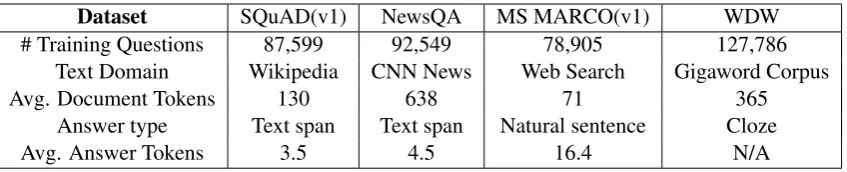
Dataset SQuAD(v1) NewsQA MS MARCO(v1) WDW # Training Questions 87,599 92,549 78,905 127,786
Text Domain Wikipedia CNN News Web Search Gigaword Corpus
Avg. Document Tokens 130 638 71 365
Answer type Text span Text span Natural sentence Cloze
[image:5.595.89.513.61.147.2]Avg. Answer Tokens 3.5 4.5 16.4 N/A
Table 1: Statistics of the datasets. Some numbers come from (Sugawara et al., 2017).
on SQuAD includes only one or two words in most cases). We instead just use the length of answers as a signal for scores. Letlkabe the length ofAk, the cross-entropy answer score is defined as:
HC,A(Ak) =−logfreqC(lka), (3)
where freqC is the frequency of answer lengths in
taskC ∈ {1, k}.
The cross entropy scores are then normalized over all samples in taskC to create a comparable metric across all auxiliary tasks:
HC,Q0 (Qk) = HC,Q(Q
k)−min(H C,Q)
max(HC,Q)−min(HC,Q)
(4)
HC,A0 (Ak) = HC,A(A
k)−min(H C,A)
max(HC,A)−min(HC,A)
(5)
for C ∈ {1,2, ..., K}. For C ∈ {2, ..., K}, the maximum and minimum are taken over all sam-ples in task k. ForC = 1 (target task), they are taken over all available samples.
Intuitively,HC,Q0 andHC,A0 represents the sim-ilarity of text Q, A to taskC; a lowHC,Q0 (resp.
HC,A0 ) means thatQk (resp. Ak) is easy to pre-dict and similar toC, and vice versa. We would like samples that are most similar from data in the target domain (lowH10), and most different (infor-mative) from data in the auxiliary task (highHk0). We thus compute the following cross-entropy dif-ference for each external data:
CED(Qk, Ak) =(H10,Q(Qk)−Hk,Q0 (Qk))+ (H10,A(Ak)−Hk,A0 (Ak)) (6)
for k ∈ {2, ..., K}. Note that a low CED score indicates high importance. Finally, we transform the scores to weights by taking negative, and nor-malize between[0,1]:
CED0(Qk, Ak) = 1−CED(Q
k, Ak)−min(CED)
max(CED)−min(CED) . (7)
Here the maximum and minimum are taken over all available samples and task. Our training
algorithm is the same as Algorithm 1, but for mini-batchbwe instead use the loss
l(b) = X (P,Q,A)∈b
CED0(Q, A)l(P, Q, A) (8)
in step 6. We define CED0(Q1, A1) ≡ 1 for all target samples(P1, Q1, A1).
5 Experiments
Our experiments are designed to answer the fol-lowing questions on multi-task learning for MRC: 1. Can we improve the performance of existing MRC systems using multi-task learning?
2. How does multi-task learning affect the perfor-mance if we combine it with other external data? 3. How does the learning algorithm change the performance of multi-task MRC?
4. How does our method compare with existing MTL methods?
We first present our experiment details and results for MT-SAN. Then, we provide a comprehensive study on the effectiveness of various MTL algo-rithms in Section 5.4. At last, we provide some additional results on combining MTL with DrQA (Chen et al., 2017) to show the flexibility of our approach1.
5.1 Datasets
We conducted experiments on SQuAD (Rajpurkar et al., 2016), NewsQA(Trischler et al., 2017), MS MARCO (v1, Nguyen et al.,2016) and WDW (On-ishi et al., 2016). Dataset statistics is shown in Table 1. Although similar in size, these datasets are quite different in domains, lengths of text, and types of task. In the following experiments, we will validate whether including external datasets as additional input information (e.g., pre-trained language model on these datasets) helps boost the performance of MRC systems.
1We include the results in the appendix due to space
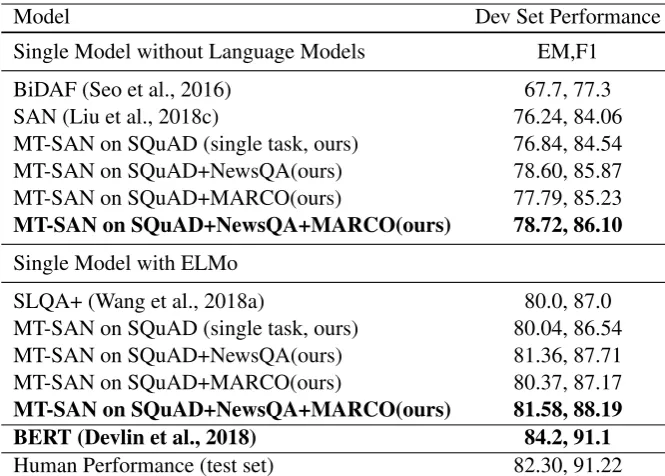
Model Dev Set Performance Single Model without Language Models EM,F1
BiDAF (Seo et al., 2016) 67.7, 77.3 SAN (Liu et al., 2018c) 76.24, 84.06 MT-SAN on SQuAD (single task, ours) 76.84, 84.54 MT-SAN on SQuAD+NewsQA(ours) 78.60, 85.87 MT-SAN on SQuAD+MARCO(ours) 77.79, 85.23
MT-SAN on SQuAD+NewsQA+MARCO(ours) 78.72, 86.10
Single Model with ELMo
SLQA+ (Wang et al., 2018a) 80.0, 87.0 MT-SAN on SQuAD (single task, ours) 80.04, 86.54 MT-SAN on SQuAD+NewsQA(ours) 81.36, 87.71 MT-SAN on SQuAD+MARCO(ours) 80.37, 87.17
MT-SAN on SQuAD+NewsQA+MARCO(ours) 81.58, 88.19 BERT (Devlin et al., 2018) 84.2, 91.1
[image:6.595.130.463.61.299.2]Human Performance (test set) 82.30, 91.22
Table 2: Performance of our method to train SAN in multi-task setting, competing published results, leaderboard results and human performance, on SQuAD dataset (single model). Note that BERT uses a much larger language model, and is not directly comparable with our results. We expect our test performance is roughly similar or a bit higher than our dev performance, as is the case with other competing models.
5.2 Experiment Details
We mostly focus on span-based datasets for MT-SAN, namely SQuAD, NewsQA, and MS MARCO. We convert MS MARCO into an answer-span dataset to be consistent with SQuAD and NewsQA, following (Liu et al., 2018c). For each question, we search for the best span using ROUGE-L score in all passage texts and use the span to train our model. We exclude questions with maximal ROUGE-L score less than 0.5 dur-ing traindur-ing. For evaluation, we use our model to find a span in all passages. The prediction score is multiplied with the ranking score, trained follow-ing Liu et al. (2018a)’s method to determine the final answer.
We train our networks using algorithms in Sec-tion 4, using SQuAD as the target task. For ex-periments with two datasets, we use Algorithm 2; for experiments with three datasets we find the re-weighting mechanism in Section 4.2 to have a better performance (a detailed comparison will be presented in Section 5.4).
For generating sample weights, we build a LSTM language model on questions following the implementation of Merity et al. (2017) with the same hyperparameters. We only keep the 10,000 most frequent words, and replace the other words
with a special out-of-vocabulary token.
Parameters of MT-SAN are mostly the same as in the original paper (Liu et al., 2018c). We utilize spaCy2 to tokenize the text and generate part-of-speech and named entity labels. We use a 2-layer BiLSTM with 125 hidden units as the BiLSTM throughout the model. During training, we drop the activation of each neuron with 0.3 probability. For optimization, we use Adamax (Kingma and Ba, 2014) with a batch size of 32 and a learning rate of 0.002. For prediction, we compute an ex-ponential moving average (EMA, Seo et al. 2016) of model parameters with a decay rate of 0.995 and use it to compute the model performance. For experiments with ELMo, we use the model imple-mented by AllenNLP 3. We truncate passage to contain at most 1000 tokens during training and eliminate those data with answers located after the 1000th token. The training converges in around 50 epochs for models without ELMo (similar to the single-task SAN); For models with ELMo, the convergence is much faster (around 30 epochs).
5.3 Performance of MT-SAN
In the following sub-sections, we report our re-sults on SQuAD and MARCO development sets,
2
https://spacy.io
as well as on the development and test sets of NewsQA 4. All results are single-model perfor-mance unless otherwise noted.
The multi-task learning results of SAN on SQuAD are summarized in Table 2. By using MTL on SQuAD and NewsQA, we can improve the exact-match (EM) and F1 score by (2%, 1.5%), respectively, both with and without ELMo. The similar gain indicates that our method is orthogo-nal to ELMo. Note that our single-model perfor-mance is slightly higher than the original SAN, by incorporating EMA and highway networks. By in-corporating with multi-task learning, it further im-proves the performance. The performance gain by adding MARCO is relatively smaller, with 1% in EM and 0.5% in F1. We conjecture that MARCO is less helpful due to its differences in both the question and answer style. For example, ques-tions in MS MARCO are real web search queries, which are short and may have typos or abbrevia-tions; while questions in SQuAD and NewsQA are more formal and well written.
Using 3 datasets altogether provides another marginal improvement. Our model obtains the best results among existing methods that do not use a large language model (e.g., ELMo). Our ELMo version also outperforms any other mod-els which are under the same setting. We note that BERT (Devlin et al., 2018) uses a much larger model than ours(around 20x), and we leave the performance of combining BERT with MTL as in-teresting future work.
The results of multi-task learning on NewsQA are in Table 3. The performance gain with multi-task learning is even larger on NewsQA, with over 2% in both EM and F1. Experiments with and without ELMo give similar results. What is worth noting is that our approach not only achieves new state-of-art results with a large margin but also sur-passes human performance on NewsQA.
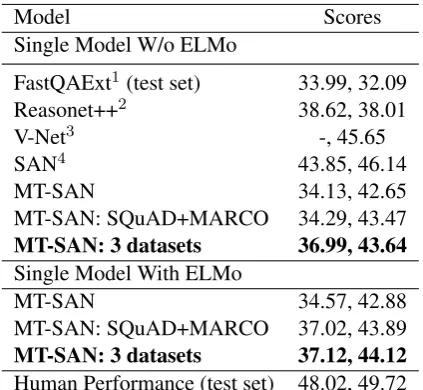
Finally we report MT-SAN performance on MS MARCO in Table 4. Multi-tasking on SQuAD and NewsQA provides a similar performance boost in terms of BLEU-1 and ROUGE-L score as in the case of NewsQA and SQuAD. Our method does not achieve very high performance compared to previous work, probably because we do not ap-ply common techniques like yes/no classification
4The official submission for SQuAD v1.1 and MARCO
v1.1 are closed, so we report results on the development set. According to their leaderboards, performances on develop-ment and test sets are usually similar.
Model Dev Set Test Set Model W/o ELMo EM,F1 EM, F1
Match-LSTM1 34.4, 49.6 34.9, 50.0 FastQA2 43.7, 56.1 42.8, 56.1 AMANDA3 48.4, 63.3 48.4, 63.7 MT-SAN (Single task) 55.8, 67.9 55.6, 68.0
MT-SAN (S+N) 57.8, 69.9 58.3, 70.7
Model With ELMo
MT-SAN (Single task) 57.7, 70.4 57.0, 70.4
MT-SAN (S+N) 60.1, 72.5 59.9, 72.6
[image:7.595.306.531.61.221.2]Human Performance -,- 46.5, 69.4
Table 3: Performance of our method to train SAN in multi-task setting, with published results and hu-man perforhu-mance on NewsQA dataset. All SAN results are from our models. “S+N” means jointly training on SQuAD and NewsQA References: 1: implemented by Trischler et al. (2017). 2:Weissenborn et al.(2017). 3: Kundu and Ng(2018).
Model Scores
Single Model W/o ELMo
FastQAExt1(test set) 33.99, 32.09 Reasonet++2 38.62, 38.01
V-Net3 -, 45.65
SAN4 43.85, 46.14
MT-SAN 34.13, 42.65 MT-SAN: SQuAD+MARCO 34.29, 43.47
MT-SAN: 3 datasets 36.99, 43.64
Single Model With ELMo
MT-SAN 34.57, 42.88 MT-SAN: SQuAD+MARCO 37.02, 43.89
MT-SAN: 3 datasets 37.12, 44.12
Human Performance (test set) 48.02, 49.72
Table 4: Performance of our method to train SAN in multi-task setting, competing published results and hu-man perforhu-mance, on MS MARCO dataset. The scores stand for (BLEU-1, ROUGE-L) respectively. All SAN results are our results. “3 dataset” means we train using SQuAD+NewsQA+MARCO. References: 1:
(Weis-senborn et al., 2017). 2: implemented by (Shen et al.,
2017).3:(Wang et al., 2018b).4: (Liu et al., 2018c)
[image:7.595.311.523.334.529.2]Model SQuAD WDW MT-SAN (Single Task) 76.8, 84.5 77.5 MT-SAN (S+W) 77.6, 85.1 78.5
[image:8.595.319.517.60.215.2]SOTA(Yang et al., 2016). 86.2, 92.2 71.7 Human Performance 82.3, 91.2 84
Table 5: Performance of MT-SAN on SQuAD Dev and WDW test set. Accuracy is used to evaluate WDW. “S+W” means jointly training on SQuAD and WDW.
Model EM, F1
+/-QANet 73.6, 82.7 0.0, 0.0 QANet + BT 75.1, 83.8 +1.5,+1.1 SAN 76.8, 84.5 0.0, 0.0
MT-SAN 78.7, 86.0 +1.9,+1.5
SAN + ELMo 80.0, 86.5 +3.2,+2.0
MT-SAN + ELMo 81.6, 88.2 +4.8, +3.7
Table 6: Comparison of methods to use external data. BT stands for back translation (Yu et al., 2018).
such questions in SQuAD is 12.9%. Moreover, WDW is a cloze dataset, whereas in SQuAD and NewsQA answers are spans in the passage. We use a task-specific answer layer in this experiment and use Algorithm 2; the WDW answer module is the same as in AS Reader (Kadlec et al., 2016), which we describe in the appendix for completeness. De-spite these large difference between datasets, our results (Table 5) show that MTL can still provide a moderate performance boost when jointly train-ing on SQuAD (around 0.7%) and WDW (around 1%).
Comparison of methods using external data.As a method of data augmentation, we compare our approach to previous methods for MRC in Table 6. Our model achieves better performance than back translation. We also observe that language models such as ELMo obtain a higher performance gain than multi-task learning, however, combining it with multi-task learning leads to the most signifi-cant performance gain. This validates our assump-tion that multi-task learning is more robust and is different from previous methods such as language modeling.
5.4 Comparison of Different MTL Algorithms
In this section, we provide ablation studies as well as comparisons with other existing algorithms on the MTL strategy. We focus on MT-SAN without
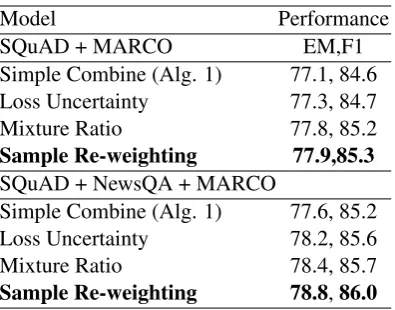
Model Performance
SQuAD + MARCO EM,F1 Simple Combine (Alg. 1) 77.1, 84.6 Loss Uncertainty 77.3, 84.7 Mixture Ratio 77.8, 85.2
Sample Re-weighting 77.9,85.3
SQuAD + NewsQA + MARCO
Simple Combine (Alg. 1) 77.6, 85.2 Loss Uncertainty 78.2, 85.6 Mixture Ratio 78.4, 85.7
Sample Re-weighting 78.8,86.0
Table 7: Comparison of different MTL strategies on MT-SAN. Performance is on SQuAD. Loss Uncer-tainty is from Kendall et al. (2018).
ELMo for efficient training.
Table 7 compares different multi-task learning strategies for MRC. Both the mixture ratio (Sec 4.1) and sample re-weighting (Sec 4.2) improves over the naive baseline of simply combining all the data (Algorithm 1). On SQuAD+MARCO, they provide around 0.6% performance boost in terms of both EM and F1, and around 1% on all 3 datasets. We note that this accounts for around a half of our overall improvement. Although sample re-weighting performs similar as mixture ratio, it significantly reduces the amount of training time as it eliminates the need for a grid searching the best ratio. Kendal et al., (2018) use task uncer-tainty to weight tasks differently for MTL; our ex-periments show that this has some positive effect, but does not perform as well as our proposed two techniques. We note that Kendal et al. (as well as other previous MTL methods) optimizes the net-work to perform well for all the tasks, whereas our method focuses on the target domain which we are interested in, e.g., SQuAD.
Sensitivity of mixture ratio. We also investigate the effect of mixture ratio on the model perfor-mance. We plot the EM/F1 score on SQuAD dev set vs. mixture ratio in Figure 1 for MT-SAN when trained on all three datasets. The curve peaks at
[image:8.595.73.293.62.133.2]Samples/Groups CED0 HQ HA
Examples
(NewsQA) Q: Where is the drought hitting?
0.824 0.732 0.951 A: Argentina
(MARCO) Q: thoracic cavity definition
0.265 0.332 0.240 A: is the chamber of the human body ... and fascia.
Averages
Samples in NewsQA 0.710 0.593 0.895 Samples in MARCO 0.587 0.550 0.669 MARCO Questions that start with “When” or “Who” 0.662 0.605 0.761
[image:9.595.94.506.61.187.2]All samples 0.654 0.573 0.791
Table 8: Scores for examples from NewsQA and MS MARCO and average scores for specific groups of samples. CED0is as in (7), whileHQandHAare normalized version of question and sample scores. “Sum” are the actual scores we use, and “LM”, “Answer” are scores from language models and answer lengths.
0 0.2 0.4 0.6 0.8 1
76 78 80 82 84 86 88
Score %
Sample Reweighting
Sample Reweighting
EM F1
Figure 1: Effect of the mixture ratio on the perfor-mance of MT-SAN. Note thatα = 0is equivalent to single task learning, andα= 1is equivalent to simple combining.
based approach is pretty straightforward to imple-ment.
Analysis of sample weights. Dataset compar-isons in Table 1 and performance in Table 2 sug-gests that NewsQA share more similarity with SQuAD than MARCO. Therefore, a MTL sys-tem should weight NewsQA samples more than MARCO samples for higher performance. We try to verify this in Table 8 by showing examples and statistics of the sample weights. We present the CED0 scores, as well as normalized version of question and answer scores (resp. (H10,Q −
Hk,Q0 )and(H10,A−Hk,A0 )in (6), and then negated and normalized over all samples in NewsQA and MARCO in the same way as in (7)). A highHQ
score indicates high importance of the question, andHAof the answer; CED0is a summary of the
two. We first show one example from NewsQA and one from MARCO. The NewsQA question is a natural question (similar to SQuAD) with a
short answer, leading to high scores both in ques-tions and answers. The MARCO question is a phrase, with a very long answer, leading to lower scores. From overall statistics, we also find sam-ples in NewsQA have a higher score than those in MARCO. However, if we look at MARCO ques-tions that start with “when” or “who” (i.e., prob-ability natural questions with short answers), the scores go up dramatically.
6 Conclusion
We proposed a multi-task learning framework to train MRC systems using datasets from dif-ferent domains and developed two approaches to re-weight the samples for multi-task learning on MRC tasks. Empirical results demonstrated our approaches outperform existing MTL meth-ods and the single-task baselines as well. Inter-esting future directions include combining with larger language models such as BERT, and MTL with broader tasks such as language inference (Liu et al., 2019) and machine translation.
Acknowledgements
Yichong Xu has been partially supported by DARPA (FA8750-17-2-0130).
References
Amittai Axelrod, Xiaodong He, and Jianfeng Gao. 2011. Domain adaptation via pseudo in-domain data selection. InProceedings of the conference on empirical methods in natural language processing, pages 355–362. Association for Computational Lin-guistics.
[image:9.595.77.273.256.413.2]Danqi Chen, Adam Fisch, Jason Weston, and Antoine Bordes. 2017. Reading wikipedia to answer open-domain questions. InProceedings of the 55th An-nual Meeting of the Association for Computational Linguistics (Volume 1: Long Papers), volume 1, pages 1870–1879.
Kyunghyun Cho, Bart van Merrienboer, Dzmitry Bah-danau, and Yoshua Bengio. 2014. On the properties of neural machine translation: Encoder–decoder ap-proaches. InProceedings of SSST-8, Eighth Work-shop on Syntax, Semantics and Structure in Statisti-cal Translation, pages 103–111.
Ronan Collobert, Jason Weston, L´eon Bottou, Michael Karlen, Koray Kavukcuoglu, and Pavel Kuksa. 2011. Natural language processing (almost) from scratch. Journal of Machine Learning Research, 12(Aug):2493–2537.
Jacob Devlin, Ming-Wei Chang, Kenton Lee, and Kristina Toutanova. 2018. Bert: Pre-training of deep bidirectional transformers for language understand-ing. arXiv preprint arXiv:1810.04805.
David Golub, Po-Sen Huang, Xiaodong He, and Li Deng. 2017. Two-stage synthesis networks for transfer learning in machine comprehension. In Pro-ceedings of the 2017 Conference on Empirical Meth-ods in Natural Language Processing, pages 835– 844.
Sepp Hochreiter and J¨urgen Schmidhuber. 1997. Long short-term memory. Neural computation, 9(8):1735–1780.
Minghao Hu, Yuxing Peng, Zhen Huang, Nan Yang, Ming Zhou, et al. 2018. Read+ verify: Machine reading comprehension with unanswerable ques-tions. arXiv preprint arXiv:1808.05759.
Rafal Jozefowicz, Oriol Vinyals, Mike Schuster, Noam Shazeer, and Yonghui Wu. 2016. Exploring the limits of language modeling. arXiv preprint arXiv:1602.02410.
Rudolf Kadlec, Martin Schmid, Ondˇrej Bajgar, and Jan Kleindienst. 2016. Text understanding with the at-tention sum reader network. In Proceedings of the 54th Annual Meeting of the Association for Compu-tational Linguistics (Volume 1: Long Papers), vol-ume 1, pages 908–918.
Alex Kendall, Yarin Gal, and Roberto Cipolla. 2018. Multi-task learning using uncertainty to weigh losses for scene geometry and semantics. In Pro-ceedings of the IEEE Conference on Computer Vi-sion and Pattern Recognition, pages 7482–7491.
Diederik Kingma and Jimmy Ba. 2014. Adam: A method for stochastic optimization. arXiv preprint arXiv:1412.6980.
Souvik Kundu and Hwee Tou Ng. 2018. A question-focused multi-factor attention network for question answering. In Thirty-Second AAAI Conference on Artificial Intelligence.
Zhouhan Lin, Minwei Feng, Cicero Nogueira dos San-tos, Mo Yu, Bing Xiang, Bowen Zhou, and Yoshua Bengio. 2017. A structured self-attentive sentence embedding. arXiv preprint arXiv:1703.03130.
Xiaodong Liu, Kevin Duh, and Jianfeng Gao. 2018a. Stochastic answer networks for natural language in-ference.arXiv preprint arXiv:1804.07888.
Xiaodong Liu, Jianfeng Gao, Xiaodong He, Li Deng, Kevin Duh, and Ye-Yi Wang. 2015. Representa-tion learning using multi-task deep neural networks for semantic classification and information retrieval. InProceedings of the 2015 Conference of the North American Chapter of the Association for Computa-tional Linguistics: Human Language Technologies, pages 912–921.
Xiaodong Liu, Pengcheng He, Weizhu Chen, and Jian-feng Gao. 2019. Multi-task deep neural networks for natural language understanding. arXiv preprint arXiv:1901.11504.
Xiaodong Liu, Wei Li, Yuwei Fang, Aerin Kim, Kevin Duh, and Jianfeng Gao. 2018b. Stochas-tic answer networks for squad 2.0. arXiv preprint arXiv:1809.09194.
Xiaodong Liu, Yelong Shen, Kevin Duh, and Jianfeng Gao. 2018c. Stochastic answer networks for ma-chine reading comprehension. InProceedings of the 56th Annual Meeting of the Association for Compu-tational Linguistics (Volume 1: Long Papers), pages 1694–1704. Association for Computational Linguis-tics.
Minh-Thang Luong, Quoc V Le, Ilya Sutskever, Oriol Vinyals, and Lukasz Kaiser. 2015. Multi-task sequence to sequence learning. arXiv preprint arXiv:1511.06114.
Bryan McCann, James Bradbury, Caiming Xiong, and Richard Socher. 2017. Learned in translation: Con-textualized word vectors. InAdvances in Neural In-formation Processing Systems, pages 6294–6305.
Bryan McCann, Nitish Shirish Keskar, Caiming Xiong, and Richard Socher. 2018. The natural language de-cathlon: Multitask learning as question answering.
arXiv preprint arXiv:1806.08730.
Stephen Merity, Nitish Shirish Keskar, and Richard Socher. 2017. Regularizing and Optimiz-ing LSTM Language Models. arXiv preprint arXiv:1708.02182.
Tri Nguyen, Mir Rosenberg, Xia Song, Jianfeng Gao, Saurabh Tiwary, Rangan Majumder, and Li Deng. 2016. Ms marco: A human generated machine reading comprehension dataset. arXiv preprint arXiv:1611.09268.
A large-scale person-centered cloze dataset. In Pro-ceedings of the 2016 Conference on Empirical Meth-ods in Natural Language Processing, pages 2230– 2235.
Jeffrey Pennington, Richard Socher, and Christo-pher D. Manning. 2014. Glove: Global vectors for word representation. InEmpirical Methods in Nat-ural Language Processing (EMNLP), pages 1532– 1543.
Matthew Peters, Mark Neumann, Mohit Iyyer, Matt Gardner, Christopher Clark, Kenton Lee, and Luke Zettlemoyer. 2018. Deep contextualized word repre-sentations. InProceedings of the 2018 Conference of the North American Chapter of the Association for Computational Linguistics: Human Language Technologies, Volume 1 (Long Papers), volume 1, pages 2227–2237.
Pranav Rajpurkar, Robin Jia, and Percy Liang. 2018. Know what you dont know: Unanswerable ques-tions for squad. InProceedings of the 56th Annual Meeting of the Association for Computational Lin-guistics (Volume 2: Short Papers), volume 2, pages 784–789.
Pranav Rajpurkar, Jian Zhang, Konstantin Lopyrev, and Percy Liang. 2016. Squad: 100,000+ questions for machine comprehension of text. InProceedings of the 2016 Conference on Empirical Methods in Nat-ural Language Processing, pages 2383–2392.
Minjoon Seo, Aniruddha Kembhavi, Ali Farhadi, and Hannaneh Hajishirzi. 2016. Bidirectional attention flow for machine comprehension. arXiv preprint arXiv:1611.01603.
Yelong Shen, Xiaodong Liu, Kevin Duh, and Jianfeng Gao. 2017. An empirical analysis of multiple-turn reasoning strategies in reading comprehension tasks.
arXiv preprint arXiv:1711.03230.
Rupesh Kumar Srivastava, Klaus Greff, and J¨urgen Schmidhuber. 2015. Highway networks. arXiv preprint arXiv:1505.00387.
Saku Sugawara, Yusuke Kido, Hikaru Yokono, and Akiko Aizawa. 2017. Evaluation metrics for ma-chine reading comprehension: Prerequisite skills and readability. InProceedings of the 55th Annual Meeting of the Association for Computational Lin-guistics (Volume 1: Long Papers), volume 1, pages 806–817.
Adam Trischler, Tong Wang, Xingdi Yuan, Justin Har-ris, Alessandro Sordoni, Philip Bachman, and Ka-heer Suleman. 2017. Newsqa: A machine compre-hension dataset. In Proceedings of the 2nd Work-shop on Representation Learning for NLP, pages 191–200.
Ashish Vaswani, Noam Shazeer, Niki Parmar, Jakob Uszkoreit, Llion Jones, Aidan N Gomez, Łukasz Kaiser, and Illia Polosukhin. 2017. Attention is all you need. InAdvances in Neural Information Pro-cessing Systems, pages 5998–6008.
Wei Wang, Ming Yan, and Chen Wu. 2018a. Multi-granularity hierarchical attention fusion networks for reading comprehension and question answering. In Proceedings of the 56th Annual Meeting of the Association for Computational Linguistics (Volume 1: Long Papers), volume 1, pages 1705–1714.
Yizhong Wang, Kai Liu, Jing Liu, Wei He, Yajuan Lyu, Hua Wu, Sujian Li, and Haifeng Wang. 2018b. Multi-passage machine reading comprehension with cross-passage answer verification. In Proceedings of the 56th Annual Meeting of the Association for Computational Linguistics (Volume 1: Long Pa-pers), volume 1, pages 1918–1927.
Marlies van der Wees, Arianna Bisazza, and Christof Monz. 2017. Dynamic data selection for neural ma-chine translation. InProceedings of the 2017 Con-ference on Empirical Methods in Natural Language Processing, pages 1400–1410.
Dirk Weissenborn, Georg Wiese, and Laura Seiffe. 2017. Making neural qa as simple as possible but not simpler. In Proceedings of the 21st Confer-ence on Computational Natural Language Learning (CoNLL 2017), pages 271–280.
Yichong Xu, Jingjing Liu, Jianfeng Gao, Yelong Shen, and Xiaodong Liu. 2017. Dynamic fusion networks for machine reading comprehension. arXiv preprint arXiv:1711.04964.
Zhilin Yang, Bhuwan Dhingra, Ye Yuan, Junjie Hu, William W Cohen, and Ruslan Salakhutdinov. 2016. Words or characters? fine-grained gating for reading comprehension. arXiv preprint arXiv:1611.01724.
Adams Wei Yu, David Dohan, Minh-Thang Luong, Rui Zhao, Kai Chen, Mohammad Norouzi, and Quoc V Le. 2018. Qanet: Combining local convolution with global self-attention for reading comprehen-sion.arXiv preprint arXiv:1804.09541.
A Answer Module for WDW
We describe the answer module for WDW here for completeness. For WDW we need to choose an answer from a list of candidates; the candi-dates are people names that have appeared in the passage. We use the same way to summary in-formation in questions as in span-based models:
s0 ← Highway
P
j
exp(w4Hjq) P
j0expw4Hjq0
·Hjq
. We
then compute an attention score via simple dot product: s = softmax(sT0M). The probability of a candidate being the true answer is the aggrega-tion of attenaggrega-tion scores for all appearances of the candidate:
Pr(c|Q, P)∝ X
1≤i≤n
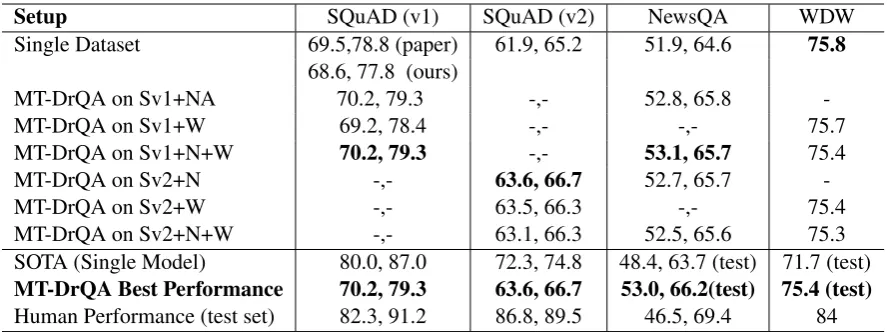
Setup SQuAD (v1) SQuAD (v2) NewsQA WDW Single Dataset 69.5,78.8 (paper) 61.9, 65.2 51.9, 64.6 75.8
68.6, 77.8 (ours)
MT-DrQA on Sv1+NA 70.2, 79.3 -,- 52.8, 65.8 -MT-DrQA on Sv1+W 69.2, 78.4 -,- -,- 75.7 MT-DrQA on Sv1+N+W 70.2, 79.3 -,- 53.1, 65.7 75.4 MT-DrQA on Sv2+N -,- 63.6, 66.7 52.7, 65.7 -MT-DrQA on Sv2+W -,- 63.5, 66.3 -,- 75.4 MT-DrQA on Sv2+N+W -,- 63.1, 66.3 52.5, 65.6 75.3 SOTA (Single Model) 80.0, 87.0 72.3, 74.8 48.4, 63.7 (test) 71.7 (test)
MT-DrQA Best Performance 70.2, 79.3 63.6, 66.7 53.0, 66.2(test) 75.4 (test)
[image:12.595.77.521.61.227.2]Human Performance (test set) 82.3, 91.2 86.8, 89.5 46.5, 69.4 84
Table 9: Single model performance of our method to train DrQA on multi-task setting, as well as state-of-the-art (SOTA) results and human performance. SQuAD and NewsQA performance are measured by (EM, F1), and WDW by accuracy percentage. All results are on development set unless otherwise noted. Published SOTA results come from (Wang et al., 2018a; Hu et al., 2018; Kundu and Ng, 2018; Yang et al., 2016) respectively.
for each candidate C. Recall that nis the length of passage P, and pi is the i-th word; therefore I(pi ∈C)is the indicator function ofpiappears in
candidateC. The candidate with the largest prob-ability is chosen as the predicted answer.
B Experiment Results on DrQA
To demonstrate the flexibility of our approach, we also adapt DrQA (Chen et al., 2017) into our MTL framework. We only test DrQA using the basic Algorithm 2, since our goal is mainly to test the MTL framework.
B.1 Model Architecture
Similar to MT-SAN, we add a highway network after the lexicon encoding layer and the contextual encoding layer and use a different answer module for each dataset. We apply MT-DrQA to a broader range of datasets. For span-detection datasets such as SQuAD, we use the same answer module as DrQA. For cloze-style datasets like Who-Did-What, we use the attention-sum reader (Kadlec et al., 2016) as the answer module. For classifi-cation tasks required by SQuAD v2.0 (Rajpurkar et al., 2018), we apply a softmax to the last state in the memory layer and use it as the prediction.
B.2 Performance of MT-DrQA
We apply MT-DrQA to SQuAD (v1.1 and v2.0), NewsQA, and WDW. We follow the setup of (Chen et al., 2017) for model architecture and hy-perparameter setup. We use Algorithm 1 to train all MT-DrQA models. Different than (Rajpurkar