A Second-Order Joint Eisner Model for Syntactic and Semantic Dependency
Parsing
Xavier Llu´ıs Stefan Bott Llu´ıs M`arquez
TALP Research Center – Software Department (LSI) Technical University of Catalonia (UPC) {xlluis,sbott,lluism}@lsi.upc.edu
Abstract
We present a system developed for the CoNLL-2009 Shared Task (Hajiˇc et al., 2009). We extend the Carreras (2007) parser to jointly annotate syntactic and semantic depen-dencies. This state-of-the-art parser factor-izes the built tree in second-order factors. We include semantic dependencies in the factors and extend their score function to combine syntactic and semantic scores. The parser is coupled with an on-line averaged perceptron (Collins, 2002) as the learning method. Our averaged results for all seven languages are
71.49 macro F1, 79.11 LAS and 63.06
seman-tic F1.
1 Introduction
Systems that jointly annotate syntactic and semantic dependencies were introduced in the past CoNLL-2008 Shared Task (Surdeanu et al., CoNLL-2008). These systems showed promising results and proved the feasibility of a joint syntactic and semantic pars-ing (Henderson et al., 2008; Llu´ıs and M`arquez, 2008).
The Eisner (1996) algorithm and its variants are commonly used in data-driven dependency pars-ing. Improvements of this algorithm presented by McDonald et al. (2006) and Carreras (2007) achieved state-of-the-art performance for English in the CoNLL-2007 Shared Task (Nivre et al., 2007). Johansson and Nugues (2008) presented a sys-tem based on the Carreras’ extension of the Eis-ner algorithm that ranked first in the past CoNLL-2008 Shared Task. We decided to extend the
Car-reras (2007) parser to jointly annotate syntactic and semantic dependencies.
The present year Shared Task has the incentive of being multilingual with each language presenting their own particularities. An interesting particularity is the direct correspondence between syntactic and semantic dependencies provided in Catalan, Spanish and Chinese. We believe that these correspondences can be captured by a joint system. We specially look at the syntactic-semantic alignment of the Catalan and Spanish datasets.
Our system is an extension of the Llu´ıs and M`arquez (2008) CoNLL-2008 Shared Task system. We introduce these two following novelties:
• An extension of the second-order
Car-reras (2007) algorithm to annotate semantic dependencies.
• A combined syntactic-semantic scoring for
Catalan and Spanish to exploit the syntactic-semantic mappings.
The following section outlines the system archi-tecture. The next sections present in more detail the system novelties.
2 Architecture
The architecture consists on four main components: 1) Preprocessing and feature extraction. 2) Syntactic preparsing. 3) Joint syntactic-semantic parsing. 4) Predicate classification.
The preprocessing and feature extraction is in-tended to ease and improve the performance of the parser precomputing a binary representation of
each sentence features. These features are borrowed from existing and widely-known systems (Xue and Palmer, 2004; McDonald et al., 2005; Carreras et al., 2006; Surdeanu et al., 2007).
The following step is a syntactic pre-parse. It is only required to pre-compute additional features (e.g., syntactic path, syntactic frame) from the syn-tax. These new features will be used for the semantic role component of the following joint parser.
The joint parser is the core of the system. This single algorithm computes the complete parse that optimizes a score according to a function that de-pends on both syntax and semantics. Some of the required features that could be unavailable or expen-sive to compute at that time are provided by the pre-vious syntactic pre-parse.
The predicate sense classification is performed as the last step. Therefore no features representing the predicate sense are employed during the training. The predicates are labeled with the most frequent sense extracted from the training corpus.
No further postprocessing is applied.
3 Second-order Eisner model
The Carreras’ extension of the Eisner inference al-gorithm is an expensiveO(n4)parser. The number of assignable labels for each dependency is a hidden multiplying constant in this asymptotic cost.
We begin describing a first-order dependency parser. It receives a sentence x and outputs a de-pendency treey. A dependency, or first-order factor, is defined as f1 = hh, m, li. Whereh is the head token,mthe modifier andlthe syntactic label. The score for this factorf1is computed as:
score1(f1, x,w) =φ(h, m, x)·w(l)
Wherew(l)is the weight vector for the syntactic la-bellandφa feature extraction function.
The parser outputs the best tree y∗ from the set
T(x)of all projective dependency trees.
y∗(x) = argmax
y∈T(x)
X
f1∈y
score(f1, x,w)
The second-order extension decomposes the de-pendency tree in factors that include some children of the head and modifier. A second-order factor is:
f2=hh, m, l, ch, cmo, cmii
where ch is the daughter of h closest to m within
the tokens[h, . . . , m];cmo is the outermost
daugh-ter ofmoutside[h, . . . , m]; and cmiis the furthest
daughter ofminside[h, . . . , m].
The score for these new factors is computed by
score2(f2, x,w) =φ(h, m, x)·w(l)+ φ(h, m, ch, x)·w(clh)+
φ(h, m, cmi, x)·w(clmi) +
φ(h, m, cmo, x)·wc(lmo)
The parser builds the best-scoring projective tree factorized in second-order factors. The score of the tree is also defined as the sum of the score of its factors.
3.1 Joint second-order model
We proceeded in an analogous way in which the Llu´ıs and M`arquez (2008) extended the first-order parser. That previous work extended a first-order model by including semantic labels in first-order de-pendencies.
Now we define a second-order joint factor as:
f2syn-sem=
h, m, l, ch, cmo, cmi, lsemp1, . . . , lsempq
Note that we only added a set of semantic labels lsemp1, . . . , lsempq to the second-order factor. Each
one of these semantic labels represent, if any, one semantic relation between the argumentm and the predicatepi. There areqpredicates in the sentence,
labeledp1, . . . , pq.
The corresponding joint score to a given joint fac-tor is computed by adding a semantic score to the previously definedscore2 second-order score func-tion:
score2syn-sem(f2syn-sem, x,w) = score2(f2, x,w) +
X
pi
scoresem(h, m, pi, lsempi, x,w)
q
where,
scoresem(h, m, pi, lsem, x,w) =
We normalize the semantic score by the number of predicatesq. The semantic score is computed as a score betweenmand each sentence predicatepi. No
second-order relations are considered in these score functions. The search of the bestch,cmoandcmiis
independent of the semantic components of the fac-tor. The computational cost of the algorithm is in-creased by one semantic score function call for every m, h, andpi combination. The asymptotic cost of
this operation isO(q·n2)and it is sequentially per-formed among other O(n2) operations in the main loop of the algorithm.
Algorithm 1Extension of the Carreras (2007) algo-rithm
C[s][t][d][m]←0,∀s, t, d, m O[s][t][d][l]←0,∀s, t, d, l
fork= 1, . . . , ndo
fors= 0, . . . , n−kdo t←s+k
∀l O[s][t][←][l] = maxr,cmi,ch
C[s][r][→][cmi] +C[r+ 1][t][←][ch]
+score(t, s, l)+scorecmi(t, s, cmi, l)+
scorech(t, s, l, ch)+
P
pimaxlsemscoresem(t, s, pi, lsem)/q
∀l O[s][t][→][l] = maxr,cmi,ch
C[s][r][→][ch] +C[r+ 1][t][←][cmi]+ score(s, t, l)+scorecmi(s, t, cmi, l)+
scorech(s, t, l, ch)+
P
pimaxlsemscoresem(t, s, pi, lsem)/q
∀m C[s][t][←][m] = maxl,cmo
C[s][m][←][cmo] +O[m][t][←][l]+ scorecmo(s, m, l, cmo)
∀m C[s][t][→][m] = maxl,cmo
O[s][m][→][l] +C[m][t][→][cmo]+ scorecmo(m, t, l, cmo)
end for end for
Our implementation slightly differs from the orig-inal Carreras algorithm description. The main dif-ference is that no specific features are extracted for the second-order factors. This allows us to reuse the feature extraction mechanism of a first-order parser. Algorithm 1 shows the Carreras’ extension of the
Eisner algorithm including our proposed joint se-mantic scoring.
The tokens s and t represent the start and end tokens of the current substring, also called span. The direction d ∈ {←,→} defines whether t or s is the head of the last dependency built inside the span. The score functionsscorech,scorecmiand
scorecmo are the linear functions that build up the previously defined second-order global score, e.g.,
scorech=φ(h, m, ch, x)·w(clh). The two tablesCand
Omaintain the dynamic programming structures. Note that the first steps of the inner loop are ap-plied for alll, the syntactic label, but the semantic score function does not depend onl. Therefore the best semantic label can be chosen independently.
For simplicity, we omitted the weight vectors re-quired in each score function and the backpointers tables to save the local decisions. We also omit-ted the definition of the domain of some variables. Moreover, the filter of the set of assignable labels is not shown. A basic filter regards the POS of the head and modifier to filter out the set of possible ar-guments for each predicate. Another filter extract the set of allowed arguments for each predicate from the frames files. These last filters were applied to the English, German and Chinese.
3.2 Catalan and Spanish joint model
The Catalan and Spanish datasets (Taul´e et al., 2008) present two interesting properties. The first prop-erty, as previously said, is a direct correspondence between syntactic and semantic labels. The second interesting property is that all semantic dependen-cies exactly overlap with the syntactic tree. Thus the semantic dependency between a predicate and an argument always has a matching syntactic depen-dency between a head and a modifier. The Chinese data also contains direct syntactic-semantic map-pings. But due to the Shared Task time constraints we did not implemented a specific parsing method for this language.
The complete overlap between syntax and seman-tics can simplify the definition of a second-order joint factor. In this case, a second-order factor will only have, if any, one semantic dependency. We only allow at most one semantic relation lsem between
lsem is not null. We extend the second-order
fac-tors with a single and possibly null semantic label, i.e.,f2syn-sem =hh, m, l, ch, cmo, cmi, lsemi. This
slightly simplifies the scoring function:
score2syn-sem(f2syn-sem, x,w) = score2(f2, x,w) + α·scoresem(h, m, x,w)
whereαis an adjustable parameter of the model and,
scoresem(h, m, x,w) =φsem(h, m, x)·w(lsem)
The next property that we are intended to exploit is the syntactic-semantic mappings. These map-pings define the allowed combinations of syntactic and semantic labels. The label combinations can only be exploited when there is semantic depen-dency between the headh and the modifiermof a factor. An argument identification classifier deter-mines the presence of a semantic relation, given h is a predicate. In these cases we only generate fac-tors that are compliant with the mappings. If a syn-tactic label has many corresponding semantic labels we will score all of them and select the combination with the highest score.
The computational cost is not significantly in-creased as there is a bounded number of syntactic and semantic combinations to score. In addition, the only one-argument-per-factor constraint reduces the complexity of the algorithm with respect to the pre-vious joint extension.
We found some inconsistencies in the frames files provided by the organizers containing the correspon-dences between syntax and semantics. For this rea-son we extracted them directly from the corpus. The extracted mappings discard the 7.9% of the rect combinations in the Catalan development cor-pus that represent a 1.7% of its correct syntactic de-pendencies. The discarded semantic labels are the 5.14% for Spanish representing the 1.3% of the syn-tactic dependencies.
4 Results and discussion
Table 1 shows the official results for all seven lan-guages, including out-of-domain data labeled as
ood. The high computational cost of the second-order models prevented us from carefully tuning the
system parameters. After the shared task evaluation deadline, some bug were corrected, improving the system performance. The last results are shown in parenthesis.
The combined filters for Catalan and Spanish hurt the parsing due to the discarded correct labels but we believe that this effect is compensated by an im-proved precision in the cases where the correct la-bels are not discarded. For example, in Spanish these filters improved the syntactic LAS from 85.34 to 86.77 on the development corpus using the gold syntactic tree as the pre-parse tree.
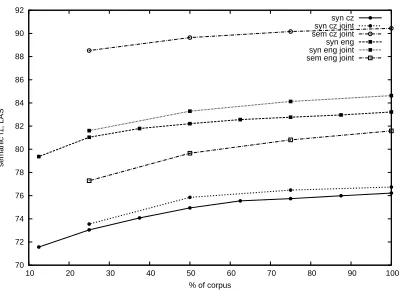
Figure 1 shows the learning curve for the English and Czech language. The results are computed in the development corpus. The semantic score is com-puted using gold syntax and gold predicate sense classification. We restricted the learning curve to the first epoch. Although the this first epoch is very close to the best score, some languages showed im-provements until the fourth epoch. In the figure we can see better syntactic results for the joint system with respect to the syntactic-only parser. We should not consider this improvement completely realistic as the semantic component of the joint system uses gold features (i.e., a gold pre-parse). Nonetheless, it points that a highly accurate semantic component could improve the syntax.
avg cat chi cze eng ger jap spa macro F1 71.49 (74.90) 56.64 (73.21) 66.18 (70.91) 75.95 81.69 72.31 81.76 65.91 (68.46) syn LAS 79.11 (82.22) 64.21(84.20) 70.53 (70.90) 75.00 87.48 81.94 91.55 83.09 (84.48) semantic F1 63.06 (67.41) 46.79 (61.68) 59.72 (70.88) 76.90 75.86 62.66 71.60 47.88 (52.30) ood macro F1 71.92 - - 74.56 73.91 67.30 - -ood syn LAS 75.09 - - 72.11 80.92 72.25 - -ood sem F1 68.74 - - 77.01 66.88 62.34 -
-Table 1: Overall results. In parenthesis post-evaluation results.
[image:5.612.107.507.57.126.2]cat chi cze eng ger jap spa syntax only (s/sentence) 18.39 8.07 3.18 2.56 1.30 1.07 15.31 joint system (s/sentence) 10.91 9.49 3.99 3.13 2.36 1.25 12.29
Table 2: Parsing time per sentence.
70 72 74 76 78 80 82 84 86 88 90 92
10 20 30 40 50 60 70 80 90 100
semanic f1, LAS
% of corpus
syn cz syn cz joint sem cz joint syn eng syn eng joint sem eng joint
Figure 1: Learning curves for the syntactic-only and joint parsers in Czech and English.
5 Conclusion
We have shown that a joint syntactic-semantic parsing can be based on the state-of-the-art Car-reras (2007) parser at an expense of a reasonable cost. Our second-order parser still does not repro-duce the state-of-the art results presented by similar systems (Nivre et al., 2007). Although we achieved mild results we believe that a competitive system based in our model can be built. Further tuning is required and a complete set of new second-order fea-tures should be implemented to improve our parser.
The multilingual condition of the task allows us to evaluate our approach in seven different languages. A detailed language-dependent evaluation can give us some insights about the strengths and weaknesses of our approach across different languages.
Unfor-tunately we believe that this objective was possibly not accomplished due to the time constraints.
The Catalan and Spanish datasets presented in-teresting properties that could be exploited. The mapping between syntax and semantics should be specially useful for a joint system. In addition the semantic dependencies for these languages are aligned with the projective syntactic dependencies, i.e., the predicate-argument pairs exactly match syn-tactic dependencies. This is a useful property to si-multaneously build joint dependencies.
6 Future and ongoing work
Our syntactic and semantic parsers, as many others, is not exempt of bugs. Furthermore, very few tuning and experimentation was done during the develop-ment of our parser due to the Shared Task time con-straints. We believe that we still did not have enough data to fully evaluate our approach. Further exper-imentation is required to asses the improvement of a joint architecture vs. a pipeline architecture. Also a careful analysis of the system across the different languages is to be performed.
Acknowledgments
[image:5.612.90.291.262.408.2]References
Aljoscha Burchardt, Katrin Erk, Anette Frank, Andrea Kowalski, Sebastian Pad´o, and Manfred Pinkal. 2006. The SALSA corpus: a German corpus resource for
lexical semantics. InProceedings of the 5th
Interna-tional Conference on Language Resources and Evalu-ation (LREC-2006), Genoa, Italy.
Xavier Carreras, Mihai Surdeanu, and Llu´ıs M`arquez. 2006. Projective dependency parsing with perceptron. In Proceedings of the 10th Conference on Computa-tional Natural Language Learning (CoNLL-2006). Xavier Carreras. 2007. Experiments with a higher-order
projective dependency parser. InProceedings of the
11th Conference on Computational Natural Language Learning (CoNLL-2007).
Michael Collins. 2002. Discriminative training meth-ods for hidden markov models: Theory and
experi-ments with perceptron algorithms. InProceedings of
the ACL-02 conference on Empirical methods in natu-ral language processing.
Jason M. Eisner. 1996. Three new probabilistic models
for dependency parsing: An exploration. In
Proceed-ings of the 16th International Conference on Compu-tational Linguistics (COLING-96).
Jan Hajiˇc, Jarmila Panevov´a, Eva Hajiˇcov´a, Petr Sgall, Petr Pajas, Jan ˇStˇep´anek, Jiˇr´ı Havelka, Marie Mikulov´a, and Zdenˇek ˇZabokrtsk´y. 2006. Prague De-pendency Treebank 2.0.
Jan Hajiˇc, Massimiliano Ciaramita, Richard Johans-son, Daisuke Kawahara, Maria Ant`onia Mart´ı, Llu´ıs M`arquez, Adam Meyers, Joakim Nivre, Sebastian Pad´o, Jan ˇStˇep´anek, Pavel Straˇn´ak, Mihai Surdeanu, Nianwen Xue, and Yi Zhang. 2009. The CoNLL-2009 shared task: Syntactic and semantic
depen-dencies in multiple languages. In Proceedings of
the 13th Conference on Computational Natural Lan-guage Learning (CoNLL-2009), June 4-5, Boulder, Colorado, USA.
James Henderson, Paola Merlo, Gabriele Musillo, and Ivan Titov. 2008. A latent variable model of syn-chronous parsing for syntactic and semantic
depen-dencies. In Proceedings of the 12th Conference on
Computational Natural Language Learning (CoNLL-2008), Manchester, UK.
Richard Johansson and Pierre Nugues. 2008.
Dependency-based syntactic–semantic analysis
with propbank and nombank. InProceedings of the
12th Conference on Computational Natural Language Learning (CoNLL-2008), Manchester, UK.
Daisuke Kawahara, Sadao Kurohashi, and Kˆoiti Hasida. 2002. Construction of a Japanese relevance-tagged
corpus. In Proceedings of the 3rd International
Conference on Language Resources and Evaluation
(LREC-2002), pages 2008–2013, Las Palmas, Canary Islands.
Xavier Llu´ıs and Llu´ıs M`arquez. 2008. A joint model for parsing syntactic and semantic dependencies. In
Proceedings of the 12th Conference on Computational Natural Language Learning (CoNLL-2008), Manch-ester, UK.
Ryan McDonald and Fernando Pereira. 2006. On-line learning of approximate dependency parsing
algo-rithms. In11th Conference of the European Chapter of
the Association for Computational Linguistics (EACL-2006).
Ryan McDonald, Koby Crammer, and Fernando Pereira. 2005. Online large-margin training of dependency
parsers. InProceedings of the 43rd Annual Meeting of
the Association for Computational Linguistics (ACL-2005).
J. Nivre, J. Hall, S. K¨ubler, R. McDonald, J. Nilsson, S. Riedel, and D. Yuret. 2007. The CoNLL 2007 shared task on dependency parsing.
Martha Palmer and Nianwen Xue. 2009. Adding
seman-tic roles to the Chinese Treebank. Natural Language
Engineering, 15(1):143–172.
Mihai Surdeanu, Llu´ıs M`arquez, Xavier Carreras, and Pere R. Comas. 2007. Combination strategies for
se-mantic role labeling. Journal of Artificial Intelligence
Research.
Mihai Surdeanu, Richard Johansson, Adam Meyers, Llu´ıs M`arquez, and Joakim Nivre. 2008. The CoNLL-2008 shared task on joint parsing of syntactic and
se-mantic dependencies. InProceedings of the 12th
Con-ference on Computational Natural Language Learning (CoNLL-2008).
Mariona Taul´e, Maria Ant`onia Mart´ı, and Marta Re-casens. 2008. AnCora: Multilevel Annotated Corpora
for Catalan and Spanish. In Proceedings of the 6th
International Conference on Language Resources and Evaluation (LREC-2008), Marrakesh, Morroco. Nianwen Xue and Martha Palmer. 2004. Calibrating
fea-tures for semantic role labeling. InProceedings of the