138
An End-to-End Multi-task Learning Model for Fact Checking
Sizhen Li and Shuai Zhao and Bo Cheng
State Key Laboratory of networking and switching technology, Beijing university of posts and telecommunications
Hao Yang
2012 Labs, Huawei Technologies CO., LTD
Abstract
With huge amount of information generated every day on the web, fact checking is an im-portant and challenging task which can help people identify the authenticity of most claims as well as providing evidences selected from knowledge source like Wikipedia. Here we decompose this problem into two parts: an en-tity linking task (retrieving relative Wikipedia pages) and recognizing textual entailment be-tween the claim and selected pages. In this pa-per, we present an end-to-end multi-task learn-ing with bi-direction attention (EMBA) model to classify the claim as “supports”, “refutes” or “not enough info” with respect to the pages retrieved and detect sentences as evidence at the same time. We conduct experiments on the FEVER (Fact Extraction and VERification) paper test dataset and shared task test dataset, a new public dataset for verification against tex-tual sources. Experimental results show that our method achieves comparable performance compared with the baseline system.
1 Introduction
When we got news from newspapers and TVs which was thoroughly investigated and written by professional journalists, most of these messages are well-found and trustworthy. However, with the popularity of the internet, there are 2.5 quintillion bytes of data created each day at our current pace1. Everyone online is a producer as well as a recip-ient of these emerging information, and some of them are incorrect, fabricated or even with some evil purposes. Most time it is difficult for us to figure out the truth of those emerging news with-out professional background and enough investi-gation. Fact checking, which firstly has been pro-duced and received a lot of attention in the
indus-1 https://www.forbes.com/sites/bernardmarr/2018/05/21/how- much-data-do-we-create-every-day-the-mind-blowing-stats-everyone-should-read/#62a15bba60ba
try of journalism, mainly verifying the speeches of public figures, is also important for other domains, e.g. wrong common-sense correction, rumor de-tection, content review etc.
With the increasing demand for automatic claim verification, several datasets for fact checking have been produced in recent years. Vlachos and Riedel (2014) are the first to release a pub-lic fake news detection and fact-checking dataset from two fact checking websites, the fact check-ing blog of Channel 42and the True-O-Meter from PolitiFact3. This dataset only includes 221 state-ments. Similarly, from PolitiFact via its API, Wang (2017) collected LIAR dataset with 12.8K manually labeled short statements, which per-mits machine learning based methods used on this dataset. Both dataset don’t include the original justification and evidence as it was not machine-readable. However, just verifying the claim based on the claim itself and without referring to any ev-idence sources is not reasonable and convincing.
In 2015, Silverman launched the Emergent Project4, a real-time rumor tracker, part of a re-search project with the Tow Center for Digi-tal Journalism5 at Columbia University. Ferreira and Vlachos (2016) firstly proposed to use the data from Emergent Project as Emergent dataset for rumor debunking, which contains 300 ru-mored claims and 2,595 associated news articles. In 2017, the Fake news challenge (Pomerleau
and Rao, 2017) consisted of 50K labeled
claim-article pairs similarly derived from the Emergent Project. These two dataset stemmed from Emer-gent Project alleviate the fact checking task by detecting the relationship between claim-article pairs. However, in more common situation, we
2http://blogs.channel4.com/factcheck/ 3
http://www.politifact.com/truth-o-meter/statements/ 4
are dealing with plenty of claims themselves on-line without associated articles which can help to verify the claims.
Fact Extraction and VERification (FEVER) dataset (Thorne et al., 2018) consists of 185,445 claims manually verified against the introduc-tory sections of Wikipedia pages and classified as SUPPORTED, REFUTED or NOTENOUGH-INFO. For the first two classes, the dataset pro-vides combination of sentences forming the nec-essary evidences supporting or refuting the claim. Obviously, this dataset is more difficult than ex-isting fact-checking datasets. In order to achieve higher FEVER score, a fact-checking system is re-quired to classify the claim correctly as well as retrieving sentences among more than 5 million Wikipedia pages jointed as correct evidence sup-porting the judgement.
The baseline method of this task comprises of three components: document retrieval, sentence-level evidence selection and textual entailment. For the first two retrieval components, the base-line method uses document retrieval component of DrQA (Chen et al.,2017) which only relies on the unigram and bigram TF-IDF with vector similarity and don’t understand semantics of the claim and pages. So, we find that it extracts lots of Wikipedia pages which are unrelated to the entities described in claims. Besides, similarity-based method pre-fer extracting supporting evidences than refuting evidences. For the recognizing textual entailment (RTE) module, on one hand, the previous retrieval results limit the performance of the RTE model. On the other hand, the selected sentences con-catenated as evidences may also confuse the RTE model due to some contradictory information.
In this paper, we introduce an end-to-end multi-task learning with bi-direction attention (EMBA) model for FEVER task. We utilize the multi-task framework to jointly extract evidences and verify the claim because these two sub-tasks can be ac-complished at the same time. For example, after selecting relative pages, we carefully scan these pages to find supporting or refuting evidences. If we find some, the claim can be labeled as SUP-PORTS or REFUTES immediately. If not, the claim will be classified as NOTENOUGHINFO after we read pages completely. Our model is trained on claim-pages pairs by using attention mechanism in both directions, claim-to-pages and pages-to-claim, which provides complimentary
in-formation to each other. We obtain claim-aware sentence representation to predict the correct ev-idence position and the pages-aware claim rep-resentation to detect the relationship between the claim and the pages.
2 Related Work
Natural Language Inference (NLI) or Recognizing textual entailment (RTE) detects the relationship between the premise-hypothesis pairs as “entail-ment”, “contradiction” and “not related”. With the renaissance of neural network (Krizhevsky
et al., 2012;Mikolov et al., 2010; Graves, 2012)
and attention mechanism (Xu et al.,2015;Luong
et al., 2015;Bahdanau et al., 2014), the popular
framework for the RTE is “matching-aggregation”
(Parikh et al., 2016; Wang et al., 2017). Under
this framework, words of two sentences are firstly aligned, and then the aligning results with orig-inal vectors are aggregated into a new represen-tation vector to make the final decision. The at-tention mechanism can empower this framework to capture more interactive features between two sentences. Compared to Fever task, RTE provides the sentence to verify against instead of having to retrieve it from knowledge source.
Another relative task is question answer-ing (QA) and machine readanswer-ing comprehension (MRC), for which approaches have recently been extended to handle large-scale resources such as Wikipedia (Chen et al., 2017). Similar to MRC task which needs to identify the answer span in a passage, FEVER task requires to detect the ev-idence sentences in Wikipedia pages. However, MRC model tends to identify the answer span based on the similarity and reasoning between the question and passage, while similarity-based method is more likely to ignore refuting evidence in pages. For example, a claim stating “Manch-ester by the Sea is distributed globally” can be re-futed by retrieving “It began a limited release on November 18, 2016” as evidence.
3 Model
backward last time-step
forward last time-step
Dense+Softmax
Embedding layer Context embedding layer Attention Matching layer Aggregation layer Output layer
ℎ#" … ℎ$# … ℎ%# ℎ"& … ℎ$' … ℎ('
)ℎ"# )ℎ $
# )ℎ %
# )ℎ
" ' )ℎ
$
' )ℎ % '
*"# *$# *%# *"' *$' *%'
+" … +$ …
…
Dense+Softmax Sentence
Claim Classification
…
…
… …
,
$-Figure 1: An End-to-End Multi-task Learning Model for Fact Checking
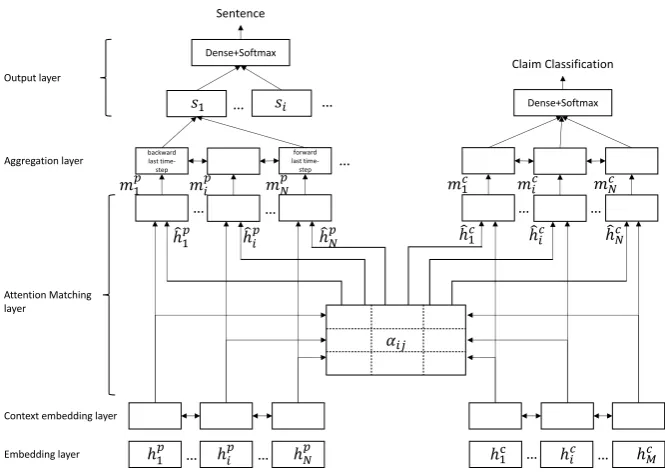
as relative pages. And (2) an end-to-end multi-task learning with bi-direction attention (EMBA) model (in Figure 1) which classify the claim as ”supports”, ”refutes” or ”not enough info” with re-spect to the pages retrieved and select sentences as evidence at the same time.
3.1 Entity Liking
S-MART is a Wikipedia entity linking tool for short and noisy text. For each claim, we use S-MART to retrieve the top 5 entities from Wikipedia. These entity pages are jointed together as the source pages then passed to select correct sentences. For a given claim, S-MART first re-trieves all possible entities of Wikipedia by surface matching, and then ranks them using a statistical model, which is trained on the frequency counts with which the surface form occurs with the en-tity.
3.2 Sentence Extraction and Claim
Verification
We now proceed to identify the correct sentences as evidence from relative pages and try to classify the claim as ”supports”, ”refutes” or ”not enough info” with respect to the pages retrieved at the same time. Inspired by the recent success of at-tention mechanism in NLI (Wang et al.,2017) and MRC (Seo et al.,2016;Tan et al.,2017), we pro-pose an end-to-end multi-task learning with
bi-direction attention (EMBA) model, which exploits both pages-to-claim attention to verify the claim and claim-to-pages attention to predict the evi-dence sentence position respectively. Our model consists of:
Embedding layer: This layer represents each
word in a fixed-size vector with two components: a word embedding and a character-level embed-ding. For word embedding, pre-trained word vec-tors, Glove (Pennington et al.,2014), provides the fixed-size embedding of each word. For character embedding, following Kim (Kim, 2014), charac-ters of each words are embedded into fixed-size embedding, then fed into a Convolutional Neural Network (CNN). The character and word embed-ding vectors are concatenated together and passed to a Highway Network (Srivastava et al., 2015). The output of this layer are two sequences of word vectors of claim and pages.
Context embedding layer: The purpose of this
layer is to incorporate contextual information into the presentation of each word of claim and pas-sage. We utilize a bi-directional LSTM (BiLSTM) on the top of the embedding provided by the pre-vious layers to encode contextual embedding for each word.
Attention matching layer: In this layer, we
[image:3.595.133.466.71.308.2]a shared similarity matrix between the contextual embedding of each word of the claimhci and each word of the pageshpj:
αij =w[hci;h p
j;hci ◦h p
j] (1)
whereαij represents the attention weights on the i-th claim word by j-th pages word, w is a train-able weight vector, ◦ is elementwise multiplica-tion, [;] is vector concatenation across row, and implicit multiplication is matrix multiplication.
Claim-to-pages attentionClaim-to-pages atten-tion represents which claim words are most rele-vant to each word of pages. To obtain attended pages vector, we take αij as the weight of hpj and weighted sum all the contextual embedding of pages:
˜ hj =
N X
i=1
αijhi/ N X
i=1
αij (2)
Finally, we match each contextual embedding with its corresponding attention vector to obtain the claim-aware representation of each word of pages:
mj =W[hj;˜hj;hj◦˜hj] (3)
Pages-to-claim attention Pages-to-claim atten-tion represents which pages words are most rele-vant to each claim word. Similar to claim-to-pages attention, the attended claim vector and the pages-aware representation of each pages word are cal-culated by:
˜ hi =
N X
j=1
αijhj/ N X
j=1
αij (4)
mi=W[hi;˜hi;hi◦h˜i] (5)
Aggregation layer: The input to the
aggrega-tion layer is two sequences of matching vectors, the claim-aware pages word representation and pages-aware claim word representation. The goal of the modeling layer is to capture the interaction among the pages words conditioned on the claim as well as the claim words conditioned on the pas-sage words. This is different from the contextual embedding layer, which captures the interaction among context information independent of match-ing information.
Sentence selection layer: The FEVER task
re-quires the model to retrieve sentences of the pas-sage as evidence to verify the claim. The sentence representationstis obtained by concatenating vec-tors from the last time-step of the previous layer
BiLSTM models output sequences. We calculate the probability distribution of the evidence posi-tion over the whole pages by:
pt=sof tmax(wst) (6)
For this sub-task, the objective function is to min-imize the negative log probabilities of true evi-dence index:
Ls=−
N X
t=1
[ytlogpt+ (1−yt) log(1−pt)] (7)
whereyt ∈0,1denotes a label,yt= 1means the t-th sentence is a correct evidence, otheryt= 0.
Claim verification layer: The input of this
layer is pages-aware claim representation pro-duced from the matching layer and the output is a 3-way classification, predicting whether the claim is SUPPORTED, REFUTED or NOTENOUGH-INFO by the pages. We utilize multiple convolu-tion layers, with the output of 3 for classificaconvolu-tion. We optimize the objective function:
Lc=−
k X
i=1
yilog ˆgi (8)
Where k is the number of claims. yt ∈ 0,1,2 denotes a label, meaning the i-th claim is SUP-PORTED, REFUTED, and NOTENOUGHINFO by the pages respectively.
Training: The model is trained by minimizing
joint objective function:
L=Ls+α∗Lc (9)
whereαis the hyper-parameter for weights of two loss functions.
4 Experiments
In this section, we evaluate our model on FEVER paper test dataset and shared task test dataset.
4.1 Model Details
EMBA Baseline
(paper test) (paper dev)
Evidence Score 30.34 32.57
Label Accuracy 45.06
-Evidence Precision 46.12
-Evidence Recall 42.84
-Evidence F1 44.42
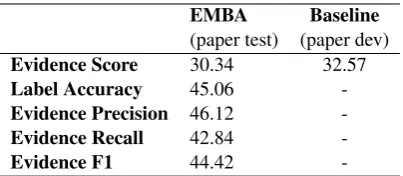
-Table 1: our EMBA model results on the FEVER paper test dataset, Baseline method results on the paper dev dataset.
Evidence F1 Label Accuracy FEVER Score
39.73 45.38 29.22
Table 2: Model results on the FEVER shared task test dataset.
CNN, all LSTM layers, and the linear transforma-tion. The parameters are initialized by the tech-niques described in (Glorot,2010). The max value used for max-norm regularization is 5. TheLcloss weight is set toα= 0.5.
4.2 Experimental Results
We use the official evaluation script6 to compute the evidence F1 score, label accuracy and FEVER score. As shown in Table 1, our method achieves comparable performance on FEVER paper test dataset comparing with the baseline method on FEVER paper dev dataset. The result shows that jointly verifying a claim and retrieving evidences at same time can be as good as pipelined model. Our method results on the FEVER paper shared task test dataset is showed in Table 2. Besides, We calculate and present the confusion matrix of claim classification results on the FEVER paper test dataset in Table 3. Our model isn’t good at identifying the unrelated relationship between claim and pages retrieved. Our model sentence se-lection performance is recorded in Table 4. We can see that our model doesn’t perform well for retrieving evidence. Though with low evidence precision, our model average accuracy without re-quirement to provide correct evidence (51.97%) is similar to 52.09% accuracy of baseline method, which means that claim verification module and the sentence extraction module are relatively inde-pendent in our model.
6https://github.com/sheffieldnlp/fever-baselines
NEI REFUTES SUPPORTS recall
NEI 1285 1432 390 41%
REFUTES 992 1937 155 62.8%
SUPPORTS 942 860 1284 41.6%
[image:5.595.81.283.61.149.2]precision 39.9% 45.8% 70.2%
Table 3: confusion matrix for claim classification. (NEI = “not enough info”)
Evidence Evidence Evidence precision recall F1 SUPPORTS 22.07% 40.08% 28.47%
[image:5.595.308.529.63.119.2]REFUTES 23.8% 45.18% 31.18%
Table 4: sentences retrieval performance.
4.3 Error Analysis
We investigate the predicted results on the paper test dataset and show several error causes as fol-lowings.
Document retrievalWe use entity linking tool
to retrieve relative Wikipedia pages. Some entity mentions in claims are linked incorrectly, hence we cannot obtain the desired pages containing the correct evidence sentences. The S-MART tool re-turned correct entities for 70% claims of paper test dataset. A better entity retrieval method should be researched for the FEVER task.
Pages lengthAfter document retrieval, the
rel-ative pages are concatenated and passed through EMBA model. However, in order to train and pre-dict effectively, the length of the pages is limited to 800 tokens. So, if there are many relative pages and the position of the evidence sentence is near the end of the page, these correct sentences would be cut off.
Evidence composition Some claims require
5 Conclusion
We propose a novel end-to-end multi-task learn-ing with bi-direction attention (EMBA) model to detect sentences as evidence and classify the claim as “supports”, “refutes” or “not enough info” with respect to the pages retrieved at the same time. EMBA uses attention mechanism in both direc-tions to capture interactive features between claim and pages retrieved. Model obtains claim-aware sentence representation to predict the correct ev-idence position and the pages-aware claim rep-resentation to detect the relationship between the claim and the pages. Experimental results on the FEVER paper test dataset show that our approach achieve comparable performance comparing with the baseline method. There are several promis-ing directions that worth researchpromis-ing in the future. For instance, in sentence selection layer, the model just predicts whether a sentence is an evidence. Further, we can try to instantly predict whether a sentence is “supporting”, “refuting” or “not re-lated with” the claim. What’s more, the hyper-parameterαfor joint loss function is fixed. A good value for this parameter can achieve one plus one is greater than two. We can try to learn this param-eter value during training the model.
6 acknowledgement
This work is supported by National Natural Sci-ence Foundation of China (Grant No. 61501048), Beijing Natural Science Foundation (Grant No. 4182042), Fundamental Research Funds for the Central Universities (No. 2017RC12), and National Natural Science Foundation of China (U1536111, U1536112).
References
Dzmitry Bahdanau, Kyunghyun Cho, and Yoshua Ben-gio. 2014. Neural machine translation by jointly learning to align and translate. Computer Science.
Danqi Chen, Adam Fisch, Jason Weston, and An-toine Bordes. 2017. Reading wikipedia to an-swer open-domain questions. arXiv preprint arXiv:1704.00051.
William Ferreira and Andreas Vlachos. 2016. Emer-gent: a novel data-set for stance classification. In
Proceedings of the 2016 conference of the North American chapter of the association for computa-tional linguistics: Human language technologies, pages 1163–1168.
Yoshua Bengio Glorot, Xavier. 2010. Understanding the difficulty of training deep feedforward neural networks. Ininternational conference on artificial intelligence and statistics, pages 249–256.
Alex Graves. 2012. Long Short-Term Memory. Springer Berlin Heidelberg.
Yoon Kim. 2014. Convolutional neural net-works for sentence classification. arXiv preprint arXiv:1408.5882.
Diederik P. Kingma and Jimmy Ba. 2014. Adam: A method for stochastic optimization. Computer Sci-ence.
Alex Krizhevsky, Ilya Sutskever, and Geoffrey E. Hin-ton. 2012. Imagenet classification with deep con-volutional neural networks. In International Con-ference on Neural Information Processing Systems, pages 1097–1105.
Minh Thang Luong, Hieu Pham, and Christopher D Manning. 2015. Effective approaches to attention-based neural machine translation. Computer Sci-ence.
Tomas Mikolov, Martin Karafi´at, Lukas Burget, Jan Cernock´y, and Sanjeev Khudanpur. 2010. Recur-rent neural network based language model. In IN-TERSPEECH 2010, Conference of the International Speech Communication Association, Makuhari, Chiba, Japan, September, pages 1045–1048.
Ankur P Parikh, Oscar T¨ackstr¨om, Dipanjan Das, and Jakob Uszkoreit. 2016. A decomposable attention model for natural language inference. arXiv preprint arXiv:1606.01933.
Jeffrey Pennington, Richard Socher, and Christopher Manning. 2014. Glove: Global vectors for word representation. InProceedings of the 2014 confer-ence on empirical methods in natural language pro-cessing (EMNLP), pages 1532–1543.
Dean Pomerleau and Delip Rao. 2017. Fake News Challenge http://fakenewschallenge.org.
Minjoon Seo, Aniruddha Kembhavi, Ali Farhadi, and Hannaneh Hajishirzi. 2016. Bidirectional attention flow for machine comprehension. arXiv preprint arXiv:1611.01603.
Rupesh Kumar Srivastava, Klaus Greff, and J¨urgen Schmidhuber. 2015. Highway networks. arXiv preprint arXiv:1505.00387.
Chuanqi Tan, Furu Wei, Nan Yang, Bowen Du, Weifeng Lv, and Ming Zhou. 2017. S-net: From answer extraction to answer generation for ma-chine reading comprehension. arXiv preprint arXiv:1706.04815.
Andreas Vlachos and Sebastian Riedel. 2014. Fact checking: Task definition and dataset construction. InProceedings of the ACL 2014 Workshop on Lan-guage Technologies and Computational Social Sci-ence, pages 18–22.
William Yang Wang. 2017. ”liar, liar pants on fire”: A new benchmark dataset for fake news detection. pages 422–426.
Zhiguo Wang, Wael Hamza, and Radu Florian. 2017. Bilateral multi-perspective matching for natural lan-guage sentences.