430
ReWE: Regressing Word Embeddings
for Regularization of Neural Machine Translation Systems
Inigo Jauregi Unanue1,2, Ehsan Zare Borzeshi∗,2, Nazanin Esmaili2, Massimo Piccardi1 1University of Technology Sydney, Sydney, Australia
2 Capital Markets Cooperative Research Centre, Sydney, Australia
{ijauregi,ezborzeshi,nesmaili}@cmcrc.com [email protected]
Abstract
Regularization of neural machine translation is still a significant problem, especially in low-resource settings. To mollify this prob-lem, we propose regressing word embeddings (ReWE) as a new regularization technique in a system that is jointly trained to predict the next word in the translation (categorical value) and its word embedding (continuous value). Such a joint training allows the proposed sys-tem to learn the distributional properties rep-resented by the word embeddings, empirically improving the generalization to unseen sen-tences. Experiments over three translation datasets have showed a consistent improve-ment over a strong baseline, ranging between
0.91and2.54BLEU points, and also a marked improvement over a state-of-the-art system.
1 Introduction
The last few years have witnessed remarkable improvements in the performance of machine translation (MT) systems. These improvements are strongly linked to the development of neu-ral machine translation (NMT): based on encoder-decoder architectures (also known as seq2seq), NMT can use recurrent neural networks (RNNs) (Sutskever et al.,2014;Cho et al.,2014;Wu et al.,
2016), convolutional neural networks (CNNs) (Gehring et al., 2017) or transformers (Vaswani et al.,2017) to learn how to map a sentence from the source language to an adequate translation in the target language. In addition, attention mecha-nisms (Bahdanau et al.,2015;Luong et al.,2015) help soft-align the encoded source words with the predictions, further improving the translation.
NMT systems are usually trained via maxi-mum likelihood estimation (MLE). However, as
∗
∗ The author has changed affiliation to Microsoft af-ter the completion of this work. His new email is: [email protected]
LSTM
sj Linear Softmax
ReWE
...
s_dim
vocab_dim
word_emb_dim
pj
[image:1.595.320.509.223.333.2]ej Decoder
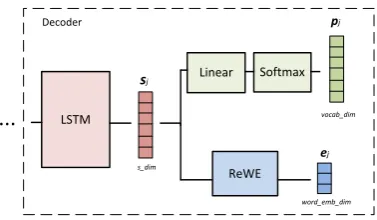
Figure 1: The proposed regularizer: the hidden vec-tor in the decoder,sj, transits through two paths: 1)
a linear and a softmax layers that output vectorvj
(vo-cab dim) which is used for predicting the target word as usual, and 2) a two-layer network (ReWE) that outputs a vector,ej, of word embedding size (word emb dim).
During training,ejis used in a regressive loss with the
ground-truth embedding.
pointed out by (Elbayad et al., 2018), MLE suf-fers from two obvious limitations: the first is that it treats all the predictions other than the ground truth as equally incorrect. As a consequence, syn-onyms and semantically-similar words — which are often regarded as highly interchangeable with the ground truth — are completely ignored dur-ing traindur-ing. The second limitation is that MLE-trained systems suffer from “exposure bias” ( Ben-gio et al., 2015; Ranzato et al., 2015) and do not generalize well over the large output space of translations. Owing to these limitations, NMT systems still struggle to outperform other tradi-tional MT approaches when the amount of super-vised data is limited (Koehn and Knowles,2017).
usual, and b) regress its word embedding (numer-ical value). Figure1shows the modified decoder. Both predictions are incorporated in the training objective, combining standard MLE with a con-tinuous loss function based on word embeddings. The rationale is to encourage the system to learn to co-predict the next word together with its context (by means of the word embedding representation), in the hope of achieving improved generalization. At inference time, the system operates as a stan-dard NMT system, retaining the categorical pre-diction and ignoring the predicted embedding. We qualify our proposal as a regularization technique since, like any other regularizers, it only aims to influence the model’s training, while leaving the inference unchanged. We have evaluated the pro-posed system over three translation datasets of dif-ferent size, namely English-French (en-fr), Czech-English (cs-en), and Basque-Czech-English (eu-en). In each case, ReWE has significantly outperformed its baseline, with a marked improvement of up to 2.54 BLEU points for eu-en, and consistently out-performed a state-of-the-art system (Denkowski and Neubig,2017).
2 Related work
A substantial literature has been devoted to im-proving the generalization of NMT systems. Fadaee et al. (2017) have proposed a data augmen-tation approach for low-resource settings that gen-erates synthetic sentence pairs by replacing words in the original training sentences with rare words. Kudo (2018) has trained an NMT model with dif-ferent subword segmentations to enhance its ro-bustness, achieving consistent improvements over low-resource and out-of-domain settings. Zhang et al. (2018) have presented a novel regulariza-tion method that encourages target-bidirecregulariza-tional agreement. Other work has proposed improve-ments over the use of a single ground truth for training: Ma et al. (2018) have augmented the conventional seq2seq model with a bag-of-words loss under the assumption that the space of cor-rect translations share similar bag-of-words vec-tors, achieving promising results on a Chinese-English translation dataset; Elbayad et al. (2018) have used sentence-level and token-level reward distributions to “smooth” the single ground truth. Chousa et al. (2018) have similarly leveraged a token-level smoother.
In a recent paper, Denkowski and Neubig
(2017) have achieved state-of-the-art translation accuracy by leveraging a variety of techniques which include: dropout (Srivastava et al., 2014), lexicon bias (Arthur et al., 2016), pre-translation (Niehues et al., 2016), data bootstrapping (Chen et al., 2016), byte-pair encoding (Sennrich et al.,
2016) and ensembles of independent models (Rokach,2010).
However, to our knowledge none of the men-tioned approaches have explicitly attempted to leverage the embeddings of the ground-truth to-kens as targets. For this reason, in this paper we explore regressing toward pre-trained word em-beddings as an attempt to capture contextual prop-erties and achieve improved model regularization.
3 Model
3.1 Seq2seq baseline
The model is a standard NMT model with atten-tion in which we use RNNs for the encoder and de-coder. Following the notation of (Bahdanau et al.,
2015), the RNN in the decoder generates a se-quence of hidden vectors,{s1, . . . ,sm}, given the
context vector, the previous hidden statesj−1 and
the previous predicted wordyj−1:
sj =decrnn(sj−1,yj−1,cj) j= 1, . . . , m (1)
wherey0ands0are initializations for the state and
label chains. Each hidden vectorsj (of parameter
sizeS) is then linearly transformed into a vector of vocabulary size,V, and a softmax layer converts it into a vector of probabilities (Eq. 2), whereW
(a matrix of size V ×S) and b (a vector of size
V ×1) are learnable parameters. The predicted conditional probability distribution over the words in the target vocabulary,pj, is given as:
pj =sof tmax(Wsj+b) (2)
As usual, training attempts to minimize the neg-ative log-likelihood (NLL), defined as:
N LLloss=− m
X
j=1
log(pj(yj)) (3)
3.2 ReWE
Pre-trained word embeddings (Pennington et al.,
2014; Bojanowski et al., 2017; Mikolov et al.,
2013) capture the contextual similarities of words, typically by maximizing the probability of word
wt+k to occur in the context of center word wt.
This probability can be expressed as:
p(wt+k|wt), −c≤k≤c, k6= 0 t= 1, . . . , T (4)
wherecis the size of the context andT is the total number of words in the training set. Traditionally, word embeddings have only been used as input representations. In this paper, we instead propose using them in output as part of the training objec-tive, in the hope of achieving regularization and improving prediction accuracy. Building upon the baseline model presented in Section3.1, we have designed a new “joint learning” setting: our de-coder still predicts the probability distribution over the vocabulary, pj (Eq. 2), while simultaneously regressing the same sharedsj to the ground-truth
word embedding,e(yj). The ReWE module con-sists of two linear layers with a Rectified Linear Unit (ReLU) in between, outputting a vectorej of
word embedding size (Eq. 5). Please note that adding this extra module adds negligible compu-tational costs and training time. Full details of this module are given in the supplementary material.
ej =ReW E(sj)
=W2(ReLU(W1sj+b1)) +b2
(5)
The training objective is a numerical loss,l(Eq.
6), computed between the output vector, ej, and
the ground-truth embedding,e(yj):
ReW Eloss =l(ej, e(yj)) (6)
In the experiment, we have explored two cases for the ReW Eloss: the minimum square error (MSE)1 and the cosine embedding loss (CEL)2. Finally, theN LLlossand theReW Elossare
com-bined to form the training objective using a posi-tive trade-off coefficient,λ:
Loss=N LLloss+λReW Eloss (7)
As mentioned in the Introduction, at inference time we ignore the ReWE output, ej, and the
model operates as a standard NMT system.
1
https://pytorch.org/docs/stable/nn.html#torch.nn. MSELoss
2https://pytorch.org/docs/stable/nn.html#torch.nn.
CosineEmbeddingLoss
Dataset Size Sources
IWSLT16 en-fr 219,777 TED talks IWSLT16 cs-en 114,243 TED talks WMT16 eu-en 89,413 IT-domain data
Dataset Validation set Test set
[image:3.595.324.508.61.149.2]en-fr TED test 2013+2014 TED test 2015+2016 cs-en TED test 2012+2013 TED test 2015+2016 eu-en Sub-sample of PaCo IT-domain test
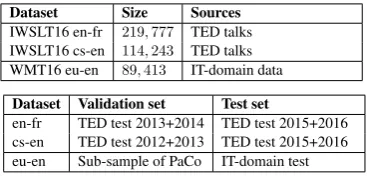
Table 1: Top: parallel training data. Bottom: validation and test sets.
4 Experiments
We have developed our models building upon the OpenNMT toolkit (Klein et al.,2017)3. For train-ing, we have used the same settings as (Denkowski and Neubig,2017). We have also explored the use of sub-word units learned with byte pair encoding (BPE) (Sennrich et al.,2016). All the preprocess-ing steps, hyperparameter values and trainpreprocess-ing pa-rameters are described in detail in the supplemen-tary material to ease reproducibility of our results. We have evaluated these systems over three publicly-available datasets from the 2016 ACL Conference on Machine Translation (WMT16)4 and the 2016 International Workshop on Spoken Language Translation (IWSLT16)5. Table1 lists the datasets and their main features. Despite hav-ing nearly 90,000 parallel sentences, the eu-en dataset only contains 2,000 human-translated sen-tences; the others are translations of Wikipedia page titles and localization files. Therefore, we regard the eu-en dataset as very low-resource.
In addition to the seq2seq baseline, we have compared our results with those recently reported by Denkowski and Neubig for non-ensemble mod-els (2017). For all models, we report the BLEU scores (Papineni et al., 2002), with the addition of selected comparative examples. Two con-trastive experiments are also added in supplemen-tary notes.
4.1 Results
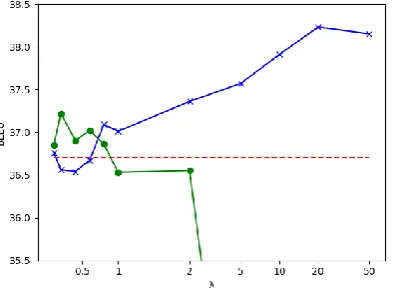
As a preliminary experiment, we have carried out a sensitivity analysis to determine the optimal value of the trade-off coefficient, λ(Eq. 6), using the en-fr validation set. The results are shown in Fig-ure2, where each point is the average of three runs trained with different seeds. The figure shows that
3
Our code can be found at: https://github.com/ijauregiCMCRC/ReWE NMT
4
WMT16: http://www.statmt.org/wmt16/
Models en-fr cs-en eu-en Word BPE Word BPE Word BPE (Denkowski and Neubig,2017) 33.60 34.50 21.00 22.60
(Denkowski and Neubig,2017) + Dropout 34.5 34.70 21.4 23.60 (Denkowski and Neubig,2017) + Lexicon 33.9 34.80 20.6 22.70 (Denkowski and Neubig,2017) + Pre-translation N/A 34.90 N/A 23.80 (Denkowski and Neubig,2017) + Bootstrapping 34.40 35.20 21.60 23.60
[image:4.595.114.484.62.163.2]Our baseline 34.16 34.09 20.57 22.69 12.14 17.17 Our baseline + ReWE (CEL) (λ= 20) 35.52 35.22 21.83 23.60 13.73 19.71
Table 2: BLEU scores over the test sets. Average of 10 models independently trained with different seeds.
Figure 2: BLEU scores of three models over the en-fr validation set for differentλvalues: baseline (red,
dashed), baseline + ReWE (MSE) (green,•), baseline
+ ReWE (CEL) (blue,×). Each point in the graph is an average of 3 independently trained models.
the MSE loss has outperformed slightly the base-line for small values of λ (< 1), but the BLEU score has dropped drastically for larger values. Conversely, the CEL loss has increased steadily withλ, reaching38.23BLEU points forλ= 20, with a marked improvement of 1.53 points over the baseline. This result has been encouraging and therefore for the rest of the experiments we have used CEL as theReW Elossand kept the value of
λto20. In Section4.3, we further discuss the be-havior of CEL and MSE.
Table 2 reports the results of the main ment for all datasets. The values of our experi-ments are for blind runs over the test sets, averaged over10independent runs with different seeds. The results show that adding ReWE has significantly improved the baseline in all cases, with an aver-age of1.46BLEU points. In the case of the eu-en dataset, the improvement has reached2.54BLEU points. We have also run unpaired t-tests between our baseline and ReWE, and the differences have proved statistically significant (p-values < 0.05) in all cases. Using BPE has proved beneficial for the cs-en and eu-en pairs, but not for the en-fr
Src: Hautatu Kontrol panela → Programa lehenetsiak , eta aldatu bertan .
Ref: Go to Control Panel → Default pro-grams, and change it there .
Baseline: Select the Control Panel →program, and change .
Baseline + ReWE: Select the Control Panel→Default Pro-gram, and changeit.
Table 3: Translation example from the eu-en test set.
pair. We speculate that English and French may be closer to each other at word level and, there-fore, less likely to benefit from the use of sub-word units. Conversely, Czech and Basque are morpho-logically very rich, justifying the improvements with BPE.
Table 2also shows that our model has outper-formed almost all the state-of-the-art results re-ported in (Denkowski and Neubig,2017) (dropout, lexicon bias, pre-translation, and bootstrapping), with the only exception of the pre-translation case for the cs-en pair with BPE. This shows that the proposed model is competitive with contemporary NMT techniques.
4.2 Qualitative comparison
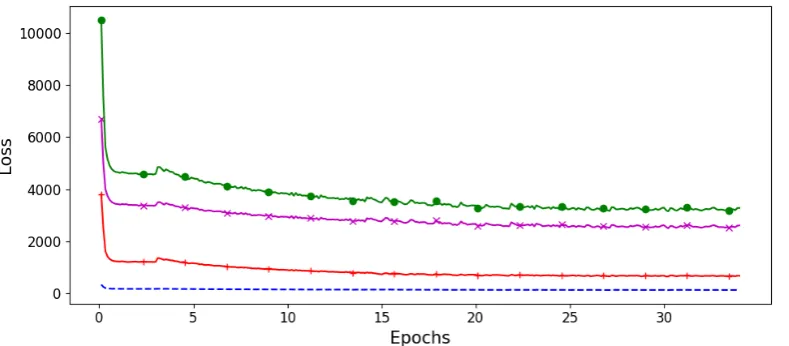
[image:4.595.82.281.201.345.2]Figure 3: Plot of the values of various loss functions during training of our model over the en-fr training set:green,
•: training loss (NLL + (λ = 20) ReWE (CEL); Eq.7); red,+: NLL loss; blue, dashed: ReWE (CEL) loss;
magenta,×: ReWE (CEL) loss scaled byλ= 20. Each point in the graph is an average value of the corresponding loss over 25,000 sentences.
4.3 Discussion
To further explore the behaviour of the ReWE loss, Figure3 plots the values of the NLL and ReWE (CEL) losses during training of our model over the en-fr training set. The natural values of the ReWE (CEL) loss (blue, dashed) are much lower than those of the NLL loss (red,+), and thus its contribution to the gradient is likely to be limited. However, when scaled up by a factor of λ = 20
(magenta, ×), its influence on the gradient be-comes more marked. Empirically, both the NLL and ReWE (CEL) losses decrease as the training progresses and the total loss (green,•) decreases. As shown in the results, this combined training ob-jective has been able to lead to improved transla-tion results.
Conversely, the MSE loss has not exhibited a similarly smooth behaviour (supplementary mate-rial). Even when brought to scale with the NLL loss, it shows much larger fluctuations as the traing progresses. In particular, it shows major in-creases at the re-starts of the optimizer for the sim-ulated annealing that are not compensated for by the rest of the training. It is easy to speculate that the MSE loss is much more sensitive than the co-sine distance to the changes in the weights caused by dropout and the re-starts. As such, it seems less suited for use as training objective.
5 Conclusion
In this paper, we have proposed a new regulariza-tion technique for NMT (ReWE) based on a joint
learning setting in which a seq2seq model simul-taneously learns to a) predict the next word in the translation and b) regress toward its word embed-ding. The results over three parallel corpora have shown that ReWE has consistently improved over both its baseline and recent state-of-the-art results from the literature. As future work, we plan to ex-tend our experiments to better understand the po-tential of the proposed regularizer, in particular for unsupervised NMT (Artetxe et al.,2018;Lample et al.,2018).
Acknowledgments
We would like to acknowledge the financial sup-port received from the Capital Markets Coopera-tive Research Centre (CMCRC), an industry-led research initiative of the Australian Government. We would also like to thank Ben Hachey, Michael Nolan and Nadia Shnier for their careful reading of our paper and their insightful comments. Fi-nally, we are grateful to the anonymous reviewers for all their comments and suggestions.
References
Mikel Artetxe, Gorka Labaka, Eneko Agirre, and Kyunghyun Cho. 2018. Unsupervised neural ma-chine translation. In International Conference on Learning Representations.
Meth-ods in Natural Language Processing, pages 1557– 1567.
Dzmitry Bahdanau, Kyunghyun Cho, and Yoshua Ben-gio. 2015. Neural machine translation by jointly learning to align and translate. InInternational Con-ference on Learning Representations.
Samy Bengio, Oriol Vinyals, Navdeep Jaitly, and Noam Shazeer. 2015. Scheduled sampling for se-quence prediction with recurrent neural networks. InAdvances in Neural Information Processing Sys-tems, pages 1171–1179.
Piotr Bojanowski, Edouard Grave, Armand Joulin, and Tomas Mikolov. 2017. Enriching word vectors with subword information. Transactions of the Associa-tion for ComputaAssocia-tional Linguistics, pages 135–146.
Wenhu Chen, Evgeny Matusov, Shahram Khadivi, and Jan-Thorsten Peter. 2016. Guided alignment training for topic-aware neural machine translation.
arXiv preprint arXiv:1607.01628.
Kyunghyun Cho, Bart Van Merri¨enboer, Caglar Gul-cehre, Dzmitry Bahdanau, Fethi Bougares, Holger Schwenk, and Yoshua Bengio. 2014. Learning phrase representations using rnn encoder-decoder for statistical machine translation. In Empirical Methods in Natural Language Processing, pages 1724–1734.
Katsuki Chousa, Katsuhito Sudoh, and Satoshi Naka-mura. 2018. Training neural machine translation using word embedding-based loss. arXiv preprint arXiv:1807.11219.
Michael Denkowski and Graham Neubig. 2017. Stronger baselines for trustable results in neural ma-chine translation. InProceedings of the First Work-shop on Neural Machine Translation, pages 18–27. Empirical Methods in Natural Language Processing.
Maha Elbayad, Laurent Besacier, and Jakob Verbeek. 2018. Token-level and sequence-level loss smooth-ing for rnn language models. InProceedings of the 56th Annual Meeting of the Association for Compu-tational Linguistics, pages 2094–2103.
Marzieh Fadaee, Arianna Bisazza, and Christof Monz. 2017. Data augmentation for low-resource neural machine translation. InProceedings of the 55th An-nual Meeting of the Association for Computational Linguistics, pages 567–573.
Jonas Gehring, Michael Auli, David Grangier, and Yann N Dauphin. 2017. A convolutional encoder model for neural machine translation. In Proceed-ings of the 55th Annual Meeting of the Association for Computational Linguistics, pages 123–135.
Guillaume Klein, Yoon Kim, Yuntian Deng, Jean Senellart, and Alexander M Rush. 2017. Opennmt: Open-source toolkit for neural machine translation.
arXiv preprint arXiv:1701.02810.
Philipp Koehn and Rebecca Knowles. 2017. Six chal-lenges for neural machine translation. In Pro-ceedings of the First Workshop on Neural Machine Translation, pages 28–39. Association for Compu-tational Linguistics.
Taku Kudo. 2018. Subword regularization: Improv-ing neural network translation models with multiple subword candidates. InProceedings of the 56th An-nual Meeting of the Association for Computational Linguistics, pages 66–75.
Guillaume Lample, Myle Ott, Alexis Conneau, Lu-dovic Denoyer, and Marc’Aurelio Ranzato. 2018. Phrase-based & neural unsupervised machine trans-lation. Empirical Methods in Natural Language Processing, pages 5039–5049.
Minh-Thang Luong, Hieu Pham, and Christopher D Manning. 2015. Effective approaches to attention-based neural machine translation. In Empirical Methods in Natural Language Processing, pages 1412–1421.
Shuming Ma, Xu Sun, Yizhong Wang, and Junyang Lin. 2018. Bag-of-words as target for neural ma-chine translation. InProceedings of the 56th Annual Meeting of the Association for Computational Lin-guistics, pages 332–338.
Tomas Mikolov, Ilya Sutskever, Kai Chen, Greg S Cor-rado, and Jeff Dean. 2013. Distributed representa-tions of words and phrases and their compositional-ity. InAdvances in Neural Information Processing Systems, pages 3111–3119.
Jan Niehues, Eunah Cho, Thanh-Le Ha, and Alex Waibel. 2016. Pre-translation for neural machine translation.arXiv preprint arXiv:1610.05243.
Kishore Papineni, Salim Roukos, Todd Ward, and Wei-Jing Zhu. 2002. Bleu: a method for automatic eval-uation of machine translation. In Proceedings of the 40th annual meeting on association for compu-tational linguistics.
Jeffrey Pennington, Richard Socher, and Christopher Manning. 2014. Glove: Global vectors for word representation. In Empirical Methods in Natural Language Processing, pages 1532–1543.
Marc’Aurelio Ranzato, Sumit Chopra, Michael Auli, and Wojciech Zaremba. 2015. Sequence level train-ing with recurrent neural networks. InAdvances in Neural Information Processing Systems.
Lior Rokach. 2010. Ensemble-based classifiers. Artifi-cial Intelligence Review, 33(1-2):1–39.
Nitish Srivastava, Geoffrey Hinton, Alex Krizhevsky, Ilya Sutskever, and Ruslan Salakhutdinov. 2014. Dropout: a simple way to prevent neural networks from overfitting. The Journal of Machine Learning Research, 15(1):1929–1958.
Ilya Sutskever, Oriol Vinyals, and Quoc V Le. 2014. Sequence to sequence learning with neural net-works. InAdvances in neural information process-ing systems, pages 3104–3112.
Ashish Vaswani, Noam Shazeer, Niki Parmar, Jakob Uszkoreit, Llion Jones, Aidan N Gomez, Ł ukasz Kaiser, and Illia Polosukhin. 2017. Attention is all you need. InAdvances in Neural Information Pro-cessing Systems, pages 5998–6008.
Yonghui Wu, Mike Schuster, Zhifeng Chen, Quoc V Le, Mohammad Norouzi, Wolfgang Macherey, Maxim Krikun, Yuan Cao, Qin Gao, Klaus Macherey, et al. 2016. Google’s neural ma-chine translation system: Bridging the gap between human and machine translation. arXiv preprint arXiv:1609.08144.