• No results found

The emergence of number and syntax units in LSTM language models

N/A
N/A
Protected

Academic year: 2020

Share "The emergence of number and syntax units in LSTM language models"

Copied!
10
0
0

Loading.... (view fulltext now)

Full text

(1)

11

The Emergence of Number and Syntax Units in LSTM Language Models

Yair Lakretz

Cognitive Neuroimaging Unit NeuroSpin center 91191, Gif-sur-Yvette, France [email protected]

German Kruszewski Facebook AI Research

Paris, France [email protected]

Theo Desbordes Facebook AI Research

Paris, France [email protected]

Dieuwke Hupkes ILLC, University of Amsterdam

Amsterdam, Netherlands [email protected]

Stanislas Dehaene Cognitive Neuroimaging Unit

NeuroSpin center 91191, Gif-sur-Yvette, France [email protected]

Marco Baroni Facebook AI Research

Paris, France [email protected]

Abstract

Recent work has shown that LSTMs trained on a generic language modeling objective capture syntax-sensitive generalizations such as long-distance number agreement. We have however no mechanistic understanding of how they ac-complish this remarkable feat. Some have conjectured it depends on heuristics that do not truly take hierarchical structure into account. We present here a detailed study of the inner mechanics of number tracking in LSTMs at the single neuron level. We discover that long-distance number information is largely man-aged by two “number units”. Importantly, the behaviour of these units is partially controlled by other units independently shown to track syntactic structure. We conclude that LSTMs are, to some extent, implementing genuinely syntactic processing mechanisms, paving the way to a more general understanding of gram-matical encoding in LSTMs.

1 Introduction

In the last years, recurrent neural networks (RNNs), and particularly long-short-term-memory (LSTM) architectures (Hochreiter and

Schmidhu-ber, 1997), have been successfully applied to a variety of NLP tasks. This has spurred interest in whether these generic sequence-processing de-vices are discovering genuine structural properties of language in their training data, or whether their success can be explained by opportunistic surface-pattern-based heuristics.

Until now, this debate has mostly relied on “behavioural” evidence: The LSTM had been treated as a black box, and its capacities had been indirectly inferred by its performance on linguistic tasks. In this study, we took a com-plementary approach inspired by neuroscience: We thoroughly investigated the inner dynamics of an LSTM language model performing a number agreement task, striving to achieve a mechanis-tic understanding of how it accomplishes it. We found that the LSTM had specialized two “grand-mother” cells (Bowers,2009) to carry number fea-tures from the subject to the verb across the in-tervening material.1 Interestingly, the LSTM also

(2)

possesses a more distributed mechanism to predict number when subject and verb are close, with the grandmother number cells only playing a crucial role in more difficult long-distance cases. Cru-cially, we independently identified a set of cells tracking syntactic structure, and found that one of them encodes the presence of an embedded phrase separating the main subject-verb depen-dency, and has strong efferent connections to the long-distance number cells, suggesting that the network relies on genuine syntactic information to regulate agreement-feature percolation.

Our analysis thus provides direct evidence for the claim that LSTMs trained on unannotated cor-pus data, despite lacking significant linguistic pri-ors, learn to perform structure-dependent linguis-tic operations. In turn, this suggests that raw lin-guistic input and generic memory mechanisms, such as those implemented in LSTMs, may suffice to trigger the induction of non-trivial grammatical rules.

2 Related Work

Starting with the seminal work of Linzen et al. (2016), a long-distance number agreement task has emerged as a standard way to probe the syn-tactic capabilities of neural language models. In the number agreement task, a model is asked to predict the verb in a sentence where the subject and main verb are separated by one or more inter-vening nouns (“theboy near thecars greets. . . ”) and evaluated based on how often it predicts the right verb form.

Following mixed initial results by Linzen and colleagues andBernardy and Lappin(2017), Gu-lordava et al. (2018) and Kuncoro et al. (2018b) have robustly established that LSTM language models achieve near-human performance on the agreement task. While Gulordava and colleagues provided some evidence that the LSTMs are re-lying on genuine syntactic generalizations, Kun-coro et al.(2018a) andLinzen and Leonard(2018) suggested that the LSTM achievements can, at least in part, be accounted by superficial heuristics (e.g., “percolate the number of the first noun in a sentence”). Other recent work has extended syn-tax probing to other phenomena such as negative polarity items and island constraints (Chowdhury and Zamparelli,2018;Jumelet and Hupkes,2018; Marvin and Linzen,2018;Wilcox et al.,2018).

While Linzen et al. (2016) presented

intrigu-ing qualitative data showintrigu-ing cells that track gram-matical number in a network directly trained on the agreement task, most of the following work focused on testing the network output behaviour, rather than on understanding how the latter fol-lows from the inner representations of the net-work. Another research line studied linguistic processing in neural networks through ‘diagnos-tic classifiers’, that is, classifiers trained to predict a certain property from network activations (e.g., Gelderloos and Chrupała,2016;Adi et al.,2017; Alain and Bengio, 2017; Hupkes et al., 2018). This approach may give insight into which infor-mation is encoded by the network in different lay-ers or at different time points, but it only provides indirect evidence about the specific mechanics of linguistic processing in the network.

Other studies are closer to our approach in that they attempt to attribute function to spe-cific network cells, often by means of visual-ization (Karpathy et al., 2016; Li et al., 2016; Tang et al., 2017). Radford et al. (2017), for example, detected a “sentiment” grandmother cell in a language-model-trained network. Ke-mentchedjhieva and Lopez(2018) recently found a character-level RNN to track morpheme bound-aries in a single cell. We are however not aware of others studies systematically characterizing the processing of a linguistic phenomenon at the level of RNN cell dynamics, as is the attempt in the study hereby presented.

3 Setup

Language Model We study the pretrained LSTM language model made available by Gu-lordava et al. (2018). This model is composed of a dimensional embedding layer, two 650-dimensional hidden layers, and an output layer with vocabulary size 50,000. The model was trained on Wikipedia data, without fine-tuning for number agreement, and obtained perplexity close to state of the art in the experiments of Gulordava et al.2

Number-Agreement Tasks We complement analysis of the naturalistic, corpus-derived number-agreement test set ofLinzen et al.(2016), in the version made available byGulordava et al. (2018), with synthetically generated data-sets.

(3)

Simple theboy greetsthe guy

Adv theboyprobablygreetsthe guy

2Adv theboymost probablygreetsthe guy

CoAdv theboyopenly and deliberatelygreetsthe guy

NamePP theboynear Patgreetsthe guy

NounPP theboynear the cargreetsthe guy

NounPPAdvtheboynear the car kindlygreetsthe guy

Table 1: NA tasks illustrated by representative singular sentences.

Each synthetic number-agreement task (NA-task) instantiates a fixed syntactic structure with varied lexical material, in order to probe subject-verb number agreement in controlled and increasingly challenging setups.3 The different structures are illustrated in Table 1, where all forms are in the singular. Distinct sentences were randomly generated by selecting words from pools of 20 subject/object nouns, 15 verbs, 10 adverbs, 5 prepositions, 10 proper nouns and 10 location nouns. The items were selected so that their combination would not lead to semantic anoma-lies. For each NA-task, we generated singular and plural versions of each sentence. We refer to each such version as a condition. For NA-tasks that have other nouns occurring between subject and main verb, we also systematically vary their number, resulting in two congruent

and two incongruent conditions. For example, the NounPP sentence in the table illustrates the congruent SS (singular-singular) condition and the corresponding sentence in the incongruent PS (plural-singular) condition is: “the boys near the car greet the guy”. For all NA-tasks, each condition consisted of 600 sentences

Syntactic Depth Data-Set We probed the im-plicit syntax-parsing abilities of the model by test-ing whether its representations predict the syn-tactic depth of the words they process. Follow-ing Nelson et al. (2017), this was operational-ized as predicting the number of open syntactic nodes at each word, given the canonical syntac-tic parse of a sentence. We generated a data-set of sentences with unambiguous but varied syntac-tic structures and annotated them with the number of open nodes at each word. For example: “Ten1

really2 ecstatic3 cousins3 of4 four5 teachers6are2

quickly3laughing4”, where indexes show the

cor-3We exclude, for the time being, agreement across a rel-ative clause, as it comes with the further complication of ac-counting for the extra agreement process taking place inside the relative clause.

responding number of open nodes. Since syntactic depth is naturally correlated with the position of a word in a sentence, we used a data-point sampling strategy to de-correlate these factors. For each length between 2 and 25 words, we randomly gen-erated 300 sentences. From this set, we randomly picked examples uniformly covering all possible position-depth combinations within the 7-12 posi-tion and 3-8 depth ranges. The final data-set con-tains 4,033 positions from 1,303 sentences.4

4 Experiments

To successfully perform the NA-task, the LSTM should: (1) encode and store the grammatical number of the subject; and (2) track the main subject-verb syntactic dependency. The latter in-formation is important for identifying the time period during which subject number should be stored, output and then updated by the network. This section describes the ‘neural circuit’ that en-codes and processes this information in the LSTM.

4.1 Long-Range Number Units

We first tested the performance of the LSTM on the Linzen’s data and on the NA-tasks in Table1. FollowingLinzen et al.(2016) and later work, we computed the likelihood that the LSTM assigns to the main verb of each sentence given the preced-ing context and compared it to the likelihood it as-signs to the wrong verb inflection. Accuracy in a given condition was measured as the proportion of sentences in this condition for which the model as-signed a higher likelihood to the correct verb form than to the wrong one.

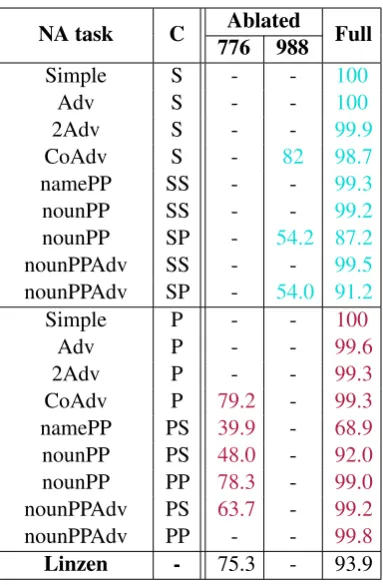
Network performance is reported in Table 2 (right column – ‘Full’). We first note that our results on the Linzen NA-task confirm those re-ported inGulordava et al. (2018). For the other NA-tasks, results show that some tasks and condi-tions are more difficult than others. For example, performance on the Simple (0-distance) NA-task is better than that on the Co-Adv NA-task, which in turn is better than that of the nounPP tasks. Second, as expected, incongruent conditions (the number-mismatch conditions of namePP, nounPP and nounPPAdv) reduce network performance.

4All our data-sets are available at: https:

(4)

NA task C Ablated Full 776 988

Simple S - - 100

Adv S - - 100

2Adv S - - 99.9

CoAdv S - 82 98.7

namePP SS - - 99.3

nounPP SS - - 99.2

nounPP SP - 54.2 87.2

nounPPAdv SS - - 99.5

nounPPAdv SP - 54.0 91.2

Simple P - - 100

Adv P - - 99.6

2Adv P - - 99.3

CoAdv P 79.2 - 99.3

namePP PS 39.9 - 68.9

nounPP PS 48.0 - 92.0

nounPP PP 78.3 - 99.0

nounPPAdv PS 63.7 - 99.2

nounPPAdv PP - - 99.8

[image:4.595.86.278.59.352.2]

Linzen - 75.3 - 93.9

Table 2: Ablation-experiments results: Percentage ac-curacy in all NA-tasks. Full: non-ablated model, C: condition, S: singular, P: plural. Pink (dark lines in B&W printing): plural subject, Light blue: singular subject. Performance reduction less than 10% is de-noted by ‘-’.

Third, for long-range dependencies, reliably en-coding singular subject across an interfering noun is more difficult than a plural subject: for both nounPP and nounPPAdv, PS is easier than SP. A possible explanation for this finding is that in En-glish the plural form is almost always more fre-quent than the singular one, as the latter only marks third person singular, whereas the former is identical to the infinitive and other forms. Thus, if the network reverts to unigram probabilities, it will tend to prefer the plural.

Looking for Number Units Through Ablation Number information may be stored in the network in either a local, sparse, or a distributed way, de-pending on the fraction of active units that carry it. We hypothesized that if the network uses a local or sparse coding, meaning that there’s a small set of units that encode number information, then ablat-ing these units would lead to a drastic decrease in performance in the NA-tasks. To test this, we ab-lated each unit of the network, one at a time, by fixing its activation to zero, and tested on the

NA-tasks.

Two units were found to have exceptional ef-fect on network performance (Table 2, 776 and 988 columns).5 Ablating them reduced network performance by more than 10% across various conditions, and, importantly, they were the only units whose ablation consistently brought network performance to around chance level in the more difficult incongruent conditions of the namePP, nounPP and nounPPAdv tasks.

Moreover, the ablation effect depended on the grammatical number of the subject: ablating 776 significantly reduced network performance only if the subject was plural (P, PS or PP condi-tions) and 988 only if the subject was singular (S, SP or SS conditions). In what follows, we will therefore refer to these units as the ‘plural’ and ‘singular’ units, respectively, or long-range (LR) number units when referring to both. Finally, we note that although the Linzen NA-task contained mixed stimuli from many types of conditions, the plural unit was found to have a substantial effect on average on network performance. The singu-lar unit didn’t show a simisingu-lar effect in this case, which highlights the importance of using carefully crafted stimuli, as in the nounPP and nounPPAdv tasks, for understanding network dynamics. Taken together, these results suggest a highly local cod-ing scheme of grammatical number when process-ing long-range dependencies.

Visualizing Gate and Cell-State Dynamics To understand the functioning of the number units, we now look into their gate and state dynam-ics during sentence processing. We focus on the nounPP NA-task, which is the simplest NA-task that includes a long-range dependency with an in-terfering noun, in both SP and PS conditions.

Recall the standard LSTM memory update and output rules (Hochreiter and Schmidhuber,1997):

Ct=ft◦Ct−1+it◦Cet (1) ht=ot◦tanh(Ct), (2)

where ft, it, ot ∈ (0,1) are gating scalars

com-puted by the network, andCet ∈(−1,1)is an up-date candiup-date for cell value.

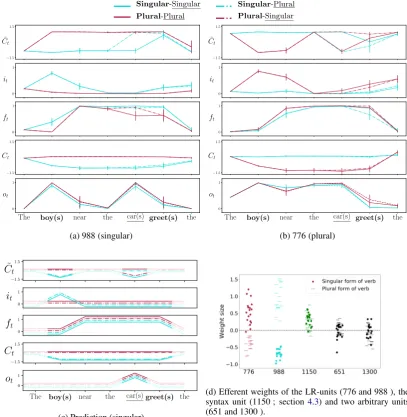
Consider now how a number unit may reliably encode and store subject number across interfer-ing nouns. Figure1cexemplifies this for a singular

(5)

−1.5 1.5

˜

Ct

0 1

it

0 1

ft

−1.5 1.5

Ct

The boy(s) near the car(s) greet(s) the

0 1

ot

(a) 988 (singular)

−1.5 1.5

˜

Ct

0 1

it

0 1

ft

−1.5 1.5

Ct

The boy(s) near the car(s) greet(s) the

0 1

ot

(b) 776 (plural)

−1.5 1.5 ˜

Ct

0 1

it

0 1

ft

−1.5 1.5

Ct

The boy(s) near the car(s)greet(s) the

0 1

ot

(c) Prediction (singular)

(d) Efferent weights of the LR-units (776 and 988 ), the syntax unit (1150 ; section 4.3) and two arbitrary units (651 and 1300 ).

Figure 1: (a) to (c) – Cell and gate activations during processing of sentences with a prepositional phrase between subject and verb. Values in (a) and (b) are averaged across all condition sentences, with error bars showing standard deviations. (d) – Efferent weights of specific units at the output layer to singular and plural verb forms.

unit, showing the desired gate and cell dynamics. The four conditions are represented with separated curves - pink for plural subject, light blue for sin-gular, and dashed lines for incongruent conditions. Gate and cell activity at time points unrelated to solving the NA-task are masked with white, as we do not make precise predictions for them.

The update rule of the LSTM cell has two terms (Eq. 1).6 In the first, ft◦ Ct−1, the forget gate

controls whether to keep the previous cell content (ft= 1: perfect remembering) or forget it (ft= 0:

complete forgetting). In the second, it◦C˜t, the

6We abuse notation here, using the symbols denoting whole layers in equations (1) and (2) to denote the compo-nents of single cells.

input gate controls whether the information cur-rently presented to the network, as encoded byC˜t,

should be written onto the cell (it = 1: full

ac-cess) or not (it = 0). The singular unit can thus

use these gates to reliably store number informa-tion across long-range dependencies. Specifically, the unit can (enumeration follows the same or-der as the panels in Figure 1c): (1) encode sub-ject number viaC˜tsubject with different values for singular and plural; (2) open the input gate only

when a singular subject is presented (itsubject = 1 in light-blue curvesonly) and protect it from in-terfering nouns (it = 0, tsubject < t < tverb);

[image:5.595.94.502.62.480.2]
(6)

store subject number across the entire dependency (ft = 1, tsubject < t < tverb); (4) this will result

in stable encoding of subject number in the cellCt

throughout the dependency; (5) finally, output sub-ject number at the right moment, when predicting the verb form (otverb−1 = 1) (Eq.2).

Figures 1a and 1b present the actual gate and cell dynamics of the singular and plural units. Both units follow the general solution for reliable number storage described above. Note that for

˜

Ct and it, and as a result also for Ct, the plural

unit ‘mirrors’ the singular unit with respect to sub-ject number (pink curves of PP and PS vs. Light blue curves of SS and SP). This is in accordance with the results of the ablation experiments, which showed that ablating these units had an effect that depended on the grammatical number of the sub-ject (Table2). This provides complementary sup-port for the identification of these units as ‘singu-lar’ and ‘plural’.

A single divergence between the solution de-picted in Figure1cand the actual dynamics of the number units is that input gate activity is smaller, but not zero, at the time step immediately fol-lowing the subject. One speculative explanation is that this might be useful to process compound nouns. In these cases, subject number information is stored with the second noun, whereas in the case of simple nouns there is no ‘risk’ of encountering an interfering noun immediately after the subject, making the delay in closing the gate safe.

[image:6.595.316.522.75.176.2]

The singular and plural units had emerged at the second layer of the network. This seems appropri-ate since number information needs to be directly projected to the output layer for correct verb-form prediction. Moreover, number-unit output should be projected differently to singular and plural verb forms in the output layer, only increasing activ-ity in output units representing the suitable form. For example, for the singular unit, since singu-lar subjects are encoded with a negative value (Ctverb−1 < −1 in figure1a), the more negative its efferent weights to singular verb forms in the output layer, the higher the probabilities of these verb forms would be. Figure1d shows the effer-ent weights of the LR-number units to all verbs in our data-sets. We found that, indeed, the effer-ent weights to the singular and plural verb forms are segregated from each other, with weight signs that correspond to the negative encoding of sub-ject number used by both singular and plural units.

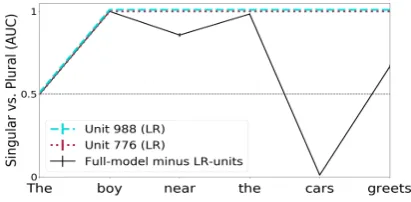
Figure 2: Generalization across time of subject-number prediction. Error bars represent standard deviations across cross-validation splits.

Two other arbitrary units, 651 and 1300 , and the syntax unit 1150 to be described below (Section 4.3) do not have segregated efferent weights to verb forms, as expected.

4.2 Short-Range Number Information

Performance on the easier NA-tasks (Simple, Adv, 2Adv) was not impaired by single-unit ablations. This suggests that number may be encoded also elsewhere in the network, perhaps via a more dis-tributed code. To verify this, we tested whether subject number can be decoded from the whole pattern of activities in the network (excluding the two LR-number units) and whether this decoding is stable across time (seeGiulianelli et al.,2018, for similar observations and related methods). We expected this distributed activity to track number in a small time window after the subject, but, un-like the LR-number units, to be affected by incon-gruent intervening nouns.

(7)

(a) 2Adv (b) nounPP (c) subject relative

[image:7.595.74.525.62.207.2]

(d) Two embeddings with subject relatives

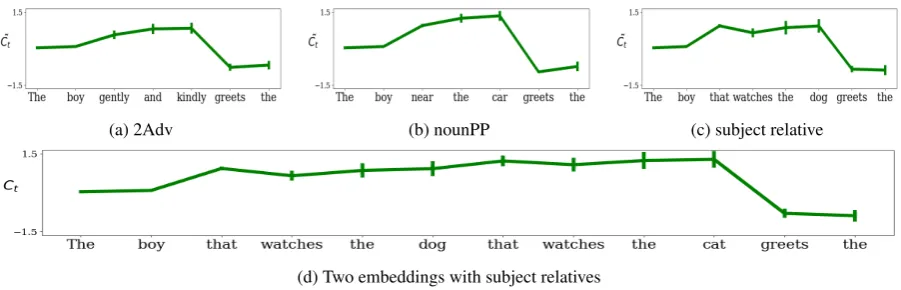
Figure 3: Cell activity of syntax unit 1150 while processing various syntactic structures. Values averaged across all stimuli in an NA-task, with error bars representing standard deviations. Relative clause NA-task stimuli were specifically generated for this visualization.

to zero around the second noun (‘cars’), whereas test performance of the models trained on cell ac-tivity of the LR-number units is consistently high. This confirms that number prediction is supported both by the LR-number units, and by distributed activation patterns of other short-range (SR) num-ber units. The latter, however, are not syntax-sensitive, and simply encode the number of the last noun encountered.

A full description of the SR-number units is be-yond our scope. However, we note that 10 SR-number units in the second layer of the network were identified, which had efferent weights with a similar segregated structure as that of the LR units (Figure 1d). These units were indeed sen-sitive to the last encountered noun: subject num-ber could be decoded from single-unit cell activ-ity during its presentation (AUC> 0.9), but ac-tivity ‘swaps’ once an interfering noun appears (i.e., AUC decreases to zero in a generalization-across-time analysis). Finally, to validate the role of SR-number units in encoding number for eas-ier NA-tasks, we ablated both SR and LR number units (12 in total) or SR units only (10 in total) and evaluated network performance on these NA-tasks. Both experiments resulted in a significant reduction in task performance compared to 1,000 random equi-size ablations (p < 0.01in all ‘eas-ier’ tasks).

Intriguingly, we observed qualitatively that LR units are almost always making the right predic-tion, even when the network predicts the wrong number. The wrong outcome, in such cases, might be due to interference from the syntax-insensitive SR units. We leave the study of LR-SR unit inter-play to future work.

4.3 Syntax Units

We saw how the input and forget gates of the LR-number units control the flow of subject-LR-number information. It remains unclear, however, how the dynamics of these gates are controlled by the work. We hypothesized that other units in the net-work may encode information about the syntac-tic structure of the sentence, and thus about the subject-verb dependency. These units could then control and coordinate the opening and closing of the input and forget gates of the number units.

To identify such ’syntax’ units, we tested from which units syntactic information can be effi-ciently decoded. We used depth of the syntac-tic tree as a proxy for syntacsyntac-tic structure (Nel-son et al., 2017) and trained an L2-regularized regression model to predict syntactic tree-depth from the hidden-state activity of all units. In all experiments, we used the data presented in Sec-tion3above and performed a nested 5-fold cross-validation procedure. Word frequency, which was added as a covariate to the model, had a negligi-ble effect on the results. Syntactic tree-depth was found to be efficiently decodable from network activity (R2

test−set = 0.85 ± 0.009;

covariate-corrected). A small subset of ‘syntax’ units had relatively high weights in the regression model (mean weight =7.6×10⁻⁴, SD=7.86×10⁻²;

(8)
[image:8.595.104.503.69.174.2]

nounPPAdv-(a) Input gate (b) Forget gate

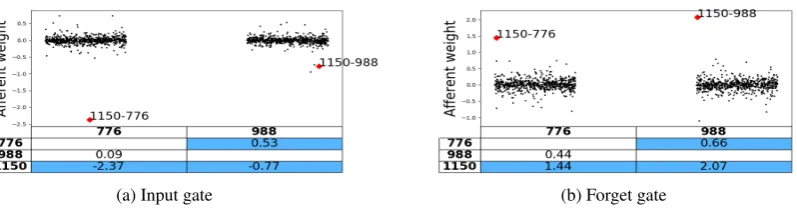
Figure 4: Connectivity among the syntax unit 1150 and LR-number units 776 and 988 . Projecting units are on the table rows. Blue background highlights outlier values (|z−score|>3). Weights from the syntax unit are marked with large diamond markers and are explicitly labeled in the plots.

SP: p = 0.011, nounPPAdv-PS: p = 0.034, nounPP-SP:p < 0.001and marginally significant in nounPP-PS:p = 0.052(compared to 1000 ran-dom ablations of subsets of units of the same size). To gain further insight regarding the functioning of the syntax units, we next visualized their gate and cell dynamics during sentence processing. We found that cell activity of unit 1150 , which also had one of the highest weights in the regression model, was remarkably structured. The activity of this unit increases across the entire subject-verb dependency and drops abruptly right after. Figures 3a and 3b show cell activity of this unit during the processing of stimuli from the 2Adv and nounPP tasks. We found the same dynamics in cases where another verb occurs between sub-ject and main verb, as in subsub-ject relatives (Figure 3c), and in exceptionally long-distance dependen-cies with two interfering nouns and verbs (Figure 3d). Taken together, these results suggest that unit 1150 consistently encodes subject-verb dependen-cies in a syntax-sensitive manner. Other syntax units did not show an easily interpretable dynam-ics and had no clear interactions with the number units in the analysis discussed next. This suggests that they perform different syntactic, or possibly other, functions.

4.4 Syntax-Number Units Connections

We finally look at the connections that were learned by the LSTM between syntax unit 1150 , which appears to be more closely involved in tracking subject-verb agreement, and the LR num-ber units, as well as at the connections between the LR-number units themselves. For each unit pair, there are 4 connection types, one for each com-ponent of the target cell (to the 3 gates and to the update candidate). We focus on input and forget gates, as they control the flow and storage of

num-ber information.

Figures4a and4bshow the distributions of all afferent recurrent weights to the input and forget gates of the LR-number units, scaled by the maxi-mal activityhtof the pre-synaptic units during the

nounPP task (this scaling evaluates theeffective in-put to the units and did not change the conclusions described below). We found that the weights from the syntax unit to the forget gate of both 776 and 988 are exceptionally high in the positive direc-tion compared to all other afferent connecdirec-tions in the network (z score = 8.1,11.2, respec-tively) and those to their input gates exception-ally negative (zscore = 16.2,7.2). Since the cell activity of syntax unit 1150 is positive across the entire subject-verb dependency (e.g., Figure3d), the connectivity from the syntax unit drives the number unit forget gates towards one (W776,1150f h1150 0 and Wf

988,1150h1150 0;

tsubject < t < tverb) and their input gates towards

zero (Wi

776,1150h1150 0andW988,1150i h1150 0). Looking at the right-hand-side of Eq. (1), this means that the first term becomes dominant and the second vanishes, suggesting that, across the entire dependency, the syntax unit conveys a ‘re-member flag’ to the number units. Similarly, when the activity of the syntax unit becomes negative at the end of the dependency, it conveys an ‘update flag’.

(9)

5 Summary and Discussion

We provided the first detailed description of the underlying mechanism by which an LSTM language-model performs long-distance number agreement. Strikingly, simply training an LSTM on a language-model objective on raw corpus data brought about single units carrying exceptionally specific linguistic information. Three of these units were found to form a highly interactive lo-cal network, which makes up the central part of a ‘neural’ circuit performing long-distance number agreement.

One of these units encodes and stores gram-matical number information when the main sub-ject of a sentence is singular, and it successfully carries this information across long-range depen-dencies. Another unit similarly encodes plurality. These number units show that a highly local en-coding of linguistic features can emerge in LSTMs during language-model training, as was previously suggested by theoretical studies of artificial neural networks (e.g.,Bowers,2009) and in neuroscience (e.g.,Kutter et al.,2018).

Our analysis also identified units whose activity correlates with syntactic complexity. These units, as a whole, affect performance on the agreement tasks. We further found that one of them encodes the main subject-verb dependency across various syntactic constructions. Moreover, the highest af-ferent weights to the forget and input gates of both LR-number units were from this unit. A natural interpretation is that this unit propagates syntax-based remember and update flags that con-trol when the number units store and release infor-mation.

Finally, number is also redundantly encoded in a more distributed way, but the latter mechanism is unable to carry information across embedded syntactic structures. The computational burden of tracking number information thus gave rise to two types of units in the network, encoding similar in-formation with distinct properties and dynamics.

The relationship we uncovered and character-ized between syntax and number units suggests that agreement in an LSTM language-model can-not be entirely explained away by superficial heuristics, and the networks have, to some extent, learned to build and exploit structure-based syn-tactic representations, akin to those conjectured to support human-sentence processing.

In future work, we intend to explore how the

en-coding pattern we found varies across network ar-chitectures and hyperparameters, as well as across languages and domains. We also would like to investigate the timecourse of emergence of the found behaviour over training time.

More generally, we hope that our study will inspire more analyses of the inner dynamics of LSTMs and other sequence-processing networks, complementing the currently popular “black-box probing” approach. Besides bringing about a mechanistic understanding of language process-ing in artificial models, this could inform work on human-sentence processing. Indeed, our study yields particular testable predictions on brain dy-namics, given that the computational burden of long-distance agreement remains the same for ar-tificial and biological neural network, despite im-plementation differences and different data sizes required for language acquisition. We conjecture a similar distinction between SR and LR units to be found in the human brain, as well as an in-teraction between syntax-processing and feature-carrying units such as the LR units, and plan to test these in future work.

Acknowledgments

We would like to thank Kristina Gulordava, Jean-Remi King, Tal Linzen, Gabriella Vigliocco and Christophe Pallier for helpful feedback and com-ments on the work.

References

Yossi Adi, Einat Kermany, Yonatan Belinkov, Ofer Lavi, and Yoav Goldberg. 2017. Fine-grained analysis of sentence embeddings using auxil-iary prediction tasks. In Proceedings of ICLR Conference Track, Toulon, France. Published online: https://openreview.net/group?

id=ICLR.cc/2017/conference.

Guillaume Alain and Yoshua Bengio. 2017. Under-standing intermediate layers using linear classifier probes. InProceedings of ICLR Conference Track, Toulon, France.

Jean-Philippe Bernardy and Shalom Lappin. 2017. Us-ing deep neural networks to learn syntactic agree-ment. Linguistic Issues in Language Technology, 15(2):1–15.

(10)

Shammur Chowdhury and Roberto Zamparelli. 2018. RNN simulations of grammaticality judgments on long-distance dependencies. In Proceedings of COLING, pages 133–144, Santa Fe, NM.

Lieke Gelderloos and Grzegorz Chrupała. 2016. From phonemes to images: levels of representation in a recurrent neural model of visually-grounded lan-guage learning. In Proceedings of COLING 2016, the 26th International Conference on Computational Linguistics: Technical Papers, pages 1309–1319.

Mario Giulianelli, Jack Harding, Florian Mohnert, Dieuwke Hupkes, and Willem Zuidema. 2018. Un-der the hood: Using diagnostic classifiers to investi-gate and improve how language models track agree-ment information. In Proceedings of the EMNLP BlackboxNLP Workshop, pages 240–248, Brussels, Belgium.

Kristina Gulordava, Piotr Bojanowski, Edouard Grave, Tal Linzen, and Marco Baroni. 2018. Colorless green recurrent networks dream hierarchically. In Proceedings of NAACL, pages 1195–1205, New Or-leans, LA.

Sepp Hochreiter and J¨urgen Schmidhuber. 1997. Long short-term memory. Neural Computation, 9(8):1735–1780.

Dieuwke Hupkes, Sara Veldhoen, and Willem Zuidema. 2018. Visualisation and ’diagnostic classi-fiers’ reveal how recurrent and recursive neural net-works process hierarchical structure. Journal of Ar-tificial Intelligence Research, 61:907–926.

Jaap Jumelet and Dieuwke Hupkes. 2018. Do lan-guage models understand anything? on the ability of lstms to understand negative polarity items. In Proceedings of the 2018 EMNLP Workshop Black-boxNLP: Analyzing and Interpreting Neural Net-works for NLP, pages 222–231.

Andrej Karpathy, Justin Johnson, and Fei-Fei Li. 2016. Visualizing and understanding recur-rent networks. In Proceedings of ICLR Work-shop Track, San Juan, Puerto Rico. Published online: https://openreview.net/group?

id=ICLR.cc/2016/workshop.

Yova Kementchedjhieva and Adam Lopez. 2018. ‘In-dicatements’ that character language models learn English morpho-syntactic units and regularities. In Proceedings of the EMNLP Workshop on analyzing and interpreting neural networks for NLP, Brussels, Belgium. In press.

Jean-R´emi King and Stanislas Dehaene. 2014. Charac-terizing the dynamics of mental representations: The temporal generalization method. Trends in Cogni-tive Sciences, 18(4):203–210.

Adhiguna Kuncoro, Chris Dyer, John Hale, and Phil Blunsom. 2018a. The perils of natural behavioral tests for unnatural models: The case of number

agreement. Poster presented at the Learning Lan-guage in Humans and in Machines conference, on-line at:https://osf.io/view/L2HM/.

Adhiguna Kuncoro, Chris Dyer, John Hale, Dani Yo-gatama, Stephen Clark, and Phil Blunsom. 2018b. LSTMs can learn syntax-sensitive dependencies well, but modeling structure makes them better. In Proceedings of ACL, pages 1426–1436, Melbourne, Australia.

Esther Kutter, Jan Bostroem, Christian Elger, Florian Mormann, and Andreas Nieder. 2018. Single neu-rons in the human brain encode numbers. Neuron, 100(3):753–761.

Jiwei Li, Xinlei Chen, Eduard Hovy, and Dan Jurafsky. 2016. Visualizing and understanding neural mod-els in NLP. InProceedings of the North American Chapter of the Association for Computational Lin-guistics: Human Language Technologies (NAACL-HLT), pages 681–691.

Tal Linzen, Emmanuel Dupoux, and Yoav Goldberg. 2016. Assessing the ability of LSTMs to learn syntax-sensitive dependencies. Transactions of the Association for Computational Linguistics, 4:521– 535.

Tal Linzen and Brian Leonard. 2018. Distinct patterns of syntactic agreement errors in recurrent networks and humans. InProceedings of CogSci, pages 692– 697, Austin, TX.

Rebecca Marvin and Tal Linzen. 2018. Targeted syn-tactic evaluation of language models. In Proceed-ings of the 2018 Conference on Empirical Methods in Natural Language Processing, pages 1192–1202.

Matthew Nelson, Imen El Karoui, Kristof Giber, Xi-aofang Yang, Laurent Cohen, Hilda Koopman, Syd-ney Cash, Lionel Naccache, John Hale, Christophe Pallier, and Stanislas Dehaene. 2017. Neurophysio-logical dynamics of phrase-structure building during sentence processing. Proceedings of the National Academy of Sciences, 114(18):E3669–E3678.

Alec Radford, Rafal Jozefowicz, and Ilya Sutskever. 2017. Learning to generate reviews and discovering sentiment. https://arxiv.org/abs/1704. 01444.

Zhiyuan Tang, Ying Shi, Dong Wang, Yang Feng, and Shiyue Zhang. 2017. Memory visualization for gated recurrent neural networks in speech recogni-tion. In Acoustics, Speech and Signal Processing (ICASSP), 2017 IEEE International Conference on, pages 2736–2740. IEEE.

Figure

Table 2: Ablation-experiments results: Percentage ac-curacy in all NA-tasks. Full: non-ablated model, C:condition, S: singular, P: plural
Figure 1: (a) to (c) – Cell and gate activations during processing of sentences with a prepositional phrase betweensubject and verb
Figure 2: Generalization across time of subject-numberprediction.Error bars represent standard deviationsacross cross-validation splits.
Figure 3: Cell activity of syntax unit 1150 while processing various syntactic structures
+2

References

Related documents

But that is Marx’s exact point in discussing the lower phase of communism: “Right can never be higher than the economic structure of society and its cultural development which

19% serve a county. Fourteen per cent of the centers provide service for adjoining states in addition to the states in which they are located; usually these adjoining states have

The objective of this study was to develop Fourier transform infrared (FTIR) spectroscopy in combination with multivariate calibration of partial least square (PLS) and

Standardization of herbal raw drugs include passport data of raw plant drugs, botanical authentification, microscopic &amp; molecular examination, identification of

Maximum weight of the palletized load : 500kg. The heaviest palletized load always must be at the lower level of the pile. See Appendix 2 for palletizing of standard GALIA

The primary objective of this study was to evaluate whether the implementation of a ventilator care bundle in the PICU could simultaneously reduce the incidence of VAP and VAT

In earlier days classical inventory model like Harris [1] assumes that the depletion of inventory is due to a constant demand rate. But subsequently, it was noticed that depletion

National Conference on Technical Vocational Education, Training and Skills Development: A Roadmap for Empowerment (Dec. 2008): Ministry of Human Resource Development, Department