1977
Shifting the Baseline:
Single Modality Performance on Visual Navigation & QA
Jesse Thomason Daniel Gordon Yonatan Bisk
Paul G. Allen School of Computer Science and Engineering
{jdtho,xkcd,ybisk}@cs.washington.edu
Abstract
We demonstrate the surprising strength of uni-modal baselines in multiuni-modal domains, and make concrete recommendations for best prac-tices in future research. Where existing work often compares against random or majority
class baselines, we argue that unimodal
ap-proaches better capture and reflect dataset bi-ases and therefore provide an important com-parison when assessing the performance of multimodal techniques. We present unimodal ablations on three recent datasets in visual nav-igation and QA, seeing an up to 29% absolute gain in performance over published baselines.
1 Introduction
All datasets have biases. Baselines should cap-ture these regularities so that outperforming them indicates a model is actually solving a task. In multimodal domains, bias can occur in any sub-set of the modalities. To address this, we argue it is not sufficient for researchers to provide ran-dom or majority class baselines; instead we rec-ommend presenting results for unimodal models. We investigate visual navigation and question an-swering tasks, where agents move through simu-lated environments using egocentric (first person) vision. We find that unimodal ablations (e.g., lan-guage only) in these seemingly multimodal tasks can outperform corresponding full models (§4.1).
This work extends observations made in both the Computer Vision (Goyal et al., 2018; Cirik et al., 2018) and Natural Language (Mudrakarta et al., 2018;Glockner et al., 2018; Poliak et al.,
2018;Gururangan et al.,2018;Kaushik and Lip-ton,2018) communities that complex models of-ten perform well by fitting to simple, uninof-tended correlations in the data, bypassing the complex grounding and reasoning that experimenters hoped was necessary for their tasks.
F L R U D E F L R U D E
F L R U D E F L R U D E
t1 t2
t3 t4
[image:1.595.306.528.223.333.2]Actions:Forward, turnLeft &Right, tiltUp &Down,End
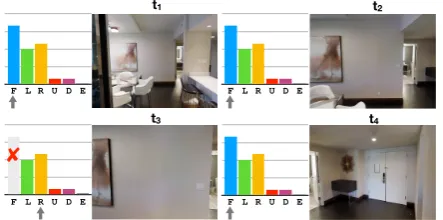
Figure 1: Navigating without vision leads to sensible navigation trajectories in response to commands like “walk past the bar and turn right”. Att3, “forward” is
unavailable as the agent would collide with the wall.
We ablate models from three recent papers: (1) navigation (Figure 1) using images of real homes paired with crowdsourced language de-scriptions (Anderson et al.,2018); and (2, 3) navi-gation and egocentric question answering (Gordon et al.,2018;Das et al.,2018a) in simulation with synthetic questions. We find that unimodal abla-tions often outperform the baselines that accom-pany these tasks.
Recommendation for Best Practices: Our find-ings show that in the new space of visual nav-igation and egocentric QA, all modalities, even an agent’s action history, are strongly informative. Therefore, while many papers ablate either lan-guage or vision, new results should ablate both. Such baselines expose possible gains from uni-modal biases in multiuni-modal datasets irrespective of training and architecture details.
2 Ablation Evaluation Framework
forward
turn left
turn right
tilt up
tilt down
end
start
forwardturn leftturn righttilt uptilt downend start
Conditional
Mar
ginal
.36
.44
.43 .54
.54
.393 .255 .257
.22 .22 .16
.071 .012 .012 .001
.00
.00 .00
.00 .00 .00
.00
.02 .02
.01 .01
[image:2.595.339.493.61.149.2].01 .01
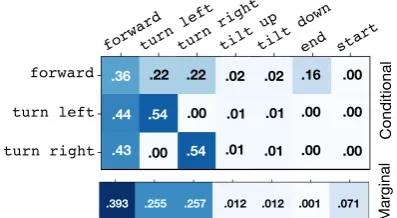
Figure 2:P(act=col|prev=row)and marginal ac-tion distribuac-tions in Matterport training. Peaked distri-butions enable agents to memorize simple rules like not turning left immediately after turning right, or moving forward an average number of steps.
(e.g.,turn left), or answer questions (e.g.,answer ‘brown’). At timestep t, a multimodal modelM takes in a visual inputVtand language question or
navigation command Lto predict the next action at. The navigation models we examine also take in
their action from the previous timestep,at−1, and
‘minimally sensed’ world informationW specify-ing which actions are available (e.g., thatforward is unavailable if the agent is facing a wall).
at← M(Vt,L, at−1;W) (1)
In each benchmark, Mcorresponds to the au-thor’s released code and training paradigm. In ad-dition to their full model, we evaluate the role of each input modality by removing those inputs and replacing them with zero vectors. Formally, we define the full model and three ablations:
Full Model is M(Vt,L, at−1;W) (2) A is M(~0,~0, at−1;W) (3) A+V is M(Vt,~0, at−1;W) (4) A+L is M(~0,L, at−1;W) (5)
corresponding to models with access toAction in-puts,Vision inputs, andLanguage inputs. These ablations preserve the architecture and number of parameters ofMby changing only its inputs.
3 Benchmark Tasks
We evaluate on navigation and question answering tasks across three benchmark datasets: Matterport Room-to-Room (no question answering compo-nent), and IQUAD V1 and EQA (question answer-ing that requires navigatanswer-ing to the relevant scene in the environment) (Anderson et al., 2018;Gordon
Is there an apple in the fridge?
[image:2.595.82.281.64.173.2]Yes No
Figure 3: IQA data construction attempts to make both the question and image necessary for QA.
et al.,2018;Das et al.,2018a). We divide the latter two into separate navigation and question answer-ing components. We then train and evaluate mod-els separately per subtask to analyze accuracy.
3.1 Matterport Room-to-Room
An agent is given a route in English and navigates through a discretized map to the specified desti-nation (Anderson et al.,2018). This task includes high fidelity visual inputs and crowdsourced natu-ral language routes.
Published Full Model: At each timestep an LSTM decoder uses a ResNet-encoded image Vt and previous actionat−1 to attend over the states
of an LSTM language encoder (L) to predict nav-igation actionat(seen in Figure2).
Published Baseline: The agent chooses a ran-dom direction and takes up to five forward actions, turning right when no forward action is available.
3.2 Interactive Question Answering
IQUAD V1 (Gordon et al., 2018) contains three question types: existence (e.g., Is there a ...?), counting (e.g., How many ...?) where the answer ranges from 0 to 3, and spatial relation: (e.g., Is there a ... in the ...?). The data was constructed via randomly generated configurations to weaken majority class baselines (Figure 3). To evalu-ate the navigation subtask, we introduce a new THOR-Nav benchmark.1 The agent is placed in a random location in the room and must approach one of fridge, garbage can, or microwave in re-sponse to a natural language question.
Although we use the same full model asGordon et al.(2018), our QA results are not directly com-parable. In particular,Gordon et al.(2018) do not quantify the effectiveness of the QA component independent of the scene exploration (i.e. naviga-tion and interacnaviga-tion). To remove the scene
ration steps ofGordon et al.(2018), we provide a complete ground-truth view of the environment.2 We use ground-truth rather than YOLO (Redmon et al.,2016) due to speed constraints.
Nav Full Model: The image and ground-truth semantic segmentation maskVt, tiled questionL,
and previous actionat−1 are encoded via a CNN
which outputs a distribution over actions. Optimal actions are learned via teacher forcing.
Nav Baseline: The agent executes 100 randomly chosen navigation actions then terminates. In AI2THOR (Kolve et al., 2017), none of the kitchens span more than 5 meters. With a step-size of 0.25 meters, we observed that 100 actions was significantly shorter than the shortest path length.
Published QA Full Model: The question en-coding L is tiled and concatenated with a top-down view of the ground truth location of all ob-jects in the sceneV. This is fed into several convo-lutions, a spatial sum, and a final fully connected layer which outputs a likelihood for each answer.
Published QA Baseline: We include the major-ity class baseline fromGordon et al.(2018).
3.3 Embodied Question Answering
EQA (Das et al., 2018a) questions are program-matically generated to refer to a single, unambigu-ous object for a specific environment, and are fil-tered to avoid easy questions (e.g.,What room is the bathtub in?). At evaluation, an agent is placed a fixed number of actions away from the object.
Published Nav Full Model: At each timestep, a planner LSTM takes in a CNN encoded imageVt, LSTM encoded questionL, and the previous ac-tionat−1and emits an actionat. The action is
ex-ecuted in the environment, and then a lower-level controller LSTM continues to take in new vision observations and at, either repeatingat again or
returning control to the planner.
Published Nav Baseline: This baseline model is trained and evaluated with the same inputs as the full model, but does not pass control to a lower-level controller, instead predicting a new action using the planner LSTM at each timestep (i.e., no hierarchical control). Das et al.(2018a) name this baselineLSTM+Question.
2This approximates the agent having visited every possi-ble location, interacted with all possipossi-ble objects, and looked in all possible directions before answering.
Matterport↑ THOR-Nav↑ EQA↓
(%) (%) (m)
Model Seen Un Seen Un Un
Pub
. Full Model 27.1 19.6 77.7 18.08 4.17
Baseline 15.9 16.3 2.18 1.54 4.21
Uni
A 18.5 17.1 4.53 2.88 4.53
A+V 21.2 16.6 35.6 7.50 ∗4.11
A+L 23.0 ∗22.1 4.03 3.46 4.64
[image:3.595.312.519.62.172.2]∆ Uni – Base +7.1 +5.8 +33.4 +5.96 -0.10
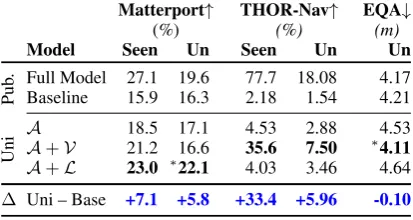
Table 1: Navigation success (Matterport, THOR-Nav)
(%)and remaining distance to target (EQA)(m). Best unimodal in bold;betterthan reported baseline;∗better than full model.
Published QA Full Model: Given the last five image encodings along the gold standard naviga-tion trajectory, Vt−4. . .Vt, and the question
en-coding L, image-question similarities are calcu-lated via a dot product and converted via attention weights to a summary weightV¯, which is concate-nated withLand used to predict the answer. Das et al. (2018a) name this oracle-navigation model ShortestPath+VQA.
QA Baseline: Das et al.(2018a) provide no ex-plicit baseline for the VQA component alone. We use a majority class baseline inspired by the data’s entropy based filtering.
4 Experiments
Across all benchmarks, unimodal baselines out-perform baseline models used in or derived from the original works. Navigating unseen environ-ments, these unimodal ablations outperform their corresponding full models on the Matterport (ab-solute ↑ 2.5% success rate) and EQA (↓ 0.06m distance to target).
4.1 Navigation
We evaluate our ablation baselines on Matterport,3 THOR-Nav, and EQA (Table 1),4 and discover that some unimodal ablations outperform their corresponding full models. For Matterport and THOR-Nav, success rate is defined by proximity to the target. For EQA, we measure absolute dis-tance from the target in meters.
Unimodal Performance: Across Matterport, THOR-Nav, and EQA, either A +V or A+L
3
We report on Matterport-validation since this allows comparing Seen versus Unseen house performance.
Matterport↑
(%)
Model Seen Unseen
Pub
. Full Model 38.6 21.8
Baseline 15.9 16.3
Uni
A 4.1 3.2
A+V 30.6 13.3
[image:4.595.118.242.61.169.2]A+L 15.4 13.9 ∆ Uni – Base +14.7 -2.4
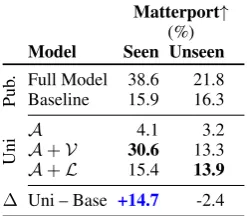
Table 2: Navigation results for Matterport when trained using student forcing. Best unimodal in bold; better than reported baseline.
achieves better performance than existing base-lines. In Matterport, the A + L ablation per-forms better than the Full Model in unseen en-vironments. The diverse scenes in this simula-tor may render the vision signal more noisy than helpful in previously unseen environments. The A+V model in THOR-Nav and EQA is able to latch onto dataset biases in scene structure to nav-igate better than chance (for IQA), and the non-hierarchical baseline (in EQA). In EQA, A+V also outperforms the Full Model;5 the latent in-formation about navigation from questions may be too distant for the model to infer.
The agent with access only to its action history (A) outperforms the baseline agent in Matterport and THOR-Nav environments, suggesting it learns navigation correlations that are not captured by simple random actions (THOR-Nav) or program-matic walks away from the starting position (Mat-terport). Minimal sensing (which actions are avail-able, W) coupled with the topological biases in trajectories (Figure2), help this nearly zero-input agent outperform existing baselines.6
Matterport Teacher vs Student forcing With teacher forcing, at each timestep the navigation agent takes the gold-standard action regardless of what action it predicted, meaning it only sees steps along gold-standard trajectories. This paradigm is used to train the navigation agent in THOR-Nav and EQA. Under student forcing, the agent sam-ples the action to take from its predictions, and loss is computed at each time step against the ac-tion that would have put the agent on the shortest
5EQA full & baseline model performances do not exactly match those inDas et al.(2018a) because we use the ex-panded data updated by the authorshttps://github.
com/facebookresearch/EmbodiedQA/.
6This learned agent begins to relate to work in minimally sensing robotics (O’Kane and LaValle,2006).
dT↓ dmin↓
(m) (m)
Model T−10 T−30 T−50 T−10 T−30 T−50
Pub
. Full 0.971 4.17 8.83 0.291 2.43 6.45
Baseline 1.020 4.21 8.73 0.293 2.45 6.38
U
ni A
∗
0.893 4.53 9.56 ∗0.242 3.16 7.99
A+V ∗0.951 ∗4.11 †8.83 ∗0.287 2.51 ∗6.44
A+L 0.987 4.64 9.51 ∗0.240 3.19 7.96
∆ U – B -0.127 -0.10 +0.10 -0.053 +0.06 +0.06
Table 3: Final distances to targets (dT) and minimum
distance from target achieved along paths (dmin) in
EQA navigation. Best unimodal in bold; better than reported baseline; ∗better than full model; †tied with full model.
path to the goal. Thus, the agent sees more of the scene, but can take more training iterations to learn to move to the goal.
Table 2 gives the highest validation success rates across all epochs achieved in Matterport by models trained using student forcing. The uni-modal ablations show that the Full Model, possi-bly because with more exploration and more train-ing episodes, is better able to align the vision and language signals, enabling generalization in un-seen environments that fails with teacher forcing.
EQA Navigation Variants Table3gives the av-erage final distance from the target (dT, used as
the metric in Table1) and average minimum dis-tance from target achieved along the path (dmin)
during EQA episodes for agents starting 10, 30, and 50 actions away from the target in the EQA navigation task. At 10 actions away, the unimodal ablations tend to outperform the full model on both metrics, possibly due to the shorter length of the episodes (less data to train the joint parame-ters). TheA+V ablation performs best among the ablations, and ties with or outperforms the Full Model in all but one setting, suggesting that the EQA Full Model is not taking advantage of lan-guage information under any variant.
4.2 Question Answering
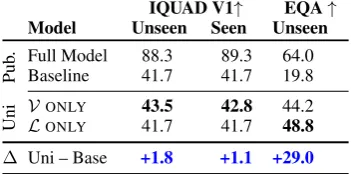
We evaluate our ablation baselines on IQUAD V1 and EQA, reporting top-1 QA accuracy (Table4) given gold standard navigation information asV. These decoupled QA models do not take in a pre-vious action, so we do not considerAONLY
abla-tions for this task.
[image:4.595.307.528.62.170.2]ab-IQUAD V1↑ EQA↑
Model Unseen Seen Unseen
Pub
. Full Model 88.3 89.3 64.0
Baseline 41.7 41.7 19.8
Uni
VONLY 43.5 42.8 44.2
LONLY 41.7 41.7 48.8
[image:5.595.306.528.62.169.2]∆ Uni – Base +1.8 +1.1 +29.0
Table 4: Top-1 QA accuracy. Best unimodal in bold; betterthan reported baseline.
lations perform nearly at chance.7 The V ONLY
model with access to the locations of all scene ob-jects only improves by 2% over random guessing. For EQA, single modality models perform sig-nificantly better than the majority class baseline. The vision-only model is able to identify salient colors and basic room features that allow it to re-duce the likely set of answers to an unknown ques-tion. The language only models achieve nearly 50%, suggesting that despite the entropy filtering inDas et al.(2018a) each question has one answer that is as likely as all other answers combined (e.g. 50% of the answers forWhat color is the bathtub? aregrey, and other examples in Figure4).
5 Related Work
Historically, semantic parsing was used to map natural language instructions to visual navigation in simulation environments (Chen and Mooney,
2011; MacMahon et al., 2006). Modern ap-proaches use neural architectures to map natu-ral language to the (simulated) world and execute actions (Paxton et al., 2019; Chen et al., 2018;
Nguyen et al., 2018; Blukis et al., 2018; Fried et al., 2018; Mei et al., 2016). In visual ques-tion answering (VQA) (Antol et al., 2015; Hud-son and Manning,2019) and visual commonsense reasoning (VCR) (Zellers et al., 2019), input im-ages are accompanied with natural language ques-tions. Given the question, egocentric QA requires an agent to navigate and interact with the world to gather the relevant information to answer the ques-tion. In both cases, end-to-end neural architectures make progress on these tasks.
For language annotations, task design, diffi-culty, and annotator pay can introduce unintended artifacts which can be exploited by models to “cheat” on otherwise complex tasks (Glockner
7Majority class and chance for IQUAD V1 both achieve 50%, 50%, 25% when conditioned on question type; our Baseline model achieves the average of these.
F
ina
l I
m
age
Question
V Only L Only Maj Class Full Model Answer
What room is the iron located in? What color is
the dresser?
What color is the loudspeaker …?
What room is the fruit bowl located in?
Brown Kitchen Brown Kitchen
Brown Green Living Room Kitchen
Brown Bathroom Brown Kitchen
Brown Brown Brown Brown
Brown Bathroom Brown Kitchen
What color is the bathtub … ?
Grey Bathroom
Grey Brown
Grey
Figure 4: Qualitative results on the EQA task. The language only model can pick out the most likely an-swer for a question. The vision only model finds salient color and room features, but is unaware of the question.
et al.,2018;Poliak et al.,2018). Such issues also occur in multimodal data like VQA (Goyal et al.,
2018), where models can answer correctly with-out looking at the image. In image captioning, work has shown competitive models relying only on nearest-neighbor lookups (Devlin et al.,2015) as well as exposed misalignment between caption relevance and text-based metrics (Rohrbach et al.,
2018). Our unimodal ablations of visual naviga-tion and QA benchmarks uncover similar biases, which deep architectures are quick to exploit.
6 Conclusions
In this work, we introduce an evaluation frame-work and perform the missing analysis from sev-eral new datasets. While new state-of-the-art mod-els are being introduced for several of these do-mains (e.g., Matterport: (Ma et al., 2019a; Ke et al.,2019;Wang et al.,2019;Ma et al.,2019b;
Tan et al., 2019; Fried et al., 2018), and EQA: (Das et al., 2018b)), they lack informative, indi-vidual unimodal ablations (i.e., ablatingboth lan-guage and vision) of the proposed models.
We find a performance gap between baselines used in or derived from the benchmarks examined in this paper and unimodal models, with unimodal models outperforming those baselines across all benchmarks. These unimodal models can even outperform their multimodal counterparts. In light of this, we recommend all future work include uni-modal ablations of proposed multiuni-modal models to vet and highlight their learned representations.
Acknowledgements
[image:5.595.92.268.63.150.2]References
Peter Anderson, Qi Wu, Damien Teney, Jake Bruce, Mark Johnson, Niko S¨underhauf, Ian Reid, Stephen Gould, and Anton van den Hengel. 2018. Vision-and-Language Navigation: Interpreting visually-grounded navigation instructions in real environ-ments. InConference on Computer Vision and
Pat-tern Recognition (CVPR).
Stanislaw Antol, Aishwarya Agrawal, Jiasen Lu, Mar-garet Mitchell, Dhruv Batra, C. Lawrence Zitnick, and Devi Parikh. 2015. VQA: Visual Question An-swering. InInternational Conference on Computer
Vision (ICCV).
Valts Blukis, Dipendra Misra, Ross A. Knepper, and Yoav Artzi. 2018. Mapping navigation instructions to continuous control actions with position visita-tion predicvisita-tion. In Proceedings of the Conference
on Robot Learning.
David L. Chen and Raymond J. Mooney. 2011. Learn-ing to interpret natural language navigation instruc-tions from observainstruc-tions. InAAAI Conference on
Ar-tificial Intelligence (AAAI).
Howard Chen, Alane Shur, Dipendra Misra, Noah Snavely, and Yoav Artzi. 2018. Touchdown: Natural language navigation and spatial reasoning in visual street environments. InNeurIPS Workshop on
Visu-ally Grounded Interaction and Language (ViGIL).
Volkan Cirik, Louis-Philippe Morency, and Taylor Berg-Kirkpatrick. 2018. Visual referring expression recognition: What do systems actually learn? In
Proc. of the North American Chapter of the
Associ-ation for ComputAssoci-ational Linguistics (NAACL).
Abhishek Das, Samyak Datta, Georgia Gkioxari, Ste-fan Lee, Devi Parikh, and Dhruv Batra. 2018a. Embodied Question Answering. In Conference on
Computer Vision and Pattern Recognition (CVPR).
Abhishek Das, Georgia Gkioxari, Stefan Lee, Devi Parikh, and Dhruv Batra. 2018b. Neural Modular Control for Embodied Question Answering. In
Con-ference on Robot Learning (CoRL).
Jacob Devlin, Saurabh Gupta, Ross Girshick, Margaret Mitchell, and C Lawrence Zitnick. 2015. Exploring nearest neighbor approaches for image captioning.
arXiv preprint arXiv:1505.04467.
Daniel Fried, Ronghang Hu, Volkan Cirik, Anna Rohrbach, Jacob Andreas, Louis-Philippe Morency, Taylor Berg-Kirkpatrick, Kate Saenko, Dan Klein, and Trevor Darrell. 2018. Speaker-follower models for vision-and-language navigation. In Neural
In-formation Processing Systems (NeurIPS).
Max Glockner, Vered Shwartz, and Yoav Goldberg. 2018. Breaking NLI systems with sentences that re-quire simple lexical inferences. InProc. of the
As-sociation for Computational Linguistics (ACL).
Daniel Gordon, Aniruddha Kembhavi, Mohammad Rastegari, Joseph Redmon, Dieter Fox, and Ali Farhadi. 2018. Iqa: Visual question answering in in-teractive environments. InConference on Computer
Vision and Pattern Recognition (CVPR).
Yash Goyal, Tejas Khot, Aishwarya Agrawal, Douglas Summers-Stay, Dhruv Batra, and Devi Parikh. 2018. Making the V in VQA matter: Elevating the role of image understanding in visual question answering.
International Journal of Computer Vision (IJCV).
Suchin Gururangan, Swabha Swayamdipta, Omer Levy, Roy Schwartz, Samuel Bowman, and Noah A. Smith. 2018. Annotation artifacts in natural lan-guage inference data. InProc. of the North Amer-ican Chapter of the Association for Computational
Linguistics (NAACL).
Drew A. Hudson and Christopher D. Manning. 2019. GQA: a new dataset for compositional question an-swering over real-world images. InConference on
Computer Vision and Pattern Recognition (CVPR).
Divyansh Kaushik and Zachary C. Lipton. 2018. How much reading does reading comprehension require? a critical investigation of popular benchmarks. In
Conference on Empirical Methods in Natural
Lan-guage Processing (EMNLP).
Liyiming Ke, Xiujun Li, Yonatan Bisk, Ari Holtz-man, Zhe Gan, Jingjing Liu, Jianfeng Gao, Yejin Choi, and Siddhartha Srinivasa. 2019. Tactical rewind: Self-correction via backtracking in vision-and-language navigation. In Conference on
Com-puter Vision and Pattern Recognition (CVPR).
Eric Kolve, Roozbeh Mottaghi, Daniel Gordon, Yuke Zhu, Abhinav Gupta, and Ali Farhadi. 2017. AI2-THOR: An Interactive 3D Environment for Visual
AI.arXiv.
Chih-Yao Ma, Jiasen Lu, Zuxuan Wu, Ghassan Al-Regib, Zsolt Kira, Richard Socher, and Caim-ing Xiong. 2019a. Self-aware visual-textual co-grounded navigation agent. In International
Con-ference on Learning Representations (ICLR).
Chih-Yao Ma, Zuxuan Wu, Ghassan AlRegib, Caiming Xiong, and Zsolt Kira. 2019b. The regretful agent: Heuristic-aided navigation through progress estima-tion. InConference on Computer Vision and Pattern
Recognition (CVPR).
Matt MacMahon, Brian Stankiewicz, and Benjamin Kuipers. 2006. Walk the talk: Connecting language, knowledge, and action in route instructions. InAAAI
Conference on Artificial Intelligence (AAAI).
Hongyuan Mei, Mohit Bansal, and Matthew R. Wal-ter. 2016. Listen, attend, and walk: Neural mapping of navigational instructions to action sequences. In
Pramod Kaushik Mudrakarta, Ankur Taly, Mukund Sundararajan, and Kedar Dhamdhere. 2018. Did the model understand the question? InProc. of the
As-sociation for Computational Linguistics (ACL).
Khanh Nguyen, Debadeepta Dey, Chris Brockett, and Bill Dolan. 2018. Vision-based navigation with language-based assistance via imitation learning with indirect intervention. InConference on
Com-puter Vision and Pattern Recognition (CVPR).
Jason M O’Kane and Steven M. LaValle. 2006. On comparing the power of mobile robots. InRobotics:
Science and Systems (RSS).
Chris Paxton, Yonatan Bisk, Jesse Thomason, Arunk-umar Byravan, and Dieter Fox. 2019. Prospection: Interpretable plans from language by predicting the future. InInternational Conference on Robotics and
Automation (ICRA).
Adam Poliak, Jason Naradowsky, Aparajita Haldar, Rachel Rudinger, and Benjamin Van Durme. 2018. Hypothesis Only Baselines in Natural Language In-ference. In Joint Conference on Lexical and
Com-putational Semantics (StarSem).
Joseph Redmon, Santosh Divvala, Ross Girshick, and Ali Farhadi. 2016. You only look once: Unified, real-time object detection. InConference on
Com-puter Vision and Pattern Recognition (CVPR).
Anna Rohrbach, Lisa Anne Hendricks, Kaylee Burns, Trevor Darrell, and Kate Saenko. 2018. Object hal-lucination in image captioning. In Conference on Empirical Methods in Natural Language Processing
(EMNLP).
Hao Tan, Licheng Yu, and Mohit Bansal. 2019. Learn-ing to navigate unseen environments: Back transla-tion with environmental dropout. In North Ameri-can Chapter of the Association for Computational
Linguistics (NAACL).
Xin Wang, Qiuyuan Huang, Asli Celikyilmaz, Jian-feng Gao, Dinghan Shen, Yuan-Fang Wang, William Yang Wang, and Lei Zhang. 2019. Re-inforced cross-modal matching and self-supervised imitation learning for vision-language navigation.
In Conference on Computer Vision and Pattern
Recognition (CVPR).
Rowan Zellers, Yonatan Bisk, Ali Farhadi, and Yejin Choi. 2019. From recognition to cognition: Visual commonsense reasoning. In Conference on