1504
One Size Does Not Fit All:
Comparing NMT Representations of Different Granularities
Nadir Durrani Fahim Dalvi Hassan Sajjad Yonatan Belinkov* Preslav Nakov
{ndurrani,faimaduddin,hsajjad,pnakov}@qf.org.qa Qatar Computing Research Institute, HBKU Research Complex, Doha 5825, Qatar
*MIT Computer Science and Artificial Intelligence Laboratory and
Harvard John A. Paulson School of Engineering and Applied Sciences, Cambridge, MA, USA [email protected]
Abstract
Recent work has shown that contextualized word representations derived from neural ma-chine translation are a viable alternative to such from simple word predictions tasks. This is because the internal understanding that needs to be built in order to be able to translate from one language to another is much more comprehensive. Unfortunately, computational and memory limitations as of present prevent NMT models from using large word vocabu-laries, and thus alternatives such as subword units (BPE and morphological segmentations) and characters have been used. Here we study the impact of using different kinds of units on the quality of the resulting representations when used to model morphology, syntax, and semantics. We found that while representa-tions derived from subwords are slightly bet-ter for modeling syntax, characbet-ter-based repre-sentations are superior for modeling morphol-ogy and are also more robust to noisy input.
1 Introduction
Recent years have seen the revolution of deep neu-ral networks and the subsequent rise of represen-tation learning based on network-internal activa-tions. Such representations have been shown use-ful when addressing various problems from fields such as image recognition (He et al.,2016), speech recognition (Bahdanau et al., 2016), and natu-ral language processing (NLP) (Mikolov et al.,
2013a). The central idea is that the internal rep-resentations trained to solve an NLP task could be useful for other tasks as well. For example, word embeddings learned for a simple word pre-diction task in context, word2vec-style (Mikolov et al.,2013b), have now become almost obligatory in state-of-the-art NLP models. One issue with such word embeddings is that the resulting repre-sentation is context-independent.
Recently, it has been shown that huge performance gains can be achieved by contextualizing the rep-resentations, so that the same word could have a different embedding in different contexts. This is best achieved by changing the auxiliary task. For example, ELMo (Peters et al.,2018) learns contex-tualized word embeddings from language model-ing (LM) usmodel-ing long short-term memory networks (LSTMs) (Hochreiter and Schmidhuber,1997).
It has been further argued that complex aux-iliary tasks such as neural machine translation (NMT) are better tailored for representation learn-ing, as the internal understanding of the input lan-guage that needs to be built by the network to be able to translate from one language to another needs to be much more comprehensive compared to what would be needed for a simple word predic-tion task. This idea is implemented in the seq2seq-based CoVe model (McCann et al.,2017).
More recently, the BERT model (Devlin et al.,
2019) proposed to use representation from another NMT model, the Transformer, while optimizing for two LM-related auxiliary tasks: (i) masked lan-guage model and (ii) next sentence prediction.
Another important aspect of representation learning is the basic unit the model operates on. In word2vec-style embeddings, it is the word, but this does not hold for NMT-based models, as computational and memory limitations, as of present, prevent NMT from using a large vocab-ulary, typically limiting it to 30-50k words (Wu et al.,2016). This is a severe limitation, as most NLP applications need to handle vocabularies of millions of words, e.g., word2vec (Mikolov et al.,
A less popular solution is to use characters as the basic unit (Chung et al., 2016; Lee et al., 2017), and in the case of morphologically complex lan-guages, yet another alternative is to reduce the vocabulary size by using unsupervised morpheme segmentation (Bradbury and Socher,2016).
The impact of using different units of represen-tation in NMT models has been studied in previous work (Ling et al., 2015; Costa-juss`a and Fonol-losa, 2016; Chung et al., 2016;Lee et al., 2017, among others), but the focus has been exclusively on the quality of the resulting translation output. However, it remains unclear what input and out-put units should be chosen if we are primarily in-terested in representation learning. Here, we aim at bridging this gap by evaluating the quality of NMT-derived embeddings originating from units of different granularity when used for modeling morphology, syntax, and semantics (as opposed to end tasks such as sentiment analysis and question answering). Our contributions are as follows:
• We study the impact of using words vs. characters vs. BPE units vs. morphological segments on the quality of representations learned by NMT models when used to model morphology, syntax, and semantics.
• We further study the robustness of these rep-resentations with respect to noise.
We found that while representations derived from morphological segments are better for modeling non-local syntactic and semantic dependencies, character-based ones are superior for morphology and are also more robust to noise. There is also value in combining different representations.
2 Related Work
Representation analysis aims at demystifying what is learned inside the neural network black-box. This includes analyzing word and sentence embeddings (Adi et al.,2017;Qian et al.,2016b;
Ganesh et al.,2017;Conneau et al.,2018, among others), RNN states (Qian et al.,2016a;Shi et al.,
2016;Wu and King,2016;Wang et al.,2017), and NMT representations (Shi et al., 2016; Belinkov et al., 2017a), as applied to morphological ( Vy-lomova et al., 2017;Dalvi et al., 2017), semantic (Qian et al., 2016b; Belinkov et al., 2017b) and syntactic (Linzen et al., 2016;Tran et al., 2018;
Conneau et al., 2018) tasks. See Belinkov and Glass(2019) for a recent survey.
Other studies carried a more fine-grained neuron-level analysis for NMT and LM (Dalvi et al.,2019;
Bau et al.,2019;Lakretz et al.,2019). While pre-vious work focused on words, here we compare units of different granularities.
Subword translation units aim at reducing the vocabulary size and the out-of-vocabulary (OOV) rate. Researchers have used BPE units (Sennrich et al., 2016), morphological segmentation ( Brad-bury and Socher,2016), characters (Durrani et al.,
2014; Lee et al., 2017), and hybrid units (Ling et al., 2015; Costa-juss`a and Fonollosa, 2016) to address the OOV word problem in MT. The choice of translation unit impacts what the net-work learns. Sennrich (2017) carried a system-atic error analysis by comparing subword versus character units and found the latter to be better at handling OOV and transliterations, whereas BPE-based subword units were better at capturing syn-tactic dependencies. In contrast, here we focus on representation learning, not translation quality.
Robustness to noise is an important aspect in machine learning. It has been studied for var-ious models (Szegedy et al., 2014; Goodfellow et al., 2015), including NLP in general ( Paper-not et al.,2016;Samanta and Mehta,2017;Liang et al.,2018;Jia and Liang,2017;Ebrahimi et al.,
2018;Gao et al.,2018), and character-based NMT in particular (Heigold et al., 2018;Belinkov and Bisk, 2018). Unlike this work, we compare ro-bustness to noise for units of different granular-ity. Moreover, we focus on representation learning rather than on the quality of the translation output.
3 Methodology
Our methodology is inspired by research on in-terpreting neural network (NN) models. A typ-ical framework involves extracting feature repre-sentations from different components (e.g., en-coder/decoder) of a trained model and then train-ing a classifier to make predictions for an auxiliary task. The performance of the trained classifier is considered to be a proxy for judging the quality of the extracted representations with respect to the particular auxiliary task.
Formally, for each input wordxi we extract the
Words Obama receives Netanyahu in the capital of USA
POS NP VBZ NP IN DT NN IN NP
Sem. PER ENS PER REL DEF REL REL GEO
[image:3.595.74.290.153.207.2]CCG NP ((S[dcl]\NP)/PP)/NP NP PP/NP PP/N N (NP\NP)/NP NP
Table 1: Example sentence with different annotations.
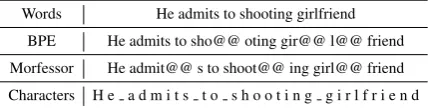
Words He admits to shooting girlfriend
BPE He admits to sho@@ oting gir@@ l@@ friend
Morfessor He admit@@ s to shoot@@ ing girl@@ friend
Characters H e a d m i t s t o s h o o t i n g g i r l f r i e n d
Table 2: Example with different segmentations.
We then train a logistic regression classifier, minimizing the cross-entropy loss:
L(θ) =−X
i
logPθ(li|xi)
wherePθ(l|xi) = Pexp(θl·zi)
l0exp(θl0·zi) is the probability
that wordxiis assigned labell.
We learn the weightsθ∈RD×Lusing gradient
descent. HereDis the dimensionality of the latent representationszi andLis the size of the label set
for propertyP. See Section4for details.
3.1 Word Representation Units
We consider four representation units: words, byte-pair encoding (BPE) units, morphological units, and characters. Table 2shows an example of each representation unit.BPEsplits words into symbols (a symbol is a sequence of characters) and then iteratively replaces the most frequent se-quences of symbols with a new merged symbol. In essence, frequent character n-grams merge to form one symbol. The number of merge oper-ations is controlled by a hyper-parameter OP; a high value ofOPmeans coarse segmentation and a low value means fine-grained segmentation ( Saj-jad et al.,2017). For morphologically segmented units, we use an unsupervised morphological seg-menter, Morfessor (Smit et al., 2014). Note that although BPE and Morfessor segment words at a similar level of granularity, the segmentation gen-erated by Morfessor is linguistically motivated. For example, it splits the gerund verb shooting
into rootshootand the suffixing. Compare this to the BPE segmentationsho+oting, which has no linguistic connotation. On the extreme, the fully
character-levelunits treat each word as a sequence of characters.
3.2 Extracting Activations for Subword and Character Units
Previous work on analyzing NMT representations has been limited to the analysis of word represen-tations only,1where there is a one-to-one mapping from input units (words) and their NMT represen-tations (hidden states) to their linguistic annota-tions (e.g., morphological tags).
In the case of subword-based systems, each word may be split into multiple subword units, and each unit has its own representation. It is less trivial to define which representations should be evaluated when predicting a word-level linguistic property such as part of speech. We consider two simple approximations to estimate a word repre-sentation from subword units:
(i) Average: for each source (or target) word, we average the activation values of all the sub-words (or characters) comprising it. In the case of a bi-directional encoder, we concate-nate the averages from the forward and the backward activations of the encoder on the subwords (or characters) that represent the current word.2
(ii) Last: we consider the activation of the last subword (or character) as the representation of the word. For the bi-directional encoder, we concatenate the forward encoder’s activa-tion on the last subword unit with the back-ward encoder’s activation on the first sub-word unit.
This formalization allows us to analyze the quality of character- and subword-based represen-tations at the word level via prediction tasks. Such kind of analysis has not been performed before.
1Belinkov et al.(2017a) analyzed representations trained from character CNN models (Kim et al.,2016), but the ex-tracted features were still based on word representations pro-duced by the character CNN. As a result, they could not an-alyze and compare results for the BPE and character-based models that do not assume segmentation into words.
4 Linguistic Properties
We choose three fundamental NLP tasks that serve as a good representative of various properties in-herent in a language, ranging from morphology (word structure), syntax (grammar), and semantics (meaning). In particular, we experiment with mor-phological tagging for German, Czech, Russian, and English,3lexical semantic taggingfor English and German, and syntactic tagging via CCG su-pertagging for English. Table1shows an example sentence with annotations for each task.
The morphological tags capture word structure, the semantic tags reflect lexical semantics, and the syntactic tags (CCG supertags) capture global syn-tactic information locally, at the lexical level.
For example, in Table1, the morphological tag
VBZ for the wordreceives marks it as a verb in third person, singular, present tense; the semantic tagENSdescribes apresent simple eventcategory; and the syntactic tagPP/NP) can be thought of as a function that takes a noun phrase on the right (e.g., the capital of USA), and returns a preposi-tional phrase (e.g.,in the capital of USA).
Artificial Error Induction Recent studies have shown that small perturbations in the input can cause significant deterioration in the performance of the deep neural networks. Here, we evaluate the robustness of various representations under noisy input conditions. We use corpora of real errors harvested byBelinkov and Bisk (2018). The er-rors contain a good mix of typos, misspellings, and other kinds of errors. In addition, we created data with synthetic noise. We induced two kinds of er-rors: (i)swapand (ii)middle. Swapis a common error, which occurs when neighboring characters are mistakenly swapped, e.g., word → wodr. In
Middle errors, the order of the first and the last characters of a word are preserved, while the mid-dle characters are randomly shuffled (Rawlinson,
1976), e.g.,example→eaxmlpe. We corruptn% words randomly in each test sentence, usingswap
ormiddleheuristics, or replace words using real-error corpora. We then re-extract feature vectors for the erroneous words in a sentence and we re-evaluate the prediction capability of these embed-dings on the linguistic tasks.
3As English is morphologically poor, we use part-of-speech tags for it. We refer to English part-of-part-of-speech tags as morphological tags later in the paper in order to keep the terminology consistent.
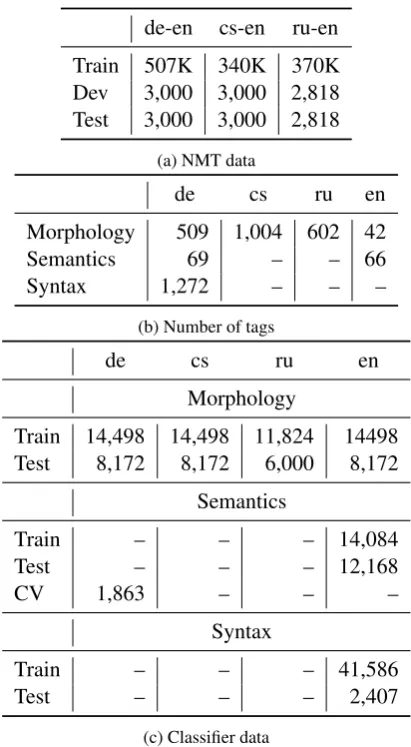
de-en cs-en ru-en
Train 507K 340K 370K Dev 3,000 3,000 2,818 Test 3,000 3,000 2,818
(a) NMT data
de cs ru en
Morphology 509 1,004 602 42 Semantics 69 – – 66 Syntax 1,272 – – –
(b) Number of tags
de cs ru en
Morphology
Train 14,498 14,498 11,824 14498 Test 8,172 8,172 6,000 8,172
Semantics
Train – – – 14,084
Test – – – 12,168
CV 1,863 – – –
Syntax
Train – – – 41,586
Test – – – 2,407
[image:4.595.313.519.59.433.2](c) Classifier data
Table 3: Statistics about NMT and classifier training data for English (en), German (de), Russian (ru), and Czech (cs). Here, CV stands for cross-validation.
5 Experimental Setup
Data and Languages We trained NMT systems for four language pairs: German-English, Czech-English, Russian-Czech-English, and English-German, using data made available through two popular machine translation campaigns, namely, WMT (Bojar et al., 2017) and IWSLT (Cettolo et al.,
Taggers We used RDRPOST (Nguyen et al.,
2014) to annotate data for the classifier. For mantic tagging, we used the gold-annotated se-mantic tags from the Groningen Parallel Mean-ing Bank (Abzianidze et al., 2017), which were made available by (Bjerva et al., 2016). The tags are grouped into coarse categories such as events, names, time, and logical expressions. There is enough data for English (≈42K), and we ran-domly sampled the same amount of data we used to train our morphological classifiers to train the semantic classifiers. Yet, only 1,863 annotated sentences (12,783 tokens) were available for Ger-man. Thus, in the experiments, we performed 5-fold cross-validation. For CCG supertagging, we used the English CCGBank (Hockenmaier and Steedman, 2007), which contains 41,586/2,407 train/test sentences.4 See Table3for more detailed statistics about the train/dev/test datasets we used.
MT Systems and Classifiers We used
seq2seq-attn(Kim,2016) to train a two-layer
encoder-decoder NMT model based on LSTM representation with attention (Hochreiter and Schmidhuber, 1997) with a bidirectional encoder and a unidirectional decoder.5 We used 500 dimensions for both word embeddings and LSTM states. We trained the systems with SGD for 20 epochs and we used the final model, i.e., the one with the lowest loss on the development dataset, to generate features for the classifier.
We trained our neural machine translation models in both *-to-English and English-to-* translation directions, and we analyzed the representations from both the encoder and the decoder. In or-der to analyze the representations or-derived from the encoder side, we fixed the decoder side with BPE-based embeddings, and we trained the source side with word/BPE/Morfessor/character units. Simi-larly, when analyzing the representations from the decoder side, we trained the encoder representa-tion with BPE units, and we varied the decoder side using word/BPE/char units. Our motivation for this setup is that we wanted to analyze the encoder/decoder side representations in isolation, keeping the other half of the network (i.e., the de-coder/encoder) static across different settings.6
4
There are no available CCG banks for the other lan-guages we experiment with, except for a German CCG bank, which is not publicly available (Hockenmaier,2006).
5
The decoder has to be unidirectional as, at decoding time, the future is unknown.
6Heigold et al.(2018) used a similar setup.
In our experiments, we used 50k BPE operations and we limited the vocabulary of all systems to 50k. Moreover, we trained the word, BPE, Mor-fessor, and character-based systems with maxi-mum sentence lengths of 80, 100, 100, and 400 units, respectively.
For the classification tasks, we used a logis-tic regression classifier whose input is either the hidden states in the case of the word-based mod-els, or theLastor the Averagerepresentations in the case of character- and subword-based mod-els. Since for the bidirectional encoder we con-catenate forward and backward states from all layers, this yields 2,000/1,000 dimensions when classifying using the representations from the en-coder/decoder: 500 dimensions×2 layers×2 di-rections (1 for the decoder, as it is uni-directional). In all cases, we trained the logistic regression clas-sifier for ten epochs.
6 Results
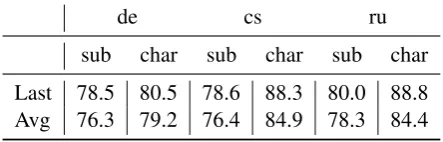
We now present the evaluation results for using representations learned from different input units to predict morphology, semantics, and syntax. For subword and character units, we found the activa-tion of the last subword/character unit of a word to be consistently better than using the average of all activations (See Table4). Therefore, we report only the results using theLastmethod, for the re-mainder of the paper.
de cs ru
sub char sub char sub char
[image:5.595.306.528.489.560.2]Last 78.5 80.5 78.6 88.3 80.0 88.8 Avg 76.3 79.2 76.4 84.9 78.3 84.4
Table 4: Classifier accuracy for the representations generated by aggregating subword (sub) or character (char) representations using either the average or the last LSTM state for each word.
6.1 Morphological Tagging
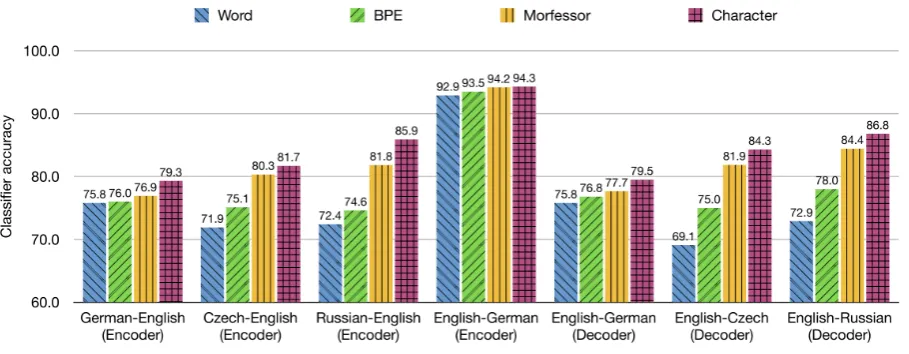
Figure 1: Morphological tagging accuracy across various systems and language pairs. The first four groups of results use BPE on the decoder side, while the last three groups use BPE on the encoder side.
0 100 101
0.2 0.4 0.6 0.8 1.0
Cl
assi
fie
r a
ccu
racy
German-English
0 100 101
Czech-English
0 100 101
Russian-English
0 100 101
English-German
Token Frequency
[image:6.595.80.524.289.422.2]Word BPE Morfessor Character
Figure 2: Morphological tagging accuracy vs. word frequency for different encoding units. Best viewed in color.
de-en cs-en ru-en en-de
word→bpe 34.0 27.5 20.9 29.7
bpe→bpe 35.6 28.4 22.4 30.2
morf→bpe 35.5 28.5 22.5 29.9
char→bpe 34.9 29.0 21.3 30.0
Table 5: BLEU scores across language pairs. “s→t” meanssource andtarget units; morf = Morfessor.
de-en cs-en ru-en en-de
MT 3.42 6.46 6.86 0.82 Classifier 4.42 6.13 6.61 2.09
Table 6: OOV rate for the MT and the classifier testsets.
We see in Figure1a difference of up to 14% in fa-vor of character-based representations when com-pared with word-based ones. The improvement is minimal in the case of English (1.2%), which is a morphologically simpler language. This is also
somewhat reflected in the translation quality.
We can see in Table 5 that character-based seg-mentation yielded higher BLEU scores in the case of a morphologically rich language such as Czech, but performed poorly in the case of German, which requires handling long-distance dependen-cies. Comparing subword units, we found Mor-fessor to yield much better morphological tagging performance, especially in the case of morpho-logically rich languages such as Czech and Rus-sian, supposedly due to the Morfessor’s linguisti-cally motivated segmentations, which are helpful for learning morphology.
We further investigated whether the perfor-mance difference between the representations is due to the difference in modeling infrequent and out-of-vocabulary (OOV) words. Table 6 shows the OOV rate for each language, which is higher for morphologically rich languages. Figure 2
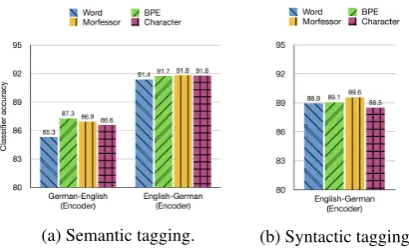
(a) Semantic tagging. (b) Syntactic tagging.
Figure 3: Semantic and syntactic tagging for English and German (using BPE on the decoder).
the word in the training data, and character-based models handle infrequent and OOV words better.
Decoder Representations Next, we used the decoder representations from the English-to-* models. We saw similar performance trends as for the encoder-side representations: characters per-formed best, and words perper-formed worst. Again, the morphological units performed better than the BPE-based units. Comparing encoder representa-tions to decoder representarepresenta-tions, it is interesting to see that in several cases the decoder side repre-sentations performed better than the encoder side ones, even though the former were trained using a uni-directional LSTM. However, since there is no difference in the general trends between the encoder- and the decoder-side representations, be-low we focus on the encoder-side only.
6.2 Semantic Tagging
Figure 3a summarizes the experimental results for evaluating representtaion units of the seman-tic tagging task. For English, the subword (BPE and Morfessor) and the character representations yielded comparable results. However, for German, BPE performed better. This is in contrast with the morphology prediction experiments, where the character representations were consistently better. We will discuss this in more detail in Section7.
6.3 Syntactic Tagging
The final task we experimented with is CCG super-tagging, which reflects modeling syntactic structure. Here we only have English tags, and thus we evaluate the performance of encoder rep-resentations for English→German models, trained using words, characters, and subword units.
We can see in Figure 3b that the morpholog-ically segmented representation units performed
the best overall. Moreover, there is no much differ-ence when using word-based vs. BPE-based repre-sentations.
The character-based representations lag behind, but the difference in accuracy is small compared to the morphological tagging results.7 It is notewor-thy that here character-based representations per-form worse than both words and subwords, con-trary to their superior performance on morphol-ogy. We will return to this in Section7below.
6.4 Robustness to Noise
Next, we evaluated the robustness of the represen-tations with respect to noise. We induced errors in the test sets by corrupting 25% of the words in each sentence using different error types (syn-thetic or real noise), as described in Section 4. We extracted the representations of the noisy test sets and we re-evaluated the classifiers. Figure4
shows the performance on each task. We can see that characters yielded much better performance on all tasks and for all languages, showing mini-mal drop in accuracy, in contrast to earlier results where they did not outperform subword units8on
the task of syntactic tagging. This shows that char-acter representations are more robust to noise.
Surprisingly, in a few cases, BPE performed worse than word units, e.g., in the case of syntac-tic tagging (80.3 vs. 81.1). We found that BPE can segment a noisy word into two or more known subword units that have no real relationship to the actual word. Thus, using representations of wrong subword units could hurt the performance.
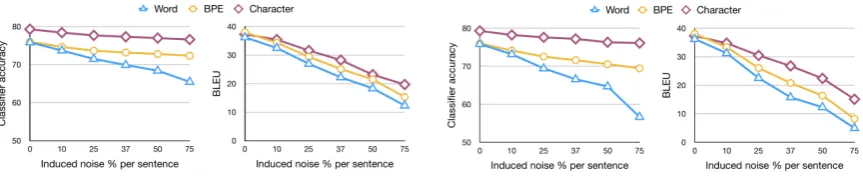
We further investigated the robustness of each classifier by increasing the percentage of noise in the test data. We found that the difference in rep-resentation quality stays constant across BPE and character representations, whereas word represen-tations deteriorate significantly as the amount of noise increases (see Figure5).
7 Discussion
7.1 Performance Across Various Tasks
Our experiments show a complicated picture, where none of the representations is superior in all scenarios. Characters were found to be bet-ter for morphological tagging, BPE was ahead in
7For perspective, these numbers are above a majority class baseline of 72% and below the state-of-the-art, which is around 94-95% (Kadari et al.,2018;Xu,2016).
Figure 4: Classification accuracy for morphological, syntactic and semantic tagging with 25% noise in each sen-tence. Absolute scores (original→noisy) are shown inset.
[image:8.595.80.499.67.261.2](a) Real noise. (b) Synthetic noise.
Figure 5: Results for morphological classification when adding induced noise.
the semantic tagging task for German (and about the same in English), and Morfessor units were slightly better for syntax.
Syntactic tagging requires knowledge about the complete sentence. Splitting a sentence into char-acters substantially increases its length: on aver-age from 50 words to 250 single-character tokens. Thus, character-based models struggle to capture long-distance dependencies. Sennrich(2017) also found this to be true in their evaluation based on contrastive translation pairs in German-English.
Similarly, in the case of morphological tagging, the information about the morphological structure of a word is dependent on the surrounding words plus some internal information (root, morphemes, etc.) present inside the word. A character-based system has access to all of this information, and thus performs well. Morphological segmentation performed better than BPE for the morpholog-ical tagging because its segments are linguisti-cally motivated units (segmented into root + mor-phemes), thus making the information about the word morphology explicit in the representation.
In contrast, BPE solely focuses on the frequency of characters occurring together in the corpus, and thus can generate linguistically incorrect units.
W B C W+B B+C W+C ALL
Morph
DE 75.8 76.0 79.3 78.0 80.8 81.1 81.6 CS 71.9 75.1 81.7 77.2 84.0 84.1 85.0 RU 72.4 74.6 85.9 77.1 88.1 88.2 88.6 EN 92.9 93.5 94.3 94.2 95.2 95.1 95.4 Sem EN 91.1 91.4 91.4 92.6 93.0 93.1 93.4
Table 7: Classification accuracy for combined rep-resentations for morphological and semantic tagging. Here, W/B/C stand for word/BPE/character units.
7.2 The Best of Many Worlds
The variations in performance for different repre-sentations suggest that they are learning different aspects of language, which might be complemen-tary. Thus, we tried to combine them. Table 7
summarizes the results for morphological and se-mantic tagging.9 We can see that combinations in-volving characters (B+C, W+C in the table) yield
[image:8.595.79.511.306.401.2]larger improvement compared to combining word-and BPE-based representations (W+B). However, combining all three performed best for all lan-guages and for all tasks.
7.3 State-of-the-Art Embeddings
We connect our findings with recent work on train-ing state-of-the-art embeddtrain-ings: CoVe (McCann et al., 2017), ELMo (Peters et al., 2018), and BERT (Devlin et al., 2019). Each of these ar-chitectures uses different units of representations: e.g., CoVe uses words, BERT is based on subword units, while ELMo focuses on characters.10
We speculate that, although these models yield state-of-the-art results for several tasks, their per-formance may be suboptimal because of the choice of their underlying representation units. In our experiments above, we have shown that it is possible to achieve potentially better performance when using units of different granularity jointly.
We have further shown that the best-performing representation unit is target task-dependent. We believe this would be true for more complex NLP tasks as well. For example, question answering generally requires learning long-range dependen-cies, and thus embeddings from a character-based model might not be the right choice in this case. Our results show that character-based models are not a viable option for handling long-range depen-dencies, and subword-based representations might be a better option for such tasks.
7.4 Translation vs. Representation Quality
Table5summarizes the translation performance of each system. We can see that in most cases, the subword-based systems perform better than the word-based and the character-based ones. How-ever, this is not true in the case of using their repre-sentations as features for a core NLP task as in our experiments above. For example, we have found that character-based representations perform best for the morphological tagging task. On a side note, although BPE-based representations perform better for some tasks, they are sensitive to noise. Their capability of segmenting any OOV word into known subwords may result in less reliable systems. Notably, the translation performance of the BPE-based system can fall below that of the character-based system even in the presence of
10However, note that ELMo uses character convolutions, which is different from a fully character-based model.
only 10% noise: from 0.7 BLEU in favor of BPE on clean data to 0.8/1.1 BLEU in favor of charac-ters with synthetic/real errors.
8 Conclusion and Future Work
We studied the impact of using different represen-tation units—words, characters, BPE units, and morphological segments—on the representations learned by seq2seq models trained for neural ma-chine translation. In particular, we evaluated the performance of such representations on core natu-ral language processing tasks modeling morphol-ogy, syntax, and semantics.
Based on our experiments, we can make the fol-lowing conclusions:
• Representations derived from subword units are better for modeling syntax.
• Character-based representations are dis-tinctly better for modeling morphology.
• Character-based representations are very ro-bust to noise.
• Using a combination of different representa-tions often works best.
Based on our findings, we further conjecture that although subword-based segmentation based on BPE are a de-facto standard when building state-of-the-art NMT systems, the underlying rep-resentations they yield are suboptimal for many external tasks. Character-based representations provide a more viable and robust alternative in this regard, followed by morphological segmentation.
In future work, we plan to study how different units affect representation quality in non-recurrent models such as the Transformer (Vaswani et al.,
2017) as well as in convolutional architectures (Gehring et al., 2017). We would also like to explore representations from robustly trained sys-tems, which should improve performance on noisy input (Belinkov and Bisk, 2018; Heigold et al.,
2018). Finally, it would be interesting to study representations in other NLP tasks besides neural machine translation.
Acknowledgements
References
Lasha Abzianidze, Johannes Bjerva, Kilian Evang, Hessel Haagsma, Rik van Noord, Pierre Ludmann, Duc-Duy Nguyen, and Johan Bos. 2017. The paral-lel meaning bank: Towards a multilingual corpus of translations annotated with compositional meaning representations. InProceedings of the 15th Confer-ence of the European Chapter of the Association for Computational Linguistics, EACL ’17, pages 242– 247, Valencia, Spain.
Yossi Adi, Einat Kermany, Yonatan Belinkov, Ofer Lavi, and Yoav Goldberg. 2017. Fine-grained anal-ysis of sentence embeddings using auxiliary pre-diction tasks. In Proceedings of the International Conference on Learning Representations, ICLR ’17, Toulon, France.
Dzmitry Bahdanau, Jan Chorowski, Dmitriy Serdyuk, Philemon Brakel, and Yoshua Bengio. 2016. End-to-end attention-based large vocabulary speech recognition. In Proceedings of the 2016 IEEE In-ternational Conference on Acoustics, Speech and Signal Processing, ICASSP ’16, pages 4945–4949, Shanghai, China.
Anthony Bau, Yonatan Belinkov, Hassan Sajjad, Nadir Durrani, Fahim Dalvi, and James Glass. 2019. Iden-tifying and controlling important neurons in neural machine translation. In Proceedings of the Inter-national Conference on Learning Representations, ICLR ’19, New Orleans, LA, USA.
Yonatan Belinkov and Yonatan Bisk. 2018. Synthetic and natural noise both break neural machine transla-tion. InProceedings of the International Conference on Learning Representations, ICLR ’18, Vancouver, Canada.
Yonatan Belinkov, Nadir Durrani, Fahim Dalvi, Hassan Sajjad, and James Glass. 2017a. What do neural ma-chine translation models learn about morphology? InProceedings of the 55th Annual Meeting of the As-sociation for Computational Linguistics, ACL ’17, pages 861–872, Vancouver, Canada.
Yonatan Belinkov and James Glass. 2019. Analysis methods in neural language processing: A survey.
Transactions of the Association for Computational Linguistics, 7:49–72.
Yonatan Belinkov, Llu´ıs M`arquez, Hassan Sajjad, Nadir Durrani, Fahim Dalvi, and James Glass. 2017b. Evaluating layers of representation in neural machine translation on part-of-speech and semantic tagging tasks. In Proceedings of the 8th Interna-tional Joint Conference on Natural Language Pro-cessing, IJCNLP ’17, pages 1–10, Taipei, Taiwan.
Johannes Bjerva, Barbara Plank, and Johan Bos. 2016. Semantic tagging with deep residual networks. In
Proceedings of the 26th International Conference on Computational Linguistics, COLING ’16, pages 3531–3541, Osaka, Japan.
Ondˇrej Bojar, Rajen Chatterjee, Christian Federmann, Yvette Graham, Barry Haddow, Shujian Huang, Matthias Huck, Philipp Koehn, Qun Liu, Varvara Logacheva, Christof Monz, Matteo Negri, Matt Post, Raphael Rubino, Lucia Specia, and Marco Turchi. 2017. Findings of the 2017 conference on machine translation. In Proceedings of the Sec-ond Conference on Machine Translation, WMT ’17, pages 169–214, Copenhagen, Denmark.
James Bradbury and Richard Socher. 2016. MetaMind neural machine translation system for WMT 2016. InProceedings of the First Conference on Machine Translation, WMT ’16, pages 264–267, Berlin, Ger-many.
Mauro Cettolo, Jan Niehues, Sebastian St¨uker, Ben-tivogli Luisa, and Marcello Federico. 2016. The IWSLT 2016 evaluation campaign. InProceedings of the 13th International Workshop on Spoken Lan-guage Translation, IWSLT ’16, Seattle, WA, USA.
Junyoung Chung, Kyunghyun Cho, and Yoshua Ben-gio. 2016. A character-level decoder without ex-plicit segmentation for neural machine translation. InProceedings of the 54th Annual Meeting of the As-sociation for Computational Linguistics, ACL ’16, pages 1693–1703, Berlin, Germany.
Alexis Conneau, Germ´an Kruszewski, Guillaume Lample, Lo¨ıc Barrault, and Marco Baroni. 2018. What you can cram into a single $&!#* vector: Probing sentence embeddings for linguistic proper-ties. In Proceedings of the 56th Annual Meeting of the Association for Computational Linguistics, ACL ’18, pages 2126–2136, Melbourne, Australia.
Marta R. Costa-juss`a and Jos´e A. R. Fonollosa. 2016. Character-based neural machine translation. In Pro-ceedings of the 54th Annual Meeting of the Associa-tion for ComputaAssocia-tional Linguistics, ACL ’16, pages 357–361, Berlin, Germany.
Fahim Dalvi, Nadir Durrani, Hassan Sajjad, Yonatan Belinkov, D. Anthony Bau, and James Glass. 2019. What is one grain of sand in the desert? Analyz-ing individual neurons in deep nlp models. In Pro-ceedings of the AAAI Conference on Artificial Intel-ligence, AAAI ’19, Honolulu, HI, USA.
Fahim Dalvi, Nadir Durrani, Hassan Sajjad, Yonatan Belinkov, and Stephan Vogel. 2017. Understanding and improving morphological learning in the neu-ral machine translation decoder. InProceedings of the Eighth International Joint Conference on Natu-ral Language Processing, IJCNLP ’17, pages 142– 151, Taipei, Taiwan.
Nadir Durrani, Hassan Sajjad, Hieu Hoang, and Philipp Koehn. 2014. Integrating an unsupervised translit-eration model into statistical machine translation. In
Proceedings of the 14th Conference of the European Chapter of the Association for Computational Lin-guistics, EACL ’14, pages 148–153, Gothenburg, Sweden.
Javid Ebrahimi, Anyi Rao, Daniel Lowd, and Dejing Dou. 2018. HotFlip: White-box adversarial exam-ples for text classification. In Proceedings of the 56th Annual Meeting of the Association for Com-putational Linguistics, ACL ’18, pages 31–36, Mel-bourne, Australia.
J. Ganesh, Manish Gupta, and Vasudeva Varma. 2017. Interpretation of semantic tweet representations. In
Proceedings of the 2017 IEEE/ACM International Conference on Advances in Social Networks Analy-sis and Mining 2017, ASONAM ’17, pages 95–102, Sydney, Australia.
Ji Gao, Jack Lanchantin, Mary Lou Soffa, and Yan-jun Qi. 2018. Black-box generation of adversarial text sequences to evade deep learning classifiers. In
Proceedings of the 2018 IEEE Security and Privacy Workshop, SPW ’18, pages 50–56, San Francisco, CA, USA.
Jonas Gehring, Michael Auli, David Grangier, Denis Yarats, and Yann N. Dauphin. 2017. Convolutional Sequence to Sequence Learning. In Proceedings of the 34th International Conference on Machine Learning, ICML ’17, pages 1243–1252, Sydney, Australia.
Ian Goodfellow, Jonathon Shlens, and Christian Szegedy. 2015. Explaining and harnessing adver-sarial examples. InProceedings of the International Conference on Learning Representations, ICLR ’15, San Diego, CA, USA.
Kaiming He, Xiangyu Zhang, Shaoqing Ren, and Jian Sun. 2016. Deep residual learning for image recog-nition. In Proceedings of the 2016 IEEE Confer-ence on Computer Vision and Pattern Recognition, CVPR ’16, pages 770–778, Las Vegas, CA, USA.
Georg Heigold, Stalin Varanasi, G¨unter Neumann, and Josef Genabith. 2018. How robust are character-based word embeddings in tagging and MT against wrod scramlbing or randdm nouse? In Proceed-ings of the 13th Conference of the Association for Machine Translation in the Americas, AMTA ’18, pages 68–80, Boston, MA, USA.
Sepp Hochreiter and J¨urgen Schmidhuber. 1997. Long short-term memory. Neural computation, 9(8):1735–1780.
Julia Hockenmaier. 2006. Creating a CCGbank and a wide-coverage CCG lexicon for German. In Pro-ceedings of the 21st International Conference on Computational Linguistics and 44th Annual Meet-ing of the Association for Computational LMeet-inguis- Linguis-tics, ACL ’06, pages 505–512, Sydney, Australia.
Julia Hockenmaier and Mark Steedman. 2007. CCG-bank: a corpus of CCG derivations and dependency structures extracted from the Penn Treebank. Com-putational Linguistics, 33(3):355–396.
Robin Jia and Percy Liang. 2017. Adversarial ex-amples for evaluating reading comprehension sys-tems. In Proceedings of the 2017 Conference on Empirical Methods in Natural Language Process-ing, EMNLP ’17, pages 2011–2021, Copenhagen, Denmark.
Rekia Kadari, Yu Zhang, Weinan Zhang, and Ting Liu. 2018. CCG supertagging via Bidirectional LSTM-CRF neural architecture. Neurocomputing, 283:31– 37.
Yoon Kim. 2016. Seq2seq-attn. https:// github.com/harvardnlp/seq2seq-attn.
Yoon Kim, Yacine Jernite, David Sontag, and Alexan-der M. Rush. 2016. Character-aware neural lan-guage models. InProceedings of the Thirtieth AAAI Conference on Artificial Intelligence, AAAI’16, pages 2741–2749, Phoenix, AZ, USA.
Yair Lakretz, German Kruszewski, Theo Desbordes, Dieuwke Hupkes, Stanislas Dehaene, and Marco Baroni. 2019. The emergence of number and syntax units in LSTM language models. InProceedings of the 17th Annual Conference of the North American Chapter of the Association for Computational Lin-guistics: Human Language Technologies, NAACL-HLT ’19, Minneapolis, MN, USA.
Jason Lee, Kyunghyun Cho, and Thomas Hofmann. 2017. Fully character-level neural machine trans-lation without explicit segmentation. Transactions of the Association for Computational Linguistics, 5:365–378.
Bin Liang, Hongcheng Li, Miaoqiang Su, Pan Bian, Xirong Li, and Wenchang Shi. 2018. Deep text classification can be fooled. InProceedings of the Twenty-Seventh International Joint Conference on Artificial Intelligence, IJCAI ’18, pages 4208–4215, Stockholm, Sweden.
Wang Ling, Isabel Trancoso, Chris Dyer, and Alan W. Black. 2015. Character-based neural machine trans-lation.CoRR, abs/1511.04586.
Tal Linzen, Emmanuel Dupoux, and Yoav Goldberg. 2016. Assessing the Ability of LSTMs to Learn Syntax-Sensitive Dependencies.Transactions of the Association for Computational Linguistics, 4:521– 535.
Tomas Mikolov, Kai Chen, Greg Corrado, and Jeffrey Dean. 2013a. Efficient estimation of word represen-tations in vector space. InProceedings of the ICLR Workshop, Scottsdale, AZ, USA.
Tomas Mikolov, Edouard Grave, Piotr Bojanowski, Christian Puhrsch, and Armand Joulin. 2018. Ad-vances in pre-training distributed word representa-tions. In Proceedings of the International Con-ference on Language Resources and Evaluation, LREC ’18, Miyazaki, Japan.
Tomas Mikolov, Ilya Sutskever, Kai Chen, Greg S Cor-rado, and Jeff Dean. 2013b. Distributed representa-tions of words and phrases and their compositional-ity. InAdvances in Neural Information Processing Systems, NIPS ’13, pages 3111–3119, Stateline, NV, USA.
Dat Quoc Nguyen, Dai Quoc Nguyen, Dang Duc Pham, and Son Bao Pham. 2014. RDRPOSTagger: A ripple down rules-based part-of-speech tagger. In
Proceedings of the 14th Conference of the European Chapter of the Association for Computational Lin-guistics, EACL ’14, pages 17–20, Gothenburg, Swe-den.
Nicolas Papernot, Patrick McDaniel, Ananthram Swami, and Richard Harang. 2016. Crafting adver-sarial input sequences for recurrent neural networks. In Proceedings of the IEEE Military Communica-tions Conference, MILCOM ’16, pages 49–54, Bal-timore, MD, USA.
Kishore Papineni, Salim Roukos, Todd Ward, and Wei-Jing Zhu. 2002. BLEU: a method for automatic evaluation of machine translation. In Proceedings of the Association for Computational Linguistics, ACL ’02, pages 311–318, Philadelphia, PA, USA.
Jeffrey Pennington, Richard Socher, and Christo-pher D. Manning. 2014. GloVe: Global vectors for word representation. In Proceedings of the Con-ference on Empirical Methods in Natural Language Processing, EMNLP ’14, pages 1532–1543, Doha, Qatar.
Matthew Peters, Mark Neumann, Mohit Iyyer, Matt Gardner, Christopher Clark, Kenton Lee, and Luke Zettlemoyer. 2018. Deep contextualized word repre-sentations. InProceedings of the 2018 Conference of the North American Chapter of the Association for Computational Linguistics: Human Language Technologies, NAACL ’18, pages 2227–2237, New Orleans, LA, USA.
Peng Qian, Xipeng Qiu, and Xuanjing Huang. 2016a. Analyzing linguistic knowledge in sequential model of sentence. InProceedings of the 2016 Conference on Empirical Methods in Natural Language Pro-cessing, EMNLP ’16, pages 826–835, Austin, TX, USA.
Peng Qian, Xipeng Qiu, and Xuanjing Huang. 2016b. Investigating language universal and specific prop-erties in word embeddings. InProceedings of the
54th Annual Meeting of the Association for Com-putational Linguistics, ACL ’16, pages 1478–1488, Berlin, Germany.
Graham Rawlinson. 1976. The significance of letter position in word recognition. Ph.D. thesis, Univer-sity of Nottingham.
Hassan Sajjad, Fahim Dalvi, Nadir Durrani, Ahmed Abdelali, Yonatan Belinkov, and Stephan Vogel. 2017. Challenging language-dependent segmenta-tion for Arabic: An applicasegmenta-tion to machine trans-lation and part-of-speech tagging. In Proceedings of the 55th Annual Meeting of the Association for Computational Linguistics, ACL ’17, pages 601– 607, Vancouver, Canada.
Suranjana Samanta and Sameep Mehta. 2017. Towards crafting text adversarial samples. arXiv preprint arXiv:1707.02812.
Rico Sennrich. 2017. How grammatical is character-level neural machine translation? Assessing MT quality with contrastive translation pairs. In Pro-ceedings of the 15th Conference of the European Chapter of the Association for Computational Lin-guistics, EACL ’17, pages 376–382, Valencia, Spain.
Rico Sennrich, Barry Haddow, and Alexandra Birch. 2016. Neural machine translation of rare words with subword units. InProceedings of the 54th Annual Meeting of the Association for Computational Lin-guistics, ACL ’16, pages 1715–1725, Berlin, Ger-many.
Xing Shi, Inkit Padhi, and Kevin Knight. 2016. Does string-based neural MT learn source syntax? In Pro-ceedings of the 2016 Conference on Empirical Meth-ods in Natural Language Processing, EMNLP ’16, pages 1526–1534, Austin, TX, USA.
Peter Smit, Sami Virpioja, Stig-Arne Gr¨onroos, and Mikko Kurimo. 2014. Morfessor 2.0: Toolkit for statistical morphological segmentation. In Proceed-ings of the 14th Conference of the European Chap-ter of the Association for Computational Linguistics, EACL ’14, pages 21–24, Gothenburg, Sweden.
Christian Szegedy, Wojciech Zaremba, Ilya Sutskever, Joan Bruna, Dumitru Erhan, Ian Goodfellow, and Rob Fergus. 2014. Intriguing properties of neu-ral networks. In Proceedings of the International Conference on Learning Representations, ICLR ’14, Banff, Canada.
Ke Tran, Arianna Bisazza, and Christof Monz. 2018. The importance of being recurrent for modeling hi-erarchical structure. In Proceedings of the 2018 Conference on Empirical Methods in Natural Lan-guage Processing, EMNLP ’18, pages 4731–4736, Brussels, Belgium.
you need. InAdvances in Neural Information Pro-cessing Systems 30, NIPS ’17, pages 5998–6008. Long Beach, CA, USA.
Ekaterina Vylomova, Trevor Cohn, Xuanli He, and Gholamreza Haffari. 2017. Word representation models for morphologically rich languages in neu-ral machine translation. InProceedings of the First Workshop on Subword and Character Level Models in NLP, SWCN ’17, pages 103–108, Copenhagen, Denmark.
Yu-Hsuan Wang, Cheng-Tao Chung, and Hung-yi Lee. 2017. Gate activation signal analysis for gated recurrent neural networks and its correla-tion with phoneme boundaries. In Proceedings of the 18th Annual Conference of the Interna-tional Speech Communication Association, Inter-speech ’2017, pages 3822–3826, Stockholm, Swe-den.
Yonghui Wu, Mike Schuster, Zhifeng Chen, Quoc V. Le, Mohammad Norouzi, Wolfgang Macherey, Maxim Krikun, Yuan Cao, Qin Gao, Klaus Macherey, Jeff Klingner, Apurva Shah, Melvin Johnson, Xiaobing Liu, ukasz Kaiser, Stephan Gouws, Yoshikiyo Kato, Taku Kudo, Hideto Kazawa, Keith Stevens, George Kurian, Nishant Patil, Wei Wang, Cliff Young, Jason Smith, Jason Riesa, Alex Rudnick, Oriol Vinyals, Greg Corrado, Macduff Hughes, and Jeffrey Dean. 2016. Google’s neural machine translation system: Bridging the gap between human and machine translation. CoRR, abs/1609.08144.
Zhizheng Wu and Simon King. 2016. Investigating gated recurrent networks for speech synthesis. In
Proceedings of the 2016 IEEE International Confer-ence on Acoustics, Speech and Signal Processing, ICASSP ’16, pages 5140–5144, Shanghai, China.