Insertion Position Selection Model for Flexible Non-Terminals in
Dependency Tree-to-Tree Machine Translation
Toshiaki Nakazawa
Japan Science and Technology Agency
5-3, Yonbancho, Chiyoda-ku, Tokyo, 102-8666, Japan [email protected]
John Richardson and Sadao Kurohashi
Kyoto University
Yoshida-honmachi, Sakyo-ku, Kyoto, 606-8501, Japan
[email protected] [email protected]
Abstract
Dependency tree-to-tree translation models are powerful because they can naturally han-dle long range reorderings which is important for distant language pairs. The translation pro-cess is easy if it can be accomplished only by replacing non-terminals in translation rules with other rules. However it is sometimes necessary to adjoin translation rules. Flex-ible non-terminals have been proposed as a promising solution for this problem. A flex-ible non-terminal provides several insertion position candidates for the rules to be ad-joined, but it increases the computational cost of decoding. In this paper we propose a neu-ral network based insertion position selection model to reduce the computational cost by selecting the appropriate insertion positions. The experimental results show the proposed model can select the appropriate insertion po-sition with a high accuracy. It reduces the de-coding time and improves the translation qual-ity owing to reduced search space.
1 Introduction
Tree-to-tree machine translation models currently receive limited attention. However, we believe that using target-side syntax is important to achieve high-quality translations between distant language pairs which require long range reorderings. Especially, using dependency trees on both source and tar-get sides is promising for this purpose (Menezes and Quirk, 2007; Nakazawa and Kurohashi, 2010; Richardson et al., 2014). Tree-based translation models naturally realize word reorderings using the non-terminals or anchors for the attachment in the translation rules: therefore they do not need a
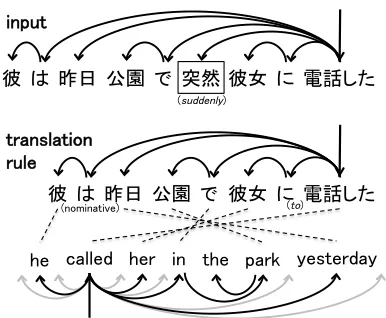
re-ordering model which string-based models require. For example, suppose we have a translation rule with the word alignment shown in Figure 1, it is easy to translate a new input sentence which has “図書館
(library)” instead of “公園(park)” because we can accomplish it by simply substituting “library” for the target word “park” without considering the reorder-ing. In this case, the source word “公園” and target word “park” work as the non-terminals.
On the other hand, it is problematic when we need to adjoin a subtree which is not presented in train-ing sentences, which we callfloatingsubtree in this paper. The floating subtrees are not necessarily ad-juncts, but any words or phrases. For example, sup-pose the Japanese input sentence in Figure 1 has “
突然 (suddenly)”, but the training corpus provides
only a translation rule without the word. In this case we cannot directly use the rule for the translation be-cause it does not know where to insert the translation of the floating word in the output. As another exam-ple, there is no context information available for the children of the OOV word in the input sentence, so we need some special process to translate them.
Previous work deals with this problem by us-ing glue rules (Chiang, 2005) or limitus-ing the de-pendency structures to be well-formed (Shen et al., 2008). Richardson et al. (2016) introduces the con-cept of flexiblenon-terminals. It provides multiple possible insertion positions for the floating subtree rather than fixed insertion positions. A possible in-sertion position must satisfy the following condi-tions:
• it must be a child of the aligned word of the parent of the floating subtree
• it must not violate the projectivity of the depen-dency tree
For example, possible insertion positions for the floating word “突然” are shown in gray arrows in
Figure 1. Since “突然” is a child of “電話する”, and the translation of “電話する” is “called”, insertion
positions must be a child of “called”. Also, insertion positions do not violate the projectivity of the tar-get tree. Flexible non-terminals are analogous to the auxiliary treeof the tree adjoining grammars (TAG) (Joshi, 1985), which is successfully adopted in ma-chine translation (DeNeefe and Knight, 2009). The difference is that TAG is defined on the constituency trees rather than the dependency trees.
Flexible non-terminals are powerful to handle floating subtrees and it achieve better translation quality. However the computational cost of decod-ing becomes high even though they are compactly represented in the lattice form (Cromieres and Kuro-hashi, 2014). In our experiments, using flexible non-terminals causes the decoding to be 3 to 6 times slower than when they are not used. Flexible non-terminals increase the number of translation rules because the insertion positions are selected during the decoding. However, we think it is possible to re-strict possible insertion positions or even select only one insertion position by looking at the tree struc-tures on both sides.
In this paper, we propose a method to select the appropriate insertion position before decoding. This can not only reduce the decoding time but also improve the translation quality because of reduced search space.
2 Insertion Position Selection
We assume that correct insertion positions can be determined before decoding, using the word to be inserted (I) with the context on the source side and
the context of the insertion positions on the target side. On the source side, we use the parent ofI(Ps) and the distance ofI from Ps (Ds). On the target side, we use the previous (Sp) and next (Sn) sibling of the insertion position, the parent of the insertion position (Pt) and the distance of the insertion posi-tion from Pt (Dt). The distances are calculated on the siblings rather than the words in the sentence, and it is a positive or negative value if the insertion
彼 は 昨日 公園 で 彼女 に 電話した
he called her in the park yesterday
(to) (nominative)
彼 は 昨日 公園 で 突然 彼女 に 電話した
(suddenly)
input
[image:2.612.331.524.55.214.2]translation rule
Figure 1:Example of an input sentence and a translation rule.
We want to insert “突然(suddenly)” which is not in the transla-tion rule. The possible insertransla-tion positransla-tions in the target sentence are shown in gray arrows.
position is to the left or to the right of the parent re-spectively.
Taking the insertion position between “park” and “yesterday” in Figure 1 as an example,I = “突然”,
Ps= “電話した”,Ds= +2,Sp= “park”,Sn= “yes-terday”,Pt= “called” andDt= -3. In cases where
Sp orSn is empty, we use special words “[[LEFT-START]]”, “[[LEFT-END]]”, “[[RIGHT-START]]” and “[[RIGHT-END]]”. In the case of “yesterday” in Figure 1,Sp= “in” andSn= “[[RIGHT-END]]”. These clues are fed into the neural network model to solve the insertion position selection problem.
2.1 Neural Network Model
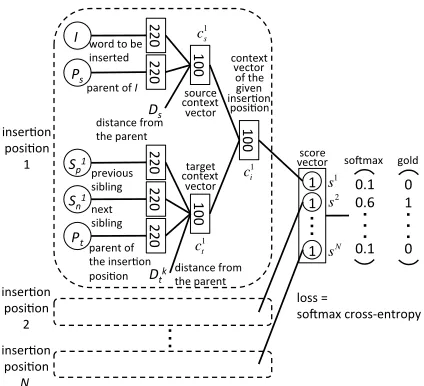
Figure 2 shows the neural network model for the in-sertion position selection. Given an inin-sertion posi-tion candidate with an index k, the words (I, Ps,
Spk,Snk,Pt) are first converted into vector represen-tations through the same three embedding layers: surface form embedding (200 dimensions.), part-of-speech embedding (10 dimensions) and depen-dency type (or phrase category) embedding (10 di-mensions), and they are concatenated to create the 220-dimension vectors. The word embedding is a randomly initialized transformation from an one-hot vector to a 200 or 10-dimensional vector, and it is learned during the whole network training.
Using these words and the distances, we create source and target context vectors ck
vec-220
I
Ps
P Sp1
Sn1
Ds
Dtk
100 100 220 220 220 220 100 source context vector target context vector context vector of the given inser4on posi4on 1 1 1 inser4on posi4on 1 inser4on posi4on 2 inser4on posi4on N score vector 0.1 0.6 0.1 0 1 0 so8max gold loss = so8max cross-entropy
word to be inserted
parent of I
[image:3.612.79.291.56.249.2]previous sibling next sibling parent of the inser4on posi4on distance from the parent distance from the parent cs 1 ct 1 ci1 s1 s2 sN
Figure 2: The neural network for the insertion position
selec-tion. The numbers inside the boxes show the dimensions of the vectors.
tor of the given insertion positionck
i is created using
cks andckt. Finally we get the score of the given
in-sertion positionskfromcki. These vectors are
calcu-lated as follows:
cks = tanh(Wcs[I;Ps;Ds])
ckt = tanh(Wct[Sp;Sn;Pt;D
k t])
cki = tanh(Wci[c
k s;ckt])
sk = Wscki
where “;” means concatenation of the vectors. The size ofcks,ckt andcki is 100 in our experiments.
The same network is applied to all the other in-sertion positions and get their scores. Finally the scores are normalized by the softmax function, and the loss is calculated by the softmax cross-entropy as the loss function. All the links between layers are fully-connected. We use dropout (50%) to avoid overfitting.
2.2 Training Data Generation
The data for training the neural network model can be automatically generated from the word-aligned parallel corpus with dependency parses in both sides by Algorithm 1. The ALIGNMENT function returns the aligned word in the target tree for the given source word1, and the ISPARENTCHILDfunction
re-turns TRUE ifPtis the parent ofCt.
1In case of the multiple word alignment, we only use the
root word of them in both source and target sides.
Algorithm 1Training Data Generation for NN
for allPs∈words in source treedo
Pt=ALIGNMENT(Ps)
for allCs∈CHILDREN(Ps)do
Ct=ALIGNMENT(Cs)
ifISPARENTCHILD(Pt, Ct)then
GENERATEDATA(Ps, Cs, Pt, Ct)
end if end for end for
Ja↔En Ja↔Zh Training 2,020,106 667,520 Development 1,789 2,115
Test 1,812 2,174
Table 1:The number of sentences in ASPEC used in our
exper-iments.
The GENERATEDATAfunction generates one in-stance of training data to predict the position ofCt fromPs,CsandPtwith their contexts by removing
Ctin the target tree. The position whereCtexists is regarded as the correct insertion position, and others as incorrect insertion positions. Note thatCs corre-sponds toI in Figure 2.
2.3 Insertion Position Selection in Translation Once the neural network model is trained, it can be applied to select the most appropriate insertion po-sitions in the translation rules for the given float-ing subtree by lookfloat-ing at the score of each inser-tion posiinser-tion. Translainser-tion rules only contain part of the original parallel sentence in most of the cases. This means that the context used for selecting the in-sertion position is different from that in the training data for the neural network. For example, if the in-put sentence does not have “公園 で(in the park)” in
Figure 1, the number of possible insertion positions is 6 and we do not use “in” as the context. How-ever, this is not so problematic because similar or same context may appear in the different part of the corpus.
3 Experiments
[image:3.612.315.541.66.236.2]Ja→En En→Ja Ja→Zh Zh→Ja
Training 15.7M 5.7M
Development 160K 58K
Test 160K 58K
ave. # IP 3.39 3.15 3.72 3.41
best epoch 89 71 61 79
[image:4.612.72.299.56.174.2]mean loss 0.089 0.058 0.105 0.056 Accuracy (%) 97.08 97.72 96.51 97.99 Logit Accuracy (%) 55.00 89.03 68.04 83.16
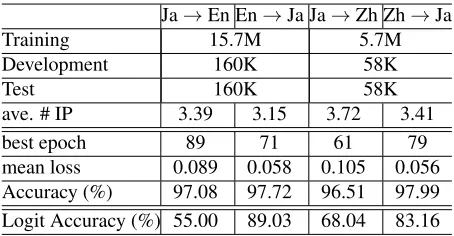
Table 2: The statistics of the data and results of the insertion
position selection experiments.
sentences. English sentences are first parsed by nl-parser (Charniak and Johnson, 2005) and then con-verted into word dependency trees using Collins’ head percolation table (Collins, 1999). We used Chi-nese word segmenter KKN (Shen et al., 2014) and dependency parser SKP (Shen et al., 2012) for Chi-nese sentences. The supervised word alignment Nile (Riesa et al., 2011) was used.
We used a state-of-the-art dependency tree-to-tree decoder (Richardson et al., 2014) with the default settings. The neural network is constructed and trained using the Chainer (Tokui et al., 2015).
3.1 Insertion Position Selection
The training, development and test data for the neu-ral network is automatically generated by the proce-dure explained in Section 2.2. The size of the gen-erated data from the ASPEC and the average num-ber of insertion positions for each floating subtree are shown in Table 2. We trained the model for 100 epochs and used the best model on the development data for testing. The vocabulary size for the surface form was 50,000.
For comparison, we also tried the logistic regres-sion to predict the correct insertion positions. Be-cause our training data is huge, we used Multi-core LIBLINEAR2 with L2-regularized logistic
regres-sion (primal) solver. The format of training in-stances are: one-hot (binary) vectors for surface form, POS and dependency type, and distances scaled to [0, 1]. We first find the best value for the C parameter, then train the model. The best insertion position is selected using the estimated probabilities for each insertion position.
The experimental results are also shown in Table
2https://www.csie.ntu.edu.tw/
∼ cjlin/libsvmtools/multicore-liblinear/
2. We evaluated the results by the mean loss of the model and the accuracy on the test data. The re-sult shows that our model can select the correct in-sertion position with very high accuracy for every language pair while the classical logistic regression model cannot. This supports our claim stated in the beginning of Section 2.
X→Ja is easier and achieved slightly better ac-curacy than the reverse direction because Japanese is a head-final language and all children are gener-ally put on the left of their parents. There are some cases judged as incorrect but acceptable insertion positions, and hence the true accuracies are higher than the ones reported above. We also investigated the top-2 accuracy and found that it is above 99.0% for Ja→X and 99.5% for X→Ja.
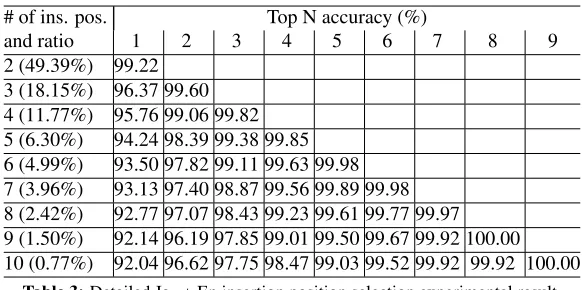
Table 3 shows the detailed result of Ja
rightarrow En experiment. The number of
insertion-position is at least 2 (left/right of the parent) and it is easy to solve (more than 99% accuracy). 3 is a situation where the parent has one child, and it is still not so difficult (97-98% accuracy). About 70% of the test data have only 2 or 3 insertion-positions. Difficult cases are the sentences which have many adjuncts as in Figure 1, but we used the scientific paper corpora, where not so many adjuncts appear.
3.2 Translation
We conducted translation experiment using the AS-PEC in 3 settings:
• No Flexible: not using the flexible non-terminals and using simple glue rules as in the baseline model of (Richardson et al., 2016)3
• Baseline: using the flexible non-terminals without the insertion position selection
• Proposed: using only the most appropriate in-sertion position for the flexible non-terminals We also report the translation quality of conven-tional models for comparison: phrase-based SMT (PBSMT) and hierarchical phrase-based SMT (Hi-ero). We used the default settings of Moses except -distortion-limit=20 for PBSMT.
The translation quality is evaluated by the auto-matic evaluation measures BLEU (Papineni et al.,
352.5% of all the translation rules require glue rule, but it is
# of ins. pos. Top N accuracy (%)
and ratio 1 2 3 4 5 6 7 8 9
[image:5.612.110.519.51.311.2]2 (49.39%) 99.22 3 (18.15%) 96.37 99.60 4 (11.77%) 95.76 99.06 99.82 5 (6.30%) 94.24 98.39 99.38 99.85 6 (4.99%) 93.50 97.82 99.11 99.63 99.98 7 (3.96%) 93.13 97.40 98.87 99.56 99.89 99.98 8 (2.42%) 92.77 97.07 98.43 99.23 99.61 99.77 99.97 9 (1.50%) 92.14 96.19 97.85 99.01 99.50 99.67 99.92 100.00 10 (0.77%) 92.04 96.62 97.75 98.47 99.03 99.52 99.92 99.92 100.00
Table 3:Detailed Ja→En insertion position selection experimental result.
Ja→En En→Ja Ja→Zh Zh→Ja
BLEU RIBES Time BLEU RIBES Time BLEU RIBES Time BLEU RIBES Time PBSMT 18.45 64.51 - 27.48 68.37 - 27.96 78.90 - 34.65 77.25 -Hiero 18.72 65.11 - 30.19 73.47 - 27.71 80.91 - 35.43 81.04 -No Flexible 20.28 65.08 1.00 28.77 75.21 1.00 24.85 66.60 1.00 30.51 73.08 1.00 Baseline 21.61 69.82 6.28 30.57 76.13 3.30 28.79 78.11 5.16 34.32 77.82 5.28 Proposed 22.07†70.49† 2.25 30.50 76.69† 1.27 29.83†79.73† 2.21 34.71†79.25† 1.89
Table 4: The results of the translation experiments. †means the Proposed method achieved significantly better score than the
Baseline (p <0.01).
2002) and RIBES (Isozaki et al., 2010) with the sig-nificance testing by bootstrap resampling (Koehn, 2004). RIBES is more sensitive to word order than BLEU, so we expect an improvement in RIBES. We also investigated relative decoding time compared to the No Flexible setting. Note that we used the word “decoding” for only exploring the search space, and it does not include constructing the search space (as the table lookup in Phrase-based SMT). Our whole translation process is:
1. translation rule extraction 2. insertion-position selection 3. decoding
At the time of the second step, we have all the trans-lation rules applicable to the input sentence. The computation time for each step is 3≫1≫2 so we only focus on the time for step 3 in the experiments (the computation time for step 2 is negligibly small). The results are shown in Table 4. The Proposed method achieved significantly better automatic eval-uation scores than the Baseline for all the language pairs except the BLEU score of En→Ja direction. Also, the decoding time is reduced by about 60% relative to that of the Baseline.
Our tree-based model is better than the conven-tional models except C→ J, where the accuracy of
Chinese parsing for the input sentences has a bad ef-fect.
4 Conclusion
In this paper we have proposed a neural network based insertion position selection model to reduce the computational cost of the decoding for de-pendency tree-to-tree translation with flexible non-terminals. The model successfully finds the appro-priate insertion position from the candidates and it leads to faster translation speed and better transla-tion quality due to the reduced search space.
[image:5.612.160.451.55.200.2]References
Eugene Charniak and Mark Johnson. 2005. Coarse-to-fine n-best parsing and maxent discriminative rerank-ing. InProceedings of the 43rd Annual Meeting of the Association for Computational Linguistics (ACL’05), pages 173–180.
David Chiang. 2005. A hierarchical phrase-based model for statistical machine translation. In Proceedings of the 43rd Annual Meeting of the Association for Com-putational Linguistics (ACL’05), pages 263–270. As-sociation for Computational Linguistics.
Michael Collins. 1999. Head-Driven Statistical Models for Natural Language Parsing. Ph.D. thesis, Univer-sity of Pennsylvania.
Fabien Cromieres and Sadao Kurohashi. 2014. Transla-tion rules with right-hand side lattices. InProceedings of the 2014 Conference on Empirical Methods in Nat-ural Language Processing (EMNLP), pages 577–588. Association for Computational Linguistics.
Steve DeNeefe and Kevin Knight. 2009. Synchronous tree adjoining machine translation. InProceedings of the 2009 Conference on Empirical Methods in Natural Language Processing, pages 727–736. Association for Computational Linguistics.
Hideki Isozaki, Tsutomu Hirao, Kevin Duh, Katsuhito Sudoh, and Hajime Tsukada. 2010. Automatic evalu-ation of translevalu-ation quality for distant language pairs. In Proceedings of the 2010 Conference on Empirical Methods in Natural Language Processing, EMNLP ’10, pages 944–952, Stroudsburg, PA, USA. Associ-ation for ComputAssoci-ational Linguistics.
A. K. Joshi. 1985. Tree adjoining grammars: How much context-sensitivity is required to provide reason-able structural descriptions? In D. R. Dowty, L. Kart-tunen, and A. M. Zwicky, editors, Natural Language Parsing: Psychological, Computational, and Theoret-ical Perspectives, pages 206–250. Cambridge Univer-sity Press, Cambridge.
Philipp Koehn. 2004. Statistical significance tests for machine translation evaluation. In Dekang Lin and Dekai Wu, editors, Proceedings of EMNLP 2004, pages 388–395, Barcelona, Spain, July. Association for Computational Linguistics.
Sadao Kurohashi and Makoto Nagao. 1994. A syntactic analysis method of long Japanese sentences based on the detection of conjunctive structures. Computational Linguistics, 20(4):507–534.
Sadao Kurohashi, Toshihisa Nakamura, Yuji Matsumoto, and Makoto Nagao. 1994. Improvements of Japanese morphological analyzer JUMAN. In Proceedings of The International Workshop on Sharable Natural Lan-guage, pages 22–28.
Yang Liu, Furu Wei, Sujian Li, Heng Ji, Ming Zhou, and Houfeng WANG. 2015. A dependency-based neu-ral network for relation classification. In Proceed-ings of the 53rd Annual Meeting of the Association for Computational Linguistics and the 7th Interna-tional Joint Conference on Natural Language Process-ing (Volume 2: Short Papers), pages 285–290. Associ-ation for ComputAssoci-ational Linguistics.
Arul Menezes and Chris Quirk, 2007. Proceedings of the Second Workshop on Statistical Machine Transla-tion, chapter Using Dependency Order Templates to Improve Generality in Translation, pages 1–8. Asso-ciation for Computational Linguistics.
Lili Mou, Hao Peng, Ge Li, Yan Xu, Lu Zhang, and Zhi Jin. 2015. Discriminative neural sentence mod-eling by tree-based convolution. In Proceedings of the 2015 Conference on Empirical Methods in Natural Language Processing, pages 2315–2325, Lisbon, Por-tugal, September. Association for Computational Lin-guistics.
Toshiaki Nakazawa and Sadao Kurohashi. 2010. Fully syntactic ebmt system of kyoto team in ntcir-8. In
In Proceedings of the 8th NTCIR Workshop Meet-ing on Evaluation of Information Access Technologies (NTCIR-8), pages 403–410.
Toshiaki Nakazawa, Manabu Yaguchi, Kiyotaka Uchi-moto, Masao Utiyama, Eiichiro Sumita, Sadao Kuro-hashi, and Hitoshi Isahara. 2016. ASPEC: Asian scientific paper excerpt corpus. In Proceedings of the Ninth International Conference on Language Re-sources and Evaluation (LREC 2016), pages 2204– 2208, Portoroˇz, Slovenia, May.
Kishore Papineni, Salim Roukos, Todd Ward, and Wei-Jing Zhu. 2002. Bleu: a method for automatic evalua-tion of machine translaevalua-tion. InACL, pages 311–318. John Richardson, Fabien Cromi`eres, Toshiaki Nakazawa,
and Sadao Kurohashi. 2014. Kyotoebmt: An example-based dependency-to-dependency translation framework. InProceedings of 52nd Annual Meeting of the Association for Computational Linguistics: System Demonstrations, pages 79–84. Association for Com-putational Linguistics.
John Richardson, Fabien Cromier`es, Toshiaki Nakazawa, and Sadao Kurohashi. 2016. Flexible non-terminals for dependency tree-to-tree reordering. In Proceed-ings of the 2016 Conference of the North American Chapter of the Association for Computational Linguis-tics: Human Language Technologies, pages 11–19. Association for Computational Linguistics.
Jason Riesa, Ann Irvine, and Daniel Marcu. 2011. Feature-rich language-independent syntax-based alignment for statistical machine translation. In
Methods in Natural Language Processing, pages 497–507. Association for Computational Linguistics. Libin Shen, Jinxi Xu, and Ralph M Weischedel. 2008.
A new string-to-dependency machine translation algo-rithm with a target dependency language model. In
Association for Computational Linguistics.
Mo Shen, Daisuke Kawahara, and Sadao Kurohashi. 2012. A reranking approach for dependency parsing with variable-sized subtree features. In Proceedings of 26th Pacific Asia Conference on Language Infor-mation and Computing, pages 308–317.
Mo Shen, Hongxiao Liu, Daisuke Kawahara, and Sadao Kurohashi. 2014. Chinese morphological analysis with character-level pos tagging (short paper). In Pro-ceedings of the 52nd Annual Meeting of the Associa-tion for ComputaAssocia-tional Linguistics (ACL2014), Balti-more, USA.