Neural
versus
Phrase-Based Machine Translation Quality: a Case Study
Luisa Bentivogli FBK, Trento
Italy
Arianna Bisazza University of Amsterdam
The Netherlands
Mauro Cettolo FBK, Trento
Italy
Marcello Federico FBK, Trento
Italy
Abstract
Within the field of Statistical Machine Trans-lation (SMT), the neural approach (NMT) has recently emerged as the first technology able to challenge the long-standing dominance of phrase-based approaches (PBMT). In particu-lar, at the IWSLT 2015 evaluation campaign, NMT outperformed well established state-of-the-art PBMT systems on English-German, a language pair known to be particularly hard because of morphology and syntactic differ-ences. To understand in what respects NMT provides better translation quality than PBMT, we perform a detailed analysis of neuralvs. phrase-based SMT outputs, leveraging high quality post-edits performed by professional translators on the IWSLT data. For the first time, our analysis provides useful insights on what linguistic phenomena are best modeled by neural models – such as the reordering of verbs – while pointing out other aspects that remain to be improved.
1 Introduction
The wave of neural models has eventually reached the field of Statistical Machine Translation (SMT). After a period in which Neural MT (NMT) was too computationally costly and resource demanding to compete with state-of-the-art Phrase-Based MT (PBMT)1, the situation changed in 2015. For the
first time, in the latest edition of IWSLT2(Cettolo et 1We use the generic term phrase-based MT to cover standard
phrase-based, hierarchical and syntax-based SMT approaches.
2International Workshop on Spoken Language Translation
(http://workshop2015.iwslt.org/)
al., 2015), the system described in (Luong and Man-ning, 2015) overtook a variety of PBMT approaches with a large margin (+5.3BLEU points) on a
diffi-cult language pair like English-German – anticipat-ing what, most likely, will be the new NMT era.
This impressive improvement follows the dis-tance reduction previously observed in the WMT 2015 shared translation task (Bojar et al., 2015). Just few months earlier, the NMT systems de-scribed in (Jean et al., 2015b) ranked on par with the best phrase-based models on a couple of lan-guage pairs. Such rapid progress stems from the im-provement of the recurrent neural network encoder-decoder model, originally proposed in (Sutskever et al., 2014; Cho et al., 2014b), with the use of the at-tention mechanism (Bahdanau et al., 2015). This evolution has several implications. On one side, NMT represents a simplification with respect to pre-vious paradigms. From a management point of view, similar to PBMT, it allows for a more efficient use of human and data resources with respect to rule-based MT. From the architectural point of view, a large recurrent network trained for end-to-end trans-lation is considerably simpler than traditional MT systems that integrate multiple components and cessing steps. On the other side, the NMT pro-cess is less transparent than previous paradigms. In-deed, it represents a further step in the evolution from rule-based approaches that explicitly manipu-late knowledge, to the statistical/data-driven frame-work, still comprehensible in its inner workings, to a sub-symbolic framework in which the translation process is totally opaque to the analysis.
What do we know about the strengths of NMT
and the weaknesses of PBMT? What are the linguis-tic phenomena that deep learning translation models can handle with such greater effectiveness? To an-swer these questions and go beyond poorly informa-tive BLEU scores, we perform the very first compar-ative analysis of the two paradigms in order to shed light on the factors that differentiate them and deter-mine their large quality differences.
We build on evaluation data available for the IWSLT 2015 MT English-German task, and com-pare the results of the first four top-ranked partic-ipants. We choose to focus on one language pair and one task because of the following advantages:
(i) three state-of-the art PBMT systems compared against the NMT system on the same data and in the very same period (that of the evaluation cam-paign); (ii) a challenging language pair in terms of morphology and word order differences;(iii) avail-ability of MT outputs’ post-editing done by pro-fessional translators, which is very costly and thus rarely available. In general, post-edits have the ad-vantage of allowing for informative and detailed analyses since they directly point to translation er-rors. In this specific framework, the high quality data created by professional translators guarantees reliable evaluations. For all these reasons we present our study as a solid contribution to the better under-standing of this new paradigm shift in MT.
After reviewing previous work (Section 2), we in-troduce the analyzed data and the systems that pro-duced them (Section 3). We then present three in-creasingly fine levels of MT quality analysis. We first investigate how MT systems’ quality varies with specific characteristics of the input, i.e. sentence length and type of content of each talk (Section 4). Then, we focus on differences among MT systems with respect to morphology, lexical, and word or-der errors (Section 5). Finally, based on the finding that word reordering is the strongest aspect of NMT compared to the other systems, we carry out a fine-grained analysis of word order errors (Section 6).
2 Previous Work
To date, NMT systems have only been evaluated by BLEU in single-reference setups (Bahdanau et al., 2015; Sutskever et al., 2014; Luong et al., 2015; Jean et al., 2015a; G¨ulc¸ehre et al., 2015).
Ad-ditionally, the Montreal NMT system submitted to WMT 2015 (Jean et al., 2015b) was part of a man-ual evaluation experiment where a large number of non-professional annotators were asked to rank the outputs of multiple MT systems (Bojar et al., 2015). Results for the Montreal system were very positive – ranked first in English-German, third in German-English, English-Czech and Czech-English – which confirmed and strengthened the BLEU results pub-lished so far. Unfortunately neither BLEU nor man-ual ranking judgements tell us which translation as-pects are better modeled by different MT frame-works. To this end, a detailed and systematic error analysis of NMTvs.PBMT output is required.
Translation error analysis, as a way to identify systems’ weaknesses and define priorities for their improvement, has received a fair amount of atten-tion in the MT community. In this work we opt for
theautomaticdetection and classification of
transla-tion errors based on manual post-edits of the MT output. We believe this choice provides an opti-mal trade-off between fully manual error analysis (Farr´us Cabeceran et al., 2010; Popovi´c et al., 2013; Daems et al., 2014; Federico et al., 2014; Neubig et al., 2015), which is very costly and complex, and fully automatic error analysis (Popovi´c and Ney, 2011; Irvine et al., 2013), which is noisy and biased towards one or few arbitrary reference translations.
sys-tem’s phrase table and is thus not applicable to NMT, which does not rely on a fixed inventory of transla-tion units extracted from the parallel data.
Previous error analyses based on manually post-edited translations were presented in (Bojar, 2011; Koponen, 2012; Popovi´c et al., 2013). We are the first to conduct this kind of study on the output of a neural MT system.
3 Experimental Setting
We perform a number of analyses on data and re-sults of the IWSLT 2015 MT En-De task, which consists in translating manual transcripts of English TED talks into German. Evaluation data are pub-licly available through the WIT3repository (Cettolo
et al., 2012).3
3.1 Task Data
TED Talks4are a collection of rather short speeches
(max 18 minutes each, roughly equivalent to 2,500 words) covering a wide variety of topics. All talks have captions, which are translated into many lan-guages by volunteers worldwide. Besides represent-ing a popular benchmark for spoken language tech-nology, TED Talks embed interesting research chal-lenges. Translating TED Talks implies dealing with spoken rather than written language, which is hence expected to be structurally less complex, formal and fluent (Ruiz and Federico, 2014). Moreover, as hu-man translations of the talks are required to follow the structure and rhythm of the English captions, a lower amount of rephrasing and reordering is ex-pected than in the translation of written documents.
As regards the English-German language pair, the two languages are interesting since, while belonging to the same language family, they have marked dif-ferences in levels of inflection, morphological varia-tion, and word order, especially long-range reorder-ing of verbs.
3.2 Evaluation Data
Five systems participated in the MTEn-Detask and were manually evaluated on a representative subset of the official 2015 test set. The Human Evaluation (HE) set includes the first half of each of the 12 test
3wit3.fbk.eu 4http://www.ted.com/
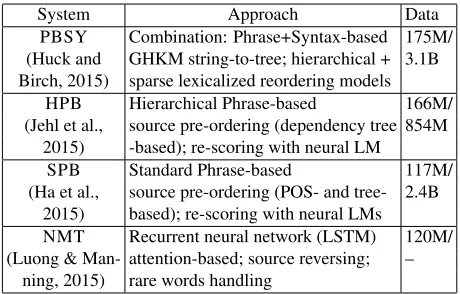
System Approach Data
PBSY Combination: Phrase+Syntax-based 175M/ (Huck and GHKM string-to-tree; hierarchical + 3.1B Birch, 2015) sparse lexicalized reordering models
HPB Hierarchical Phrase-based 166M/ (Jehl et al., source pre-ordering (dependency tree 854M
2015) -based); re-scoring with neural LM
SPB Standard Phrase-based 117M/ (Ha et al., source pre-ordering (POS- and tree- 2.4B
2015) based); re-scoring with neural LMs
NMT Recurrent neural network (LSTM) 120M/ (Luong & Man- attention-based; source reversing; –
[image:3.612.312.542.56.203.2]ning, 2015) rare words handling
Table 1: MT systems’ overview. Data column: size of paral-lel/monolingual training data for each system in terms of En-glish and German tokens.
talks, for a total of 600 sentences and around 10K words. Five professional translators were asked to post-edit the MT output by applying the minimal ed-its required to transform it into a fluent sentence with the same meaning as the source sentence. Data were prepared so that all translators equally post-edited the five MT outputs,i.e.120 sentences for each eval-uated system.
The resulting evaluation data consist of five new reference translations for each of the sentences in the HE set. Each one of these references represents
the targeted translation of the system output from
which it was derived, but the other four additional
translations can also be used to evaluate each MT
system. We will see in the next sections how we ex-ploited the available post-edits in the more suitable way depending on the kind of analysis carried out.
3.3 MT Systems
Our analysis focuses on the first four top-ranking systems, which include NMT (Luong and Manning, 2015) and three different phrase-based approaches: standard phrase-based (Ha et al., 2015), hierarchi-cal (Jehl et al., 2015) and a combination of phrase-based and syntax-phrase-based (Huck and Birch, 2015). Ta-ble 1 presents an overview of each system, as well as figures about the training data used.5
The phrase+syntax-based (PBSY) system com-bines the outputs of a string-to-tree decoder, trained with the GHKM algorithm, with those of two
stan-5Detailed information about training data was kindly made
dard phrase-based systems featuring, among others, adapted phrase tables and language models enriched with morphological information, hierarchical lexi-calized reordering models and different variations of the operational sequence model.
The hierarchical phrase-based MT (HPB) system leverages thousands of lexicalised features, data-driven source pre-ordering (dependency tree-based), word-based and class-based language models, and n-best re-scoring models based on syntactic and neu-ral language models.
The standard phrase-based MT (SPB) system fea-tures an adapted phrase-table combining in-domain and out-domain data, discriminative word lexicon models, multiple language models (word-, POS- and class-based), data-driven source pre-ordering (POS-and constituency syntax-based), n-best re-scoring models based on neural lexicons and neural lan-guage models.
Finally, the neural MT (NMT) system is an en-semble of 8 long short-term memory (LSTM) net-works of 4 layers featuring 1,000-dimension word embeddings, attention mechanism, source revers-ing, 50K source and target vocabularies, and out-of-vocabulary word handling. Training with TED data was performed on top of models trained with large out-domain parallel data.
With respect to the use of training data, it is worth noticing that NMT is the only system not employ-ing monolemploy-ingual data in addition to parallel data. Moreover, NMT and SPB were trained with smaller amounts of parallel data with respect to PBSY and HPB (see Table 1).
3.4 Translation Edit Rate Measures
The Translation Edit Rate (TER) (Snover et al.,
2006) naturally fits our evaluation framework, where it traces the edits done by post-editors. Also,
TER shift operations are reliable indicators of
re-ordering errors, in which we are particularly inter-ested. We exploit the available post-edits in two dif-ferent ways: (i) for Human-targeted TER (HTER) we compute TER between the machine translation and its manually post-edited version (targeted ref-erence), (ii) for Multi-reference TER (mTER), we compute TER against the closest translation among all available post-edits (i.e. targeted and additional references) for each sentence.
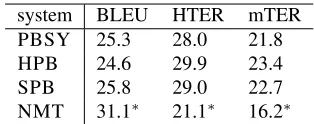
[image:4.612.347.504.56.118.2]system BLEU HTER mTER PBSY 25.3 28.0 21.8 HPB 24.6 29.9 23.4 SPB 25.8 29.0 22.7 NMT 31.1∗ 21.1∗ 16.2∗
Table 2: Overall results on the HE Set: BLEU, computed against the original reference translation, and TER, computed with respect to the targeted edit (HTER) and multiple post-edits (mTER).
Throughout sections 4 and 5, we mark a score achieved by NMT with the symbol * if this is bet-ter than the score of its best competitor at statistical significance level0.01. Significance tests for HTER
and mTER are computed by bootstrap re-sampling, while differences among proportions are assessed via one-tailed z-score tests.
4 Overall Translation Quality
Table 2 presents overall system results according to HTER and mTER, as well as BLEU computed against the original TED Talks reference translation. We can see that NMT clearly outperforms all other approaches both in terms of BLEU and TER scores. Focusing on mTER results, the gain obtained by NMT over the second best system (PBSY) amounts to 26%. It is also worth noticing that mTER is con-siderably lower than HTER for each system. This re-duction shows that exploiting all the available post-edits as references for TER is a viable way to control and overcome post-editors variability, thus ensuring a more reliable and informative evaluation about the real overall performance of MT systems. For this reason, the two following analyses rely on mTER. In particular, we investigate how specific character-istics of input documents affect the system’s overall translation quality, focusing on (i) sentence length and(ii)the different talks composing the dataset.
4.1 Translation quality by sentence length
Figure 1:mTER scores on bins of sentences of different length. Points represent the average mTER of the MT outputs for the sentences in each given bin.
significant differences. As a general tendency, the performance of all approaches worsens as sentence length increases. However, for sentences longer than 35 words we see that NMT quality degrades more markedly than in PBMT systems. Considering the percentage decrease with respect to the preceding length bin (26-35), we see that the %∆ for NMT
(-15.4) is much larger than the average%∆for the
three PBMT systems (-7.9). Hence, this still seems an issue to be addressed for further improving NMT.
4.2 Translation quality by talk
As we saw in Section 3.1, the TED dataset is very heterogeneous since it consists of talks covering dif-ferent topics and given by speakers with difdif-ferent styles. It is therefore interesting to evaluate trans-lation quality also at the talk level.
Figure 2 plots the mTER scores for each of the twelve talks included in the HE set, sorted in ascend-ing order of NMT scores. In all talks, the NMT sys-tem outperforms the PBMT syssys-tems in a statistically significant way.
We analysed different factors which could impact translation quality in order to understand if they cor-relate with such performance differences. We stud-ied three features which are typically considered as indicators of complexity (see (Franc¸ois and Fairon, 2012) for an overview), namely(i)the length of the talk, (ii) its average sentence length, and (iii) the
Figure 2: mTER scores per talk, sorted in ascending order of NMT scores.
type-token ratio6 (TTR) which – measuring lexical
diversity – reflects the size of a speaker’s vocabulary and the variety of subject matter in a text.
For the first two features we did not find any cor-relation; on the contrary, we found a moderate Pear-son correlation (R=0.7332) between TTR and the
mTER gains of NMT over its closest competitor in each talk. This result suggests that NMT is able to cope with lexical diversity better than any other con-sidered approach.
5 Analysis of Translation Errors
We now turn to analyze which types of linguistic er-rors characterize NMTvs. PBMT. In the literature, various error taxonomies covering different levels of granularity have been developed (Flanagan, 1994; Vilar et al., 2006; Farr´us Cabeceran et al., 2010; Stymne and Ahrenberg, 2012; Lommel et al., 2014). We focus on three error categories, namely(i) mor-phology errors,(ii)lexical errors, and(iii)word or-der errors. As for lexical errors, a number of existing taxonomies further distinguish among translation er-rors due to missing words, extra words, or incor-rect lexical choice. However, given the proven dif-ficulty of disambiguating between these three sub-classes (Popovi´c and Ney, 2011; Fishel et al., 2012), we prefer to rely on a more coarse-grained linguistic error classification where lexical errors include all of them (Farr´us Cabeceran et al., 2010).
6The type-token-ratio of a text is calculated dividing the
[image:5.612.318.538.57.214.2]For error analysis we rely on HTER results under the assumption that, since the targeted translation is generated by post-editing the given MT output, this method is particularly informative to spot MT er-rors. We are aware that translator subjectivity is still an issue (see Section 4), however in this more fine-grained analysis we prefer to focus on what a hu-man implicitly annotated as a translation error. This particularly holds in our specific evaluation frame-work, where the goal is not to measure the absolute number of errors made by each system, but to com-pare systems with each other. Moreover, the post-edits collected for each MT output within IWSLT allow for a fair and reliable comparison since sys-tems were equally post-edited by all translators (see Section 3.2), making all analyses uniformly affected by such variability.
5.1 Morphology errors
A morphology error occurs when a generated word form is wrong but its corresponding base form (lemma) is correct. Thus, we assess the ability of systems to deal with morphology by comparing the HTER score computed on the surface forms (i.e.
morphologically inflected words) with the HTER score obtained on the corresponding lemmas. The additional matches counted on lemmas with respect to word forms indicate morphology errors. Thus, the closer the two HTER scores, the more accurate the system in handling morphology.
To carry out this analysis, the lemmatized (and POS tagged) version of both MT outputs and cor-responding post-edits was produced with the Ger-man parser ParZu (Sennrich et al., 2013). Then, the HTER-based evaluation was slightly adapted in or-der to be better suited to an accurate detection of morphology errors. First, punctuation was removed since – not being subject to morphological inflection – it could smooth the results. Second, shift errors were not considered. A word form or a lemma that matches a corresponding word or lemma in the post-edit, but is in the wrong position with respect to it, is counted as a shift error in TER. Instead – when focusing on morphology – exact matches are not er-rors, regardless their position in the text.7
7Note that the TER score calculated by setting to 0 the
cost of shifts approximates the Position-independent Error Rate (Tillmann et al., 1997).
system wordHTERnoShftlemma %
∆
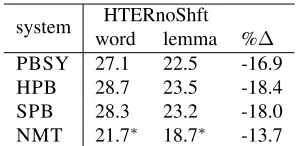
[image:6.612.352.500.56.129.2]PBSY 27.1 22.5 -16.9 HPB 28.7 23.5 -18.4 SPB 28.3 23.2 -18.0 NMT 21.7∗ 18.7∗ -13.7
Table 3: HTER ignoring shift operations computed on words and corresponding lemmas, and their % difference.
Table 3 presents HTER scores on word forms and lemmas, as well as their percentage difference which gives an indication of morphology errors. We can see that NMT generates translations which are mor-phologically more correct than the other systems. In particular, the%∆ for NMT (-13.7) is lower than
that of the second best system (PBSY, -16.9) by 3.2% absolute points, leading to a percentage gain of around 19%. We can thus say that NMT makes at least 19% less morphology errors than any other PBMT system.
5.2 Lexical errors
Another important feature of MT systems is their ability to choose lexically appropriate words. In or-der to compare systems unor-der this aspect, we con-sider HTER results at the lemma level as a way to abstract from morphology errors and focus only on actual lexical choice problems. The evaluation on the lemmatised version of the data performed to identify morphology errors fits this purpose, since its driving assumptions (i.e. punctuation can be ex-cluded and lemmas in the wrong order are not errors) hold for lexical errors too.
The lemma column of Table 3 shows that NMT outperforms the other systems. More precisely, the NMT score (18.7) is better than the second best (PBSY, 22.5) by 3.8% absolute points. This corre-sponds to a relative gain of about 17%, meaning that NMT makes at least 17% less lexical errors than any PBMT system. Similarly to what observed for mor-phology errors, this can be considered a remarkable improvement over the state of the art.
5.3 Word order errors
To analyse reordering errors, we start by focusing on
shiftoperations identified by the HTER metrics. The
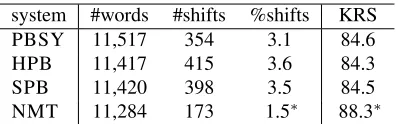
first three columns of Table 4 show, respectively:
system #words #shifts %shifts KRS PBSY 11,517 354 3.1 84.6 HPB 11,417 415 3.6 84.3 SPB 11,420 398 3.5 84.5 NMT 11,284 173 1.5∗ 88.3∗
Table 4: Word reordering evaluation in terms of shift opera-tions in HTER calculation and of KRS. For each system, the number of generated words, the number of shift errors and their corresponding percentages are reported.
(ii)the number of shifts required to align each sys-tem output to the corresponding post-edit; and (iii)
the corresponding percentage of shift errors. Notice that the shift error percentages are incorporated in the HTER scores reported in Table 2. We can see in Table 4 thatshift errors in NMT translations are definitely less than in the other systems. The error reduction of NMT with respect to the second best system (PBSY) is about 50% (173vs.354).
It should be recalled that these numbers only re-fer to shiftsdetected by HTER, that is (groups of) words of the MT output and corresponding post-edit that are identical but occurring in different positions. Words that had to be moved and modified at the same time (for instance replaced by a synonym or a morphological variant) are not counted in HTER
shift figures, but are detected assubstitution,
inser-tion or deletion operations. To ensure that our
re-ordering evaluation is not biased towards the align-ment between the MT output and the post-edit per-formed by HTER, we run an additional assessment using KRS – Kendall Reordering Score (Birch et al., 2010) – which measures the similarity between the source-reference reorderings and the source-MT output reorderings.8 Being based on bilingual word
alignment via the source sentence, KRS detects re-ordering errors also when post-edit and MT words are not identical. Also unlike TER, KRS is sensitive to thedistancebetween the position of a word in the MT output and that in the reference.
Looking at the last column of Table 4, we can say that our observations on HTER are confirmed by the KRS results: the reorderings performed by NMT are much more accurate than those performed by any PBMT system.9 Moreover, according to the approx-8To compute the word alignments required by KRS, we used
the FastAlign tool (Dyer et al., 2013).
9To put our results into perspective, note that Birch (2011)
imate randomization test, KRS differences are statis-tically significant between NMT and all other sys-tems, but not among the three PBMT systems.
Given the concordant results of our two quanti-tative analyses, we conclude that one of the ma-jor strengths of the NMT approach is its ability to place German words in the right position even when this requires considerable reordering. This outcome calls for a deeper investigation, which is carried out in the following section.
6 Fine-grained Word Order Error Analysis
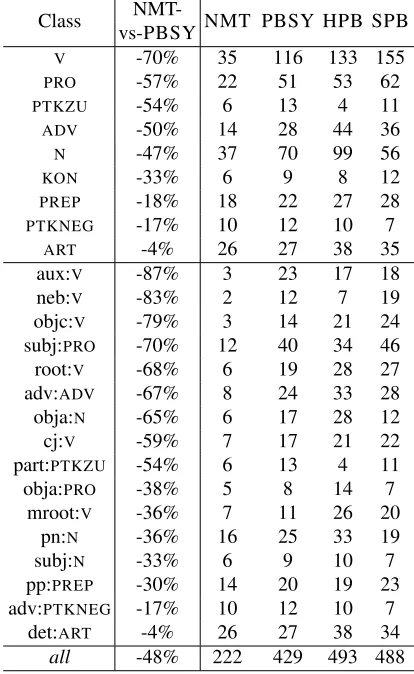
We have observed that word reordering is a very strong aspect of NMT compared to PBMT, accord-ing to both HTER and KRS. To better understand this finding, we investigate whether reordering er-rors concentrate on specific linguistic constructions across our systems. Using the POS tagging and dependency parsing of the post-edits produced by ParZu, we classify the shift operations detected by HTER and count how often a word with a given POS label was misplaced by each of the systems (alone or as part of a shifted block). For each word class, we also compute the percentage order error reduction of NMT with respect to the PBMT system that has highest reordering accuracy overall, that is PBSY. Results are presented in Table 5, ranked by NMT-vs-PBSY gain. Punctuation is omitted as well as word classes that were shifted less than 10 times by all systems. Examples of salient word order error types are presented in Table 6.
The upper part of Table 5 shows that verbs are by far the most often misplaced word category in all PBMT systems – an issue already known to affect standard phrase-based SMT between German and English (Bisazza and Federico, 2013). Reordering is particularly difficult when translatinginto German, since the position of verbs in this language varies according to the clause type (e.g. mainvs. subor-dinate). Our results show that even syntax-informed PBMT does not solve this issue. Using syntax at decoding time, as done by one of the systems com-bined within PBSY, appears to be a better strategy
Class vs-PBSYNMT- NMT PBSY HPB SPB
V -70% 35 116 133 155
PRO -57% 22 51 53 62
PTKZU -54% 6 13 4 11
ADV -50% 14 28 44 36
N -47% 37 70 99 56
KON -33% 6 9 8 12
PREP -18% 18 22 27 28
PTKNEG -17% 10 12 10 7
ART -4% 26 27 38 35
aux:V -87% 3 23 17 18 neb:V -83% 2 12 7 19
objc:V -79% 3 14 21 24
subj:PRO -70% 12 40 34 46
root:V -68% 6 19 28 27
adv:ADV -67% 8 24 33 28
obja:N -65% 6 17 28 12
cj:V -59% 7 17 21 22
part:PTKZU -54% 6 13 4 11
obja:PRO -38% 5 8 14 7
mroot:V -36% 7 11 26 20
pn:N -36% 16 25 33 19
subj:N -33% 6 9 10 7 pp:PREP -30% 14 20 19 23 adv:PTKNEG -17% 10 12 10 7
[image:8.612.81.288.59.396.2]det:ART -4% 26 27 38 34 all -48% 222 429 493 488
Table 5: Main POS tags and dependency labels of words oc-curring in shifted blocks detected by HTER. NMT-vs-PBSY denotes the reduction of reordering errors in NMTvs. PBSY system. Only word classes that were shifted 10 or more times in at least one system output are shown.
than using it for source pre-ordering, as done by the HPB and SPB systems. However this only results in a moderate reduction of verb reordering errors (-12% and -25%vs.HPB and SPB respectively). On the contrary, NMT reduces verb order errors by an impressive -70% with respect to PBSY (-74% and -77%vs.HPB and SPB respectively) despite being trained on raw parallel data without any syntactic annotation, nor explicit modeling of word reorder-ing. This result shows that the recurrent neural lan-guage model at the core of the NMT architecture is very successful at generating well-formed sentences even in languages with less predictable word order, like German (see examples in Table 6(a,b)). NMT, though, gains notably less on nouns (-47%), which is the second most often misplaced word category
in PBSY. More insight on this is provided by the lower part of the table, where reordering errors are divided by their dependency label as well as POS tag. Here we see that order errors on nouns are notably reduced by NMT when they act as syntac-tic objects (-65% obja:N) but less when they act as
preposition complements (-36% pn:N) or subjects
(-33% subj:N).
The smallest NMT-vs-PBSY gains are observed on prepositions (-18% PREP), negation particles
(-17% PTKNEG) and articles (-4% ART). Manual
inspection of a data sample reveals that misplaced prepositions are often part of misplaced preposi-tional phrases acting, for instance, as temporal or instrumental adjuncts (e.g. ‘in my life’, ‘with this
video’). In these cases, the original MT output is
overall understandable and grammatical, but does not conform to the order of German semantic argu-ments that is consistently preferred by post-editors (see example in Table 6(c)). Articles, due to their commonness, are often misaligned by HTER and marked as shift errors instead of being marked as two unrelated substitutions. Finally, negation parti-cles account for less than 1% of the target tokens but play a key role in determining the sentence meaning. Looking closely at some error examples, we found that the correct placement of the German particle
nichtwas determined by the focus of negation in the
source sentence, which is difficult to detect in En-glish. For instance in Table 6(d) two interpretations are possible (‘that did not work’or‘that worked, but
not for systematic reasons’), each resulting in a
Auxiliary-main verb construction [aux:V]:
SRC in this experiment , individualswere shownhundreds of hours of YouTube videos
HPB in diesem Experiment , Individuengezeigt wurdenHunderte von Stunden YouTube-Videos
% (a) PE in diesem ExperimentwurdenIndividuen Hunderte von Stunden Youtube-Videosgezeigt
NMT in diesem ExperimentwurdenIndividuen hunderte Stunden YouTube Videosgezeigt ! PE in diesem ExperimentwurdenIndividuen hunderte Stunden YouTube Videosgezeigt
Verb in subordinate (adjunct) clause [neb:V]:
SRC ... when coaches and managers and ownerslookat this information streaming ...
PBSY ... wenn Trainer und Manager und Eigent¨umerbetrachtendiese Information Streaming ...
% (b) PE ... wenn Trainer und Manager und Eigent¨umer dieses Informations-Streamingbetrachten...
NMT ... wenn Trainer und Manager und Besitzer sich diese Informationenanschauen... !
PE ... wenn Trainer und Manager und Besitzer sich diese Informationenanschauen... Prepositional phrase [pp:PREP det:ART pn:N] acting as temporal adjunct:
SRC so like many of us , I ’ve lived in a few closetsin my life
SPB so wie viele von uns , ich habe in ein paar Schr¨ankein meinem Lebengelebt
% (c) PE so habe ich wie viele von unsw¨ahrend meines Lebensin einigen Verstecken gelebt
NMT wie viele von uns habe ich in ein paar Schr¨ankein meinem Lebengelebt %
PE wie viele von uns habe ichin meinem Lebenin ein paar Schr¨anken gelebt Negation particle [adv:PTKNEG]:
SRC but I eventually came to the conclusion that that just didnotwork for systematic reasons
HPB aber ich kam schlielich zu dem Schluss , dass nur aus systematischen Gr¨undennichtfunktionieren
!
(d) PE aber ich kam schlielich zu dem Schluss , dass es einfach aus systematischen Gr¨undennichtfunktioniert NMT aber letztendlich kam ich zu dem Schluss , dass das einfachnichtaus systematischen Gr¨unden funktionierte%
PE ich musste aber einsehen , dass das aus systematischen Gr¨undennichtfunktioniert
Table 6:MT output and post-edit examples showing common types of reordering errors.
7 Conclusions
We analysed the output of four state-of-the-art MT systems that participated in the English-to-German task of the IWSLT 2015 evaluation campaign. Our selected runs were produced by three phrase-based MT systems and a neural MT system. The analysis leveraged high quality post-edits of the MT outputs, which allowed us to profile systems with respect to reliable measures of post-editing effort and transla-tion error types.
The outcomes of the analysis confirm that NMT has significantly pushed ahead the state of the art, especially in a language pair involving rich morphol-ogy prediction and significant word reordering. To summarize our findings:(i)NMT generates outputs that considerably lower the overall post-edit effort with respect to the best PBMT system (-26%); (ii)
NMT outperforms PBMT systems on all sentence lengths, although its performance degrades faster with the input length than its competitors;(iii)NMT seems to have an edge especially on lexically rich texts;(iv)NMT output contains less morphology
er-rors (-19%), less lexical erer-rors (-17%), and substan-tially less word order errors (-50%) than its closest competitor for each error type;(v)concerning word order, NMT shows an impressive improvement in the placement of verbs (-70% errors).
While NMT proved superior to PBMT with re-spect to all error types that were investigated, our analysis also pointed out some aspects of NMT that deserve further work, such as the handling of long sentences and the reordering of particular linguistic constituents requiring a deep semantic understand-ing of text. Machine translation is definitely not a solved problem, but the time is finally ripe to tackle its most intricate aspects.
Acknowledgments
References
Dzmitry Bahdanau, Kyunghyun Cho, and Yoshua Ben-gio. 2015. Neural machine translation by jointly learning to align and translate. InProc. of ICLR, San Diego, US-CA.
Alexandra Birch, Miles Osborne, and Phil Blunsom. 2010. Metrics for MT evaluation: evaluating reorder-ing. Machine Translation, 24(1):15–26.
Alexandra Birch. 2011. Reordering Metrics for Statisti-cal Machine Translation. Ph.D. thesis, School of In-formatics, University of Edinburgh, UK.
Arianna Bisazza and Marcello Federico. 2013. Effi-cient solutions for word reordering in German-English phrase-based statistical machine translation. InProc. of WMT, Sofia, Bulgaria.
Eduardo Blanco and Dan Moldovan. 2011. Semantic representation of negation using focus detection. In Proc. of ACL-HLT, Portland, US-OR.
Ondˇrej Bojar, Rajen Chatterjee, Christian Federmann, Barry Haddow, Matthias Huck, Chris Hokamp, Philipp Koehn, Varvara Logacheva, Christof Monz, Matteo Negri, Matt Post, Carolina Scarton, Lucia Specia, and Marco Turchi. 2015. Findings of the 2015 workshop on statistical machine translation. In Proc. of WMT, Lisbon, Portugal.
Ondrej Bojar. 2011. Analyzing error types in English-Czech machine translation. The Prague Bulletin of Mathematical Linguistic, (95):63–76.
Mauro Cettolo, Christian Girardi, and Marcello Fed-erico. 2012. WIT3: Web Inventory of Transcribed
and Translated Talks. InProc. of EAMT, Trento, Italy. Mauro Cettolo, Jan Niehues, Sebastian St¨uker, Luisa Bentivogli, Roldano Cattoni, and Marcello Federico. 2015. The IWSLT 2015 evaluation campaign. In Proc. of IWSLT, Da Nang, Vietnam.
Kyunghyun Cho, Bart van Merri¨enboer, Dzmitry Bah-danau, and Yoshua Bengio. 2014a. On the proper-ties of neural machine translation: encoder–decoder approaches. InProc. of SSST-8, Doha, Qatar.
Kyunghyun Cho, Bart van Merrienboer, Caglar Gulcehre, Dzmitry Bahdanau, Fethi Bougares, Holger Schwenk, and Yoshua Bengio. 2014b. Learning phrase repre-sentations using RNN encoder–decoder for statistical machine translation. InProc. of EMNLP, Doha, Qatar. Joke Daems, Lieve Macken, and Sonia Vandepitte. 2014. On the origin of errors: a fine-grained analysis of MT and PE errors and their relationship. InProc. of LREC, Reykjavik, Iceland.
Chris Dyer, Victor Chahuneau, and Noah A. Smith. 2013. A simple, fast, and effective reparameterization of IBM model 2. InProc. of NACL-HLT, Atlanta, US-GA.
Mireia Farr´us Cabeceran, Marta Ruiz Costa-Juss`a, Jos´e Bernardo Mari˜no Acebal, and Jos´e Adri´an Rodr´ıguez Fonollosa. 2010. Linguistic-based evalu-ation criteria to identify statistical machine translevalu-ation errors. InProc. of EAMT, Saint-Rapha¨el, France. Marcello Federico, Matteo Negri, Luisa Bentivogli, and
Marco Turchi. 2014. Assessing the impact of transla-tion errors on machine translatransla-tion quality with mixed-effects models. InProc. of EMNLP, Doha, Qatar. Mark Fishel, Ondrej Bojar, and Maja Popovi´c. 2012.
Terra: a collection of translation error-annotated cor-pora. InProc. of LREC, Istanbul, Turkey.
Mary Flanagan. 1994. Error classification for MT evalu-ation. InProc. of AMTA, Columbia, US-MD.
Thomas Franc¸ois and C´edrick Fairon. 2012. An “AI readability” formula for French as a foreign language. InProc. of EMNLP-CoNLL, Jeju Island, Korea. C¸aglar G¨ulc¸ehre, Orhan Firat, Kelvin Xu, Kyunghyun
Cho, Lo¨ıc Barrault, Huei-Chi Lin, Fethi Bougares, Holger Schwenk, and Yoshua Bengio. 2015. On us-ing monolus-ingual corpora in neural machine translation. CoRR, abs/1503.03535.
Thanh-Le Ha, Jan Niehues, Eunah Cho, Mohammed Me-diani, and Alex Waibel. 2015. The KIT translation systems for IWSLT 2015. In Proc. of IWSLT, Da Nang, Vietnam.
Matthias Huck and Alexandra Birch. 2015. The Edin-burgh machine translation systems for IWSLT 2015. InProc. of IWSLT, Da Nang, Vietnam.
Ann Irvine, John Morgan, Marine Carpuat, Hal Daum´e III, and Dragos Munteanu. 2013. Measuring machine translation errors in new domains. Transactions of the Association for Computational Linguistics, 1:429– 440.
S´ebastien Jean, Kyunghyun Cho, Roland Memisevic, and Yoshua Bengio. 2015a. On using very large target vocabulary for neural machine translation. InProc. of ACL-IJCNLP, Beijing, China.
S´ebastien Jean, Orhan Firat, Kyunghyun Cho, Roland Memisevic, and Yoshua Bengio. 2015b. Montreal neural machine translation systems for WMT15. In Proc. of WMT, Lisbon, Portugal.
Laura Jehl, Patrick Simianer, Julian Hitschler, and Ste-fan Riezler. 2015. The Heidelberg university English-German translation system for IWSLT 2015. InProc. of IWSLT, Da Nang, Vietnam.
Maarit Koponen. 2012. Comparing human perceptions of post-editing effort with post-editing operations. In Proc. of WMT, Montr´eal, Canada.
Minh-Thang Luong and Christopher D Manning. 2015. Stanford neural machine translation systems for spo-ken language domains. InProc. of IWSLT, Da Nang, Vietnam.
Thang Luong, Hieu Pham, and Christopher D. Manning. 2015. Effective approaches to attention-based neural machine translation. InProc. of EMNLP, Lisbon, Por-tugal.
Graham Neubig, Makoto Morishita, and Satoshi Naka-mura. 2015. Neural Reranking Improves Subjective Quality of Machine Translation: NAIST at WAT2015. InProc. of WAT2015, Kyoto, Japan.
Maja Popovi´c and Hermann Ney. 2011. Towards au-tomatic error analysis of machine translation output. Computational Linguistics, 37(4):657–688.
Maja Popovi´c, Eleftherios Avramidis, Aljoscha Bur-chardt, Sabine Hunsicker, Sven Schmeier, Cindy Tscherwinka, David Vilar, and Hans Uszkoreit. 2013. Learning from human judgments of machine transla-tion output. InProc. of MT Summit, Nice, France. Maja Popovi´c. 2011. Hjerson: an open source tool for
automatic error classification of machine translation output. The Prague Bulletin of Mathematical Linguis-tic, (96):59–68.
Jean Pouget-Abadie, Dzmitry Bahdanau, Bart van Mer-rienboer, Kyunghyun Cho, and Yoshua Bengio. 2014. Overcoming the curse of sentence length for neural machine translation using automatic segmentation. In Proc. of SSST-8, Doha, Qatar.
Nicholas Ruiz and Marcello Federico. 2014. Complexity of spoken versus written language for machine trans-lation. InProc. of EAMT, Dubrovnik, Croatia. Rico Sennrich, Martin Volk, and Gerold Schneider. 2013.
Exploiting synergies between open resources for Ger-man dependency parsing, POS-tagging, and morpho-logical analysis. InProc. of RANLP, Hissar, Bulgaria. Matthew Snover, Bonnie Dorr, Rich Schwartz, Linnea Micciulla, and John Makhoul. 2006. A study of trans-lation edit rate with targeted human annotation. In Proc. of AMTA, Boston, US-MA.
Sara Stymne and Lars Ahrenberg. 2012. On the practice of error analysis for machine translation evaluation. In Proc. of LREC, Istanbul, Turkey.
Ilya Sutskever, Oriol Vinyals, and Quoc V. Le. 2014. Sequence to sequence learning with neural networks. InProc. of NIPS, Montr´eal, Canada.
Christoph Tillmann, Stephan Vogel, Hermann Ney, Alexander Zubiaga, and Hassan Sawaf. 1997. Ac-celerated DP based search for statistical translation. In Proc. of Eurospeech, Rhodes, Greece.
David Vilar, Jia Xu, Luis Fernando d’Haro, and Hermann Ney. 2006. Error analysis of statistical machine trans-lation output. InProc. of LREC, Genoa, Italy.