Designing Optimal Flow Networks
∗
M. G. Volz
†M. Brazil
†K. J. Swanepoel
‡D. A. Thomas
§Abstract—We investigate the problem of design-ing a minimum cost flow network interconnectdesign-ing n sources and a single sink, each with known locations and flows. The network may contain other unpre-scribed nodes, known as Steiner points. For concave increasing cost functions, a minimum cost network of this sort has a tree topology, and hence can be called a Minimum Gilbert Arborescence (MGA). We charac-terise the local topological structure of Steiner points in MGAs for linear cost functions. This problem has applications to the design of drains, gas pipelines and underground mine access.
Keywords: optimisation, networks, network flows, Steiner trees
1
Introduction
One of the most important advances in physical network design optimisation since the 1960’s has been the devel-opment of theory for solving the Steiner Minimum Tree (SMT) problem. This problem asks for a shortest net-work spanning a given set of points, calledterminals, in a given metric space. It differs from the minimum span-ning tree problem in that additional points, calledSteiner points, can be included to create a spanning network that is shorter than would otherwise be possible. This has nu-merous applications, including the design of telecommu-nications or transport networks for the problem in the Euclidean plane (the l2 metric), and the design of mi-crochips for the problem in the rectilinear plane (the l1 metric) [5].
Gilbert [4] proposed a generalisation of the SMT prob-lem whereby symmetric non-negativeflows are assigned between each pair of terminals. The aim is to find a least cost network interconnecting the terminals, where each edge has an associated total such that the flow condi-tions between terminals are satisfied, and Steiner points satisfy Kirchhoff’s rule (ie, the net incoming and outgo-ing flows at each Steiner point are equal). The cost of an edge is its length multiplied by a non-negativeweight. The weight is determined by a given function of the total
∗This research was supported by an ARC Linkage Grant with
Newmont Australia Limited.
†Department of Electrical and Electronic Engineering, The
Uni-versity of Melbourne, Victoria 3010, Australia.
‡Fakult¨at f¨ur Mathematik, Technische Universit¨at Chemnitz,
D-09107 Chemnitz, Germany
§Department of Mechanical Engineering, The University of
Mel-bourne, Victoria 3010, Australia.
flow being routed through that edge, where the function satisfies a number of conditions. The Gilbert network problem (GNP) asks for a minimum-cost network span-ning a given set of terminals with given flow demands and a given weight function.
An important variation on this problem that we will show to be a special case of the GNP occurs when the terminals consist ofnsources and a unique sink, and all flows not between a source and the sink are zero. This problem has applications to drainage networks [7], gas pipelines [1], and underground mining networks [2].
If the weight function is concave and increasing, the re-sulting minimum network has a tree topology, and pro-vides a directed path from each source to the sink. Such a network can be called an arborescence, and we refer to this special case of the GNP as the Gilbert arbores-cence problem (GAP). Traditionally, the term ‘arbores-cence’ has been used to describe a rooted tree providing directed paths from the unique root (source) to a given set of sinks. Here we are interested in the case where the flow directions are reversed, i.e. flow is from n sources to a unique sink. It is clear, however, that the resulting weights for the two problems are equivalent, hence we will continue to use the term ‘arborescence’ for the latter case. Moreover, if we take the sum of these two cases, and rescale the flows (dividing flows in each direction by 2), then again the weights for the total flow on each edge are the same as in the previous two cases. This justifies our claim that the GAP can be treated as a special case of the GNP. It will be convenient, however, for the remain-der of this paper to think of arborescences as networks with a unique sink.
A minimum Gilbert arborescence (MGA) is a (global) minimum-cost arborescence for a given set of terminals and flows, and a given cost function. All flows in the net-work are directed towards the unique sink. MGAs have been used to model drainage networks, such as plumb-ing networks in buildplumb-ings [7], as well as gas pipeline net-works [1]. In both cases heuristics were provided for ob-taining low-cost solutions. A special complication for these networks is that the cost of an edge depends on the diameter of the pipe, and the diameter of the pipe depends on its length. This complication will not be con-sidered in this work.
under-ground mining networks [2]. Given a set of underunder-ground locations, called draw points, and their estimated ore tonnages, the development and haulage costs associated with an underground mine can be minimised by finding an MGA interconnecting the underground points with a fixed breakout point at the surface. Although the Eu-clidean metric is useful in some situations, more generally additional constraints must be imposed for truck naviga-bility such as a gradient constraint, which can be handled by altering the metric [2].
In Section 2 we specify the nature of the weight func-tion that we consider in this paper, and formally define minimum Gilbert networks and Gilbert arborescences in Minkowski spaces (which generalise Euclidean spaces). In Section 3 we give a general topological characterisation of Steiner points in such networks, for smooth Minkowski spaces. We then apply this characterisation, in Section 4, to the smooth Minkowski plane with a linear weight func-tion to show that in this case all Steiner points have de-gree 3.
2
Preliminaries
The cost functions for the networks we consider in this paper make use of more general norms than simply the Euclidean norm. Hence, we introduce a generalisation of Euclidean spaces, namely finite-dimensional normed spaces or Minkowski spaces. See [12] for an introduction to Minkowski geometry.
AMinkowski space (orfinite-dimensional Banach space) isRn endowed with anorm ·, which is a function·:
Rn→R that satisfies
• x ≥0 for allx∈Rn,x= 0 only ifx= 0, • αx=|α|xfor allα∈R andx∈Rn, and
• x+y ≤ x+y.
We now discuss some aspects of the SMT problem, since this is a special case of the GNP, where all flow are zero. Our terminology for the SMT problem is based on that used in [5]. LetT be a network interconnecting a set N = {p1, . . . , pn} of points, called terminals, in a Minkowski space. A vertex inT which is not a terminal is called aSteiner point. LetG(T) denote thetopologyofT, i.e. G(T) represents the graph structure ofT but not the embedding of the Steiner points. ThenG(T) for a short-est networkT is necessarily a tree, since if a cycle exists, the length ofT can be reduced by deleting an edge in the cycle. A network with a tree topology is called atree, its links are called edges, and its nodes are called vertices. An edge connecting two vertices a, b in T is denoted by
ab, and its length bya−b.
Thesplittingof a vertex is the operation of disconnecting two edges av, bv from a vertex v and connecting a, b, v
to a newly created Steiner point. Furthermore, though the positions of terminals are fixed, Steiner points can be subjected to arbitrarily small movements provided the resulting network is still connected. Such movements are calledperturbations, and are useful for examining whether the length of a network is minimal.
A Steiner tree (ST) is a tree whose length cannot be shortened by a small perturbation of its Steiner points, even when splitting is allowed. By convexity, an ST is a minimum-length tree for its given topology. ASteiner minimum tree (SMT) is a shortest tree among all STs. For many Minkowski spaces bounds are known for the maximum possible degree of a Steiner point in an ST, giving useful restrictions on the possible topology of an SMT. For example, in Euclidean space of any dimension every Steiner point in an ST has degree three. Given a set
Nof terminals, theSteiner problem(orSteiner Minimum Tree problem) asks for an SMT spanning N.
Gilbert [4] proposed the following generalisation of the Steiner problem in Euclidean space, which we now extend to Minkowski space. LetT be a network interconnecting a set N = {p1, . . . , pn} of n terminals in a Minkowski space. For each pair pi, pj, i = j of terminals, a non-negative flow tij =tjiis given. The cost of an edgeein
T is w(te)le, where le is the length of e, te is the total flow being routed through e, and weight w(·) is a unit cost function satisfying
w(t) ≥ 0 and w(t)>0 ift >0 (1)
w(t1+t2) ≥ w(t1) ∀t2>0 (2)
w(t1+t2) ≤ w(t1) +w(t2) ∀t1, t2>0 (3)
w(·) is concave (4)
A network satisfying Conditions (1) - (3) is called a
Gilbert network. For a given edgeein T,w(te) is called the weight ofe, and is also denoted simply by we. The
total cost of a Gilbert network T is the sum of all edge costs, i.e.
C(T) =
e∈E w(te)le
where E is the set of all edges in T. A Gilbert network
T is a minimum Gilbert network (MGN), if T has the minimum cost of all Gilbert networks spanning the same point setN, with the same flow demandstijand the same cost function w(·). By the arguments of [3], an MGN always exists in a Minkowski space when Conditions (1) - (4) are assumed for the weight function.
do not guarantee that a minimum Gilbert network is a tree and an example of such a minimum network where the flow necessarily splits will be given in a later paper. (Note that in [3], Condition (3), which we call the trian-gular condition, was incorrectly interpreted as concavity of the cost function.)
The Gilbert network problem (GNP) is to find an MGN for a given terminal set N, flows tij and cost func-tion w(·). Since its introduction in [4], various aspects of the GNP have been studied, although the emphasis has been on discovering geometric properties of MGNs (see [3], [11], [13], [14]). As in the Steiner problem, addi-tional vertices can be added to create a Gilbert network whose cost is less than would otherwise be possible, and these additional points are again calledSteiner points. A Steiner point s in T is called locally minimal if a per-turbation of sdoes not reduce the cost ofT. A Gilbert network is calledlocally minimalif no perturbation of the Steiner points reduces the cost of T.
The special case of the Gilbert model that is of interest in this work is whenN={p1, . . . , pnq}is a set of termi-nals in a Minkowski space, where p1, . . . , pn are sources with respective positive flowst1, . . . , tn, andqis thesink. All flows are between the sources and the sink; there are no flows between sources. It has been shown in [11] that concavity of the weight function implies that an MGN of this sort is a tree. Hence we refer to an MGN with this flow structure as a minimum Gilbert arborescence
(MGA), and, as mentioned in the introduction, we re-fer to the problem of constructing such an MGA as the
Gilbert arborescence problem (GAP).
If v1 and v2 are two adjacent vertices in a Gilbert ar-borescence, and flow is fromv1tov2then we denote the edge connecting the two vertices byv1v2.
3
Characterisation of Steiner Points
In this section, we generalise a theorem of Lawlor and Morgan [6] to give a local characterisation of Steiner points in an MGA. The characterisation in [6] holds for SMTs, which correspond to the case of MGAs with a con-stant weight function. Their theorem is formulated for ar-bitrary Minkowski spaces with differentiable norm. Our proof is based on the proof of Lawlor and Morgan’s the-orem given in [8]. A generalisation to non-smooth norms is contained in [10] for SMTs and in [15] for MGAs. Such a generalisation is much more complicated and involves the use of the subdifferential calculus.
We first introduce some necessary definitions relating to Minkowski geometry, in particular with relation to dual spaces. For more details, see [12].
We denote the inner product of two vectors x, y ∈ Rn
by x, y. For any given norm ·, the dual norm·∗is
defined as follows:
z∗= sup
x≤1z, x.
We say that a Minkowski space (Rn,·) issmoothif the norm is differentiable at anyx=o, i.e., if
lim
t→0
x+th − x
t =:fx(h)
exists for all x, h ∈ Rn with x = o. It follows easily
that fx is a linear operatorfx :Rn →R and so can be
represented by a vectorx∗∈Rn, called the dual vector of x, such thatx∗, y=fx(y) for ally∈Rn, andx∗∗= 1.
In fact x∗ is just the gradient of the norm at x, i.e.,
x∗=∇x.
More generally, even if the norm is not differentiable at
x, a vector x∗ ∈ Rn is a dual vector of x if x∗
satis-fies x∗, x= xand x∗∗ = 1. By the Hahn-Banach separation theorem, each non-zero vector in a Minkowski space has at least one dual vector. A Minkowski space is then smooth if and only if each non-zero vector has a unique dual vector.
A norm is strictly convexif x = y = 1 and x = y
imply that 12(x+y)<1, or equivalently, that theunit sphere
S(·) ={x∈Rn:x= 1}
does not contain any straight line segment. A norm · is smooth [strictly convex] if and only if the dual norm
·∗ is strictly convex [smooth, respectively].
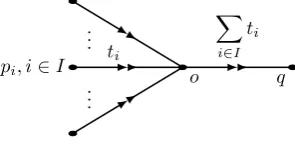
Theorem 1. Suppose a smooth Minkowski space
(Rn,·)is given together with a concave weight function w, sourcesp1, . . . , pn∈Rn, and a single sinkq∈Rn, all
different from the origin o. Let the flow associated with
pi be ti. (See Figure 1.) For each pi let p∗i denote its
o q
.. . .. .
pi, i∈I ti
[image:3.595.338.486.539.611.2]
i∈I ti
Figure 1: A Gilbert network with star topology.
dual vector, and let q∗ denote the dual vector ofq. Then the Gilbert arborescence with edges opi, i= 1, . . . , nand
oq, where all flows are routed via the Steiner point o, is a minimal Gilbert arborescence if and only if
n
i=1
w(ti)p∗i +w( n
i=1
ti)q∗=o (5)
and
i∈I
w(ti)p∗i∗≤w(
i∈I
Note: We think of Condition 5 as a flow-balancing condi-tion at the Steiner point, and Condicondi-tion 6 as a condicondi-tion that ensures that the Steiner point does not split.
Proof. (⇒) We are given that the star is not more ex-pensive than any other Gilbert network with the same sources, sink, flows and weight function.
In particular,ois the so-called weighted Fermat-Torricelli point of p1, . . . , pn, q with weights t1, . . . , tn,
n
i=1ti, re-spectively, which implies the balancing condition (5). We include a self-contained proof for completeness. If the Steiner pointois moved to−te, wheret∈Rande∈Rn
is a unit vector (in the norm), the resulting arborescence is not better, by the assumption of minimality. Therefore, the function
ϕe(t) =
n
i=1
w(ti)(pi+te − pi)
+w(
n
i=1
ti)(q+te − q)≥0
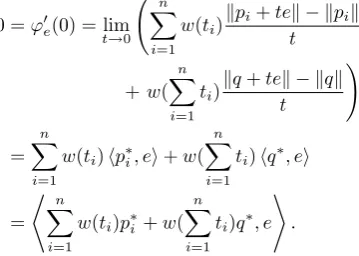
attains its minimum att= 0. Fortin a sufficiently small neighbourhood of 0,pi+te=oandq+te=o, henceϕe
is differentiable. Therefore,
0 =ϕe(0) = limt→0
n
i=1
w(ti)pi+te − pi
t
+ w(
n
i=1
ti)q+te − q
t = n i=1
w(ti)p∗i, e+w( n
i=1
ti)q∗, e
=
n
i=1
w(ti)p∗i +w( n
i=1
ti)q∗, e
.
Since this holds for all unit vectorse, (5) follows.
To show (6) for each I ⊆ {1, . . . , n}, we may assume without loss of generality thatI =∅andI ={1, . . . , n}. Consider the Gilbert network obtained by splitting the Steiner point into two points oand +te(t∈R,ea unit vector) as follows. Each pi, i /∈I, is still adjacent to o
with flow ti, andq is joined too with flowni=1ti, but now each pi,i∈I, is adjacent totewith flowti, andte
is adjacent toowith flowi∈Iti, as shown in Figure 2.
Since the new network cannot be better than the original star, we obtain that for any unit vector e, the function
ψe(t) =
i∈I
w(ti)(pi−te − pi) +w(
n
i=1
ti)|t| ≥0
attained its minimum at t = 0. Althoughψe is not
dif-te o
pi, i∈I
pi, i /∈I
q
.. . ..
. ti ...
[image:4.595.75.255.427.555.2]
i∈I ti ti n i=1 ti
Figure 2: The Gilbert network obtained by splitting the Steiner point o.
ferentiable at 0, we can still calculate as follows:
0≤ lim
t→0+
ψe(t)
t
= lim
t→0+
i∈I
w(ti)pi−te − pi
t +w(
n i=1 ti) =
i∈I
w(ti)p∗i,−e
+w(
n
i=1
ti).
Therefore, i∈Iw(ti)p∗i, e ≤ w(
n
i=1ti) for all unit vectorse, and (6) follows from the definition of the dual norm.
(⇐) Now assume thatp∗1, p∗n, qare dual unit vectors that
satisfy (5) and (6). Consider an arbitrary Gilbert ar-borescence T for the given data. For each i, let Pi be the path in T from pi to q, i.e., Pi = x(1i)x
(i) 2 . . . x
(i)
ki,
where x(1i)=pi, x (i)
ki =q, andx
(i)
j x
(i)
j+1 are distinct edges of T for j = 1, . . . , ki −1. For each edge e of T, let
Se={i:eis on pathPi}. Then the flow oneisi∈Seti
and the total cost ofT is
e=xyis an edge ofT
w(
i∈Se
ti)x−y.
The cost of the star is
n
i=1
w(ti)pi+w(
n
i=1
ti)q
=
n
i=1
w(ti)p∗i, pi+w( n
i=1
ti)q∗, q
=
n
i=1
w(ti)p∗i, pi−q by (5)
=
n
i=1
w(ti)
ki−1
j=1
p∗i, x
(i)
j −x
(i)
j+1
=
e=xyis an edge ofT
i∈Se
w(ti)p∗i, x−y
≤
e=xyis an edge ofT
i∈Se
w(ti)p∗i∗x−y
≤
e=xyis an edge ofT
w(
i∈Se
ti)x−y by (6).
Note that the necessity of the conditions (5) and (6) holds even if the weight function is not concave. It is only in the proof of the sufficiency that we need all minimal Gilbert networks with a single source to be arborescences.
4
Degree
of
Steiner
Points
in
a
Minkowski plane with linear weight
function
We now apply the characterisation of the previous section in the two-dimensional case, assuming further that the weight function is linear: w(t) =d+ht,d >0, h≥0.
Theorem 2. In a smooth Minkowski plane and assuming
a linear weight function w(t) = d+ht, d >0, h≥ 0, a Steiner point in an MGA necessarily has degree3.
Proof. By Theorem 1, an MGA with a Steiner point of degree n+ 1 exists inR2 with a smooth norm·if and only if there exist dual unit vectors p∗1, . . . , p∗n, q∗ ∈ R2
such that
n
i=1
(d+hti)p∗i + (d+h n
i=1
ti)q∗=o
and
i∈I
(d+hti)p∗i∗≤d+h
i∈I
ti for allI ⊆ {1, . . . , n}.
Label thep∗i so that they are in order around the dual unit
circle. Letvi∗= (d+hti)p∗i andw∗= (d+h
n
i=1ti)q∗. Then the conditions become
v1∗+· · ·+v∗n+w∗=o,
and
i∈I
vi∗∗ ≤ d+h
i∈I
ti for allI ⊆ {1, . . . , n}. (7)
Thus we may think of the vectors v1∗, . . . , v∗n, w∗ as the
edges of a convex polygon with vertices a∗j =
j
i=1v∗i, j= 0, . . . , nin this order (see Figure 3).
Assume for the purpose of finding a contradiction that
n >3. Then the polygon has at least 4 sides. Note that the diagonals a∗0a∗j and a∗j−1a∗n intersect. Applying the
a∗n
w∗
o=a∗0
v∗1
a∗1
v∗2
a∗2
. . . a∗j−1
v∗j a∗j
[image:5.595.88.528.103.222.2]. ..
Figure 3: A polygon with edges corresponding tovj∗.
o p1
p2
pn
s1
s2
q
.. .
n
i=1
ti t1
t2
tn
t1+t2
t2
t2
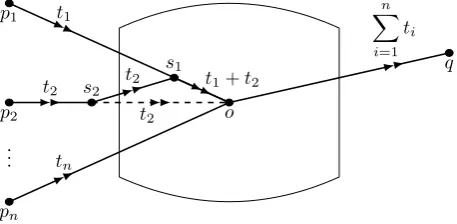
Figure 4: Illustration of the proof of Theorem 2 for a unit ball with straight line segments on the boundary.
triangle inequality to the two triangles formed by these diagonals and the two edgesvj∗and w∗ (as illustrated in
Figure 3), we obtain
a∗j∗+a∗n−a∗j−1∗≥ v∗j∗+w∗∗
=d+htj+d+h n
i=1
ti
=d+h j
i=1
ti+d+h n
i=j ti
≥ j
i=1
vi∗∗+ n
i=j
v∗i∗ by (7)
=a∗j∗+a∗n−a∗j−1∗.
Therefore, equality holds throughout, and we obtain equality in the triangle inequality. Since the dual norm is strictly convex, it follows that vj∗ and w∗ are
paral-lel. This holds for all j = 2, . . . , n−1. It follows that
p∗1=· · ·=p∗n=−q∗. Geometrically this means that the
unit vectors 1
pipiand−
1
qqall have the same
support-ing line on the unit ball. We can think of this condition on the vectors piandq as a generalisation of collinearity to Minkowski space.
[image:5.595.300.529.261.373.2]x+y for any x, y such that the unit vectors x1x
and 1yy lie on this segment. In particular,
s2−s1+s1−o=s2−o. (8)
Now replacep2oby the edgesp2s2ands2s1, replacep1o byp1s1ands1o, and add the flowt2 tos1o. The change in cost in the new Gilbert arborescence is
(w(t1)p1−s1+w(t1+t2)s1−o +w(t2)p2−s2+w(t2)s2−s1)
−(w(t1)p1−o −w(t2)p2−o) =−w(t1)s1 −w(t2)s2+w(t1+t2)s1
+w(t2)(s2 − s1) by (8) = (w(t1+t2)−w(t1)−w(t2))s1
= (d+h(t1+t2)−(d+ht1)−(d+ht2))s1 =−ds1<0.
We have shown that a Steiner point of degree at least 4 leads to a decrease in cost. In an MGA a Steiner point must then necessarily be of degree 3.
5
Conclusion
In this paper we have studied the problem of designing a minimum cost flow network interconnectingn sources and a single sink, each with known locations and flows, in general finite-dimensional normed spaces. The net-work may contain other unprescribed nodes, known as Steiner points. For concave increasing cost functions, a minimum cost network of this sort has a tree topology, and hence can be called a Minimum Gilbert Arbores-cence (MGA). We have characterised the local topologi-cal structure of Steiner points in MGAs for linear weight functions, specifically showing that Steiner points neces-sarily have degree 3.
6
Acknowledgments
The authors wish to thank Charl Ras for a number of illuminating discussions on the topic of this paper.
References
[1] S. Bhaskaran, and F. J. M. Salzborn, “Optimal de-sign of gas pipeline networks”, Journal of the Op-erational Research Society, vol. 30, pp. 1047-1060, 1979.
[2] M. Brazil, D. H. Lee, J. H. Rubinstein, D. A. Thomas, J. F. Weng, and N. C. Wormald, “Network optimisation of underground mine design”,The Aus-tralian Institute of Mining and Metallurgy Proceed-ings, vol. 305, pp. 57-65, 2000.
[3] C. L. Cox, “Flow-dependent networks: Existence and behavior at Steiner points”, Networks, vol. 31, pp. 149-156, 1998.
[4] E. N. Gilbert, “Minimum cost communication net-works”, Bell System Technical Journal, vol. 46, pp. 2209-2227, 1967.
[5] F. K. Hwang, D. S. Richards, and P. Winter, “The Steiner tree problem”,Annals of Discrete Mathemat-ics vol. 53, Elsevier Science Publishers, 1992.
[6] G. R. Lawlor, and F. Morgan, “Paired calibrations applied to soap films, immiscible fluids, and sur-faces and networks minimizing other norms”,Pacific Journal of Mathematics, vol. 166, pp. 55-82, 1994.
[7] D. H. Lee, “Low cost drainage networks”,Networks, vol. 6, pp. 351-371, 1976.
[8] K. J. Swanepoel, “Vertex degrees of Steiner Minimal Trees in d
p and other smooth Minkowski spaces”,
Discrete Comput. Geom., vol. 21, 437-447, 1999.
[9] K. J. Swanepoel, “The local Steiner problem in normed planes”, Networks, vol. 36, pp. 104-113, 2000.
[10] K. J. Swanepoel, “The local Steiner problem in finite-dimensional normed spaces”,Discrete & Com-putational Geometry, vol. 37 pp. 419-442, 2007.
[11] D. A. Thomas, and J. F. Weng, “Minimum cost flow-dependent communication networks”,Networks, vol. 48, pp. 39-46, 2006.
[12] A. C. Thompson, Minkowski Geometry, Encyclope-dia of Mathematics and its Applications 63, Cam-bridge University Press, 1996.
[13] D. Trietsch, “Minimal Euclidean networks with flow dependent costs - the generalized Steiner case”, Discussion Paper No. 655, Center for Mathemati-cal Studies in Economics and Management Science, Northwestern University, Evanston, Illinois, 1985.
[14] D. Trietsch, and J. F. Weng, “Pseudo-Gilbert-Steiner trees”,Networks, vol. 33, pp. 175-178, 1999.
[15] M. Volz, “Gradient-constrained flow-dependent net-works for underground mine design”, PhD thesis, Department of Electrical and Electronic Engineer-ing, University of Melbourne, 2008.