Abstract—To aim at time-variant or uncertain network delays in the hybrid networked control systems (HNCS)of the wired and wireless, as well as Smith predictor models and real models of the controlled plants might be mismatch, a novel approach is proposed that a new Smith predictor combined with fuzzy immune control for the HNCS. Because new Smith predictor hides predictor models of the network delays into real network data transmission processes, further all network delays no longer need to be measured, identified or estimated on-line. It is applicable to some occasions that network delays are random, time-variant or uncertain, possibly large compared to one, even tens sampling periods, at the same time, there are some data dropouts in closed loops. Based on IEEE 802.11 b/g (WLAN) and CSMA/CD (Ethernet) respectively in the inner and outer closed loops, the results of simulation show validity of the control scheme, and indicate that system has better dynamic performance and robustness.
Index Terms—Hybrid networked control systems (HNCS), wireless networked control systems (WNCS), network delay, Smith predictor.
I. INTRODUCTION
A wireless networked control systems (WNCS) is one in which a control loop is closed via the wireless network. The WNCS have many compelling applications,for example, the wireless sensor networks have found important applications in environmental monitoring, agriculture, building and industrial automation, machine condition monitoring, intelligent transportation systems, health care, surveillance, and defense. On the other hand, there has also been an increasing trend for control systems to utilize digital communication networks for exchanging information between sensor and controller and/or controller and actuator as well as between subsystems or systems that share the same communication networks due to flexibility and significant cost saving introduced by networks.
The network is a factor that should not be neglected because of the use of the communication network shared by other applications, and communication delays and packet losses may occur [1]-[4]. These issues become more significant in wireless where there commonly exist the fading time varying throughput in the communication channels as
Manuscript received December 10, 2008.
Du Feng is with the College of Information Sciences & Technology, Hainan University, Haikou, CO 570228 China (phone: +86-898-66275569; fax: +86-898-66187056; e-mail: dufeng488@ sina.com).
Du Wencai is with the College of Information Sciences & Technology, Hainan University, Haikou, CO 570228 China (e-mail: dufeng488@ yahoo.com.cn).
Lei Zhi is with the Sichuan University, Chengdu, CO 611731 China (e-mail: [email protected]).
well as the constraints and uncertainties, such as, the limited energy, bandwidth, and computing power, channel fading, time varying capacity, out-of-sequence data, transmission delays, packet losses, etc. There is an imperative need for new theory and algorithms for control, estimation and decision making that take these uncertainties and constraints into consideration and address interplay among communication, computing and control. These problems have stimulated a strong research interest in the WNCS within the control community.
Many of the research works based on assuming the network delay is constant [5]-[7], or distribution is known, or delay is shorter than one sampling period, delay through the introduction of buffer is larger than one sampling period [8]. Based on Smith predictor, but need to measured on-line, identified or estimated network delays[9]-[11], etc. These overfull postulates might produce impractical results and might limit their applications. Although delay is an important factor that needs to be considered for control systems implemented over industrial network, it has not been well defined or studied by standards organizations defining network protocols [12].
The biology immune system is characterized by its strong robustness and self-adaptability even when encountering many disturbances and uncertain conditions. It has become a new research field as an intelligent information process system after the neural network and evolutionary computation [13], and has obtained some research fruits [14], such as pattern recognition, robot control, adaptive control etc. Besides, fuzzy controller can realize any linear and nonlinear functions. Therefore, based on the immune feedback law, some studies [15]-[18]further proposed fuzzy immune control to advance the control performance such as robust and adaptive ability.
In this paper, a novel approach is proposed that new Smith predictor combined with the fuzzy immune control for the hybrid networked control systems (HNCS) of the wired and wireless. It enhances the system robustness and realizes double Smith dynamic prediction compensations for the delays of the network and controlled plants. Furthermore, the network delays in the return network paths can totally be eliminate, while remove the all delays in the forward path from the loops. Therefore, the traffics on the return network paths do not need to be scheduled, thereby allows utilizing the capacity of the communication channel more effectively than static or dynamic scheduling could, and simultaneously increases system robustness when there are data dropouts in return network paths. Where network delays are allowed to be random, time-variant and uncertain, possibly large compared to one, even tens sampling periods and they are no need to be measured, identified or estimated on line. Based
A New Smith Predictor and Fuzzy Immune
Control for Hybrid Networked Control Systems
C(s) Gp(s)
y send u e-τ
cas recv u
recv y e-τ
scs send y
controller node actuator plant
sensor node wireless
[image:2.595.330.530.246.292.2]network wireless network
Fig. 1 Structure of the WNCS.
Fig. 2 WNCS with Smith predictor
on IEEE 802.11 b/g (WLAN) in the inner closed loop and CSMA/CD (Ethernet) in the outer closed loop, the results of simulation show validity of the control scheme, and indicate that system of the HNCS has better dynamic performance and robustness.
This paper is organized for the four sections as follows: section II analyzes the Smith predictor and proposes a new Smith predictor for the WNCS and HNCS, and introduces the fuzzy immune control for the HNCS. The simulation is described in section III, and conclusions in section IV.
II. PROBLEM DESCRIPTION A. Structure of the WNCS
In the WNCS, the network delay is primary factor which influences on the system performance. The typical structure of the WNCS is shown as fig.1.
We assume that sensor is time-driven; controller and actuator are event-driven, and the actuator and sensor are co-located on the same node. Where Gp(s) is controlled plant
without delay, the C(s) is controller, the r and y are input and output of system respectively, the τsc and τcaare network
delays, the τscis from sensor to controller, and the τca is from
controller to actuator. The total network delay (τ = τsc + τca) is
[image:2.595.49.287.259.377.2]larger than one, even tens sampling periods. The closed loop transfer function is given by
( ) ( ) ( ) cas ( ) (1 ( ) cas ( ) scs)
p p
y s r s =C s e−τ G s +C s e−τ G s e−τ (1) From the (1), we can be seen that e-τ
cas and e-τscs have been
contained in the denominator of the closed loop transfer function. They can degrade the performances of the WNCS and even cause system instability.
B. Smith Predictor for the WNCS
The internal compensation loop is closed around controller side of wireless network, the Smith predictor can be described as Fig.2.
Where Gpm(s) is prediction model of the Gp(s), the τscm and
τcam are prediction values of the τsc and τca respectively. The
closed loop transfer function of the system is given as follows ( ) / ( ) ( ) ( ) / (1 ( ) ( )
( ) ( ) ( ) ( ))
ca ca sc
cam scm
s s s
p p
s s
pm pm
y s r s C s e G s C s e G s e
C s e G s e C s G s
τ τ τ
τ τ
− − −
− −
= +
− + (2)
When τcam = τca, τscm = τsc, Gpm(s) = Gp(s), the prediction
models can approximate the true models, the above (2) is reduced to
( ) ( ) ( ) cas ( ) (1 ( ) ( ))
p p
y s r s =C s e−τ G s +C s G s (3)
According to the (3), the fig.2 can be treated as fig.3.
Though Smith predictor can totally eliminate the delay τsc
in the return path, remove the delay τca in the forward path
from the closed loop, when the prediction models can accurately approximate the true models, and the delays can be totally compensated. However, the above-mentioned
Smith predictor has some problems: 1) It is difficult to satisfy complete compensation
conditions. First, because of uncertainty of wireless network delay, it is hard to get the precise prediction models of the τsc and τca. Secondly, on account of the
clock of network nodes might be asynchronous [19], it is difficult to get the exact values of delays by measurement on-line, identification or estimate. Thirdly, owing to network delays result in vacancy sampling and multi-sampling, the Smith predictor will bring errors of compensation model.
2) Because network delay τca occurs in a process that is
controller transmission data to actuator, therefore it is impossible that data are truly predicted in the controller node beforehand, no matte method is adopted, and the prediction error of delay τca is always existent.
3) When network delay large compared to one, even tens sampling periods, a lot of memory units are required for storing old data, consume memory resources and increase calculation delays, shorten life of the wireless nodes.
4) When the controlled plant includes delay τp, the
denominator of transfer function in the (3) will contain exponent e-τ
ps. Therefore, the stability of the WNCS
should be affected.
C. New Smith Predictor for the WNCS
We aim at existent problems of the fig.2, if the controlled plant with delay τp is know, a new Smith dynamic predictor is
shown in Fig. 4. Where τpm is prediction value of the τp, thus
the closed loop transfer function of the WNCS is given as follows
C(s) e-τcas Gp(s)
Gpm(s)
e-τ
scms Gpm(s)e-τcams
r
e-τ
scs
wireless network
C(s) e-τ
cas
[image:2.595.66.285.676.769.2]Gp(s)
Fig. 4 WNCS with new Smith predictor. ( ) / ( ) ( ) ( ) / (1 ( ) ( )
( ) ( ( ) ( ) ) )
p ca
p pm
ca sc
s s
p pm
s s
s s
p pm
y s r s C s e G s e C s G s
C s e G s e G s e e
τ τ
τ τ
τ τ
− −
− −
− −
= + +
− (4)
When τpm = τp, Gpm(s) = Gp(s), the prediction models can
[image:3.595.307.543.210.318.2] [image:3.595.309.540.618.745.2]accurately approximate true models, above (4) is reduced to
( ) ( ) ( ) cas ( ) ps (1 ( ) ( ))
p p
y s r s =C s e−τ G s e−τ +C s G s (5)
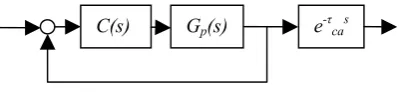
As can be seen from the (5), the effects of the delays have been completely eliminated from the denominator of the (5).
According to the (5), the fig.4 can be treated as fig.5.
From the fig.4 to fig. 5 and the (5), we can see 1) New Smith predictor realizes the double Smith dynamic
prediction compensation on structure for the delays of network and dead time delay of the controlled plant. 2) The all delays of the forward path are removed from the
closed loop and appear as gain blocks before the output, and the time-variant uncertain network delay in the return path is totally eliminated from the system. Further, it can cancel effects of the network delays and the dead time delay of the controlled plant for the system stability in the closed loop, and it enhances the control quality.
3) Because the network delays on the return path can totally be eliminated, therefore the traffic on the return path does not need to be scheduled, and the output signal of the sensor, whenever possible, can be transmitted back to remote controller node on line. This allows utilizing the capacity of the communication channel more effectively than static or dynamic scheduling could. On the other hand, increases system robustness when there are data packet dropouts on the return path of the WNCS.
4) The new Smith predictor is the real-time, on-line and dynamic predictor, and it doesn’t include the predictor models of all network delays on actualization. Because the information flow passed through the network delays which are true network delays in the data transmission process, therefore network delays no longer need to be measured, identified or estimated on line. Therefore it reduces the requirement of the clock synchronization of the nodes. Furthermore, it avoids estimate errors which are brought due to inaccurate model, and avoids nodes memory resource to be wasted when the network delays are identified or estimated. At the same time, it avoids
compensation errors, which are brought by network delays owing to vacancy-sampling and multi-sampling. D. Structure of the HNCS
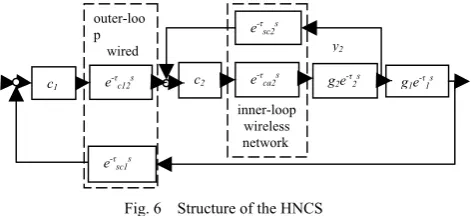
The cascade control is a common control structure in process control systems, servomechanisms and position control of the robot etc [20]. The reason for cascade control instead of single loop control is that it can give a much better compensation for disturbances, and has faster response [21]. Usually, a cascade control system consists of two control loops; an inner closed loop is embedded within an outer closed loop [22]. The hybrid networked control system (HNCS) with the cascade control structure is shown in fig.6.
In the outer-loop, the r is input of system, and y is output of the controlled plant g1(s)e-τ1s. The τsc1 and τc12 are network
delays respectively. The τsc1 is from sensor to controller c1(s),
and the τc12 is from the c1(s) to controller c2(s). In the
inner-loop, the y2 is output of the controlled plant g2(s)e-τ2s.
The τsc2 and τca2 are wireless network delays respectively. The
τsc2 is from sensor to the c2(s), and the τca2 is from the c2(s) to
actuator, this actuator is used for implementing control to the controlled plant g2(s)e-τ2s. We assume that sensors are
time-driven; controllers and actuator are event-driven. In the Fig.3, the closed-loop transfer function can be given by
12 2 2 1
12 2 2 1 1
2 2 2
1 2 2 1
1 2 2 1
2 2
( ) ( ) ( ) ( ) ( ) ( ) (1
( ) ( ) ( ) ( )
( ) ( ) )
c ca
c ca sc
ca sc
s s s s
s s s s s
s s s
y s r s c s e c s e g s e g s e
c s e c s e g s e g s e e
c s e g s e e
τ τ τ τ
τ τ τ τ τ
τ τ τ
− − − −
− − − − −
− − −
= +
+
(6)
From the (6), we can see that all delays have been contained in the denominator. Their existence will degrade system performance and even cause system instability.
E. HNCS with the New Smith Predictor
By means of the method from the Fig.4, the system of the fig.6 can be treated as fig.7.
The closed loop transfer function of the Fig.7 is given by
C(s) e-τ
cas
Gp(s) e-τps
Fig. 5 Equivalent control system C(s) e-τcas Gp(s)e-τps
Gpm(s) Gpm(s)e-τpm
e-τ
scs
wireless network
g2e-τ2s
e-τ
c12s c2
e-τ
sc1s
c1 e
-τ
ca2s g1e-τ1s
e-τ
sc2s
inner-loop wireless network
y2
outer-loo p
wired
Fig. 6 Structure of the HNCS
g2e-τ2s
e-τ
c12s c2
e-τ
sc1s
c1 e
-τ
ca2s g1e-τ1s
e-τ
sc2s
1 2 2
2 2
1 m m m
m m
g g c c g
+
g2m g2me-τ
2ms g1me-τ1ms g2me-τ
2ms
y2
12 2 2 1
1 2 2 1
2 2
1 2 2 1
2 2
( ) ( ) ( ) ( )
(1 ( ) ( )) ( )
( ) ( ) ( ) ( )
( ) (1 )
(1 ( ) ( ))
c s cas s s
m
m m m
m m
c s e c s e g s e g s e
c s g s y s
c s c s g s g s
r s A B
c s g s
τ τ τ τ
− − − −
+ =
+ + + +
(7)
2 2 2 2
2 2 2
2 2
( ) ( ( ) ( ) )
(1 ( ) ( ))
cas s ms scs
m
m
c s e g s e g s e e
A
c s g s
τ τ τ τ
− − − − −
=
+ (8)
12 2 2 1
2 1 1
1 2 2 1
2 1 2 2
( ) ( ) ( ( ) ( )
( ) ( ) ) (1 ( ) ( ))
c ca
m m sc
s s s s
s s s
m m m
B c s e c s e g s e g s e
g s e g s e e c s g s
τ τ τ τ
τ τ τ
− − − −
− − −
= −
+ (9)
When g1m(s) = g1(s), g2m(s) = g2(s), τ1m = τ1, τ2m = τ2, c2m(s) =
c2(s), above (7) is reduced to
12 2 2 1
1 2 2 1
2 2 1 2 2 1
( ) ( ) ( ) ( )
( )
( ) (1 ( ) ( ) ( ) ( ) ( ) ( ))
c s cas s s
c s e c s e g s e g s e
y s
r s c s g s c s c s g s g s
τ τ τ τ
− − − −
=
+ + (10)
According to the Fig.7 and the (10), we can see 1) The new Smith predictor can cancel effects from the τsc1
and τc12, the τsc2 and τca2, the τ1 and τ2 for system stability,
and realizes double Smith dynamic prediction compensations for the network delays and the dead time delays of the controlled plants on structure.
2) In the Fig.7, there are no τsc1m and τc12m, τsc2m and τca2m, and the network delays no longer need to be measured on-line, identified or estimated, allow network delays to be random, time-variant or uncertain. If only satisfies g1m(s) = g1(s), g2m(s) = g2(s), τ1m = τ1, τ2m = τ2, c2m(s) =
c2(s), the Smith predictor is always effective.
3) Because the nodes of the HNCS are all intelligent nodes, it is easy to be implemented.
4) The c2(s) often adopts P controller, and the c1(s) can
adopt PID control, also adopt intelligent control strategy when the controlled plant is time-variant, or nonlinear, as well as the Smith predictor models might be imprecise.
F. Fuzzy Immune Control
As is known, immune is a special physiological reaction in biosome, corresponding antibody is produced to resist attacking antigen, which is destroyed by phagocytosis or particular enzyme generated by antibody. Immune system is composed of antibody and lymphocyte, which is made up of T cells (auxiliary cell Th and suppressor cell Ts) produced by
thymocyte and B cells created by marrow. When antigen invades organism and is digested by surrounding cells, messages are sent to Th and Ts cells, and B cell is stimulated to
create more antibody so as to eliminate antigen. If quantity of antigen is large, much more auxiliary cells Th yield, but
number of suppressor cell Ts reduces, which results in more B
cell production; if antigen becomes less, number of Ts
increases and that of Th decreases, which results in decrease
of B cell. Synergism between suppressor mechanism and main feedback mechanism is realized via immune system quick response to antigen and stabilizing immune system [23].
Based on the immune feedback theory, assuming the number of kth generation of antigen is ε(k), the output of
auxiliary cell Th is Th(k), impact of Ts on B is Ts (k), and all
impetus that B cell received is
( ) h( ) s( )
S k =T k −T k (11)
Where Th(k) = k1ε(k), Ts(k) = k2f(s(k), Δs(k))ε(k). If number of
antigen ε(k) is supposed to be equivalent to the error e(k), and overall impetus S(k) that B received is equivalent to u(k), following control scheme is gained
1 2
1
( ) ( ) ( ( ), ( )) ( ) (1 ( ( ), ( ))) ( )
( )
p
u k k e k k f u k u k e k
K f u k u k e k
k e k
η
= − Δ
= − Δ
=
(12)
Where K = k1 is control of response speed, kp1=K (1-ηf (u(k),
Δu(k))) is proportional gain, the η = k2 / k1 is used to control
the stabilization effect, and f(u(k),Δu(k)) is a selected nonlinear function.
In order to determine f (u(k),Δu(k)), fuzzy control theory is utilized to acquire an approximate function. Following control rules are defined to determine f (u(k), Δu(k)):
1) If u(k) is P and Δu(k) is P then f (u(k), Δu(k)) is N. 2) If u(k) is P and Δu(k) is N then f (u(k), Δu(k)) is Z. 3) If u(k) is N and Δu(k) is P then f (u(k), Δu(k)) is Z. 4) If u(k) is N and Δu(k) is N then f (u(k), Δu(k)) is P. In the rules above, we use fuzzy logical AND, OR operation of Zadeh, adopt common used anti-fuzzy way of mom to obtain the output f (u(k),Δu(k)) of fuzzy controller, so as to construct fuzzy immune PID controller. We can assure negative feedback when 0 ≤η f(u(k),Δu(k))≤1, that is, assure the system stable, ηf(u(k),Δu(k))≥1 represents positive feedback control. If η = 0 or f (u(k),Δu(k)) = 0, the controller is just as a regular linear PID controller. So output of immune PID controller is
1
( ) ( 1) (( ( ) ( 1)) ( )
( ( ) 2 ( 1) ( 2))
p i
d
u k u k k e k e k k e k
k e k e k e k
= − + − − +
+ − − + − (13)
While the kp1 is regulated by fuzzy immune scheme, the ki
and kd is modified online using fuzzy control scheme to adapt
well to different e and error change rate ec. III. SIMULATION EXPERIMENT
_ 0.01
_ ( ) 6 ( 2)
P inners s
p inner
G s e−τ = e− s+
(14) Their predictor models are given by
_ 0.01
_ ( ) 6 ( 2)
pm inners s
pm inner
G s e−τ = e− s+
(15) In the outer closed loop, also select three selfsame controlled plant1, plant3 and plant5, and they are the second order plus dead time delay systems as follows:
_ 0.02 2
_ ( ) p outer 1770 ( 60 1770)
s s
p outer
G s e−τ = e− s + s+ (16)
Their predictor models are given by
_ 0.02 2
_ ( ) 1770 ( 60 1770)
pm outers s
pm outer
G s e−τ = e− s + s+ (17)
The HNCS1 and HNCS2 are composed by the plant1 and plant2, plant3 and plant4, respectively, simultaneously are implemented controls by new Smith predictor combined with fuzzy immune PID plus P controls, and their outputs are y1 and y3 respectively. The HNCS3 is composed by the plant5 and plant6, simultaneously is implemented controls by the fuzzy immune PID plus P control, and its output is y5.
In order to research system robustness, we change model parameters of the HNCS2, and make model parameters of Smith predictors and true controlled plant3 and plant4 are mismatch. Where true controlled plant4 in the inner closed loop is changed from the (14) to the (17) as follows
_ 0.02
_ ( ) c inner 12 (2 5)
s s
c inner
G s e−τ = e− s+
(17) At the same time, the controlled plant3 in the outer closed loop is changed from the (16) to the (18) as follows
_ 0.03 2
_ ( ) c outer 2160 ( 65 1570)
s s
c outer
G s e−τ = e− s + s+ (18)
But, the Smith predictor model parameters of true controlled plant3 and plant4 are always unchanged to keep the (15) and (17) in entire simulation process. Meanwhile, all tuned parameters of the controllers completely depend on the (14) and (16), where fuzzy immune controller parameters are K = 0.260, ki = 0.240, kd = 0.190, η = 0.680; and proportion gain
of the P controller is kp-inner= 2. In the simulation process, data
from the samplings and controls are encapsulated in the same data package for the wired or wireless network transmission.
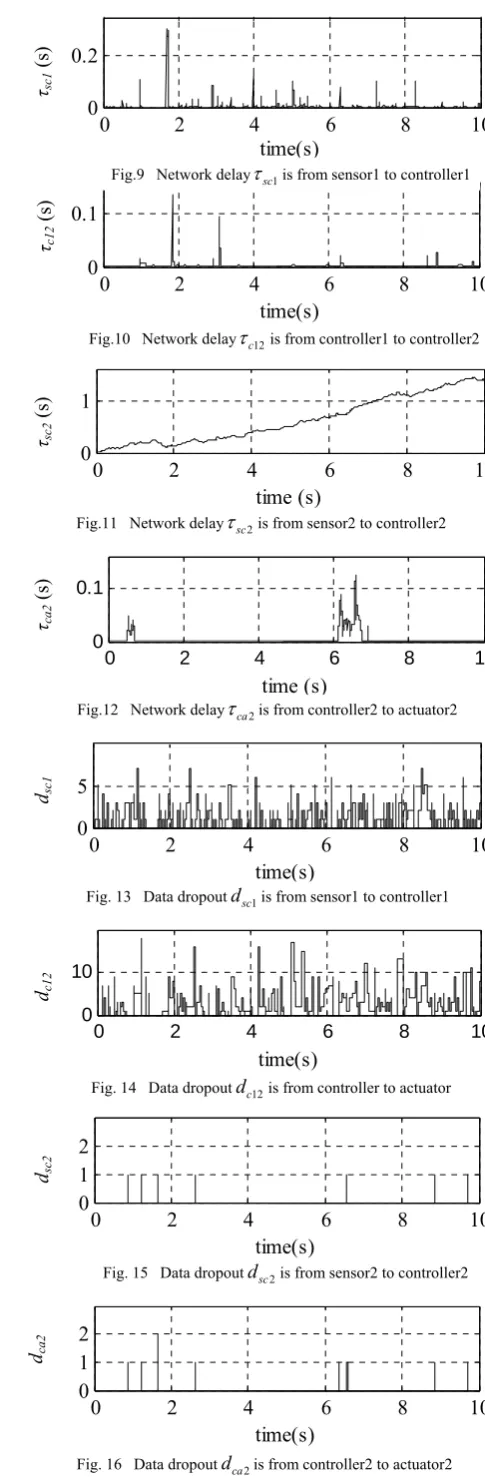
The simulation result is displayed in fig.8 to fig.16.
0 2 4 6 8 10
-1 0 1
time(s) y5
y1 y3
0 2 4 6 8 10
0 0.2
time(s)
0 2 4 6 8 10
0 0.1
time(s)
0 2 4 6 8 10
0 1
time (s)
0 2 4 6 8 10
0 0.1
time (s)
0 2 4 6 8 10
0 5
time(s)
0 2 4 6 8 10
0 10
time(s)
0 2 4 6 8 10
0 1 2
time(s)
0 2 4 6 8 10
0 1 2
time(s)
τsc1
(s)
Fig.9 Network delayτsc1is from sensor1 to controller1
Fig.11 Network delayτsc2is from sensor2 to controller2
Fig. 13 Data dropoutdsc1is from sensor1 to controller1
dsc1 τsc2
(s)
Fig. 14 Data dropoutdc12is from controller to actuator
dc12
y1, y3, y5
Fig. 8 Outputs y1, y3 and y5. The y1 and y3 are new Smith predictor combined with fuzzy immune plus P control (model parameters of true plant3 and plant4 with its Smith predictors are mismatching). The y5 is fuzzy immune plus P control.
Fig.10 Network delayτc12is from controller1 to controller2
τc12
(s)
τca2
(s)
Fig.12 Network delayτca2is from controller2 to actuator2
[image:5.595.295.538.42.782.2]dsc2
Fig. 15 Data dropoutdsc2is from sensor2 to controller2
Fig. 16 Data dropoutdca2is from controller2 to actuator2
[image:5.595.53.286.624.694.2]From the fig.8 to fig.16, we can see
1) The network delays τsc1, τc12 and τca2 are random,
time-variant or uncertain, and τsc2 is time-variant. The
maximums of the τsc1, τc12 and τca2 are respectively
0.308s, 0.138s and 0.122s, their all exceed ten sampling periods (one sampling period is 0.01s). 2) In the outer closed loop, the data packet dropout dsc1
maximum is 7, and the dc12 is 18. In the inner closed
loop, the dsc2 maximum is 1, and the dca2 is 2.
However lost messages consume the network bandwidth, but never arrive at the destination. 3) The y1 (thick dot line) and y3 (thick real line) is
timely in tracking square wave in the fig.8, and the overshoot is less, they completely satisfies performance requirement. At the same time, it also indicates that systems with new Smith predictor have stronger robustness although the true model parameters of the plant3 and plant4 are mismatching to compare with their Smith predictor model parameters.
4) The y5 give overshoot at 1.385s, along with increase and fluctuation of the network delays and data dropouts. Finally, results in system instability after 3.115s, therefore the y5 doesn’t satisfy requirement. Simulation results show that new Smith predictor combined with fuzzy immune control is effective for the HNCS.
III. CONCLUSION
In order to overcome influences of network delays, a novel approach is proposed that new Smith predictor combined with fuzzy immune control for the HNCS. Its structure is simple, and has stronger robustness. Therefore it will have wide engineering application prospect.
REFERENCES
[1] J. Y. Wei, “Stability analysis of decentralized networked control systems,” Proceedings of the 7th World Congress on Intelligent Control and Automation, June 25-27, 2008, Chongqing, China, pp 5477–5482.
[2] X. L. Zhu and G. H. Yang, “New results on stability analysis of networked control systems,” 2008 American Control Conference
Westin Seattle Hotel, Seattle, Washington, USA. June 11-13, 2008. pp. 3792–3797.
[3] W. Zhang, M. S. Branicky,S. M. Phillips, “Stability of networked control systems,” IEEE Control Syst. Magn., vol.21, No.2, pp.84–99, 2001.
[4] Y. Ge, Q. G Chen and M. Jiang, Z.A. Liu. “Stability analysis of networked control systems with data dropout and transmission delays,” Proceedings of the 7th World Congress on Intelligent Control
and Automation, June 25 - 27, 2008, Chongqing, China, pp
7986–7981.
[5] L. Dugy, E. I. Verriest, “Stability and control of time-delay systems,” New York: Springer, 1998.
[6] J.P. Richard, “Time-delay systems: an overview of some recent advances and open problems,” Automatica, vol. 39, no. 10, pp. 1667–1694, 2003.
[7] K. Watanabe, E. Nobuyama, A. Kojima, “Recent advances in control of time delay systems VA tutorial review,” in Proc. IEEE Conf. Decision and Control, 1996, pp. 2083–2088.
[8] Y. S. Xiong, L. Yu, J. M. Xu, “Design of sliding mode predicting controller for network control system,” Electric Drive Automation, 25(4): 39–40, 2003.
[9] P. Chen, Y. Dong, S. Ji, “The study of Smith prediction controller in NCS based on time delay identification,” 2004 8th Conference on Control, Automation, Robotics and Vision Kunming. China, 6-9th, December, 2004.
[10] K. B. Fite, J. E. Speich, M. Goldfarb, “Transparency and stability robustness in two-channel bilateral telemanipulation,” ASME Journal of Dynamic Systems, Measurement t, and Control, 2001.
[11] P. H. Bauer, M .L. Sichitiu, C. Lorand et al. “Total delay compensation in LAN control systems and implications for scheduling,”
Proceedings of the American Control Conference Arlington, VA June 25-27, 2001, pp. 4300–4305.
[12] J. P. Thomesse, “Fieldbus technology in industrial automation,” Proc. IEEE, vol. 93, no. 6, pp. 1073–1101, Jun. 2005.
[13] S. Gutnikov, Y. Melnikov, “A simple non-linear model of immune response,” Chaos, Solutions and Fractals, 2003, 16: pp. 125–132. [14] D. G. Peng, H. Zhang, P. Yang, et al. “A novel immune feedback
controller and its applications for main stream temperature system,”
Proceedings of the IEEE International Conference on Automation and Logistics August 18 - 21, 2007, Jinan, China, pp. 1625–1629. [15] J. L. Castro, M. Delgado, “Fuzzy systems with defuzzification are
universal approximates,” IEEE Trans. Syst., Man, Cybern., vol. 26, pp.149–152, 1996.
[16] Y. Ding, “A nonlinear PID controller based on fuzzy-tuned immune feedback law,” Proc. of the 3th World Conference on Intelligent Control and Automation, pp.1576–1580, China, 2000.
[17] X. Gao, Y. Zhao, W. Guo, and X. Yu, “Simulation and research of fuzzy immune adaptive PID control in coke oven temperature control system,” Proc. of the 6th World Conference on Intelligent Control and Automation, pp.3315–3319, China, 2006.
[18] S. Wang, Y. Jiang and H.Yang, “Chaos optimization strategy on fuzzy immune- PID control of the turbine governing system,” Proc. of the IEEE International Conference on Intelligent Robots and Systems, pp.1594–1598, China, 2006.
[19] S. Johannessen, “Time synchronization in a local area network”, IEEE Control Syst. Mag., 24: 61–69, 2004.
[20] Jang P S and Jung S. “Guidance and control of a mobile robot using neural network correction based on a remotely located sensor,”
Proceedings of the 2006 IEEE/RSJ International Conference on Intelligent Robots and Systems October 9 - 15, 2006, Beijing, China, pp.1464–1469.
[21] Guo C G, Song Q and Cai W J. “A neural network assisted cascade control system for air handling unit,” IEEE Transaction on Industrial Electronics, Vol. 54, No. 1, February 2007, pp. 620–628.
[22] Talasaz A, Shooshtari A N. “Closed-loop pressure control based on Smith predictor for gas distribution network”. 2007 Information, Decision and Control, 2007, pp. 266–271.
[23] L. H. Fang, Z. Z. Wu, A. G. Wu, et al. “ Fuzzy immune self-regulating PID control of networked control system,” International Conference on Computational Intelligence for Modeling Control and Automation, and International Conference on Intelligent Agents, Web Technologies and Internet Commerce (CIMCA-IAWTIC'06), 2006. [24] O. L. Martin, H. K. Dan, C. Anton, “TrueTime 1.5-reference manual,”
Department of Automatic Control, Lund University, Sweden,