Incremental Query Generation
Laura Perez-Beltrachini Faculty of Computer Science Free University of Bozen-Bolzano
Bozen-Bolzano, Italy
Claire Gardent CNRS/LORIA
Nancy, France
Enrico Franconi Faculty of Computer Science Free University of Bozen-Bolzano
Bozen-Bolzano, Italy
Abstract
We present a natural language genera-tion system which supports the incremen-tal specification of ontology-based queries in natural language. Our contribution is two fold. First, we introduce a chart based surface realisation algorithm which supports the kind of incremental process-ing required by ontology-based queryprocess-ing. Crucially, this algorithm avoids confusing the end user by preserving a consistent ordering of the query elements through-out the incremental query formulation pro-cess. Second, we show that grammar based surface realisation better supports the generation of fluent, natural sounding queries than previous template-based ap-proaches.
1 Introduction
Previous research has shown that formal ontolo-gies could be used as a means not only to provide a uniform and flexible approach to integrating and describing heterogeneous data sources, but also to support the final user in querying them, thus im-proving the usability of the integrated system. To support the wide access to these data sources, it is crucial to develop efficient and user-friendly ways to query them (Wache et al., 2001).
In this paper, we present a Natural Language (NL) interface of an ontology-based query tool, called Quelo1, which allows the end user to for-mulate a query without any knowledge either of the formal languages used to specify ontologies, or of the content of the ontology being used. Follow-ing the conceptual authorFollow-ing approach described in (Tennant et al., 1983; Hallett et al., 2007), this interface masks the composition of a formal query
1krdbapp.inf.unibz.it:8080/quelo
as the composition of an English text describ-ing the equivalent information needs usdescrib-ing natu-ral language generation techniques. The natunatu-ral language generation system that we propose for Quelo’s NL interface departs from similar work (Hallett et al., 2007; Franconi et al., 2010a; Fran-coni et al., 2011b; FranFran-coni et al., 2010b; FranFran-coni et al., 2011a) in that it makes use of standard gram-mar based surface realisation techniques. Our con-tribution is two fold. First, we introduce a chart based surface realisation algorithm which supports the kind of incremental processing required by on-tology driven query formulation. Crucially, this algorithm avoids confusing the end user by pre-serving a consistent ordering of the query ele-ments throughout the incremental query formu-lation process. Second, we show that grammar based surface realisation better supports the gener-ation of fluent, natural sounding queries than pre-vious template-based approaches.
The paper is structured as follows. Section 2 discusses related work and situates our approach. Section 3 describes the task being addressed namely, ontology driven query formulation. It in-troduces the input being handled, the constraints under which generation operates and the opera-tions the user may perform to build her query. In Section 4, we present the generation algo-rithm used to support the verbalisation of possi-ble queries. Section 5 reports on an evaluation of the system with respect to fluency, clarity, cover-age and incrementality. Section 6 concludes with pointers for further research.
2 Related Work
Our approach is related to two main strands of work: incremental generation and conceptual au-thoring.
Incremental Generation (Oh and Rudnicky, 2000) used an n-gram language model to
tically generate system turns. The language model is trained on a dialog corpus manually annotated with word and utterance classes. The generation engine uses the appropriate language model for the utterance class and generates word sequences randomly according to the language model distri-bution. The generated word sequences are then ranked using a scoring mechanism and only the best-scored utterance is kept. The system is incre-mental is that each word class to be verbalised can yield a new set of utterance candidates. However it supports only addition not revisions. Moreover it requires domain specific training data and man-ual annotation while the approach we propose is unsupervised and generic to any ontology.
(Dethlefs et al., 2013) use Conditional Random Fields to find the best surface realisation from a semantic tree. They show that the resulting sys-tem is able to modify generation results on the fly when new or updated input is provided by the dia-log manager. While their approach is fast to ex-ecute, it is limited to a restricted set of domain specific attributes; requires a training corpus of example sentences to define the space of possi-ble surface realisations; and is based on a large set (800 rules) of domain specific rules extracted semi-automatically from the training corpus. In contrast, we use a general, small size grammar (around 50 rules) and a lexicon which is automat-ically derived from the input ontologies. The re-sulting system requires no training and thus can be applied to any ontology with any given signa-ture of concepts and relations. Another difference between the two approaches concerns revisions: while our approach supports revisions anywhere in the input, the CRF approach proposed by (Deth-lefs et al., 2013) only supports revisions occurring at the end of the generated string.
There is also much work (Schlangen and Skantze, 2009; Schlangen et al., 2009) in the do-main of spoken dialog systems geared at mod-elling the incremental nature of dialog and in par-ticular, at developing dialog systems where pro-cessing starts before the input is complete. In these approaches, the focus is on developing efficient ar-chitectures which support the timely interleaving of parsing and generation. Instead, our aim is to develop a principled approach to the incremental generation of a user query which supports revision and additions at arbitrary points of the query being built; generates natural sounding text; and
maxi-mally preserves the linear order of the query.
Conceptual authoring Our proposal is closely related to the conceptual authoring approach de-scribed in (Hallett et al., 2007). In this approach, a text generated from a knowledge base, describes in natural language the knowledge encoded so far, and the options for extending it. Starting with an initial very general query (e.g., all things), the user can formulate a query by choosing between these options. Similarly, (Franconi et al., 2010a; coni et al., 2011b; Franconi et al., 2010b; Fran-coni et al., 2011a) describes a conceptual author-ing approach to queryauthor-ing semantic data where in addition , logical inference is used to semantically constrain the possible completions/revisions dis-played to the user.
Our approach departs from this work in that it makes use of standard grammars and algorithms. While previous work was based on procedures and templates, we rely on a Feature-Based Tree Ad-joining Grammar to capture the link between text and semantics required by conceptual authoring; and we adapt a chart based algorithm to support the addition, the revision and the substitution of input material. To avoid confusing the user, we additionally introduce a scoring function which helps preserve the linear order of the NL query. The generation system we present is in fact inte-grated in the Quelo interface developed by (Fran-coni et al., 2011a) and compared with their previ-ous template-based approach.
3 Incremental Generation of Candidate Query Extensions
The generation task we address is the following. Given a knowledge base K, some initial formal queryq and a focus pointpin that query, the rea-soning services supported by Quelo’s query logic framework (see (Guagliardo, 2009)) will compute a set of new queries rev(q) formed by adding, deleting and revising the current query q at point
we assume that formal queries are represented us-ing Description Logics (Baader, 2003).
The following examples show a possible se-quence of NL queries, their corresponding DL rep-resentation and the operations provided by Quelo that can be performed on a query (bold face is used to indicate the point in the query at which the next revision takes place). For instance, the query in (1c) results from adding the conceptY oungto the query underlying (1b) at the point highlighted by
man.
(1) a. I am looking for something (initial query) ⊤
b. I am looking for a man (substitute con-cept)
Man
c. I am looking for a young man (add com-patible concept)
Man⊓Y oung
d. I am looking for a young man who is
married to a person (add relation) Man⊓Y oung⊓ ∃isMarried.(P erson)
e. I am looking for a young married man (substitute selection)
MarriedMan⊓Y oung
f. I am looking for a married man (delete concept)
MarriedMan
4 Generating Queries
Generation of KB queries differs from standard natural language generation algorithms in two main ways. First it should support the revi-sions, deletions and additions required by incre-mental processing. Second, to avoid confusing the user, the revisions (modifications, extensions, deletions) performed by the user should have a minimal effect on the linear order of the NL query. That is the generator is not free to produce any NL variant verbalising the query but should produce a verbalisation that is linearly as close as possi-ble, modulo the revision applied by the user, to the query before revisions. Thus for instance, given the DL query (2) and assuming a linearisation of that formula that matches the linear order it is pre-sented in (see Section 4.2.1 below for a definition of the linearisation of DL formulae), sentence (2b) will be preferred over (2c).
(2) a. Car ⊓ ∃runOn.(Diesel) ⊓ ∃equippedW ith.(AirCond)
b. A car which runs on Diesel and is equipped with air conditioning
c. A car which is equipped with air condi-tioning and runs on Diesel
In what follows, we describe the generation al-gorithm used to verbalise possible extensions of user queries as proposed by the Quelo tool. We start by introducing and motivating the underlying formal language supported by Quelo and the input to the generator. We then describe the overall ar-chitecture of our generator. Finally, we present the incremental surface realisation algorithm support-ing the verbalisation of the possible query exten-sions.
4.1 The Input Language
Following (Franconi et al., 2010a; Franconi et al., 2011b; Franconi et al., 2010b; Franconi et al., 2011a) we assume a formal language for queries that targets the querying of various knowledge and data bases independent of their specification guage. To this end, it uses a minimal query lan-guageLthat is shared by most knowledge repre-sentation languages and is supported by Descrip-tion Logic (DL) reasoners namely, the language of tree shaped conjunctive DL queries. Let Rbe a set of relations andCbe a set of concepts, then the language of tree-shaped conjunctive DL queries is defined as follows: S ::=C | ∃R.(S)|S⊓S whereR ∈ R,C ∈ C,⊓denotes conjunction and ∃is the existential quantifier.
A tree shaped conjunctive DL query can be rep-resented as a tree where nodes are associated with a set of concept names (node labels) and edges are labelled with a relation name (edge labels). Figure 1 shows some example query trees.
4.2 NLG architecture
Our generator takes as input two L formula: the formula representing the current query q and the formula representing a possible revision r (addi-tion/deletion/modification) of q. Given this in-put, the system architecture follows a traditional pipeline sequencing a document planner which (i) linearises the input query and (ii) partition the in-put into sentence size chunks; a surface realiser mapping each sentence sizeLformula into a sen-tence; and a referring expression generator verbal-ising NPs.
4.2.1 Document Planning
x {Man}
(a)
x
w
{Man}
{House}
livesIn
(b)
x
w
z
{Man}
{House}
livesIn
{RichP erson}
ownedBy
(c)
x
w
z
{Man}
{House, Beautiful}
livesIn
{RichP erson}
ownedBy
(d)
✬
✫
✩
✪
x
y w
z {Man}
{P erson}
{House, Beautiful}
{RichP erson}
marriedTo livesIn
ownedBy
(e)
Figure 1: Example of query tree and incremental query construction.
query into sentence size chunks.
Query Linearisation Among the different strategies investigated in (Dongilli, 2008) to find a good order for the content contained in a query tree the depth-first planning, i.e. depth-first traversal of the query tree, was found to be the most appropriate one. Partly because it is obtained straightforward from the query tree but mostly due to the fact that it minimizes the changes in the text plan that are required by incremental query modifications. Thus, (Franconi et al., 2010a) defines a query linearisation as a strict total order2 on the query tree that satisfies the following conditions:
• all labels associated with the edge’s leaving node precede the edge label
• the edge label is followed by at least one label associated with the edge’s arriving node • between any two labels of a node there can
only be (distinct) labels of the same node
The specific linearisation adopted in Quelo is defined by the depth-first traversal strategy of the query tree and a total order on the children which is based on the query operations. That is, the la-bels of a node are ordered according to the se-quence applications of the add compatible conceptoperation. The children of a node are inversely ordered according to the sequence of ap-plications of theadd relationoperation.
According to this linearisation definition, for the query tree (e) in Figure 1 the following linear order is produced:
(3) a. Man marriedTo P ersonlivesIn House
BeautifulownedByRichP eron
2A strict total order can be obtained by fixing an order in
the children nodes and traversing the tree according to some tree traversal strategy.
Query Segmentation Given a linearised query
q, the document planner uses some heuristics based on the number and the types of rela-tions/concepts present in q to output a sequence of sub-formulae each of which will be verbalised as a sentence.
4.2.2 Incremental Surface Realisation and Linearisation Constraints
We now describe the main module of the generator namely the surface realiser which supports both the incremental refinement of a query and a mimal modification of the linear order between in-crements. This surface realiser is caracterised by the following three main features.
Grammar-Based We use a symbolic,
grammar-based approach rather than a statistical one for two reasons. First, there is no training corpus available that would consist of knowledge base queries and their increments. Second, the approach must be portable and should apply to any knowledge base independent of the domain it covers and indepen-dent of the presence of a training corpus. By com-bining a lexicon automatically extracted from the ontology with a small grammar tailored to produce natural sounding queries, we provide a generator which can effectively apply to any ontology with-out requiring the construction of a training corpus.
Chart-Based A chart-based architecture
en-hances efficiency by avoiding the recomputation of intermediate structures while allowing for a natural implementation of the revisions (addition, deletion, substitution) operations required by the incremental formulation of user queries. We show how the chart can be used to implement these op-erations.
Beam search. As already mentioned, for
should also be sufficiently fast to support a timely Man/Machine interaction. We use beam search and a customised scoring function both to preserve linear order and to support efficiency.
We now introduce each of these components in more details.
Feature-Based Tree Adjoining Grammar
A tree adjoining grammar (TAG) is a tuple hΣ, N, I, A, SiwithΣa set of terminals,N a set of non-terminals, I a finite set of initial trees,Aa finite set of auxiliary trees, andS a distinguished non-terminal (S ∈ N). Initial trees are trees whose leaves are labeled with substitution nodes (marked with a down-arrow) or with terminal categories3. Auxiliary trees are distinguished by a foot node (marked with a star) whose category must be the same as that of the root node.
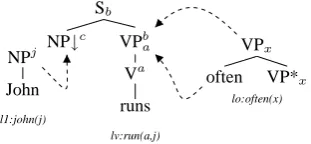
Two tree-composition operations are used to combine trees: substitution and adjunction. Sub-stitution inserts a tree onto a subSub-stitution node of some other tree while adjunction inserts an aux-iliary tree into a tree. In a Feature-Based Lexi-calised TAG (FB-LTAG), tree nodes are further-more decorated with two feature structures which are unified during derivation; and each tree is an-chored with a lexical item. Figure 2 shows an ex-ample toy FB-LTAG with unification semantics. The dotted arrows indicate possible tree combina-tions (substitution for John, adjunction for often). As the trees are combined, the semantics is the union of their semantics modulo unification. Thus given the grammar and the derivation shown, the semantics of John often runs is as shown namely,
named(j john), run(a,j), often(a).
NPj
John
l1:john(j)
Sb
NP↓c VPba
Va
runs
lv:run(a,j)
VPx
often VP*x
lo:often(x)
[image:5.595.98.254.548.620.2]l1:named(j john), lv:run(a,j), lv:often(a)
Figure 2:Derivation and Semantics for “John often runs”
Chart-Based Surface Realisation Given an FB-LTAG G of the type described above, sen-tences can be generated from semantic formulae by (i) selecting all trees inGwhose semantics sub-sumes part of the input formula and (ii) combining
3For a more detailed introduction to TAG and FB-LTAG,
see (Vijay-Shanker and Joshi, 1988).
these trees using the FB-LTAG combining opera-tions namely substitution and adjunction. Thus for instance, in Figure 2, given the semanticsl1:named(j john), lv:run(a,j), lv:often(a), the three trees shown are selected. When combined they produce a com-plete phrase structure tree whose yield (John runs often) is the generated sentence.
Following (Gardent and Perez-Beltrachini, 2011), we implement an Earley style generation algorithm for FB-LTAG which makes use of the fact that the derivation trees of an FB-LTAG are context free and that an FB-LTAG can be con-verted to a a Feature-Based Regular Tree Gram-mar (FB-RTG) describing the derivation trees of this FB-LTAG4.
On the one hand, this Earley algorithm en-hances efficiency in that (i) it avoids recomput-ing intermediate structures by storrecomput-ing them and (ii) it packs locally equivalent structures into a single representative (the most general one). Lo-cally equivalent structures are taken to be partial derivation trees with identical semantic coverage and similar combinatorics (same number and type of substitution and adjunction requirements).
On the other hand, it naturally supports the range of revisions required for the incremental for-mulation of ontology-based queries. LetC be the current chart i.e., the chart built when generating a NL query from the formal query. Then additions, revisions and deletion can be handled as follows.
• Add concept or property X: the grammar units selected byXare added to the agenda5 and tried for combinations with the elements ofC.
• Substitute selectionXwithY: all chart items derived from a grammar unit selected by an element of X are removed from the chart. Conversely, all chart items derived from a grammar unit selected by an element ofY are added to the agenda. All items in the agenda are then processed until generation halts. • Delete selection X: all chart items derived
from a grammar unit selected by an element ofXare removed from the chart. Intermedi-ate structures that had previously used X are moved to the agenda and the agenda is pro-cessed until generation halts.
4For more details on this algorithm, we refer the reader to
(Gardent and Perez-Beltrachini, 2010).
5The agenda is a book keeping device which stores all
Beam Search To enhance efficiency and favor those structures which best preserve the word or-der while covering maximal input, we base our beam search on a scoring function combining lin-ear order and semantic coverage information. This works as follows. First, we associate each literal in the input query with its positional information e.g.,
(4) a. man(x)[0] marriedTo(x y)[1] person(y)[2] livesIn(x w)[3] house(w)[4]
This positional information is copied over to each FB-LTAG tree selected by a given literal and is then used to compute a word order cost (Cwo) for each derived tree as follows:
Cwo(ti+j) =Cwo(ti) +Cwo(tj) +Cwo(ti+tj)
That is the cost of a treeti+j obtained by com-bining ti and tj is the sum of the cost of each of these trees plus the cost incurred by combin-ing these two trees. We define this latter cost to be proportional to the distance separating the ac-tual position (api) of the tree (ti) being substi-tuted/adjoined in from its required position (rpi). If ti is substituted/adjoined at position n to the right (left) of the anchor of a tree tj with posi-tion pj, then the actual position of ti is pj +n (pj−n) and the cost of combining ti withtj is |pj+n−rpi |/α(|pj−n−rpi |/α) where
we empirically determinedαto be 1006.
Finally, the total score of a tree reflects the rela-tion between the cost of the built tree, i.e. its word order cost, and its semantic coverage, i.e. nb. of literals from the input semantics:
S(ti) =
(
−(|literals| −1) Cwo(ti) = 0
Cwo(ti)/(|literals| −1) otherwise
The total score is defined by cases. Those trees with Cwo = 0get a negative value according to their input coverage (i.e. those that cover a larger subset of the input semantics are favored as the trees in the agenda are ordered by increasing total score). Conversely, those trees withCwo > 0get a score that is the word order cost proportional to the covered input.
In effect, this scoring mechanism favors trees with low word order cost and large semantic cov-erage. The beam search will select those trees with lowest score.
6
In the current implementation we assume that n = 1.
Furthermore, as ti might be a derived tree we also add to
Cwo(ti+tj)the cost computed on each treetkused in the derivation oftiwith respect totj.
4.2.3 Referring Expression Generation
The referring expression (RE) module takes as input the sequence of phrase structure trees out-put by the surface realiser and uses heuristics to decide for each NP whether it should be ver-balised as a pronoun, a definite or an indefinite NP. These heuristics are based on the linear order and morpho-syntactic information contained in the phrase structure trees of the generated sentences.
5 Experiments and evaluation
We conducted evaluation experiments designed to address the following questions:
• Does the scoring mechanism appropriately capture the ordering constraints on the gen-erated queries ? That is, does it ensure that the generated queries respect the strict total order of the query tree linearisation ?
• Does our grammar based approach produce more fluent and less ambiguous NL query than the initial template based approach cur-rently used by Quelo ?
• Does the automatic extraction of lexicons from ontology support generic coverage of arbitrary ontologies ?
We start by describing the grammar used. We then report on the results obtained for each of these evaluation points.
5.1 Grammar and Lexicon
We specify an FB-LTAG with unification seman-tics which covers a set of basic constructions used to formulate queries namely, active and passive transitive verbs, adjectives, prepositional phrases, relative and elliptical clauses, gerund and partici-ple modifiers. The resulting grammar consists of 53 FB-LTAG pairs of syntactic trees and semantic schema.
To ensure the appropriate syntax/semantic in-terface, we make explicit the arguments of a relation using the variables associated with the nodes of the query tree. Thus for instance, given the rightmost query tree shown in Figure 1, the flat semantics input to surface realisation is
{Man(x), Person(y), House(w), Beautiful(w), RichPerson(z), marriedTo(x,y), livesIn(x,w), ownedBy(w,z)}.
5.2 Linearisation
In this first experiment, we manually examined whether the incremental algorithm we propose supports the generation of NL queries whose word order matches the linearisation of the input query tree.
We created four series of queries such that each serie is a sequence q1. . . qn where qi+1 is an in-crement of qi. That is, qi+1 is derived from qi by adding, removing or substituting to qi a con-cept or a relation. The series were devised so as to encompass the whole range of possible operations at different points of the preceding query (e.g., at the last node/edge or on some node/edge occur-ring further to the left of the previous query); and include 14 revisions on 4 initial queries.
For all queries, the word order of the best NL query produced by the generator was found to match the linearisation of the DL query.
5.3 Fluency and Clarity
Following the so-called consensus model (Power and Third, 2010), the current, template based ver-sion of Quelo generates one clause per relation7. Thus for instance, template-based Quelo will gen-erate (5a) while our grammar based approach sup-ports the generation of arguably more fluent sen-tences such as (5b).
(5) a. I am looking for a car. Its make should be a Land Rover. The body style of the car should be an off-road car. The exterior color of the car should be beige.
b. I am looking for car whose make is a Land Rover, whose body style is an off-road car and whose exterior color is beige.
We ran two experiments designed to assess how fluency impacts users. The first experiment aims to assess how Quelo template based queries are perceived by the users in terms of clarity and flu-ency, the second aims to compare these template based queries with the queries produced by our grammar-based approach.
Assessing Quelo template-based queries Us-ing the Quelo interface, we generated a set of 41 queries chosen to capture different combina-tions of concepts and relacombina-tions. Eight persons (four native speakers of English, four with C2
7This is modulo aggregation of relations. Thus two
sub-ject sharing relations may be realised in the same clause.
level of competence for foreign learners of En-glish) were then asked to classify (a binary choice) each query in terms of clarity and fluency. Fol-lowing (Kow and Belz, 2012), we take Fluency to be a single quality criterion intended to cap-ture language quality as distinct from its meaning, i.e. how well a piece of text reads. In contrast,
Clarity/ambiguity refers to ease of understanding
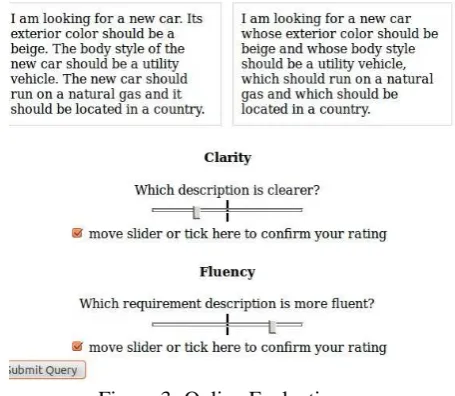
[image:7.595.303.531.302.500.2](Is the sentence easy to understand?). Taking the average of the majority vote, we found that the judges evaluated the queries as non fluent in 50% of the cases and as unclear in 10% of the cases. In other words, template based queries were found to be disfluent about half of the time and unclear to a lesser extent. The major observation made by most of the participants was that the generated text is too repetitive and lacks aggregation.
Figure 3: Online Evaluation.
the sentences from both systems were equally dis-tributed to both sides of the screen.
For this experiment, we used 14 queries built from two ontologies, an ontology on cars and the other on universities. The extracted lexicons for each of these ontology contained 465 and 297 en-tries respectively.
The results indicate that the queries generated by the grammar based approach are perceived as more fluent than those produced by the template based approach (19.76 points in average for the grammar based approach against 7.20 for the tem-plate based approach). Furthermore, although the template based queries are perceived as clearer (8.57 for Quelo, 6.87 for our approach), the dif-ference is not statistically significant (p < 0.5). Overall thus, the grammar based approach appears to produce verbalisations that are better accepted by the users. Concerning clarity, we observed that longer sentences let through by document plan-ning were often deemed unclear. In future work, we plan to improve clarity by better integrating document planning and sentence realisation.
5.4 Coverage
One motivation for the symbolic based approach was the lack of training corpus and the need for portability: the query interface should be usable independently of the underlying ontology and of the existence of a training corpus. To support coverage, we combined the grammar based ap-proach with a lexicon which is automatically ex-tracted from the ontology using the methodology described in (Trevisan, 2010). When tested on a corpus of 200 ontologies, this approach was shown to be able to provide appropriate verbalisa-tion templates for about 85% of the relaverbalisa-tion iden-tifiers present in these ontologies. 12 000 relation identifiers were extracted from the 200 ontologies and 13 syntactic templates were found to be suf-ficient to verbalise these relation identifiers (see (Trevisan, 2010) for more details on this evalua-tion).
That is, in general, the extracted lexicons permit covering about 85% of the ontological data. In ad-dition, we evaluated the coverage of our approach by running the generator on 40 queries generated from five distinct ontologies. The domains ob-served are cinema, wines, human abilities, dis-abilities, and assistive devices, e-commerce on the Web, and a fishery database for observations about
an aquatic resource. The extracted lexicons con-tained in average 453 lexical entries and the cov-erage (proportion of DL queries for which the gen-erator produced a NL query) was 87%.
Fuller coverage could be obtained by manually adding lexical entries, or by developing new ways of inducing lexical entries from ontologies (c.f. e.g. (Walter et al., 2013)).
6 Conclusion
Conceptual authoring (CA) allows the user to query a knowledge base without having any knowledge either of the formal representation lan-guage used to specify that knowledge base or of the content of the knowledge base. Although this approach builds on a tight integration between syntax and semantics and requires an efficient pro-cessing of revisions, existing CA tools predomi-nantly make use of ad hoc generation algorithms and restricted computational grammars (e.g., Def-inite Clause Grammars or templates). In this pa-per, we have shown that FB-LTAG and chart based surface realisation provide a natural framework in which to implement conceptual authoring. In par-ticular, we show that the chart based approach nat-urally supports the definition of an incremental al-gorithm for query verbalisation; and that the added fluency provided by the grammar based approach potentially provides for query interfaces that are better accepted by the human evaluators.
In the future, we would like to investigate the interaction between context, document structuring and surface realisation. In our experiments we found out that this interaction strongly impacts flu-ency whereby for instance, a complex sentence might be perceived as more fluent than several clauses but a too long sentence will be perceived as difficult to read (non fluent). Using data that can now be collected using our grammar based approach to query verbalisation and generalising over FB-LTAG tree names rather than lemmas or POS tags, we plan to explore how e.g., Conditional Random Fields can be used to model these inter-actions.
Acknowledgments
References
Franz Baader. 2003. The description logic handbook:
theory, implementation, and applications. Cam-bridge university press.
Nina Dethlefs, Helen Hastie, Heriberto Cuay´ahuitl, and Oliver Lemon. 2013. Conditional Random Fields for Responsive Surface Realisation using Global Features. Proceedings of ACL, Sofia, Bulgaria.
Paolo Dongilli. 2008. Natural language rendering of a conjunctive query. KRDB Research Centre
Techni-cal Report No. KRDB08-3). Bozen, IT: Free Univer-sity of Bozen-Bolzano, 2:5.
E. Franconi, P. Guagliardo, and M. Trevisan. 2010a. An intelligent query interface based on ontology navigation. In Workshop on Visual Interfaces to the
Social and Semantic Web, VISSW, volume 10.
Cite-seer.
E. Franconi, P. Guagliardo, and M. Trevisan. 2010b. Quelo: a NL-based intelligent query interface. In
Pre-Proceedings of the Second Workshop on Con-trolled Natural Languages, volume 622.
E. Franconi, P. Guagliardo, S. Tessaris, and M. Tre-visan. 2011a. A natural language ontology-driven query interface. In 9th International Conference on
Terminology and Artificial Intelligence, page 43.
E. Franconi, P. Guagliardo, M. Trevisan, and S. Tes-saris. 2011b. Quelo: an Ontology-Driven Query Interface. In Description Logics.
C. Gardent and L. Perez-Beltrachini. 2010. RTG based Surface Realisation for TAG. In COLING’10, Bei-jing, China.
B. Gottesman Gardent, C. and L. Perez-Beltrachini. 2011. Using regular tree grammar to enhance sur-face realisation. Natural Language Engineering,
17:185–201. Special Issue on Finite State Methods and Models in Natural Language Processing.
Paolo Guagliardo. 2009. Theoretical foundations of an ontology-based visual tool for query formulation support. Technical report, KRDB Research Centre, Free University of Bozen-Bolzano, October.
C. Hallett, D. Scott, and R. Power. 2007. Composing questions through conceptual authoring.
Computa-tional Linguistics, 33(1):105–133.
Eric Kow and Anja Belz. 2012. LG-Eval: A Toolkit for Creating Online Language Evaluation Experi-ments. In LREC, pages 4033–4037.
Alice H Oh and Alexander I Rudnicky. 2000. Stochas-tic language generation for spoken dialogue sys-tems. In Proceedings of the 2000 ANLP/NAACL
Workshop on Conversational systems-Volume 3,
pages 27–32. Association for Computational Lin-guistics.
R. Power and A. Third. 2010. Expressing owl ax-ioms by english sentences: dubious in theory, fea-sible in practice. In Proceedings of the 23rd
Inter-national Conference on Computational Linguistics: Posters, pages 1006–1013. Association for
Compu-tational Linguistics.
David Schlangen and Gabriel Skantze. 2009. A gen-eral, abstract model of incremental dialogue pro-cessing. In Proceedings of the 12th Conference of
the European Chapter of the Association for Com-putational Linguistics, pages 710–718. Association
for Computational Linguistics.
David Schlangen, Timo Baumann, and Michaela At-terer. 2009. Incremental reference resolution: The task, metrics for evaluation, and a bayesian filtering model that is sensitive to disfluencies. In
Proceed-ings of the SIGDIAL 2009 Conference: The 10th An-nual Meeting of the Special Interest Group on Dis-course and Dialogue, pages 30–37. Association for
Computational Linguistics.
H. R Tennant, K. M Ross, R. M Saenz, C. W Thomp-son, and J. R Miller. 1983. Menu-based natural lguage understanding. In Proceedings of the 21st
an-nual meeting on Association for Computational Lin-guistics, pages 151–158. Association for
Computa-tional Linguistics.
Marco Trevisan. 2010. A Portable Menuguided
Nat-ural Language Interface to Knowledge Bases for Querytool. Ph.D. thesis, Masters thesis, Free
Uni-versity of Bozen-Bolzano (Italy) and UniUni-versity of Groningen (Netherlands).
K. Vijay-Shanker and A. Joshi. 1988. Feature based tags. In Proceedings of the 12th International
Con-ference of the Association for Computational Lin-guistics, pages 573–577, Budapest.
Holger Wache, Thomas Voegele, Ubbo Visser, Heiner Stuckenschmidt, Gerhard Schuster, Holger Neu-mann, and Sebastian H¨ubner. 2001. Ontology-based integration of information-a survey of existing approaches. In IJCAI-01 workshop: ontologies and
information sharing, volume 2001, pages 108–117.
Citeseer.
Sebastian Walter, Christina Unger, and Philipp Cimi-ano. 2013. A corpus-based approach for the induc-tion of ontology lexica. In Natural Language
Pro-cessing and Information Systems, pages 102–113.