Abstract
—
In the paper is offered the method of calculation of options PID - regulator (P- Proportional, I - Integrated, D - Differential) on the basis of correlations defining a stability stock on the module and on the phase which are expressed in the form of four nonlinear equations. For calculation of options PID- regulator the system of four nonlinear equations is solved at various values of dimensionless parameter α =TD/TI ofdifferentiating part PID - regulator. For the definitive choice of options PID - regulator value of integrated quadratic criterion of the quality of the work of the control system was calculated. Results of calculation are presented in the form of the schedule to dependences of integrated quadratic criterion of quality on dimensionless parameter α. This dependence has monotonous character, increase in accuracy of the work of the control system from α. Value α proportionate to the least value of integrated quadratic criterion of quality is equal 2.In this connection α received proportionate options PID -regulator.
I. INTRODUCTION
The basic requirement at calculation of options of typical regulators is maintenance of working capacity of the closed control system that is a stability stock. Known ways of calculation of options allow doing it. For example, in the method of the expanded peak-phase characteristics the stability stock is provided with parameter introduction – degrees of oscillation “m”, setting its value in the limit 0.22«m« 0.366 [1]. Degree of oscillation “m” indirectly characterizes a stability stock. Other method of calculation of options of regulators with provision taken for the stock of stability is based on the considering as well of indirect parameter - index of oscillation "M" which is defined on the maximum quantity of the amplitude-phase characteristic of closed control system on resonant frequency.
.
The value of M set in calculations is in limits of 1.33"M« 1.7 [2].Manuscript received May 19, 2009.
1- Professor in the department of engineering, automation and cybernetics, Moscow State University of Environmental Engineering, Moscow 105066, Russia.
2 - Student-Master in the department of engineering, automation and cybernetics, Moscow State University of Environmental Engineering, Moscow 107884, Russia (e-mail: [email protected]).
There are other methods the calculation of options in which is based on empirical dependences, for example, a known method Ziegler Nichols. At last, in the work [3] the method based on the definition of the stock of stability on the module and the phase is offered directly the distance of locus of Nyquist to stability border (-1, j.0) on the fixed frequencies. Definition of the stock of stability on the module and the phase is added up to drawing up of four equations. The system of the equations which decision allows calculating options for typical PI - regulator as a result turns out. In the same work is offered the way of calculation of options PID - regulator having, as it is known, three parameters of options. The author [3] adds up calculation to calculation PI- regulator, setting the constant of time of differentiation of an equal constant of time of the dynamics of the object. In the given work for calculation of options PID - regulator as well four equations are applied for the definition of the stock of stability on the module and the phase, however for the task of the third parameter is entered [2] dimensionless parameter α=TD/TI (TD-differentiation
time constant, TI- integration time constant). Calculation is
conducted for various preset values of parameter α and a final variant gets out on the basis of values of integrated quadratic criterion of quality of the accuracy of the work of the control system.
II. DETERMINATIONOFTHESTOCKOFSTABILITY
The stability stock on the module and on the phase is found by means of following four equations:
(
.
).
(
.
)
arg
R
PIDj
PW
0j
P(1)
)
.
(
).
.
(
1
0 P P
PID m
j
W
j
R
A
(2
)
1
)
.
(
).
.
(
c 0 c
PID
j
W
j
R
(3)
marg
R
PID(
j
.
c).
W
0(
j
.
c)
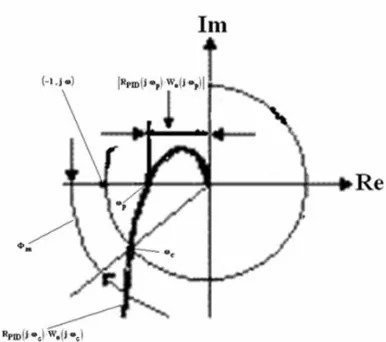
(4) Correlations (1) ÷ (4) are illustrated in Fig. 1.
Calculating of Options PID Regulator on
the Basis of a Stability Stock on the Module
and on the Phase
Fig. 1.To the notion of stability margin in module, phase and the stability
(Nyquist‘s criterion)
Under operating conditions system parameters for whatever reasons can vary in certain limits (ageing, temperature fluctuations, etc.). These fluctuations of parameters can lead to loss of the stability of system if it works near to stability border. Therefore they aspire to design the automated system of the regulation (АSR) so that it worked far from stability boundary. Degree of this removal is named a stability stock. According to criterion of Nyquist, the further the peak-phase characteristic (PPC) from the critical point (-1, j0), the has more reserved stability. Stability stocks are distinguished on the module and on the phase.
Stability stock on the module characterizes removal of the locus of the peak-phase characteristic of the opened automated system of regulation from the critical point in the direction of the material axis and is defined by the distance from the critical point to the point of intersection by the locus axes of abscises ωp(Fig.1).
Stability stock on the phase characterizes removal of the locus from the critical point on an the arch of the circle of the individual radius and is defined by the angle φ between the negative direction of the material semi axis and the ray lined from the beginning of co-ordinates into the point of intersection of the locus with an individual circle ωc (Fig.1).
Initial data necessary for the calculation represents dynamics of the object in the form of the following transfer function:
1
.
.
)
(
. 0
p
T
e
K
p
W
p o (5) Where
К0 – Factor of proportionality,
Т - Constant of time, τ – Time of pure delay, p - Operator on Laplas, ω-frequency
,
j- Complex variables.
Transfer function of the regulator we will write down as follows:
p
T
p
T
p
T
k
p
R
I I I c PID.
)
1
.
.
.
(
)
(
2 2
(6)
Where:
ТI - constant of time of integration,
kc - Factor of transfer of regulator,
The equation (1) is necessary for frequency definition ωp on which locus of Nyquist crosses axis Re. (Fig. 1.) With that end in view we will write down the frequency characteristic of the opened control system:
) 1 . . .( . . . 1 . . . ) . .( ( . ) . ( ). ( . . 2 2 0 0 p p I j p I p I c p PID j T j T e j T j T K k j W p R p
(7)
From here we will pass to the developed equation:
0 . ) m ( 2 m p deno deno nume nume Rе I arctg Rе I arctg
Where
Imnume, Renume, Imdeno, Redeno- imaginary and real parts relatively of the numerator and the denominator of the formula (7).
Let's definitively receive the equation for frequency calculation ωp:
0 . ) . ( ) . . 1 . (
2 2 2
p p p I p I T arctg T T
arctg
(8)
The module is in the same way defined:
1 . 1 . . . 1 . . ) . ( ). ( 2 2 2 2 2 0 0 p p I p I c p PID T T T K k j W p R
(9)
Then according to the expression (2) we will find a stability stock on the module:
1
.
.
.
1
.
.
1
.
2 2 2 0 2 2
p I p I c p mT
T
K
k
T
A
(10)
1
)
1
.
.
.(
.
.
.
.
.
.
1
.
.
0 2 2
c c I I c c I cj
T
j
T
T
j
T
K
k
(11)
As a result of simple transformations from the equation 11 we receive:
1
.
.
.
1
1
.
.
2 2 2 2 2 0
c I c I c cT
T
T
K
k
(12)
From last equation there is a stability stock on the phase:
( . ) . . . 1 .
2 2 2 c c
c I
c I
m arctgT
T T
(13)
III. CALCULATIONOFVALUESOFINTEGRATED
QUADRATICCRITERIONOFQUALITYOF
ACCURACYOFTHECLOSEDCONTROLSYSTEM
For the definitive choice of options PID - regulator we will enter an additional indicator which is the integrated quadratic criterion of the quality:
0 2
)
(
t
dt
(14)
ε (t) = y
v- y
Where: ε (t) – Error of regulation;
yv – Given value;
y – Controlled value;
Using a known equality of Parseval, we will present criterion (14) in the frequency area:
j
d
I
.
(
.
)
22
1
(15)
Let's set expression for ε (j. ω) provided that disturbance Z (t) operates directly on adjustable size. Then between the error of regulation and disturbance it is possible to present interrelation as follows:
) . ( . ) . ( ). . ( 1 1 ) . ( 0
Z j
j W j R j
PID
(16)
Change of disturbance Z (t) we will assume in the form of the step function which transformation of Laplas is represented thus:
.
)
.
(
j
A
j
Z
(17)
Where:
A-amplitude function
Having put in integral (15) correlations for the regulator and the object through function (16). As a result we will receive:
)
1
.
.
.(
.
.
.
1
1
.
2
1
. . 2
j
T
j
T
e
A
A
I
I
Ij
(18)
Where:
.(
.
)
.
.
.
.
K
0T
2j
2T
j
k
A
c I
IIn the integral (18) we will make approximation of the link of delay by one member of some Padé:
.
.
.
5
.
0
1
.
.
.
5
.
0
1
. .j
j
e
j p
(19)
With the account of the expression (19) and having executed not difficult, but bulky transformations, we receive:
0 2 2 . ) . .( ) ( 2 1 K k G j F E D T C B I c I (20)
Where: 2
)
.
.(
.
.
.
5
.
0
T
T
j
B
I)
.
).(
.
5
.
0
(
T
j
T
C
I
3 2
0
.
.
.
).(
.
)
.
.
.
(
5
.
0
T
T
k
K
T
j
D
I
c II
I
T
T
T
E
.
0
.
5
.
.
)
.
.
5
.
0
.
.
(
.
0 I2 Ic
K
T
T
k
F
T
k
.
K
0(
T
0
.
5
.
)
.
j
.
G
I
c I
Received integral (20) is easy taken with the aid of special tables [4]: ) . . .( . . 2 . . . ). . . 2 ( . . 2 1 3 0 3 0 3 2 2 2 3 0 2 0 2 1 1 0 2 2 3 d d d d d d d d C d d C C C d d C I
(21)
Where:
I
T
C
0
2
.
.
.
.
2
1
T
IT
T
IC
.
.
2T
T
0 0
2
.
k
.
K
d
c
. . . . . .
. . . . 2 . . . . . . 2
. . . . . 2 . 2
2 0 3
2 0 0
2
0 0
1
I c I
I c I
c I I
C I c I
T K k T T d
T K k T
K k T T T d
K k T K k T d
IV. RESULTSANDDISCUSSION
Thus, to calculate the options of the PID- regulator from the four equations (9), (10), (11), (12) the system is received, which includes the four unknown parameters: ωp, ωc, kc, TI.
Numerical values of parameters of the dynamics of the object:
τ = 15 c; K0 = 1.35; T = 180c.
The values of given of stability stock on the module and on the phase [3]:
Am = 3; Фm = 45 °
the parameter α: 0.25, 0.5, 1.0, 1.25, 1.5, 1.75 and 2. The results of calculations are presented in this table (1):
№
ω
p×10+4
ω
c ×10+3k
cT
Iα
1 4.396 2.615 0.247 49560 0.25
2 6.066 2.616 0.247 2535 0.5
3 8.203 2.618 0.246 1321 1.0
4 9.655 2.62 0.246 913.4 1.5
5 10.24 2.621 0.246 796.3 1.75
6 10.76 2.621 0.246 708.2 2.0
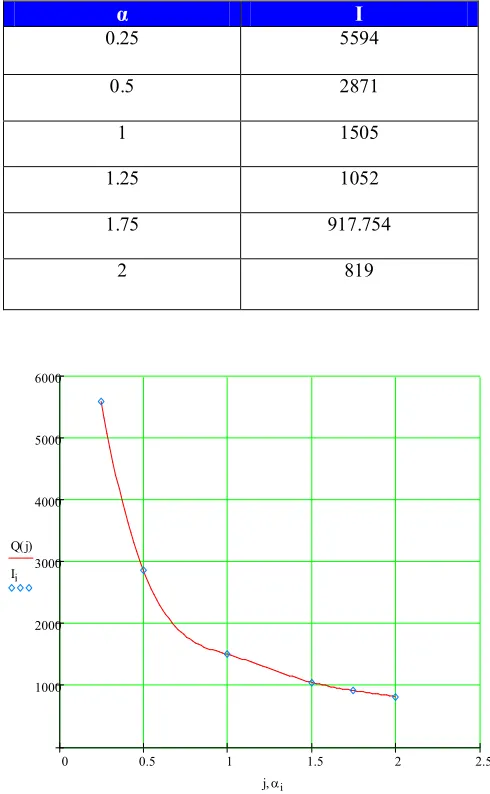
The results of calculations of integral quadratic criterion of quality are presented in table (2) and shown on the graph (Fig.2.) depending on the given parameter α.
0 0.5 1 1.5 2 2.5
1000 2000 3000 4000 5000 6000
Q j( ) Ii
ji
V. CONCLUSIONS
1) For the definitive choice of options PID-regulator calculated value of the integral quadratic criterion of the quality management for the system.
2) As shown in the graph, with increasing value of α the integral quadratic criterion of quality is monotonically decreasing.
3) By the decrease of the values of integral quadratic criterion of quality, the dynamic error is also decreasing, respectively, the quality of management system is improving. Therefore, the optimal options PID-regulator is at αopt = 2:
(k)opt = 0.246; (T)opt = 708.179 c; (T)opt = 1416.26 c.
α
I
0.25 5594
0.5 2871
1 1505
1.25 1052
1.75 917.754
[image:4.595.310.555.127.524.2]2 819
Fig. 2. Relation between the integralquadratic criterion of the quality Iand α Table 1. Obtained options for PID regulator with
different values α
[image:4.595.46.284.444.598.2]REFERENCES
.
[1] J. N Sofieva, A.E Sofiev (Theory of automatic control), MSU IE, M.,2002.
[2] V.Ya. Rotach (The theory of automatic control of energy processes), Izd Energoatomizdat, M., 1985. [3] Weng Khuen Ho, Chang Chieh Hang and Linsheng S.
CAO, (Tuning of PID Controllers Based on Gain and Phase Margin) Specifications, Automatic vol.31, № 3, 1995.
[4] J. Newton., Gould LA, and J. Kaiser. F (The theory of linear tracking systems), Izd Fizmatlitetatury, M., 1961. [5] A. I Tikhonov (2002). Theory of automatic control,
lecture № 10, paragraph 10.2 (Concept of stability margin)[Online]: