Fine-Grained Entity Type Classification by Jointly Learning
Representations and Label Embeddings
Abhishek, Ashish Anand and Amit Awekar Department of Computer Science and Engineering
Indian Institute of Technology Guwahati Assam, India - 781039
{abhishek.abhishek, anand.ashish, awekar}@iitg.ernet.in
Abstract
Fine-grained entity type classification (FETC) is the task of classifying an entity mention to a broad set of types. Distant su-pervision paradigm is extensively used to generate training data for this task. How-ever, generated training data assigns same set of labels to every mention of an en-tity without considering its local context. Existing FETC systems have two major drawbacks: assuming training data to be noise free and use of hand crafted fea-tures. Our work overcomes both draw-backs. We propose a neural network model that jointly learns entity mentions and their context representation to elim-inate use of hand crafted features. Our model treats training data as noisy and uses non-parametric variant of hinge loss function. Experiments show that the pro-posed model outperforms previous state-of-the-art methods on two publicly avail-able datasets, namely FIGER(GOLD) and BBNwith an average relative improvement
of 2.69% in micro-F1 score. Knowledge learnt by our model on one dataset can be transferred to other datasets while us-ing same model or other FETC systems. These approaches of transferring knowl-edge further improve the performance of respective models.
1 Introduction
Entity type classification is the task for assigning types or labels such as organization, location to entity mentions in a document. This classifica-tion is useful for many natural language process-ing (NLP) tasks such as relation extraction (Mintz et al., 2009), machine translation (Koehn et al.,
2007), question answering (Lin et al., 2012) and knowledge base construction (Dong et al., 2014).
There has been considerable amount of work on Named Entity Recognition (NER) (Collins and Singer, 1999; Tjong Kim Sang and De Meul-der, 2003; Ratinov and Roth, 2009; Manning et al., 2014), which classifies entity mentions into a small set of mutually exclusive types, such as
Person, Location, Organization andMisc. How-ever, these types are not enough for some NLP applications such as relation extraction, knowl-edge base construction (KBC) and question an-swering. In relation extraction and KBC, know-ing fine-grained types for entities can significantly increase the performance of the relation extrac-tor (Ling and Weld, 2012; Koch et al., 2014; Mitchell et al., 2015) since this helps in filtering out candidate relation types that do not follow the type constrain. Fine-grained entity types provide additional information while matching questions to its potential answers and significantly improves performance (Dong et al., 2015). For example, Li and Roth (2002) rank questions based on their ex-pected answer types (will the answer befood, ve-hicleordisease).
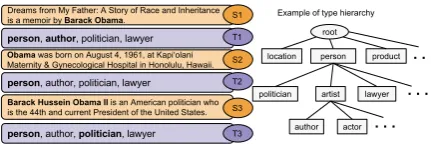
Typically, FETC systems use over hundred la-bels, arranged in a hierarchical structure. An im-portant aspect of FETC is that based on local con-text, two different mentions of same entity can have different labels. We illustrate this through an example in Figure 1. All three sentences S1, S2, andS3mention same entityBarack Obama. How-ever, looking at the context, we can infer thatS1
mentions Obama as aperson/author,S2mentions Obama only as aperson, andS3mentions Obama as aperson/politician.
Available training data for FETC has noisy la-bels. Creating manually annotated training data for FETC is time consuming, expensive, and er-ror prone. Note that, a human annotator will
Figure 1: Noise introduced via distant supervision process. S1-S3 indicates sentences where only a subset of labels for entity mention (bold typeface) are relevant given context, highlighted in T1-T3.
have to assign a subset of correct labels from a set of around hundred labels for each entity men-tion in the corpus. Existing FETC systems use distant supervision paradigm (Craven and Kum-lien, 1999) to automatically generate training data. Distant supervision maps each entity in the cor-pus to knowledge bases such as Freebase (Bol-lacker et al., 2008), DBpedia (Auer et al., 2007), YAGO (Suchanek et al., 2007). This method as-signs same set of labels to all mentions of an entity across the corpus. For example, Barack Obamais a person, politician, lawyer, and author. If a knowledge base has these four matching la-bels for Barack Obama, then distant supervision assigns all of them to every mention of Barack Obama. Training data generated with distant su-pervision will fail to distinguish between mentions of Barack Obama in sentencesS1,S2, andS3.
Existing FETC systems have one or both of fol-lowing drawbacks:
1. Assuming training data to be noise free (Ling and Weld, 2012; Yosef et al., 2012; Yogatama et al., 2015; Shimaoka et al., 2016)
2. Use of hand crafted features (Ling and Weld, 2012; Yosef et al., 2012; Yogatama et al., 2015; Ren et al., 2016)
We have observed that for real world datasets, more than twenty five percent of training data has noisy labels. First drawback propagates this noise in training data to the FETC model. To extract hand crafted features various NLP tools are used. Since errors inevitably exist in such tools, the sec-ond drawback propagates errors of these tools to FETC model.
We propose a neural network based model to overcome the two drawbacks of existing FETC systems. First, we separate training data intoclean
andnoisypartitions using the same method as in AFET system (Ren et al., 2016). For these
parti-tions, we use simple yet effective non-parametric variant of hinge loss function while training. To avoid use of hand crafted features, we learn repre-sentations for given entity mention and its context. Additionally, we investigate effectiveness of us-ing transfer learnus-ing (Pratt, 1993) for FETC task both at feature and model level. We show that feature level transfer learning can be used to im-prove performance of other FETC system such as AFET, by up to 4.5% in micro-F1 score. Simi-larly, model level transfer learning can be used to improve performance of the same model using dif-ferent dataset by up to 3.8% in micro-F1 score.
Our contributions can be summarized as fol-lows:
1. We propose a simple neural network model that learns representations for entity mention and its context, and incorporate noisy label information using a variant of non-parametric hinge loss function. Experimental results on two publicly available datasets demonstrate the effectiveness of proposed model, with an average relative improvement of 2.69% in micro-F1 score.
2. We investigate the use of feature level and model level transfer-learning strategies in the domain of the FETC task. The proposed transfer learning strategies further improve the state-of-the-art on BBN dataset by 3.8% in micro-F1 score.
2 Related Work
Ling et al. (2012) proposed the first system for FETC task, which used 112 overlapping labels. They used linear classifier perceptron for label classification. Yosef et al. (2012) used multi-ple binary SVM classifiers in a hierarchy, to clas-sify an entity mention to a set of 505 types. While the initial work assumed that all labels present in a training dataset for an entity mention are correct, Gillick et al. (2014) introduced context dependent FETC and proposed a set of heuristics for pruning labels that might not be relevant given the entity mention’s local context. Yogatama et al. (2015) proposed an embedding based model where user-defined features and labels were embedded into a low dimensional feature space to facilitate infor-mation sharing among labels.
atten-(a)αmodels label-label cor-relation. Higher theα, lower is the margin between non-correlation labels.
(b) During inference, labels above this threshold are pre-dicted as positive.
Figure 2: Effect of change of parameters on AFET’s performance.
tion mechanism to allow the model to focus on rel-evant expressions in the entity mention’s context. However, the model assumed that all labels ob-tained via distant supervision are correct. In con-trast, our model does not assume that all labels are correct. To learn entity representation, we propose a scheme which is simpler yet more effective.
Most recently, Ren et al. (2016) have proposed AFET, an FETC system. AFET separates the loss function forclean andnoisyentity mentions. AFET uses label-label correlation information ob-tained by given data in its parametric loss function (model parameter α). During inference, AFET uses a threshold to separate positive types from negative types (similarity threshold parameterd). However, AFET’s loss function is sensitive to change in parameters, which are data dependent. Figure 2 shows the effect of parameter α and
d, on AFET performance evaluated on different datasets. In contrast, our model uses a simple yet effective variant of hinge loss function. This func-tion does not need to tune the similarity threshold. Transfer learning is well applied to many NLP applications, such as cross-domain document clas-sification (Shi et al., 2010), multi-lingual word clustering (T¨ackstr¨om et al., 2012) and sentiment classification (Mou et al., 2016). Initialization of word vectors with pre-trained word vectors in neu-ral network models can be considered as one of the best example of transfer learning in NLP. Wang et al. (2015) provide a broad overview of transfer learning techniques used for language processing.
3 The Proposed Model
3.1 Problem description
[image:3.595.310.524.63.215.2]Our task is to automatically classify type informa-tion of entity meninforma-tions present in natural language
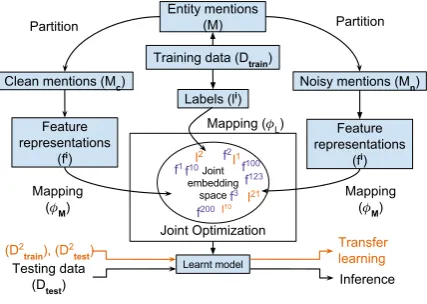
Figure 3: The system overview.
sentences. Figure 3 shows a general overview of our proposed approach.
Input: The input to the model is a training and
testing corpus consisting of a set of sentences on which entity mentions have been identified. In training corpus, every entity mention will have corresponding labels according to a given hierar-chy. Formally, a training corpus Dtrain consists of a set of sentences, S = {si}N
i=1. Each
sen-tencesiwill have one or more entity mentions de-noted by mi
j,k, where j andkdenotes indices of start and end tokens, respectively. SetMconsists of all the entity mentions mi
j,k. For every entity mentionmi
j,k, there will be a corresponding label vector li
j,k ∈ {0,1}K, which is a binary vector, whereli
j,kt = 1iftthtype is true otherwise it will
be zero.K denotes the total number of labels in a given hierarchyΨ. Testing corpusDtestwill only contain sentences and entity mentions.
Output: For entity mentions in testing corpus
Dtest, predict their corresponding labels.
3.2 Training set partition
Similar to AFET, we partition the mention setM
of training corpusDtrain into two parts, a setMc, consisting only ofcleanentity mentions and a set
Mn, consisting only ofnoisyentity mentions. An entity mentionmi
j,k is said to becleanif its labels
li
j,k belong to only a single path (not necessary to be leaf) in the hierarchy Ψ, that is its labels are not ambiguous; otherwise, it isnoisy. For exam-ple, as per hierarchy given in figure 1, an entity mention with labels person, artist and politician
[image:3.595.75.285.75.152.2]Figure 4: The architecture of the proposed model.
3.3 Feature representations
Mention representation: This representation
captures information about entity mention’s mor-phology and orthography. We decompose an en-tity mention into character sequence, and use a vanilla LSTM encoder (Hochreiter and Schmidhu-ber, 1997) to encode character sequences to a fixed dimensional vector. Formally, for entity mention
mi
j,k, we decompose it into a sequence of charac-ter tokensci
j,k1, cij,k2, . . .,cj,ki |mij,k|, where |mij,k| denotes the total number of characters present in the entity mention. For entity mention containing multiple tokens, we join these tokens with a space in between tokens. Every character will have cor-responding vector representation in a lookup table for characters. The character sequence is then fed one by one to a LSTM encoder, and the final out-put is used as a feature representation for entity mentionmi
j,k. We denote this process by a func-tion Fm : M → RDm, where Dm is the num-ber of dimensions for mention representation. The whole process is illustrated in figure 4 (Mention representation).
Context representation:This representation
cap-tures information about the context surrounding the entity mention. Context representation is fur-ther divided into two parts, left and right context representation. The left context consists of a se-quence of tokens within a sentence from the start of a sentence till the last token of entity men-tion. The right context consists of a sequence
of tokens from the start of entity mention till the end of a sentence. We use bi-directional LSTM encoders (Graves et al., 2013) to encode token level sequences of both context to a fixed dimen-sional vector. Formally, for an entity mentionmi
j,k present in a sentencesi, decompose si into a se-quence of tokenssi
1,si2,. . .,sikfor the left context, andsi
j,sij+1,. . .,si|si|for the right context, where |si|denotes the number of tokens in the sentence. Every token will have a corresponding vector rep-resentation in a lookup tables for token. The token sequence is then fed one by one to a bi-directional LSTM encoder, and the final output will be used as feature representation. We denote this whole pro-cess by function Flc : (M,S) → RDlc for com-puting left context andFrc : (M,S) →RDrc for computing right context.DlcandDrcare the num-ber of dimensions for the left context and the right context representation, respectively. The whole process is illustrated in figure 4 (Left and right context representation).
The context representation described above is slightly different from what was proposed in (Shi-maoka et al., 2016), here we include entity men-tion tokens within both left and right context, to explicitly encode context relative to an entity men-tion.
F : (M,S)→RDf given by:
F(mi
j,k, si) =Fm(mij,k)⊕Flc(mij,k, si)⊕Frc(mij,k, si)
(1) where ⊕ denotes vector concatenation. For brevity, we will now omit the use of subscriptj, k
frommi
j,k andlj,ki , and will usefi to denote fea-ture representation for entity mention and its con-text obtained via equation 1.
3.4 Feature and label embeddings
Similar to Yogatama et al. (2015) and Ren et al. (2016), we embed feature representations and labels in a same dimensional space such that an object is embedded closer to the objects that share similar types than the objects that do not. For-mally, we are trying to learn linear mapping func-tionsφM :RDf → RDe andφL :RDK → RDe,
whereDe is the size of embedding space. These mappings are given by:
φM(fi) =fiTU; φL(lit) =ltiTV (2)
where,U ∈ RDf×De andV ∈ RDK×De are
pro-jection matrices for features representations and type labels respectively and li
t is one-hot vector representation for labelt.
We assign a score to each label typetand feature vector as a dot product of their embeddings. For-mally, we denote a score as:
s(fi, lit) =φM(fi)·φL(lit) (3)
3.5 Optimization
We use two different loss functions to modelclean
andnoisyentity mentions. For cleanentity men-tions, we use a hinge loss function. The intuition is simple: maintain a margin, centered at zero, between positive and negative type scores. The scores are computed by similarity between an en-tity mention and label types (eq. 3). Hinge loss function has two advantages. First, it intuitively seprates positive and negative labels during infer-ence. Second, it is independent of data dependent parameter. Formally, for a given entity mention
mi and its labelliwe compute the associated loss as given by:
Lc(mi, li) = X
t∈γ
max(0,1−s(mi, lit))
+X
t∈γ¯
max(0,1 +s(mi, lit)) (4)
whereγandγ¯are set of indices that have positive and negative labels respectively.
Fornoisyentity mentions, we propose a variant of a hinge loss where, like Lc, score for all neg-ative labels should go below −1. However, for positive labels, as we don’t know which labels are relevant to entity mention’s local context, we pro-pose that the maximum score from the set of given positive labels should be greater than one. This maintains a margin between all negative types and the most relevant positive type. Formally, noisy
label loss,Lnis defined as:
Ln(mi, li) = X
t∈¯γ
max(0,1 +s(mi, lti))
+ max(0,1−s(mi, lit∗)); t∗ = arg max
t∈γ s(m i, li
t) (5)
Again, using this loss function makes it intuitive to set a threshold of zero during inference.
These loss functions are different from the loss functions used in (Yogatama et al., 2015; Ren et al., 2016) in a way that, we make strict absolute criteria to distinguish between positive and neg-ative labels. Whereas in (Yogatama et al., 2015; Ren et al., 2016) positive labels should have a higher score than negative labels. As their scoring is relative, the final result varies on the threshold used to separate positive and negative labels.
To train the partitioned dataset together, we for-mulate the joint objective problem as:
min
θ O =
X
m∈Mc
Lc(m, l) + X
m∈Mn
Ln(m, l) (6)
where θ is the collection of all model parame-ters that needs to be learned. To jointly optimize the objective O, we use Adam (Kingma and Ba, 2014), a stochastic gradient-based optimization al-gorithm.
3.6 Inference
For every entity mention in setMfromDtest, we perform a top-down search in the given type hi-erarchyΨ, and estimate the correct type pathΨ∗.
with a node falls below an absolute threshold zero. The thresold is fixed across all datasets used.
3.7 Transfer learning
We want to investigate, whether the feature repre-sentations learnt for an entity mention are useful. We study what contribution these feature repre-sentations make to an existing feature engineering based method such as AFET. We learn the pro-posed model on one training dataset, namely Wiki dataset, which has the highest number of entity mentions among other datasets and use this model to generate representations that isF(mi
j,k, si)for another training and testing data. These rep-resentations, which are Df dimensional vectors, are used as feature for an existing state-of-the-art model, AFET, in place of the hand-crafted features that were originally used. AFET model is then trained using these feature representations. We call this as feature level transfer learning. On the other hand, we also evaluate model level transfer learning, where we initialize weights of LSTM en-coders for a new dataset with the weights learnt from the model trained on another dataset, namely Wiki dataset.
4 Experiments
4.1 Datasets used
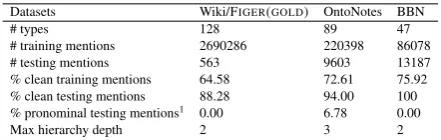
We evaluate the proposed model on three publicly available datasets, provided in a pre-processed to-kenized format by Ren et al. (2016). Statistics of the datasets used in this work are shown in Table 1. The details of the datasets are as follows:
Wiki/FIGER(GOLD): The training data consists
of Wikipedia sentences and was automatically generated in distant supervision paradigm, by mapping hyperlinks in Wikipedia articles to Free-base. The test data, mainly consisting of sentences from news reports, was manually annotated as de-scribed in (Ling and Weld, 2012).
OntoNotes: OntoNotes dataset consists of
sen-tences from newswire documents present in OntoNotes text corpus (Weischedel et al., 2013). DBpedia spotlight (Daiber et al., 2013) was used to automatically link entity mention in sentences to Freebase. For this corpus, manually annotated test data was shared by Gillick et al. (2014). BBN: BBN dataset consists of sentences from Wall Street Journal articles and is completely man-ually annotated (Weischedel and Brunstein, 2005). Please refer to (Ren et al., 2016) for more details
Datasets Wiki/FIGER(GOLD) OntoNotes BBN
# types 128 89 47
# training mentions 2690286 220398 86078 # testing mentions 563 9603 13187 % clean training mentions 64.58 72.61 75.92 % clean testing mentions 88.28 94.00 100 % pronominal testing mentions1 0.00 6.78 0.00
[image:6.595.306.527.61.131.2]Max hierarchy depth 2 3 2
Table 1: Statistics of the datasets used in this work.
of the datasets.
4.2 Evaluation settings 4.2.1 Baselines
We compared the proposed model with state-of-the-art entity classification meth-ods2: (1) FIGER (Ling and Weld, 2012);
(2) HYENA (Yosef et al., 2012); (3)
AFET-NoCo (Ren et al., 2016): AFET without data based label-label correlation modeled in loss function; (4) AFET-CoH (Ren et al., 2016): AFET with hierarchy based label-label correlation modeled in loss function; (5) AFET(Ren et al., 2016); (6)Attentive(Shimaoka et al., 2016): An attentive neural network based model.
We compare these baselines with variants of our proposed model: (1) our: complete model;
(2)our-AllCassuming all mentions areclean; (3)
our-NoMwithout mention representation.
4.2.2 Experimental setup
We use Accuracy or Strict-F1 score, Macro-averaged F1 score, and Micro-Macro-averaged F1 score as metrics for evaluation. Existing methods for FETC use same measures (Ling and Weld, 2012; Yogatama et al., 2015; Shimaoka et al., 2016; Ren et al., 2016). We removed entity mentions that do not have any label in training as well as test set. We also remove entity mentions that have spuri-ous indices (i.e entity mention length of0).3 For all the three datasets, we randomly sampled 10% of the test set, and use it as a development set, on which we tune model parameters. The remaining 90% is used for final evaluation. For all our exper-iments, we train each model using same hyperpa-rameters five times and report their performance in terms of micro-F1 score on the development set as 1We considered an entity mention as pronominal, if all of
its tokens have POS tag as pronoun.
2Whenever possible, the baselines result are reported
from (Ren et al., 2016), otherwise we re-implemented base-line methods based on description available in corresponding papers.
3The code to replicate the work is available athttps:
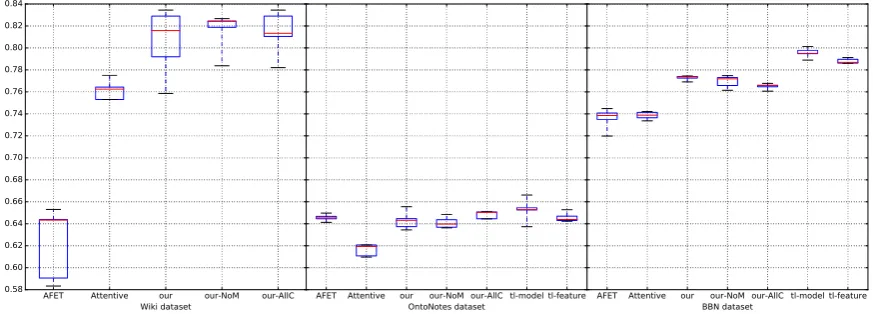
Figure 5: These box-plots show the performance of different baselines on validation set. The red line, boxes and whiskers indicate the median, quartiles and range.
shown in Figure 5. On Wiki dataset, we observed a large variance in performance as compared to other two datasets. This might be because of the fact that Wiki dataset has a very small develop-ment set. From each of these five runs, we pick the best performing model based on the develop-ment set and report its result on the test set.
Hyperparameter setting:All the neural network
based models in this paper used 300 dimensional pre-trained word embeddings distributed by Pen-nington et al. (2014). The hidden-layer size of word level bi-directional LSTM was 100, and that of character level LSTM was 200. Vectors for character embeddings were randomly initialized and were of size 200. We use dropout with the probability of 0.5 on the output of LSTM en-coders. The embedding dimension used was 500. We use Adam (Kingma and Ba, 2014) as optimiza-tion method with learning rate of 0.0005-0.001 and mini-batch size in the range of 800 to 1500. The proposed model and some of the baselines were implemented using TensorFlow4framework.
4.3 Transfer learning
In feature level transfer learning, we use the best performing proposed model trained on Wiki dataset to generate representations that is Df di-mensional vector for every entity mention present in the train, development, and test set of the BBN and the OntoNotes dataset. Figure 4 illustrates an example for the encoding process. Then we use these representations as a feature vector in place of the user-defined features and train the AFET
4http://tensorflow.org/
model. Its hyper-parameters were tuned on the de-velopment set. These results are shown in table 2
asfeature level transfer-learning.
In model level transfer learning, we use the learnt weights of LSTM encoders from the best performing proposed model trained on Wiki dataset and initialize the LSTM encoders of the same model with these weights while training on BBN and OntoNotes datasets. These results are shown in table 2 as model level transfer learn-ing.
4.4 Performance comparison and analysis Table 2 shows the results of the proposed method, its variants and the baseline methods.
Comparison with other feature learning meth-ods: The proposed model and its variants (
our-AllC, our-NoM) perform better than the existing
feature learning method by Shimaoka et al. (2016)
(Attentive), consistently on all datasets. This
indicates benefits of the proposed representation scheme and joint learning of representation and la-bel embedding.
Comparison with feature engineering meth-ods: The proposed model performs better than the existing feature engineered methods (FIGER,
HYENA, AFET-NoCo, AFET-CoH)
perfor-Typing methods Acc.Wiki/FMa-F1 Mi-F1 Acc.IGER(GOLD) OntoNotesMa-F1 Mi-F1 Acc. Ma-F1 Mi-F1BBN
FIGER*(Ling and Weld, 2012) 0.474 0.692 0.655 0.369 0.578 0.516 0.467 0.672 0.612 HYENA*(Yosef et al., 2012) 0.288 0.528 0.506 0.249 0.497 0.446 0.523 0.576 0.587 AFET-NoCo*(Ren et al., 2016) 0.526 0.693 0.654 0.486 0.652 0.594 0.655 0.711 0.716 AFET-CoH*(Ren et al., 2016) 0.433 0.583 0.551 0.521 0.680 0.609 0.657 0.703 0.712
AFET*(Ren et al., 2016) 0.533 0.693 0.664 0.551 0.711 0.647 0.670 0.727 0.735
AFET†‡(Ren et al., 2016) 0.509 0.689 0.653 0.553 0.712 0.646 0.683 0.744 0.747
Attentive†(Shimaoka et al., 2016) 0.581 0.780 0.744 0.473 0.655 0.586 0.484 0.732 0.724
our-AllC† 0.662 0.805 0.770 0.514 0.672 0.626 0.655 0.736 0.752
our-NoM† 0.646 0.808 0.768 0.521 0.683 0.626 0.615 0.742 0.755
our† 0.658 0.812 0.774 0.522 0.685 0.633 0.604 0.741 0.757
model level transfer-learning† - - - 0.531 0.684 0.637 0.645 0.784 0.795
feature level transfer-learning† - - - 0.471 0.689 0.635 0.733 0.791 0.792
Table 2: Performance analysis of entity classification methods on the three datasets.
mance comparison on OntoNotes dataset in sub-section 4.5.
Comparison with variants of our model: The
proposed model performs better on all dataset as compared toour-AllCin terms of micro-F1 score. However, we find the performance difference on Wiki and OntoNotes dataset is not statistically sig-nificant. We investigated it further and found that across all three datasets, there exist only few entity types for which more than 85% of entity mentions are noisy. These types consist of approximately 3-4% of test set, and our model fails on these types (zero micro-F1 score). However, our-AllC per-forms relatively well on these types. Examples of such types are: /building,/person/political figure,
/GPE/STATE PROVINCE. This indicates two lim-itations of the proposed model. First, the separat-ing of clean and noisy mentions based on the hier-archy has its own inherent limitation of assuming labels within a path are correct. Second, our model learns better if more clean examples are available at the cost of not learning very noisy types. We will try to address these limitations in our future work. Compared with our-NoM, the proposed model performs slightly better across all datasets in terms of micro-F1 score.
Feature level transfer learning analysis: We
observed 4.5% performance increase in micro-F1 score of AFET on BBN dataset, after replac-ing hand-crafted features with feature representa-tions generated by the proposed model. This in-dicates usefulness of the learnt feature representa-tions. However, if we repeat the same process with OntoNotes dataset, there is only a subtle change in performance. This is majorly because of the data distribution of OntoNotes dataset is different from
that of Wiki dataset. This issue is discussed in the next subsection.
Model level transfer learning analysis:In model
level transfer learning, sharing knowledge from similar dataset (Wiki to BBN) increases the perfor-mance by 3.8% in terms of micro-F1 score. How-ever, sharing knowledge from Wiki to OntoNotes dataset slightly increases the performance by 0.4% in terms of micro-F1 score.
4.5 Case analysis: OntoNotes dataset
We observed three things; (i) all models perform relatively poor on OntoNotes dataset compared to their performance on other two datasets; (ii) the proposed model outperforms other models in-cluding AFET on the other two datasets, but gave worse performance on OntoNotes dataset; (iii) the two variants of transfer learning significantly im-prove performance of the proposed model on the BBN dataset but resulted in only a subtle perfor-mance change on OntoNotes dataset.
Statistics of the dataset (Table 1) indicates that presence of pronominal or other kinds of men-tions are relatively higher in OntoNotes (6.78%
in test set) than the other two datasets (0% in test set). Examples of such mentions are 100 people, It, the director, etc. Table 3 shows 20 randomly sampled entity mentions from test set of OntoNotes datasets. Some of these mentions are very generic and likely to be dependent on *These results are from (Ren et al., 2016) that also uses
10% of the test set as development set and the remaining for evaluation.
‡We used the publicly available code distributed by Ren et al. (2016).
previous sentences. As all the methods use fea-tures solely based on the current sentence, they fail to transfer cross-sentence boundary knowl-edge. Removing pronominal mentions from test set increases the performance of all feature learn-ing methods by around 3%.
his thousands of angry people
A reporter export competitiveness
Freddie Mac Messrs. Malson and Seelenfreund
the numbers Hollywood and New York
his explanation April
volatility This institution
their hands the 1987 crash
it January 4th
Macau investment enterprises
[image:9.595.73.287.164.291.2]France any means
Table 3: 20 randomly sampled entity mentions present in the test set of OntoNotes dataset.
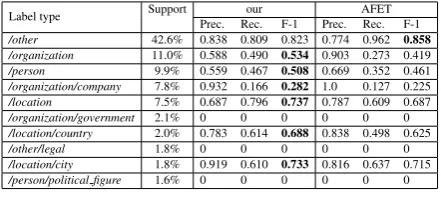
Next we analyse where the proposed model is failing as compared to AFET. For this, we look at type-wise performance for the top-10 most fre-quent types in the OntoNotes test dataset. Results are shown in Table 4. Compared to AFET, the proposed model performs better in all types ex-ceptotherin the top-10 frequent types. Theother
type, which is dominant in test set (42.6%of en-tity mentions are of typeother) and is a collection of multiple broad subtypes such asproduct,event,
art,living thing,food. Performance of AFET sig-nificantly drops (AFET-NoCo) when data-driven label-label correlation is ignored, which indicates that modeling data-driven correlation helps. How-ever, as shown in Figure 2a, the use of label-label correlation depends on appropriate values of pa-rameters which vary from one dataset to another.
Label type Support Prec. Rec.our F-1 Prec. AFETRec. F-1
/other 42.6% 0.838 0.809 0.823 0.774 0.962 0.858 /organization 11.0% 0.588 0.490 0.534 0.903 0.273 0.419
/person 9.9% 0.559 0.467 0.508 0.669 0.352 0.461
/organization/company 7.8% 0.932 0.166 0.282 1.0 0.127 0.225
/location 7.5% 0.687 0.796 0.737 0.787 0.609 0.687
/organization/government 2.1% 0 0 0 0 0 0
/location/country 2.0% 0.783 0.614 0.688 0.838 0.498 0.625
/other/legal 1.8% 0 0 0 0 0 0
/location/city 1.8% 0.919 0.610 0.733 0.816 0.637 0.715
/person/political figure 1.6% 0 0 0 0 0 0
Table 4: Performance analysis of the proposed model and AFET on top 10 (in terms of type fre-quency) types present in OntoNotes dataset.
5 Conclusion and Future Work
In this paper, we propose a neural network based model for the task of fine-grained entity classi-fication. The proposed model learns represen-tations for entity mention, its context and in-corporate label noise information in a variant of non-parametric hinge loss function. Experiments show that the proposed model outperforms exist-ing state-of-the-art models on two publicly avail-able datasets without explicitly tuning data depen-dent parameters.
Our analysis indicates the following observa-tions. First, OntoNotes dataset has a different dis-tribution of entity mentions compared with other two datasets. Second, if data distribution is simi-lar, then transfer learning is very helpful. Third, incorporating data-driven label-label correlation helps in the case of labels of mixed types. Fourth, there is an inherent limitation in assuming all la-bels to be clean if they belong to the same path of the hierarchy. Fifth, the proposed model fails to learn label types that are very noisy.
Future work could analyse the effect of label noise reduction techniques on the proposed model, revisiting the definition of clean and noisy labels and modeling label-label correlation in a princi-pled way that is not dependent on dataset specific parameters.
Acknowledgments
We thank the anonymous reviewers for their in-valuable and insightful comments. Abhishek is supported by MHRD fellowship, Government of India. We acknowledge the use of computing re-sources made available from the Board of Re-search in Nuclear Science (BRNS), Dept. of Atomic Energy (DAE), Govt. of India spon-sered project (No.2013/13/8-BRNS/10026) by Dr. Aryabartta Sahu at Department of Computer Sci-ence and Engineering, IIT Guwahati.
References
S¨oren Auer, Christian Bizer, Georgi Kobilarov, Jens Lehmann, Richard Cyganiak, and Zachary Ives. 2007. Dbpedia: A nucleus for a web of open data. InProceedings of the 6th International The tic Web and 2nd Asian Conference on Asian Seman-tic Web Conference, ISWC’07/ASWC’07, pages 722–735, Berlin, Heidelberg. Springer-Verlag. Kurt Bollacker, Colin Evans, Praveen Paritosh, Tim
[image:9.595.71.292.601.701.2]collaboratively created graph database for structur-ing human knowledge. InProceedings of the 2008 ACM SIGMOD International Conference on Man-agement of Data, SIGMOD ’08, pages 1247–1250, New York, NY, USA. ACM.
Michael Collins and Yoram Singer. 1999. Unsuper-vised models for named entity classification. In
In Proceedings of the Joint SIGDAT Conference on Empirical Methods in Natural Language Processing and Very Large Corpora, pages 100–110.
Mark Craven and Johan Kumlien. 1999. Constructing biological knowledge bases by extracting informa-tion from text sources. InProceedings of the Sev-enth International Conference on Intelligent Systems for Molecular Biology, pages 77–86. AAAI Press. Joachim Daiber, Max Jakob, Chris Hokamp, and
Pablo N. Mendes. 2013. Improving efficiency and accuracy in multilingual entity extraction. In Pro-ceedings of the 9th International Conference on Se-mantic Systems, I-SEMANTICS ’13, pages 121– 124, New York, NY, USA. ACM.
Xin Dong, Evgeniy Gabrilovich, Geremy Heitz, Wilko Horn, Ni Lao, Kevin Murphy, Thomas Strohmann, Shaohua Sun, and Wei Zhang. 2014. Knowl-edge vault: A web-scale approach to probabilistic knowledge fusion. InProceedings of the 20th ACM SIGKDD International Conference on Knowledge Discovery and Data Mining, KDD ’14, pages 601– 610, New York, NY, USA. ACM.
Li Dong, Furu Wei, Hong Sun, Ming Zhou, and Ke Xu. 2015. A hybrid neural model for type classification of entity mentions. InProceedings of the 24th In-ternational Conference on Artificial Intelligence, IJ-CAI’15, pages 1243–1249. AAAI Press.
Dan Gillick, Nevena Lazic, Kuzman Ganchev, Jesse
Kirchner, and David Huynh. 2014.
Context-dependent fine-grained entity type tagging. arXiv preprint arXiv:1412.1820.
Alex Graves, Abdel-rahman Mohamed, and Geoffrey Hinton. 2013. Speech recognition with deep recur-rent neural networks. In 2013 IEEE International Conference on Acoustics, Speech and Signal Pro-cessing, pages 6645–6649. IEEE.
Sepp Hochreiter and J¨urgen Schmidhuber. 1997.
Long short-term memory. Neural computation,
9(8):1735–1780, November.
Diederik Kingma and Jimmy Ba. 2014. Adam: A method for stochastic optimization. arXiv preprint arXiv:1412.6980.
Mitchell Koch, John Gilmer, Stephen Soderland, and Daniel S. Weld. 2014. Type-aware distantly su-pervised relation extraction with linked arguments. In Proceedings of the 2014 Conference on Em-pirical Methods in Natural Language Processing (EMNLP), pages 1891–1901, Doha, Qatar, October. Association for Computational Linguistics.
Philipp Koehn, Hieu Hoang, Alexandra Birch, Chris Callison-Burch, Marcello Federico, Nicola Bertoldi, Brooke Cowan, Wade Shen, Christine Moran, Richard Zens, Chris Dyer, Ondrej Bojar, Alexan-dra Constantin, and Evan Herbst. 2007. Moses: Open source toolkit for statistical machine transla-tion. InProceedings of the 45th Annual Meeting of the Association for Computational Linguistics Com-panion Volume Proceedings of the Demo and Poster Sessions, pages 177–180, Prague, Czech Republic, June. Association for Computational Linguistics. Xin Li and Dan Roth. 2002. Learning question
classi-fiers. InProceedings of the 19th International Con-ference on Computational Linguistics - Volume 1, COLING ’02, pages 1–7, Stroudsburg, PA, USA. Association for Computational Linguistics.
Thomas Lin, Mausam, and Oren Etzioni. 2012. No noun phrase left behind: Detecting and typing un-linkable entities. In Proceedings of the 2012 Joint Conference on Empirical Methods in Natural guage Processing and Computational Natural Lan-guage Learning, pages 893–903, Jeju Island, Korea, July. Association for Computational Linguistics. Xiao Ling and Daniel S. Weld. 2012. Fine-grained
entity recognition. In Proceedings of the Twenty-Sixth AAAI Conference on Artificial Intelligence, AAAI’12, pages 94–100. AAAI Press.
Christopher Manning, Mihai Surdeanu, John Bauer, Jenny Finkel, Steven Bethard, and David McClosky. 2014. The stanford corenlp natural language pro-cessing toolkit. In Proceedings of 52nd Annual Meeting of the Association for Computational Lin-guistics: System Demonstrations, pages 55–60, Bal-timore, Maryland, June. Association for Computa-tional Linguistics.
Mike Mintz, Steven Bills, Rion Snow, and Daniel Ju-rafsky. 2009. Distant supervision for relation ex-traction without labeled data. InProceedings of the Joint Conference of the 47th Annual Meeting of the ACL and the 4th International Joint Conference on Natural Language Processing of the AFNLP, pages 1003–1011, Suntec, Singapore, August. Association for Computational Linguistics.
T. Mitchell, W. Cohen, E. Hruschka, P. Talukdar, J. Betteridge, A. Carlson, B. Dalvi, M. Gardner, B. Kisiel, J. Krishnamurthy, N. Lao, K. Mazaitis, T. Mohamed, N. Nakashole, E. Platanios, A. Rit-ter, M. Samadi, B. Settles, R. Wang, D. Wijaya, A. Gupta, X. Chen, A. Saparov, M. Greaves, and J. Welling. 2015. Never-ending learning. In Pro-ceedings of the Twenty-Ninth AAAI Conference on Artificial Intelligence, AAAI’15, pages 2302–2310. AAAI Press.
Jeffrey Pennington, Richard Socher, and Christopher Manning. 2014. Glove: Global vectors for word representation. In Proceedings of the 2014 Con-ference on Empirical Methods in Natural Language Processing (EMNLP), pages 1532–1543, Doha, Qatar, October. Association for Computational Lin-guistics.
Lorien Y. Pratt. 1993. Discriminability-based trans-fer between neural networks. InAdvances in Neural Information Processing Systems 5, pages 204–211, San Francisco, CA, USA. Morgan Kaufmann Pub-lishers Inc.
Lev Ratinov and Dan Roth. 2009. Design chal-lenges and misconceptions in named entity recog-nition. In Proceedings of the Thirteenth Confer-ence on Computational Natural Language Learning (CoNLL-2009), pages 147–155, Boulder, Colorado, June. Association for Computational Linguistics.
Xiang Ren, Wenqi He, Meng Qu, Lifu Huang, Heng Ji, and Jiawei Han. 2016. Afet: Automatic fine-grained entity typing by hierarchical partial-label embedding. InProceedings of the 2016 Conference on Empirical Methods in Natural Language Pro-cessing, pages 1369–1378, Austin, Texas, Novem-ber. Association for Computational Linguistics.
Lei Shi, Rada Mihalcea, and Mingjun Tian. 2010. Cross language text classification by model trans-lation and semi-supervised learning. In Proceed-ings of the 2010 Conference on Empirical Methods in Natural Language Processing, pages 1057–1067, Cambridge, MA, October. Association for Compu-tational Linguistics.
Sonse Shimaoka, Pontus Stenetorp, Kentaro Inui, and Sebastian Riedel. 2016. An attentive neural ar-chitecture for fine-grained entity type classification. In Proceedings of the 5th Workshop on Automated Knowledge Base Construction, pages 69–74, San Diego, CA, June. Association for Computational Linguistics.
Fabian M. Suchanek, Gjergji Kasneci, and Gerhard Weikum. 2007. Yago: A core of semantic knowl-edge. InProceedings of the 16th International Con-ference on World Wide Web, WWW ’07, pages 697– 706, New York, NY, USA. ACM.
Oscar T¨ackstr¨om, Ryan McDonald, and Jakob Uszko-reit. 2012. Cross-lingual word clusters for direct transfer of linguistic structure. In Proceedings of the 2012 Conference of the North American Chap-ter of the Association for Computational Linguis-tics: Human Language Technologies, pages 477– 487, Montr´eal, Canada, June. Association for Com-putational Linguistics.
Erik F. Tjong Kim Sang and Fien De Meulder. 2003. Introduction to the conll-2003 shared task: Language-independent named entity recognition. In
Walter Daelemans and Miles Osborne, editors, Pro-ceedings of the Seventh Conference on Natural Lan-guage Learning at HLT-NAACL 2003, pages 142– 147.
Dong Wang and Thomas Fang Zheng. 2015. Trans-fer learning for speech and language processing. In 2015 Asia-Pacific Signal and Information Pro-cessing Association Annual Summit and Conference (APSIPA), pages 1225–1237. IEEE.
Ralph Weischedel and Ada Brunstein. 2005.
BBN Pronoun Coreference and Entity Type
Cor-pus LDC2005T33. Linguistic Data Consortium,
Philadelphia, 112.
Ralph Weischedel, Martha Palmer, Mitchell Marcus, Eduard Hovy, Sameer Pradhan, Lance Ramshaw, Nianwen Xue, Ann Taylor, Jeff Kaufman, Michelle Franchini, et al. 2013. Ontonotes release 5.0 ldc2013t19. Linguistic Data Consortium, Philadel-phia, PA.
Dani Yogatama, Daniel Gillick, and Nevena Lazic. 2015. Embedding methods for fine grained entity type classification. InProceedings of the 53rd An-nual Meeting of the Association for Computational Linguistics and the 7th International Joint Confer-ence on Natural Language Processing (Volume 2: Short Papers), pages 291–296, Beijing, China, July. Association for Computational Linguistics.