Learning to Freestyle: Hip Hop Challenge-Response Induction via
Transduction Rule Segmentation
DekaiWu KarteekAddanki MarkusSaers MeriemBeloucif Human Language Technology Center
Department of Computer Science HKUST, Clear Water Bay, Hong Kong
{dekai|vskaddanki|masaers|mbeloucif}@cs.ust.hk
Abstract
We present a novel model, Freestyle, that learns to improvise rhyming and fluent re-sponses upon being challenged with a line of hip hop lyrics, by combining both bottom-up token based rule induction and top-down rule segmentation strategies to learn a stochas-tic transduction grammar that simultaneously learns both phrasing and rhyming associations. In this attack on the woefully under-explored natural language genre of music lyrics, we exploit a strictly unsupervised transduction grammar induction approach. Our task is par-ticularly ambitious in that no use of anya pri-ori linguistic or phonetic information is al-lowed, even though the domain of hip hop lyrics is particularly noisy and unstructured. We evaluate the performance of the learned model against a model learned only using the more conventional bottom-up token based rule induction, and demonstrate the superi-ority of our combined token based and rule segmentation induction method toward gen-erating higher quality improvised responses, measured on fluency and rhyming criteria as judged by human evaluators. To highlight some of the inherent challenges in adapting other algorithms to this novel task, we also compare the quality of the responses generated by our model to those generated by an out-of-the-box phrase based SMT system. We tackle the challenge of selecting appropriate training data for our task via a dedicated rhyme scheme detection module, which is also acquired via unsupervised learning and report improved quality of the generated responses. Finally, we report results with Maghrebi French hip hop lyrics indicating that our model performs surprisingly well with no special adaptation to other languages.
1 Introduction
The genre of lyrics in music has been severely under-studied from the perspective of computational lin-guistics despite being a form of language that has perhaps had the most impact across almost all human cultures. With the motivation of spurring further re-search in this genre, we apply stochastic transduc-tion grammar inductransduc-tion algorithms to address some of the modeling issues in song lyrics. An ideal start-ing point for this investigation is hip hop, a genre that emphasizes rapping, spoken or chanted rhyming lyrics against strong beats or simple melodies. Hip hop lyrics, in contrast to poetry and other genres of music, present a significant number of challenges for learning as it lacks well-defined structure in terms of rhyme scheme, meter, or overall meaning making it an interesting genre to bring to light some of the less studied modeling issues.
The domain of hip hop lyrics is particularly un-structured when compared to classical poetry, a do-main on which statistical methods have been applied in the past. Hip hop lyrics are unstructured in the sense that a very high degree of variation is permit-ted in the meter of the lyrics, and large amounts of colloquial vocabulary and slang from the subculture are employed. The variance in the permitted me-ter makes it hard to make any assumptions about the stress patterns of verses in order to identify the rhyming words used when generating output. The broad range of unorthodox vocabulary used in hip hop make it difficult to use off-the-shelf NLP tools for doing phonological and/or morphological analy-sis. These problems are further exacerbated by dif-ferences in intonation of the same word and lack of robust transcription (Liberman, 2010).
We argue that stochastic transduction grammars,1 given their success in the area of machine transla-tion and efficient unsupervised learning algorithms, are ideal for capturing the structural relationship be-tween lyrics. Hence, our Freestyle system mod-els the problem of improvising a rhyming response given any hip hop lyric challenge as transducing a challenge line into a rhyming response. We use a stochastic transduction grammar induced in a completely unsupervised fashion using a combi-nation of token based rule induction and segment-ing (Saers et al., 2013) as the underlying model to fully-automatically learn a challenge-response sys-tem and compare its performance against a simpler token based transduction grammar model. Both our models are completely unsupervised and use no prior phonetic or linguistic knowledge whatsoever despite the highly unstructured and noisy domain.
We believe that the challenge-response system based on an interpolated combination of token based rule induction and rule segmenting transduction grammars will generate more fluent and rhyming re-sponses compared to one based on token based trans-duction grammars models. This is based on the ob-servation that token based transduction grammars suffer from a lack of fluency; a consequence of the degree of expressivity they permit. Therefore, as a principal part of our investigation we compare the quality of responses generated using a combination of token based rule induction and top-down rule seg-menting transduction grammars to those generated by pure token based transduction grammars.
We also hypothesize that in order to generate flu-ent and rhyming responses, it is not sufficiflu-ent to train the transduction grammars on all adjacent lines of a hip hop verse. Therefore, we propose a data selec-tion scheme using a rhyme scheme detector acquired through unsupervised learning to generate the train-ing data for the challenge-response systems. The rhyme scheme detector segments each verse of a hip hop song into stanzas and identifies the lines in each stanza that rhyme with each other which are then added as training instances. We demonstrate the su-periority of our training data selection method by comparing the quality of the responses generated by the models trained on data selected with and without
1Also known in SMT as “synchronous grammars”.
using the rhyme scheme detector.
Unlike conventional spoken and written language, disfluencies and backing vocals2 occur very fre-quently in the domain of hip hop lyrics which af-fect the performance of NLP models designed for processing well-formed sentences. We propose two strategies to mitigate the effect of disfluencies on our model performance and compare their efficacy using human evaluations. Finally, in order to illustrate the challenges faced by other NLP algorithms, we con-trast the performance of our model against a conven-tional, widely used phrase-based SMT model.
A brief terminological note: “stanza” and “verse” are frequently confused and sometimes conflated. Worse yet, their usage for song lyrics is often con-tradictory to that for poetry. To avoid ambiguity we consistently follow these technical definitions for segments in decreasing size of granularity:
verse a large unit of a song’s lyrics. A song typi-cally contains several verses interspersed with choruses. In the present work, we do not differ-entiate choruses from verses. In song lyrics, a verse is most commonly represented as a sepa-rate paragraph.
stanza a segment within a verse which has a me-ter and rhyme scheme. Stanzas often consist of 2, 3, or 4 lines, but stanzas of more lines are also common. Particularly in hip hop, a single verse often contains many stanzas with differ-ent rhyme schemes and meters.
line a segment within a stanza consisting of a single line. In poetry, strictly speaking this would be called a “verse”, which however conflicts with the conventional use of “verse” in song lyrics.
In Section 2, we discuss some of the previous work that applies statistical NLP methods to less conventional domains and problems. We describe our experimental conditions in Section 3. We com-pare the performance of token and segment based transduction grammar models in Section 4. We com-pare our data selection schemes and disfluency han-dling strategies in Sections 5 and 6. Finally, in
2
Section 7 we describe some preliminary results ob-tained using our approach on improvising hip hop responses in French and conclude in Section 8.
2 Related work
Although a few attempts have been made to apply statistical NLP learning methods to unconventional domains,Freestyleis among the first to tackle the genre of hip hop lyrics (Addanki and Wu, 2013; Wu et al., 2013a,b). Our preliminary work suggested the need for further research to identify models that cap-ture the correct generalizations to be able to gener-ate fluent and rhyming responses. As a step towards this direction, we contrast the performance of inter-polated bottom-up token based rule induction and top-down segmenting transduction grammar models and token based transduction grammar models. We briefly describe some of the past work in statistical NLP on unconventional domains below.
Most of the past work either uses some form of prior linguistic knowledge or enforces harsher con-straints such as set number of words in a line, or a set meter which are warranted by more structured do-mains such as poetry. However, in hip hop lyrics it is hard to make any linguistic or structural assump-tions. For example, words such as sho, flo, holla which frequently appear in the lyrics are not part of any standard lexicon and hip hop does not require a set number of syllables in a line, unlike poems. Also, surprising and unlikely rhymes in hip hop are fre-quently achieved via intonation and assonance, mak-ing it hard to apply prior phonological constraints.
A phrase based SMT system was trained to “trans-late” the first line of a Chinese couplet or duilian into the second by Jiang and Zhou (2008). The most suitable next line was selected by applying linguistic constraints to thenbest output of the SMT system. However in contrast to Chinese couplets, which ad-here to strict rules requiring, for example, an identi-cal number of characters in each line and one-to-one correspondence in their metrical length, the domain of hip hop lyrics is far more unstructured and there exists no clear constraint that would ensure fluent and rhyming responses to hip hop challenge lyrics. Barbieri et al. (2012) use controlled Markov pro-cesses to semi-automatically generate lyrics that sat-isfy the structural constraints of rhyme and meter.
Tamil lyrics were automatically generated given a melody using conditional random fields by A.et al. (2009). The lyrics were represented as a sequence of labels using theKNM system whereK,N andM represented the long vowels, short vowels and con-sonants respectively.
Genzel et al. (2010) used SMT in conjunction with stress patterns and rhymes found in a pronun-ciation dictionary to produce translations of poems. Although many constraints were applied in translat-ing full verses of poems, it was challengtranslat-ing to sat-isfy all the constraints. Stress patterns were assigned to words given the meter of a line in Shakespeare’s sonnets by Greene et al. (2010), which were then combined with a language model to generate poems. Sonderegger (2011) attempted to infer the pronun-ciation of words in old English by identifying the rhyming patterns using graph theory. However, their heuristic of clustering words with similar IPA end-ings resulted in large clusters of false positives such asbloomandnumb. A language-independent gener-ative model for stanzas in poetry was proposed by Reddy and Knight (2011) via which they could dis-cover rhyme schemes in French and English poetry.
3 Experimental conditions
Before introducing ourFreestylemodels, we first detail our experimental assumptions and the evalua-tion scheme under which the responses generated by different models are compared against one another. We describe our training data as well as a phrase-based SMT (PBSMT) contrastive baseline. We also define the evaluation scheme used to compare the re-sponses of different systems on criteria of fluency and rhyming.
3.1 Training data
listeners is expensive, a small subset of 85 lines was chosen as the test set to provide challenges for com-paring the quality of responses generated by different systems.
3.2 Evaluation scheme
The performance of various Freestyle versions was evaluated on the task of generating a improvised fluent and rhyming response given a single line of a hip hop verse as a challenge. The output of all the systems on the test set was given to three indepen-dent frequent hip hop listeners for manual evalua-tion. They were asked to evaluate the system out-puts according to fluency and the degree of rhyming. They were free to choose the tune to make the lyrics rhyme as the beats of the song were not used in the training data. Each evaluator was asked to score the response of each system on the criterion of fluency and rhyming as beinggood,acceptableorbad.
3.3 Phrase-based SMT baseline
In order to evaluate the performance of an out-of-the-box phrase-based SMT (PBSMT) system toward this novel task of generating rhyming and fluent re-sponses, a standard Moses baseline (Koehn et al., 2007) was also trained in order to compare its per-formance with our transduction grammar induction model. A 4-gram language model which was trained on the entire training corpus using SRILM (Stolcke, 2002) was used to generate responses in conjunction with the phrase-based translation model. As no au-tomatic quality evaluation metrics exist for hip hop responses analogous to BLEU for SMT, the model weights cannot be tuned in conventional ways such as MERT (Och, 2003). Instead, a slightly higher than typical language model weight was empirically cho-sen using a small development set to produce fluent outputs.
4 Interpolated segmenting model vs. token based model
We compare the performance of transduction gram-mars induced via interpolated token based and rule segmenting (ISTG) versus token based transduction grammars (TG) on the task of generating a rhyming and fluent response to hip hop challenges. We use the framework of stochastic transduction grammars, specifically bracketing ITGs (inversion transduction
grammars) (Wu, 1997), as our translation model for “transducing” any given challenge into a rhyming and fluent response. Our choice is motivated by the significant amount of empirical evidence for the representational capacity of transduction grammars across a spectrum of natural language tasks such as textual entailment (Wu, 2006), mining parallel sen-tences (Wu and Fung, 2005) and machine translation (Zens and Ney, 2003). Further, existence of effi-cient learning algorithms (Saerset al., 2012; Saers and Wu, 2011) that make no language specific as-sumptions, make inversion transduction grammars a suitable framework for our modeling needs. Exam-ples of lexical transduction rules can be seen in Ta-bles 3 and 5. In addition, the grammar also includes structural transduction rules for the straight case A→ [A A] and also the inverted caseA→<A A>.
4.1 Token based vs. segmental ITGs
The degenerate case of ITGs are token based ITGs wherein each translation rule contains at most one token in input and output languages. Efficient induc-tion algorithms with polynomial run time exist for to-ken based ITGs and the expressivity they permit has been empirically determined to capture most of the word alignments that occur across natural languages. The parameters of the token based ITGs can be es-timated using expectation maximization through an efficient dynamic programming algorithm in con-junction with beam pruning (Saers and Wu, 2011).
et al.(2013).
Saers et al. (2013) induce a phrasal inversion transduction grammar via interpolating the bottom-up rule chunking approach proposed in Saerset al. (2012) with a top-down rule segmenting approach driven by a minimum description length objective function (Solomonoff, 1959; Rissanen, 1983) that trades off the maximum likelihood against model size. Saers et al. (2013) report improvements in BLEU score (Papineniet al., 2002) on their transla-tion task. In our current approach instead of using a bottom-up rule chunking approach we use a simpler token based grammar instead. Given two grammars (Ga andGb) and an interpolation parameter α the
probability function of the interpolated grammar is given by:
pa+b(r) =αpa(r) + (1−α)pb(r)
for all rulesr in the union of the two rule sets, and where pa+b is the rule probability function of the
combined grammar andpaandpb are the rule
prob-ability functions of Ga and Gb respectively. The
pseudocode for the top-down rule segmenting algo-rithm is shown in 1. The algoalgo-rithm uses the methods
collect_biaffixes, eval_dl, sort_by_delta and make_segmentations. These methods collect all the
biaffixes in an ITG, evaluate the difference in de-scription length, sort candidates by these differences, and commit to a given set of candidates, respectively. The suitable interpolation parameter is chosen em-pirically based on the responses generated on a small development set.
We compare the performance of inducing a token based ITG versus inducing a segmental ITG using in-terpolated bottom-up token based rule induction and top-down rule segmentation. To highlight some of the inherent challenges in adapting other algorithms to this novel task, we also compare the quality of the responses generated by our model to those generated by an off-the-shelf phrase based SMT system.
4.2 Decoding heuristics
We use our in-house ITG decoder implemented ac-cording to the algorithm mentioned in Wu (1996) for the generating responses to challenges by decod-ing with the trained transduction grammars. The de-coder uses a CKY-style parsing algorithm (Cocke,
Algorithm 1 Iterative rule segmenting learning driven by minimum description length.
1: Φ ▷The ITG being induced
2: repeat 3: δsum ←0
4: bs←collect_biaffixes(Φ) 5: bδ←[]
6: for allb∈bsdo
7: δ ←eval_dl(b,Φ)
8: if δ <0then 9: bδ←[bδ,⟨b, δ⟩]
10: sort_by_delta(bδ)
11: for all⟨b, δ⟩ ∈bδdo 12: δ′ ←eval_dl(b,Φ)
13: if δ′<0then
14: Φ←make_segmentations(b,Φ)
15: δsum ←δsum+δ′
16: untilδsum≥0
17: return Φ
1969) with cube pruning (Chiang, 2007). The de-coder builds an efficient hypergraph structure which is then scored using the induced grammar. The trained transduction grammar model was decoded using the 4-gram language model and the model weights determined as described in 3.3.
In our decoding algorithm, we restrict the reorder-ing to only be monotonic as we want to produce out-put that follows the same rhyming order of the chal-lenge. Interleaved rhyming order is harder to evalu-ate without the larger context of the song and we do not address that problem in our current model. We also penalize singleton rules to produce responses of similar length as successive lines in a stanza are typ-ically of similar length. Finally, we add a penalty to reflexivetranslation rules that map the same surface form to itself such asA → yo/yo. We obtain these rules with a high probability due to the presence of sentence pairs where both the input and output are identical strings as many stanzas in our data contain repeated chorus lines.
4.3 Results: Rule segmentation improves responses
Table 1: Percentage of≥goodand≥acceptable(i.e., either good or acceptable) responses on fluency and rhyming criteria. PBSMT, TG and ISTG models trained using corpus generated from all adjacent lines in a verse. PBSMT+RS, TG+RS, ISTG+RS are models trained on rhyme scheme based corpus selection strategy. Disfluency correction strategy was used in all cases.
model fluency (≥good) fluency (≥acceptable) rhyming (≥good) rhyming (≥acceptable)
PBSMT 3.14% 4.70% 1.57% 4.31%
TG 21.18% 54.51% 23.53% 39.21%
ISTG 26.27% 57.64% 27.45% 48.23%
PBSMT+RS 30.59% 43.53% 1.96% 9.02%
TG+RS 34.12% 60.39% 20.00% 42.74%
ISTG+RS 30.98% 61.18% 30.98% 53.72%
Table 2: Transduction rules learned by ISTG model.
transduction grammar rule log prob.
A→long/wrong -11.6747
A→rhyme/time -11.6604
A→felt bad/couldn't see what i really had -11.3196 A→matter what you say/leaving anyway -11.8792 A→arhythamatic/this rhythm is sick -12.3492
the ISTG model produces a significantly higher frac-tion of sentences ratedgood (26.27% vs. 21.18%) and≥acceptable(57.64% vs. 54.51%). Higher frac-tion of responses generated by the ISTG model are rated asgood(27.45% vs. 23.53%) and≥acceptable (57.64% vs. 54.51%) compared to the TG model. Both TG and ISTG model perform significantly bet-ter than the PBSMT baseline. Upon inspecting the learned rules, we noticed that the ISTG models cap-ture rhyming correspondences both at the token and segmental levels. Table 2 shows some examples of the transduction rules learned by ISTG grammar trained using rhyme scheme detection.
5 Data selection via rhyme scheme detection vs. adjacent lines
We now compare two data selection approaches for generating the training data for transduction grammar induction via a rhyme scheme detection module and choosing all adjacent lines in a verse. We also briefly describe the training of the rhyme scheme detection module and determine the efficacy of our data selection scheme by training the ISTG model, TG model and the PBSMT baseline on train-ing data generated with and without employtrain-ing the
rhyme scheme detection module. As the rule seg-menting approach was intended to improve the flu-ency as opposed to the rhyming nature of the re-sponses, we only train the rule segmenting model on the randomly chosen subset of all adjacent lines in the verse. Further, adding adjacent lines as the training data to the segmenting model maintains the context of the responses generated thereby produc-ing higher quality responses. The segmental trans-duction grammar model was combined with the to-ken based transduction grammar model trained on data selected with and without using rhyme scheme detection model.
5.1 Rhyme scheme detection
Although our approach adapts a transduction gram-mar induction model toward the problem of generat-ing fluent and rhymgenerat-ing hip hop responses, it would be undesirable to train the model directly on all the successive lines of the verses—as done by Jiang and Zhou (2008)—due to variance in hip hop rhyming patterns. For example, adding successive lines of a stanza which followsABABrhyme scheme as traing instances to the transduction grammar causes in-correct rhyme correspondences to be learned. The fact that a verse (which is usually represented as a separate paragraph) may contain multiple stanzas of varying length and rhyme schemes worsens this problem. Adding all possible pairs of lines in a verse as training examples not only introduces a lot of noise but also explodes the size of the training data due to the large size of the verse.
the same stanza and marked as rhyming according to the rhyme scheme detection model are added to the training corpus. We believe that this data selec-tion scheme will improve the rhyming associaselec-tions learned during the transduction grammar induction thereby biasing the model towards producing fluent and rhyming output.
The rhyme scheme detection model proposes a HMM based generative model for a verse of hip hop lyrics similar to Reddy and Knight (2011). However, owing to the lack of well-defined verse structure in hip hop, a number of hidden states corresponding to stanzas of varying length are used to automatically obtain a soft-segmentationof the verse. Each state in the HMM corresponds to a stanza with a particu-lar rhyme scheme such asAA,ABAB,AAAAwhile the emissions correspond to the final words in the stanza. We restrict the maximum length of a stanza to be four to maintain a tractable number of states and further only use states to represent stanzas whose rhyme schemes could not be partitioned into smaller schemes without losing a rhyme correspondence.
The parameters of the HMM are estimated using the EM algorithm (Devijer, 1985) using the corpus generated by taking the final word of each line in the hip hop lyrics. The lines from each stanza that rhyme with each other according to the Viterbi parse using the trained model are added as training instances for transduction grammar induction. As the source and target languages are identical, each selected pair gen-erates two training instances: a challenge-response and a response-challenge pair.
The training data for the rhyme scheme detector was obtained by extracting the end-of-line tokens from each verse. However, upon data inspection we noticed that shorter lines in hip hop stanzas are typi-cally joined with a comma and represented as a sin-gle line of text and hence all the tokens before the commas were also added to the training corpus. We obtained a corpus containing 4.2 million tokens cor-responding to potential rhyming candidates compris-ing of around 153,000 unique token types.
We evaluated the performance of our rhyme scheme detector on the task of correctly labeling a given verse with rhyme schemes. As our model is completely unsupervised, we chose a random sam-ple of 75 verses from our training data as our test set. Two native English speakers who were frequent hip
hop listeners were asked to partition the verse into stanzas and assign them with a gold standard rhyme scheme. Precision and recall were aggregated for the Viterbi parse of each verse against this gold standard and f-score was calculated. The rhyme scheme de-tection module employed in our data selection ob-tained a precision of 35.81% and a recall of 57.25%, giving an f-score of 44.06%.
5.2 Training data selection via rhyme scheme detection
We obtained around 600,000 training instances upon extracting a training corpus using rhyme scheme de-tection module as described in Section 5.1. We added those lines that were adjacentandlabeled as rhyming by the rhyme scheme detector as training in-stances resulting in a training corpus of size 200,000.
5.3 Training data selection via adjacent lines
Considering all adjacent lines in a verse resulted in a corpus with over 5 million training instances. In order to ensure fair comparison of models trained on data selected using rhyme scheme detection, we randomly chose 200,000 training instances from the generated corpus. The training corpus thus gener-ated shared around 15% of training instances with the corpus generated through our proposed data se-lection scheme.
5.4 Results: Rhyme scheme detection helps
Table 3: English hip hop challenge-response examples. challenge man idietoseeem all thun i just don'tcare
tg+rs in theskyandmethe in polla and the youthere
tg and the ride the me the and white the i theair
pbsmt+rsman i live to see em all i just don't care
challenge did a twelve yearbidin the streets and held itdown
tg+rs to the girls herekidthe and to the thought thenow
tg to the p's heredidthe a the i was the the
pbsmt+rsdid a year in the streets and it down
challenge oh i believe inyesterday
tg+rs can you see theday
tg now you see theway
pbsmt+rsoh i believe in tomorrow
challenge what would ido
tg+rs just me andyou
tg and you andyou
pbsmt+rswhat would you do
challenge cause you ain't goinghometill the earlymorn
tg+rs and the you thisalonei i gottaon
tg and i you my on the a home we
pbsmt+rscause you and your friends aint nothing but
It is also interesting to note from Table 1 that ISTG+RS performs better than TG+RS indicating that transduction grammar induced via interpolating token based grammar and rule segmenting produces better responses than token based transduction gram-mar on both data selection schemes. Although the average fraction of responses ratedgoodon fluency are slightly lower for ISTG+RS compared to TG+RS (34.12% vs. 30.98%), the fraction of responses rated ≥acceptableare higher (61.18% vs. 57.64%). It is important to note that the fraction of sentences rated good and≥acceptableon rhyming are much larger for ISTG+RS model. Although the fluency of the responses generated by PBSMT+RS drastically im-proves compared to PBSMT it still lags behind the TG+RS and ISTG+RS models on both fluency and rhyming. The results in Table 1 confirm our hypoth-esis that off-the-shelf SMT systems are not guaran-teed to be effective on our novel task.
5.5 Challenge-response examples
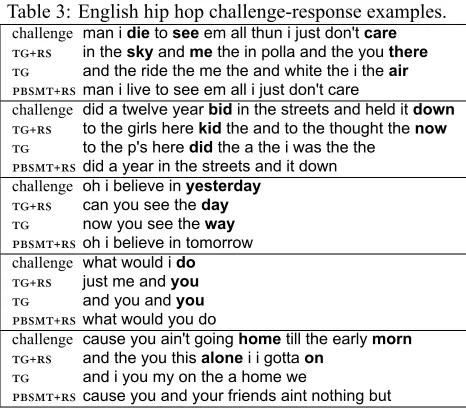
Table 3 shows some of the challenges and the cor-responding responses of PBSMT+RS, TG+RS and TG model. While PBSMT+RS and TG+RS mod-els generate responses reflecting a high degree of fluency, the output of the TG contains a lot of ar-ticles. It is interesting to note that TG+RS produces responses comparable to PBSMT+RS despite being a token based transduction grammar. However, PB-SMT tends to produce responses that are too simi-lar to the challenge. Moreover, TG models produce
responses that indeed rhyme better (shown in bold-face). In fact, TG tries to rhyme words not only at the end but also in middle of the lines, as our transduc-tion grammar model captures structural associatransduc-tions more effectively than the phrase-based model.
6 Disfluency handling via disfluency correction and filtering
In this section, we compare the effect of two dis-fluency mitigating strategies on the quality of the re-sponses generated by the PBSMT baseline and token based transduction grammar model with and without using rhyme scheme detection.
6.1 Correction vs. filtering
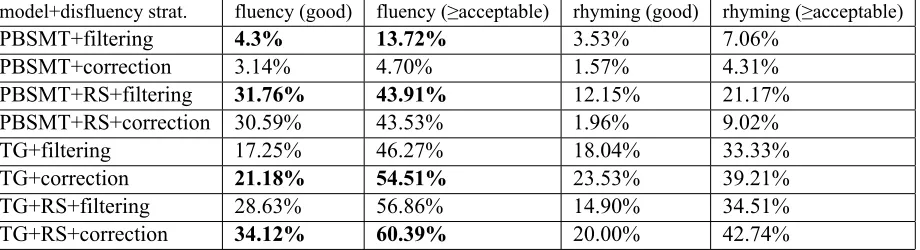
Error analysis of our initial runs showed a dis-turbingly high proportion of responses generated by our system that contained disfluencies with succes-sive repetitions of words such astheandI. Upon in-spection of data we noticed that the training lyrics actually did contain such disfluencies and backing vocal lines, amounting to 10% of our training data. We therefore compared two alternative strategies to tackle this problem. The first strategy involved fil-tering out all lines from our training corpus which contained such disfluencies. In the second strategy, we implemented a disfluency detection and correc-tion algorithm (for example, the the the, which fre-quently occurred in the training corpus, was cor-rected to simplythe). The PBSMT baseline and the TG model were trained on both the filtered and cor-rected versions of the training corpus and the quality of the responses were compared.
6.2 Results: Disfluency correction helps
Table 4: Effect of the disfluency correction strategies on fluency of the responses generated for the TG induction models vs PBSMT baselines using both rhyme scheme detection and adjacent lines as the corpus selection method.
model+disfluency strat. fluency (good) fluency (≥acceptable) rhyming (good) rhyming (≥acceptable)
PBSMT+filtering 4.3% 13.72% 3.53% 7.06%
PBSMT+correction 3.14% 4.70% 1.57% 4.31%
PBSMT+RS+filtering 31.76% 43.91% 12.15% 21.17%
PBSMT+RS+correction 30.59% 43.53% 1.96% 9.02%
TG+filtering 17.25% 46.27% 18.04% 33.33%
TG+correction 21.18% 54.51% 23.53% 39.21%
TG+RS+filtering 28.63% 56.86% 14.90% 34.51%
TG+RS+correction 34.12% 60.39% 20.00% 42.74%
the training corpus causes useful word association information necessary for rhyming to be lost. Sur-prisingly, for both PBSMT and PBSMT+RS models, the disfluency correction has a negative effect on the fluency level of the response but still falls behind TG and TG+RS models. As disfluency correction yields more fluent responses for TG and TG+RS models, the results for ISTG and ISTG+RS models in Table 1 were obtained using disfluency correction strategy.
7 Maghrebi French hip hop
We have begun to apply Freestyle to rap in lan-guages other than English, taking advantage of the language independence and linguistics-light ap-proach of our unsupervised transduction grammar induction methods. With no special adaption our transduction grammar based model performs sur-prisingly well, even with significantly smaller train-ing data size and noisier data. These results across different languages are encouraging as they can be used to discover truly language independence as-sumptions. We briefly describe our initial experi-ments on Maghrebi French hip hop lyrics below.
7.1 Dataset
We collected freely available French hip hop lyrics of approximately 1300 songs. About 85% of the songs were by Maghrebi French artists of Alge-rian, Moroccan, or Tunisian cultural backgrounds, while the remaining were by artists from the rest of Francophonie. As the large majority of songs are in Maghrebi French, the lyrics are sometimes interspersed with romanized Arabic such as “De la traversée du désert au bon couscous deYéma” (Yéma
meansMy mother). Some songs also contain Berber phrases, for instance “a yemmi ino, a thizizwith” (which means my son, a bee). Furthermore, some songs also contained English phrases in the style of gangster rap such as “T'esgame over,game over... Le son deChicken wings”. As mentioned earlier, it is complexity like this which dissuaded us from mak-ing language specific assumptions in our model.
We extracted the end-of-line words and obtained a corpus containing 120,000 tokens corresponding to potential rhyming candidates with around 29,000 unique token types which was used as the training data for the rhyme scheme detector module. For the transduction grammar induction, the training data contained about 47,000 sentence pairs selected us-ing rhyme scheme detection.
7.2 Results
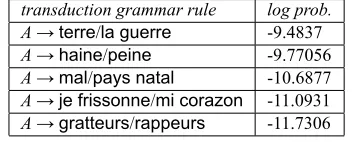
After human evaluation by native French speak-ers and frequent hip hop listenspeak-ers, our transduction grammar based model generates about 9.2% and 14.5% of the responses that are ratedgood by the human evaluators on the criterion of fluency and rhyming respectively. About 30.2% and 38% of the responses are rated as≥acceptable. These num-bers are encouraging given the noisy lyrics and much smaller amount of training data. Some examples of the challenge-response pairs and learned transduc-tion rules in French are shown in Tables 5 and 6.
re-Table 5: French hip hop challenge-response examples. challenge Si je metrompe
response faut que jeraconte challenge Un jour je suis unlivre response et ce que je devivre
challenge Pacha mama ils ne voient pas tasouffrance response Combat ni leur de voulait de ladécadence challenge la palestine n'etait pas uneterresans peuple. response ledarfour d'autrede laguerreon est challenge Unebanlieuequimeut
[image:10.612.77.295.69.173.2]response lesyeuxet
Table 6: Transduction rules for Maghrebi French hip hop.
transduction grammar rule log prob. A→terre/la guerre -9.4837 A→haine/peine -9.77056 A→mal/pays natal -10.6877 A→je frissonne/mi corazon -11.0931 A→gratteurs/rappeurs -11.7306
sponse in the third example, exhibits strong rhyming with the challenge and both the challenge and the response contain words like souffrance, combat and décadencewhich are related. Similarly in the fourth example, the challenge and response also contain se-mantically related tokens which also rhyme. These examples illustrate that our transduction grammar formalism coupled with our rhyme scheme detection module does capture the necessary correspondences between lines of hip hop lyrics without assuming any language specific resources.
8 Conclusion
We presented a new machine learning approach for improvising hip hop responses to challenge lyrics by inducing stochastic transduction grammars, and demonstrated that inducing the transduction rules by interpolating bottom-up token based rule induction and rule segmentation strategies outperforms a token based baseline. We compared the performance of ourFreestylemodel against a widely used off-the-shelf phrase-based SMT model, showing that PB-SMT falls short in tackling the noisy and highly un-structured domain of hip hop lyrics. We showed that the quality of responses improves when the training data for the transduction grammar induction is se-lected using a rhyme scheme detector. Several do-main related oddities such as disfluencies and back-ing vocals have been identified and some strategies for alleviating their effects have been compared. We
also reported results on Maghrebi French hip hop lyrics which indicate that our model works surpris-ingly well with no special adaptation for languages other than English. In the future, we plan to inves-tigate alternative training data selection techniques, disfluency handling strategies, search heuristics, and novel transduction grammar induction models.
Acknowledgements
This material is based upon work supported in part by the Hong Kong Research Grants Council (RGC) research grants GRF620811, GRF621008, GRF612806; by the Defense Advanced Research Projects Agency (DARPA) under BOLT contract no. HR0011-12-C-0016, and GALE contract nos. 0022 and HR0011-06-C-0023; and by the European Union under the FP7 grant agreement no. 287658. Any opinions, findings and con-clusions or recommendations expressed in this material are those of the authors and do not necessarily reflect the views of the RGC, EU, or DARPA.
References
Ananth Ramakrishnan A., Sankar Kuppan, and Lalitha Devi Sobha. “Automatic generation of Tamil lyrics for melodies.” Workshop on Computa-tional Approaches to Linguistic Creativity (CALC-09). 2009.
KarteekAddankiand DekaiWu. “Unsupervised rhyme scheme identification in hip hop lyrics using hidden Markov models.”1st International Conference on Sta-tistical Language and Speech Processing (SLSP 2013). 2013.
Gabriele Barbieri, François Pachet, Pierre Roy, and MirkoDegli Esposti. “Markov constraints for gen-erating lyrics with style.” 20th European Conference on Artificial Intelligence, (ECAI 2012). 2012.
DavidChiang. “Hierarchical phrase-based translation.”
Computational Linguistics, 33(2), 2007.
JohnCocke.Programming languages and their compil-ers: Preliminary notes. Courant Institute of Mathemat-ical Sciences, New York University, 1969.
P.A.Devijer. “Baum’s forward-backward algorithm re-visited.” Pattern Recognition Letters, 3(6), 1985.
D.Genzel, J.Uszkoreit, and F.Och. “Poetic statisti-cal machine translation: rhyme and meter.”2010 Con-ference on Empirical Methods in Natural Language Processing (EMNLP 2010). Association for Computa-tional Linguistics, 2010.
[image:10.612.96.274.205.276.2]to generation and translation.” 2010 Conference on Empirical Methods in Natural Language Processing (EMNLP 2010). Association for Computational Lin-guistics, 2010.
Long Jiang and Ming Zhou. “Generating Chinese couplets using a statistical MT approach.” 22nd In-ternational Conference on Computational Linguistics (COLING 2008). 2008.
Philipp Koehn, Hieu Hoang, Alexandra Birch, ChrisCallison-Burch, MarcelloFederico, Nicola
Bertoldi, Brooke Cowan, Wade Shen, Christine
Moran, RichardZens, ChrisDyer, OndrejBojar, AlexandraConstantin, and EvanHerbst. “Moses: Open source toolkit for statistical machine translation.”
Interactive Poster and Demonstration Sessions of the 45th Annual Meeting of the Association for Computa-tional Linguistics (ACL 2007). June 2007.
MarkLiberman. “Rap scholarship, rap meter, and the an-thology of mondegreens.”http://languagelog.ldc. upenn.edu/nll/?p=2824, December 2010. Accessed:
2013-06-30.
Franz JosefOch. “Minimum error rate training in sta-tistical machine translation.” 41st Annual Meeting of the Association for Computational Linguistics (ACL-2003). July 2003.
Kishore Papineni, Salim Roukos, Todd Ward, and Wei-JingZhu. “BLEU: a method for automatic evalu-ation of machine translevalu-ation.” 40th Annual Meeting of the Association for Computational Linguistics (ACL-02). July 2002.
S.Reddyand K.Knight. “Unsupervised discovery of rhyme schemes.”49th Annual Meeting of the Associa-tion for ComputaAssocia-tional Linguistics: Human Language Technologies (ACL HLT 2011), vol. 2. Association for Computational Linguistics, 2011.
JormaRissanen. “A universal prior for integers and es-timation by minimum description length.” The Annals of Statistics, 11(2), June 1983.
MarkusSaers, KarteekAddanki, and DekaiWu. “From finite-state to inversion transductions: Toward un-supervised bilingual grammar induction.” 24th In-ternational Conference on Computational Linguistics (COLING 2012). December 2012.
Markus Saers, Karteek Addanki, and Dekai Wu. “Combining top-down and bottom-up search for un-supervised induction of transduction grammars.” Sev-enth Workshop on Syntax, Semantics and Structure in Statistical Translation (SSST-7). June 2013.
MarkusSaersand DekaiWu. “Reestimation of reified rules in semiring parsing and biparsing.” Fifth Work-shop on Syntax, Semantics and Structure in Statistical
Translation (SSST-5). Association for Computational Linguistics, June 2011.
Ray J. Solomonoff. “A new method for discov-ering the grammars of phrase structure languages.”
International Federation for Information Processing Congress (IFIP). 1959.
M.Sonderegger. “Applications of graph theory to an English rhyming corpus.” Computer Speech & Lan-guage, 25(3), 2011.
AndreasStolcke. “SRILM – an extensible language modeling toolkit.” 7th International Conference on Spoken Language Processing (ICSLP2002 - INTER-SPEECH 2002). September 2002.
DekaiWu. “A polynomial-time algorithm for statisti-cal machine translation.” 34th Annual Meeting of the Association for Computational Linguistics (ACL96). 1996.
DekaiWu. “Stochastic inversion transduction grammars and bilingual parsing of parallel corpora.” Computa-tional Linguistics, 23(3), 1997.
DekaiWu. “Textual entailment recognition using inver-sion transduction grammars.” Joaquin
Quiñonero-Candela, IdoDagan, BernardoMagnini, and Flo-renced’Alché Buc(eds.),Machine Learning Chal-lenges, Evaluating Predictive Uncertainty, Visual Ob-ject Classification and Recognizing Textual Entail-ment, First PASCAL Machine Learning Challenges Workshop (MLCW 2005), vol. 3944 ofLecture Notes in Computer Science. Springer, 2006.
Dekai Wu, Karteek Addanki, and Markus Saers. “FREESTYLE: A challenge-response system for hip hop lyrics via unsupervised induction of stochastic transduction grammars.” 14th Annual Conference of the International Speech Communication Association (Interspeech 2013). 2013a.
Dekai Wu, Karteek Addanki, and Markus Saers. “Modeling hip hop challenge-response lyrics as ma-chine translation.” 14th Machine Translation Summit (MT Summit XIV). 2013b.
Dekai Wu and Pascale Fung. “Inversion transduc-tion grammar constraints for mining parallel sentences from quasi-comparable corpora.” Second Interna-tional Joint Conference on Natural Language Process-ing (IJCNLP 2005). Springer, 2005.