Proceedings of the 2011 Conference on Empirical Methods in Natural Language Processing, pages 322–332,
Universal Morphological Analysis using Structured Nearest Neighbor
Prediction
Young-Bum Kim
University of Wisconsin-Madison [email protected]
João V. Graça L2F INESC-ID Lisboa, Portugal
Benjamin Snyder
University of Wisconsin-Madison [email protected]
Abstract
In this paper, we consider the problem of un-supervised morphological analysis from a new angle. Past work has endeavored to design un-supervised learning methods which explicitly or implicitly encode inductive biases appropri-ate to the task at hand. We propose instead to treat morphological analysis as a structured prediction problem, where languages with la-beled data serve as training examples for un-labeled languages, without the assumption of parallel data. We define a universal morpho-logical feature space in which every language and its morphological analysis reside. We de-velop a novel structured nearest neighbor pre-diction method which seeks to find the mor-phological analysis for each unlabeled lan-guage which lies as close as possible in the feature space to a training language. We ap-ply our model to eight inflecting languages, and induce nominal morphology with substan-tially higher accuracy than a traditional, MDL-based approach. Our analysis indicates that accuracy continues to improve substantially as the number of training languages increases.
1 Introduction
Over the past several decades, researchers in the nat-ural language processing community have focused most of their efforts on developing text processing tools and techniques for English (Bender, 2009), a morphologically simple language. Recently, in-creasing attention has been paid to the wide variety of other languages of the world. Most of these lan-guages still pose severe difficulties, due to (i) their
lack of annotated textual data, and (ii) the fact that they exhibit linguistic structure not found in English, and are thus not immediately susceptible to many traditional NLP techniques.
Consider the example of nominal part-of-speech analysis. The Penn Treebank defines only four En-glish noun tags (Marcus et al., 1994), and as a re-sult, it is easy to treat the words bearing these tags as completely distinct word classes, with no inter-nal morphological structure. In contrast, a compara-ble tagset for Hungarian includes 154 distinct noun tags (Erjavec, 2004), reflecting Hungarian’s rich in-flectional morphology. When dealing with such lan-guages, treating words as atoms leads to severe data sparsity problems.
Because annotated resources do not exist for most morphologically rich languages, prior research has focused on unsupervised methods, with a focus on developing appropriate inductive biases. However, inductive biases and declarative knowledge are no-toriously difficult to encode in well-founded models. Even putting aside this practical matter, a universally correct inductive bias, if there is one, is unlikely to be be discovered bya priorireasoning alone.
In this paper, we argue that languages for which wehavegold-standard morphological analyses can be used as effective guides for languages lacking
such resources. In other words, instead of treating each language’s morphological analysis as ade novo
induction problem to be solved with a purely hand-coded bias, we instead learn from our labeled lan-guages what linguistically plausible morphological analyses looks like, and guide our analysis in this direction.
More formally, we recast morphological induc-tion as a new kind of supervised structured predic-tion problem, where each annotated language serves as a single training example. Each language’s noun lexicon serves as a single inputx, and the analysis of the nouns into stems and suffixes serves as a com-plex structured labely.
Our first step is to define a universal morpholog-ical feature space, into which each language and its morphological analysis can be mapped. We opt for a simple and intuitive mapping, which measures the sizes of the stem and suffix lexicons, the entropy of these lexicons, and the fraction of word forms which appear without any inflection.
Because languages tend to cluster into well de-fined morphological groups, we cast our learn-ing and prediction problem in the nearest neighbor framework (Cover and Hart, 1967). In contrast to its typical use in classification problems, where one can simply pick the label of the nearest training ex-ample, we are here faced with a structured predic-tion problem, where locapredic-tions in feature space de-pend jointly on the input-label pair(x, y). Finding a
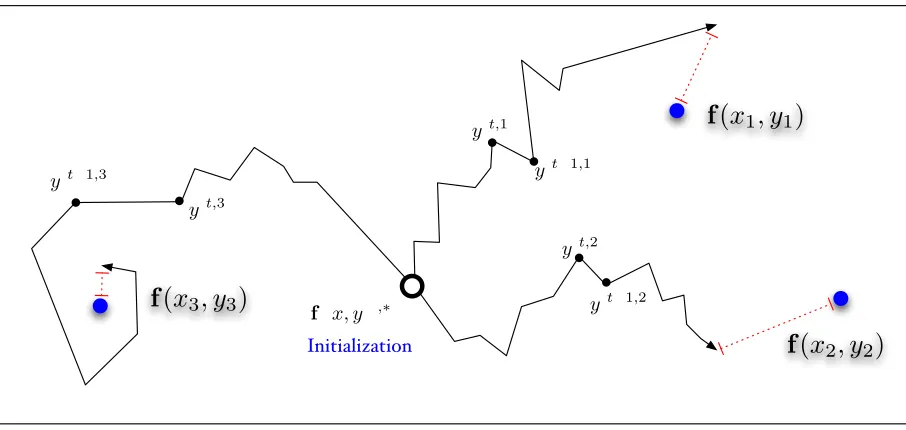
nearest neighbor thus consists ofsearchingover the space of morphological analyses, until a point in fea-ture space is reached which lies closest to one of the labeled languages. See Figure 1 for an illustration.
To provide a measure of empirical validation, we applied our approach to eight languages with inflec-tional nominal morphology, ranging in complexity from very simple (English) to very complex (Hun-garian). In all but one case, our approach yields substantial improvements over a comparable mono-lingual baseline (Goldsmith, 2005), which uses the minimum description length principle (MDL) as its inductive bias. On average, our method increases accuracy by 11.8 percentage points, corresponding to a 42% decrease in error relative to a supervised upper bound. Further analysis indicates that accu-racy improves as the number of training languages increases.
2 Related Work
In this section, we briefly review prior work on un-supervised morphological induction, as well as mul-tilingual analysis in NLP.
Unsupervised Morphological Induction: Unsu-pervised morphology remains an active area of re-search (Schone and Jurafsky, 2001; Goldsmith, 2005; Adler and Elhadad, 2006; Creutz and gus, 2005; Dasgupta and Ng, 2007; Creutz and La-gus, 2007; Poon et al., 2009). Many existing algo-rithms derive morpheme lexicons by identifying re-curring patterns in words. The goal is to optimize the compactness of the data representation by finding a small lexicon of highly frequent strings, resulting in a minimum description length (MDL) lexicon and corpus (Goldsmith, 2001; Goldsmith, 2005). Later work cast this idea in a probabilistic framework in which the the MDL solution is equivalent to a MAP estimate in a suitable Bayesian model (Creutz and Lagus, 2005). In all these approaches, a locally op-timal segmentation is identified using a task-specific greedy search.
Multilingual Analysis: An influential line of prior multilingual work starts with the observation that rich linguistic resources exist for some languages but not others. The idea then is to project linguis-tic information from one language onto others via parallel data. Yarowsky and his collaborators first developed this idea and applied it to the problems of part-of-speech tagging, noun-phrase bracketing, and morphology induction (Yarowsky and Wicentowski, 2000; Yarowsky et al., 2000; Yarowsky and Ngai, 2001), and other researchers have applied the idea to syntactic and semantic analysis (Hwa et al., 2005; Padó and Lapata, 2006) In these cases, the existence of a bilingual parallel text along with highly accurate predictions for one of the languages was assumed.
in-duction (Cohen and Smith, 2009; Berg-Kirkpatrick and Klein, 2010).
In contrast to these previous approaches, the method proposed in this paper doesnotassume the existence of any parallel text, butdoesassume that labeled data exists for a wide variety of languages, to be used as training examples for our test language.
3 Structured Nearest Neighbor
We reformulate morphological induction as a super-visedlearning task, where each annotated language serves as a single training example for our language-independent model. Each such example consists of an input-label pair(x, y), both of which contain
complex internal structure: The input x ∈ X
con-sists of a vocabulary list of all words observed in a particular monolingual corpus, and the labely ∈ Y
consists of the correct morphological analysis of all the vocabulary items in x.1 Because our goal is
to generalize across languages, we define a feature function which maps each(x, y)pair to a universal
feature space:f :X × Y →Rd.
For each unlabeled input languagex, our goal is
to predict a complete morphological analysisy∈ Y
which maximizes a scoring function on the fea-ture space, score : Rd → R. This scoring func-tion is trained using then labeled-language
exam-ples: (x, y)1, . . . ,(x, y)n, and the resulting predic-tion rule for unlabeled inputxis given by:
y∗= argmax
y∈Y
score f(x, y)
Languages can be typologically categorized by the type and richness of their morphology. On the assumption that for each test language, at least one typologically similar language will be present in the training set, we employ a nearest neighborscoring function. In the standard nearest neighbor classifi-cation setting, one simply predicts the label of the closest training example in the input space.2 In our structured prediction setting, the mapping to the uni-versal feature space depends crucially on the struc-ture of the proposed label y, not simply the input
1Technically, the label space of each input,
Y, should be thought of as a function of the inputx. We suppress this depen-dence for notational clarity.
2More generally the majority label of thek-nearest
neigh-bors.
x. We thus generalize nearest-neighbor prediction
to the structured scenario and propose the following prediction rule:
y∗= argmin
y∈Y
min
` kf(x, y)−f(x`, y`)k, (1)
where the index`ranges over the training languages.
In words, we predict the morphological analysisy
for our test language which places it as close as pos-sible in the universal feature space to one of the training languages`.
Morphological Analysis: In this paper we focus on nominal inflectional suffix morphology. Consider the word utiskom in Serbian, meaning impression
with the instrumental case marking. A correct analy-sis of this word would divide it into a stem (utisak = impression), a suffix (-om= instrumental case), and a phonological deletion rule on the stem’s penulti-mate vowel (..ak#→..k#).
More generally, as we define it, a morphological analysis of a word typewconsists of (i) a stemt, (ii), a suffixf, and (iii) a deletion ruled. Either or both
of the suffix and deletion rule can beN U LL. We
al-low three types of deletion rules on stems: deletion of final vowels (..V# → ..#), deletion of
penulti-mate vowels (..V C# → ..C#), and removals and
additions of final accent marks (e.g. ..a˜#→..a#).
We require that stems be at least three characters long and that suffixes be no more than four. And, of course, we require that after (1) applying deletion ruledto stemt, and (2) adding suffixfto the result,
we obtain wordw.
Universal Feature Space: We employ a fairly simple and minimal set of features, all of which could plausibly generalize across a wide range of languages. Consider the set of stemsT, suffixesF,
and deletion rulesD, induced by the morphological
analyses y of the wordsx. Our first three features simply count the sizes of these three sets.
f
(
x
2, y
2)
f
(
x
1, y
1)
f
(
x
3, y
3)
y(t,1)
y(t+1,1)
y(t+1,2) y(t,2) y(t,3)
y(t+1,3)
f�x, y(0,∗)�
[image:4.612.80.533.76.291.2]Initialization
Figure 1:Structured Nearest Neighbor Search:The inference procedure for unlabeled test languagex, when trained with three labeled languages,(x1, y1),(x2, y2),(x3, y3). Our search procedure iteratively attempts to find labels forx
which are as close as possible in feature space to each of the training languages. After convergence, the label which is closest in distance to a training language is predicted, in this case being the label near training language(x3, y3).
For example, if the (x, y) pair consists of the
ana-lyzed words{kiss, kiss-es, hug}, then the empirical distributions over stems, suffixes, and deletion rules would be:
• P(t=kiss) = 2/3 • P(t=hug) = 1/3 • P(f =N U LL) = 2/3 • P(f =−es) = 1/3 • P(d=N U LL) = 1
The three entropy features are defined as the shan-non entropies of these stem, suffix, and deletion rule probabilities:H(t), H(f), H(d).3
Finally, we consider two simple percentage fea-tures: the percentage of words inxwhich according
to y are left unsegmented (i.e. have the null
suf-fix, 2/3 in the example above), and the percentage of segmented words which employ a deletion rule (0 in the example above). Thus, in total, our model em-ploys 8 universal morphological features. All fea-tures are scaled to the unit interval and are assumed to have equal weight.
3Note that here and throughout the paper, we operate over
word types, ignoring their corpus frequencies.
3.1 Search Algorithm
The main algorithmic challenge for our model lies in efficiently computing the best morphological analy-sisyfor each language-specific word setx,
accord-ing to Equation 1. Exhaustive search through the set of all possible morphological analyses is impos-sible, as the number of such analyses grows expo-nentially in the size of the vocabulary. Instead, we develop a greedy search algorithm in the following fashion (the search procedure is visually depicted in Figure 1).
At each time-stept, we maintain a set of frontier
analysesy(t,`) `, where`ranges over the training
languages. The goal is to iteratively modify each of these frontier analysesy(t,`) → y(t+1,`) so that the
location of the training language in universal feature space —f x, y(t+1,`)— is as close as possible to
the location of the training language`:f x`, y`). After iterating this procedure to convergence, we are left with a set of analysesy(`)
`, each of which approximates the analyses which yield minimal dis-tances to a particular training language:
y(`)≈argmin
y∈Y k
f(x, y)−f(x`, y`)k.
make our prediction:
`∗ = argmin
` k
f(x, y(`))−f(x`, y`)k
y∗ =y(`∗)
The main outline of our search algorithm is based on the MDL-based greedy search heuristic devel-oped and studied by (Goldsmith, 2005). At a high level, this search procedure alternates between indi-vidual analyses of words (keeping the set of stems and suffixes fixed), aggregate discoveries of new stems (keeping the suffixes fixed), and aggregate dis-coveries of new suffixes (keeping stems fixed). As input, we consider the test wordsx in our new
lan-guage, and we run the search in parallel for each training language (x`, y`). For each such test-train language pair, the search consists of the following stages:
Stage 0: Initialization
We initially analyze each wordw ∈x according
to peaks insuccessor frequency.4 Ifw’s n-character prefixw:nhas successor frequency>1and the sur-rounding prefixes,w:n−1 andw:n+1 both have
suc-cessor frequency= 1, then we analyzewas a
stem-suffix pair: (w:n, wn+1:).5 Otherwise, we initialize
was an unsuffixed stem. As this procedure tends to produce an overly large set of suffixesF, we further
prune F down to the number of suffixes found in
the training language, retaining those which appear with the largest number of stems. This initialization stage is carried out once, and afterwards the follow-ing three stages are repeated until convergence. Stage 1: Reanalyze each word
In this stage, we reanalyze each word (in random order). We use the set of stems T and suffixes F
obtained from the previous stage, and don’t permit the addition of any new items to these lists. In-stead, we focus on obtaining better analyses of each word, while also building up a set of phonological deletion rules D. For each word w ∈ x, we
con-sider all possible segmentations of w into a
stem-4Thesuccessor frequencyof a string prefixsis defined as
the number of unique characters that occur immediately afters in the vocabulary.
5With the restriction that at this stage we only allow suffixes
up to length 5, and stems of at least length 3.
suffix pair(t, f), for whichf ∈ F, and where
ei-ther t ∈ T or somet0 ∈ T such that tis obtained
fromt0 using a deletion rule d(e.g. by deleting a
final or penultimate vowel). For each such possi-ble analysis y0, we compute the resulting location in feature spacef(x, y0), and select the analysis that
brings us closest to our target training language:
y= argminy0 kf(x, y0)−f(x`, y`)k.
Stage 2: Find New Stems
In this stage, we keep our set of suffixes F and
deletion rulesDfrom the previous stage fixed, and
attempt to find new stems to add toTthrough an
ag-gregate analysis of unsegmented words. For every strings, we consider the set of words which are
cur-rently unsegmented, and can be analyzed as a stem-suffix pair (s, f) for some existing suffix f ∈ F,
and some deletion rule d ∈ D. We then consider
the joint segmentation of these words into a new stems, and their respective suffixes. As before, we
choose the segmentation if it brings us closer in fea-ture space to our target training language.
Stage 3: Find New Suffixes
This stage is exactly analogous to the previous stage, except we now fix the set of stemsTand seek
to find new suffixes.
3.2 A Monolingual Supervised Model
In order to provide a plausible upper bound on per-formance, we also formulate a supervised monolin-gual morphological model, using the structured per-ceptron framework (Collins, 2002). Here we as-sume that we are given some training sequence of in-puts and morphological analyses (all within one lan-guage): (x1, y1),(x2, y2), . . . ,(xn, yn). We define each inputxito be a nounw, along with a morpho-logical tagz, which specifies the gender, case, and
number of the noun. The goal is to predict the cor-rect segmentation ofwinto stem, suffix, and
phono-logical deletion rule:yi = (t, f, d).6
To do so, we define a feature function over input-label pairs,(x, y), with the following binary feature
templates: (1) According to labelyi, the stem ist
6While the assumption of the correct morphological tag as
Type Counts Entropy Percentage # words # stems # suffs # dels stem entropy suff entropy del entropy unseg deleted
BG 4833 3112 21 8 11.4 2.7 0.9 .45 .29
CS 5836 3366 28 12 11.5 3.2 1.6 .38 .53
EN 4178 3453 3 1 11.7 1.0 0.1 .73 .06
ET 6371 3742 141 5 11.5 5.0 0.2 .31 .04
HU 8051 3746 231 7 11.3 5.8 0.5 .23 .11
RO 5578 3297 23 8 11.5 2.9 1.4 .48 .51
SL 6111 3172 32 6 11.3 3.2 1.5 .33 .56
[image:6.612.74.545.70.211.2]SR 5849 3178 28 5 11.4 2.9 1.4 .33 .53
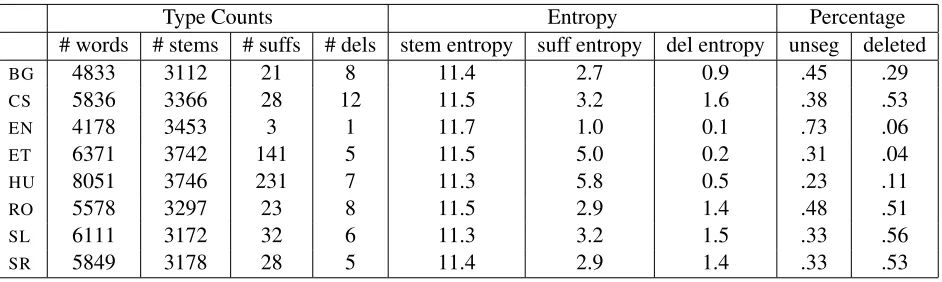
Table 1: Corpus statistics for the eight languages. The first four columns give the number of unique word, stem, suffix, and phonological deletion rule types. The next three columns give, respectively, the entropies of the distributions of stems, suffixes (includingN U LL), and deletion rules (includingN U LL) over word types. The final two columns give, respectively, the percentage of word types occurring with theN U LLsuffix, and the number of non-N U LLsuffix words which use a phonological deletion rule. Note that the final eight columns define the universal feature space used by our model. BG= Bulgarian,CS = Czech,EN= English, ET= Estonian,HU= Hungarian,RO= Romanian, SL= Slovene,SR= Serbian
(one feature for each possible stem). (2) Accord-ing to labelyi, the suffix and deletion rule are(f, d) (one feature for every possible pair of deletion rules and suffixes). (3) According to labelyiand morpho-logical tag z, the suffix, deletion rule, and gender
are respectively(f, d, G). (4) According to labelyi and morphological tag z, the suffix, deletion rule,
and case are(f, d, C). (5) According to labelyi and morphological tag z, the suffix, deletion rule, and
number are(f, d, N).
We train a set of linear weights on our fea-tures using the averaged structured perceptron algo-rithm (Collins, 2002).
4 Experiments
In this section we turn to experimental findings to provide empirical support for our proposed frame-work.
Corpus: To test our cross-lingual model, we ap-ply it to a morphologically analyzed corpus of eight languages (Erjavec, 2004). The corpus includes a roughly 100,000 word English text, Orwell’s novel “Nineteen Eighty Four,” and its translation into seven languages: Bulgarian, Czech, Estonian, Hun-garian, Romanian, Slovene, and Serbian. All the words in the corpus are tagged with morphologi-cal stems and a detailed morpho-syntactic analysis. Although the texts are parallel, we note that par-allelism is nowhere assumed nor exploited by our
model. See Table 1 for a summary of relevant cor-pus statistics. As indicated in the table, the raw num-ber of nominal word types varies quite a bit across the languages, almost doubling from 4,178 (English) to 8,051 (Hungarian). In contrast, the number of stems appearing within these words is relatively sta-ble across languages, ranging from a minimum of 3,112 (Bulgarian) to a maximum of 3,746 (Hungar-ian), an increase of just 20%.
In contrast, the number of suffixes across the lan-guages varies quite a bit. Hungarian and Esto-nian, both Uralic languages with very complex nom-inal morphology, use 231 and 141 nomnom-inal suffixes, respectively. Besides English, the remaining lan-guages employ between 21 and 32 suffixes, and En-glish is the outlier in the other direction, with just three nominal inflectional suffixes.
Baselines and Results: As our unsupervised monolingual baseline, we use the Linguistica pro-gram (Goldsmith, 2001; Goldsmith, 2005). We ap-ply Linguistica’s default settings, and run the “suffix prediction” option. Our model’s search procedure closely mirrors the one used by Linguistica, with the crucial difference that instead of attempting to greedily minimize description length, our algorithm instead tries to find the analysis as close as possi-ble in the universal feature space to that of another language.
Linguistica
Our Model
Supervised
Nearest Neighbor Self (oracle) Avg.
Accuracy Distance Accuracy Distance Accuracy Distance
BG 68.7 84.0 (RO) 0.13 88.7 0.03 68.6 3.90 94.7
CS 60.4 82.8 (BG) 0.40 84.5 0.03 66.3 4.05 93.5
EN 81.1 75.8 (BG) 1.29 89.3 0.10 58.3 4.30 93.4
ET 51.2 66.6 (HU) 0.35 80.9 0.03 52.8 4.57 86.5
HU 64.5 69.3 (ET) 0.81 66.5 1.10 68.0 4.94 94.9
RO 65.6 71.0 (CS) 0.11 71.2 0.15 62.3 3.95 89.1
SL 61.1 82.8 (SR) 0.07 85.5 0.04 61.7 3.69 95.4
SR 64.2 79.1 (SL) 0.06 82.2 0.04 63.0 3.71 94.8
[image:7.612.74.542.71.238.2]avg. 64.6 76.4 0.40 81.1 0.19 62.6 4.14 92.8
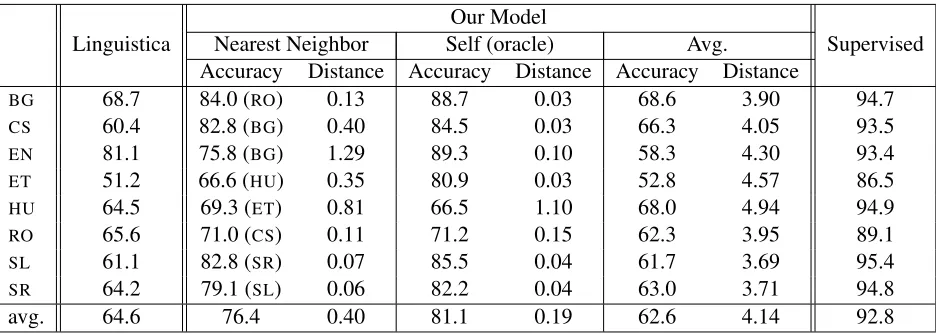
Table 2:Prediction accuracyover word types for the Linguistica baseline, our cross-lingual model, and the monolin-gual supervised perceptron model. For our model, we provide both prediction accuracy and resulting distance to the training language in three different scenarios: (i)Nearest Neighbor: The training languages include all seven other languages in our data set, and the predictions with minimal distance to a training language are chosen (the nearest neighbor is indicated in parentheses). (ii)Self (oracle): Each language is trained to minimize the distance to itsown gold-standard analysis. (iii) Average: The feature values of all seven training languages are averaged together to create a single objective.
languages in turn as the test language, with the other seven serving as training examples. For each test language, we iterate the search procedure for each training language (performed in parallel), until con-vergence. The number of required iterations varies from 6 to 36 (depending on the test-training lan-guage pair), and each iteration takes no more than 30 seconds of run-time on a 2.4GHz Intel Xeon E5620 processor. We also consider two variants of our method. In the first (Self (oracle)), we train each test language to minimize the distance to its own
gold standard feature values. In the second variant (Avg.), we average the feature values of all seven training languages into a single objective. As a plau-sible upper bound on performance, we implemented the structured perceptron described in Section 3.2. For each language, we train the perceptron on a ran-domly selected set of 80% of the nouns, and test on the remaining 20%.
The prediction accuracy for all models is calcu-lated as the fraction of word types with correctly predicted suffixes. See Table 2 for the results. For all languages other than English (which is a mor-phological loner in our group of languages), our model improves over the baseline by a substantial margin, yielding an average increase of 11.8 abso-lute percentage points, and a reduction in error
rela-tive to the supervised upper bound of 42%. Some of the most striking improvements are seen on Serbian and Slovene. These languages are closely related to one another, and indeed our model discovers that they are each others’ nearest neighbors. By guiding their morphological analyses towards one another, our model achieves a 21 percentage point increase in the case of Slovene and a 15 percentage point in-crease in the case of Slovene.
Perhaps unsurprisingly, when each language’s gold standard feature values are used as its own
Linguistica Gold Standard Our Method
BG
CS
EN
ET
HU
RO
SL
SR
BG
CS
EN
ET
HU
RO
SL SR
BG
CS
EN
ET
HU
[image:8.612.113.500.77.314.2]RO
SL
SR
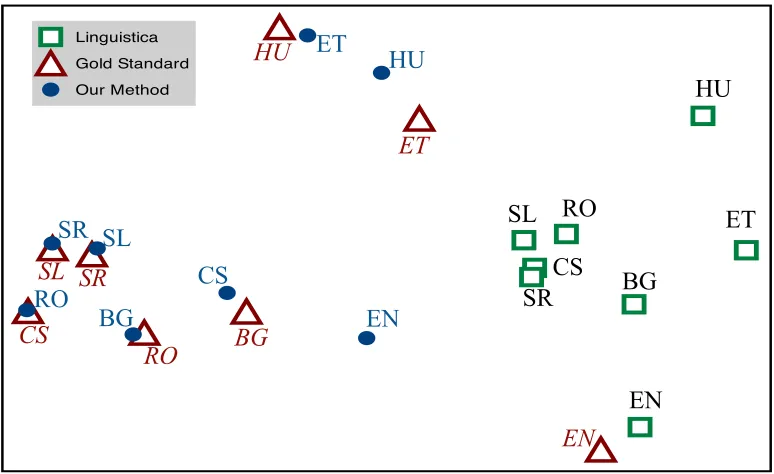
Figure 2: Locations in Feature Spaceof Linguistica predictions (green squares), gold standard analyses (red tri-angles), and our model’s nearest neighbor predictions (blue circles). The original 8-dimensional feature space was reduced to two dimensions using Multidimensional Scaling.
result may indicate that the average feature point be-tween training languages is simply unattainable as an analysis of a real lexicon of nouns.
Visualizing Locations in Feature Space: Besides assessing our method quantitatively, we can also vi-sualize the the eight languages in universal feature space according to (i) their gold standard analyses, (ii) the predictions of our model and (iii) the pre-dictions of Linguistica. To do so, we reduce the 8-dimensional features space down to two dimensions while preserving the distances between the predicted and gold standard feature vectors, using Multidi-mensional Scaling (MDS). The results of this anal-ysis are shown in Figure 2. With the exception of English, our model’s analyses lie closer in feature space to their gold standard counterparts than those of the baseline. It is interesting to note that Serbian and Slovene, which are very similar languages, have essentially swapped places under our model’s anal-ysis, as have Estonian and Hungarian (both highly inflected Uralic languages). English has (unfortu-nately) been pulled towards Bulgarian, the second least inflecting language in our set.
Learning Curves: We also measured the perfor-mance of our method as a function of the number of languages in the training set. For each target lan-guage, we consider all possible training sets of sizes ranging from 1 to 7 and select the predictions which bring our test language closest in distance to one of the languages in the set. We then average the result-ing accuracy over all trainresult-ing sets of each size. Fig-ure 3 shows the resulting learning curves averaged over all test languages (left), as well as broken down by test language (right). The overall trend is clear: as additional languages are added to the training set, test performance improves. In fact, with only one training language, our method performs worse (on average) than the Linguistica baseline. However, with two or more training languages available, our method achieves superior results.
1 2 3 4 5 6 7 Number of training languages
0.55 0.6 0.65 0.7 0.75 0.8 0.85
BG CS SL SR EN RO HU ET
1 2 3 4 5 6 7
Number of training languages
0.62 0.64 0.66 0.68 0.7 0.72 0.74 0.76
[image:9.612.76.535.74.270.2]Our Model Linguistica
Figure 3:Learning curvesfor our model as the number of training languages increases. The figure on the left shows the average accuracy of all eight languages for increasingly larger training sets (results are averaged over all training sets of size 1,2,3,...). The dotted line indicates the average performance of the baseline. The figure on the right shows similar learning curves, broken down individually for each test language (see Figure 1 for language abbreviations).
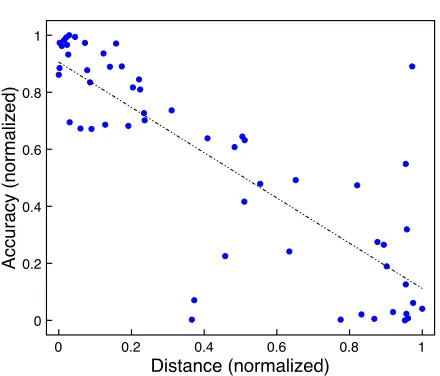
one of them. It thus stands to reason that a strong (negative) correlation between distance and accu-racy would lead to increased accuaccu-racy with larger training sets. In order to assess this correlation, we considered all 56 test-train language pairs and col-lected the resulting accuracy and distance for each pair. We separately scaled accuracy and distance to the unit interval for each test language (as some test languages are inherently more difficult than others). The resulting plot, shown in Figure 4, shows the ex-pected correlation: When our test language can be guided very closely to the training language, the re-sulting predictions are likely to be good. If not, the predictions are likely to be bad.
5 Conclusions and Future Work
The approach presented in this paper recasts mor-phological induction as a structured prediction task. We assume the presence of morphologically labeled languages astraining exampleswhich guide the in-duction process for unlabeled test languages. We developed a novel structured nearest neighbor ap-proach for this task, in which all languages and their morphological analyses lie in a universal feature space. The task of the learner is to search through the space of morphological analyses for the test lan-guage and return the result which lies closest to one
0 0.2 0.4 0.6 0.8 1
Distance (normalized)
0 0.2 0.4 0.6 0.8 1
Accu
ra
cy
(n
o
rma
lize
d
)
[image:9.612.313.533.389.577.2]of the training languages. Our empirical findings validate this approach: On a set of eight different languages, our method yields substantial accuracy gains over a traditional MDL-based approach in the task of nominal morphological induction.
One possible shortcoming of our approach is that it assumes a uniform weighting of the cross-lingual feature space. In fact, some features may be far more relevant than others in guiding our test language to an accurate analysis. In future work, we plan to in-tegrate distance metric learning into our approach, allowing some features to be weighted more heavily than others. Besides potential gains in prediction ac-curacy, this approach may shed light on deeper rela-tionships between languages than are otherwise ap-parent.
References
Meni Adler and Michael Elhadad. 2006. An un-supervised morpheme-based hmm for hebrew mor-phological disambiguation. In Proceedings of the ACL/CONLL, pages 665–672.
Emily M. Bender. 2009. Linguistically naïve != lan-guage independent: why NLP needs linguistic typol-ogy. In Proceedings of the EACL 2009 Workshop on the Interaction between Linguistics and Compu-tational Linguistics, pages 26–32, Morristown, NJ, USA. Association for Computational Linguistics. Taylor Berg-Kirkpatrick and Dan Klein. 2010.
Phyloge-netic grammar induction. InProceedings of the ACL, pages 1288–1297, Uppsala, Sweden, July. Association for Computational Linguistics.
P. Blunsom, T. Cohn, and M. Osborne. 2009. Bayesian synchronous grammar induction. Advances in Neural Information Processing Systems, 21:161–168. David Burkett, Slav Petrov, John Blitzer, and Dan Klein.
2010. Learning better monolingual models with unan-notated bilingual text. InProceedings of CoNLL. Shay B. Cohen and Noah A. Smith. 2009. Shared
lo-gistic normal distributions for soft parameter tying in unsupervised grammar induction. In Proceedings of the NAACL/HLT.
Michael Collins. 2002. Discriminative training meth-ods for hidden markov models: theory and experi-ments with perceptron algorithms. InProceedings of EMNLP, pages 1–8.
T. Cover and P. Hart. 1967. Nearest neighbor pattern classification. Information Theory, IEEE Transactions on, 13(1):21–27.
Mathias Creutz and Krista Lagus. 2005. Unsupervised morpheme segmentation and morphology induction from text corpora using morfessor 1.0. Publications in Computer and Information Science Report A81, Helsinki University of Technology.
Mathias Creutz and Krista Lagus. 2007. Unsupervised models for morpheme segmentation and morphology learning.ACM Transactions on Speech and Language Processing, 4(1).
Ido Dagan, Alon Itai, and Ulrike Schwall. 1991. Two languages are more informative than one. In Proceed-ings of the ACL, pages 130–137.
Sajib Dasgupta and Vincent Ng. 2007. Unsuper-vised part-of-speech acquisition for resource-scarce languages. In Proceedings of the EMNLP-CoNLL, pages 218–227.
T. Erjavec. 2004. MULTEXT-East version 3: Multi-lingual morphosyntactic specifications, lexicons and corpora. InFourth International Conference on Lan-guage Resources and Evaluation, LREC, volume 4, pages 1535–1538.
John Goldsmith. 2001. Unsupervised Learning of the Morphology of a Natural Language. Computational Linguistics, 27(2):153–198.
John Goldsmith. 2005. An algorithm for the unsuper-vised learning of morphology. Technical report, Uni-versity of Chicago.
R. Hwa, P. Resnik, A. Weinberg, C. Cabezas, and O. Ko-lak. 2005. Bootstrapping parsers via syntactic projec-tion across parallel texts. Journal of Natural Language Engineering, 11(3):311–325.
M.P. Marcus, B. Santorini, and M.A. Marcinkiewicz. 1994. Building a large annotated corpus of En-glish: The Penn Treebank. Computational linguistics, 19(2):313–330.
Tahira Naseem, Benjamin Snyder, Jacob Eisenstein, and Regina Barzilay. 2009. Multilingual part-of-speech tagging: two unsupervised approaches. Journal of Ar-tificial Intelligence Research, 36(1):341–385.
Sebastian Padó and Mirella Lapata. 2006. Optimal con-stituent alignment with edge covers for semantic pro-jection. InProceedings of ACL, pages 1161 – 1168. Hoifung Poon, Colin Cherry, and Kristina Toutanova.
2009. Unsupervised morphological segmentation with log-linear models. In Proceedings of Human Lan-guage Technologies: The 2009 Annual Conference of the North American Chapter of the Association for Computational Linguistics, NAACL ’09, pages 209– 217, Stroudsburg, PA, USA. Association for Compu-tational Linguistics.
on Tagging Text with Lexical Semantics: Why, What, and How?, pages 79–86.
Patrick Schone and Daniel Jurafsky. 2001. Knowledge-free induction of inflectional morphologies. InNAACL ’01: Second meeting of the North American Chapter of the Association for Computational Linguistics on Lan-guage technologies 2001, pages 1–9, Morristown, NJ, USA. Association for Computational Linguistics. Benjamin Snyder and Regina Barzilay. 2008a.
Cross-lingual propagation for morphological analysis. In Proceedings of the AAAI, pages 848–854.
Benjamin Snyder and Regina Barzilay. 2008b. Unsuper-vised multilingual learning for morphological segmen-tation. In Proceedings of the ACL/HLT, pages 737– 745.
Benjamin Snyder, Tahira Naseem, Jacob Eisenstein, and Regina Barzilay. 2008. Unsupervised multilingual learning for POS tagging. InProceedings of EMNLP, pages 1041–1050.
Benjamin Snyder, Tahira Naseem, and Regina Barzilay. 2009a. Unsupervised multilingual grammar induction. InProceedings of the ACL, pages 73–81.
Benjamin Snyder, Tahira Naseem, Jacob Eisenstein, and Regina Barzilay. 2009b. Adding more languages im-proves unsupervised multilingual part-of-speech tag-ging: a Bayesian non-parametric approach. In Pro-ceedings of the NAACL, pages 83–91.
David Yarowsky and Grace Ngai. 2001. Inducing mul-tilingual pos taggers and np bracketers via robust pro-jection across aligned corpora. InProceedings of the NAACL, pages 1–8.
David Yarowsky and Richard Wicentowski. 2000. Min-imally supervised morphological analysis by multi-modal alignment. In ACL ’00: Proceedings of the 38th Annual Meeting on Association for Computa-tional Linguistics, pages 207–216, Morristown, NJ, USA. Association for Computational Linguistics. David Yarowsky, Grace Ngai, and Richard Wicentowski.