Rule-based Information Extraction is Dead!
Long Live Rule-based Information Extraction Systems!
Laura Chiticariu IBM Research - Almaden
San Jose, CA [email protected]
Yunyao Li
IBM Research - Almaden San Jose, CA
Frederick R. Reiss IBM Research - Almaden
San Jose, CA [email protected]
Abstract
The rise of “Big Data” analytics over unstruc-tured text has led to renewed interest in infor-mation extraction (IE). We surveyed the land-scape of IE technologies and identified a major disconnect between industry and academia: while rule-based IE dominates the commercial world, it is widely regarded as dead-end tech-nology by the academia. We believe the dis-connect stems from the way in which the two communities measure the benefits and costs of IE, as well as academia’s perception that rule-based IE is devoid of research challenges. We make a case for the importance of rule-based IE to industry practitioners. We then lay out a research agenda in advancing the state-of-the-art in rule-based IE systems which we believe has the potential to bridge the gap between academic research and industry practice.
1 Introduction
The recent growth of “Big Data” analytics over large quantities of unstructured text has led to increased interest in information extraction technologies from both academia and industry (Mendel, 2013).
Most recent academic research in this area starts from the assumption that statistical machine learn-ing is the best approach to solvlearn-ing information ex-traction problems. Figure 1 shows empirical ev-idence of this trend drawn from a survey of re-cent published research papers. We examined the EMNLP, ACL, and NAACL conference proceedings from 2003 through 2012 and identified 177 different EMNLP research papers on the topic of entity ex-traction. We then classified these papers into three categories, based on the techniques used: purely
[image:1.612.318.536.224.391.2]Commercial*Vendors*(2013)* NLP*Papers*
(200392012)*
100%$
50%$
0%$
3.5%*
21%$
75%$
Rule,$ Based$
Hybrid$
Machine$ Learning$ Based$ 45%*
22%$
33%$
Implementa@ons*of*En@ty*Extrac@on*
Large*Vendors* 67%*
17%$
17%$
All*Vendors*
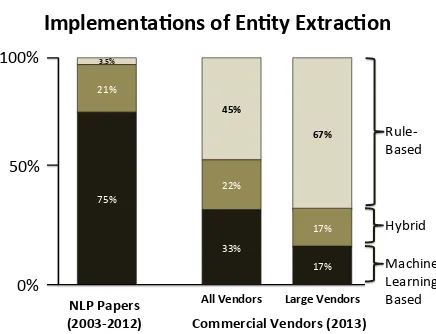
Figure 1: Fraction of NLP conference papers from EMNLP, ACL, and NAACL over 10 years that use ma-chine learning versus rule-based techniques to perform entity extraction over text (left); the same breakdown for commercial entity extraction vendors one year after the end of this 10-year period (right). The rule-based ap-proach, although largely ignored in the research commu-nity, dominates the commercial market.
rule-based, purely machine learning-based, or a hy-brid of the two. We focus on entity extraction, as it is a classical IE task, and most industrial IE systems offer this feature.
The left side of the graph shows the breakdown of research papers according to this categorization. Only six papers relied solely on rules to perform the extraction tasks described. The remainder relied en-tirely or substantially on statistical techniques. As shown in Figure 2, these fractions were roughly con-stant across the 10-year period studied, indicating that attitudes regarding the relative importance of the different techniques have remained constant.
We found that distinguishing “hybrid” systems
En@ty*Extrac@on*Papers*by*Year*
0%$ 25%$ 50%$ 75%$ 100%$
Year$of$PublicaAon$
Fr
ac
Ao
n$
of
$N
LP
$P
ap
er
s$
Hybrid$
Machine$ Learning$ Based$
[image:2.612.75.294.90.231.2]Rule,$ Based$
Figure 2: The conference paper data (left-hand bar) from Figure 1, broken down by year of publication. The rel-ative fractions of the three different techniques have not changed significantly over time.
from pure machine learning systems was quite chal-lenging. The papers that use a mixture of rule-based and machine learning techniques were gener-ally written so as to obfuscate the use of rules, em-phasizing the machine learning aspect of the work. Authors hid rules behind euphemisms such as “de-pendency restrictions” (Mausam et al., 2012), “en-tity type constraints” (Yao et al., 2011), or “seed dic-tionaries” (Putthividhya and Hu, 2011).
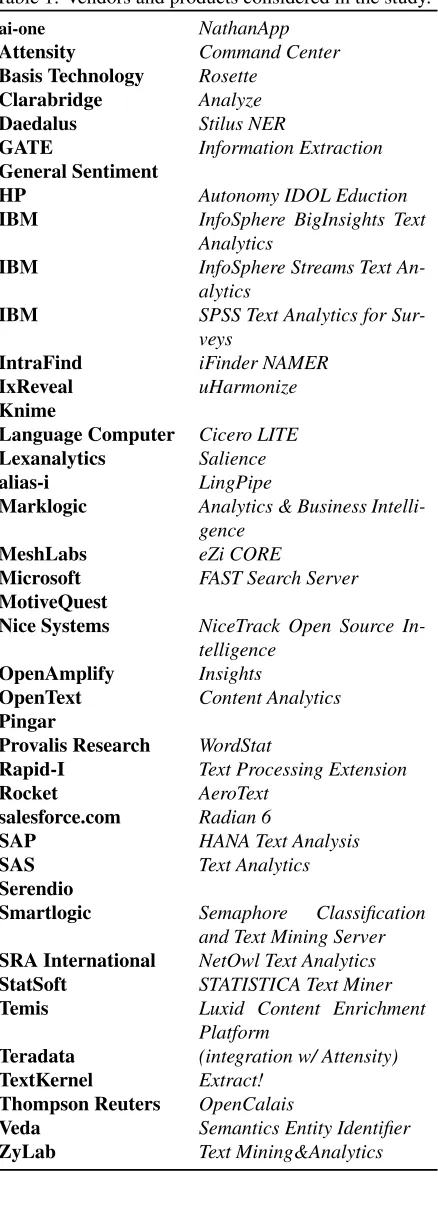
In the commercial world, the situation is largely reversed. The right side of Figure 1 shows the result of a parallel survey of commercial entity extraction products from 54 different vendors listed in (Yuen and Koehler-Kruener, 2012). We studied analyst reports and product literature, then classified each product according to the same three categories. Ta-ble 1 shows the 41 products considered in the study
1. We conducted this industry survey in 2013, one
year after the ten-year run of NLP papers we stud-ied. One would expect the industrial landscape to reflect the research efforts of the previous 10 years, as mature technology moved from academia to in-dustry. Instead, results of this second survey showed the opposite effect, with rule-based systems com-prising the largest fraction of those surveyed. Only 1/3 of the vendors relied entirely on machine learn-ing. Among public companies and private
compa-1Other products do not offer entity extraction, or we did not
find sufficient evidence to classify the technology.
Table 1: Vendors and products considered in the study.
ai-one NathanApp
Attensity Command Center
Basis Technology Rosette
Clarabridge Analyze
Daedalus Stilus NER
GATE Information Extraction
General Sentiment
HP Autonomy IDOL Eduction
IBM InfoSphere BigInsights Text
Analytics
IBM InfoSphere Streams Text
An-alytics
IBM SPSS Text Analytics for Sur-veys
IntraFind iFinder NAMER
IxReveal uHarmonize
Knime
Language Computer Cicero LITE
Lexanalytics Salience
alias-i LingPipe
Marklogic Analytics & Business
Intelli-gence
MeshLabs eZi CORE
Microsoft FAST Search Server
MotiveQuest
Nice Systems NiceTrack Open Source
In-telligence
OpenAmplify Insights
OpenText Content Analytics
Pingar
Provalis Research WordStat
Rapid-I Text Processing Extension
Rocket AeroText
salesforce.com Radian 6
SAP HANA Text Analysis
SAS Text Analytics
Serendio
Smartlogic Semaphore Classification
and Text Mining Server
SRA International NetOwl Text Analytics
StatSoft STATISTICA Text Miner
Temis Luxid Content Enrichment
Platform
Teradata (integration w/ Attensity)
TextKernel Extract!
Thompson Reuters OpenCalais
Veda Semantics Entity Identifier
[image:2.612.320.539.99.702.2]Table 2: Pros and Cons
Pros Cons
Rule-based
•Declarative •Heuristic •Easy to comprehend •Requires tedious •Easy to maintain manual labor •Easy to incorporate
domain knowledge •Easy to trace and fix
the cause of errors
ML-based
•Trainable •Requires labeled data •Adaptable •Requires retraining •Reduces manual for domain adaptation
effort •Requires ML expertise to use or maintain •Opaque
nies with more than $100 million in revenue, the sit-uation is even more skewed towards rule-based sys-tems, with large vendors such as IBM, SAP, and Mi-crosoft being completely rule-based.
2 Explaining the Disconnect
What is the source of this disconnect between re-search and industry? There does not appear to be a lack of interaction between the two communities. Indeed, many of the smaller companies we surveyed were founded by NLP researchers, and many of the larger vendors actively publish in the NLP literature. We believe that the disconnect arises from a differ-ence in how the two communities measure the costs and benefits of information extraction.
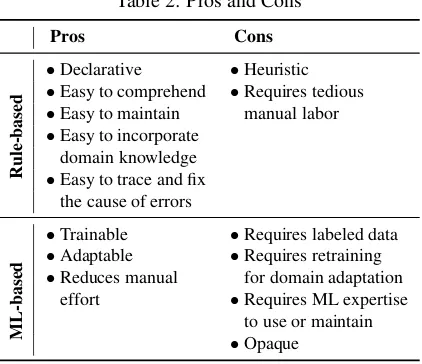
Table 2 summarizes the pros and cons of machine learning (ML) and rule-based IE technologies (Atz-mueller and Kluegl, 2008; Grimes, 2011; Leung et al., 2011; Feldman and Rosenfeld, 2006; Guo et al., 2006; Krishnan et al., 2005; Yakushiji et al., 2006; Kluegl et al., 2009). On the surface, both academia and commercial vendors acknowledge es-sentially the same pros and cons for the two ap-proaches. However, the two communities weight the pros and cons significantly differently, leading to the drastic disconnect in Figure 1.
Evaluating the benefits of IE. Academic papers
evaluate IE performance in terms of precision and recall over standard labeled data sets. This simple, clean, and objective measure is useful for judging competitions, but the reality of the business world is
much more fluid and less well-defined.
In a business context, definitions of even basic en-tities like “product” and “revenue” vary widely from one company to another. Within any of these ill-defined categories, some entities are more important to get right than others. For example, in electronic legal discovery, correctly identifying names of ex-ecutives is much more important than finding other types of person names.
In real-world applications, the output of extrac-tion is often the input to a larger process, and it is the quality of the larger process that drives busi-ness value. This quality may derive from an aspect of extracted output that is only loosely correlated with overall precision and recall. For example, does extracted sentiment, when broken down and aggre-gated by product, produce an unbiased estimate of average sentiment polarity for each product?
To be useful in a business context, IE must func-tion well with metrics that are ill-defined and sub-ject to change. ML-based IE models, which require a careful up-front definition of the IE task, are poor fit for these metrics. The commercial world greatly values rule-based IE for its interpretability, which makes IE programs easier to adopt, understand, de-bug, and maintain in the face of changing require-ments (Kluegl et al., 2009; Atzmueller and Kluegl, 2008). Furthermore, rule-based IE programs are val-ued for allowing one to easily incorporate domain knowledge, which is essential for targeting specific business problems (Grimes, 2011). As an example, an application may pose simple requirements to its entity recognition component to output only full per-son names, and not include salutation. With a rule-based system, such a requirement translates to re-moving a few rules. On the other hand, a ML-based approach requires a complete retrain.
Evaluating the costs of IE. In a business setting,
the most significant costs of using information ex-traction are thelabor costof developing or adapting extractors for a particular business problem, and the
hardware costof compute resources required by the
system.
point out in the next section, they motivate a research effort to build better languages and tools.
But there is a strong tendency in the NLP lit-erature to ignore the complex and time-consuming tasks inherent in solving an extraction problem using machine learning. These tasks include: defining the business problem to be solved in strict mathematical terms; understanding the tradeoffs between different types of models in the context of the NLP task def-inition; performing feature engineering based on a solid working understanding of the chosen model; and gathering extensive labeled data — far more than is needed to measure precision and recall — often through clever automation.
All these steps are time-consuming; even highly-qualified workers with postgraduate degrees rou-tinely fail to execute them effectively. Not sur-prisingly, in industry, ML-based systems are often deemed risky to adopt and difficult to understand and maintain, largely due to model opaqueness (Fry, 2011; Wagstaff, 2012; Malioutov and Varshney, 2013). The infeasibility of gathering labeled data in many real-world scenarios further increases the risk of committing to a ML-based solution.
A measure of the system’s scalability and run-time efficiency, hardware costs are a function of two metrics: throughput and memory footprint. These figures, while extremely important for commercial vendors, are typically not reported in NLP litera-ture. Nevertheless, our experience in practice sug-gests that ML-based approaches are much slower, and require more memory compared to rule-based approaches, whose throughput can be in the order of MB/second/core for complex extraction tasks like NER (Chiticariu et al., 2010).
The other explanation.Finally, we believe that the
most notable reason behind the academic commu-nity’s steering away from rule-based IE systems is the (false) perception of lack of research problems. The general attitude is one of“What’s the research in rule-based IE? Just go ahead and write the rules.”
as indicated by anecdotal evidence and only implic-itly stated in the literature, where any usage of rules is significantly underplayed as explained earlier. In the next section, we strive to debunk this perception.
3 Bridging the Gap
As NLP researchers who also work regularly with business customers, we have become increasingly worried about the gap in perception between infor-mation extraction research and industry. The recent growth of Big Data analytics has turned IE into big business (Mendel, 2013). If current trends continue, the business world will move ahead with unprinci-pled, ad-hoc solutions to customers’ business prob-lems, while researchers pursue ever more complex and impractical statistical approaches that become increasingly irrelevant. Eventually, the gap between research and practice will become insurmountable, an outcome in neither community’s best interest.
The academic NLP community needs to stop treating rule-based IE as a dead-end technology. As discussed in Section 2, the domination of rule-based IE systems in the industry is well-justified. Even in their current form, with ad-hoc solutions built on techniques from the early 1980’s, rule-based sys-tems serve the industry needs better than the lat-est ML techniques. Nonetheless, there is an enor-mous untapped opportunity for researchers to make the rule-based approach more principled, effective, and efficient. In the remainder of this section, we lay out a research agenda centered around captur-ing this opportunity. Specifically, takcaptur-ing a systemic approach to rule-based IE, one can identify a set of research problems by separating rule development and deployment. In particular, we believe research should focus on: (a) data models and rule language, (b) systems research in rule evaluation and (c) ma-chine learning research for learning problems in this richer target language.
Define standard IE rule language and data
model. If research on rule-based IE is to move
forward in a principled way, the community needs a standard way to express rules. We believe that the NLP community can replicate the success of the SQL language in connecting data management research and practice. SQL has been successful largely due to: (1) expressivity: the language pro-vides all primitives required for performing basic manipulation of structured data, (2)extensibility: the language can be extended with new features without fundamental changes to the language, (3)
com-putation logic without describing its control flow, thus allowing developers to codewhatthe program should accomplish, rather thanhowto accomplish it. An earlier attempt in late 1980’s to formal-ize a rule language resulted in the Common Pat-tern Specification Language (CPSL) (Appelt and Onyshkevych, 1998). While CPSL did not suc-ceed due to multiple drawbacks, including expres-sivity limitations, performance limitations, and its lack of support for core operations such as part of speech (Chiticariu et al., 2010), CPSL did gain some traction, e.g., it powers the JAPE language of the GATE open-source NLP system (Cunningham et al., 2011). Meanwhile, a number of declarative IE lan-guages developed in the database community, in-cluding AQL (Chiticariu et al., 2010; Li et al., 2011), xLog (Shen et al., 2007), and SQL extensions (Wang et al., 2010; Jain et al., 2009), have shown that for-malisms of rule-based IE systems are possible, as exemplified by (Fagin et al., 2013). However, they largely remain unknown in the NLP community.
We believe now is the right time to establish a standard IE rule language, drawing from existing proposals and experience over the past 30 years. To-wards this goal, IE researchers need to answer the following questions: What is the right data model to capture text, annotations over text, and their proper-ties? Can we establish a standard declarative exten-sible rule language for processing data in this model with a clear set of constructs that is sufficiently ex-pressive to solve most IE tasks encountered so far?
Systems research based on standard IE rule
lan-guage. Standard IE data model and language
en-ables the development of systems implementing the standard. One may again wonder,“Where is the
re-search in that?”As in the database community,
ini-tial research should focus on systemic issues such as data representation and speeding up rule evalua-tion via automatic performance optimizaevalua-tion. Once baseline systems are established, system-related re-search would naturally diverge in several directions, such as extending the language with new primitives (and corresponding optimizations), and exploring modern hardware.
ML research based on standard IE rule language.
A standard rule language and corresponding execu-tion engine enables researchers to use the standard language as the expressivity of the output model,
and define learning problems for this target lan-guage, including learning basic primitives such as regular expressions and dictionaries, or complete rule sets. (One need not worry about choosing the language, nor runtime efficiency.) With an expres-sive rule language, a major challenge is to prevent the system from generating arbitrarily complex rule sets, which would be difficult to understand or main-tain. Some interesting research directions include devising proper measures for rule complexity, con-straining the search space such that the learnt rules closely resemble those written by humans, active learning techniques to cope with scarcity of labeled data, and visualization tools to assist rule develop-ers in exploring and choosing between different au-tomatically generated rules. Finally, it is conceiv-able that some problems will not fit in the target language, and therefore will need alternative solu-tions. However, the community would have shown – objectively – that the problem is not learnable with the available set of constructs, thus motivating follow-on research on extending the standard with new primitives, if possible, or developing novel hy-brid IE solutions by leveraging the standard IE rule language together with ML technology.
4 Conclusion
While rule-based IE dominates the commercial world, it is widely considered obsolete by the academia. We made a case for the importance of rule-based approaches to industry practitioners. Drawing inspiration from the success of SQL and the database community, we proposed directions for addressing the disconnect. Specifically, we call for the standardization of an IE rule language and outline an ambitious research agenda for NLP re-searchers who wish to tackle research problems of wide interest and value in the industry.
Acknowledgments
References
Douglas E. Appelt and Boyan Onyshkevych. 1998. The Common Pattern Specification Language. In Proceed-ings of a workshop held at Baltimore, Maryland: Oc-tober 13-15, 1998, TIPSTER ’98, pages 23–30. Martin Atzmueller and Peter Kluegl. 2008. Rule-Based
Information Extraction for Structured Data Acquisi-tion using TextMarker. InLWA.
Laura Chiticariu, Rajasekar Krishnamurthy, Yunyao Li, Sriram Raghavan, Frederick Reiss, and Shivakumar Vaithyanathan. 2010. SystemT: An Algebraic Ap-proach to Declarative Information Extraction. InACL. Hamish Cunningham, Diana Maynard, Kalina Bontcheva, Valentin Tablan, Niraj Aswani, Ian Roberts, Genevieve Gorrell, Adam Funk, An-gus Roberts, Danica Damljanovic, Thomas Heitz, Mark A. Greenwood, Horacio Saggion, Johann Petrak, Yaoyong Li, and Wim Peters. 2011. Text Processing with GATE (Version 6), Chapter 8: JAPE: Regular Expressions over Annotations.
Ronald Fagin, Benny Kimelfeld, Frederick Reiss, and Stijn Vansummeren. 2013. Spanners: a formal frame-work for information extraction. InPODS.
Ronen Feldman and Benjamin Rosenfeld. 2006. Boost-ing Unsupervised Relation Extraction by UsBoost-ing NER. InEMNLP, pages 473–481.
C. Fry. 2011. Closing the Gap between Analytics and Action. INFORMS Analytics Mag., 4(6):405.
Seth Grimes. 2011. Text/Content Analyt-ics 2011: User Perspectives on Solutions.
http://www.medallia.com/resources/item/
text-analytics-market-study/.
Hong Lei Guo, Li Zhang, and Zhong Su. 2006. Empirical study on the performance stability of named entity recognition model across domains.
InEMNLP, pages 509–516.
Alpa Jain, Panagiotis Ipeirotis, and Luis Gravano. 2009. Building query optimizers for information extraction: the sqout project. SIGMOD Record, 37(4):28–34.
Peter Kluegl, Martin Atzmueller, and Frank Puppe. 2009. TextMarker: A Tool for Rule-Based Infor-mation Extraction. In UIMA@GSCL Workshop, pages 233–240.
Vijay Krishnan, Sujatha Das, and Soumen Chakrabarti. 2005. Enhanced answer type inference from questions using sequential mod-els. InHLT, pages 315–322.
Cane Wing-ki Leung, Jing Jiang, Kian Ming A. Chai, Hai Leong Chieu, and Loo-Nin Teow.
2011. Unsupervised Information Extraction with Distributional Prior Knowledge. In EMNLP, pages 814–824.
Yunyao Li, Frederick Reiss, and Laura Chiticariu. 2011. Systemt: A declarative information extrac-tion system. InACL.
Dmitry M. Malioutov and Kush R. Varshney. 2013. Exact rule learning via boolean compressed sens-ing. InICML.
Mausam, Michael Schmitz, Stephen Soderland, Robert Bart, and Oren Etzioni. 2012. Open Lan-guage Learning for Information Extraction. In
EMNLP-CoNLL, pages 523–534.
Thomas Mendel. 2013. Business Intelligence and Big Data Trends 2013. http://www.hfsresearch.com/
Business-Intelligence-and-Big-Data-Trends-2013
(accessed March 28th, 2013).
Duangmanee Putthividhya and Junling Hu. 2011. Bootstrapped Named Entity Recognition for Product Attribute Extraction. InEMNLP, pages 1557–1567.
Warren Shen, AnHai Doan, Jeffrey F. Naughton, and Raghu Ramakrishnan. 2007. Declarative Infor-mation Extraction Using Datalog with Embedded Extraction Predicates. In VLDB, pages 1033– 1044.
Kiri Wagstaff. 2012. Machine learning that matters. InICML.
Daisy Zhe Wang, Eirinaios Michelakis, Michael J. Franklin, Minos N. Garofalakis, and Joseph M. Hellerstein. 2010. Probabilistic Declarative In-formation Extraction. InICDE.
Akane Yakushiji, Yusuke Miyao, Tomoko Ohta, Yuka Tateisi, and Jun’ichi Tsujii. 2006. Auto-matic construction of predicate-argument struc-ture patterns for biomedical information extrac-tion. InEMNLP, pages 284–292.
Limin Yao, Aria Haghighi, Sebastian Riedel, and Andrew McCallum. 2011. Structured Relation Discovery using Generative Models. InEMNLP, pages 1456–1466.