Multi-domain Adaptation for SMT Using Multi-task Learning
∗Lei Cui1,Xilun Chen2,Dongdong Zhang3,Shujie Liu3,Mu Li3, andMing Zhou3
1Harbin Institute of Technology, Harbin, P.R. China
2Cornell University, Ithaca, NY, U.S.
3Microsoft Research Asia, Beijing, P.R. China
{dozhang,shujliu,muli,mingzhou}@microsoft.com
Abstract
Domain adaptation for SMT usually adapts models to an individual specific domain. However, it often lacks some correlation among different domains where common knowledge could be shared to improve the overall translation quality. In this paper, we propose a novel multi-domain adaptation ap-proach for SMT using Multi-Task Learning (MTL), with in-domain models tailored for each specific domain and a general-domain model shared by different domains. The pa-rameters of these models are tuned jointly via MTL so that they can learn general knowledge more accurately and exploit domain knowl-edge better. Our experiments on a large-scale English-to-Chinese translation task val-idate that the MTL-based adaptation approach significantly and consistently improves the translation quality compared to a non-adapted baseline. Furthermore, it also outperforms the individual adaptation of each specific domain.
1 Introduction
Domain adaptation is an active topic in statisti-cal machine learning and aims to alleviate the do-main mismatch between training and testing data. Like many machine learning tasks, Statistical Ma-chine Translation (SMT) assumes that the data dis-tributions of training and testing domains are sim-ilar. However, this assumption does not hold for real world SMT systems since training data for SMT models may come from a variety of domains. The translation quality is often unsatisfactory when
∗
This work was done while the first and second authors were visiting Microsoft Research Asia.
translating texts from a specific domain using a gen-eral model that is trained over a hotchpotch of bilin-gual corpora. Therefore, domain adaptation is cru-cial for SMT systems to achieve better performance. Previous research on domain adaptation for SMT includes data selection and weighting (Eck et al., 2004; L¨u et al., 2007; Foster et al., 2010; Moore and Lewis, 2010; Axelrod et al., 2011), mixture mod-els (Foster and Kuhn, 2007; Koehn and Schroeder, 2007; Sennrich, 2012; Razmara et al., 2012), and semi-supervised transductive learning (Ueffing et al., 2007), etc. Most of these methods adapt SMT models to a specific domain according to testing data and have achieved good performance. It is natural that real world SMT systems should adapt the mod-els to multiple domains because the input may be heterogeneous, so that the overall translation qual-ity can be improved. Although we can easily ap-ply these methods to multiple domains individually, it is difficult to use the common knowledge across different domains. To leverage the common knowl-edge, we need to devise a multi-domain adaptation approach that jointly adapts the SMT models.
Multi-domain adaptation has been proved quite effective in sentiment analysis (Dredze and Cram-mer, 2008) and web ranking (Chapelle et al., 2011), where the commonalities and differences across multiple domains are explicitly addressed by Multi-task Learning (MTL). MTL is an approach that learns one target problem with other related prob-lems at the same time, using a shared feature repre-sentation. The key advantage of MTL is to enable implicit data sharing and regularization. Therefore, it often leads to a better model for each task. Anal-ogously, we expect that the overall translation qual-ity can be further improved by using an MTL-based
TM1
S1 S2 S3
Multiple In-domain Translation Models & Language Models
One General-domain Translation Model & Language Model T1
LM1
TM2 LM2
TM3 LM3
Domain-specific SMT Systems In-domain
Training Data T2 T3
T
MTL-based Tuning
Entire Training Data
TM-G LM-G TMN
LMN TN
SN
...
... ...
[image:2.612.134.504.65.260.2]...
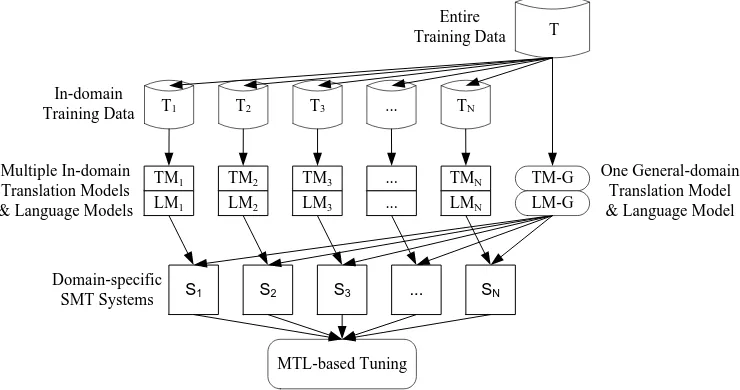
Figure 1: An example withNpre-defined domains, whereTis the entire training corpus.Tiis the in-domain training
data for thei-th domain selected fromT using the bilingual cross-entropy based method (Axelrod et al., 2011). The in-domain TMiand LMiare trained using the in-domain training dataTi. The general-domain models TM-G and
LM-G are trained using the entire training corpusT.Siis the domain-specific SMT system for thei-th domain, leveraging
the in-domain models and the general-domain models as features.
multi-domain adaptation approach.
In this paper, we use MTL to jointly adapt SMT models to multiple domains. Specifically, we de-velop multiple SMT systems based on mixture mod-els, where each system is tailored for one specific domain with an in-domain Translation Model (TM) and an in-domain Language Model (LM). Mean-while, all the systems share a same general-domain TM and LM. These SMT systems are considered as several related tasks with a shared feature represen-tation, which fits well into a unified MTL frame-work. With the MTL-based joint tuning, general knowledge can be better learned by the general-domain models, while general-domain knowledge can be better exploited by the in-domain models as well. By using a distributed stochastic learning approach (Simianer et al., 2012), we can estimate the fea-ture weights of multiple SMT systems at the same time. Furthermore, we modify the algorithm to treat in-domain and general-domain features separately, which brings regularization to multiple SMT sys-tems in an efficient way. Experimental results have shown that our method can significantly improve the translation quality on multiple domains over a non-adapted baseline. Moreover, the MTL-based adap-tation also outperforms the conventional individual
adaptation approach towards each domain.
The rest of the paper is organized as follows: The proposed approach is explained in Section 2. Exper-imental results are presented in Section 3. Section 4 introduces some related work. Section 5 concludes the paper and suggests future research directions.
2 The Proposed Approach
Figure 1 gives an example with N pre-defined do-mains to illustrate the main idea. There are three steps in the training phase. First, in-domain train-ing data is selected accordtrain-ing to the pre-defined do-mains (Section 2.1). Second, in-domain models and general-domain models are trained to develop the domain-specific SMT systems (Section 2.2). Third, multiple domain-specific SMT systems are tuned jointly by using an MTL-based approach (Section 2.3).
2.1 In-domain Data Selection
In the first step, in-domain bilingual data is selected from all the bilingual data to train in-domain TMs. We use the bilingual cross-entropy based approach (Axelrod et al., 2011) to obtain the in-domain data:
where{s,t}is a bilingual sentence pair in the entire bilingual corpus. HI−xxx(·) and HG−xxx(·) repre-sent the cross-entropy of a string according to an in-domain LM and a general-in-domain LM, respectively. ”xxx” denotes either the source language (src) or the target language (tgt).HI−src(s)−HG−src(s)is the cross-entropy difference of stringsbetween the in-domain and general-in-domain source-side LMs, and
HI−tgt(t)−HG−tgt(t) is the cross-entropy differ-ence of stringtbetween the in-domain and general-domain target-side LMs. This criterion biases to-wards sentence pairs that are like the in-domain cor-pus but unlike the general-domain corcor-pus. There-fore, the sentence pairs with lower scores (larger dif-ferences) are presumed to be better.
Now, the question is how to find sufficient mono-lingual data to train in-domain LMs. A straight-forward solution is to collect the data from the in-ternet. There are a large number of monolingual webpages with domain information from web por-tal sites1, which can be collected to train in-domain LMs. In large-scale real world SMT systems, practi-cal domain adaptation techniques should target more domains rather than just one due to heterogeneous input. Therefore, we use a web crawler to collect monolingual webpages ofNdomains from web por-tal sites, for both the source language and the tar-get language. The statistics of web-crawled data is given in Section 3.1. We use the web-crawled mono-lingual documents to trainN in-domain source-side LMs andN in-domain target-side LMs. Addition-ally, we also train the source-side and target-side general-domain LMs with all the web-crawled doc-uments from different domains. Finally, these in-domain and general-in-domain LMs are used to select in-domain bilingual data for different domains ac-cording to Formula (1).
2.2 SMT Systems with Mixture Models
In the second step, with the selected in-domain train-ing data, we develop SMT systems based on mix-ture models. In particular, we use the mixmix-ture model based approach proposed by Koehn and Schroeder
1
Many web portal sites contain domain information for webpages, such as ”www.yahoo.com” in English and ”www.sina.com.cn” in Chinese and etc. The webpages are of-ten categorized by human editors into different domains, such as politics, sports, business, etc.
(2007). Specifically, we have developed N SMT systems for N domains respectively, where each system is a typical log-linear model. For each sys-tem, the best translation candidatefˆis given by:
ˆ
f = arg max
f
{P(f|e)} (2)
where the translation probabilityP(f|e)is given by:
P(f|e)∝X
i
wi·logφi(f, e)
=X
j∈I
wj·logφj(f, e)
| {z }
In-domain
+X
k∈G
wk·logφk(f, e)
| {z }
General domain (3)
whereφj(f, e)is the in-domain feature function and
wj is the corresponding feature weight. φk(f, e)is the general-domain feature function and wk is the feature weight. The detailed feature description is as follows:
In-domain features
• An in-domain TM, including phrase translation probabilities and lexical weights for both direc-tions (4 features)
• An in-domain target-side LM (1 feature)
• word count (1 feature)
• phrase count (1 feature)
• NULL penalty (1 feature)
• Number of hierarchical rules used (1 feature)
General-domain features
• A general-domain TM, including phrase trans-lation probabilities and lexical weights for both directions (4 features)
• A general-domain target-side LM (1 feature)
for data selection (Section 2.1). Compared with a normal single-model system, the system with mix-ture models can balance the contributions from the general-domain and in-domain knowledge. Hence it potentially benefits from both.
2.3 MTL-based Tuning
In the third step, the feature weights in multiple domain-specific SMT systems are estimated. In-stead of tuning each domain-specific system sepa-rately, we treat different systems as related tasks and tune them jointly in an MTL framework. There are two main reasons for MTL-based tuning:
1. Domain-specific translation tasks share the same general-domain LM and TM. MTL often leads to better performance by leveraging com-monalities among different tasks.
2. By enforcing that the general-domain LM and TM perform equally across different domains, MTL provides a kind of regularization to pre-vent over-fitting.
Formally, the objective function of the proposed MTL-based approach is described as follows:
min
W
( N X
i=1
Loss(Ei,ˆe(Fi,wi)) )
(4)
where N is the number of pre-defined domains.
{Fi,Ei}is the in-domain development dataset for the
i-th domain.Fidenotes the source sentences andEi denotes the reference translations. wiis aD-length feature weight column vector for the i-th domain, whereDis the dimension of the feature space.Wis a N-by-D matrix, representing [w1|w2|. . .|wN]T.
ˆ
e(Fi,wi) are the best translations obtained for Fi with parameters wi. Loss(·,·) denotes the loss be-tween the system’s output and the reference trans-lations. The basic idea of the objective function is to minimize the sum of loss functions for all the do-mains, rather than one domain at a time. Therefore, by adjusting the in-domain and general-domain fea-ture weights, the translation quality is expected to be good across different domains.
To effectively tune SMT systems jointly, we mod-ify the asynchronous Stochastic Gradient Descend (SGD) Algorithm (Simianer et al., 2012) to optimize
objective function (4). We follow the pairwise rank-ing approach with the perceptron algorithm (Shen and Joshi, 2005) to update feature weights. Let a translation candidate be denoted by its feature vector
v∈RD, the pairwise preference for training is con-structed by ranking two candidates according to the smoothed sentence-level BLEU (Liang et al., 2006). For a preference pairv[j]=(v(1),v(2)) where v(1) is preferred, a hinge loss is used:
L(wi) = (−hwi,v(1)−v(2)i)+ (5)
where(x)+ = max(0, x) andh·,·i denotes the
in-ner product of two vectors. With the perceptron al-gorithm (Shen and Joshi, 2005), the gradient of the hinge loss is:
∇L(wi) = (
v(2)−v(1) ifhw
i,v(1)−v(2)i ≤0
0 otherwise (6)
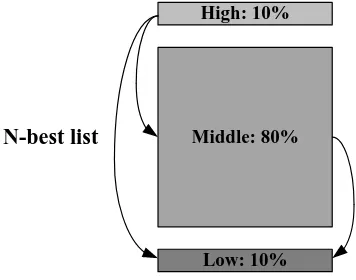
The training instances for the discriminative learning in pairwise ranking are made by comparing the N-best list of the translation candidates scored by the smoothed sentence-level BLEU (Liang et al., 2006). Following Simianer et al. (2012), the N-best list is divided into three bins: the top 10% (High), the middle 80% (Middle), and the last 10% (Low). These bins are used for pairwise ranking where the translation preference pairs are built between the candidates in Middle, Middle-Low, and High-Low, but not the candidates within the same bin, which is shown in Figure 2. The idea is to guar-antee that the ranker is more discriminative to prefer the good translations to the bad ones.
High: 10%
Middle: 80%
[image:4.612.342.520.533.673.2]Low: 10% N-best list
Algorithm 1Modified Asynchronous SGD
1: Distribute N domain-specific decoders to N ma-chines
2: Initializew1,w2, . . . ,wN ←0
3: for epochst←0. . . T−1do
4: for all domainsd∈ {1. . . N}:parallel do 5: ud,t,0,0=wd
6: S=|Fd|
7: for alli∈ {0. . . S−1}do
8: Decodei-th sentence withud,t,i,0 9: P = No. of pairs built from the N-best list 10: for all pairs v[j], j∈ {0. . . P−1}do 11: ud,t,i,j+1←ud,t,i,j−η∇L(ud,t,i,j)
12: end for
13: ud,t,i+1,0←ud,t,i,P
14: end for 15: end for
16: for all domainsd∈ {1. . . N}do 17: wd=ud,t,S,0
18: end for 19: WG←[wG
1|. . .|wGN]T
20: for all domainsd∈ {1. . . N}do 21: fork←1. . .|wG
d|do
22: wG
d[k] =
1
N PN
n=1W
G[n][k]
23: end for
24: wd←
wId wG d
25: end for 26: end for
27: return w1,w2, . . . ,wN
Our modified algorithm is illustrated in Algorithm 1. Each column vector wi is further split into two parts wIi and wGi , representing the In-domain and
General-domain feature weights respectively. In Al-gorithm 1, we first distribute the domain-specific SMT decoders to different machines and initialize the feature weights (line 1-2). Typically, the SGD al-gorithm runs in several iterations (In this study, we set the number of epochsT to 20) (line 3). Multi-ple SMT decoders run in parallel and each decoder updates its feature weights individually using its in-domain development data (line 4-15). For each do-main, the domain-specific decoder translates each in-domain development sentence and determines the N-best translations (line 4-8). The preference pairs are built and used to update the parameters by gra-dient descent with η = 0.0001 (line 9-13). Each domain-specific decoder translates its in-domain de-velopment data multiple times. After each itera-tion, feature weights from all decoders are collected
(line 16-19). In contrast to the original algorithm (Simianer et al., 2012), we only average the general-domain feature weightswG1, . . . ,wGN, but do not av-erage the in-domain feature weights (line 20-25). The reason is we hope to leverage the commonalities among these systems. Meanwhile, general knowl-edge is enforced to be conveyed equally across dif-ferent domains. Finally, the algorithm returns all the domain-specific feature weightsw1,w2, . . . ,wN that are used for testing (line 27).
After the joint MTL-based tuning, the feature weights tailored for domain-specific SMT systems are used to translate the testing data. We collect in-domain testing data for each in-domain to evaluate the domain-specific systems. Although this is not al-ways the case in real applications where the testing domain is known, this study mainly focuses on the effectiveness of the MTL-based tuning approach.
3 Experiments
3.1 Data
We evaluated our MTL-based domain adaptation approach on a large-scale English-to-Chinese ma-chine translation task. The training data consisted of two parts: monolingual data and bilingual data. The monolingual data was used to train the source-side and target-source-side LMs, both of which were used for data selection in Section 2.1. In addition, the target-side LMs were re-used in the SMT systems as features. As mentioned in Section 2.1, we built a web crawler to collect a large number of webpages from web portal sites in English and Chinese respec-tively. In the experiments, we mainly focused on six popular domains, namely Business, Entertainment, Health, Science & Technology, Sports, and Politics. For both English and Chinese webpages, the HTML tags were removed and the main content was ex-tracted. The data statistics are shown in Table 1.
The bilingual data we used was mainly mined from the web using the method proposed by Jiang et al. (2009), with a post-processing step using our bilingual data cleaning method (Cui et al., 2013). Therefore, the data quality is pretty good. In addi-tion, we also used the English-Chinese parallel cor-pus released by LDC2. In total, the bilingual data
Domain English Chinese Docs Words Docs Words Business 21M 10.4B 7.91M 2.73B Ent. 18.3M 8.29B 4.16M 1.31B Health 8.7M 4.73B 0.9M 0.42B Sci&Tech 10.9M 5.33B 5.28M 1.6B Sports 18.9M 9.58B 2.49M 0.59B Politics 10.3M 5.56B 1.67M 0.39B
Table 1: Statistics of web-crawled monolingual data, in numbers of documents and words (main content). ”M” refers to million and ”B” refers to billion.
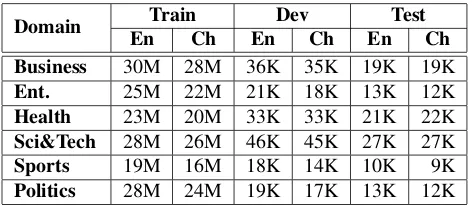
contained around 30 million sentence pairs, with 404M words in English and 329M words in Chi-nese. For each domain, we used the cross-entropy based method in Section 2.1 to rank the entire bilin-gual data, and the top 10% sentence pairs from the ranked bilingual data were selected as the in-domain data to train the in-domain TM. Moreover, we pre-pared 2,000 in-domain sentences for development and 1,000 in-domain sentences for testing in each domain. The details are shown in Table 2.
Domain Train Dev Test En Ch En Ch En Ch
[image:6.612.71.307.374.477.2]Business 30M 28M 36K 35K 19K 19K Ent. 25M 22M 21K 18K 13K 12K Health 23M 20M 33K 33K 21K 22K Sci&Tech 28M 26M 46K 45K 27K 27K Sports 19M 16M 18K 14K 10K 9K Politics 28M 24M 19K 17K 13K 12K
Table 2: Statistics of in-domain training, development and testing data, in number of words.
3.2 Setup
An in-house hierarchical phrase-based SMT de-coder was implemented for our experiments. The CKY decoding algorithm was used and cube prun-ing was performed with the same default parameter settings as in Chiang (2007). We used a 100-best list from the decoder for the pairwise ranking al-gorithm. Translation models were trained over the bilingual data that was automatically word-aligned using GIZA++ (Och and Ney, 2003) in both direc-tions, and the diag-grow-final heuristic was used to
LDC2006E34, LDC2006E85, LDC2006E92.
refine the symmetric word alignment. The phrase tables were filtered to retain top-20 translation can-didates for each source phrase for efficiency. An in-house language modeling toolkit was used to train the 4-gram language models with modified Kneser-Ney smoothing (Kneser and Ney, 1995) over the web-crawled data. The evaluation metric for the overall translation quality was case-insensitive BLEU4 (Papineni et al., 2002). A statistical sig-nificance test was performed using the bootstrap re-sampling method (Koehn, 2004).
3.3 Baseline
We have two baselines. The first baseline is a non-adapted Hiero using our implementation. It con-tained the general-domain TM and LM, as well as other standard features. In addition, the fix-discount method (Foster et al., 2006) for phrase table smooth-ing was also used. The system was general-domain oriented and it was tuned by using MERT (Och, 2003) with a combination of six in-domain develop-ment datasets. The second baseline is Google Online Translation Service3. We obtained the English-to-Chinese translations of the testing data from Google Translation to have a more solid comparison.
Moreover, we also compared our method with the adapted systems towards each domain individually (Koehn and Schroeder, 2007). This is to demon-strate the superiority of our MTL-based tuning ap-proach across different domains.
3.4 Results
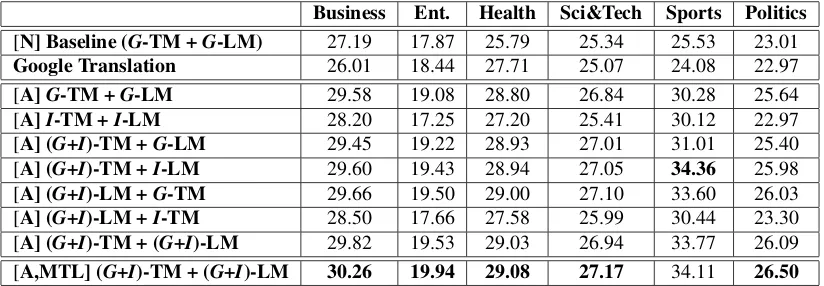
The end-to-end translation performance is shown in Table 3. We found that the baseline has a similar performance to Google Translation, with certain do-mains performed even better (Business, Sci&Tech, Sports, Politics). This demonstrates that the transla-tion quality of our baseline is state-of-the-art. More-over, we can answer three questions according to the experimental results as follow:
First, is domain mismatch a significant prob-lem for a real world SMT system? We used the same system only with general-domain TM and LM, but tuned towards each domain individually using in-domain dev data. Table 3 shows that the setting ”[A] G-TM + G-LM” performs much better than
3
Business Ent. Health Sci&Tech Sports Politics
[N] Baseline (G-TM +G-LM) 27.19 17.87 25.79 25.34 25.53 23.01 Google Translation 26.01 18.44 27.71 25.07 24.08 22.97
[image:7.612.101.513.60.203.2][A]G-TM +G-LM 29.58 19.08 28.80 26.84 30.28 25.64 [A]I-TM +I-LM 28.20 17.25 27.20 25.41 30.12 22.97 [A] (G+I)-TM +G-LM 29.45 19.22 28.93 27.01 31.01 25.40 [A] (G+I)-TM +I-LM 29.60 19.43 28.94 27.05 34.36 25.98 [A] (G+I)-LM +G-TM 29.66 19.50 29.00 27.10 33.60 26.03 [A] (G+I)-LM +I-TM 28.50 17.66 27.58 25.99 30.44 23.30 [A] (G+I)-TM + (G+I)-LM 29.82 19.53 29.03 26.94 33.77 26.09 [A,MTL] (G+I)-TM + (G+I)-LM 30.26 19.94 29.08 27.17 34.11 26.50
Table 3: End-to-end experimental results (BLEU4%) with large-scale training data (p <0.05). ”[N]” means the system is non-adapted and tuned using MERT on general-domain dev data. ”[A]” denotes that the system is adapted towards each domain individually using MERT on in-domain dev data. ”[A,MTL]” indicates that the system was tuned using our MTL-based approach on in-domain dev data. ”I-TM” and ”G-TM” denote the in-domain and general-domain translation model. ”I-LM” and ”G-LM” denote the in-domain and general-domain language model. We also obtained translations of the testing data using Google Translation for comparison.
the non-adapted baseline across all domains with at least 1.2 BLEU points. In addition, the setting ”[A]
G-TM + G-LM” also outperforms Google Transla-tion on all domains. Analogous to previous research, this confirms that the domain mismatch indeed ex-ists and the parameter estimation using in-domain dev data is quite useful.
Second, does the mixture models based adap-tation work for a variety of domains? We experi-mented with different settings with multiple TMs or LMs, or both. It is interesting to note that for large-scale SMT systems, using in-domain models alone is inferior to using the general models alone. The setting ”[A]G-TM +G-LM” is better than the set-ting ”[A] I-TM +I-LM” across different domains. The reason is the data for general models has already included the in-domain data and the data coverage is much larger, thus the probability estimation is more reliable and the translation quality is much better.
For the LM, the in-domain LM performs better than the general-domain LM because our mono-lingual data (Table 1) for each domain is already sufficient for training an in-domain LM with good performance. From Table 3, we observed that the setting ”[A] (G+I)-TM + I-LM” outperforms ”[A] (G+I)-TM +G-LM”, with the ”Sports” domain be-ing the most significant. For the TM, the per-formance of the in-domain TM is inferior to the general-domain TM. The results show that the
set-ting ”[A] (G+I)-LM +G-TM” is significantly better than ”[A] (G+I)-LM +I-TM”. The main reason is the data coverage for in-domain TM is much smaller than the general model. When each system uses two TMs and two LMs, it consistently results in better performance, indicating that mixture models are cru-cial for domain adaptation in SMT.
Third, can MTL further improve the transla-tion quality? We used the MTL-based approach to jointly tune multiple domain-specific systems, lever-aging the commonalities among different but related tasks. From Table 3, the MTL-based approach sig-nificantly improve the translation quality over the non-adapted baseline, and also outperforms conven-tional mixture models based methods. In particular, the ”Sports” domain benefits the most from the in-domain knowledge, which confirms that in-domain dis-crepancy should be addressed and may bring large improvements on certain domains.
3.5 Discussion
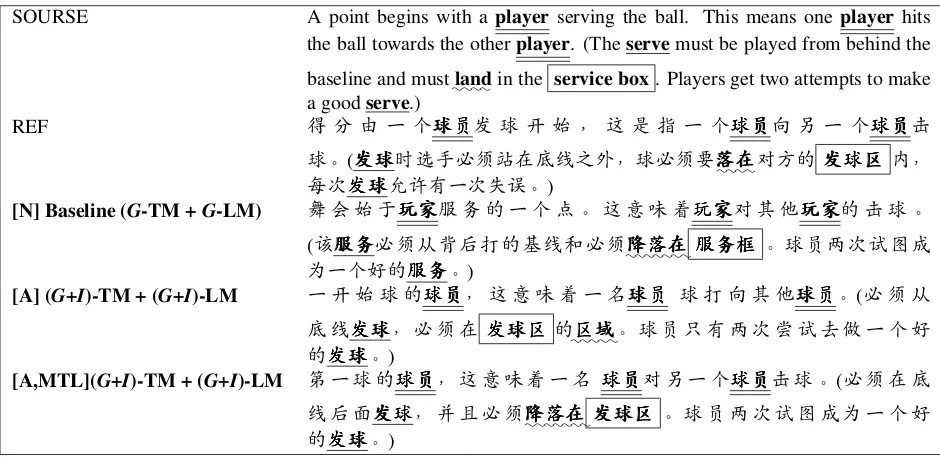
SOURSE A point begins with aplayer serving the ball. This means oneplayerhits the ball towards the otherplayer. (Theservemust be played from behind the
baseline and must::::landin the service box. Players get two attempts to make a goodserve.)
REF 得分由一 个球球球员员员发球开始,这是指一 个球球球员员员向另一 个球球球员员员击
球。(发发发球球球时选手必须站在底线之外,球必须要 :::: 落 落
落在在在对方的发发发球球球区区区内, 每次发发发球球球允许有一次失误。)
[N] Baseline (G-TM +G-LM) 舞会始于玩玩玩家家家服务的一 个点。这意味着玩玩玩家家家对其他玩玩玩家家家的击球。
(该服服服务务务必须从背后打的基线和必须
:::::::降降降落落落在在在服服服务务务框框框。球员两次试图成 为一个好的服服服务务务。)
[A] (G+I)-TM + (G+I)-LM 一开始球的球球球员员员,这意味着一名球球球员员员 球打向其他球球球员员员。(必须从
底线发发发球球球,必须在发发发球球球区区区的
:::::区区区域域域。球员只有两次尝试去做一 个好 的发发发球球球。)
[A,MTL](G+I)-TM + (G+I)-LM 第一球的球球球员员,员 这意味着一名 球球球员员员对另一 个球球球员员员击球。(必须在底
线后面发发发球球球,并且必须 ::::::: 降 降
降落落落在在在发发发球球球区区区。球员两次试图成为 一 个好
[image:8.612.72.542.59.290.2]的发发发球球球。)
Table 4: Examples illustrating some different translations, where the Chinese phrases are translated from the English phrases with the same symbols (e.g., underline, wavy-line, and box). The details are explained in Section 3.5.
we enforced them to play the same role across dif-ferent domains. It seems that averaging the out-of-domain feature weights can be considered as a kind of regularization.
An example sentence from the Sports domain with translations from different methods is shown in Table 4. In this sentence, the baseline always translates ”player” to ”玩家” (game player), which should be ”球员” (ball player). And, the base-line translates ”serve” to ”服务” (work for), which should be ”发球” (put the ball into play). The phrase ”service box” here means ”发球区”, which denotes the zone where the ball is to be served. However, the baseline incorrectly splits them into two words, then translates ”service” to ”服务” and ”box” to ”框”. In contrast, the approaches with adapted models are able to translate these words very well.
Both our MTL-based approach and the conven-tional adaptation methods leverage the mixture mod-els. A natural question is why our MTL-based ap-proach performs better than the individual adapta-tion. To answer this question, we looked into the details of the tuning and decoding procedures in the MTL-based approach. We observed that the BLEU score on the development data for each system was lower than the score when conducting individual adaptation. Considering that the algorithm
enforc-ing the general features play the same role across different domains, we suspect that MTL-based ap-proach introduces a kind of regularization for each domain-specific system. The regularization prevents the general features from biasing towards certain do-mains to the extreme. This property is quite impor-tant for real world SMT systems. Usually, a sen-tence is composed of some domain-specific words and some general words, so it is often improper to translate every word in the sentence using the in-domain knowledge. For the example in Table 4, the individual adaptation method ”[A] (G+I)-TM + (G+I)-LM” translates ”land” to ”区域” (zone) im-properly, because ”区域” appears more often in the Sports text than the general-domain text. This shows that the individual adaptation methods tend to over-fit the in-domain development data. In contrast, the MTL-based approach ”[A,MTL](G+I)-TM + (G+I )-LM” just translates ”land” to ”降落在” (fall on), which is more appropriate.
4 Related Work
4.1 Domain Adaptation
et al. (2004) first decoded the testing data with a general TM, and then used the translation results to train an adapted LM, which was in turn used to re-decode the testing data. L¨u et al. (2007) tried to weight the training data according to the similar-ity with test data using information retrieval mod-els, while Foster et al. (2010) trained a discrimina-tive model to estimate a weight for each sentence in the training corpus. Other methods conducted data selection based on cross-entropy (Moore and Lewis, 2010), and Axelrod et al. (2011) further ex-tended their cross-entropy based method to the se-lection of bilingual corpus in the hope that more rel-evant corpus to the target domain could yield smaller models with better performance. Other methods included using semi-supervised transductive learn-ing techniques to exploit the monollearn-ingual in-domain data (Ueffing et al., 2007).
Adaptation methods also involved the utiliza-tion of mixture models. Foster and Kuhn (2007) explored a number of variants of utilizing multi-ple TMs and LMs by interpolation. Koehn and Schroeder (2007) used MERT to simultaneously tune two TMs or LMs. Sennrich (2012) investi-gated the TM perplexity minimization as a method to set model weights in mixture modeling. In ad-dition, inspired by system combination approaches, Razmara et al. (2012) used the ensemble decoding method to mix multiple translation models, which outperformed a variety of strong baselines.
Generally, most previous methods merely con-ducted domain adaption for a single domain, rather than multiple domains at the same time. One could also simply build multiple SMT systems that were adapted to multiple domains, but they were often separated and not tuned together. So far, there has been little research into the multi-domain adaptation problem over mixture models for SMT systems, as proposed in this paper.
4.2 Multi-task Learning
In machine learning, MTL is an approach to learn one target problem with other related problems at the same time. This often leads to a better model for the main task because it allows the learner to use the commonality among the tasks. MTL is performed by learning tasks in parallel while using a shared representation. Therefore, what is learned for each
task can help other tasks be learned better.
MTL was successfully applied in some Natu-ral Language Processing (NLP) tasks. For exam-ple, Blitzer et al. (2006) extended the MTL ap-proach (Ando and Zhang, 2005) to domain adapta-tion tasks in part-of-speech tagging. Collobert and Weston (2008) proposed using deep neural networks to train a set of tasks, including part-of-speech tag-ging, chunking, named entity recognition, and se-mantic roles labeling. They reported that jointly learning these tasks led to superior performance. MTL was also applied in sentiment analysis (Dredze and Crammer, 2008) and web ranking (Chapelle et al., 2011) to address the multi-domain learning and adaptation. In SMT, Duh et al. (2010) pro-posed using MTL for N-best re-ranking on sparse feature sets, where each N-best list corresponded to a distinct task. Simianer et al. (2012) proposed dis-tributed stochastic learning with feature selection in-spired by MTL. The distributed learning approach outperformed several other training methods includ-ing MIRA and SGD.
Inspired by these methods, we used MTL to tune multiple SMT systems at the same time, where each system was composed of in-domain and general-domain models. Through a shared feature represen-tation, the commonalities among the SMT systems were better learned by the general models. In ad-dition, domain-specific translation knowledge was also better characterized by the in-domain models.
5 Conclusion and Future Work
In this paper, we propose an MTL-based approach to address multi-domain adaptation for SMT. We first use the cross-entropy based data selection method to obtain domain bilingual data. After that, in-domain TMs and LMs are trained for each in- domain-specific SMT system. In addition, the general-domain TM and LM are also trained and shared across different systems. Finally, MTL is lever-aged to tune multiple systems jointly. Experimen-tal results have shown that our approach is quite promising for the multi-domain adaptation problem, and it brings significant improvement over both the non-adapted baselines and the conventional domain adaptation methods with mixture models.
data is known beforehand in this study. However, this is not always the case for real world SMT sys-tems. Therefore, to apply our approach in real appli-cations, the domain information needs to be identi-fied automatically. In the future, we will pre-define more popular domains and develop automatic do-main classifiers. For those dodo-mains that are iden-tified with high confidence, we use the domain-specific system to translate the texts. For other texts, we use the general system to translate them. Fur-thermore, since our approach is a general training method, we may also combine this approach with other domain adaptation methods to get more per-formance improvement.
Acknowledgments
We are especially grateful to Nan Yang, Yajuan Duan, Hong Sun and Danran Chen for the helpful discussions. We also thank the anonymous review-ers for their insightful comments.
References
Rie Kubota Ando and Tong Zhang. 2005. A framework for learning predictive structures from multiple tasks and unlabeled data. The Journal of Machine Learning Research, 6:1817–1853.
Amittai Axelrod, Xiaodong He, and Jianfeng Gao. 2011. Domain adaptation via pseudo in-domain data selec-tion. In Proceedings of the 2011 Conference on Empirical Methods in Natural Language Processing, pages 355–362, Edinburgh, Scotland, UK., July. As-sociation for Computational Linguistics.
John Blitzer, Ryan McDonald, and Fernando Pereira. 2006. Domain adaptation with structural correspon-dence learning. In Proceedings of the 2006 Confer-ence on Empirical Methods in Natural Language Pro-cessing, pages 120–128, Sydney, Australia, July. As-sociation for Computational Linguistics.
Olivier Chapelle, Pannagadatta Shivaswamy, Srinivas Vadrevu, Kilian Weinberger, Ya Zhang, and Belle Tseng. 2011. Boosted multi-task learning. Machine learning, 85(1-2):149–173.
David Chiang. 2007. Hierarchical phrase-based transla-tion. Computational Linguistics, 33(2):201–228. Ronan Collobert and Jason Weston. 2008. A unified
ar-chitecture for natural language processing: deep neu-ral networks with multitask learning. InProceedings of the 25th international conference on Machine learn-ing, pages 160–167. ACM.
Lei Cui, Dongdong Zhang, Shujie Liu, Mu Li, and Ming Zhou. 2013. Bilingual data cleaning for smt using graph-based random walk. InProceedings of the 51st Annual Meeting of the Association for Computational Linguistics (Volume 2: Short Papers), pages 340–345, Sofia, Bulgaria, August. Association for Computa-tional Linguistics.
Mark Dredze and Koby Crammer. 2008. Online methods for multi-domain learning and adaptation. In Proceed-ings of the 2008 Conference on Empirical Methods in Natural Language Processing, pages 689–697, Hon-olulu, Hawaii, October. Association for Computational Linguistics.
Kevin Duh, Katsuhito Sudoh, Hajime Tsukada, Hideki Isozaki, and Masaaki Nagata. 2010. N-best reranking by multitask learning. InProceedings of the Joint Fifth Workshop on Statistical Machine Translation and Met-ricsMATR, pages 375–383, Uppsala, Sweden, July. Association for Computational Linguistics.
Matthias Eck, Stephan Vogel, and Alex Waibel. 2004. Language model adaptation for statistical machine translation based on information retrieval. InIn Proc. of LREC.
George Foster and Roland Kuhn. 2007. Mixture-model adaptation for SMT. In Proceedings of the Second Workshop on Statistical Machine Translation, pages 128–135, Prague, Czech Republic, June. Association for Computational Linguistics.
George Foster, Roland Kuhn, and Howard Johnson. 2006. Phrasetable smoothing for statistical machine translation. InProceedings of the 2006 Conference on Empirical Methods in Natural Language Processing, pages 53–61, Sydney, Australia, July. Association for Computational Linguistics.
George Foster, Cyril Goutte, and Roland Kuhn. 2010. Discriminative instance weighting for domain adapta-tion in statistical machine translaadapta-tion. InProceedings of the 2010 Conference on Empirical Methods in Natu-ral Language Processing, pages 451–459, Cambridge, MA, October. Association for Computational Linguis-tics.
Long Jiang, Shiquan Yang, Ming Zhou, Xiaohua Liu, and Qingsheng Zhu. 2009. Mining bilingual data from the web with adaptively learnt patterns. In Proceedings of the Joint Conference of the 47th Annual Meeting of the ACL and the 4th International Joint Conference on Natural Language Processing of the AFNLP, pages 870–878, Suntec, Singapore, August. Association for Computational Linguistics.
Philipp Koehn and Josh Schroeder. 2007. Experiments in domain adaptation for statistical machine transla-tion. InProceedings of the Second Workshop on Sta-tistical Machine Translation, pages 224–227, Prague, Czech Republic, June. Association for Computational Linguistics.
Philipp Koehn. 2004. Statistical significance tests for machine translation evaluation. In Dekang Lin and Dekai Wu, editors, Proceedings of EMNLP 2004, pages 388–395, Barcelona, Spain, July. Association for Computational Linguistics.
Percy Liang, Alexandre Bouchard-Cˆot´e, Dan Klein, and Ben Taskar. 2006. An end-to-end discriminative ap-proach to machine translation. In Proceedings of the 21st International Conference on Computational Lin-guistics and 44th Annual Meeting of the Association for Computational Linguistics, pages 761–768, Syd-ney, Australia, July. Association for Computational Linguistics.
Yajuan L¨u, Jin Huang, and Qun Liu. 2007. Improving statistical machine translation performance by train-ing data selection and optimization. In Proceedings of the 2007 Joint Conference on Empirical Methods in Natural Language Processing and Computational Natural Language Learning (EMNLP-CoNLL), pages 343–350, Prague, Czech Republic, June. Association for Computational Linguistics.
Robert C. Moore and William Lewis. 2010. Intelligent selection of language model training data. In Pro-ceedings of the ACL 2010 Conference Short Papers, pages 220–224, Uppsala, Sweden, July. Association for Computational Linguistics.
Franz Josef Och and Hermann Ney. 2003. A system-atic comparison of various statistical alignment mod-els. Computational Linguistics, 29(1):19–51.
Franz Josef Och. 2003. Minimum error rate training in statistical machine translation. InProceedings of the 41st Annual Meeting of the Association for Compu-tational Linguistics, pages 160–167, Sapporo, Japan, July. Association for Computational Linguistics. Kishore Papineni, Salim Roukos, Todd Ward, and
Wei-Jing Zhu. 2002. Bleu: a method for automatic eval-uation of machine translation. InProceedings of 40th Annual Meeting of the Association for Computational Linguistics, pages 311–318, Philadelphia, Pennsylva-nia, USA, July. Association for Computational Lin-guistics.
Majid Razmara, George Foster, Baskaran Sankaran, and Anoop Sarkar. 2012. Mixing multiple translation models in statistical machine translation. In Proceed-ings of the 50th Annual Meeting of the Association for Computational Linguistics (Volume 1: Long Papers), pages 940–949, Jeju Island, Korea, July. Association for Computational Linguistics.
Rico Sennrich. 2012. Perplexity minimization for trans-lation model domain adaptation in statistical machine translation. InProceedings of the 13th Conference of the European Chapter of the Association for Compu-tational Linguistics, pages 539–549, Avignon, France, April. Association for Computational Linguistics. Libin Shen and Aravind K Joshi. 2005. Ranking and
reranking with perceptron. Machine Learning, 60(1-3):73–96.
Patrick Simianer, Stefan Riezler, and Chris Dyer. 2012. Joint feature selection in distributed stochastic learn-ing for large-scale discriminative trainlearn-ing in smt. In Proceedings of the 50th Annual Meeting of the Associ-ation for ComputAssoci-ational Linguistics (Volume 1: Long Papers), pages 11–21, Jeju Island, Korea, July. Asso-ciation for Computational Linguistics.