Final Draft of:
Lead Optimization of Benzoxepin-Type Selective Estrogen Receptor (ER) Modulators and Downregulators with Subtype-Specific ERα and ERβ Activity
Niamh Mary O'Boyle,* Irene Barrett, Lisa M Greene, Miriam Carr, Darren Fayne, Brendan Twamley, Andrew J.S. Knox, Niall O. Keely, Daniela M. Zisterer, and Mary Jane Meegan
Journal of Medicinal Chemistry
Just Accepted Manuscript. Publication Date (Web): April 20, 2017 DOI: http:/dx.doi.org/10.1021/acs.jmedchem.6b01917
Lead Optimization of Benzoxepin-Type Selective Estrogen Receptor (ER) Modulators and
Downregulators with Subtype-Specific ERα and ERβ Activity
Niamh M. O’Boyle,1,2* Irene Barrett,1 Lisa M. Greene,2 Miriam Carr,1 Darren Fayne,2
Brendan Twamley,3 Andrew J.S. Knox,2 Niall O. Keely,1 Daniela M. Zisterer2 and Mary J.
Meegan1
1School of Pharmacy and Pharmaceutical Sciences, Trinity Biomedical Sciences Institute, Trinity
College Dublin, 152 - 160 Pearse St, Dublin 2, D02 R590, Ireland.
2School of Biochemistry and Immunology, Trinity Biomedical Sciences Institute, Trinity College
Dublin, 152 - 160 Pearse St, Dublin 2, D02 R590, Ireland.
3School of Chemistry, Trinity Biomedical Sciences Institute, Trinity College Dublin, 152 - 160
Pearse St, Dublin 2,D02 R590, Ireland.
synthesised – series I containing an acrylic acid, series II with an acrylamide and series III with a saturated carboxylic acid substituent. These compounds were shown to be high affinity ligands for the ER with nanomolar IC50 binding values. Series I acrylic acid ligands were generally ER selective. In particular, compound 13e featuring a phenylpenta-2,4-dienoic acid substituent was shown to be antiproliferative and downregulated ERand ER expression in MCF-7 breast
cancer cells. Interestingly, from series III, the phenoxybutyric acid derivative compound 22 was not antiproliferative and selectively downregulated ER. A docking study of the benzoxepin
ligands was undertaken. Compound 13e is a promising lead for development as a clinically relevant SERD, whilst compound 22 will be a useful experimental probe for helping to elucidate the role of ERβ in cancer cells.
Key words:
Introduction
The two nuclear estrogen receptors (ERand ER mediate the biological effects of the estrogen hormones and ER is an attractive therapeutic target for diseases including breast cancer and
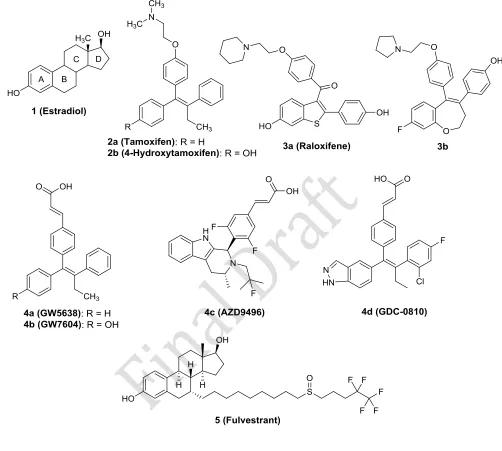
osteoporosis.1 Estrogens including estradiol (1, Figure 1) are known to have tissue selective effects, and there is considerable interest in the therapeutic use of selective estrogen receptor modulators (SERMs).2 A number of SERMs are currently in clinical use,3 including tamoxifen (2a) for treatment of hormone-dependent breast cancer, and raloxifene (3a), lasofoxidine and basidoxifene for the prevention of osteoporosis (Figure 1).4 The clinical successes of 2a and 3a
has provided the driving force to discover new, multifunctional SERMs. There is ongoing debate about the role of ERβ in cancer. It is generally thought that expression of ERβ has antiproliferative effects in breast cancer cells.5, 6 In prostate cancer, its role is still unclear and there is some evidence that certain isoforms of ERβ are oncogenic.7, 8 ER expression has been reported have a potentially protective effect in normal cells on ER promoted
hyperproliferation.9 There is much research being undertaken to fully elucidate the effects of ERβ in cancers.
12 Breast cancers resistant to 2a are not cross-resistant to 4a indicating that this type of SERD has potential as a therapeutic agent. The SERD action of 4b causes a decrease in cellular ER
levels.13 Related compounds showed low stimulation of uterine cell proliferation with good ER and ER binding affinities.14 Acrylic acid-substituted quinoline,14 naphthalene,15
tetrahydroisoquinoline,16 bicyclo[3.3.1]nonane,17 coumarin,18 benzopyranobenzoxepanes19 and benzosuberone scaffolds have also been investigated as SERMs.15, 20, 21 The 1H -pyrido[3,4-b]indol-1-ylphenylacrylic acid AZD9496 (4c),22 coumarin,23 and the indazole ER modulator GDC-0810 (4d)24 were recently reported as potent and orally bioavailable SERDs and antagonists (Figure 1).
We have previously identified novel SERMs [e.g. compound 3b (Figure 1)] which demonstrated potential as ER binding ligands,25 and now we report the development of this chemical template for nonsteroidal SERDs where the ER degradation was optimised. The conformationally restricted benzoxepin template has been elaborated to incorporate substitution with acrylic acids, and related structural modifications. An overview of the three distinct series of compounds described in this study is provided in Figure 2. The evaluation of antiproliferative activity and relative binding affinity of these ligands for ERand ER together with their stimulatory effect
on uterine tissue is examined. A molecular modelling study was investigated to rationalise the binding selectivity of these ligands for the ER and ER receptors.
Chemistry
targeted structural alterations (Schemes 1-3). The first group (Series I, compounds 11a-11d and related alkenes 13a-c and 13e, Scheme 1) are ring-fused analogues of 4a/4b, with variation in substitution at the C-8 position of the benzoxepin or benzothiepin scaffold structure. The fluorine substituent at C-8 of the benzoxepin and benzothiepin structure would be expected to increase the lipophilicity of these compounds and also block expected metabolic inactivation, contributing to a longer plasma half-life. It has been reported that the inclusion of a fluorine contributes to the SERM activity of ER ligands such as oxachrysenol26 and we have observed a similar effect for compound 5.25 The second group of compounds investigated (Series II, 14a
-14i, Scheme 2) contain amide-modified derivatives of the core acrylic acid compound 11c.
Compounds 19a, 19b and 22 (Series III, Scheme 3) are distinguished by the inclusion of the 4-oxyacetic and 4-oxybutyric acid substituent in place of the acrylic acid in Ring B of 11c.
The synthetic route that produced the required products 11a-11d (series I) most efficiently is shown in Scheme 1. The benzoxepin-4-ones 6a-d were treated with trifluoromethanesulfonic anhydride to afford the intermediate triflates which were then coupled with the arylboronic ester to afford the aldehydes 7a-d in good yield (steps i and ii). Vinyl bromination of the alkenes 7a
-d with pyridinium tribromide gave the bromides 8a-d (Scheme 1, step iii). Bromides 8a-c were then coupled with 4-hydroxyboronic acid in a second Suzuki reaction to afford the phenolic substituted benzoxepins 9a-c (Scheme 1, step iv). A Wittig-Horner reaction of 9a-c with (ethoxycarbonyl methylene)triphenylphosphorane, followed by saponification of the esters 10a-c
hydrolysis of the ester in situ afforded the acrylic acid 12. Suzuki coupling of the acid 12 with 4-hydroxyphenylboronic acid gave the required product 11d. The related alkene
and-unsaturated ketone products 13a-c were also synthesised by similar Wittig type reactions from
9a-9c (Scheme 1, step vii). The extended unsaturated acid compound 13e was obtained from aldehyde 9c by treatment with (E)-ethyl 4-(diethoxyphosphoryl)but-2-enoate (prepared from ethyl 4-bromocrotonate and triethylphosphite) followed by saponification of the ester 13d
(Scheme 1, steps vii and viii).
Series II consisting of eight -unsaturated amides 14a-h was obtained from the unsaturated acid 11c by coupling with various amines in the presence of HOBt, using EDCI as the coupling agent (Scheme 2, step i). Surprisingly, the coupling of 11c with aniline proved to be difficult. An alternative method to obtain the desired product 14i required the initial preparation of the phosphonate 15 (Scheme 2). 2-Bromo-N-phenylacetamide (prepared from aniline and acetylbromide) was treated with triphenylphosphite to afford the corresponding phosphonate
15,27 which was reacted with aldehyde 9c to afford the required product 14i in 83% yield (Scheme 2, step ii). An alternative reaction of 9c with the phosphonium bromide prepared from 2-bromo-N-phenylacetamide and triphenylphosphine was unsuccessful.
Related compounds 19a and 19b (series III) containing an 8-oxyacetic acid side chain were obtained by O-alkylation of the vinyl bromides 16a and 16b (prepared as previously reported)25 with ethyl bromoacetate to afford esters 17a and 17b (Scheme 3, step i). Subsequent Suzuki coupling with 4-hydroxyphenylboronic acid followed by hydrolysis of esters 18a and 18b
of 16a with ethyl bromobutyrate afforded the ester product 20, which was subsequently arylated with 4-hydroxyphenylboronic acid to yield 21 (Scheme 3, steps i and ii). Hydrolysis of ester 21
gave the product 22 containing the required oxybutyric acid side chain (Scheme 3, step iii).
Acrylic acid 4b,required for comparative biochemical studies,was obtained in a novel three-step route by initial McMurray coupling of ketone 23 and propiophenone to afford the iodo-substituted triphenylethylene 24 as the major product (Scheme 4, step i), which could be separately converted into either the acrylic acid 25 (94%) or the acrylate ester 26 (93%) by Heck-type reactions with acrylic acid and ethyl acrylate respectively in the presence of palladium acetate (Scheme 4, steps ii and iii respectively). Deprotection of 25 with boron tribromide directly afforded 4b (Scheme 4, step iv; 28% overall yield) as the major Z isomer was obtained (E/Z mixture: 1:3.5),while demethylation of 26 followed by in situ hydrolysis of intermediate 27
also yielded acrylic acid 4b (22% overall yield) (Scheme 4, steps iv and v). Previous synthetic routes to this compound and analogues have relied on Friedel-Crafts acylation, Grignard or Suzuki coupling reactions to generate the triphenylethylene structure,10, 13, 28 followed by a Wittig or Horner-Emmons reaction for introduction of the acrylate side chain [15% overall yield (Friedel-Crafts, Grignard and Wittig for synthesis of 4b)] and 48% overall yield (Suzuki coupling followed by Horner-Emmons reaction for synthesis of 4a)].
X-Ray Crystallography
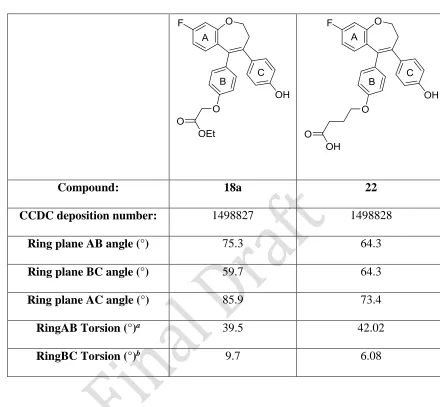
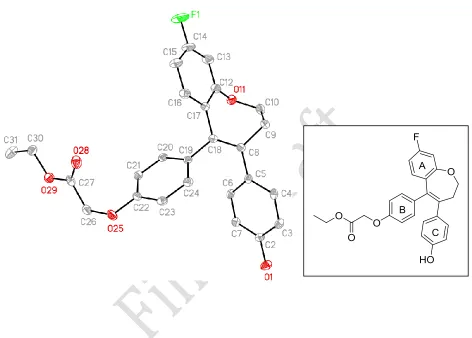
conformation in both structures (Figure 3). This results in a molecular arrangement in which the three aromatic rings attached to the 7-membered ring are not coplanar. Calculation of the ring plane and torsional angles between the aromatic rings of these compounds further demonstrates that these rings are arranged out-of-plane with respect to each other (Table 1). For example, the ring angle between the planes of ring A and ring B of compound 22 is 64.3°, and the torsional angle is 42°. Bond lengths between C8 and C18 (compound 18a) and C8 and C19 (compound
22) of 1.345 Å and 1.350 Å, respectively, indicate the position of the double bond in the 7-membered ring.
Biochemical Results: Antiproliferative activity in MCF-7 breast cancer cells. The antiproliferative activity of the benzoxepin compounds was firstly evaluated using the ER-expressing (ER-dependent) MCF-7 human breast cancer cell line. Compound 2a (IC50 = 4.1 M) and 4b (IC50 = 1.3 μM) were used as positive controls and the IC50 values obtained are in
agreement with previously reported values for these compounds (Table 2).29, 10, 13, 30
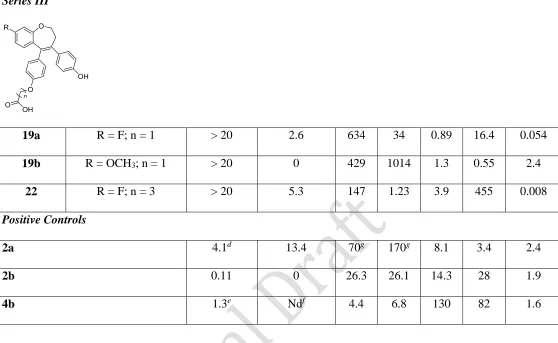
Introduction of the amide modification (series II) resulted in a decrease in the antiproliferative activity of the fluorinated products 14a-i when compared with acrylic acid compound 11c. Piperidine-substituted amides 14e and 14g proved to be the most active, together with 14h (IC50 = 0.48, 1.05 and 0.70 μM respectively). Oxyacetic analogues of 2a had been reported to act as estrogen antagonists in MCF-7 cells.31, 32 In series III, compounds 19a and 19b, containing a 4-oxyacetic acid substituent in place of the acrylic acid in 11b and 11c, along with compound 22, did not have antiproliferative activity at concentrations up to 20 μM (as was observed for the oxyacetic analogue of 2a32).
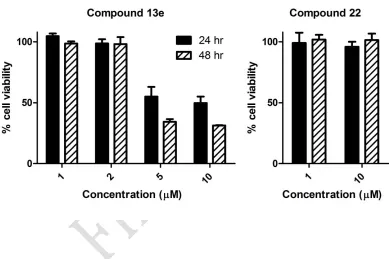
Cytotoxicity was evaluated by use of the standard LDH assay to establish that the observed antiproliferative effects were attributable to cytostasis rather than cellular necrosis (Table 2). The majority of the compounds demonstrated minimal cytotoxicity (<5% at 10 M concentration), considerably below that obtained for 2a (13.4%). Compounds 13e and 22 were also assessed for toxicity using the non-tumorigenic MCF-10a mammary epithelial cell line. Compound 22 did not have any effect on the viability of MCF-10a cells at concentrations of 1 and 10 M over 24 and 48 h periods (Figure 4). No effects were observed for compound 13e at 1
and 2 μM; however, MCF-10a cell viability was reduced at higher concentrations of 5 and 10 M, with reduction of 50% at 5 M over 24 h. As the IC50 value of 13e in MCF-7 cells is 1.6 μM, there is a therapeutic window available for this compound at which it may cause antiproliferative effects in breast tumour cells without significant toxicity to non-tumorigenic cells.
fluorescence polarisation procedure was employed for this competitive binding assay which measures the displacement of fluorescein-labelled estradiol (fluoromone) from the human recombinant full length ERand ER. All ER-binding values are expressed in nM. The relative
binding affinity (RBA) of ER ligands is often reported. Compound 1 is typically used as the reference ligand and is taken as the 100 % binding value. Using the reported reference IC50 values obtained for 1 in ERα (5.7 nM)33 and ERβ (5.6 nM)34, the RBAs of the selected conjugates were calculated (Table 2). Values greater than 100 % indicate a greater affinity for the ER than 1; values less than 100 % indicate a diminished affinity for the ER.
All compounds (with the exception of 13b) displayed potent ER and ER binding activities,
with the majority of the more potent compounds showing selectivity for ER. Introduction of
the 8-fluoro substituent in series I, as in (11c), and also the benzothiepin ring scaffold (11d) gave increased ER binding activity for both ER and ER. As an example of the series, compound
11d exhibited potent binding to both ERα and ERβ with IC50 = 4.1 nM (ERα) and 3.1 nM (ERβ). Compound 13e, containing the extended penta-2,4-dienoic acid substituent in Ring B, was found to display potent ER-binding activity with IC50 = 71.6 nM (ERand 0.55 nM (ERβ), equivalent to 129-fold ER selectivity. Compound 4a and related amides have previously been
reported as SERMs with antagonist activity in rat uterus and acting as agonists in bone.10 In our acrylamide series II (compounds 14a-i) compound 14i demonstrated the most effective binding activity [IC50 = 11.7 nM (ERα) and 0.94 nM (ERβ)], with 11-fold ER selectivity. Acrylamide 14b, possessing moderate antiproliferative activity, demonstrated good ER-binding activity (IC50
Triarylethylene oxyalkanoic acid modifications of 2a have been reported as bone selective estrogen mimetics.31 Of our compounds in series III, 19a and 19b had high IC50 binding values indicative of poor affinity for both ERα and ERβ, perhaps explaining their poor antiproliferative activity. The related compound 22, containing the 4-oxybutyric acid substituent, demonstrated extremely interesting ER-binding properties with IC50 = 147 nM (ERand 1.23 nM (ERβ), which is 117-fold selectivity for ER despite its lack of antiproliferative potency. This binding
value for 22 is an improvement on reported values for the corresponding oxybutyric acid analogue of 2a.32
In order to assist us in the rationalisation of the selectivity observed for the ER binding results obtained for these benzoxepin compounds, the ER binding effects of the core structure 9c
was determined as IC50 = 407 nM for ER and 395 nM for ERThis indicates that ER binding
is related to the presence of 4-hydroxyphenyl at C-4 or C-5 of the 4,5-diaryl-8-fluorobenzoxepin scaffold. ER selectivity is conferred by the specific type of acidic side chain substituent present at C-4 of Ring B. Small modifications to this side chain lead to dramatic differences in ER-binding affinity, subtype selectivity and antiproliferative potency.
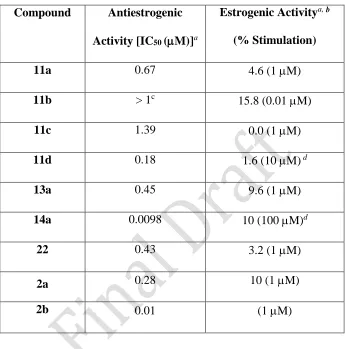
possessed an improved potency over 2a as an ER antagonist (IC50 = 0.18 μM) while compounds
11a, 11c, 13a and 22 also displayed good antiestrogenic activity, with IC50 values in the range 0.43 - 1.39 M. In the acrylamide series, compound 14a was found to be extremely potent as an
estrogen antagonist with an IC50 value of 0.0098 μM, comparable to the value reported for 4b.14 This compound does not demonstrate significant antiproliferative activity in the estrogen dependent MCF-7 cells (IC50 = 13 μM) which is 10-fold less potent than 4b (IC50 = 1.3 μM); ER binding is also less potent than observed for 4b. This may be attributed to the differences in interaction of 14a with the ER on binding due to replacement of carboxylic acid of 4b, 11c and
11d with the more lipophilic N,N-diethylamide substituent. The estrogenic stimulatory effect is determined by measuring AlkP stimulation in the absence of 1 (Table 3). Compounds 11c, 11d
and 22, which were among the most potent ER-binding compounds, demonstrated an absence of or very low stimulatory effects (0 %, 1.6 % and 3.2 % at concentrations of 1 M, 10 M and 1 M respectively), when compared with 4b (4%)14 and 2a (10%). The most potent antagonist
compound, acrylamide 14a (evaluated for stimulatory activity at a 100-fold higher concentration of 100 μM, as 1 μM had no effect), together with the ketone 13a (1 μM), and acrylic acid 11a (1 μM), showed relatively low stimulatory values of 10 %, 9.6 % and 4.6 % respectively. Selection of the optimal structural features for antiestrogenic activity for benzoxepin and benzothiepin ring scaffolds, without adverse estrogenic effects on tissues such as the uterus, is possible by reference to the results of these AlkP assays.
Biochemical Results: Effect of compounds 13e and 22 on the expression levels of ERα and
The expression of ERα and ERβ in MCF-7 cells was examined by Western blotting (Figure 5). Compounds 13e (series I) and 22 (series III) were chosen for further biochemical evaluation; compound 22 showed an interesting profile of activity due to its lack of antiproliferative effect whilst having an extremely selective effect on ERβ. Compound 13e has potent antiproliferative activity in MCF-7 cells and good potency against both ERα and ERβ (Table 2). The pure estrogen antagonist 5, a known SERD, downregulates the expression of ERα and was used as a
positive control. Compound 5 causes rapid proteasomal degradation of ERvia
ubiquitinylation, resulting in shutdown of the estrogen-signaling process and thus inducing proliferation arrest and apoptosis of estrogen-dependent breast cancer cells.36 In contrast, SERMs such as 4-hydroxytamoxifen (2b, Figure 1) bind to ER as antagonists or partial
agonists depending on the target tissue. MCF-7 breast cancer cells were treated with compounds 13e and 22 (10 M), and after 24 h whole cell lysates were prepared and analysed by
SDS-PAGE and Western blotting for expression levels of ERα or ERβ. The known SERD 5
reduced ER protein levels, with little or no effect on ERβ (Figure 5). Compound 13e, which
possessed good antiproliferative activity, was found to downregulate both ERα and ERβ (Figure 5). Compound 22 selectively downregulated ERβ in MCF-7 cells, with little effect on the expression of ER. This result is consistent with the ER-binding assay, in which compound 22
was ERβ selective.
has antiproliferative effects in breast cancer cells.5, 6 Due to its unique combination of cellular effects, compound 22 is a useful tool for investigation of the role of ERβ in cancer cells.
Molecular Modelling of Benzoxepins in ERα and ERβ
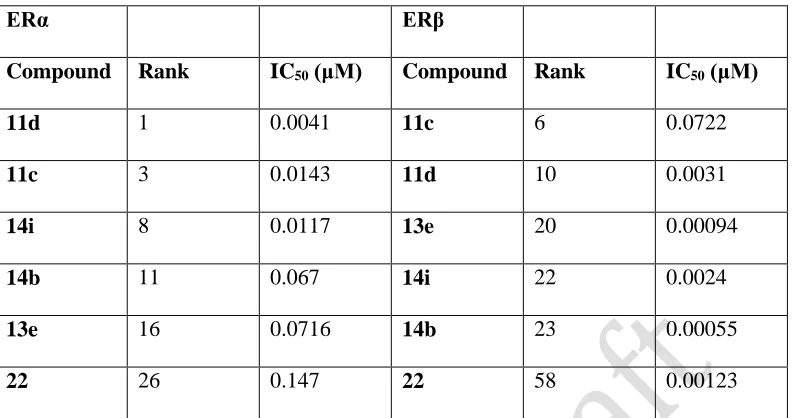
A number of structurally related benzoxepins were discovered to have diverse effects on ERα and ERβ, in particular compounds 13e and 22. Hence, a molecular modelling study of 11c, 11d,
13e, 14b, 14i and 22 was carried out to investigate their potential interactions with ERα and ERβ.
The two ER subtypes differ significantly in size: 595 amino acids in ERα compared to 485 amino acids (ERβ). The conservation of amino acid sequence in the ligand binding sites of ER and ER is only 59%, with the most notable differences being replacement of Met412 and Leu384 in ER with Ile and Met in ER The 3ERT X-ray structure of hERα co-crystallised
with 2b37 was downloaded from the PDB website. For ERβ the 1NDE X-ray structure co-crystallised with a triazine modulator was used.38 After validating the docking protocol and determining receiver operating characteristic (ROC) values of 0.896 and 0.819 for the ERα and ERβ haystack docking respectively, we undertook a more in-depth binding analysis on compounds 13e and 22 as they demonstrated the optimal ERα:ERβ binding ratio in favour of
ERβ. In addition to 1125 inactive compounds, the ER and ER haystacks contained 39 and 32
in this study ranked in the top 5% of the ordered hit list and are comparable to the known active compounds.
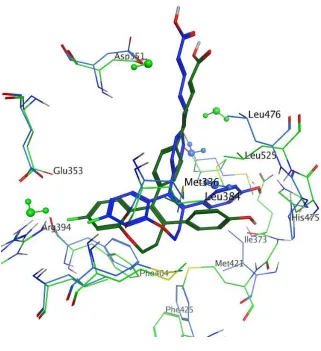
In ERβ, the acid 22 has a 180 degree flipped orientation compared to other compounds in this study, in that the phenolic hydroxyl group mimics the position adopted by 2b (Figure 7). The fluorine-containing ring no longer clashed with Leu525 of ERα, as this sidechain has rotated 180° and is directed outside the LBP, but is ideally positioned to accept a HB from His475 of ERβ. The ortho hydrogen of the ether appended phenyl ring B is located adjacent to the co-crystallised water molecule thereby enabling a HBD interaction. The oxygen atom of the benzoxepin ring is adjacent to the Met421 of ERα which protrudes into the pocket and would lead to electrostatic repulsion but in ERβ this residue is replaced by the Ile373 and moves to the side of the pocket to form a hydrophobic layer below the ligand’s fluorinated phenyl group. In ERα, 22 overlays well on the core structure of 2b except that the ring A fluorophenyl fluorine maps to the hydroxyl group of 2b (Figure 7). The carboxylic acid side chain is not oriented towards the Asp351 group but this may result from only generating 50 conformers of each ligand as the side-chain has many degrees of freedom. This series of LBP amino acid positional changes between ERα and ERβ all favour binding of 22 to ERβ over ERα which is experimentally reflected in the IC50 ER binding values and in the effects on ER expression demonstrated in the western blot in MCF-7 cells.
Arg394.40 However, a later 2002 X-ray structure of the aroylbenzothiophene core of 3a with no sidechain (1GWQ)41 places the A ring in this position and the phenolic moiety interacts with Glu353 and Arg394 which is analogous to the interactions made by 2b (3ERT). This illustrates the possible symmetry of binding mode of the core scaffold which can rotate 180 degrees depending on the nature of the appended side-chain. While the ability of fluorine to act as a HBA is still debated there is evidence that it is possible, although to a lesser extent than oxygen.42 Crystallographic evidence in the case of ER binding to fluorinated A ring ligands is not available. However, a very recent publication detailing the X-ray structure of 4,4-dichlorodiphenyltrichloroethane (DDT) in ER (5KRA) places a different halogen, chlorine, in position to partly mimic the Ring A phenolic groups’ interactions with Glu353 and Arg394.43 In addition to the capacity to accept hydrogen bonds, chlorine can also interact with Glu353 through a halogen bond.44 This data adds confidence to our postulated binding modes wherein the fluorine atom can occupy the traditional “Ring A” hydroxyl group position and engage in HBA or dipole interactions with Arg394 and a bridging water molecule.
For both ERα and ERβ, 13e co-locates the ring A fluorinated phenyl group adjacent to the 4-hydroxy group of 2b and is positioned to accept HBs from Arg394/346 (Figure 6). The flipped orientation as observed with 22 docked in ERβ is not possible in this case due to the linear delocalised nature of the “antagonistic” sidechain which would clash with Asp351/303.For the ERβ binding pose of 13e, the phenolic ring C clashes with Leu525 of ERα which is involved
therefore relocate enabling the phenol group to occupy the pocket and act as a HBD with Met295, in addition to potentially acting as a HBA with His475. In ERβ, the ortho hydrogen atoms of both the phenol C ring and phenyl B ring are adjacent to the co-crystallised water molecule, bridging from Met336, thereby enabling HBD interactions.
Consistent with previously reported X-Ray studies of 4a12 and 4c22 in ERα, the acrylic acid moiety of 13e is located adjacent to Asp351/303 in both the ERα and ERβ docked structures, demonstrating an unusual acid−acid interaction which causes helix 12 to adopt an unexpected conformation and has been proposed to be important for achieving a downregulator-antagonist profile for these acrylic acid ligands. With these studies in mind, the docked compounds were not deprotonated. This observation is also consistent with the X-Ray structure of 4a in the LBP of ER which has revealed that the compound occupies an orientation similar to 2b in the ligand
Discussion
In this work, we have identified novel structures based on the benzoxepin scaffold which have a distinct profile of activity compared to 2a, implying that they may be useful in the treatment of ER-positive breast cancer tumours which may have developed resistance to conventional hormonal treatments.45, 46 Breast tumorigenesis can be associated with an increase in ER expression and a decrease in ER. Thus, it is hypothesized that ER plays a role as a tumor
suppressor in breast cancer. Breast tumours that become resistant to one antiestrogen class often continue to maintain sensitivity to another class of antiestrogen. SERDs can be considered as a further development in the design of antiestrogen type treatments for breast cancer, and agents such as 5 have been shown to be effective against ER-positive, 2a-resistant breast cancers.47 Compounds that induce ERαdegradation could be used to increase the period of time that patients can be successfully treated with antiestrogen therapies.48
potent SERMs for treatment of postmenopausal symptoms, behaving as antagonists in the uterus, whilst exhibiting potent agonist activity in bone and plasma lipids.19 We have identified a number of fluoro-substituted benzoxepin compounds containing an acrylic acid side chain which demonstrate potent antiproliferative activity against the MCF-7 human breast cancer cell line (Table 2). The presence of the fluorine substituent at C-8 in Ring A (Figure 2) is expected to block metabolism of these compounds, ensuring a longer plasma half-life. These ER-targeting benzoxepins are designed to circumvent the metabolic complications introduced by E, Z isomerisation of the 2a-type triarylethylene antiestrogen structures. These compounds were demonstrated to be high affinity ligands for the ER with the majority of IC50 values in the nanomolar range. The acrylic acid ligands in series I were generally ERα selective, while the phenylpenta-2,4-dienoic acid derivative 13e, acrylamide 14i and the phenoxybutyric acid derivative 22 demonstrated selectivity for ER of 11-, 117- and 129-fold respectively, with low
Ishikawa cell stimulation. In series III, it was apparent that two–carbon homologation of the oxyacetic side chain of 19a to produce compound 22 resulted in a notable improvement in the ER affinity and reduced estrogenic stimulatory effect as demonstrated in the Ishikawa cell assay. Compound 13e was shown to be a downregulator of ERα expression in MCF-7 breast cancer cells, while compound 22 was non-antiproliferative and selectively downregulated expression of ERβ. The compounds demonstrated low cytotoxicity in both the LDH assay and in the MCF-10a non-tumorigenic cell line. The receptor selectivity for ER for the most potent compounds
molecule) and the expected interaction with Asp 351. The novel SERDs 13e and 22 based on the high-affinity benzoxepin ligand core structure with phenoxybutyric acid and penta-2,4-dienoic acid substituents respectively resulted in differing profiles of downregulation of the ER, and are potentially useful scaffolds for future development.
Molecular modelling studies confirm that inclusion of the benzoxepin scaffold in compounds 13e
and 22 facilitates a number of key interactions with the ER LBD residues. The low oral bioavailability of 5 indicates the potential for the development of potent orally available SERDs.49 Further biochemical studies are necessary to determine the effects of these novel analogues on estrogen response element (ERE) transcription and ERstability in MCF-7 cells,
and to determine the mechanistic differences between their activity and that of 2a. Molecular modifications which facilitate varied interactions between the ligand and the receptor residues, resulting in possible unfolding of the LBD and increasing its hydrophobicity are seen to result in the discovery of new types of antiestrogens with potential clinical applications.
Conclusions
acid substituent on the benzoxepin core, was antiproliferative and effectively downregulated ERin MCF-7 breast cancer cells. These novel ligands can be used to probe the size, shape and flexibility of the ER and ERligand-binding domains and will be investigated further as
Experimental Section
Materials and methods: Chemistry
General Method I. Preparation of 6a, 6c, 6d. A mixture of appropriately substituted butyric acid (27.8 mmol) and polyphosphoric acid (51 g) was heated at 70 °C for 4 h. The brown syrup was poured into ice-water (100 mL) and the aqueous layer extracted with ethyl acetate (4 × 200 mL). The combined organic layers were washed with 10% NaOH (100 mL), brine (100 mL), dried over sodium sulfate and the solvent removed under reduced pressure. Compounds 6a
(waxy white solid, 35% yield),50 6c (yellow oil, 31% yield)51 and 6d (yellow oil, 77% yield)52 were prepared and characterized as previously reported.
General Method II: Synthesis of 7a-7d. Trifluoromethanesulfonic anhydride (4.38 mmol) in dichloromethane (20 mL) was added to a suspension of 6a-6d (2.19 mmol) and sodium sulphate (4.38 mmol) in dichloromethane (20 mL) at 0 °C. The suspension was stirred at rt for 18 h, filtered and the filtrate washed with water (50 mL), brine (50 mL), dried over sodium sulfate and the solvent removed under reduced pressure. The residue was dissolved in THF (10 mL), and 4-formylphenylboronic acid (7.2 mmol) and Na2CO3 (2M aq., 2.93 mL) were added. The mixture was stirred under nitrogen for 10 min. Pd(PPh3)4 (138 mg) was added and the reaction refluxed at 85 °C for 6 h. The solution was cooled to 20 °C and acidified with HCl (2M). The aqueous layer was extracted with dichloromethane (3 × 30 mL) and the combined organic layers were washed with water (30 mL), brine (30 mL), dried over sodium sulfate and the solvent removed under reduced pressure.
were washed with water (2 × 20 mL), and dried over sodium sulfate. The solvent was removed under reduced pressure and the crude product purified by flash column chromatography.
General method IV: Preparation of 9a-9c, 18a-18b and 21. To a solution of 8a-8c, 17a, 17b
or 20 (2.63 mmol) in THF (20 mL) was added 4-hydroxyphenylboronic acid (3.94 mmol), sodium carbonate (2M, 6.58 mL, 13.2 mmol), and Pd(PPh3)4 (0.05 g) and the solution refluxed at 90 °C for 22 h. The solution was cooled, water was added (20 mL) and the aqueous layer extracted with dichloromethane (4 × 50 mL). The combined organic layers were washed with brine (20 mL), dried over sodium sulfate and the solvent removed under reduced pressure. General Method V. Preparation of 10a-10c. A solution of 9a-9c (2.05 mmol) and (ethoxycarbonylmethylene)triphenylphosphorane (2.67 mmol) in dry CH2Cl2 (20 mL) was refluxed for 6 h. The solution was cooled to rt and the organic layer diluted with dichloromethane (20 mL), washed with water (30 mL) and brine (30 mL), dried over sodium sulfate and the solvent removed under reduced pressure. The residue was purified by flash column chromatography (silica gel, 5% ethyl acetate/95% hexane) to remove triphenylphosphine oxide.
General Method VI: Preparation of 11a-11c. To a solution of 10a-10c (1.64 mmol) in methanol (10 mL) was added NaOH (2M aq., 10 mL) and the mixture was refluxed for 3 h, cooled to rt and then acidified with conc. HCl. The aqueous layer was extracted with dichloromethane (3 × 30 mL) and the combined organic layers were washed with water, brine, dried over sodium sulfate and the solvent removed under reduced pressure. The crude product was purified by flash column chromatography (silica gel, 5% ethyl acetate/hexane).
The product was isolated as a colourless oil (100%) and used in the following reaction. To a suspension of sodium hydride (1.5 mmol, 60% dispersion) in THF (10 mL) at 0 °C was added the appropriate phosphorane or triphenylphosphonium salt (1.5 mmol) and the solution stirred for 10 min. Compound 9c (1.0 mmol) was added to this mixture at 0 °C and the solution warmed to room temperature and stirred overnight. Water (30 mL) was added and the aqueous layer extracted with dichloromethane (2 × 30 mL). The combined organic layers were washed with brine (30 mL), dried over sodium sulfate and the solvent removed under reduced pressure.
General Method VIII: Synthesis of 14a-14h. To a solution of 11c (0.62 mmol) in CH2Cl2 (30 mL) at 0 °C was added HOBt (1.10 mmol), EDCI (1.10 mmol) and triethylamine (1.36 mmol) and the mixture was stirred for 10 min. The appropriate amine (1.10 mmol) was added and the mixture stirred overnight at rt. Water (30 mL) was added and the aqueous layer extracted with CH2Cl2 (2 × 30 mL). The combined organic layers were washed with brine (30 mL), dried over sodium sulfate and the solvent removed under reduced pressure.
General Method IX: Preparation of 13e, 19a, 19b, and 22. A solution of 13d, 18a, 18b or 21
(100 mg) was refluxed in ethanol (5 mL) with NaOH (aq., 1M, 2 mL) for 1 h. The solution was cooled, acidified and the aqueous layer extracted with dichloromethane (2 × 30 mL). The combined organic layers were washed with brine, dried over sodium sulfate and the solvent removed under reduced pressure. The product was purified by flash column chromatography (1:1 ethyl acetate/hexane).
(E)-3-{4-[(E/Z)-1-(4-Hydroxyphenyl)-2-phenylbut-1-enyl]phenyl}acrylic acid (4b)
was added slowly to the reaction mixture. The reaction was stirred at -78 °C for 45 min then at rt for a further three h. The reaction was quenched by addition of methanol (5 mL). The mixture was evaporated to dryness in vacuo and the residue was purified via flash chromatography (DCM:MeOH) to afford 4b as a resin (60%).28 Method 2: A solution of the ester 26 (0.38 mmol)was stirred in anhydrous DCM (5 mL) and the reaction mixture was cooled to -78 °C. Boron tribromide solution (1.0 M, 1.52 mmol, 4 eq.) was added slowly to the solution. The reaction was stirred at -78 °C for 45 min then at rt for a further three h. The reaction was quenched by addition of methanol (5 mL). The mixture was evaporated to dryness in vacuo. The residual product (27) was dissolved in THF (10 mL) and 0.1 M NaOH solution was added. The mixture was refluxed for 1 h., then diluted with ethyl acetate and the solution was acidified with HCl (10 %). The aqueous phase was extracted with ethyl acetate (3 × 50 mL). The combined organic phases were dried over sodium sulfate and evaporated to dryness in vacuo. The residue was purified via flash chromatography (DCM:MeOH) to afford 4b as a resin (50%, Z/E = 3.5/1). IR: νmax (KBr) cm-1: 3396, 3189, 2965, 1685, 1635, 1603, 1511, 1441. 1H NMR (CDCl3): δ 10.84 (1H, bs), 7.56 - 7.60 (1H d, J = 16 Hz), 6.56 – 7.38 (13H, m), 6.42 – 6.48 (1H, d, J = 16 Hz), 3.02 (1H, bs), 2.53 – 2.59 (2H, m), 0.96 – 1.00 (3H, m). 13C NMR (CDCl3): δ 167.7, 157.2, 146.7, 145.1, 143.4, 143.0, 139.1, 134.9, 132.7, 132.6, 132.0, 130.7, 130.4, 128.9, 128.7, 128.6, 128.0, 127.1, 126.9, 118.8, 118.3, 115.9, 115.2, 30.3, 29.6, 13.7. HRMS (ESI): Found 369.1490 (M–H)+, C25H21O3 requires 369.1491.
7.78 Hz), 7.09 (1H, d, J = 8.00 Hz), 6.91 (1H, t, J = 7.54 Hz), 6.67 (1H, d, J = 7.52 Hz), 5.28 (1H, s), 4.56 (2H, t, J = 5.76 Hz), 3.06 (2H, t, J = 5.78 Hz)
4-(8-Methoxy-2,3-dihydrobenzo[b]oxepin-5-yl)benzaldehyde (7b) was prepared from 6b by general method II. The product was purified by flash column chromatography (silica gel, 5% diethyl ether/hexane) to give the product as a yellow oil (40%) which was used without further purification in the following reaction. 1H NMR (CDCl3): δ 10.03 (1H, s), 7.86 (2H, d, J = 8.00 Hz), 7.46 (2H, d, J = 8.00 Hz), 6.81 (1H, d, J = 8.52 Hz), 6.69 (1H, d, J = 2.48 Hz), 6.59 (1H, d,d, J = 2.50 Hz, 6.04 Hz), 6.27 (1H, t, J = 6.02 Hz, CH), 4.50 (2H, t, J = 5.78 Hz, OCH2), 3.82 (3H, s, OCH3), 2.59 (2H, q, J = 6.01 Hz, OCH2CH2); 13C NMR (CDCl3): δ 191.5, 159.6, 158.9, 149.1, 139.7, 134.7, 131.3, 129.3, 128.8, 128.5, 123.1, 109.1, 106.5, 76.0, 54.9, 30.3.
4-(8-Fluoro-2,3-dihydrobenzo[b]oxepin-5-yl)benzaldehyde (7c) was prepared from 6c by general method II. The product was purified by flash column chromatography (silica, 2.5% methanol/dichloromethane) to give the product as yellow oil (80%). IR max(KBr): 1698, 1601,
1151 cm-1; 1H NMR (CDCl3): δ 10.05 (1H, s), 7.91 (2H, d, J = 8 Hz), 7.40 (2H, d, J = 8 Hz), 6.82 (1H, d, J = 8 Hz), 6.65 (2H, d, J = 8 Hz), 4.60 (2H, t, J = 6.0 Hz), 3.10 (2H, t, J = 6.0 Hz); 13C (101 MHz, CDCl3): δ 191.5, 162.0 (J
F = 250 Hz), 158.8 (JF = 12 Hz), 148.4, 139.5, 134.8, 131.6 (JF= 10 Hz), 129.6, 129.4, 128.7, 127.1, 110.2 (JF= 21 Hz), 109.0 (JF= 23 Hz), 107.4 (JF = 23 Hz), 76.8, 29.8; 19F NMR (CDCl3): δ -112.7. HRMS (ESI) Found 269.0987(M+H)+; C17H14O2F requires 269.0978.
Hz), 7.42 (1H, q (d,d), J = 2.52 Hz, 6.00 Hz), 7.36 (2H, d, J = 8.52 Hz), 7.02 – 6.98 (2H, m), 6.69 (1H, t, J = 7.78 Hz), 3.49 (2H, t, J = 6.52 Hz), 2.35 (2H, q, J = 7.03 Hz); 13C NMR (CDCl3): δ 191.4, 161.9, 147.2, 142.0, 139.8, 136.4, 134.9, 131.7, 131.6, 131.4, 129.4, 128.0, 121.3, 121.0, 115.2, 115.0; 19F NMR (CDCl3): δ -113.593; HRMS (ESI) Found 283.0584(M-H)+; C17H12FOS requires 283.0593.
4-(4-Bromo-2,3-dihydrobenzo[b]oxepin-5-yl)benzaldehyde (8a) was prepared from 7a by general method III. The crude product purified by flash column chromatography (silica gel, 5% diethyl ether/hexane) to give 8a as a brown oil (74%) which was used without further purification. 1H NMR (CDCl3): δ 10.01 (1H, s), 7.89 (2H, d, J = 8.0 Hz), 7.40 (2H, d, J = 8.0 Hz), 7.22-7.13 (2H, m), 6.90 (1H, d, J = 7.5 Hz), 6.66 (1H, d, J = 7.5 Hz), 4.54 (2H, t, J = 6.0 Hz), 3.05 (2H, t, J = 5.8 Hz).
4-(4-Bromo-8-methoxy-2,3-dihydrobenzo[b]oxepin-5-yl)benzaldehyde (8b) was prepared from 7b by general method III. The crude product was obtained as a dark brown solid (93%) which was used without further purification; Mp 94 °C; 1H NMR (CDCl3): δ 10.06 (1H, s), 7.93 (2H, d, J = 8.0 Hz), 7.42 (2H, d, J = 8.0 Hz), 6.65 (1H, d, J = 2.5 Hz), 6.57 (1H, d, J = 9.0 Hz), 6.50 (1H, dd, J = 2.5 Hz, 6.5 Hz), 4.57 (2H, t, J = 5.7 Hz), 3.79 (3H, s), 3.15 (2H, t, J = 5.7 Hz); 13C NMR (CDCl3): δ 191.4, 159.8, 157.8, 148.7, 137.9, 134.8, 131.8, 130.2, 129.3, 123.3, 121.6, 109.3, 106.5, 75.3, 54.9, 41.7.
4-(4-Bromo-8-fluoro-2,3-dihydrobenzo[b]oxepin-5-yl)benzaldehyde (8c) was prepared from
7c by general method III. The crude product was purified by flash column chromatography (silica, 5% diethyl ether/hexane) to give 8c as a white solid (91%). Mp 96 °C; IR max (KBr):
Hz); 13C NMR (CDCl3): δ 191.4, 162.1 (d, JF = 251 Hz), 157.5 (d, JF = 10 Hz), 148.1, 137.6, 134.9, 132.0, 129.8, 127.5 (JF = 10 Hz) 122.9, 110.4 (JF = 20 Hz), 109.2, 108.9, 76.2, 41.2; 19F NMR (CDCl3): δ -111.71. HRMS (ESI): Found; 347.0076 (M+H)+; C17H13O2BrF requires 347.0083.
4-(4-Bromo-8-fluoro-2,3-dihydrobenzo[b]thiepin-5-yl)benzaldehyde (8d) was prepared from
7d by general method III. The crude product was purified by chromatography (silica gel, 10% diethyl ether/hexane) to give 8d as a yellow oil (76%). 1H NMR (CDCl3): δ 10.02 (1H, s), 7.86 (2H, d, J = 8.5 Hz), 7.42-7.38 (3H, m), 6.95-6.91 (1H, m), 6.84 (1H, q (d,d), J = 5.5 Hz, 3.0 Hz), 3.49 (2H, t, J = 6.5 Hz), 2.88 (2H, t, J = 6.3 Hz) ppm; 13C NMR (CDCl3) δ: 191.3, 162.0, 147.2, 140.8, 140.7, 135.1, 135.0, 134.9, 131.7, 131.6, 130.0, 129.2, 124.8, 121.6, 121.3, 115.4, 115.2; 19F (CDCl3): -112.599 ppm; HRMS (ESI): Found; 362.9877(M+H)+; C17H13OFSBr requires 362.9855.
4-(4-(4-Hydroxyphenyl)-2,3-dihydrobenzo[b]oxepin-5-yl)benzaldehyde (9a) was prepared from 8a by general method IV. The crude product was purified by flash column chromatography (silica gel, 5% diethyl ether/hexane) to give 9a as a bright yellow powder (85%). Mp 164 °C; which was used without further purification in the subsequent reaction. IR max(KBr): 3334, 1675, 1610, 1598, 1190, 1169 cm-1; 1H NMR (CDCl3): δ 9.90 (1H, s), 7.67 (2H, d, J = 8.0 Hz), 7.23-7.17 (4H, m), 7.03 (2H, d, J = 8.0 Hz), 6.88 (2H, d, J = 8.5 Hz), 6.82 (1H, d, J = 7.6 Hz), 6.70 (2H, d, J = 8.5 Hz), 4.66 (2H, t, J = 6.0), 3.82 (2H, t, J = 5.5 Hz); 13C NMR (CDCl3): δ 192.3, 163.6, 161.1, 157.1, 155.1, 148.5, 140.5, 135.0, 134.2, 133.3, 131.7, 131.6, 130.8, 129.3, 115.2, 111.1, 110.9, 109.8, 109.6, 80.6, 35.8.
chromatography (silica gel, 50% diethyl ether/hexane) to give 9b as a yellow solid (54 %). IR vmax (KBr) 3394, 1691, 1598, 1215, 1144 cm-1; 1H NMR (CDCl3): δ 7.75-7.67 (2H, m), 7.57 (2 H, d, J = 8.6 Hz), 7.55-7.48 (1H, m), 7.26 (2H, d, J = 8.0 Hz), 6.65 (1H, d, J = 2.5 Hz), 6.62 (1H, s), 6.52-6.46 (2H, m), 4.56 (2H, t, J = 5.8 Hz), 3.79 (3H, s), 3.11 (2H, t, J = 5.8 Hz); 13C NMR (CDCl3): δ 192.2, 160.0, 157.2, 154.7, 148.8, 139.4, 135.8, 134.2, 134.0, 132.1, 131.4, 130.9, 129.2, 128.4, 115.1, 110.0, 107.4, 80.2, 55.4, 36.1; HRMS (ESI): Found 395.1265(M+Na)+ C24H20O4Na requires 395.1259.
4-(8-Fluoro-4-(4-hydroxyphenyl)-2,3-dihydrobenzo[b]oxepin-5-yl)benzaldehyde (9c) was prepared from 8c by general method IV. The crude product was purified by flash column chromatography (silica gel, 10% diethyl ether/hexane) to give 9c as a yellow solid (100%). Mp 141 °C; IR max(KBr): 3394, 1691, 1598, 1215, 1144 cm-1; 1H NMR (CDCl3): δ 9.89 (1H, s), 7.64 (2H, d, J = 8.5 Hz), 7.14 (2 H, d, J = 8.0 Hz), 6.98 (2H, d, J = 8.6 Hz), 6.88 (1H, d, J = 9.0 Hz), 6.75 (2H, d, J = 7.0 Hz), 6.66 (2H, d, J = 8.5 Hz), 4.65 (2H, t, J = 6.0 Hz), 2.73 (2H, t, J = 6.0 Hz); 13C NMR (CDCl3): δ 191.9, 163.2, 160.7, 156.6, 154.7, 148.1, 140.1, 134.6, 133.8, 132.9, 131.6, 131.3, 130.4, 128.9, 114.8, 110.7, 110.5, 109.4, 109.2, 80.2, 35.4; 19F NMR (CDCl3): δ -112.59. HRMS (ESI):Found 359.1086(M-H)+; C23H16O3F requires 359.1083.
Ethyl (E)-3-(4-(4-(4-hydroxyphenyl)-2,3-dihydrobenzo[b]oxepin-5-yl)phenyl)acrylate (10a)
144.1, 143.6, 138.9, 136.3, 135.7, 133.6, 131.8, 131.5, 130.4, 128.9, 128.1, 127.1, 123.3, 121.7, 117.1, 114.6, 80.0, 60.1, 35.4, 13.9.
Ethyl
(E)-3-(4-(4-(4-hydroxyphenyl)-8-methoxy-2,3-dihydrobenzo[b]oxepin-5-yl)phenyl)acrylate (10b) was prepared from 9b by general method V as a yellow solid (96%). Mp 198 °C; IR max (KBr): 3033, 1681, 1602, 1219, 1145 cm-1; 1H NMR (CDCl3): δ 7.60 (1H, d,
J = 15.6 Hz), 7.28 (2H, t, J = 4.3 Hz), 7.03 (4H, q, J = 4.0 Hz), 3.79-6.71 (2H, m), 6.67 (2H, d, J = 8.5 Hz), 6.63 (1H, dd, J = 2.5 Hz, 6.0 Hz), 4.64 (2H, t, J = 5.8 Hz), 4.28 (2H, q, J = 7.0 Hz), 3.84 (3H, s), 2.74 (2H, t, J = 6.0 Hz); 13C NMR (CDCl3): δ 171.5, 154.4, 147.0, 142.8, 141.3, 138.9, 135.6, 134.2, 133.8, 131.8, 130.8, 126.8, 125.7, 119.7, 115.0, 110.9, 109.7, 80.7, 59.8, 55.1, 35.7, 15.1; HRMS (ESI): Found 465.1697 (M+Na)+; C28H26O5Na requires 465.1678.
Ethyl
(E)-3-(4-(8-fluoro-4-(4-hydroxyphenyl)-2,3-dihydrobenzo[b]oxepin-5-yl)phenyl)acrylate (10c) was prepared from 9c by general method V as a yellow solid (98%); Mp 146 °C. 1H NMR (CDCl3): δ 7.62 (1H, d, J = 16.1 Hz), 7.29 (2H, d, J = 8.4 Hz), 7.02-6.97 (4H, m), 6.88 (1H, q(dd), J = 2.6 Hz, 6.9 Hz), 6.82-6.73 (2H, m), 6.65 (2H, d, J = 8.8 Hz), 6.37 (1H, d, J = 15.7 Hz), 4.64 (2H, t, J = 6.0 Hz), 4.27 (3H, q, J = 7.1 Hz), 2.73 (2H, t, J = 6.0 Hz), 1.34 (3H, t, J = 7.2 Hz); 13C NMR (CDCl3): δ 167.4, 162.3 (d, JF = 241 Hz), 157.1 (JF = 10 Hz), 154.7, 144.4, 139.2, 134.0, 132.4, 131.8, 131.7, 131.0, 130.8, 129.6, 127.60, 119.3, 117.1, 115.1, 110.9 (d, JF = 20 Hz), 109.6 (d, JF = 20 Hz), 80.7, 60.6, 35.8, 14.3; 19F NMR (CDCl3): δ -112.556. HRMS (ESI):Found 431.1648(M+H)+; C27H24O4F requires 431.1659.
(E)-3-(4-(4-(4-Hydroxyphenyl)-2,3-dihydrobenzo[b]oxepin-5-yl)phenyl)acrylic acid (11a)
6.76 (1H, dd, J = 1.5 Hz, 6.0 Hz), 6.59 (2H, d, J = 8.5 Hz), 6.31 (1H, d, J = 16.0 Hz), 4.56 (2H, t, J = 6.1 Hz), 2.64 (2H, t, J = 6.0 Hz); 13C NMR (CDCl3): δ 171.6, 157.1, 154.4, 146.8, 144.8, 138.3, 136.0, 134.4, 132.0, 131.9, 131.5, 130.9, 128.7, 127.8, 116.5, 115.1, 109.9, 107.3, 80.4, 36.0; HRMS (ESI) Found 407.1253(M+Na)+ ; C25H20O4Na requires 407.1259.
(E)-3-(4-(4-(4-Hydroxyphenyl)-8-methoxy-2,3-dihydrobenzo[b]oxepin-5-yl)phenyl)acrylic
acid (11b) was prepared from 10b by general method VI as an orange powder (83%); Mp 125 °C; IR max (KBr): 3033, 1681, 1602, 1219, 1145 cm-1; 1H NMR (CDCl3): δ 7.72 (1H, d, J = 15.8
Hz), 7.32 (2H, d, J = 8.0 Hz), 7.04 (4H, d, J = 8.3 Hz), 6.75 (2H, d, J = 9.0 Hz), 6.73-6.60 (3H, m), 6.39 (2H, d, J = 15.8 Hz), 4.64 (2H, t, J = 6.0 Hz), 3.85 (3H, s), 2.75 (2H, t, J = 6.0 Hz); 13C NMR (CDCl3): δ 171.6, 159.9, 157.1, 154.4, 146.8, 144.8, 138.3, 136.0, 134.4, 132.0, 131.9, 131.5, 130.9, 128.7, 127.8, 116.5, 115.1, 109.9, 107.3, 80.4, 55.4, 36.0; HRMS (ESI) Found 437.1354(M+Na)+; C26H22O5Na requires 437.1365.
(E)-3-(4-(8-Fluoro-4-(4-hydroxyphenyl)-2,3-dihydrobenzo[b]oxepin-5-yl)phenyl)acrylic
acid (11c) was prepared from 10c by general method VI to give a pale yellow solid (96%); Mp 130 °C; IR max (KBr): 3033, 1681, 1602, 1219, 1145cm-1; 1H NMR (CDCl3): δ 7.70 (1H, d, J
= 16.6 Hz), 7.32 (2H, d, J = 8.8 Hz), 7.03 (4H, m), 6.88 (1H, q(d,d), J = 2.4 Hz, 6.8 Hz), 6.74 (2H, m), 6.65 (2H, d, J = 8.8 Hz), 6.37 (1H, d, J = 16.6 Hz), 4.63 (2H, t, J = 5.9 Hz), 2.62 (2H, t, J = 5.9 Hz); 13C NMR (CDCl3): δ 171.5, 154.4, 147.0, 142.8, 141.3, 138.9, 135.6, 134.2, 133.8, 131.8, 130.8, 126.8, 125.7, 119.7, 115.0, 110.9, 109.7, 80.7, 35.7; 19F NMR (CDCl3): δ -112.939; HRMS (ESI): Found 425.1180 (M+Na)+; C25H19O4FNa requires 425.1165.
(E)-3-(4-(8-Fluoro-4-(4-hydroxyphenyl)-2,3-dihydrobenzo[b]thiepin-5-yl)phenyl)acrylic
1246, 1176 cm-1; 1H NMR (CDCl3): δ 7.49-7.43 (4H, m), 7.18-7.14 (1H, m), 6.99 (2H, d, J = 8.5 Hz), 6.87 (1H, q, (d,d), J = 6.0 Hz, 2.5 Hz), 6.83 (2H, d, J = 8.5 Hz), 6.59 (2H, d, J = 8.5 Hz), 6.41 (1H, d, J = 16.1 Hz), 3.40 (2H, m), 2.58 (2H, m); 13C NMR (CDCl3): δ 167.6, 161.5, 156.5, 144.0, 143.3, 142.6, 135.8, 132.7, 132.6, 132.1, 131.3, 131.1, 130.5, 127.7, 118.9, 116.0, 115.0; 19F NMR (CDCl3): δ -114.444.
(E)-Ethyl 4-(diethoxyphosphoryl)but-2-enoate. A solution of ethyl (E)-4-bromobut-2-enoate (10 mmol) and triethylphosphite (11.4 mmol) was refluxed at 120-130 °C for 2 h. The product was obtained as a colourless oil (100%). 1H NMR (CDCl3): δ 6.77 (1H, m), 5.88 (1H, dd,), 4.15-3.86 (6H, m), 2.62 (2H, m), 1.22 (9H, m); 13C NMR (CDCl3): δ 165.3, 137.2, 125.5, 62.0, 60.2, 30.9, 29.5, 16.1, 13.9; 31P NMR (CDCl3): δ 25.580; HRMS (ESI): Found 273.0860 (M+Na)+; C10H19O5NaP requires 273.0868.
(E)-4-(4-(8-Fluoro-4-(4-hydroxyphenyl)-2,3-dihydrobenzo[b]oxepin-5-yl)phenyl)but-3-en-2-one (13a) was prepared from diethyl (2-oxopropyl)phosphonateand 9c by general method VII. The residue was purified by flash column chromatography (silica gel, 20% ethyl acetate/hexane) to give the product as a yellow solid (50%); Mp 188 °C; IR max(KBr): 3250, 1634, 1599, 1270
cm-1; 1H (d-DMSO): δ 7.48 (1H, d, J = 16.6 Hz), 7.34 (2H, d, J = 8.0 Hz), 7.04-7.00 (4H, m), 6.87 (1H, d, J = 9.5 Hz), 6.82-6.65 (5H, m), 4.65 (2H, t, J = 5.8 Hz), 2.74 (2H, t, J = 5.8 Hz), 2.38 (3H, s); 13C NMR (CDCl3): δ 198.5, 163.1, 160.6, 156.7, 154.4, 143.8, 143.2, 139.0, 134.9, 133.4, 131.9, 131.5, 131.4, 131.3, 130.4, 127.4, 126.2, 114.7, 110.6, 110.4, 109.3, 109.1, 80.3, 35.3, 27.0; 19F NMR (CDCl3): δ -112.976. HRMS (ESI): Found 401.1537(M+H)+; C26H22FO3 requires 401.1553.
(E)-4-(8-Fluoro-5-(4-styrylphenyl)-2,3-dihydrobenzo[b]oxepin-4-yl)phenol (13b) was prepared from 9c by general method VII. To a solution of 9c (250 μmol) in benzene (4 mL) was added benzyltriphenylphosphonium bromide 250 μmol) and benzoic acid (250 μmol) and the solution was refluxed for 5 h and then cooled to rt. The crude residue was purified by flash column chromatography (silica gel, 15% ethyl acetate in hexane) to give the product as a brown gel (65%). IR max (film): 3454, 2918, 2845, 1609, 1581 cm-1; 1H NMR (CDCl3): δ 7.51 (1H, d,
J = 8.0 Hz), 6.88-6.83 (3H, m), 6.79 (1H, t,d, J = 2.2 Hz, 6.0 Hz), 6.68 (2H, d, J = 8.0 Hz), 6.55 (1H, d, J = 2.0 Hz), 4.86 (1H, bs, OH), 4.64 (2H, t, J = 6.0 Hz), 2.72 (2H, t, J = 6.3 Hz); 13C NMR (CDCl3): δ 156.5, 153.8, 139.9, 137.8, 136.7, 135.6, 134.9, 134.1, 131.5, 131.4, 131.2, 130.7, 130.4, 129.7, 129.4, 128.4, 128.2, 127.8, 127.6, 127.1, 126.6, 125.5, 114.5, 114.4, 110.4, 110.2, 109.1, 108.9, 80.3, 35.2; 19F NMR (CDCl3): δ -113.461; HRMS (ESI) Found 433.1596(M-H)+; C30H22FO2 requires 433.1604.
(E)-3-(4-(8-Fluoro-4-(4-hydroxyphenyl)-2,3-dihydrobenzo[b]oxepin-5-yl)phenyl)-1-phenylprop-2-en-1-one (13c) was prepared from 9c by general method VII. To a solution of 9c
(90 mg, 250 mol) in benzene (4 mL) was added 1-phenyl-2-(triphenylphosphoranylidene)ethanone (95 mg, 250 mol) and benzoic acid (30.5 mg, 250 mol) and the solution was refluxed for 5 h and then cooled to rt. The crude residue was
purified by flash column chromatography (15% ethyl acetate in hexane) to give the product as a yellow solid (67%); Mp 201°C; IR max (KBr): 3256, 1650, 1576, 1597, 1588, 1217 cm-1; 1H NMR (CDCl3): δ 7.98 (2H, d, J = 8.5 Hz), 7.72 (2H, d, J = 16.1 Hz), 7.59 (2H, m), 7.56 – 7.49 (2H, m), 7.39 (2H, d, J = 8.0 Hz), 7.02 – 6.97 (4H, m), 6.87 (1H, dd, J = 9.5 Hz, 2.5 Hz), 6.82 – 6.73 (2H, m), 6.67 (2H, d, J = 8.5 Hz), 4.64 (2H, t, J = 6.0 Hz), 2.72 (2H, t, J = 6.5 Hz); 13C NMR (CDCl3): δ 192.1, 190.8, 163.5, 161.0, 157.1, 156.9, 154.8, 144.8, 144.3, 139.4, 138.1, 135.4, 133.9, 132.8, 132.5, 131.8, 131.6, 130.8, 129.3, 128.5, 128.0, 121.5, 115.0, 111.0, 109.7, 109.5, 80.7, 35.8; 19F NMR (CDCl3): δ -112.953; HRMS (ESI) Found 485.1546(M+Na)+; C31H23FO3Na requires 485.1529.
Ethyl
4-by general method VII as yellow crystals (96%); Mp 88 °C; IR max(KBr): 3436, 1682, 1623, 1261 cm-1; 1H NMR (CDCl3): δ 7.44 (1H, m), 7.24 (2H, d, J = 8.5 Hz), 7.04 (2 H, d, J = 8.5 Hz), 6.98 (2H, d, J = 8.0 Hz), 6.89 (1H, q (dd), J = 2.5 Hz, 7.0 Hz), 6.80 (3H, m), 6.77 (1H, q (dd), J = 2.5 Hz, 5.5 Hz) 6.69 (2H, d, J = 8.5 Hz), 5.98 (1H, d, J = 15.6 Hz), 4.66 (2H, t, J = 6.0 Hz), 4.26 (2H, J = 5.9 Hz), 2.74 (2H, t, J = 6.0 Hz), 1.33 (3H, t, J = 7.3 Hz); 13C NMR (CDCl3): δ 167.2, 161.5, 160.0, 154.4, 144.6, 142.5, 142.0, 138.8, 135.7, 134.3, 134.1, 132.7, 131.8, 130.8, 126.7, 126.0, 121.0, 115.2, 110.9, 110.8, 109.7, 109.5, 80.7, 60.4, 35.8, 14.3; 19F NMR (CDCl3): δ -113.094. HRMS (ESI): Found 457.1821(M+H)+; C29H26O4F requires 457.1815.
(2E,4E)-5-(4-(8-Fluoro-4-(4-hydroxyphenyl)-2,3-dihydrobenzo[b]oxepin-5-yl)phenyl)penta-2,4-dienoic acid (13e) was prepared from 13d by general method IX as a yellow solid (86%); Mp 156 °C; IR max(KBr): 3436, 1684, 1621, 1513 cm-1; 1H NMR (CDCl3): δ 7.52 (1H, ddd, J
=15.3, 8.5, 1.9 Hz), 7.26 (2H, d, J = 8.0 Hz), 7.04 (2 H, d, J = 8.5 Hz), 6.98 (2H, d, J = 8.5 Hz), 6.90 (1H, q (dd), J = 2.5 Hz, 7.0 Hz), 6.82 (3H, m), 6.77 (1H, q (dd), J = 2.5 Hz, 6.0 Hz) 6.67 (2H, d, J = 8.5 Hz), 5.98 (1H, d, J = 15.5 Hz), 4.65 (2H, t, J = 5.8 Hz), 2.74 (2H, t, J = 5.8 Hz); 13C NMR (CDCl3): δ 170.9, 161.3, 157.0, 154.3, 146.8, 142.7, 141.2, 138.8, 135.5, 134.2, 133.8, 132.4, 131.8, 131.7, 130.7, 129.1, 126.7, 125.6, 119.5, 114.9, 110.8, 110.6, 109.5, 109.3, 80.5, 35.6; 19F NMR (CDCl3): δ -113. HRMS (ESI): Found 427.1352(M-H)+ C27H20FO4 requires 427.1346.
(E)-N,N-Diethyl-3-(4-(8-fluoro-4-(4-hydroxyphenyl)-2,3-dihydrobenzo[b]oxepin-5-yl)phenyl)acrylamide (14a) was prepared from diethylamine by general method VIII.
The residue was purified by flash column chromatography (silica gel, 5% ethyl acetate/hexane) to give 14a as a yellow solid (60%); Mp 239 °C; IR max (KBr): 3379, 1685, 1599, 1510, 1260
7.02-6.90 (4H, m,), 6.86 (1H, q(d,d), J = 2.5 Hz, 7.00 Hz), 6.80-6.69 (5H, m) 4.63 (2H, t, J =6.0 Hz), 3.47 (4H, m), 2.70 (2H, t, J = 6.0 Hz), 1.25 (3H, t, J = 7.0 Hz), 1.17 (3H, t, J = 7.0 Hz); 13C NMR (CDCl3): δ 166.3, 163.4, 157.0, 156.9, 155.9, 143.4, 142.8, 139.4, 134.9, 133.0, 132.9, 132.7, 131.8, 131.7, 131.4, 130.6, 127.3, 116.6, 115.3, 110.9, 110.7, 109.6, 109.4, 80.8, 42.5, 41.3, 35.7, 14.9, 13.1; 19F NMR (CDCl3): δ -113.328. HRMS (ESI) Found 458.2109(M+H)+; C29H29FNO3 requires 458.2131.
(E)-3-(4-(8-Fluoro-4-(4-hydroxyphenyl)-2,3-dihydrobenzo[b]oxepin-5-yl)phenyl)-1-(pyrrolidin-1-yl)prop-2-en-1-one (14b) was prepared from pyrrolidine by general method VIII. The residue was purified by flash column chromatography (silica, 5% ethyl acetate/hexane) to give 14b as a yellow solid (61%); Mp 140 °C. IR max(KBr): 3405, 1646, 1578, 1215, 1143 cm
-1; 1H NMR (CDCl3): δ 7.57 (1H, d, J = 15.2 Hz), 7.25 (2H, d, J = 8.2 Hz), 6.99 (4H, q (d,d) J = 2.1 Hz, 6.40 Hz), 6.87 (1H, q (d,d), J = 2.6 Hz, 7.0 Hz), 6.72- 6.81 (4H, m), 6.67 (1H, d, 15.2 Hz), 4.63 (2H, t, J = 5.8 Hz), 3.63-3.57 (4H, m), 2.72 (2H, t, J = 5.8 Hz), 2.02 (2H, q, J = 6.6 Hz), 1.89 (2H, q, J = 6.6 Hz); 13C NMR (CDCl3): δ 192.3, 163.3, 160.8, 157.0, 156.9, 156.1, 143.5, 142.2, 139.5, 134.8, 132.7, 131.7, 131.5, 130.6, 127.6, 127.3, 117.6, 115.3, 115.0, 110.8, 110.6, 109.6, 109.4, 80.8, 46.8, 46.2, 35.7, 25.9, 24.2; 19F NMR (CDCl3): δ -113.308; HRMS (ESI) Found 478.1811(M+Na)+; C29H26NO3FNa requires 478.1794.
(E)-N-(2-(Diethylamino)ethyl)-3-(4-(8-fluoro-4-(4-hydroxyphenyl)-2,3-dihydrobenzo[b]oxepin-5-yl)phenyl)acrylamide (14c) was prepared from
(d,d), J = 2.3 Hz, 7.5 Hz), 6.82 - 6.71 (2H, m), 6.67 (2H, d, J = 8.5 Hz), 6.30 (2H, d, J = 15.5 Hz), 4.62 (2H, t, J = 6.0 Hz), 3.48 (2H, d, J = 5.0 Hz), 2.68 (8 H, m), 1.08 (6H, t, J = 7.3 Hz); 13C NMR (CDCl3): δ 166.2, 160.5, 156.6, 156.5, 155.4, 142.9, 140.3, 138.9, 134.7, 132.6, 132.2, 131.4, 131.3, 130.3, 126.9, 119.6, 114.9, 110.5, 110.3, 109.2, 108.9, 80.4, 51.1, 46.3, 36.2, 35.3, 10.3; 19F NMR (CDCl3): δ -113.284. HRMS (ESI) Found 501.2541; C31H34N2O3F(M+H)+ requires 501.2553.
(E)-3-(4-(8-Fluoro-4-(4-hydroxyphenyl)-2,3-dihydrobenzo[b]oxepin-5-yl)phenyl)-1-(piperazin-1-yl)prop-2-en-1-one (14d) was prepared from piperazine by general method VIII. The crude residue was purified by flash column chromatography (silica, 25% methanol/dichloromethane) to afford 14d as a yellow solid (59%); Mp 188 °C; IR max(KBr): 3392 (OH and NH), 1641 (C=O), 1603, 1509; 1H NMR (CD3OD): δ 7.53 (1H, d, J = 15.6 Hz), 7.46 (2H, d, J = 8.0 Hz), 7.15 (1H, d, J = 15.6 Hz), 7.01 – 6.96 (4H, q (d,d), J = 8.5 Hz), 6.91-6.79 (3H, m), 6.68 (2H, d, J = 8.5 Hz), 4.62 (2H, t, J = 5.8 Hz), 3.67 (3H, br d, J = 30.1 Hz), 2.74 (2H, t, J = 5.8 Hz), 2.08 (6H, m); 13C NMR (CD3OD): δ 164.1, 156.1, 142.8, 140.7, 139.5, 134.3, 133.3, 132.3, 131.4, 131.3, 131.1, 130.2, 126.9, 117.3, 114.5, 110.0, 109.8, 108.9, 108.6, 80.0, 35.2; 19F NMR (CD3OD): δ -115.054; HRMS (ESI):Found 493.1906 (M+Na)+; C29H27N2O3FNa requires 493.1903.
(CDCl3): δ 165.4, 162.9, 156.6, 155.3, 143.0, 142.6, 138.9, 134.7, 132.7, 132.5, 131.3, 130.30, 126.9, 117.2, 115.7, 114.8, 110.5, 110.3, 109.2, 109.0, 80.4, 54.7, 45.4, 45.2, 35.3; 19F NMR (CDCl3): δ -113.228. M+ 485.3. HRMS (ESI): Found 485.2242 (M+H); C30H30FN2O3 requires 485.2240.
(E)-1-(4-Benzylpiperazin-1-yl)-3-(4-(8-fluoro-4-(4-hydroxyphenyl)-2,3-dihydrobenzo[b]oxepin-5-yl)phenyl)prop-2-en-1-one (14f) was prepared from 1-benzylpiperazine by general method VIII. The crude residue was purified by flash column chromatography (silica gel, 10% methanol/dichloromethane) to give 14f as a yellow solid (92%); Mp 130 °C; IR max(KBr): 3240 (OH), 1643 (C=O), 1602, 1580, 1511, 1439 cm-1; 1H NMR (CDCl3): δ 7.57 (1H, d, J = 15.6 Hz), 7.22 (2H, d, J = 8.0 Hz), 6.99 (4H, d, J = 6.5 Hz), 6.88 (1H, q (d,d), J = 2.3 Hz, 7.0 Hz), 6.83-6.75 (3H, m), 6.69 (2H, d, J = 8.5 Hz), 4.64 (2H, t, J = 5.8 Hz), 3.72 (4H, br d), 3.56 (2H, s), 2.73 (2H, t, J = 5.8 Hz), 2.50 (4H, t, J = 4.5 Hz), 2.27 (3H, s); 13C NMR (CDCl3): δ 165.4, 162.9, 156.6, 155.4, 143.0, 142.6, 139.0, 136.7, 134.6, 132.5, 132.5, 132.3, 131.4, 130.4, 130.3, 129.7, 128.8, 127.9, 126.9, 126.9, 116.4, 115.7, 114.9, 110.5, 110.3, 109.2, 109.0, 80.4, 62.4, 52.8, 45.4, 35.6; 19F NMR (CDCl3): δ -113.186; HRMS (ESI) Found 561.2528(M+H)+; C36H34FN2O3 requires 561.2553
(4H, s), 2.70 (2H, t, J = 6.5 Hz), 2.27 (3H, s); 13C NMR (CDCl3): δ 171.3, 165.9, 157.1, 155.6, 148.6, 143.5, 143.3, 139.4, 135.1, 133.2, 132.9, 131.8, 130.7, 130.3, 129.8, 127.3, 117.0, 115.9, 115.2, 110.9, 110.7, 109.6, 109.4, 80.8, 60.4, 50.4, 49.9, 45.9, 42.2, 35.7, 21.0, 20.4 ; 19F NMR (CDCl3): δ -113.168; HRMS (ESI):Found 561.2560(M+H)+; C36H34FN2O3 requires 561.2553
(E)-N-Ethyl-3-(4-(8-fluoro-4-(4-hydroxyphenyl)-2,3-dihydrobenzo[b]oxepin-5-yl)phenyl)acrylamide (14h) was prepared from ethylamine hydrochloride by general method VIII. The crude residue was purified by flash column chromatography (silica gel, 10% methanol/dichloromethane) to give 14h as a yellow solid (40%); Mp 251 °C; IR max(film): 3279
cm-1(OH and NH), 1650 (C=O), 1602 cm-1; 1H NMR (d-DMSO): δ 7.36 (2H, d, J = 7.6 Hz), 7.29 (1H, s), 7.00-6.97 (1H, q, J = 2.8 Hz, 7 Hz), 6.94-6.88 (5H, m), 6.76-6.72 (1H, t, J = 7.8 Hz) 6.60-6.58 (2H, d, J =8.5 Hz), 6.56-6.52 (1H, d, J = 15.6 Hz), 4.56-4.53 (2H, t, J = 5.8 Hz), 3.18 (2H, m), 2.66-2.63 (3H, t, J = 5.8 Hz), 1.08-1.04 (2H, t, J = 7.3 Hz, CH3); 13C NMR (CDCl3): δ 176.4, 164.7, 159.9, 156.4, 139.6, 137.8, 134.0, 132.9, 131.7, 131.3, 130.4, 127.1, 122.2, 118.2, 114.9, 111.3, 109.1, 81.0, 35.3, 33.5, 14.7; 19F NMR (CDCl3): δ -113.510; HRMS (ESI): Found 430.1805 (M+H)+; C27H25FNO3 requires 430.1818.
(E)-3-(4-(8-Fluoro-4-(4-hydroxyphenyl)-2,3-dihydrobenzo[b]oxepin-5-yl)phenyl)-N-phenylacrylamide (14i). To a suspension of sodium hydride (375 mol) in THF (10 mL) at 0 °C was added 15 (375 mol) and the solution was stirred for 30 min. The aldehyde 9c (250 mol) in THF (10 mL) was added and the solution was refluxed overnight. Water (30 mL) was
max(KBr): 3517, 1663, 1597, 1512, 1257, 1172 cm-1; 1H NMR (d-DMSO): δ 7.67 (2H, d, J =
8.0 Hz), 7.52 (1H, d, J = 15.6 Hz), 7.43 (2H, d, J = 8.0 Hz), 7.33 (2H, t, J = 8.0 Hz), 7.08-6.92 (7 H, m), 6.79-6.74 (2H, m), 6.60 (2H, d, J = 8.5 Hz), 4.55 (2H, t, J = 5.5 Hz), 2.65 (2H, t, J = 5.8 Hz); 13C NMR (d-DMSO): δ 163.5, 160.2, 156.9, 143.1, 139.8, 139.6, 139.3, 134.0, 132.7, 131.8, 131.5, 130.4, 128.8, 127.4, 123.3, 122.1, 119.2, 114.9, 111.0, 110.8, 109.5, 109.3, 80.4, 35.5; 19F NMR (CDCl3): δ -113.439; HRMS (ESI): Found 500.1645(M+Na)+ C31H24NO3FNa requires 500.1638.
Phenylcarbamoylmethylphosphonic acid diethyl ester (15). Bromoacetyl bromide (10 mmol) in diethyl ether (9 mL) was added dropwise to a solution of aniline (10 mmol) and NaOH (1 M, 4.55 mL) at 0 °C, and the solution stirred overnight at rt. The solution was diluted with water and the aqueous layer extracted with dichloromethane (3 × 30 mL). The combined organic layers were washed with brine, dried over sodium sulfate and the solvent removed under reduced pressure. The crude 2-bromo-N-phenylacetamide product was purified by recrystallisation to give the required product as a white solid (51%). A solution of 2-bromo-N-phenylacetamide (4.8 mmol) and triethylphosphite (5.26 mmol) was refluxed in toluene (10 mL) at 120°C for 4 h and cooled to rt. The toluene was removed under reduced pressure and the residue purified by flash column chromatography (silica gel, methanol/dichloromethane/hexane 5:50:150) to afford
15 as a colourless oil (89 %)27 which was used in the following reaction without further purification.
[4-(4-Bromo-8-fluoro-2,3-dihydrobenzo[b]oxepin-5-yl)phenoxy]acetic acid ethyl ester
under reduced pressure. The residue was purified by chromatography (silica gel, 5% diethyl ther/hexane) to give the product as a colourless oil (70%) which was used without further purification in the subsequent reaction. 1H NMR (CDCl3): δ 7.14 (2H, d, J = 8.5 Hz), 6.99 (2H, d, J = 8.6 Hz), 6.87-6.85 (1H, m), 6.80-6.78 (2H, q, J = 1.5 Hz, 6.5 Hz), 4.77 (1H, s), 4.62-4.59 (2H, t, J = 5.8 Hz), 4.31-4.25 (2H, q, J = 7.0 Hz, 7.5 Hz), 3.06-3.03 (2H, t, J = 6.0 Hz), 1.37-1.33 (3H, t, J = 7.0 Hz).
Ethyl 2-[4-(4-bromo-2,3-dihydro-8-methoxybenzo[b]oxepin-5-yl)phenoxy]acetate (17b) was prepared from 16b (1.86 mmol) and ethyl bromoacetate (2.23 mmol) using a procedure similar to that described for 17a. The crude residue was purified by chromatography (silica, 10% diethyl ether/hexane) to give the product as a brown solid (77%) which was used without further purification in the subsequent reaction. Mp 94 °C; IR vmax (KBr) 3445, 1695, 1607, 1198 cm-1; 1H NMR (CDCl3): δ 7.14 (2H, d, J = 8.5 Hz), 6.93 (2H, d, J = 8.6 Hz,), 6.65-6.70 (2H, m), 6.55 (1H, q, J = 2.8 Hz, 6.0 Hz), 4.64 (2H, t, J = 5.0 Hz), 4.58-4.53 (2H, m), 4.31-4.26 (2H, m), 3.79 (3H, s), 3.05 (2H, t, J = 5.8 Hz), 1.32 (3H, t, J = 7.2 Hz). 13C NMR (CDCl3): δ 168.9, 159.9, 157.8, 157.2, 156.9, 138.7, 136.2, 135.3, 134.9, 132.4, 131.1, 129.7, 126.4, 125.1, 120.6, 114.4, 114.2, 109.5, 106.8, 105.7, 105.5, 65.4, 61.4, 56.3, 41.6, 14.1.
{4-[8-Fluoro-4-(4-hydroxyphenyl)-2,3-dihydrobenzo[b]oxepin-5-yl]phenoxy}acetic acid
ethyl ester (18a) was prepared from 17a by general method IV. The crude product was purified by flash column chromatography (silica gel, 25% ethyl acetate/hexane) to give 17a as a white solid (74%); Mp 181 °C; IR max(KBr): 3431, 1731 (C=O), 1211cm-1; 1H NMR (CDCl3): δ 6.98