organic papers
Acta Cryst.(2005). E61, o4229–o4230 doi:10.1107/S160053680503792X Tobias van Almsick C
3H10As+I
o4229
Acta Crystallographica Section E
Structure Reports Online
ISSN 1600-5368
Trimethylarsonium iodide
Tobias van Almsick
Lehrstuhl fu¨r Analytische Chemie, Ruhr-Universita¨t Bochum, Universita¨tsstrasse 150, 44780 Bochum, Germany
Correspondence e-mail: [email protected]
Key indicators
Single-crystal X-ray study
T= 292 K
Mean(s–C) = 0.007 A˚
Rfactor = 0.029
wRfactor = 0.078
Data-to-parameter ratio = 22.4
For details of how these key indicators were automatically derived from the article, see http://journals.iucr.org/e.
#2005 International Union of Crystallography Printed in Great Britain – all rights reserved
The title compound, C3H10As +
I, contains discrete [(CH3)3AsH]
+
cations with a distorted tetrahedral geometry for the central As atom, which lies on a mirror plane. Weak van der Waals contacts are observed between the I atom and the H atoms in the range 3.15 (1)–3.25 (1) A˚ .
Comment
[(CH3)4As]+ cations have been reported with a variety of different counteranions. Tetramethylarsonium halides, for example, have been characterized by X-ray structural analysis for the heavier halides bromide (Collinset al., 1963) and iodide (Assenmacher & Jansen, 1995), whereas the chloride compound has not yet been characterized by single-crystal structure analysis, although Debye–Scherrer investigations have revealed that it is isostructural with (CH3)4AsBr (Ang & Dunell, 1976). In contrast, the trimethylarsonium cation has been characterized only twice. In both [(CH3)3AsH][As2F11] and [(CH3)3AsH][SbF6] (Minkwitz et al., 1999), relatively large counteranions are needed to stabilize the [(CH3)3AsH]
+ cations in the solid state.
The title compound, (CH3)3AsHI, (I), is the first example of a discrete trimethylarsonium cation crystallizing with a halide counteranion. The As atom, which lies on a mirror plane, exhibits a distorted tetrahedral environment, with As—C distances of 1.923 (5) and 1.927 (8) A˚ , which are similar to those observed in [(CH3)3AsH][As2F11] [1.894 (5)– 1.908 (5) A˚ ].
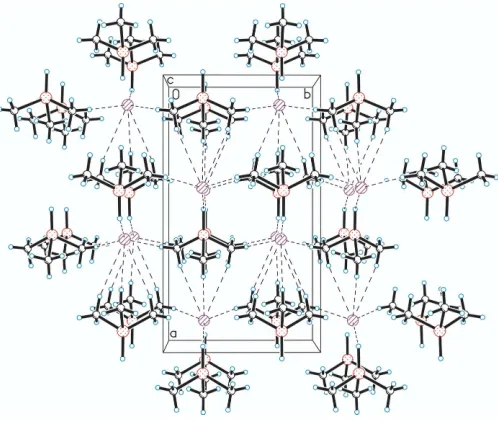
The I counteranion exhibits long-range van der Waals interactions with its surrounding H atoms [I H 3.15 (1)– 3.25 (1) A˚ ]; these stabilize the arrangement of (I) in the crystal packing (Fig. 2).
Experimental
GeI4(580.19, 1.0 mmol), As2Se3(193.4 mg, 0.5 mmol), Se (79.0 mg,
1.0 mmol) and K2CO3(138.2 mg, 1.0 mmol) were heated to 433 K in
CH3OH (0.8 ml) in a sealed glass tube. After 2 d, the contents were
cooled to room temperature to afford colourless crystals of (I) in 52% yield.
Crystal data
C3H10As+I
Mr= 247.93
Orthorhombic,Pnma a= 14.174 (3) A˚
b= 8.0458 (16) A˚
c= 6.2037 (12) A˚
V= 707.5 (2) A˚3
Z= 4
Dx= 2.328 Mg m
3
MoKradiation Cell parameters from 21
reflections = 6.2–15.0
= 9.04 mm1
T= 292 (2) K Block, colourless 0.410.330.21 mm
Data collection
SiemensP4 four-circle diffractometer !scans
Absorption correction: scan (XPREPinSHELXTL; Sheldrick, 1995)
Tmin= 0.040,Tmax= 0.152
671 measured reflections 671 independent reflections
576 reflections withI> 2(I) max= 25.0
h= 0!16
k=9!0
l= 0!7
3 standard reflections every 97 reflections intensity decay: none
Refinement
Refinement onF2
R[F2> 2(F2)] = 0.029
wR(F2) = 0.078
S= 1.16 671 reflections 30 parameters
H-atom parameters constrained
w= 1/[2(F
o2) + (0.0439P)2]
whereP= (Fo2+ 2Fc2)/3
(/)max< 0.001 max= 0.82 e A˚
3 min=0.73 e A˚
3
Extinction correction:SHELXL97
(Sheldrick, 1997)
Extinction coefficient: 0.0286 (17)
Table 1
Selected geometric parameters (A˚ ,).
As—C1 1.923 (6) As—C2 1.927 (8)
C1i—As—C1 98.9 (3) C1—As—C2 97.8 (2)
Symmetry code: (i)x;yþ1 2;z.
H atoms were located in a difference electron-density map but were refined with fixed individual displacement parameters [Uiso(H) =
1.5Ueq(C)] using a riding model, with C—H = 0.96 A˚ . The idealized
As—H bond length is 1.40 A˚ .
Data collection:R3m/V(Siemens, 1989); cell refinement:R3m/V; data reduction: XDISK(Siemens, 1989); program(s) used to solve structure: SHELXS97(Sheldrick, 1997); program(s) used to refine structure: SHELXL97 (Sheldrick, 1997); molecular graphics: SHELXTL(Sheldrick, 1995); software used to prepare material for publication:SHELXL97.
References
Ang, T. T. & Dunell, B. A. (1976).Can. J. Chem.54, 1985–1990.
Assenmacher, W. & Jansen, M. (1995).Z. Anorg. Allg. Chem.621, 143–148.
Collins, E., Sutor, D. J. & Mann, F. G. (1963).J. Chem. Soc.pp. 4051–4055. Minkwitz, R., Hirsch, C. & Berends, T. (1999).Eur. J. Inorg. Chem.12, 2249–
2254.
Sheldrick, G. M. (1995).SHELXTL. Release 5.03 for Siemens R3. Siemens Analytical X-ray Instruments Inc., Madison, USA.
Sheldrick, G. M. (1997). SHELXS97 and SHELXL97. University of Go¨ttingen, Germany.
[image:2.610.313.565.70.210.2]Siemens (1989).R3m/V(Version 3.2) and XDISK(Version 3.11). Siemens Analytical X-ray Instruments Inc., Madison, Wisconsin, USA.
Figure 1
The structure of (I). Displacement ellipsiods are drawn at the 50% probability level. [Symmetry code: (i)x,1
[image:2.610.316.565.267.478.2]2y,z.]
Figure 2
supporting information
sup-1
Acta Cryst. (2005). E61, o4229–o4230
supporting information
Acta Cryst. (2005). E61, o4229–o4230 [https://doi.org/10.1107/S160053680503792X]
Trimethylarsonium iodide
Tobias Van Almsick
Trimethylarsonium iodide
Crystal data C3H10As+·I−
Mr = 247.93
Orthorhombic, Pnma Hall symbol: -P 2ac 2n a = 14.174 (3) Å b = 8.0458 (16) Å c = 6.2037 (12) Å V = 707.5 (2) Å3
Z = 4 F(000) = 456
Dx = 2.328 Mg m−3
Melting point: not measured K Mo Kα radiation, λ = 0.71073 Å Cell parameters from 21 reflections θ = 6.2–15.0°
µ = 9.04 mm−1
T = 292 K Block, colourless 0.41 × 0.33 × 0.21 mm
Data collection Siemens P4 four-circle
diffractometer
Radiation source: fine-focus sealed tube Graphite monochromator
ω scans
Absorption correction: ψ scan
(XPREP in SHELXTL; Sheldrick, 1995) Tmin = 0.040, Tmax = 0.152
671 measured reflections
671 independent reflections 576 reflections with I > 2σ(I) Rint = 0.000
θmax = 25.0°, θmin = 2.9°
h = 0→16 k = −9→0 l = 0→7
3 standard reflections every 97 reflections intensity decay: none
Refinement Refinement on F2
Least-squares matrix: full R[F2 > 2σ(F2)] = 0.029
wR(F2) = 0.078
S = 1.16 671 reflections 30 parameters 0 restraints
Primary atom site location: structure-invariant direct methods
Secondary atom site location: difference Fourier map
Hydrogen site location: inferred from neighbouring sites
H-atom parameters constrained w = 1/[σ2(F
o2) + (0.0439P)2]
where P = (Fo2 + 2Fc2)/3
(Δ/σ)max < 0.001
Δρmax = 0.82 e Å−3
Δρmin = −0.73 e Å−3
Extinction correction: SHELXL97 (Sheldrick, 1997), Fc*=kFc[1+0.001xFc2λ3/sin(2θ)]-1/4
Special details
Geometry. All e.s.d.'s (except the e.s.d. in the dihedral angle between two l.s. planes) are estimated using the full covariance matrix. The cell e.s.d.'s are taken into account individually in the estimation of e.s.d.'s in distances, angles and torsion angles; correlations between e.s.d.'s in cell parameters are only used when they are defined by crystal symmetry. An approximate (isotropic) treatment of cell e.s.d.'s is used for estimating e.s.d.'s involving l.s. planes.
Refinement. Refinement of F2 against ALL reflections. The weighted R-factor wR and goodness of fit S are based on F2,
conventional R-factors R are based on F, with F set to zero for negative F2. The threshold expression of F2 > σ(F2) is used
only for calculating R-factors(gt) etc. and is not relevant to the choice of reflections for refinement. R-factors based on F2
are statistically about twice as large as those based on F, and R- factors based on ALL data will be even larger.
Fractional atomic coordinates and isotropic or equivalent isotropic displacement parameters (Å2)
x y z Uiso*/Ueq
I 0.40703 (3) 0.2500 0.09746 (9) 0.0509 (3)
As 0.08001 (5) 0.2500 −0.06698 (14) 0.0482 (3)
H3 −0.0166 0.2500 −0.1138 0.072*
C1 0.1327 (4) 0.0683 (7) 0.0946 (9) 0.0565 (14)
H1A 0.1985 0.0885 0.1196 0.085*
H1B 0.1253 −0.0329 0.0146 0.085*
H1C 0.1005 0.0588 0.2302 0.085*
C2 0.1695 (6) 0.2500 −0.3007 (13) 0.056 (2)
H2A 0.1538 0.3465 −0.3792 0.084*
H2B 0.2316 0.2500 −0.2407 0.084*
Atomic displacement parameters (Å2)
U11 U22 U33 U12 U13 U23
I 0.0487 (4) 0.0535 (4) 0.0505 (4) 0.000 −0.0053 (2) 0.000
As 0.0374 (4) 0.0659 (5) 0.0412 (5) 0.000 −0.0046 (3) 0.000
C1 0.066 (3) 0.048 (3) 0.055 (3) −0.007 (3) 0.001 (3) −0.002 (3)
C2 0.065 (5) 0.057 (5) 0.046 (4) 0.000 0.006 (4) 0.000
Geometric parameters (Å, º)
As—C1i 1.923 (6) C1—H1B 0.9600
As—C1 1.923 (6) C1—H1C 0.9600
As—C2 1.927 (8) C2—H2A 0.9432
As—H3 1.4000 C2—H2B 0.9557
C1—H1A 0.9600
C1i—As—C1 98.9 (3) H1A—C1—H1B 109.5
C1i—As—C2 97.8 (2) As—C1—H1C 109.5
C1—As—C2 97.8 (2) H1A—C1—H1C 109.5
supporting information
sup-3
Acta Cryst. (2005). E61, o4229–o4230
As—C1—H1A 109.5 H2A—C2—H2B 114.7
As—C1—H1B 109.5