Mid-IR Imaging and Multivariate Analysis of Dynamic
Processes in Pharmaceutically Relevant Microparticles
KELES, Hakan
Available from Sheffield Hallam University Research Archive (SHURA) at:
http://shura.shu.ac.uk/8158/
This document is the author deposited version. You are advised to consult the publisher's version if you wish to cite from it.
Published version
KELES, Hakan (2014). Mid-IR Imaging and Multivariate Analysis of Dynamic Processes in Pharmaceutically Relevant Microparticles. Doctoral, Sheffield Hallam University.
Copyright and re-use policy
See http://shura.shu.ac.uk/information.html
Sheffield Hallam University Research Archive
Mid-IR Imaging and Multivariate Analysis of Dynamic
Processes in Pharmaceutically Relevant Microparticles
Hakan Keles
A thesis submitted in partial fulfilment of the requirements of
Sheffield Hallam University
for the degree of Doctor of Philosophy
Collaborating Organisations:
EPSRC
&
Critical Pharmaceuticals Limited, Nottingham, United Kingdom
Acknowledgements
I would like to thank people whose support during this project was invaluable;
First of all, Chris Sammon for his help and scientific advice during this project which
helped me develop as a standalone researcher and for always being there when needed.
His great sense of humour and optimism made my PhD experience a fruitful one since
October 2010.
Andrew Naylor (at CPL) and Francis Clegg for the useful scientific discussions during
project meetings.
CPL staff for providing the samples and for their help with bulk characterisation
techniques.
Chris Breen and Jack Yarwood for their advice during PCAS Group meetings.
Christine Le Maitre (at The Biomedical Research Centre) for her help with
cryo-microtomy at the early stages of the project.
All the MERI staff, particularly Corrie Houton, Gillian Hill and Deeba Zahoor, for their
professional approach and prompt responses, without their great help it probably would
not be possible to complete this project on time.
Friends in the PCAS group;
Victoria Boyes, Prakash Muthudoss, Fabio Pappini, Marianne Labet, Michael Barwood,
Subodh Sabnis, Trinh Pham, Kerstin Mader and Thomas Smallwood.
My mother and mother in law for looking after Ela during my PhD studies.
EPSRC and CPL for the Industrial CASE sponsorship that financially supported this 42
month project.
And my better half, Nilgun, for supporting me by all means during this PhD, and
particularly for covering most of my responsibilities as a parent to Ela since August
i
Contents
List of Abbreviations... v
Abstract ... viii
1 Introduction ... 1
1.1 Drug Delivery ... 2
1.2 Controlled Release Drug Delivery ... 3
1.3 Polymers ... 5
1.3.1 Polymers in Sustained Release Drug Delivery ... 7
1.4 Proteins ... 11
1.4.1 Bovine Serum Albumin (BSA) ... 12
1.4.2 Human growth hormone (hGH) ... 12
1.5 Methods of Producing Controlled Release Drug Delivery Systems ... 13
1.5.1 Spray Drying ... 13
1.5.2 Emulsion ... 14
1.5.3 Supercritical Fluid Technologies ... 15
1.6 Mid-IR Spectroscopic Imaging and Analysis Concept ... 18
1.7 Project Aims ... 20
1.8 References ... 22
2 Experimental Methods and Data Analysis ... 27
2.1 Fourier Transform Infrared Spectroscopy ... 27
2.1.1 Infrared Theory ... 27
2.1.2 Fourier Transform Infrared Spectrometry ... 30
2.1.3 FTIR Imaging with Focal Plane Array Detectors ... 35
2.2 Raman Microspectroscopy ... 44
2.3 Scanning Electron Microscopy (SEM) ... 47
2.4 Ultraviolet-Visible (UV-Vis) Dissolution Testing ... 49
2.5 Sieving ... 49
2.6 Ultra-Microtomy ... 49
2.7 Gamma Irradiation ... 50
2.8 Differential Scanning Calorimetry (DSC) ... 50
2.9 High Performance Liquid Chromatography (HPLC) ... 51
2.9.1 Size Exclusion Chromatography (SEC) ... 52
ii
3 Evaluation of Relevant Image Analysis Tools and Development of NLCF
Methodology- A Direct Numerical Comparison on Mid-infrared Images Obtained from
A Degrading Single Microparticle ... 56
3.1 Introduction ... 56
3.2 Experimental ... 58
3.2.1 Materials ... 58
3.2.2 CriticalMixTM Process ... 59
3.2.3 Macro ATR-FTIR imaging of reactions with the Golden GateTM Sampling Accessory ... 59
3.2.4 Real-time ATR-FTIR Imaging of Reactions... 59
3.3 Raw Data and Pre-processing ... 61
3.4 Univariate Analysis ... 62
3.5 Multivariate Analysis ... 63
3.5.1 MCR-ALS- a Soft Modelling Tool ... 63
3.5.2 NLCF - A Hard Modelling Tool ... 64
3.6 Results and Discussion ... 68
3.6.1 Spatial Resolution Comparison ... 68
3.6.2 Image Comparison ... 71
3.6.3 Interface Analysis... 77
3.6.4 Degradation Rate Calculation ... 83
3.7 Conclusions ... 88
3.8 References ... 90
4 Investigation of Factors Influencing the Hydrolytic Degradation of Single PLGA Microparticles ... 95
4.1 Introduction ... 95
4.2 Experimental ... 97
4.2.1 Materials ... 97
4.2.2 CriticalMixTM Processing of PLGAs ... 97
4.2.3 γ-Irradiation ... 97
4.2.4 Scanning Electron Microscopy ... 97
4.2.5 Molecular Weight Determination ... 97
4.2.6 DSC ... 97
4.2.7 Macro ATR-FTIR imaging of reactions with the Golden GateTM Sampling Accessory ... 98
4.3 Data Processing ... 98
iii
4.4.1 The Effect of scCO2 Process on Morphology and Hydrolytic Degradation
of PLGA Microparticles ... 98
4.4.2 The effect of Composition and Temperature on Hydrolytic Degradation Kinetics of scCO2 processed PLGA ... 104
4.4.3 Visual Evidence of Lactic acid Diffusion from a Degrading PLA Microparticle ... 112
4.4.4 The Effect of γ-Irradiation on Hydrolytic Degradation of PLGA 50/50 114 4.5 Summary of the Findings ... 120
4.6 Conclusions ... 121
4.7 References ... 123
5 Investigation of Physiochemical Factors Affecting the Protein Release from γ-Irradiated PLGA Microparticles ... 127
5.1 Introduction ... 127
5.2 Experimental ... 129
5.2.1 Materials ... 129
5.2.2 Spray Drying of hGH ... 129
5.2.3 Preparation of Microparticles Using scCO2 Processing ... 130
5.2.4 Sieving of Microparticles ... 130
5.2.5 Sample Preperation for Micro-ATR-FTIR Imaging ... 130
5.2.6 γ-Irradiation ... 130
5.2.7 ATR-FTIR Spectroscopy ... 131
5.2.8 Transmission FTIR Imaging ... 131
5.2.9 Micro-ATR-FTIR Imaging ... 131
5.2.10 Macro-ATR-FTIR Imaging of Drug Release from Individual Microparticles ... 131
5.2.11 FTIR Imaging Data Processing ... 132
5.2.12 Scanning Electron Microscopy ... 132
5.2.13 UV-Vis Spectrophotometry of Pure hGH ... 133
5.2.14 In vitro Drug Release ... 133
5.2.15 DSC ... 133
5.2.16 Evaluation of hGH Stability and Integrity ... 133
5.2.17 Molecular Weight Determination ... 133
5.3 Results and Discussion ... 133
5.3.1 Determination of The Spatial Distribution of Encapsulated hGH within The Microparticles ... 133
iv
5.3.3 Effect of Gamma Irradiation on Redistribution and Release of hGH from
Single Microparticles ... 139
5.3.4 SEM of hGH Loaded Formulations ... 140
5.3.5 Determination and Comparison of Dissolution Profiles Obtained from FTIR Images ... 143
5.3.6 The Nature of Released Species ... 149
5.3.7 Effect of γ-irradiation on the Chemistry of PLGA, PLA and Poloxamer 407……. ... 151
5.3.8 Summary of the Findings ... 159
5.4 Conclusions ... 160
5.5 References ... 163
6 Overall Conclusions and Further Work ... 167
6.1 Introduction ... 167
6.2 Overall Conclusions ... 167
6.3 Further Work ... 170
6.3.1 FTIR Imaging of Microparticles ... 170
6.3.2 Multivariate Analysis of FTIR Images for Studying Kinetic Processes in Microparticle Systems ... 170
6.3.3 Real-time Monitoring of Polymer Degradation Using FTIR Imaging.... 171
6.3.4 Real-time Monitoring of Drug Release Using FTIR Imaging ... 171
Word Count ... 173
Appendix ... 174
PAPER I
v
List of Abbreviations
API Active pharmaceutical ingredient
ATR Attenuated total reflection
B Hydrated layer size
BSA Bovine serum albumin
cm-1 Wavenumber
CPL Critical Pharmaceuticals Limited
CPU Central processing unit
D2O Heavy water
DSC Differential scanning calorimetry
FDA U.S.A Food and Drug Administration
FoV Field of view
FPA Focal plane array
FTIR Fourier transform infrared
FWHM Full width at half maximum
GA Glycolic acid
Ge Germanium
GPC Gel permeation chromatography
GRAS Generally recognised as safe
h Hour
H2O Water
HEPES 4-(2-hydroxyethyl)-1-piperazineethanesulfonic acid
hGH Human growth hormone
vi
IR Infrared
k Degradation rate
K Kelvin
kGy Kilo Gray
LA Lactic acid
m Minute
MCR Multivariate curve resolution
MCR-ALS Multivariate curve resolution-alternating least squares
MCT Mercury-cadmium-telluride
Mid-IR Medium-infrared
mm Millimetre
Mn Average molecular weight
Mw Molecular weight
NA Numerical aperture
NLCF Non-linear curve fitting
nm Nanometre
PBS Phosphate buffer saline
PCA Principal component analysis
PDI Polydispersity index
PH Peak height
PLA Poly(lactic acid) or Polylactide
PLGA Poly(lactic-co-glycolic acid)
PGSS Particles from gas saturated solutions
vii
RAM Random-access memory
ROI Region of interest
ScCO2 Supercritical carbon dioxide
sd Spray dried
SEC Size-exclusion chromatography
SEM Scanning electron microscopy
t Time
Tc Crystallisation temperature
Tg Glass transition temperature
Tm Melting temperature
UV Ultraviolet
UV-Vis Ultraviolet-Visible
2D 2 Dimensional
3D 3 Dimensional
γ Gamma
λ Wavelength
°C Degree Celsius
viii
Abstract
Sustained release microparticles used for parenteral drug delivery must be well characterized in terms of their size range, morphology and function. It is widely understood that the chemistry and morphology of microparticles have a degree of interdependence which strongly affects drug release behaviour from microparticles. This thesis investigates, for the first time, the use of mid-IR imaging along with the development and optimisation of relevant multivariate image analysis methods for studying the real-time degradation of pharmaceutically relevant biodegradable polymer microparticles and the real-time release of protein based drugs from such microparticle systems.
The application of attenuated total reflection - Fourier transform infrared spectroscopic (ATR-FTIR) imaging and analysis to monitor the degradation of a single microparticle is optimised and the developed methodology is detailed. A series of time resolved images of a PLGA microparticle undergoing hydrolysis at 70 °C are obtained using ATR-FTIR imaging for the first time. A novel partially supervised non-linear curve fitting (NLCF) tool is developed and the output from the NLCF is evaluated by direct quantitative comparison with a traditional peak height (PH) data analysis approach and multivariate curve resolution alternating least squares (MCR-ALS) analysis for the same images, in order to develop an image analysis strategy. The NLCF method is shown to facilitate the calculation of hydrolysis rate constants for both the glycolic (kG) and lactic (kL) segments of the PLGA copolymer. This results in improved spatial resolution on time-resolved microparticle images, so providing better insight into the dimensions of hydration layers and particle dimension changes during hydrolysis when compared to images derived from both PH measurements and ALS. The MCR-ALS routine is shown to be faster than NLCF and its images are found to provide sufficient contrast to be used for qualitative comparison.
The optimised mid-IR-ATR procedures are then applied to investigate several factors influencing the hydrolytic degradation of a family of PLGA microparticles. Degradation rate constants for glycolic and lactic units are shown to increase (whilist maintaining a ~1.3 ratio between each other) with increasing initial glycolic content of the copolymer, temperature or γ-radiation exposure. Differential scanning calorimetry (DSC) and gel permeation chromatography (GPC) results indicate a chain scission based degradation in PLGA upon γ exposure. The distribution of lactic acid is probed with IR during the hydrolysis of a PLA microparticle for the first time, showing a diffusional pathway from the degrading microparticle outwards into surrounding water.
Utilising the chemical selectivity of the infrared methodology, ATR-FTIR imaging is applied for the first time to monitor the redistribution and release of human growth hormone (hGH) from a range of CriticalMixTM processed PLGA/PLA microparticles during a set of dissolution experiments at 37 °C in D2O. Increasing the γ dose is shown
to have a profound influence on the release mechanism, with higher γ doses leading to a dramatic increase in the initial burst release followed by retardation in the sustained release and a lower total level of hGH release over the dissolution experiment. These changes are shown to be the result of: (i) protein aggregation as a function of applied γ-dose as studied by size exclusion chromatography; (ii) decrease in overall porosity as studied by SEM; (iii) decrease in Mw of all of the component polymers post γ irradiation
1
1
Introduction
This thesis investigates the use of Mid-IR spectroscopic imaging and relevant
multivariate data analysis techniques to characterise the degradation kinetics of
biodegradable polymer microparticles and the release of protein drugs from such
matrices.
The work presented within this thesis was conducted at Sheffield Hallam University in
collaboration with Critical Pharmaceuticals Ltd. This chapter provides a brief
introduction into the drug delivery systems investigated within this thesis. It includes
information about polymers, proteins and controlled release drug delivery systems along
with production methods for such systems with particular attention to supercritical CO2
based processes among which a modified particles from gas saturated solutions (PGSS)
method (CriticalMixTM) was used to produce the samples studied here by the
collaborating company.
In this chapter a very brief initial insight is given for Mid-IR spectroscopic imaging,
including its relevance for studying polymer degradation and drug release before the
aims of this work are discussed in detail.
In Chapter 2, the theory of the main method of study, FTIR spectroscopy and imaging,
is detailed and relevant data analysis techniques are discussed. Other characterisation
methods including scanning electron microscopy, chromatography, differential scanning
calorimetry, UV-Vis dissolution testing and microscopic sample preparation method
(ultra-microtomy) are also detailed including information regarding the parameters and
methods used.
Chapter 3 demostrates the optimisation of ATR imaging method coupled with relevant
image analysis techniques for studying degradation in single polymeric microparticles.
A direct numerical comparison of three data analysis methods: peak height
measurements, soft and hard modelling, is studied using the same IR image set of a
PLGA 75/25 microparticle undergoing hydrolysis at 70 °C.
In Chapter 4, a range of single PLGA microparticles are studied using the ATR imaging
methodology developed in Chapter 3. Effect of CriticalMixTM process, copolymer ratio
2
PLGA based microparticle systems) on hydrolytic degradation behaviour of individual
PLGA microparticles is investigated and results are discussed.
In Chapter 5, a lead controlled release formulation that consists of PLGA/PLA polymers,
an excipient (Poloxamer 407) and human growth hormone (hGH) is initially
investigated in terms of its components’ spatial distributions in dry form in order to
validate the formulation model. The release of hGH from scuh complex formulation is
monitored using ATR-FTIR imaging. Finally the effect of γ- irradiation on the stability
of PLGA microparticles and on the release of the hGH protein from the microparticles
is investigated using FTIR imaging, SEM analyses and using a combination of
conventional bulk methods including; differential scanning calorimetry (DSC) to
understand thermal properties of irradiated and un-irradiated pure polymers, gel
permeation chromatography (GPC) to monitor effect of irradiation on the molecular
weight of the polymers, UV-Vis spectrophotometry to monitor in vitro API release from
the microparticles and size exclusion chromatography (SEC) to determine protein
aggregation and stability.
The overall conclusions and possible further work are summarised in Chapter 6.
1.1 Drug Delivery
The concept of drug delivery is the administration of active pharmaceutical ingredients
(APIs) to patients, in sufficient amounts that they reach and treat the targeted region of
body without causing any adverse effect(s). Although this can be achieved by several
routes including parenteral (which is achieved thorugh injection; into a vein, under the
skin or into a muscle, or through inhalation or through absorption by intact skin), oral,
pulmonary or nasal application, the administration of proteins are limited to the
parenteral (often subcutaneous) type as their high molecular weight or poor stability
blocks their transdermal, nasal or oral delivery.
Another problem in the delivery of proteins and peptides is their short half-life in the
human body. Therefore their unfavourable pharmacokinetics means that they are
usually administered by frequent injections, for example for human growth hormone
deficiency every 3 days, which is inconvenient for patients and can affect patient
compliance. However, the development of sustained release formulations can overcome
these issues as controlled release drug delivery is used to delay the release of drugs
3
1.2 Controlled Release Drug Delivery
The use of biodegradable polymers is one of the fundamental ways of controlling
release systems. There are three different types of micro-scale controlled release
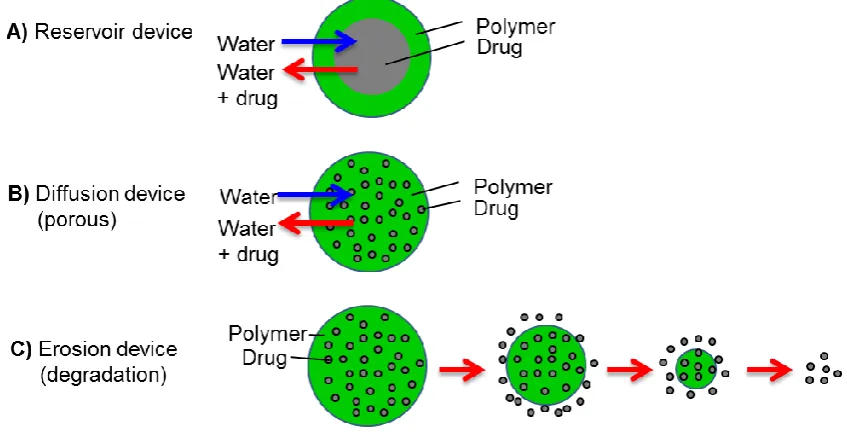
systems; (1) reservoir devices, where the drug is released upon degradation of a
biopolymer that is used to encapsulate it avoiding immediate release, (2) diffusion
devices, where the drug is released through pores of the biopolymer matrix and (3)
erosion, where the drug release is based up on degradation of the biopolymer matrix.
However for porous biopolymer matrices it is often the case that combination of last
two hypotheses occurs as initially the surface attached drug molecules will be released
upon contact with aqueous media by diffusion through pores and finally the degradation
of biopolymer will result in release of the drug molecules entrapped deeper in the
biopolymer matrix (Figure 1.1).
Figure 1.1 Controlled release scenarios for polymer microparticles; (a) reservoir
devices, (b) diffusion of drug from porous polymer matrix and (c) erosion
mechanism where the drug molecules are released as they become free from
degrading polymer.
In recent years research in molecular and cell biology to meet clinical needs has
intensified the interest in biologics, a variety of therapeutics such as vaccines,
recombinant proteins and peptides, genes, viruses and synthetic tissues, ensuing a strong
market growth [1]. As a result, currently hundreds of recombinant proteins and peptides
[image:15.595.117.541.317.533.2]4
There are numerous candidate biodegradable polymers for carrying and releasing
biologics as shown in Figure 1.1 however concerning biocompatibility to human body,
the FDA approved ones are few [2,3].
Poly (lactide-co-glycolide) (PLGA) is a FDA approved biodegradable synthetic
polyester that is physically strong and highly processable [4]. Hence PLGA has been the
most studied carrier matrix for macromolecules such as proteins, DNA, RNA, vaccines
and peptides for treatment of important diseases such as cancer, human growth
deficiency and multiple sclerosis [3].
Another advantage of PLGA is that its degradation in vivo is controllable by choice of
polymer molecular weight and copolymer ratio (lactide to glycolide (L/G)) and yields
lactic and glycolic acids, which are biocompatible and rapidly cleared from the body via
the renal system [2].
The number of PLGA based formulations that are readily administered through a
syringe, has been researched increasingly resulting in many formulations that are
[image:16.595.115.538.429.649.2]marketed today including ones given in Table 1.1.
Table 1.1 PLGA based microparticle formulations available in the market [1,3].
From the pharmaceutical manufacturing technology perspective, the key goal;
controlling the release of the drug for longer periods without causing any degradation of
the drug at production stage, can be achieved by obtaining a homogenous distribution of
the drug within the matrix. The following sections will give relevant details of the
5
protein loaded polymer microparticle systems, with a focus on relation to the novel
microparticle systems characterised in this thesis.
1.3 Polymers
The self-definition of ‘polymers’ can be derived from the Greek words ‘poly’ meaning
‘many’ and ‘mono’ meaning ‘one’, as polymers are macromolecules built up from
monomers covalently bonded together forming a chain type structure. Repeating
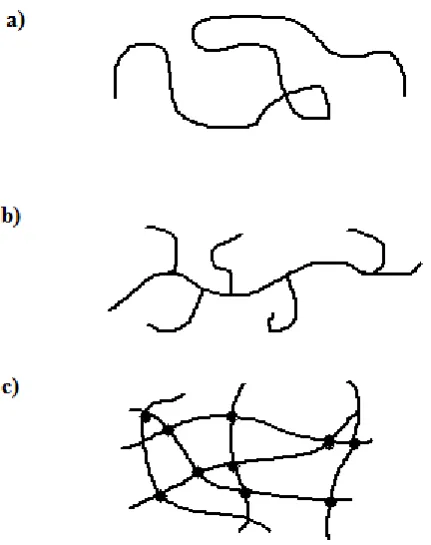
monomer units connected together may form linear, branched or 3D structured
(cross-linked polymers in which one chain is bonded with monomers of another chain) types
[image:17.595.219.435.267.540.2]as illustrated in Figure 1.2.
Figure 1.2 Linear (a), branched (b) and 3-dimensional (c) structures of polymers.
Since the initial understanding of their structure by Hermann Staudinger [5], polymers
became the most versatile material type in our daily lives ranging from the simplest
form as a recyclable carrier bag, to arguably more complicated and important forms
such as long life batteries used in mobile electronic devices or biodegradable matrices
for carrying drugs.
Polymers can be grouped most generally in to two; biopolymers (polymers with natural
origin) such as chitosan and proteins, or synthetic polymers including biodegradables
6
poly(β-malic acid)) and non-biodegradables such as silicones and some acrylic
polymers [6]. Step growth polymerisation and chain growth polymerisation are the two
principal methods for synthesising man-made polymers [7]. Step growth polymerisation
occurs as multifunctional monomers react to form dimers, trimers longer oligomers and
long chain polymers at the end of the reactions. Chain growth polymerisation occurs as
the unsaturated monomers continuously add onto the growing polymeric chains.
Polymers exhibit two types of morphology; crystalline in which molecules are packed
in regular arrays and amorphous in which molecules are oriented randomly and are
entangled and most polymers contain both crystalline and amorphous regions
(semicrystalline). At low temperatures the molecules of an amorphous polymer vibrate
at low frequency, exhibiting solid state properties, this is termed as the ‘glassy state’.
Upon heating an amorphous polymer, due to the increase in molecular energy, a
transition occurs from the glassy state to a rubbery state and the inflection temperature
at which this effect occurs is called the glass transition temperature (Tg). Crystalline
polymers show a clear phase transition upon heating; melting. The temperature at which
this thermodynamic effect occurs is called melting temperature (Tm).
Differential scanning calorimetry (DSC) which is discussed in Chapter 2 can be used to
determine the melting temperature and the glass transition temperature of polymers.
Thermal properties of polymers are often dependent on their molecular weight which
can be given as;
∑
∑ Equation 1.1
or their molecular number which can be given as;
∑
∑ Equation 1.2
where Niis the number of molecules with length i and Mi is the mass of polymer chain
with length i, both define the size of a molecule and can both be measured using gel
permeation chromatography (GPC) [8] as discussed in Chapter 2.
Most polymers vary in their chain lengths. Their distribution in the length of the chains
is defined as polydispersity index (PDI) which is molecular number per molecular
weight. The decrease in molecular weight due to degradation, measured with GPC, can
7
Copolymers are substances that are usually produced by step polymerisation from
chains in which two or more different monomers are connected through covalent bonds.
Copolymers are useful in that thermodynamic and physicochemical properties of
polymers therein can be improved and modified. Considering their form, copolymers
can be grouped as; ‘random’ in which two or more different repeating units are
distributed randomly, in which sequences of the different monomers alternate without
any regular pattern and block in which long sequences of monomers are followed by
another of the same or graft in which one type of monomer chain is connected to
another as branches at different points. The formation of copolymers results in a
combination of the properties of the original homopolymers and this can improve the
properties of the individual polymers such as tensile strength, reactivity and
thermodynamic properties [9].
Two or more polymers or co-polymers can be mixed, typically; by heating and/or
stirring or by dissolving each in a co-solvent adding together and letting solvent
evaporate or using one monomer as a solvent for another, resulting in a ‘blend’ in which
polymers are connected by intermolecular forces, but not covalent bonds. Depending on
their homogeneity at a molecular level, polymer blends are classed as miscible (very
homogenous) or immiscible (phase separated) showing single or multiple Tg in DSC
analysis, respectively.
1.3.1 Polymers in Sustained Release Drug Delivery
The use of biodegradable and biocompatible (i.e. that can degrade in to molecules that
are not toxic to human body and therefore are ejected without causing any damage)
polymers enables the extended release of drugs.
During this project, two polymers have been used as the drug carrier matrix, poly(lactic
acid) (PLA) and poly (lactide-co-glycolide) (PLGA). Poloxamer407, accepted as a
GRAS (generally regarded as safe) has also been used as a processing aid in the
production of these microparticles as it enhances the drug release [10].
1.3.1.1 Poly(lactic acid) (PLA)
PLA has 3 stereoisomers that are the crystalline l-PLA and d-PLA forms and the
amorphous DL-PLA [11]. The most common synthetic route to produce PLA is via the
ring opening polymerisation of lactide which is catalysed by stannous octanoate (Figure
8
Figure 1.3 Synthesis of PLA where chiral centres are indicated with X.
PLA are more suited as implants than controlled release delivery devices as their
crystalline nature retards their water uptake causing long degradation times (typically
more than a year depending on molecular weight). Upon contact with aqueous media,
PLA undergoes hydrolysis and breaks down to lactic acid fragments. PLA has a Tg of
about 60-65 ºC and a melting temperature of about 173-178 ºC [11].
1.3.1.2 Poly(lactide-co-glycolide) (PLGA)
PLGA is synthesised by the ring opening polymerisation of the cyclic diesters of lactic
acid and glycolic acid, catalysed by stannous octanoate (Figure 1.4) [12].
Figure 1.4 Synthesis of PLGA.
Although PGA is not useful as a drug delivery device due to its high crystallinity and
high melting temperature, as mentioned earlier in this chapter, PLGA, a copolymer of
glycolic acid (GA) and lactic acid (LA), is the most used biodegradable polymer in
delivery of biologics [13]. Depending on the ratio of lactide to glycolide used for the
polymerization, different forms of PLGA can be obtained. These are usually identified
by the monomer ratio used. For example PLGA 75:25 identifies a copolymer
composition of 75% lactic acid and 25% glycolic acid. All PLGAs are amorphous rather
than crystalline and show a glass transition temperature in the range of 40-60 °C [12].
Unlike the homopolymers of lactic acid (polylactide) and glycolic acid (polyglycolide),
which show poor solubilities, PLGA has the property of hydrophobicity and therefore
9
acetate. The production of a 50:50 mixture of these two polymers also reduces the
degradation time of PLA from several months to few weeks.
Figure 1.5 Structures of PLA, PGA and PLGA.
As shown in Figure 1.5, PLA contains an additional methyl group over PGA which
creates the amorphous nature by making chain packing more difficult whereas the
absence of this group allows PGA to be crystalline. As PLGA is a copolymer of these
two monomers it is less crystalline compared to PGA, due to the addition of the methyl
group. And this provides the observed differences in the degradation rates. Degradation
rates of bulk PLGAs can be calculated using Raman and IR spectroscopies [14]. PLGA
can degrade via hydrolysis of the ester linkage into small, water soluble fragments.
1.3.1.2.1 PLGA Hydrolysis
When PLGA is exposed to an aqueous solution or vapour, the ester carbonyl is subject
to nucleophilic attack by water, as shown in Figure 1.6 [15]. The ester group in these
polymers will be hydrolysed via a tetrahedral intermediate to give primary OH and
carboxyl end groups, resulting in chain cleavage. Esters are vulnerable to hydrolysis
because the electron withdrawing effects of the attached oxygen atoms result in a
partially positive ester carbon. The accumulation of carboxylic acid hydrolysis products
in PLGA matrices results in autocatalysis of the hydrolysis reaction which is followed
by addition of a proton to carbonyl oxygen, which facilitates the reaction by stabilizing
10
Figure 1.6 PLGA hydrolysis mechanism via ester links. R groups represent CH3
for lactide and H for glycolide. The resulting alcohol can abstract a proton from
the carboxylic acid during the chain cleavage step as shown, or a proton addition
to alcohol and removal from carboxylic acid can be provided by water (from [15]).
Alteration of either the PLA:PGA ratio, molecular weight or PDI can change the
degradation rate of PLGA. Glycolic acid is slightly more hydrophilic than lactic acid,
therefore increased glycolic acid content may lead to an increase in the hydrolysis rate
for the same morphology and size of particles [13]. Typical ratios of lactide to glycolide
range from 50:50 to 100:0 with molecular weights typically ranging from 10 to 100 kDa
(or 103 unified atomic mass units). The hydrolysis rate of PLGA also depends on its end
groups which may be carboxylic acid, making the polymer more hydrophilic or
ester-capped, decreasing the rate.
1.3.1.3 Poloxamer 407
Poloxamer 407 (also known as Lutrol or Pluronic F127), poly(ethylene
oxide)/poly(propylene oxide)/poly(ethylene oxide) (PEO–PPO–PEO) triblock
copolymers, is a hydrophilic surfactant and best known for its use in mouthwash and
contact lens solutions where its function is to help remove organic molecules such as
lipids by increasing their solubility in aqueous media.
11
Surfactants are often used to increase the water solubility of poorly soluble drugs, in
pharmaceutical formulations.
In controlled release drug delivery, poloxamer 407 is shown to enhance solubilisation of
biologics and also prolong their release [16].
1.4 Proteins
Like other bio-macromolecules such as nucleic acids, proteins are essential parts of
organisms and participate in many processes within cells. With varying sizes and
molecular weights, proteins have a range of functions as they are able to bind to other
biomolecules, nucleic acids and metal ions [17]
Linkage between amino acids result in long polymer chains called proteins. Proteins
consist of carbon, hydrogen, nitrogen, oxygen and sulphur atoms, for example,
C990H1532N262O300S7, namely human growth hormone.
Figure 1.8Structure of an amino acid showing the amine in the left hanside and
carboxyl group in the right hand side circles, respectively.
There are twenty common types of aminoacids that vary in their R groups (Figure 1.8).
Aminoacids can be grouped as non-polar, uncharged polar and charged polar [17]. Non
polar amino acids tend to be unreactive. Uncharged polar amino acids contain either
hydroxyl or amine groups, which are capable of hydrogen bonding to other residues and
the third group can bind to metal ions and which is important in biology [17].
The primary structure of a protein is the sequence of aminoacids of this backbone. The
secondary protein structure is the specific geometric shape caused by intramolecular and
intermolecular hydrogen bonding of amide groups. Proteins have three common
secondary structures, α-helix, β-sheet and turn [17]. The secondary structure of proteins
can readily be characterised by FTIR spectroscopy [18]. The tertiary structure of
proteins is the bending and twisting of the polypeptide backbone into a compact
structure. Several polypeptide chains may exhibit weak interactions forming large
12
detect proteins when dissolved in a solution as proteins absorb UV light at 200nm
(peptide bonds) and ~280 nm (aminoacids with aromatic rings, Tyrosine and
Tryptophan) [19].
1.4.1 Bovine Serum Albumin (BSA)
With its 582 amino acids and 66267 Da total molecular weight, BSA is a large and
widely used model protein as it is not only cheap but also stable at 60 ºC up to 10 hours
[20]. BSA has a total charge of -18 (at pH 7) which is high due to its charged amino
acids such as arginine and aspartic acid. BSA has been used as a model protein in this
project for the preliminary investigations of a single polymer formulation.
Figure 1.9 BSA structure showing the three charge domains.
1.4.2 Human growth hormone (hGH)
Human growth hormone (hGH) has been used to treat various diseases including
children with growth hormone deficiency (paediatric hypopituitary dwarfism),
muscle-wasting disease associated with HIV, Turner's syndrome for girls and chronic kidney
failure [21]. For children’s growth deficiency treatment it is delivered via a painful
injection ~3 times a week, consuming valuable hospital resources and resulting in poor
patient compliance.
hGH contains 191 amino acid residues and is a single chain peptide with a molecular
weight of ~22.13 kDa and melting point of 76 ºC [22]. Its secondary structure, shown in
Figure 1.10, contains four helices connected with random loops and chains and
internally cross linked by two disulfide bonds that provide stability and enable
13
Figure 1.10 hGH secondary structure (from [22]).
1.5 Methods of Producing Controlled Release Drug Delivery Systems
In order to produce microparticles that follow one or both of the hypothesised scenarios
shown in Figure 1.1b and Figure 1.1c, the drug needs to be mixed with the polymer(s)
homogenously and this is mainly dependent on liquefication of the polymer(s) during
the formation of the particles. Common methods for producing sustained release drug
delivery systems differ mainly in how they are liquefied, as outlined in this section.
1.5.1 Spray Drying
Spray drying is an established method in the food industry for producing a range of dry
powder form products including coffee and milk powder [23]. The use of spray drying
is also common in micronisation (the process of reducing particles to a size of less than
typically 10 μm) of drug-polymer formulations in the pharmaceutical industry. During a
typical micronisation process a solvent such as dichloromethane (DCM), in which the
polymer of interest is dissolved initially, is mixed with the drug, forming a solvated
mixture. This mixture is then induced to atomise and forms droplets as it is forced
through a nozzle as shown in Figure 1.11. The spray is dried by applying a hot (~65 °C)
14
Figure 1.11 Schematic diagram of spray dryer (from [24]).
The spray drying method has been studied widely for producing PLGA based sustained
release devices as carriers for various biologics and has been shown to be successful in
producing <100 µm microspheres with encapsulation efficiencies up to ~80% [3,25,26].
However, considering the efficacy of proteins that are very sensitive to temperature and
the biocompatibility of the produced formulation, the high process temperatures
(beyond 60 ºC) and the possible existence of toxic solvent residues within
microparticles caused by insufficient drying, exist as critical drawbacks.
1.5.2 Emulsion
Emulsification processes can be grouped into two; single and double [3]. The former
involves two main steps; firstly, dissolving the polymer in an organic solvent such as
chloroform and adding the drug molecules to this solution and secondly, adding this
mixture into a water- emulsifier mixture and stirring. Upon evaporation of the solvent,
the drug loaded polymer solidifies in the aqueous phase. As one can expect by the
description of the method, single emulsification is not suitable for water soluble drugs
[4].
The double emulsion method is similar to the single emulsion one, the only difference
being that the drug molecules are dissolved in water before being added to the polymer
solution, such that a primary emulsion is formed on mixing. The rest of the procedure
follows as in single emulsification. A stabilizer such as polyvinyl alcohol (PVA) may
15
Since the solvents used can cause degradation, emulsification is not suitable for the
encapsulation of sensitive drugs such as proteins into biodegradable polymers such as
PLGA. Requiring the use of large amounts of solvents, this method is also expensive
and has potential environmental hazards.
1.5.3 Supercritical Fluid Technologies
Substances become supercritical fluids (SCF) when placed above their critical point (i.e.
above their critical temperature and critical pressure) exhibiting the flow properties of a
gas (i.e. showing low viscosity) and the dissolving power of a liquid, thus becoming
ideal solvents [27].
SCF, first observed by Cagniard de la Tour in 1822 [28], can easily penetrate through
materials because they do not exhibit significant surface tension, and their solvent
power can be controlled by altering temperature and/or pressure as it is related to their
density [29].
Among many other molecules including propane, ethane, ammonia and water, carbon
dioxide has become the fluid of choice in SC processes because it is cheap,
non-flammable, has GRAS (generally regarded as safe) status, is environmentally acceptable
and may be recycled. ScCO2 is best known for its ‘famous’ application of caffeine
extraction from coffee beans, but perhaps more importantly, its easily achievable critical
point (31.1ºC and 73.8 bar) also makes it ideal for processing biologics without causing
denaturation [30].
During the last decade, drug encapsulation of polymer microparticles using supercritical
fluid technology has been reported using a number of methods. These include expansion
of supercritical solutions (RESS), gas solvent techniques (GAS), supercritical
anti-solvent technique (SAS) and particles from gas saturated solutions (PGSS) [31]. One
disadvantage of scCO2 considering applicability for wide use is that only non-polar and
some low polar molecular substances can dissolve in scCO2. However for the latter
method, PGSS, this is not a concern, particularly for biodegradable polymers and most
biologics as they do not need to be dissolved in CO2 as detailed in section 1.5.3.4.
1.5.3.1 Rapid Expansion of Supercritical Solutions (RESS)
This process requires both the polymer and drug to be dissolved in scCO2, before being
mixed and then forced through a nozzle (typically <150 µm) into a lower pressure zone.
16
process however since only a few polymers are soluable in scCO2 this method has not
been widely applied. In the case of having to use a poor scCO2 soluble polymer, organic
co-solvents can be added to improve solubility; however this may cause protein
degradation. Also, the processes may have to be performed at temperatures over 100 ºC
and 200 bar, to improve polymer solubility, which makes it impossible to process
biologics without damaging them [31].
1.5.3.2 Gas Antisolvent Technique (GAS)
In this process, scCO2 acts as an anti-solvent (a solvent in which the product is insoluble)
therefore the polymer and drug are not required to dissolve in scCO2. A solution of the
drug and polymer in an organic solvent is produced beforehand and scCO2 is then
gradually added. As the polymer and drug are insoluble in the scCO2 they come out as
microparticles.
This process has been used to prepare insulin and insulin/PEG loaded PLLA
nanoparticles with ~94% encapsulation efficiency and very low residual content ~300
ppm) [33]. However, solvent residue issues cannot be overcome with this technique.
1.5.3.3 Supercritical Antisolvent Technique (SAS)
Although this is a similar process to GAS, based on scCO2 being used as an antisolvent,
it is different in that the polymer-drug solution is forced through a nozzle or capillary
into the scCO2 phase. The solvent then evaporates forming encapsulated polymer
microparticles. Using this process Duarte et al. produced naproxen-loaded microspheres
from ethylcellulose/methylcellulose blends for oral delivery that showed a sustained
release of the drug [34].
1.5.3.4 Particles from Gas Saturated Solution (PGSS)
This process, first developed for the coatings industry [35], is simply analogous to
painting with a spray coater using small particles. After its reported suitability for
micronisation of nifedipine [36], a small molecule drug, more recent developments have
focused on production of drug particles entrapped within polymers in microparticle [37],
implant [38] or scaffold [39] form. Unlike the aforementioned methods, PGSS has the
advantage in that it works in the absence of organic solvents and the polymer and drugs
do not need to be soluble in scCO2. However the polymer needs to be sufficiently
plasticised by scCO2. This is achievable at moderate temperatures (typically <40 °C)
and pressures (<150 bar) which have been shown to have no adverse effect on the
17
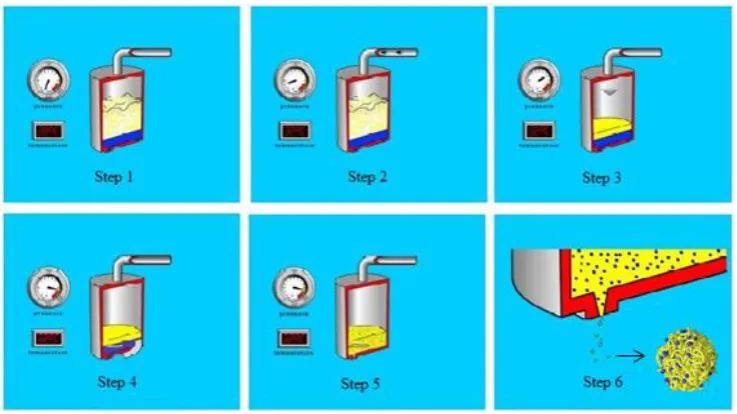
PGSS procedure for producing a protein encapsulated polymer formulation is illustrated
in Figure 1.12. The polymer and drug are initially added to a high pressure vessel
(Figure 1.12-step1). CO2 is added and the temperature and pressure are set to the critical
conditions of CO2 (Figure 1.12-step2). Then as a result, as shown in Figure 1.12-step3,
the polymer liquefies. The plasticised mixture is then stirred with a helical impeller
(Figure 1.12-step4) to mix the drug molecules with liquefied polymer until a
homogenous mixture is formed as depicted in Figure 1.12-step5. This polymer/drug
mixture is then let through a nozzle generating particles as shown in Figure 1.12-step6.
Upon spraying, the CO2 evaporates setting the shape of the particles as the polymer
solidifies [31]. Using different nozzles, the particle shape and size can be controlled.
An important complication of this process may be that the escaping CO2 can influence
polymer morphology, for example generating macroporosity [40]. Further this process
requires high precision equipment which is expensive both to modify for drug
encapsulation and to maintain.
Figure 1.12 Schematic diagram of the processing steps of PGSS method (from
[41]).
1.5.3.4.1 A Custom Built PGSS Apparatus-CriticalMixTM
A high pressure particle rig was developed at University of Nottingham implementing
the PGSS process to encapsulate drugs within polymer microparticles [42].
The CriticalMixTM method is a novel PGSS approach developed using this rig, and was
[image:29.595.143.512.367.574.2]18
process with 100% encapsulation efficiency [37]. The workings of the method are
briefly outlined below.
When suitable polymers, such as PLGA, PLA and protein particles, such as BSA, hGH,
are exposed to scCO2 in a pressure vessel, the polymer is liquefied, thereby allowing the
protein to be mixed efficiently with the polymer. Following mixing, the mixture is
depressurised through a nozzle whereby the CO2 returns to a gaseous state and
evaporates whilst the polymer solidifies around the protein, resulting in the production
of microparticles with the protein distributed throughout.
For the formulations investigated in this thesis, a typical batch was prepared by adding
2.1 g of a pre-weighed combination of polymer, protein and excipients such as
Poloxamer407 to the PGSS apparatus. The apparatus was sealed, pressurised with CO2
to 700 psi (48 bar) and heated to 40 °C. Once at temperature, the pressure was increased
to 2030 psi (140 bar). The liquefied protein/polymer mixture was then stirred at 150
rpm for 1 hour, after which time stirring was stopped and the mixture was depressurised
through a nozzle generating microparticles. These were collected in a cyclone and
recovered as a free flowing white powder.
1.6 Mid-IR Spectroscopic Imaging and Analysis Concept
The subject of this thesis is the development of mid-IR spectroscopic imaging and
multivariate analysis applied to controlled release polymer microparticles to investigate
kinetic processes, including degradation, drug release and particle morphology,
‘visually’ and ‘quantitatively’.
A brief introduction is given here particularly to introduce the subject area for readers
unfamiliar with chemical imaging and analysis concepts and to help better define the
aims of the project.
Natural contrast arises from molecular vibrations in vibrational spectroscopy, magnetic
effects in nuclear magnetic resonance imaging, electronic transitions in electron and
x-ray microscopy, from chemical labels in near field optical microscopy, auto or enhanced
fluorescence in fluorescence microscopy or surface topography (mechanically) in
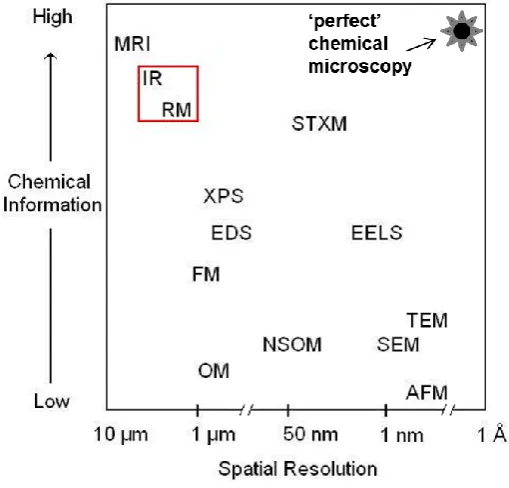
scanning probe microscopy (Figure 1.13). For polymers and proteins, chemical
information is richest at mid-IR wavelengths, without the need of any dyes, complicated
specimen preparation or radiation damage concerns. Also obtaining spatiotemporal
19
been ‘the’ other non-invasive and non-destructive imaging modality that facilitates
internal and surface images (2D and 3D) of pharmaceuticals and living organisms on
both micro and macro scale [43]. Figure 1.13 demonstrates that SEM is also well suited
to the study of morphology and it requires relatively simple sample preparation.
Figure 1.13 A comparison plot of well-established microscopy methods that
particle systems can be studied with micron scale or better spatial resolution
versus chemical information. Magnetic resonance imaging (MRI), vibrational
chemical imaging (Raman and Infrared microscopic imaging, RM and IR,
respectively), x-ray photoelectron spectroscopy (XPS), energy dispersive x-ray
spectroscopy (EDS), scanning transmission x-ray microscopy (STXM), electron
energy loss spectroscopy (EELS), transmission electron microscopy (TEM),
scanning electron microscopy (SEM), fluorescence microscopy (FM), optical
microscopy (OM), nearfield scanning optical microscopy (NSOM) and atomic
force microscopy (AFM) (adapted from [44]).
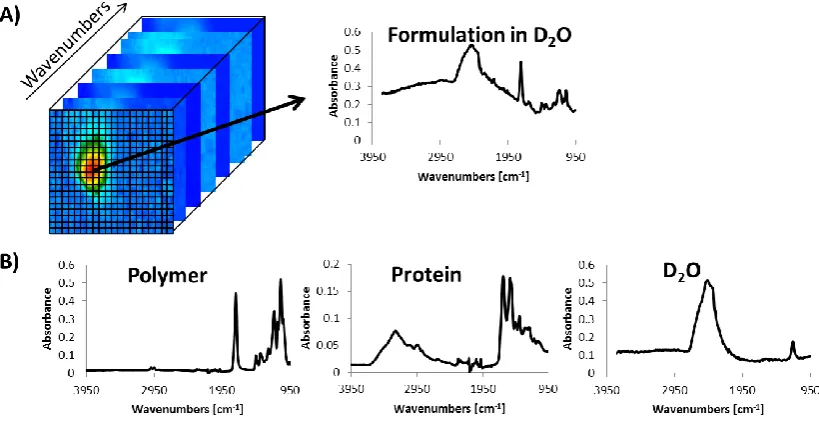
Mid-IR imaging facilitates the generation of chemical images using an FPA detector
where each of the pixels of the focal plane array (FPA) detector acts as an individual
detector, allowing the collection of thousands of IR spectra simultaneously. A stack of
2D images can be collected within a few minutes, proving good temporal resolution in
slow processes with a spatial resolution down to 5 µm depending on the sampling
method used (Figure 1.14). However regardless of the sampling method (transmission,
[image:31.595.198.453.151.395.2]20
experiments that last longer than a few hours, hyperspectral images often require
detailed analysis once collected.
Figure 1.14 Mid-infrared spectroscopic image stack of a protein loaded polymer
microparticle in water, showing a pixel spectrum on the right (A) and pure
component spectra (B) therein to be extracted from formulation spectra for each
pixel.
1.7 Project Aims
The preliminary aim of this project has been to investigate and fine-tune the application
of mid-IR imaging to characterise scCO2 processed ‘dry’ microparticle formulations as
received. This is based on determining their changing components’ distributions,
particularly the drug distribution throughout individual microparticles using available
sampling methods (described in Chapter 2) and relevant multivariate data analysis
methods (described in Chapter 3).
Following dry state characterisation of model drug loaded PLGA microparticles, the
next objective was to optimise the experimental conditions such that the first kinetic
imaging study on real-time hydrolysis of a single PLGA microparticle was conducted.
Further objectives related to this novel experiment were to improve this temporal
hyperspectral data set which had decreasing SNR over time, in terms of spatial
resolution and SNR, using soft multivariate methods and developing a hard modelling
method to obtain and compare the most important information of such experiment,
[image:32.595.121.531.118.329.2]21
physicochemical phenomena such as swelling, shrinking and eroding was also
investigated using soft and hard modelling approaches.
Developing this proof of concept, a further objective, emerging immediately, was to
study PLGA copolymer microparticles with L/G molar compositions of 100/0, 75/25
and 50/50 at 50 ºC and 70 ºC to investigate and compare effects on their degradation
rates, again for the first time utilising mid-IR imaging and multivariate analysis.
ATR-FTIR imaging has been a fast progressing method used to study drug release in
semisolid formulations, drug penetration, and the influence of penetration modifiers in
situ commonly at sample-solution interfaces. However there has been lack of literature
in studying evolution of single microparticles during dissolution. Hence it was of
interest to see and monitor drug redistribution and release in such systems and to
correlate such data to conventional drug dissolution methods.
Consequently an aim was set to demonstrate the feasibility of the ATR geometry for
monitoring drug release in situ from PLGA microparticles and to utilise data analysis
methods to extract associated drug release profiles.
Pharmaceuticals often need to be sterilised before use. Finally mid-IR imaging and
analysis were used for visualising and rationalising the effect of gamma irradiation (a
common sterilisation method for biodegradable polymer based drugs) on a pipeline
product of the collaborating company that has shown successful in vivo and in vitro
sustained release for the delivery of hGH.
The overall aim of this project can be summarised as the development of mid-IR
imaging and analysis as a standalone toolbox for studying kinetic processes in
biopolymeric microparticles. This was assisted mainly by verification of morphology
using SEM, thermal properties using DSC, dissolution testing using
22 1.8 References
[1] C.F. van der Walle, O. Olejnik, Chapter 1 - An Overview of the Field of Peptide and
Protein Delivery, in: C.F. van der Walle (Ed.), Peptide and Protein Delivery, 1st ed.,
Academic Press, Boston, 2011, pp. 1-22.
[2] S.S. Davis, L. Illum, S. Stolnik, Polymers in drug delivery, Current Opinion in
Colloid & Interface Science. 1 (1996) 660-666.
[3] R.C. Mundargi, V.R. Babu, V. Rangaswamy, P. Patel, T.M. Aminabhavi,
Nano/micro technologies for delivering macromolecular therapeutics using
poly(d,l-lactide-co-glycolide) and its derivatives, Journal of Controlled Release. 125 (2008)
193-209.
[4] C. Wischke, S.P. Schwendeman, Principles of encapsulating hydrophobic drugs in
PLA/PLGA microparticles, Int. J. Pharm. 364 (2008) 298-327.
[5] H. Staudinger, Ketene, eine neue Körperklasse, Berichte der deutschen chemischen
Gesellschaft. 38 (1905) 1735-1739.
[6] O. Pillai, R. Panchagnula, Polymers in drug delivery, Curr. Opin. Chem. Biol. 5
(2001) 447-451.
[7] Walton D , Lorimer P, Polymers, Oxford University Press, New York, 2000.
[8] J. M. G. Cowie, V. Arrighi, Polymers: Chemistry and Physics of Modern Materials,
3rg ed., CRC Press, UK, 2008.
[9] P.L. D. Walton, Polymers, Oxford University Press, New York, 2000.
[10] G. Dumortier, J. L.Grossiord, F. Agnely, J. C. Chaumeil, A Review of Poloxamer
407 Pharmaceutical and Pharmacological Characteristics, Pharmaceutical Research. 23
(2006) 2709-2728.
[11] S. Inkinen, M. Hakkarainen, A. Albertsson, A. Sodergard, From Lactic Acid to
Poly(lactic acid) (PLA): Characterization and Analysis of PLA and Its Precursors,
23
[12] C.E. Astete, C.M. Sabliov, Synthesis and characterization of PLGA nanoparticles,
Journal of Biomaterials Science, Polymer Edition. 17 (2006) 247-289.
[13] J. M. Anderson , M. S. Shive, Biodegradation and biocompatibility of PLA and
PLGA microspheres, Advanced Drug Delivery Reviews. 28 (1997) 5-24.
[14] E. Vey, C. Rodger, J. Booth, M. Claybourn, A.F. Miller, A. Saiani, Degradation
kinetics of poly(lactic-co-glycolic) acid block copolymer cast films in phosphate buffer
solution as revealed by infrared and Raman spectroscopies, Polym. Degrad. Stab. 96
(2011) 1882-1889.
[15] M.L. Houchin, E.M. Topp, Chemical degradation of peptides and proteins in
PLGA: a review of reactions and mechanisms, Journal of pharmaceutical sciences. 97
(2008) 2395-2404.
[16] G. Dumortier, Grossiord J.L., F. Agnely, J.C. Chaumeil, A review of poloxamer
407 pharmaceutical and pharmacological characteristics, Pharmaceutical Research. 23
(2006) 2709-2728.
[17] J.M. Berg, J.L. Tymoczko, L. Stryer , Protein Structure and Function, in: J.M. Berg
(Ed.), Biochemistry, 5th ed., W.H. Freeman, New York, 2002, pp. Chapter 3.
[18] K. Fu, K. Griebenow, L. Hsieh, A.M. Klibanov, R. Langera, FTIR characterization
of the secondary structure of proteins encapsulated within PLGA microspheres, J.
Controlled Release. 58 (1999) 357-366.
[19] A. Aitken, M. Learmonth, Protein Determination by UV Absorption, in: J. Walker
(Ed.), Humana Press, 2002, pp. 3-6.
[20] X.M. He, J.X. Carter, Structure of human serum albumin, Science. 249 (1990)
302-303.
[21] J. M. Tanner, R. H. Whitehouse, P. C. R. Hughes and F. P. Vince, Effect of Human
Growth Hormone Treatment for 1 to 7 Years on Growth of 100 Children, with Growth
Hormone Deficiency, Low Birthweight, Inherited Smallness, Turner's Syndrome, and
24
[22] I. Gomez-Orellana, B. Varinano, J. Miura-Fraboni, S. Milstein, D.R. Paton,
Thermodynamic characterization of an intermediate state of human growth hormone,
Protein Science. 7 (1998) 1352-1358.
[23] http://www.niro.com/NIRO/cmsdoc.nsf/WebDoc/webb8ckjc8, December 2013.
[24] http://www.malvern.de/ProcessEng/processes/spraydrying/overview.htm,
December 2013.
[25] S. Guerrero, E. Muñíz, C. Teijón, R. Olmo, J.M. Teijón, M.D. Blanco,
Ketotifen-loaded microspheres prepared by spray-drying poly(D,L-lactide) and
poly(D,L-lactide-co-glycolide) polymers: Characterization and in vivo evaluation, J. Pharm. Sci. 97
(2008) 3153-3169.
[26] P.A. Rivera, M. Martinez-Oharriz, M. Rubio, J.M. Irache, S. Espuelas, Fluconazole
encapsulation in PLGA microspheres by spray-drying, J. Microencapsul. 21 (2004)
203-211.
[27] S.C. Tucker, Solvent Density Inhomogeneities in Supercritical Fluids, Chem. Rev.
99 (1999) 391-418.
[28] C. de la Tour , C., Annales des Chimie et des Physique. 22 (1822) 127-132.
[29] J. Williams, A. Clifford, S. Al-Saidi, Supercritical fluids and their applications in
biotechnology and related areas, Mol. Biotechnol. 22 (2002) 263-286.
[30] C.A. Kelly, S.M. Howdle, A. Naylor, G. Coxhill, L.C. Tye, L. Illum, A.L. Lewis,
Stability of human growth hormone in supercritical carbon dioxide, J. Pharm. Sci. 101
(2012) 56-67.
[31] O.R. Davies, A.L. Lewis, M.J. Whitaker, H. Tai, K.M. Shakesheff, S.M. Howdle,
Applications of supercritical CO2 in the fabrication of polymer systems for drug
delivery and tissue engineering, Adv. Drug Deliv. Rev. 60 (2008) 373-387.
[32] J.W. Tom, Lim Gio-Bin, P.G. Debenedetti, R.K. Prud'homme, Applications of
Supercritical Fluids in the Controlled Release of Drugs, in: Anonymous American
25
[33] N. Elvassore, A. Bertucco, P. Caliceti, Production of insulin-loaded poly(ethylene
glycol)/poly(l-lactide) (PEG/PLA) nanoparticles by gas antisolvent techniques, J.
Pharm. Sci. 90 (2001) 1628-1636.
[34] A.R.C. Duarte, M.S. Costa, A.L. Simplício, M.M. Cardoso, C.M.M. Duarte,
Preparation of controlled release microspheres using supercritical fluid technology for
delivery of anti-inflammatory drugs, International journal of pharmaceutics. 308 (2006)
168-174.
[35] M.D. Donohue, J.L. Geiger, A.A. Kiamos, K.A. Nielsen, Reduction of Volatile
Organic Compound Emissions During Spray Painting, in: Anonymous American
Chemical Society, 1996, pp. 152-167.
[36] J. Kerč, S. Srčič, Ž Knez, P. Senčar-Božič, Micronization of drugs using
supercritical carbon dioxide, Int. J. Pharm. 182 (1999) 33-39.
[37] M.J. Whitaker, J. Hao, O.R. Davies, G. Serhatkulu, S. Stolnik-Trenkic, S.M.
Howdle, K.M. Shakesheff, The production of protein-loaded microparticles by
supercritical fluid enhanced mixing and spraying, J. Controlled Release. 101 (2005)
85-92.
[38] V.K. Popov, A.V. Evseev, E.N. Antonov, V.N. Bagratashvili, A.N. Konovalov,
V.Y. Panchenko, J.J.A. Barry, M.J. Whitaker, S.M. Howdle, Laser technologies for
fabricating individual implants and matrices for tissue engineering, J. Opt. Technol. 74
(2007) 636-640.
[39] H. Tai, M.L. Mather, D. Howard, W. Wang, L.J. White, J.A. Crowe, S.P. Morgan,
A. Chandra, D.J. Williams, S.M. Howdle, K.M. Shakesheff, Control of pore size and
structure of tissue engineering scaffolds produced by supercritical fluid processeing,
European Cells and Materials. 14 (2007) 64-77.
[40] J. Hao, M.J. Whitaker, B. Wong, G. Serhatkulu, K.M. Shakesheff, S.M. Howdle,
Plasticization and spraying of poly (DL-lactic acid) using supercritical carbon dioxide:
control of particle size, J. Pharm. Sci. 93 (2004) 1083-1090.
26
[42] J. Hao, M.J. Whitaker, G. Serhatkulu, K.M. Shakesheff, S.M. Howdle,
Supercritical fluid assisted melting of poly(ethylene glycol): a new solvent-free route to
microparticles, J. Mater. Chem. 15 (2005) 1148-1153.
[43] J.C. Richardson, R.W. Bowtell, K. Mäder, C.D. Melia, Pharmaceutical applications
of magnetic resonance imaging (MRI), Adv. Drug Deliv. Rev. 57 (2005) 1191-1209.
[44] http://www.lightsource.ca/files/download.php?id=2707&view=1, December 2013.
27
2
Experimental Methods and Data Analysis
2.1 Fourier Transform Infrared Spectroscopy
2.1.1 Infrared Theory
2.1.1.1 Infrared (IR) Radiation
Light is an electromagnetic wave. Electromagnetic waves ‘radiate’ from electrically
charged particles as the particles move in a magnetic field, thus light is also called
electromagnetic ‘radiation’. Electromagnetic radiation occurs, as electric and magnetic
waves undulate in planes perpendicular to each other, in the direction of the third
Cartesian coordinate that is perpendicular to the first two. Motion of electromagnetic
waves can fundamentally be described as an oscillation following simple harmonic
motion and therefore the amplitude of the electric vector is often illustrated by a sine
function as shown in Figure 2.1. Distance that a wave can travel during time that takes
to complete a repeating period (T), or a cycle, is its wavelength (λ).
In vibrational spectroscopy commonly the number of waves per unit length called
wavenumber in 1/cm is used instead of wavelength as it is proportional to energy
therefore easier to interpret.
Figure 2.1 Electric vector amplitude of a light wave.
Electromagnetic radiation can also be defined as a stream of particles (photons),
travelling at the speed of light (c=3x10⁸ m/s), that have no mass but energy (E) that is
related to their frequency (ν) according to Planck’s equation;
Equation 2.1
-2 -1 0 1 2
A
m
pli
tud
e
Time
28 where h=6.626 x 10⁻³⁴Js is the Planck’s constant.
The full range of photon energies are listed in a chart, so-called electromagnetic
spectrum (Figure 2.2a). The IR region of the electromagnetic spectrum includes
near-infrared (NIR), mid-near-infrared (MIR) and far-near-infrared (FIR) (Figure 2.2b). In this thesis
the terms ‘infrared’ or ‘IR’ are used to indicate the mid-IR region, that is wavelengths
between 25 and 2.5 µm (or wavenumbers from 4000 cm-1 to 400 cm-1).
Figure 2.2 (a) Electromagnetic spectrum (adapted from [1]) and (b) The part of
EM spectrum, in wavenumbers, that FTIR spectroscopy is related to.
2.1.1.2 Molecular Vibrations
The total energy of a molecule consists of its electronic, vibrational, rotational and
translational energy levels. Unlike shorter wavelength radiation, IR radiation cannot
excite electrons but can cause a change in a molecule’s net dipole moment inducing
transitions between quantized vibrational energy levels. An electronic energy level of a
molecule can be divided in to a number of vibrational states and each vibrational state
includes multiple rotational states. FIR and microwave radiation, having lower energy
than rest of the IR region, can induce rotational energy level transitions that match
energy levels of molecules made of heavy atoms and/or weak bonds. The theory of
vibration-rotation spectroscopy and near infrared spectroscopy will not be discussed
because they are beyond the scope of this thesis.
A non-linear molecule with N atoms can exhibit translational motion and rotational
motion in 3 orthogonal directions, x, y and z, excluding these; a molecule has 3N-6
degrees of freedom that is the number of ways that the atoms of the molecule can
vibrate. For a linear molecule the number vibrational modes is 3N-5 as it has 2
rotational modes instead of 3. As one can imagine, these vibrations result either a
periodic change in bond length (stretching) or a periodic change in bond angle a)
29
(bending). For multiple bonds, the stretching mode can be symmetric or antisymmetric
and four types of bending modes are possible, namely; scissoring, rocking, wagging and
twisting. Visual illustration of these modes is demonstrated in many web sites including
[2].
Vibration of a diatomic molecule, that is confined to stretching only as explained above,
can be approximated to simple harmonic oscillation of 2 masses connected with a spring
in space following Hook’s law and their motion is determined by the causing force as;
Equation 2.2
where k is the spring constant and x is displacement. Potential energy of this system is;
Equation 2.3
Since vibrational energies are quantised vibrational energy of the modes that
approximated to simple harmonic motion, or Hooke’s law, can be calculated from the
Schrodinger equation to reflect this as;
( ) Equation 2.4
where n=0, 1, 2, 3, … is the vibrational quantum number.
Figure 2.3 Potential energy of a diatomic molecule following Hooke’s law and an
anharmonic oscillator (adapted from [3]).
In practice Equation 2.4 should be derived from a Morse-type or anharmonic potential
30
Hooke’s law, therefore potential energy of real molecules deviate from simple harmonic
oscillator approximation as anharmonicity arises (Figure 2.3).
The energy levels including anharmonicity effect can be approximated as;
( ) ( ) Equation 2.5
where is α is the anharmonicity constant.
To move a molecule from one energy level to another (i.e. from E=0 to E=1), in order to
induce IR bands, molecular vibrations must cause a change in the dipole moment of the
molecule. This is called ‘the selection rule’ and for example O2 and N2 do not reveal IR
bands because their stretch vibration does not cause a change in their dipole moments.
Commonly observed transitions postulated by E
![Table 1.1 PLGA based microparticle formulations available in the market [1,3].](https://thumb-us.123doks.com/thumbv2/123dok_us/737173.578429/16.595.115.538.429.649/table-plga-based-microparticle-formulations-available-market.webp)
![Figure 1.10 hGH secondary structure (from [22]).](https://thumb-us.123doks.com/thumbv2/123dok_us/737173.578429/25.595.219.439.57.322/figure-hgh-secondary-structure-from.webp)