Five features for modelling augmented reality
LIANG, Sha and ROAST, Chris <http://orcid.org/0000-0002-6931-6252>
Available from Sheffield Hallam University Research Archive (SHURA) at:
http://shura.shu.ac.uk/7889/
This document is the author deposited version. You are advised to consult the
publisher's version if you wish to cite from it.
Published version
LIANG, Sha and ROAST, Chris (2014). Five features for modelling augmented
reality. In: STEPHANIDIS, Constantine, (ed.) HCI International 2014 - Posters’
Extended Abstracts : International Conference, HCI International 2014, Heraklion,
Crete, Greece, June 22-27, 2014. Proceedings. Communications in Computer and
Information Science, Part I (434). Springer, 607-612.
Copyright and re-use policy
See
http://shura.shu.ac.uk/information.html
Sheffield Hallam University Research Archive
adfa, p. 1, 2011.
© Springer-Verlag Berlin Heidelberg 2011
Five Features for Modelling Augmented Reality
Sha Liang and Chris Roast
Communication & Computing Research Centre, Sheffield Hallam University, Howard Street, Sheffield S1 1WB, UK
[email protected], [email protected]
Abstract. Augmented reality is growing rapidly and supports people in
differ-ent fields such as education, design, navigation and medicine. However, there is limited discussion about the characteristic features of augmented reality and what is meant by the term. This paper presents five different features: changea-bility, synchronicity and instant, antecedent, partial one to one and hidden reali-ty. The explanation of each of these features is given follow a consistent struc-ture. The benefits of generating features and future work are described.
Keywords: augmented reality, features, technology.
1
Introduction
Augmented reality (AR) technology combines virtual information with the real envi-ronment in real-time performance [1]. Due to the development of the mobile devices, AR is growing rapidly and is becoming popular through in a variety of areas [2]. However, because of the broad meaning for this term, it is not exactly clear what is meant or intended when people use AR. Some of the sources use a very general meaning for it, whereas others mean something very specific and narrow [3]. Section two will explicitly outline the existing research concerning the features of augmented reality. Section three presents five different features and briefly summaries the mean-ings of them using a lightweight diagrammatic notation. The benefits of developing our understanding through such features are then described in term of how they will be used in future work.
2
Related Work
augmentations to other human capabilities (like cognition). Establishing meanings and identifying boundaries to concepts is a common and important activity much research and AR should benefit from the same.
3
Features
This paper introduces the five features of augmented reality, followed by an explana-tion of each to initiate establishing the characteristics of the concept. The features have been arrived at from reviewing existing AR research and critical reflection by the authors. The format of explaining the AR features is based upon Borcher's ap-proach [6], which describes a formal model of pattern languages to reduce ambiguity. The structure of this model is simplified in this paper. The explanation of features consists of the following items:
Title: a short and memorable phrase.
Problem: the major issue that the feature addresses.
Definition: a brief summary of the meaning of features.
Description: a detailed explanation of AR features including examples.
Diagram: a diagram summarizing the main idea in a graphical way.
3.1 Changeability
Problem: How should virtual information be generated?
Definition: Virtual information born of the real-world information can be changed
during an AR event.
Description: With respect to an augmented reality system, virtual information is
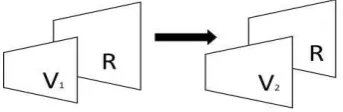
su-perimposed on a view of the real world [3]. A key aspect of augmented reality is that the virtual information can be changed dynamically, while the real-world information does not. For example, Wikipedia World is an AR application providing users with the locations of stations, hotels and more [7]. When users use the app and move around, the virtual information bubble will pop up automatically. An icon visually indicating, say, a real-world station, can be clicked more Wikipedia information will be about the station will be presented. This additional information replaces the previ-ous virtual bubble. The content of virtual information has been changed easily and completely. As opposed to the virtual information, the real station has not changed. The feature of changeability is captured by the following diagram (see Fig. 1).
[image:3.595.211.383.612.668.2]Diagram:
Letter R represents the real-world information and V the virtual information overlaid on the real-world content. The arrow expresses that the V1-R augmented reality
sys-tem is transferred to V2-R because of an effect of changeability.
3.2 Synchronicity and instant
Problem: How should the virtual and real content be connected?
Definition: Changing the real content will result in the synchronic and instantaneous
transformation of the virtual counterpart.
Description: Due to the changes of the real-world content, an AR virtual counterpart
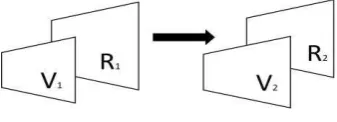
has to be updated synchronously and instantaneously. For example, Word lens [8] is an AR translation application that scans and foreign text and displays the test translat-ed in real time. Once the user changes his or her point of view to another word, the displayed translation on the device changes rapidly in the same time. If the process of generating virtual information is delayed for a long time, viewers are unable to obtain the useful information. However, the time lags can exist because of the inherent in-formation processing. Synchronicity and instant is captured by the following diagram (see Fig. 2).
[image:4.595.212.381.390.451.2]Diagram:
Fig. 2. Synchronicity and instant
V1-R1 augmented reality system presents that the virtual content V1 is the overlay of
real-world content R1. If changing the real-world content from R1 to R2, the virtual
content has to be transformed from V1 to V2 in this process. This corresponding
trans-formation is synchronous and instantaneous.
3.3 Antecedent
Problem: How should information about the real world be generated?
Definition: The real-world content in an AR system is existing or happening before
the virtual counterpart.
Description: In respect of the AR system, there is no restriction on what the
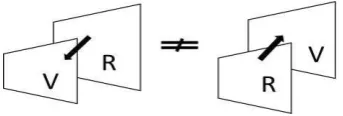
created before the real-world content, the virtual element is meaningless because it has no real world interpretation (see Fig. 3).
[image:5.595.211.383.195.253.2]Diagram:
Fig. 3. Feature of Antecedent
The left diagram shows the V-R augmented reality system that the real-world infor-mation is antecedent and the virtual content is overlaid. The right diagram illustrates the "R-V" system, which is not an AR system because the virtual information exists at first.
3.4 Partial one to one
Problem: How should the virtual and real content be matched?
Definition: There is one and only one real-world content to correspond with the virtu-al content. However, there might be one or more than one piece of virtuvirtu-al information to correspond with the real-world content.
Description: A key aspect to augmented reality is that the relationship between
virtu-al and revirtu-al-world content is one-to-one. Word lens [8] translator could display a trans-lated word '¡Hola!' in Spanish when the AR device scanned the real word 'Hello!' in English. The meaning of one-to-one relationship is that the virtual content '¡Hola!' should only present the real content 'Hello!' and not another physical word. However, AR translator could also render the English word 'Hello!' into different foreign lan-guage, such as '你好!' in Chinese, 'Bonjour!' in French and so on. That means the real
content can be augmented to lots of virtual content. The term 'Partial one to one' de-scribes this AR feature (see Fig. 4).
Diagram:
[image:5.595.240.356.563.648.2]The left diagram V1V2V3 - R1 augmented reality system summarizes the real-world
content R1 could match the different virtual content V1, V2, V3. However, it is not AR
if more than one real-world contents correspond with the virtual content V1.
3.5 Hidden Reality
Problem: How is the real content hidden by virtual content?
Definition: In an AR system, generating the virtual information will often result in
the obstruction of real-world information.
Description: While users look through the virtual content, the real content will be
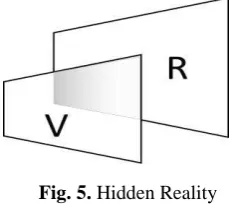
more or less hidden. For example, Word lens [8] AR translator generates the virtually translated words, which replace the real-world words. Users have to remove the AR device if they need to see the original words. They cannot see both the virtual and real content simultaneously. While in such cases it is possible to try alternatives, such as whether the virtual content could be overlaid on the less important information. It still depends on the specific conditions to judge the difference between important and unimportant information, and intrinsic risk of AR is that the virtual occludes some of reality (see Fig. 5).
[image:6.595.239.354.391.494.2]Diagram:
Fig. 5. Hidden Reality
In this diagram, the virtual information V partially obstructs the real-world infor-mation R. The shadow presents the hidden real-world content because of the generat-ing virtual content.
4
Conclusion and Future Work
foundation of ongoing PhD research. Our hope is that this paper serves as to innovate,
refine and prototype potential solutions using AR for enhancing older population’s
experience in the future.
Acknowledgements We are grateful to thank our supervisor team member, Luigina
Ciolfi and Elizabeth Uruchurtu for their insightful comments on an earlier draft.
5
Reference
1. Liarokapis, F., De Freitas, S.: A Case Study of Augmented Reality Serious Games. In: Eb-ner, M., SchiefEb-ner, M. (eds.) Looking Toward the Future of Technology-Enhanced Educa-tion: Ubiquitous Learning and the Digital Native, pp. 178-191. IGI Global Press (2010) 2. Papagiannakis, G., Simgh, G., Magnenat-Thalmann, N.: A survey of mobile and wireless
technologies for augmented reality systems. Computer Animation and Virtual Worlds 19(1), 3-22 (2008)
3. Craig, A. B.: The Understanding of augmented reality: Concepts and Applications. Mor-gan Kaufmann, Waltham (2013)
4. Caudell, T.P., Mizell, D.W.: Augmented reality: An application of heads-up display tech-nology to manual manufacturing processes. In: Proc. Hawaii Int’l Conf. on Systems Sci-ences, pp. 659–669, Kauai, USA, IEEE CS Press (1992)
5. Azuma, R.T.: A survey of augmented reality. Presence 6(4), 355–385 (1997)
6. Borchers, J.O.: A pattern approach to interaction design. AI & SOCIETY 15(4), 359-376 (2001)
7. Madden, L.: Professional Augmented Reality Browsers for Smartphones: Programming for junaio, Layar and Wikitude, p29, John Wiley & Sons, Chichester (2011)