ALLAN, Paul.
Available from Sheffield Hallam University Research Archive (SHURA) at:
http://shura.shu.ac.uk/19248/
This document is the author deposited version. You are advised to consult the
publisher's version if you wish to cite from it.
Published version
ALLAN, Paul. (2013). Holistic perspectives on learning and knowledge : An awarding
body perspective. Doctoral, Sheffield Hallam University (United Kingdom)..
Copyright and re-use policy
See
http://shura.shu.ac.uk/information.html
1 0 2 0 4 8 3 0 3 2
Haii&m University - ■ ■ ■:: h - j !i (formation Services
efts Centre, City Campus Sheffield S1 1WD
All rights reserved
INFORMATION TO ALL USERS
The quality of this reproduction is dependent upon the quality of the copy submitted.
In the unlikely event that the author did not send a com plete manuscript and there are missing pages, these will be noted. Also, if material had to be removed,
a note will indicate the deletion.
uest
ProQuest 10694128
Published by ProQuest LLC(2017). Copyright of the Dissertation is held by the Author.
All rights reserved.
This work is protected against unauthorized copying under Title 17, United States C ode Microform Edition © ProQuest LLC.
ProQuest LLC.
789 East Eisenhower Parkway P.O. Box 1346
P
aul Allan
A thesis submitted in partial fulfilment of the requirements of
Sheffield Hallam University for the degree of Doctorate of
Business Administration
October 2013
Acknowledgement
It goes without saying that a considerable amount of people have guided and
supported me during the undertaking of this research.
Firstly, I would like to thank Dr Daniel M. O’Hare for his valuable guidance, comments and endless support throughout the course and development of this thesis. He has made enormous contributions, going beyond that of an advisor; his great guidance, inspiration and support have been invaluable, not only intellectually but also emotionally. I consider myself extremely fortunate to find someone who has such a kind heart who has continually supported me during my journey. Without his support and our frank discussions I would not have been able to finish this thesis in a timely manner. He will never be forgotten and I will be indebted to him for the rest of my life.
I would also like to record my appreciation to the following individuals:
Dr Murray Clark
Professor Bob Garvey
Dr Luiz Montanheiro
Dr Pawel Capik
Special thanks go to my friends and colleagues at Sheffield Business School at Sheffield Hallam University for all their kindness, support and encouragement during this long journey.
Dedication
I would like to dedicate my work to all those who have battled cancer.
Abstract
This study took a grounded theory approach with the aim of developing a more
holistic approach to learning and knowledge. There has been a lot written about learning and knowledge but very little has been written looking at the complex entanglement of the two.
The research was very much grounded in the data whilst remaining sensitive to the theory of complexity. This study wanted to reject the simplistic and often mechanistic views of learning and knowledge and wanted to explore the more complex entanglement. This was done by taking data from three focus groups each consisting of 4-6 individuals. In addition a sense making workshop consisting of 5 individuals then helped to code and cluster the data which helped support the researcher’s findings. At the time the research environment was going through a climate of change faced with huge financial pressures due to the economic downturn whilst still carrying the scars from previous litigation.
The findings suggest that learning and knowledge is a very complex entanglement which is far more elaborate and complex than the theory immediately implies. These insights are discussed with reference to academic theory and a number of implications for business were identified.
Table of contents
A c k n o w le d g e m e n t...ii
D e d ic a tio n ...iii
A b s tra c t...iv
T a b le o f c o n te n ts ... v
Chapter 1... 1
1.1 Background of the organisation...1
1.2 P ro b lem ... 2
1.3 Background of s tu d y ...3
1.4 Organisational learning ... 4
1.5 Knowledge M a n a g e m e n t...5
1.6 Com plexity th e o ry ...6
1.7 Purpose of s tu d y ... 8
1.8 The aim of the research ... 9
1.9 Contribution to kn o w led g e... 10
1.10 Structure of thesis...11
Chapter 2...13
2.1 Literature review...13
2.2 Grounded theory and the lite ra tu re ...13
2.3 Knowledge m anagem ent (K M )... 14
2.3.1 K M /IT or HR... 15
2.3.3 Organisational learning ... 21
Figure 2.1: Convergent them es of organisational learning and knowledge m anagem ent (Adapted from Vera and Crossan, 2 0 0 3 )... 22
2.4 Can KM increase business efficiency?...25
2.4.1 Eastern and W estern perspectives...26
2.4.2 Strategic reso u rce...28
2.5 D ifferent definitions and p erspectives...29
2.6 Business application... 32
2.6.1 Literature suggestions... 34
2.6.2 Com plexity th e o ry ... 35
2.7 Chapter conclusion...36
Chapter 3...39
3.1 Grounded theory methodology...39
3.1.1 Grounded theory o verview ... 39
3.1.2 Data collection and analysis...40
Figure 3.1: Steps in developing grounded th eo ry (Adolph Hall and Kruchten, 2 0 1 1 )... 41
3.1.3 Coding focus groups as part o f the analytical process... 42
3 .1.4 Developing categories... 43
3.2 Use o f grounded theory in this s tu d y ...44
Table 3.2: Data collection and analysis p h a s e ...46
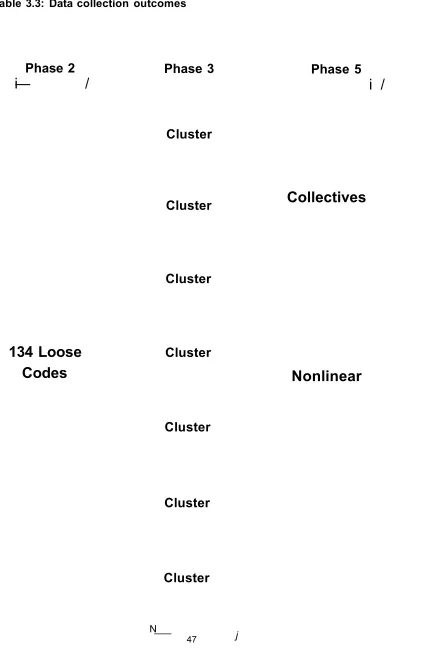
Table 3.3: Data collection o u tc o m e s ...47
3.2.1 Substantive and form al th e o ry ...49
3.2.3 Grounded theory criteria... 50
3.2.4 Objectivist and constructivist approach...51
3.2.5 Grounded theory limitations...52
3.2.6 Ethical considerations... 53
3.3 Chapter conclusion...53
Chapter 4...56
4.1 Methods... 56
4.1.1 Overview of method...56
Table 4.1 Data collection and analysis...57
Phase 1 ...58
4.2 Focus groups...58
Phase 2 ...59
4.2.1 Sense making and category development (Group)...59
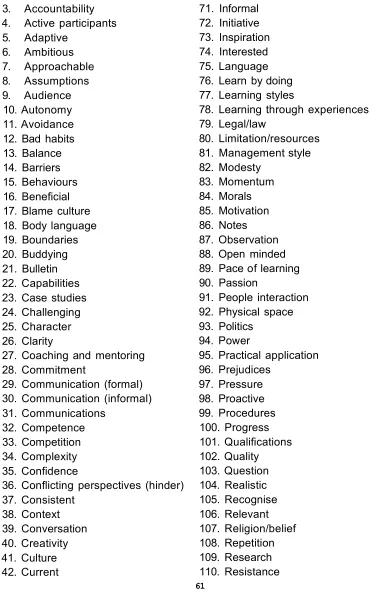
Table 4.1 Codes developed in workshop... 61
Phase 3 ...63
4.2.2 Grouping codes...63
Loose Clusters...64
Phase 4 ...65
4.2.3 Category saturation and theoretical sampling...65
Phase 5 ...66
4.3 Chapter conclusion (Grounding the theory)... 66
5.1 Introduction to findings...67
5.2 Learning...68
5.2.1 W orkplace train in g ...70
5.2.2 Organisational learning...71
5.2.3 Knowledge... 71
5.2.4 Collective kn o w led g e...73
5.2.5 Organisational k n o w le d g e ... 73
5.2.6 Knowledge flo w ... 74
5.2.7 Learning and knowledge constructions...75
5.2.8 C ateg ories...76
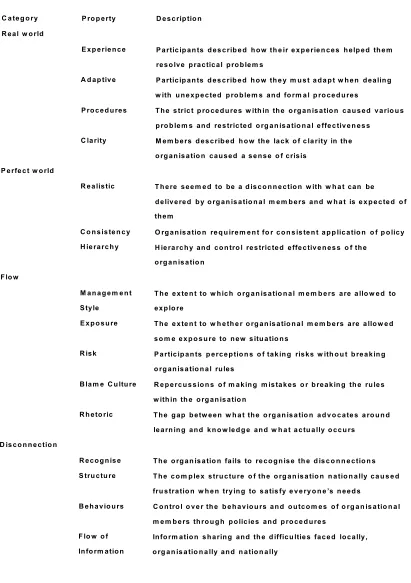
5.3 O verview of the th ree findings categories...77
5.3.1 C ollectives...77
Table 5.1 Categories and properties of C ollectives... 78
5.3.2 N onlinear... 79
Table 5.2 Categories and properties of N onlinear a c tiv itie s ... 81
5.3.3 D iversity...82
Table 5.3 Categories and properties of Diversity...83
5.4 Chapter conclusion...83
Chapter 6...84
6.1 Collectives... 84
6 .2 F in d in g s ... 84
6.3.1 Motivation...87
6.3.2 Conflict... 88
6.4 Trust... 89
6.4.1 Fitness... 91
6.4.2 Commitment... 92
6.4.3 Initiative...93
6.4.4 Fear of change...95
6.5 Chapter conclusion...97
Chapter 7...99
7.1 Nonlinear... 99
7.2 Experience... 99
7.2.1 Adaptive... 100
7.2.2 Procedures... 102
7.2.3 Clarity... 104
7.3 Realistic...107
7.3.1 Consistency... 108
7.3.2 Hierarchy...112
7.3.3 Management style...114
7.3.4 Exposure...116
7.3.5 Risk...117
7.3.6 Blame culture...118
7.4 Recognise... 122
7.4.1 S tru c tu re ...124
7.4.2 B ehavio urs...126
7.4.3 Flow of in fo rm a tio n ...128
7.5 Chapter conclusion...130
Chapter 8... 131
8.1 Diversity... 131
8 .1.1 C ulture...134
8.1.2 Balance... 136
8.1.3 Acceptance...138
8.1 .4 E m p ath y...140
8.1.5 A u d ie n c e...141
8.2 Chapter conclusion... 141
Chapter 9...143
9.1 Discussions and implications...143
9.2 W orkplace e x p e rie n c e ...144
9.2.1 Individual and collective le a rn in g ...144
9.2.2 Individual and local co llectives... 145
9.2.3 Localisation and shared experiences...146
9 .2 .4 Individual, collective learning and kn ow ledge...147
9.2.5 The collectives self-organise... 149
9.3 Complex kn o w ledge...151
9.3.1 Learning through w o rk ...152
9.3.2 N onlinear le a rn in g ... 152
9.3.3 Structures and collectives... 153
9.4 Diversity and lea rn in g ...155
9.4.1 Learning and in n o v a tio n ...156
9.5 Learning and kn o w led g e...157
9.5.1 W orkplace learn in g ... 159
9.6 Learning and organisational kn o w led g e...159
9.6.1 Individual learning and the co llective... 160
9.6.2 A utonom y and consistency...161
9.6.3 Learning through w o rk...162
9.6 .4 Learning through w ork/organisational k n o w le d g e ... 163
9.7 Chapter conclusions...165
Chapter 10...167
10.1 Conclusion... 167
10.2 Individual and collective lea rn in g ... 168
10.2.1 E m erg en ce... 168
10.2.2 A u to n o m y ...169
10.2.3 Interaction...169
10.2.4 Flexibility... 170
10.2.6 In n o vatio n ... 173
10.2.7 Com plexity (Im plications fo r business)...173
10.2.8 Power and politics...173
10.2.9 H ierarchy...174
Figure 10.1: Current challenges faced at com pany XXX X...176
Figure 10.2: Potential im provem ents th at could be m ade at com pany XXXX...177
10.3 Findings and su m m ary...178
10.4 Contributions to s tu d y ... 180
10.5 Further re se arc h ...182
Bibliography... 183
Appendix A ... 217
Participants’ information... 217
Appendix B ... 219
Chapter 1
1.1 Background of the organisation
Whilst conducting this research the researcher was a senior manager of a
leading Awarding Body in the UK which produced qualifications and courses for thousands of colleges and educational institutions. The researcher was brought into the organisation (head office) in 2007/2008 with a view of overseeing all the human resource activities which comprised of 11 regions. Part of the researchers remit was to reduce employment tribunal litigation along with overseeing all learning and development activities and to improve the overall knowledge of the organisation.
The coalition government (Conservative-Liberal Democrats) of 2010 took immediate plans to cut the current deficit of the British economy. As a consequence many funding streams for education were being cut and a new focus was being placed on academic qualifications. This was presented in the
Department of Education schools White Paper, ‘The Importance of Teaching
(2010)’, that sets out a radical reform programme for schools and colleges. The proposals put forward in the white paper was having a devastating impact on this Awarding Body as many of the qualifications they produced and sold were vocational qualifications. On January 28th 2013 the Guardian reported that, “60% of schools were either planning to cut provision of vocational qualifications or have already done so” (Guardian Online). The customer base of this organisation was in the region of 4-6 million people with thousands of college and other education institutions. It almost goes without saying that the expensive litigation and the economic downturn were having a devastating impact on this organisations finances and business operations. As a consequence this organisation needed to rethink many of its current business activities and learn and behave differently and share its knowledge across the entire network more effectively to remain competitive in one of the worst economic downturns the UK has ever seen.
Unfortunately the researcher was forced to sign a Compromise Agreement which prevents the disclosure of what could be seen as ‘sensitive’ or ‘confidential’ information. The compromise agreement was finalised by Russell Jones and Walker Solicitors, 2011.
1.2 Problem
The current understanding of learning and knowledge within this organisation must be questioned as there appears to be a separation of practices and how the organisation perceives learning and knowledge across the 11 regions. The literature often supports this argument that learning and knowledge are deeply entwined through workplace experience interaction (Stacey, 2003a, Fenwick 2003, Mullins, 2010). What seems surprising is that in practice, organisations
still focus on more formalised training programmes and
information/communication based knowledge management systems which are often separated from each other and seem relatively distant from the informing theory.
1.3 Background of study
What most people might (or might not) find surprising is that learning and
knowledge functions are often dealt with separately in business through human/technical systems. It is often treated in a disjointed fashion and then placed in separate systems, structures and teams often with disconnected frameworks, policies and practices.
This research wanted to reject the simplistic and often mechanistic views of learning and knowledge within business. Instead it wanted to investigate the more complex entanglement with each other, collectively and individually and in the context of their appearance.
This thesis offers a particular evaluation on workplace experiences of learning and knowledge and acknowledges some of the complexities that surround this entanglement in practical terms. The aim of this research is to obtain a greater understanding into how people learn at work and how this learning then interacts with organisational knowledge. Within this study, learning can only be understood when applied to a context where knowledge emerges from such engagement which is positioned, active and social.
It would be fair to say that the thrust of this research was a desire to discover whole experiences which provide a much greater understanding than some of the more observational research that is conducted within organisations (Bernard, 2006). This approach will provide a greater understanding on learning and knowledge facilitation and the interaction with one another. Hopefully by taking this approach it will lead to a much more satisfying workplace experience and enhanced organisational knowledge achievements.
reference to the ‘speed of change’ and the ‘frequency of change’ especially when relating to the ‘global market’ which has in all fairness diminished the reference in recent years (Richards, 2012). However, with the depth of the global economic crisis there is an argument to suggest that we should once again consider the importance of learning and knowledge in organisations (OECD, 2009).
Advances in technology and communications have all contributed to the speed of globalisation and writers such as Prusak, (2008) highlight the importance of focusing on knowledge in organisations. In addition, the abrupt changes in consumer tastes, non-traditional competitors, technology gaps and regulatory upheavals have all impacted on the organisations success (Hamel and Valikangas, 2003). Having a much greater understanding of the complexities surrounding work and learning (Burns, 2002) as well as organisational knowledge which is often said to be very complex and elusive (Malhotra, 2002) will help (if a greater knowledge is achieved) provide a more effective way of working in organisations (Stacey, 2009, Stacey 2010). Peter Drucker says that knowledge has power because it controls access to opportunity and advancement (Drucker, 1993).
Reviewing the literature in this field seems to suggest a lack of empirical research which explicitly explores the interaction between workplace learning and organisation knowledge. This study aims to explore this relationship in much more detail.
1.4 Organisational learning
relationship between the individual, organisation and organisations knowledge (Senge, 2006). Increasingly, some of the theories around education have contributed to a very complex understanding of learning, organisational learning and knowledge; particularly, the understanding of what constitutes knowledge and how it emerges individually and collectively and how this connects with the organisations learning literatures (Loermans, 2002; Scott, 2005).
The literature often suggests the importance of HR in promoting learning at work and how this links to organisational learning and then utilising this knowledge as a competitive advantage (Mullins, 2010). There is some importance between these domains and how it makes reference to complexity and education theories. All too often we see learning placed at the feet of HR and they are asked to distribute organisational certified information which is often done by some sort of formal training.
You often find that workplace learning strategies have to conform to an accepted set of standards and principles which aims to promote knowledge which provides consistent skills and aims to standardise individual’s competencies. This approach goes against the notions of organisational learning which focuses on flexibility and change with an aim of promoting new ways of thinking, epistemologically (Earl, 2001).
1.5 Knowledge Management
Knowledge management in a more traditional setting sits within the information systems of an organisation and often focuses on the dissemination of explicit knowledge around the organisation (Vera and Crossan, 2003). Knowledge management appeared from an anxiety to promote organisational knowledge but has been fixated with the principles of information in an attempt to disseminate across the organisation to increase performance through electronic channels (Malhotra, 2002).
(Spender, 1996). As a consequence there were very little investigations of the epistemology underpinnings (Blackman and Henderson, 2005). So therefore, practice stayed the same and was informed by constructions of knowledge which focused on extraction and dissemination. Learning was seen as the transfer of knowledge between the expert and the novice which aimed at standardisation and consistency (Blackman and Henderson, 2005). These approaches were unlinked to the theoretical discussions in the literature and mainly centred on information and communication technologies. The development of theory in learning and knowledge management challenged this traditional viewpoint and highlighted convergence themes across the discourse.
There have been some advances in knowledge management theory which attempt to pay a closer consideration to the epistemology debate. Having a clearer separation between the various dimensions on data-wisdom and having a greater awareness of the differences between knowledge bases will contribute to improved knowledge strategies. These advances will provide a greater recognition of the complexities surrounding knowledge, experiences and this entanglement with people (Earl, 2001).
1.6 Complexity theory
Complexity theory often argues that there is very little that takes a clear and linear path of action and effect (Anderson, 1999).
1.7 Purpose of study
There is very little empirical research that considers the relationship between
workplace learning and organisation knowledge and its complex entanglement.
The purpose of this study was to explore this interaction from an employee’s perspective in more detail. The question that needs to be considered in this
research is, ‘what are the relationships between workplace learning experiences
and organisation knowledge?’ The aim of this research is to provide a more holistic perspective on learning and knowledge through workplace experiences than separate investigations into these areas. In short this study will take a grounded theory approach that is sensitive to complexity theory to provide a deeper understanding of how the two occur in a complex network of interactions.
1.8 The aim of the research
The aim of this research is to provide a more holistic perspective on learning
and knowledge in organisations from employees and their working experiences.
Approach
This research took a grounded theory approach but wanted to remain sensitive to complexity theory. The aim of this study was to reject the simplification and often mechanistic views of learning and knowledge and wanted to explore the complex entanglement. Complexity theory helps provide a new and innovative perspective through its theoretical and empirical integration.
This research considers some important areas in the literature and avoids the simplification and general assumptions of knowledge and research. Complexity and some of the ideas that surround this theory are noticeable in this study which allows participants responses to self-organise which also allows the emergence of new and novel perspectives. In addition, this approach allows the data to be richly interconnected which recognises the logical and interactive nature of knowledge which highly values the experiences of the participants and how this relates to their work.
1.9 Contribution to knowledge
There is very little research that has been done which examines the relationship
between learning and knowledge in organisations whilst considering complexity theory. Although suggested in the literature, there is very little empirical research.
This research begins to fill this gap directly and contributes in the following ways:
(a) Focuses on individual and collective learning experiences and the broader context of organisation learning and the management of emergent knowledge which adds empirical weight to the theoretical discourse.
(b) Provides significant empirical support towards the development of practice which shows an appreciation of the problematic nature of knowledge and the complex interactions to characterise organisational behaviour. The findings demonstrate the interaction and entanglement of learning and knowledge in organisations and point to the possible implications.
(c) Takes a unique and innovative approach which considers complexity theory as part of its development.
(d) Adds convergent themes and offers a novel perspective on organisational learning and knowledge management and their integration.
Finally, but not least the research will draw some conclusions about business application and how this study will help improve business practice and performance.
1.10 Structure of thesis
Introduction (Chapter 1)
This research has taken a grounded theory approach whilst considering complexity theory looking at ‘whole’ perspectives on learning and knowledge in organisations. Chapter 1 gives an introduction and considerations to this thesis.
Literature review (Chapter 2)
The literature review looks at some of the complex discussions on learning and knowledge and the many different views, cultures and perspectives on this very subject. It provides the reader with an understanding as to why this was not an easy subject to research.
Philosophical considerations and research methodologies (Chapter 3)
Philosophical considerations and research methodologies consider some of the main debates in philosophy before considering why I chose the grounded theory approach that was sensitive to complexity theory for this research.
Methods (Chapter 4)
This chapter provides the aims and objectives of the research and the processes involved in the methods and the selection of the population and organisation. This chapter also explains some of the tools and the technique used in the selection.
Introduction to findings (Chapter 5)
Findings (Chapter 6, 7 and 8)
Chapter 6, 7 and 8 present detailed findings of the relationships and the complex entanglement of organisation learning and knowledge and how organisational members self-organise in an attempt to be successful within their local environments.
Discussions and implications (Chapter 9)
This chapter starts to draw in the findings and compares and contrasts this with the academic literature and previous research on workplace learning. The experiences of the organisational members precede some of the discussions around learning and knowledge which co-emerges through the various interactions.
Conclusion and business application (Chapter 10)
Chapter 2
2.1 Literature review
The body of literature that deals with Knowledge Management (KM) and
learning in organisations is immense. This survey introduces how grounded theory fits into the literature review discussions and will then critique some of the major themes and dominant paradigms and debates over the history of the subject areas. This chapter will also introduce some discussions surrounding complexity theory and how it has had an influence on this study.
2.2 Grounded theory and the literature
grounded theory researchers should “just get on and do it” and encouraged to ignore exiting literature (Glaser, 1978, p93).
The literature review in this study is to put the study into some kind of context and consider some of the dominant paradigms. These views are supported by Glaser (1998) when he advocates that grounded theory researchers should do some preliminary reading to put the study into context. These views are also supported by the work of Charmaz when she argues that the researcher should do an initial literature review whether or not they “...support your grounded theory and show points of divergence as well as convergence” (Charmaz, 2006, p168).
2.3 Knowledge management (KM)
In 1597 when Sir Francis Bacon stated that knowledge was power he could not have foreseen the everlasting echo of his saying (Faulkner, 1993). Indeed, nothing haunts the post-bureaucratic organisation like the dilemma of knowledge (Fleckscher and Donnellson, 1994). Yet businesses still seem puzzled about what it is, and how it should be employed practically.
Yet, whilst I have been working in business for over 22 years I ask myself, what is it we still really manage? What is the connection between workplace learning experience and organisational knowledge? Knowledge was considered to be the fourth factor of production (Jameson, 2001), a dynamic and relational one, whose complexity, according to Schneider (2007), makes it as difficult to define as life, or culture.
Despite these complexities some writers see knowledge as the most strategically important resource of the firm (Drucker, 1988; Grant, 1996). Although there is value in explicit knowledge entrenched in processes, practices and patent, more strategic value lies in tacit knowledge (Polyani, 1983) and dynamic capabilities (Teece et al., 1997) necessary for strategic change and innovation.
KM strategies are often seen as a natural partner to Human Resources (HR) (Davenport and Prusak, 2000, Senge, 2006, Boxall and Macky, 2009, Mullins, 2010) especially as the term human capital has become more popular with its emphasis on firm-wide knowledge sharing and organisational learning. As HR professionals we are often told that an effective KM and learning programme ‘could/should/will’ give any business a competitive advantage if implemented effectively (Mullins, 2010). With the ‘could/should/will’ in mind, a more detailed critical look is required at the literature surrounding this topic and hopefully helps identify how learning and knowledge are entwined.
2.3.1 KM/IT or HR
pertinent forms of knowledge, know-how and information that enhance the firm’s business (Nonaka and Tackeuchi, 1995).
When thinking about setting up a Knowledge Management System (KMS), firms often focus on Information Technology (IT), but many dispute this as only a conduit for accommodating and disseminating the knowledge around the firm. Those setting up the system need to recognise the type of knowledge the firm should distribute to benefit its business. With this in mind and some of the confusion about what constitutes knowledge, Knowledge Management (KM), Intellectual Capital (IC), Learning Organisation (LO) (to name a few) it is important to appreciate and understand the discussions around this subject in more detail.
KM implementation can be separated into IT based KM and HR related KM, as well as process based approaches (Tidd, Bessant and Pavitt, 2001). IT based or supply driven KM emphasises the need for (easy) access to active knowledge stored in databases or elsewhere (Swan et al., 1999). In contrast to that, the demand-driven approach is more vexed with facilitating interactive knowledge sharing and creation (Swan etal., 1999).
Numerous definitions and conceptions of KM exist (Alavi and Leidner, 2001; Coombs and Hull, 1998; Davenport and Prusak, 1998; Nonaka and Takeuchi, 1995). These different approaches to KM focus on the creation, diffusion, storage and application of either existing or new knowledge (Coombs and Hull, 1998). Wiig (1997) puts his emphasis on the management of existing knowledge and argues that the function of KM is to maximize the enterprise’s knowledge-related efficiency and returns from its knowledge assets and to renew them continuously. Davenport and Prusak (1996) stress that KM consists of making knowledge noticeable and creating a knowledge intensive culture. Several studies recognise acquisition, identification, development, diffusion, usage and repository of knowledge as core KM processes (Collinson and Parcell, 2004; Alavi and Leidner, 2001). Swan et al, (1999) argue that knowledge exploration and utilisation are the core objectives of KM.
Nonaka and Takeuchi (1995) argue that innovation and KM are intimately linked. According to Senge (2006), innovation is the result of a recombination of conceptual and physical materials that were formerly in existence. In other words, innovation is the combination of a firm’s existing knowledge resources to create new knowledge. The primary task of the innovating firm is therefore to reconfigure existing knowledge assets and resources and to discover new knowledge (Galunic and Rodan, 1998; Grant, 1996; Nonaka and Takeuchi, 1995). Both exploration and exploitation of knowledge have been revealed to contribute to the innovativeness of firms and to its competitive advantage (Swan et al., 1999; Hall and Andriani, 2002; Levinthal and March, 1993; March, 1991). Various studies focus on the role of KM in the innovation process. The results found by Senge (1990) substantiate the vital role which KM has for the knowledge dispensation capability and in turn, on speed and activity of innovation. Huergo (2006) supports the positive role technology management plays for the likelihood and success of firm innovations. Yang (2005) provides a very different approach. He hypothesises that knowledge incorporation and knowledge innovation improve new product performance, via the moderating effects of marketing and manufacturing competencies, knowledge acquisition, and knowledge dissemination. This seems to be supported by Brockman and Morgan, (2003). They argue that the KM tools ‘use of innovative information’, ‘efficient information gathering’ and ‘shared interpretation’ improve the performance and innovativeness of new commodities.
and failures of preceding managerial trends like TQM and BPR, some managers are in conflict that the last untapped resource is the knowledge of the employees and of the organisation as a whole. Drucker (1993) argues that in the new market, knowledge is not just another resource beside the traditional factors of production labour, capital and land but the only significant resource today. As a result, KM, i.e. utilising efficient management principles which will help to improve the performance of persons and organisations by maintaining and leveraging the worth of knowledge assets, has emerged into an executive megatrend.
A large amount of the literature on KM and organisational learning is developed by, and aimed at, industrial businesses and firms. Many organisations in the corporate sector look to KM as an answer to the new challenges of the information age. Knowledge and information are becoming vital core assets for businesses, who have to learn to handle these assets in new and creative ways. Conventional accounting and monitoring systems designed to deal with tangible inputs and outputs are no longer sufficient (Drucker, 1993). Instead, organisations now find that they have to share information internally more economically and learn to adapt more quickly to peripheral circumstances in order to retain their economic advantage. In response to this situation, the ‘first generation’ of KM strategies aimed to advance knowledge sharing within organisations (McElroy, 2000).
self-control and self-organisation. They are also moving from utilisation of already recognised knowledge to the creation of new knowledge, from pure ‘technology’ KM applications to also include ‘process’ applications (Binney,
2001).
At what time and how these shifts should be undertaken often depends on the type of organisation in question. Accenture’s (2002) presentation of a typology of work settings distinguishes between four different types of organisations ‘process’, ‘systems’, ‘network’ and ‘competence’ based on the diverse levels of interdependence and complexity that are necessary in different work situations. The ‘competence’ model describes a place of work that is highly dependent on individual expertise (low level of interdependence) in order to carry out assessment and judgement-oriented work (high level of interpretation). The ‘network’ model denotes a place of work that depends on a fluid operation of flexible teams (high level of interdependence) in order to devise and meet new challenges as they occur (high level of interpretation). Different work settings need different ways of handling and processing information to create the essential knowledge.
2.3.2 Differing views on KM and OL
parts. Argyris (1992) looks at the idea of learning by considering the differences between single and double loop learning. The purpose of single loop learning is to bring organisational action back on track. This is no doubt significant, but does not promote organisational innovation. Whereas, double loop learning is the ability of the organisation’s members to think critically and imaginatively about the underlying structure.
Levitt and March (1988) take a slightly different and less positive approach about the ability of organisations to manage knowledge efficiently and to learn from previous experiences and underline instead the considerable limitations that hold back organisational learning. These embrace the complexity of organisational experiences, human habits, hierarchical structures, routines, and differing interpretations by diverse sub-groups within an organisation. Schein (1992) considers many of the same issues as Levitt and March (1998), but in a more positive manner. He believes that the limits to learning within an organisation can be defeated through good leadership. By good leadership Schein means the capability of the leader to guide the organisation through various stages of a change process, to contain nervousness, and manipulate the organisational culture in a constructive way throughout this development.
2.3.3 Organisational learning
The meaning of the word ‘learning’ is very ambiguous in academic literature.
Workplace learning
Vocational; education and
Knowledge based view of
Knowledge assets Information systems
t'TTTTT It I r i I ■'/
Interrelationships between the individual and community/organisation
Complexity Cognitive and
behavioural aspects of learning
and knowledge Nonlinear Collective learning
and knowledge Learning in communities
Changes in knowing and
knowledge
Learning as knowledge processes, creation,
retention, transfer
Electronic learning
Systems and infrastructures alignment between strategy structures, culture, procedures
and systems
Organisational learning Knowledge management
There has been critical attention paid to the over simplification about cognitive and behavioural perspectives relating to organisational behaviour and organisational learning in the past. Fiol and Lyles state that you “...must separate behavioural and cognitive development from each other if a theory of organisational learning theory is to be developed” (Fiol and Lyles, 1991, p811). This definition is particularly rooted in behaviour and that organisational learning is very much about the process “...of improving actions through better knowledge and understanding” (Fiol and Lyles, 1985, p803).
Cognitivism is very much built on the assumption which was developed from individual learning theories based on individual speech and motor skills, particularly when it became difficult to provide insights into organisational learning revolving around experience which was seen as “...unique and non- repetitive...” (Fiol and Lyles, 1985, p804). Seely-Brown articulate, “learning is a social or community phenomenon. Understanding the process through which groups learn, how they combine individual knowledge and beliefs into shared cognitive structures, and take co-ordinated action is important. Indeed a sense of community, the desire to belong, may be one of the fundamental motivations for learning” (Seeley-Brown, 1993, p94).
There are other theorists who move away from the cognitivist preoccupation with organisation learning theory and consider more about the community and how it is situated. Lave and Wenger (1991, 2000) and Brown and Duguid, (2000) refer more to the practical nature of learning and how it is embedded in everyday human action. Elkjaer articulates that “learning is a practical, rather than a cognitive process and cannot be separated from the creation of professional identity” (Elkjaer, 2004, p422).
example Mirvis (1996) referenced Piaget, Spender (1996) referenced Vygotsky, Elkjaer (2004) referenced Dewey and Ghosh (2004) also made reference to Vygotsky.
Educational theory has helped enrich discussions and the roles of experience, participation, situatedness, constructions, critical thinking and the cultural process which relate to learning. The discourse around organisational learning theory makes reference to the unavoidable parts of human activity and its complex nature. These definitions go beyond the individual learner and highlight the collective learner and the context. Backstrom highlights a very interesting area when describing learning as “...enduring changes in a collective as a result of interaction between the collective and its context” (Backstrom, 2004, p471).
Stacey seems to go further and moves away from the simple and mechanistic views of learning and its transmission when he articulates, “learning is the activity of interdependent people and can only be understood in terms of self organisation communicative interactions and power relating in which identities are potentially transformed. Individuals cannot learn in isolation and organisations can never learn (Stacey, 2003a, p331). Senge also has an interesting perspective when he states, “the discipline of team learning starts with ‘dialogue’, the capacity of members of a team to suspend assumptions and enter into genuine ‘thinking together’. To the Greeks dia-logos meant free flowing of meaning through a group, allowing the group to discover insights not attainable individually” (Senge, 2006, p10).
Emotions are also discussed and the problematic nature of organisational learning “...a unique combination of skills and knowledge acquisition and participation in communities of practice and institution and emotions are important triggers for the development of experience and knowledge in organisations” (Elkjaer, 2004, p430).
There is much optimism that surrounds many of the arguments and discussions that organisational learning is a precursor for organisational accomplishment. However, there are occasional references made that organisational learning can have a negative effect over time (Fiol and Lyles, 1985 and Wang and Ahmed, 2003). “Entities can incorrectly learn, and they can correctly learn that which is incorrect” (Huber, 1991, p89). This reveals a consideration of learning and complex human activity which deviates from some of the dominant learning discussions.
It is the problematic nature of organisational learning which has helped propel this study to consider and explore the experiences of learning in organisations and how this links to the knowledge held within the organisation. It is for these reasons a reflection of some of the dominant literature paradigms over time which is important to help fit a contemporary discussion.
2.4 Can KM increase business efficiency?
measurement systems that capture not only potential increases in production derived from KM, but also increases in intangible assets and strategic advantage (Ahmed, Lim and Zairi, 1999). One of the companies that seem to be at the forefront of such thinking is Skandia, which has appointed a Director of Intellectual Capital who assembles and presents metric indicators of the company’s intellectual capital in the annual figures (Marchand, 1998).
Both the conventional measurement systems and the later, more strategically oriented measurement models are focused on evaluating KM through metrics. Performance measurement even when dealing with intellectual capital, as in Skandia is defined as “the systematic assignment of numbers to entities” (Ahmed, Lim and Zairi, 1999, p258). This makes it possible to change uncertain processes into a scale that measures more certain figures of assets, competencies, efficiency, and profit and loss. Such models of performance measurement foster ‘single loop learning’ i.e. they allow managers to take immediate remedial action if and when processes are seen to become inefficient but they leave little room for ‘double loop learning’ (Argyris, 1992).
2.4.1 Eastern and Western perspectives
embedded into action. It is the knowledge that although allows us to ride a bicycle, we find it difficult to express effectively. Explicit knowledge on the other hand, is knowledge that we can confine and converse in terms of reports, articles, manuals, blueprints etc. Tacit and explicit knowledge account for one of the dimensions of a two-dimensional knowledge creating space. The second dimension of this space comprises the levels of knowledge creating entities (individual, group, organisational and inter-organisational) (Nonaka and Takeuchi, 1995).
explicit knowledge into tacit knowledge. This mode of knowledge discussion is closely related to ‘learning by doing’ and made easier when the explicit knowledge is diagrammed or verbalised into documents, manuals, or oral stories.
There is little doubt that none of the above knowledge exchange modes can maintain knowledge creation by itself. Nonaka’s and Takeuchi’s theory attributes organisational knowledge creation to the interaction between tacit and explicit knowledge by bringing together the above knowledge conversion modes. The result is an increasing spiral that starts with the formation of new tacit knowledge by socialisation, its externalisation to explicit knowledge, its mixture with other explicit knowledge and ultimately back to internalisation as individual tacit knowledge. Clearly, tacit knowledge of individuals is the basis of knowledge creation. This is obviously where the spiral starts as an organisation cannot create knowledge by itself. Nonaka and Takeuchi recognise the importance of the tacit knowledge of individuals, but they do seem to focus their studies at higher levels in the organisation, often obtaining feedback from middle and higher level managers.
2.4.2 Strategic resource
(2000, p36) describes organisational knowledge as “embedded...in organisational processes, procedures routines and structures.”
There are many authors who choose to avoid the epistemological debate on the meaning of knowledge by making the comparison between knowledge, information and data (Alavi and Leidner, 2001). A commonly held observation is that data is raw numbers and facts, information is processed data and knowledge is genuine information (Dreske, 1981; Machlup and Mansfield, 1983). The belief of hierarchy from data to information to knowledge with each varying along some dimension such as context, usefulness or interpretability is inaccurate (Alavi and Leidner, 2001). They go further and state that the most useful and distinctive feature between information and knowledge is not found in the structure, content, usefulness or interpretability, but rather knowledge is information held in the minds of individuals and it is personalised information (which may be unique, useful, new, or accurate) connected to procedures, concepts, facts, ideas, interpretations, judgements, and observations. Likewise, Dahlbom and Mathiassen (1995) argue that data, information, knowledge and competence correspond to different levels or forms of human action. They argue that data is a formalised depiction of information, and that information is fundamentally a charting of knowledge within a shared practice. This is only possible by relying on shared practices and experiences of situations. “Think of what a cookbook for a true novice would look like. Every recipe would begin: “Turn on the light in the kitchen” (Dahlbom and Mathiassen 1995, p56).
2.5 Different definitions and perspectives
and share than information; and knowledge is much harder to incorporate and comprehend than information. Nonaka and Takeuchi (1995) go further and portray differences in how Westerners and Japanese frequently view knowledge. They advocate that Japanese view knowledge as being mainly tacit, something not easily observed or expressible. Western culture has a much stronger focus on explicit knowledge, which can be expressed more easily in words and numbers and is far simpler to communicate than tacit knowledge. They explain the contrast between these perceptions on knowledge as being entrenched in culture. They suggest that in the Western culture; there has been a long history of untying knowledge from the knower, which is different in the Japanese culture. Nonaka and Takeuchi (1995) adopt a more conventional definition of knowledge as ‘justified personal belief. Belief is important to this idea of knowledge because it is closely fixed to an individual’s, or groups, values and beliefs. From this perspective knowledge originates, from in the minds and bodies of individuals. Extremely important to the concept of knowledge is that of knowing. Knowing and learning detain the dynamic aspects of knowledge. A knower, one who knows, can be said to have ‘actionable knowledge’. Miller and Morris (1999) put forward that knowledge is gained when theory, information, and experience are incorporated. Cook and Brown (1999) argue that innovation comes about from a generative dance between knowledge and knowing.
must trust your employees. Employees must trust that sharing heightens employment status and does not weaken the business’s need for them. Employees must know that experimentation and well-intentioned failure are acceptable. There must be no such thing as failure; every supposed failure should be turned into an achievement, by allowing the organisation to learn from it. Senior members of staff should set the tone and show support. Day-to- day strengthening must come from mid-level managers (Senge, 2006). Success depends on the readiness and aptitude of the entire senior executive group to tackle not just their individual function or divisional responsibilities, but also their collective responsibility for the company as a whole (Palmer, 1998). It should never be forgotten that double-loop learning occurs when error is identified and addressed in ways that involve the alteration of an organisation’s underlying norms, policies and objectives (Smith, 2002). For KM to thrive within any organisation the senior members of staff must help create a culture that allows its policies and norms to be questioned by everyone and they should be willing to change these policies and well-known guidelines in response to any inquiries.
2.6 Business application
The literature around OL and KM is often complex and contradictory, however,
we could argue that the implementation of an effective programme could provide the capability to understand the market, correctly assess the customers' needs, and turn them into products and services by integrating organisational resources. KM incorporates the process of detection, formation, dissemination, and utilisation of knowledge. For successful execution of KM programmes, managers need to recognise the various organisational elements including organisational structure, culture and FIR. Particularly, FIR as this could be (arguably) one of the essential factors for driving an effective KM programme. Organisational knowledge should be created based on each employee's knowledge. That is, organisational knowledge is personal and construction of organisational knowledge is unimaginable without employees (Lesser and Storck, 2001). The literature suggests a proactive FIR element to KM is the key to implementing a successful KM programme (Frenkel and Sanders, 2007, Beltran-Martin and Roca-Puig et al, 2008). The literature has acknowledged several key variables for the success of KM. The findings from the literature can help identify important success factors of KM. The literature does suggest the importance of training (formal and informal) should offer employees and managers the skills and information to accomplish their responsibilities. One of the reasons for the failure in effective work behaviours would be insufficient training to sustain these principles. Well designed training initiatives help to preserve knowledge within the organisation. (Acton and Golden, 2003, Ahmed, Lim and Zairi, 1999). Employee participation describes how all employees can contribute successfully to meeting the organisation's objectives. Employee engagement is one of the key factors in successful KM operations because the nature of knowledge formation and sharing is unthinkable without employee participation (Collinson and Parcell, 2004).
experiences towards its processes and problem-solving. Organisation's members must always work collectively and build on each other's ideas and strengths. Any person who has knowledge and interest in a problem should be included on the team (Greengard, 1998). Empowering your employees will also be a key factor for KM success because true empowerment can give the employees a sense of belonging and ownership in the overall aim of the organisational KM system. Employers can and should value their employees' expertise through empowerment (Martinez, 2011). Furthermore, employers can tap into employees' knowledge and support them to communicate their knowledge by creating ways to detain, organise, and share knowledge.
For a successful KM programme, the visible leadership and commitment of top management must be constant throughout a KM effort because effective knowledge formation is not possible unless leaders empower employees and show a strong commitment to the organisation. Management must always be willing to communicate with their employees to make knowledge realistic and help organise the KM process (Dess and Picken, 2000). The literature suggests using their leadership and commitment in implementing a KM project management must have: (1) Adequate knowledge; (2) Sensible expectation of KM results; (3) Ability to converse with employees; and (4) Capability to coordinate the different interests of functional units involved in the KM implementation process (Collinson and Parcell, 2009).
2.6.1 Literature suggestions
HR professionals are often pushed to the forefront to promote learning and
knowledge creation within an organisation. The literature supports some of these arguments where HR are expected help promote behaviours to promote organisational performance (Podsakoff, Mackenzie, Paine and Bachrach, 2000) and to promote employee involvement (Boxall and Macky, 2009) and to provide an interactive and vibrant work structure (Frenkel and Sanders, 2007) with greater flexibility and commitment across the organisation (Beltran-Martin and Roca-Puig et al, 2008).
Of course the literature is not suggesting this can only be done by HR but does suggest HR could contribute in the following ways: (1) Help to expand an open culture in which the values and norms emphasises the importance of sharing knowledge. (2) Promote a climate of dedication and trust. (3) Advise on the design and development of organisations which make possible knowledge sharing through networks and communities of practice (groups of people who share common concerns about aspects of their work), and teamwork. (4) Advise on resourcing policies and provide resourcing services which make certain that valued employees who can contribute to knowledge creation and sharing are attracted and retained. (5) Advise on methods of motivating people to share knowledge and rewarding those who do so. (6) Help in the creation of performance management processes which focus on the expansion and sharing of knowledge. (7) Develop processes of organisational and individual learning which will produce and assist in disseminating knowledge. (8) Set up and arrange workshops, conferences, seminars which enable knowledge to be shared on a person to person basis. (9) Promote the cause of KM with senior managers to support them to exert leadership and support KM initiatives (to name a few) (Armstrong, 2002).
and sceptical have declared KM to be another float in the parade of ideas to rejuvenate workers and the place of work. Thomas Stewart (1998, 2001) explains that although reengineering and quality management are not the coin of the business world today, these big ideas did change American and Japanese businesses dramatically.
Of course there are sceptics out there who believe that KM has been developed to replace the waning re-engineering movement. Possibly the majority of the sceptics take this view. However, I disagree with this view slightly because with increased speed of globalisation and the complexity of global trade and the deterioration of central economies has created a frantic atmosphere within firms which feel obliged to bring new products and services to larger markets much more quickly. This mixture of global reach and speed forces organisations to ask themselves, what we know, who knows it and what do we not know that should be known (Prusak, 2001).
2.6.2 Complexity theory
The complex nature of organisations are fairly frequent in the literature but the dominant paradigm of control still oversees a lot of the management discourse in practice. This dominance is attributed to the preference of simple and to some degree linear mechanisms of control which are perceived as easier to implement and dominate organisational dynamics (Dooley and Van de Ven, 1999). In essence this linear behaviour is being constantly reinforced as organisations are built very linear to support linear behaviour.
Complexity theory is very evasive as a whole in academic literature and the concept is often dismissed as abstract or “...there are a variety of interpretations” (Cohen, 1999, p373) or that “one unified theory does not exist...” (Anderson, 1999, p217). The general understanding of complexity is that it provides a greater focus on nonlinear interactions of a diverse set of agents through various feedback loops which helps provide greater focus on collective behaviours and unanticipated behaviours.
Complexity theory offers an insight into some of the more illogical behaviours of learning which provides a more reflexive approach and offers a robust and penetrating challenge to the theories which are often based on clear linear or
mechanistic assumption about human behaviour. “Reflexivity is a stance of
being able to locate oneself in the picture, to appreciate how one’s own self influences [actions]. Reflexivity is potentially more complex than being reflective, in that the potential for understanding the myriad ways in which one’s own presence and perspective influence the knowledge and actions which are created is potentially more problematic than the simple searching for implicit theory” (Fook 2002, p43).
2.7 Chapter conclusion
Complexity theory helps provide a fresh perspective on organisations and helps provide researchers and practitioners with a new and novel way to “...understand learning, teaching and education from nonlinear perspectives, drawing on the emphasis complexity places on variations as a source of outcome thinking and the important role of interaction, diversity and redundancy on processes of cognition” (Davis and Phelps, 2004, p3).
Whilst conducting this research I was a senior manager working in a knowledge intensive organisation (Awarding Body) and was personally responsible for overseeing all HR activities. In my role I witnessed first-hand the endless mistakes made and the huge financial costs (often through litigation) associated with these mistakes. I struggled to understand why members of staff were not learning and sharing knowledge effectively and I wanted to investigate this matter further. The literature does suggest that the benefits of having a more effective KM programme could include a more efficient and accelerated decision-making process, reduced product development (for example, qualification development and research), improved academic, administrative and student services by means of eliminating outmoded processes and streamlining operations, reducing costs could lead to superior efficiency. The education environment is a place where knowledge is acquired, generated, disseminated, shared, applied, leveraged and stored and these involve a lot of activities.
However, this organisation is not unique as most professional organisations today are the same or at least similar. The literature seems to suggest that most organisations could benefit from an effective KM programme and should be supported by all. “Organisations work the way they do because of how we work, how we think and interact: the changes required ahead are not only in our organisations but in ourselves as well” (Senge, 1990, pxvi).
Chapter 3
3.1 Grounded theory methodology
This chapter will explain in greater detail the different approaches to grounded
theory methodology (GTM) and how it guided the data collection, analysis and the development of theory. The subsequent sections will start to describe the data collection phases for this study which consisted of three focus groups, a sense making workshop and a connection making workshop. The chapter will conclude by explaining the reasoning of this approach and how it helped in the analysis.
3.1.1 Grounded theory overview
Strauss and Corbin (1998b) provide useful guidance about when it is best to use GTM for any research project and state “if someone wanted to know whether one drug is more effective than another, then a double blind clinical trial would be more appropriate than grounded theory study. However, if someone wanted to know what it was like to be a participant in a drug study then he or she might sensibly engage in grounded theory project or some type of qualitative study” (Strauss and Corbin, 1998b, p40). The GTM provides some very useful tools if one wanted to look at an individual’s feelings or perceptions regarding a specific subject area. On the other hand quantitative data would probably be more useful if one wanted to measure the attitudes across a large sample. GTM provides a very powerful framework if the aim of the study is to learn about individual perceptions.
GTM shares certain characteristics with other qualitative methods which shares parallels with this study:
• Focuses on everyday life experiences • Places value on participant perspectives
(Marshall and Rossman, 1999)
GTM and its methods, which are often thought of as the procedures, are still very influential when carrying out qualitative research when the researcher wants to generate a theory. This form of qualitative research has evolved from its original use by sociologists to many other social researcher fields such as education, accounting, business management, nursing, social working and public health. This clearly demonstrates the desire for various theoretical explanations and the growing use of qualitative materials and how these are analysed. There are a variety of sources researchers can use when considering grounded theory and these may include some of the following; The Discovery of Grounded Theory’ (Glaser and Strauss, 1967), Theoretical Sensitivity’ (Strauss, 1987) ‘Basics of Qualitative Research’ (Strauss and Corbin, 1990, 1998a, 1998b) ‘Handbook of Qualitative Research’ (Denzin and Lincoln, 1994) and ‘Constructing Grounded Theory’ (Charmaz, 2006).
The Discovery of Grounded Theory’ (Glaser and Strauss, 1967) articulates the authors overall research strategy when studying patients dying in hospitals. Their studies were often seen as a response to the dominant quantitative research paradigms of the time.
GTM does not seek to obtain statistical generalisability and its overall aim is to explain and/or predict phenomena based on empirical data. The data collection can use a variety of sources such as interviews, focus groups and observations. However, it can also include other sources such as existing research literature and quantitative data. GTM provides useful guidelines on data collection, analysis (consisting of coding), comparisons between data and how to write memos and theoretical sampling.
3.1.2 Data collection and analysis
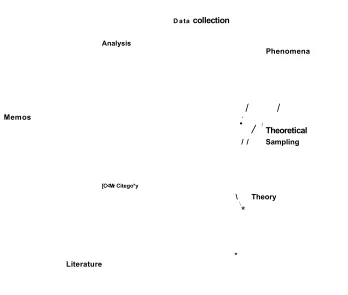
alternating sequence (see Figure 3.1). This is also described as a cycle between induction and deduction which consists of collecting data and the comparisons between the results and new findings which guide further data collection (Strauss and Corbin, 1990). As a consequence the overall development and identification of variables does not take place before the data collection but happens as part of the overall data collection process. Therefore the participants within the study initiate the variables and concepts which are then developed further by the sense making workshop and the researcher and then conceptualised. Data is collected until saturation is achieved and no new relevant data emerges regarding the categories and their relationships (Strauss and Corbin, 1998b).
D ata collection
Analysis
Phenomena
[ C<Mr Citego*y
/ /
'
• /
/ Theoretical
/ / Sampling
\ Theory
\
*
* Literature
Memos
Figure 3.1: Steps in developing grounded theory (Adolph Hall and Kruchten, 2011)
[image:56.614.99.447.284.579.2]