TRAIN STATION’S IDENTITY THROUGH IMAGE
1,*
Hossam A. Tork,
2Prof. Dr. Amr F. Elgohary, Ph.D and
1
BSc. Ain Shams University, Faculty of Engineering, Department of Architecture
2Professor of Architectural Design; Ain Shams Uni
3
Professor of Architectural Design; British University in Egypt
ARTICLE INFO ABSTRACT
Background:
philosophies of design
surrounding community, space division for several activities and uses, axes plan
gathering and the quality of the prevailing economic activity in it and divide the assembly elements and its distribution, and also keep up with the rapid evolution in rail transport technology
inception, train stations has been cultures, and multi
expressive image for the entrance to the city, and to visualise the form of urbani activity and social community within the urban or rural areas
new visual elements that are not constrained by the traditional art styles that highlight several visual elements that help in providin
themes, and also offer a new experience to the stations’ users.
discussion is an analysis for case studies; for the purpose of obtaining enough results
provide conclusions for the assumptions about the design: reviewing each item, and its effect on the expressive language to the station building.
developed beyond the traditional orders and the 20th
Copyright © 2019, Hossam A. Tork et al. This is an open use, distribution, and reproduction in any medium, provided
INTRODUCTION
In the 1830's, critics debated about the defining look of a station, and the defining featured volume; whether it is the shed, the hotel, the clock tower, etc. The railroad station was to become the gate into the modern city. The symbolism of the
gateway for stations was considered the "Grand Hall"
volume that welcomes the travelers also provides a lack of visibility from street level of the trains and other operational functions (Tsai, 1991). The "Grand Hall" in the British rail station was a symbol for the great entry way to the trains; a meaning that was transformed into a literal great archway in Euston Station, designed by architect Philip Hardwick. Critic William Cubitt said:
"A good station could be built at King's Cross for less than the cost of the ornamental archway at Euston Square."
*Corresponding author: Hossam A. Tork,
BSc. Ain Shams University, Faculty of Engineering, Department of Architecture.
ISSN: 0975-833X
Article History:
Received 14th August, 2019
Received in revised form 18th September, 2019
Accepted 25th October, 2019
Published online 26th November, 2019
Citation:Hossam A. Tork, Prof. Dr. Amr F. Elgohary, Ph.D and Prof. Khaled M. Dewidar, Ph.D
elements”, International Journal of Current Research
Key Words: Station, Identity, Gateway, Colours, Image.
RESEARCH ARTICLE
TRAIN STATION’S IDENTITY THROUGH IMAGE-BASED ELEMENTS
Prof. Dr. Amr F. Elgohary, Ph.D and
3Prof. Khaled M.
BSc. Ain Shams University, Faculty of Engineering, Department of Architecture
Professor of Architectural Design; Ain Shams University, Faculty of Engineering
Professor of Architectural Design; British University in Egypt
ABSTRACT
Background: The ideas and designing process of train stations had evolved to follow the several philosophies of design-led elements, such as: highlighting the cultural development of the surrounding community, space division for several activities and uses, axes plan
gathering and the quality of the prevailing economic activity in it and divide the assembly elements and its distribution, and also keep up with the rapid evolution in rail transport technology
inception, train stations has been represented as gates; a symbol of the crossing to the other centres of cultures, and multi-cultural and economic opportunities, so that the station has become the optimized expressive image for the entrance to the city, and to visualise the form of urbani
activity and social community within the urban or rural areas. Objectives:
new visual elements that are not constrained by the traditional art styles that highlight several visual elements that help in providing a distinctive identity to station buildings, reflecting new ideas and themes, and also offer a new experience to the stations’ users. Methods:
discussion is an analysis for case studies; for the purpose of obtaining enough results
provide conclusions for the assumptions about the design: reviewing each item, and its effect on the expressive language to the station building. Results: Image-based elements in the current era have developed beyond the traditional orders and themes of the visual representations in the beginning of
th
century.
open access article distributed under the Creative Commons Attribution provided the original work is properly cited.
In the 1830's, critics debated about the defining look of a station, and the defining featured volume; whether it is the The railroad station was to become the gate into the modern city. The symbolism of the "Grand Hall"; the large volume that welcomes the travelers also provides a lack of level of the trains and other operational The "Grand Hall" in the British rail station was a symbol for the great entry way to the trains; a meaning that was transformed into a literal great archway in Euston Station, designed by architect Philip Hardwick. Critic
tion could be built at King's Cross for less than the cost of the ornamental archway at Euston Square."
BSc. Ain Shams University, Faculty of Engineering, Department of
DISCUSSION
Concourses as gateways: The size of station building and its interiors affects emotional response and visual weight generated by their impression.
spacious interiors but might be also overwhelming and produce feelings of anxiety, so it needs to
elements. Smaller stations were designed more in relation to human scale. The light contributes to the perception of scale even if the station is small, impressive lighting design can make station visually more spacious
classical pediment and column façade is an example of the
literal transformation of the "gateway"
of the entry into the city. Explaining the different style period of the design, it seems the form of the gateway was simply borrowed from the classical reference, and does not reflect in any way the materials or technology of that time period 1991). It should be noted that its Greek Doric arch ( conformed to contemporary thinking that
was a gateway to the city” (Tsai, 1991
International Journal of Current Research Vol. 11, Issue, 11, pp.8370-8374, November, 2019
DOI: https://doi.org/10.24941/ijcr.37182.11.2019
Hossam A. Tork, Prof. Dr. Amr F. Elgohary, Ph.D and Prof. Khaled M. Dewidar, Ph.D. 2019. “Train station’s identity through image Journal of Current Research, 11, (11), 8370-8374.
BASED ELEMENTS
Prof. Khaled M. Dewidar, Ph.D
BSc. Ain Shams University, Faculty of Engineering, Department of Architecture
versity, Faculty of Engineering
Professor of Architectural Design; British University in Egypt
The ideas and designing process of train stations had evolved to follow the several led elements, such as: highlighting the cultural development of the surrounding community, space division for several activities and uses, axes planning for human gathering and the quality of the prevailing economic activity in it and divide the assembly elements and its distribution, and also keep up with the rapid evolution in rail transport technology. Since their represented as gates; a symbol of the crossing to the other centres of cultural and economic opportunities, so that the station has become the optimized expressive image for the entrance to the city, and to visualise the form of urbanization and economic Objectives: The paper aims to examine new visual elements that are not constrained by the traditional art styles that highlight several visual g a distinctive identity to station buildings, reflecting new ideas and Methods: The methodology of the discussion is an analysis for case studies; for the purpose of obtaining enough results that should provide conclusions for the assumptions about the design: reviewing each item, and its effect on the based elements in the current era have themes of the visual representations in the beginning of
ribution License, which permits unrestricted
The size of station building and its interiors affects emotional response and visual weight generated by their impression. Large stations have more spacious interiors but might be also overwhelming and produce feelings of anxiety, so it needs to incorporate human-sized were designed more in relation to human scale. The light contributes to the perception of scale – even if the station is small, impressive lighting design can make station visually more spacious (Kido, 2013). That classical pediment and column façade is an example of the
"gateway" and “monumentality”
of the entry into the city. Explaining the different style period of the design, it seems the form of the gateway was simply owed from the classical reference, and does not reflect in any way the materials or technology of that time period (Tsai,
. It should be noted that its Greek Doric arch (Figure 1)
conformed to contemporary thinking that “the railroad station
Tsai, 1991).
INTERNATIONAL JOURNAL OF CURRENT RESEARCH
Source: https://londonist.com/2014/03/wemightnotbeentirelyserious
Figure 1. Original entrance to Euston Station (1896)
[image:2.595.319.546.49.223.2]Source: http://www.alamy.com
Figure 2. Bank Station in Princes St., London.
Source: https://en.wikipedia.org
Figure 3. Paris Métro entrance by Hector Guimard
Aesthetical representation of identities in the current era:
These are certainly qualities that one would seek in any building; although the route to achieving them may differ depending on the historical, geographical and social context. The search for formulas that will produce good buildings was the origin of architectural theory and continues to this day, although it is generally recognized that there is surely is an element of intangible art to the most successful buildings. Form and function for train station design became over time more integrated with each other to the point of reaching some difficulty in some cases to separate their effects on the station design components:
[image:2.595.330.544.260.402.2]Source: https://en.wikipedia.org
Figure 4. Omotensandō Station, Tokyo
[image:2.595.59.270.263.424.2]Source: www.fosterandpartners.com
Figure 5. Metro Bilbao, Spain
Source: http://www.japanvisitor.com/
Figure 6. Advertisements covering the façade of Shibuya Station, Tokyo
Source: Shamsian, J. (2016, July).
[image:2.595.325.544.422.582.2] [image:2.595.59.270.461.631.2] [image:2.595.322.544.619.766.2]Source: Shamsian, J. (2016, July).
Figure 8. Berlin Hauptbahnh of with a glass facade showing the connecting lines of the station
[image:3.595.61.268.261.401.2]Source: Tyzack, A. (2017, June).
Figure 9. Author Michael Bond; “Paddington”, next to the Paddington Bear statue on Paddington Station, London, UK
Source: Stewart, C., & King, S. (2018).
Figure 10. The diagrid structure plays an important role in daylighting.
How can the necessities of travelling modes contribute to an experience for the user? What are the tools needed to shape a concept or deliver a message through designing a station? What message / expression should be used in the first place?. In subjective response to the station’s built form, there are image-based elements related to design context, representation of the image of railways, of a brand of train operators, landmarks features, and to inclusion of artistic elements. These are related to transportation and commercial station function
(Kido, 2013). Station entrance: Entrances should be exposed
and have harmony with its surroundings in the case of elevated stations. In case of subways, since there are no buildings for them, entrances become more important.
Even if a building is present, it is difficult to find an appropriate design to connect the building with the station, but a good design can provide distinguishing. Here are some
examples (Kido, 2013):
Some subway entrances emphasize the company logo: at
London’s Underground (Figure 2).
Others have an articulate design reflecting total concept
of the subway lines: Art Nouveau entrances in Paris (Figure 3).
Some show interesting design and subway operator’s
logo: in Japan, with some recent entrances, such as at Omotensandō (Figure 4).
Some are architecturally very distinguished and have the
quality of urban landmarks that strongly identify
particular city: stations on subway at Bilbao – Metro
Bilbao (Figure 5).
In general, station entrance has important roles functionally, which can be summarized as follows:
The front plaza, which is an important feature, provides
direct vehicular access to station by private vehicles and public transportation, alongside passengers arriving on foot.
Providing a shelter for people waiting for a bus or taxi;
which emphasizes the importance of the front of the station as the station plaza, canopy, entrance and concourse are all related elements in the progression from the city to the train.
Practical design to enables traffic flow, and a
symbolism for the station; as the starting point of the journey.
Advertisements
Commercial advertising has been source of income of railway companies in Europe from the early days and present, including
Japan (Figure 6). Treatment of advertisement reflects approach
to aesthetics in public spaces, and enhances the station’s image as a value. Particularly sensitively should be handled the advertisements at historical stations, where they should be well integrated with station architecture.
Advertisements are inevitable and their design should be a part of total design concept. For example:
It can be associated with the context of the station
environment.
Having a reference to healthy lifestyle products, or
culture, etc.
Landmarks
Landmark elements emphasise the design idea through simple graphical elements or objects. Built forms often express their association with certain location – “sense of place”.
They might express the image of the city (Figure 7).
Through marking station entrances with company
logo. The logo applied by many European operators has an informative, decorative and signature values
[image:3.595.46.282.447.594.2] As landmarks, if they are visible and their image-based elements are strongly related to their urban, historical, cultural, and social context (Kido, 2013) (Figure 9).
Colours and lighting for themes: One important element of form conception is colours. Train stations play an important role in choosing the required colour palette to identify the station buildings’ as a part of the history and cultural qualities
[image:4.595.112.481.57.293.2]Source: Stewart, C., & King, S. (2018).
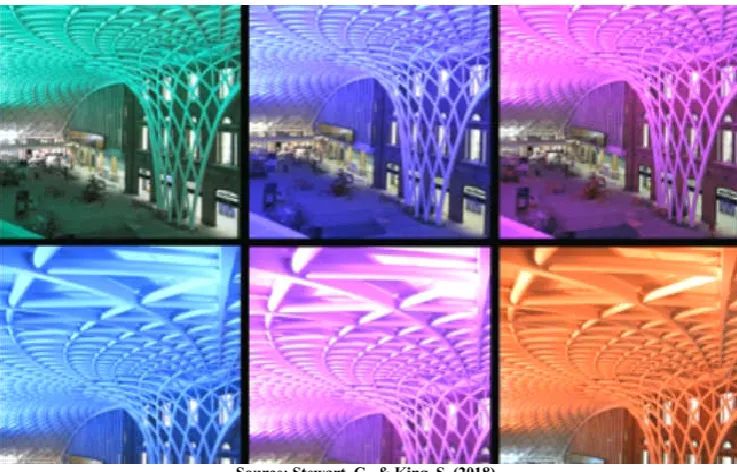
Figure 11. Different hues on the diagrid structure at night
[image:4.595.125.472.328.505.2]Source: González , M.F. (2019, June)
Figure 12. Exterior night shot of Madinah Station
Source: Welch, A. (2016, January)
[image:4.595.194.402.542.715.2]of the city, or to identify the concept of new stations resembling airports in our current age. Brighter stations are livelier and probably safer. Design of lighting may create desirable atmosphere. Daylight in daytime is preferable; therefore a provision of glazing increases the possibility of natural light’s penetration inside the station. Artificial lighting is functional as well, and it can increase visual expression of the station. Top lights create secure environment and enhance
architectural features of the interior(Kido, 2013).
Perception of colour is subjective and influenced by size, other colours and light. Colours may have also influence on the “visual weight”. Some colours, which are “warm”, make spaces visually smaller, while “cool” colours make them visually larger. At the station, colour can be created by using colourful materials and colourful artificial lighting. Bright colours visually increase space; warm colours increase the feelings of safety. Colours are also used to express the design concept. Colours combined with light can be used for aesthetic and functional arrangement at the station, to underline particular functional elements, branding or to show directions (Kido, 2013). A good example for the effect of combining light with colours for visual weight is in King’s Cross Station, London. Lighting design for the concourse was done by Arup. To strengthen the visual impact of its new diagrid structure, the lighting uses ceramic-based metal halide projectors that produce from the mezzanine roof structure an indirect, highly efficient and colour-stable light, which offers a comforting atmosphere to connect passengers to the time of day and the life of the city outside (Stewart, 2018). The original plan was to make the lighting colour blue; to contrast with the yellowish-coloured masonry, but it was changed to add more colours with stable hue all over the diagrid structure. The uniformity of the colour is done by a lighting modulor software to adjust lighting
angles (Stewart, 2018) (Figure 10). Colours are also used to
express the design concept. Colours combined with light can be used for aesthetic and functional arrangement at the station, to underline particular functional elements, branding or to show
directions (Kido, 2013). For the people with visual
impairments, the surfaces must not be too reflective and vertical planes well contrasted from horizontal surfaces (Wilson, 2015).
Symbolising an urban context: The four stations of
Haramain High Speed Rail(HHSR) are inspired by the
traditional art and culture of the city. Using a modular approach, the stations have common design elements. A different colour is assigned for the vaults in each station, to identify the city in it (González, 2019). Each of the four stations varies in colour; which signify the four cities while
remaining symbolic to the HHR system(Haramain, 2009):
Makkah Station: Gold; references the gold leaf of the
decorated Kab'ah and the city's significance as a holy site.
Madinah Station: Green; draws inspiration from the
Mosque of the Prophet.
Jeddah Station:Purple; symbolises the city.
KAEC Station: Blue and silver; representing the future
role as a modern new city.
RESULTS
The form of a station and its aesthetical values becomes
more expressive to the city’s identity, even if the exterior design can be a representative of an international style at first glance. Therefore, aesthetics are not bound to representing a specific art movement, but rather symbolizing an identity to its environment.
The entrance to a station delivers a strong message; either
for urban integration, cultural identity, or corporate identity. The importance of designing an entrance may be even greater when the station is not visible (underground for example). Whether the visual design is subtle, symbolic, or conspicuous, the entrance to a station should deliver a clear message.
Colours and image-based elements became more vital in
providing symbolism to a station, rather than the traditional elements of specific art styles.
Lighting provides an interpretation to colours and interior
spaces that affect the mood and experience of users.
The importance of providing a visual value to the station
is in providing a new experience to users and gaining satisfaction towards the provided transportation service.
Advertisements play an important role in adding an
image-based value to the station; being part of an urban context that reacts with the services provided through commercials. Advertisements should also maintain a limit in their spread to avoid messing the image of old stations.
Conflict of Interest statement: I declare that there is no conflict of interest with the publication of the article.
Funding statement: I declare that there is no funding of the publication of the article.
REFERENCES
Gonzلlez, M.F. 2019. Haramain High Speed Rail / Foster + Partners. Retrieved June 2019, from Archdaily: https://www.archdaily.com/919039/haramain-high-speed-rail-foster-plus-partners
Haramain High Speed Rail-Saudi Arabia 2009. 2009. Retrieved
November 2016, from Foster+Partners:
http://www.fosterandpartners.com/projects/haramain-high-speed-rail/
Kido, E. M. 2013. Stations for People: Recent Developments in Railway Station Design, p.63-70.
Stewart, C., & King, S. 2018. New Concourse and Stunning Diagrid Roof. Retrieved August 2018, from ARUP: https://www.arup.com/projects/kings-cross-station
Tsai, M. D. 1991. Taipei Terminal Rail Station: Creating an
Urban Gateway. Massachusetts Institute of Technology,
Architecture, MIT Libraries, p. 10-15.
Wilson, T., & Yariv, B. 2015. Station Design Principles for
Network Rail. Network Rail, Document no.
BLDG-SP80-002