CLINICAL SKILLS IN NURSING: OSCE/OSPE
GUIDELINES FOR IMPLEMENTATION
*
Bhopal memorial Hospital And Research Centre, India
ARTICLE INFO ABSTRACT
Background:
competence of students but currently it has been extensively used in nursing field to appraise the clinical competence of nursing students.
perception on OSCE from faculty and students and the complexities associated with it. An extensive review of nursing literature through different databases was conducted by 2 independent reviewers. Results:
among nursing students and a better evaluation tool over the Traditional Clinical Exam. The various attributes of OSCE; objectivity, skill mix, and well structured format were appreciated bu complexities in OSCE ; time allotted at different stations, student anxiety and the implementation cost were addressed as barriers.
the review.
Copyright©2019, Abin Varghese. This is an open access distribution, and reproduction in any medium, provided
INTRODUCTION
The appraisal of clinical competence is an elemental issue in clinical health education: appraisal of clinical practice is long standing and receives extraordinary attention in nursing education (Mater et al., 2014). The concept of clinical competence needs to be elaborated. The competence has been defined in a holistic way by Australian Nurses and Midwifery Council (2005) as a “combination of skills, knowledge, attitudes, values and abilities that underpin effective and/or superior performance in a profession. Indeed the complex nature of competence most often pose a challenge to determine and segregate the effective assessment strategies that are able to measure all the attributes by maintaining validity, reliability and objectivity” (http://www.edcan.org). The key dimensions of competence in nursing education comprises mainly of the cognitive, affective and psychomotor domains. The psychomotor domain predominantly envisages the development of clinical skills with regard
profession(Brosnan et al., 2006). However, objective evaluation of clinical competence in nursing students remains a major challenge for nurse educators due to limited sites for clinical placements, varying clinical hours, and no consisten assessment of practice tools (Crookes
Furthermore the students clinical experiences are not equivalent because of varying exposure to different patients making it difficult to measure individual and program
ISSN: 0975-833X
Article History:
Received 16th May, 2019
Received in revised form
20th June, 2019
Accepted 11th July, 2019
Published online 31st August, 2019
Citation: Abin Varghese and Gigini George, 2019.
implementation”, International Journal of Current Research
Key Words:
OSCE/OSPE, Assessment, Nursing.
*Corresponding author: Abin Varghese
RESEARCH ARTICLE
CLINICAL SKILLS IN NURSING: OSCE/OSPE-A SCOPING SYSTEMATIC REVIEW TO DEVELOP
GUIDELINES FOR IMPLEMENTATION
*
Abin Varghese and Gigini George
Bhopal memorial Hospital And Research Centre, India
ABSTRACT
Background: The OSCE assessment tool has been used in the medicine field long back to assess the competence of students but currently it has been extensively used in nursing field to appraise the clinical competence of nursing students. Method: A systematic review was
perception on OSCE from faculty and students and the complexities associated with it. An extensive review of nursing literature through different databases was conducted by 2 independent reviewers. Results: The faculty and students perceived OSCE as an effective tool for competency assessment among nursing students and a better evaluation tool over the Traditional Clinical Exam. The various attributes of OSCE; objectivity, skill mix, and well structured format were appreciated bu complexities in OSCE ; time allotted at different stations, student anxiety and the implementation cost were addressed as barriers. Conclusion: Guidelines for the conduct of OSCE has been developed from the review.
access article distributed under the Creative Commons Attribution License, the original work is properly cited.
The appraisal of clinical competence is an elemental issue in clinical health education: appraisal of clinical practice is long-standing and receives extraordinary attention in nursing
The concept of clinical eds to be elaborated. The competence has been defined in a holistic way by Australian Nurses and Midwifery Council (2005) as a “combination of skills, knowledge, attitudes, values and abilities that underpin effective and/or ssion. Indeed the complex nature of competence most often pose a challenge to determine and segregate the effective assessment strategies that are able to measure all the attributes by maintaining validity, reliability The key dimensions of competence in nursing education comprises mainly of the cognitive, affective and psychomotor domains. The predominantly envisages the development of clinical skills with regard to the nursing 2006). However, objective evaluation of clinical competence in nursing students remains a major challenge for nurse educators due to limited sites for ing clinical hours, and no consistent et al., 2010). Furthermore the students clinical experiences are not equivalent because of varying exposure to different patients making it difficult to measure individual and program
outcomes (Rentschler et al., 2
strategies in nursing education has undergone heightened evolutions throughout the years beginning from the
as classroom-based exhibit of practical skill, which was highly criticized due to concerns about
situations, to the use of behavioral checklists in the 1970s, to continuous clinical assessment in the 1980s (Redfern 2002). The Objective Structured Practical/Clinical Examination (OSPE/OSCE) has earned popularity measure of clinical skills since its development in the 1970s (Bartfay et al., 2004; El Nemer
structured clinical examination (OSCE) was introduced by Drs. Harden and Gleeson in 1975 as a method to evaluate the clinical competence of medical students at Dundee University, Scotland, United Kingdom. Even though OSCE originated from medical education, it has been used generously in nursing education worldwide (Shadia et al
of the OSCE model are to ev
classroom and laboratory learning experiences into simulated clinical practice, and to objectively assess their clinical performance (Mc William et al
domains of educational objectives: cognitive, aff
psychomotor can be assessed by OSCE. OSCEs serve as a platform where the students can demonstrate their mastery of clinical competencies by applying acquired knowledge to a given situation (Franklin et al.,
OSCE varies in different nursing institutions however a common pattern consisting of a circuit or series of short
International Journal of Current Research Vol. 11, Issue, 08, pp.6239-6245, August, 2019
DOI: https://doi.org/10.24941/ijcr.36281.08.2019
2019. “Clinical skills in Nursing: OSCE/OSPE-A scoping systematic Review to develop guidelines for
International Journal of Current Research, 11, (08), 6239-6245.
Available online at http://www.journalcra.com
A SCOPING SYSTEMATIC REVIEW TO DEVELOP
The OSCE assessment tool has been used in the medicine field long back to assess the competence of students but currently it has been extensively used in nursing field to appraise the : A systematic review was conducted to bring out the perception on OSCE from faculty and students and the complexities associated with it. An extensive review of nursing literature through different databases was conducted by 2 independent reviewers. nts perceived OSCE as an effective tool for competency assessment among nursing students and a better evaluation tool over the Traditional Clinical Exam. The various attributes of OSCE; objectivity, skill mix, and well structured format were appreciated but the complexities in OSCE ; time allotted at different stations, student anxiety and the implementation cost : Guidelines for the conduct of OSCE has been developed from
License, which permits unrestricted use,
2007). The clinical assessment strategies in nursing education has undergone heightened throughout the years beginning from the pre-1971 based exhibit of practical skill, which was highly criticized due to concerns about transferability to real clinical situations, to the use of behavioral checklists in the 1970s, to ous clinical assessment in the 1980s (Redfern et al., 2002). The Objective Structured Practical/Clinical Examination (OSPE/OSCE) has earned popularity as a since its development in the 1970s El Nemer et al., 2009). Objective structured clinical examination (OSCE) was introduced by Drs. Harden and Gleeson in 1975 as a method to evaluate the tence of medical students at Dundee University, Scotland, United Kingdom. Even though OSCE originated from medical education, it has been used generously in nursing et al., 2010). Themain objectives of the OSCE model are to evaluate students’ transfer of classroom and laboratory learning experiences into simulated clinical practice, and to objectively assess their clinical et al., 2012).Moreover the three domains of educational objectives: cognitive, affective and psychomotor can be assessed by OSCE. OSCEs serve as a platform where the students can demonstrate their mastery of clinical competencies by applying acquired knowledge to a ., 2005). The mode of conducting ies in different nursing institutions however a of a circuit or series of short
INTERNATIONAL JOURNAL OF CURRENT RESEARCH
assessment tasks (stations), each of which is assessed by an examiner using a predetermined, objective marking scheme is being utilized all over (Bartfay et al., 2004). Student performance is assessed by examiners against checklist of detailed objective criteria relating to skill components (Brosnan et al., 2006). The OSCE stations can be skill or knowledge assessment: The various competencies that can be checked includes a)infection control b)Health and safety- management of Needle stick injury, slips, trips, falls and so on. c ) Resuscitation- CPR/defibrillation scenarios d)fire safety skills e)Medicines management f) Nasogastric tube placement g)Correct use of medical devices h)blood transfusion i)interpersonal or communication skills j)Professionalism k)practice based learning (www.nursingtimes.net/vol).
The number of OSCE examination stations vary from 12 – 15 or even 20 stations with an exit time ranging from 5-10 minutes per station. For credibility and objectivity, all the students to perform the examination gather, wait and start from a large hall and exit from an opposite door at the end of the assessment. It is thus expected that candidates yet to be examined should not have contact with those already examined. Candidates are earlier briefed on the movement in the examination hall and advised to switch off / stay without their phones until end of the exams (Boursicot et al., 2005). Some stations in the OSCE use standardized patients (SPs), actors who use a script to pose as patients during a student encounter designed to create a real-world simulation. OSCE encounters are structured, well reasoned, and focused directly on meeting the competencies needed to ensure quality practice. SPs purposefully pretend to have a medical condition in order to provide nursing students with realistic, accurate, dynamic, and interactive training experiences (Adamo et al., 2003; Mac Donald et al., 2004). Interviews with SPs and physical examinations allow students to demonstrate assessment and the planning, implementation, and/or evaluation of care given in response to a single patient encounter (Eva et al., 2004). The use of SPs can decrease stress for students, promoting a more relaxed environment for learning and evaluation (Bramble et al., 1994). The modified version of OSCE includes the Observed Structured Practical Examination (OSPE) which is a performance based assessment used for the summative assessment of practical knowledge and skills (Soliman et al., 2014). In particular the features of OSCE/OSPE includes a)A broad range of clinical skills are included in the assessment with adequate sampling of skills and content b)Short stations with time not exceeding 4-5 minutes c)numerous stations ranging from 12-20 d)Highly focused stations e)Pre-structured checklist/marking schemes e)objectivity in scoring f)Use of SPs/models for acute cases g) Decreased patient/examiner input thus increasing the validity of examination (Osaji et al., 2005).The objective of the current study was to explore feasibility assessment of clinical competence of nursing students using OSCE.
MATERIALS AND METHODS
Inclusion and Exclusion Criteria: The following inclusion
criteria was used to retrieve the OSCE literature: studies done from 2005 to 2017, published in English with full text availability, Nursing students and faculty members as study participants, OSCE/OSPE being the central theme. The exclusion criterion included review articles, opinion studies, unpublished research articles.
Search Strategy: Two independent reviewers screened the
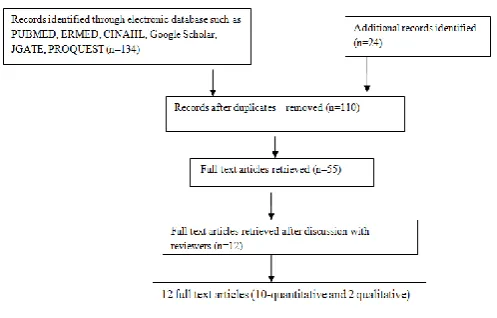
title, abstract; keywords of each reference identified by the search through different data bases such as PUBMED. ERMED, CINAHL, Google Scholar, JGATE, PROQUEST by using the key words-OSCE/OSPE, Nursing with further retrieving of the article by subjecting them to the inclusion and exclusion criteria. Differences in opinion of the reviewers were resolved by mutual discussion and the potential articles were retrieved with full text (figure 1). The outcome from different studies reveals that OSCE is an effective tool for the assessment of competencies among nursing students from the viewpoint of faculty and students. Majority of studies have used researcher developed questionnaire to get feedback and evaluation regarding OSCE from faculty and students. The traditional final examination was ranked as unsatisfactory by more than two third of the students with a mean of 25.3±18.1 while OSCE was ranked as very satisfactory to satisfactory by more than half of the students with a mean score of 49.8±18.3 which shows the negative perspective of students ‘regarding the traditional final examination (Delavar et al., 2013). A major proportion of students displayed their positive feeling towards OSCE (Renee et al., 2017). Participants documented feeling “much more positive” and “happy” about this style of assessment after they had completed it, they felt it was “fair” and they had “achieved” something.
Fig. 1. Flow chart showing literature search for OSCE
Indeed the student anxiety emerged as a major theme from the qualitative study. Over half of the sample (n = 69) documented feeling “nervous” or “anxious” regarding the impending OSCE. The interaction between students and assessors had a role in contributing stress to the students. More than two thirds of the sample (n = 82) commented positively on the interactions between themselves and the RN assessing them. Words such as “supportive,” “kind,” and “understanding” were frequently mentioned in participant comments. However, not all assessor interactions were viewed in a positive way. Ten participants’ comments were negative in terms of their allocated assessor, as they felt the attitude of the assessor resulted in them becoming more “nervous” and “stressed” (Renee et al., 2017). The preparation of students in various arenas such as awareness of the skills under review, access to the marking criteria, opportunities to view skill stations, and reassurance from the facilitator before and during the OSCE assessment has been felt relaxing by the students. The time alloted to students at different stations was a major concern in almost all the studies. The participants from qualitative studies had mixed views about the time allotted to each station. Some participants felt 30 min per station was excessive, while others felt they required the allocated time to observe students’ perform the skill and to complete the checklist (Evelyn et al., 2008). Furthermore only 31.5 percent agreed on adequacy of time per station, and twenty six students requested to increase the time alloted to each station. The clinical instructors commented on having more parallel stations so that many students can be evaluated at a time. Comments from some clinical instructors further stated that: ‘need to provide more time for students’, ‘some stations takes more than planned and some takes less’, while other suggested that: ‘procedures/competency that requires a longer time should be separated from those procedures that require less time’. Moreover a time limit of six minutes per station was felt unsatisfactory by students (Delavar et al., 2013).
DISCUSSION
The current systematic review has addressed various concerns set forth by the assessment tool- OSCE from the perspective of nursing students and faculty. The popularity of OSCE resulted from concerns that were raised about the traditional clinical and oral examinations used for assessing clinical competence. The concerns were triggered by the discovery of low correlations between examiners mark allocation, which resulted in unacceptable reliability. However, change in some parts of the world took long to occur due to a general lack of
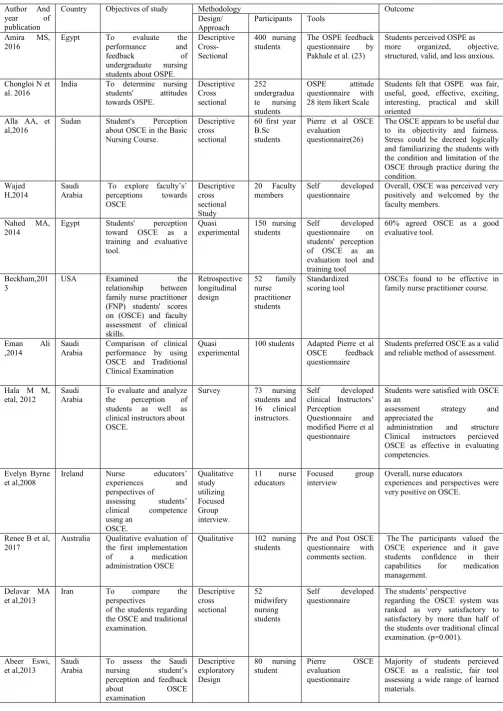
an optional assessment method for clinical competence (Rushforth et al., 2007; Levettte et al., 2010)).The study included in the review done by Eman Ali, et al (2014) revealed that there was a statistically significant difference between the mean of Traditional Clinical Exam (TCE) score and the mean of Objective Structured Clinical Exam (OSCE) score and accepted normal distribution curve of the student’s grades. The findings are congruent with Mondal et al. (2012) who compared the two examination styles and showed that students fared better in objective structured clinical examination than in conventional examination with respect to mean total score (p <0.001) as well as mean percentage score (Mondal et al., 2012). The OSCE assessment has vanquished TCE in terms of its uniformity in the method of assessment and is being supported by studies in the review done by Alla et al., 2013,Amira et al., 2017 and Eman Ali et al., 2014 whereby 90 percentage,64 percentage and 79 percentage of participants agreed on the objective nature of OSCE respectively. It is also emphasized in the article by Rushforth, 2007, that “In an OSCE, all students are assessed using exactly the same stations with the same marking scheme to make the assessment of clinical skills more objective rather than subjective”. The evaluation of nursing students during a practical examination carries high variability in terms of the opportunities for assessment and the skills of the examiners in the traditional clinical exam. This means some students face more difficult examinations than other students which raises questions of the uniformity of in-situ exams. These observations would indeed support the suggestion that a multimethod approach offered by OSCE to assess the different domains of competence.
Table 1. Summary of reviewed articles
Author And
year of
publication
Country Objectives of study Methodology Outcome
Design/ Approach
Participants Tools
Amira MS,
2016
Egypt To evaluate the
performance and
feedback of
undergraduate nursing
students about OSPE.
Descriptive Cross-Sectional
400 nursing students
The OSPE feedback
questionnaire by
Pakhale et al. (23)
Students perceived OSPE as
more organized, objective,
structured, valid, and less anxious.
Chongloi N et al. 2016
India To determine nursing
students' attitudes
towards OSPE. Descriptive Cross sectional 252 undergradua
te nursing
students
OSPE attitude
questionnaire with
28 item likert Scale
Students felt that OSPE was fair, useful, good, effective, exciting, interesting, practical and skill oriented
Alla AA, et al,2016
Sudan Student's Perception
about OSCE in the Basic Nursing Course.
Descriptive cross sectional
60 first year B.Sc students
Pierre et al OSCE evaluation
questionnaire(26)
The OSCE appears to be useful due to its objectivity and fairness. Stress could be decreed logically and familiarizing the students with the condition and limitation of the OSCE through practice during the condition.
Wajed H,2014
Saudi Arabia
To explore faculty’s’
perceptions towards
OSCE
Descriptive cross sectional Study
20 Faculty
members
Self developed
questionnaire
Overall, OSCE was perceived very positively and welcomed by the faculty members.
Nahed MA,
2014
Egypt Students' perception
toward OSCE as a
training and evaluative tool.
Quasi experimental
150 nursing students
Self developed
questionnaire on
students' perception of OSCE as an evaluation tool and training tool
60% agreed OSCE as a good evaluative tool.
Beckham,201 3
USA Examined the
relationship between
family nurse practitioner (FNP) students' scores on (OSCE) and faculty assessment of clinical skills.
Retrospective longitudinal design
52 family
nurse practitioner students
Standardized scoring tool
OSCEs found to be effective in family nurse practitioner course.
Eman Ali
,2014
Saudi Arabia
Comparison of clinical performance by using OSCE and Traditional Clinical Examination
Quasi experimental
100 students Adapted Pierre et al
OSCE feedback
questionnaire
Students preferred OSCE as a valid and reliable method of assessment.
Hala M M, etal, 2012
Saudi Arabia
To evaluate and analyze
the perception of
students as well as
clinical instructors about OSCE.
Survey 73 nursing
students and
16 clinical
instructors.
Self developed
clinical Instructors’ Perception
Questionnaire and
modified Pierre et al questionnaire
Students were satisfied with OSCE as an
assessment strategy and
appreciated the
administration and structure
Clinical instructors percieved
OSCE as effective in evaluating competencies.
Evelyn Byrne et al,2008
Ireland Nurse educators’
experiences and
perspectives of
assessing students’
clinical competence
using an OSCE. Qualitative study utilizing Focused Group interview.
11 nurse
educators
Focused group
interview
Overall, nurse educators
experiences and perspectives were very positive on OSCE.
Renee B et al, 2017
Australia Qualitative evaluation of
the first implementation
of a medication
administration OSCE
Qualitative 102 nursing
students
Pre and Post OSCE
questionnaire with
comments section.
The The participants valued the OSCE experience and it gave
students confidence in their
capabilities for medication
management.
Delavar MA et al,2013
Iran To compare the
perspectives
of the students regarding the OSCE and traditional examination. Descriptive cross sectional 52 midwifery nursing students
Self developed
questionnaire
The students’ perspective regarding the OSCE system was ranked as very satisfactory to satisfactory by more than half of the students over traditional clincal examination. (p=0.001).
Abeer Eswi, et al,2013
Saudi Arabia
To assess the Saudi
nursing student’s
perception and feedback
about OSCE
examination
Descriptive exploratory Design
80 nursing
student
Pierre OSCE
evaluation questionnaire
Comments related to preparation by the participants in the study by Renee et al. 2017 centred on the online availability of assessment information in the form of a step-by-step guide to OSCE processes, as well as the presentation of the marking criteria (Renee et al., 2017). Moreover the study by Evelyn B, 2007 indicated that the students were appropriately prepared for the OSCE in light of the measures that were put in place prior to the examination such as, Students’ access to the marking criteria which is supported by Anderson (2002); Evelyn et al., (2008); Anderson et al., (2002). The Nurse educator plays a significant role in the setting of OSCE environment and is an indispensable part of OSCE assessment. All the studies included in the review has highlighted the role of nurse educator in OSCE and is supported by studies done by Brosnan et al 2006 and Boursicot 2005 indicating the positive impact of the co-ordinator or facilitator on the OSCE process. The criteria of a good examination includes a relaxed environment for the students which will be percieved as a stress free milieu. The stressful nature of OSCE has been brought out by Franklin, 2005; Alla, 2016 and Delavar, 2013 in the review. There are multiple reasons for the stress experienced by nursing students undergoing OSCE. In one hand, possible explanation provided by Benseñor (2004), is that it becomes very embarrassing when student expertise in analyzing a clinical situation is assessed by an observer inside the room verifying if he/she is doing the right thing.
The presence of an observer may, in these cases, be a stressful situation. In the other hand, students expressed considerable concern that the time allocated to performance was inadequate and remarked that they were stressed by the lack of enough time to deal with the scenario in some stations (Bensenor 2004). Troncon (2004) explained: “it is conceivable that student stress could be related to fears concerning possible failure, and it could also originate from local cultural factors as students might tend to perceive assessment procedures and tests as something aiming only at rewarding a few students and punishing others”. Tabatabaie (2005) reported that lack of practice at being examined in the OSCE format might also contribute to both the dissatisfaction with the time available and the perceptions of the OSCE as a highly stressful examination, particularly in competences not previously assessed in the 'traditional' examination. Finally, Iqbal et al. 2009 added that reasons for stress may also include receiving inadequate prior instructions, the newness of the format to students and their inexperience with it. Indeed the use of OSCE as a summative assessment has created stress among students so it would be preferable to use OSCE in the midterm exam as a preparation stage for students before the final OSCE. The role of standardised patients in reducing stress has been brought by Kurz et al. 2009 and Mc Laughlin et al. 2006.
Despite the stressful experience, students still view OSCEs as a valuable learning tool (Rennie et al., 2006). Moreover any kind of examination can induce stress in students, OSCE is considered to be one of the assessment strategy that can allow students to exhibit their competencies in full potential (Ali et al., 2012) . The cost economics associated with OSCE carries important implication in terms of its application in various nursing institutions. Budgeting and costs of the OSCE fall into the following major categories: standardized patient training and performance costs, examiner costs, support staff costs, supplies, space and equipment, catering, and psychometric analysis costs (Hodges et al., 2002; Wallace et al., 2002). The major barriers faced by facilitators in many studies in conducting OSCE were a lack of adequate real standardized patients and a lack of OSCE laboratories. Rushforth (2007) recommended that conducting OSCE requires adequate human resources. The personnel required standardized patients, examiners, scenario and checklist designers, and related executive faculty. All the personnel and faculty require full and detailed preparation before OSCE implementation. The poor student performance on the nursing OSCEs can be attributed to a number of nonstudent-related factors, including poor design of the nursing OSCE station (e.g., case scenarios, inadequately trained standardized patients, and gaps or deficits in curricular programming). All such factors need to be considered before the remediation process can be designed. Abeer et al., 2013, in the review highlighted the student’s suggestion for improvement of OSCE, 60 percentage of the students suggested that OSCE should be applied in all nursing clincal examination across the specialities, 28.75 percentage demanded clear instructions and 11.25 percentage mentioned revision related to all competencies and training for OSCE just before the examination (Abeer et al., 2013).
Conflict of interest: The authors report no conflict of interest
and the authors alone are responsible for the content of article. No funding has been recieved for the conduct of study.
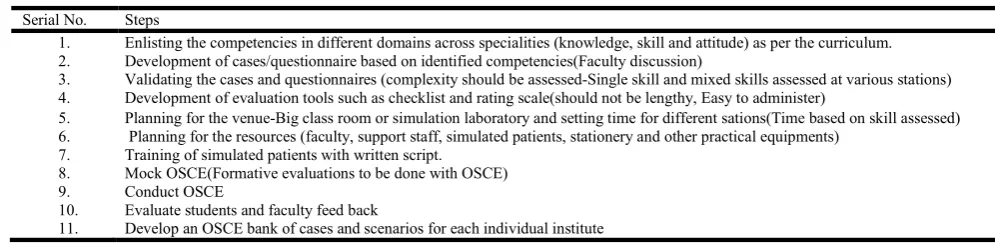
Implications for Practice: The following guidelines can be
summarized from the systematic review for the OSCE assessment (Table 2). Further research needs to be carried out in the various attributes of OSCE especially the cost effectiveness of OSCE, comparison of standardized patients and senior nursing students as simulated patients, effectiveness of video OSCE over the current OSCE method and correlation of OSCE with other methods of evaluation.
Conclusion
[image:5.595.42.540.76.199.2]The assessment of competence through OSCE among nursing students has increased popularity among nurse educators over Table 2. OSCE planning and implementation phases
Serial No. Steps
1. Enlisting the competencies in different domains across specialities (knowledge, skill and attitude) as per the curriculum.
2. Development of cases/questionnaire based on identified competencies(Faculty discussion)
3. Validating the cases and questionnaires (complexity should be assessed-Single skill and mixed skills assessed at various stations)
4. Development of evaluation tools such as checklist and rating scale(should not be lengthy, Easy to administer)
5. Planning for the venue-Big class room or simulation laboratory and setting time for different sations(Time based on skill assessed)
6. Planning for the resources (faculty, support staff, simulated patients, stationery and other practical equipments)
7. Training of simulated patients with written script.
8. Mock OSCE(Formative evaluations to be done with OSCE)
9. Conduct OSCE
10. Evaluate students and faculty feed back
the last decade considering the various advantages of OSCE such as: assessment of clinical competence for large samples of students, the examiner can specify in advance what has to be assessed, the use of checklist and rating scales encourages a more objective assessment, large number of examiners for each student and all students have the same, nearly identical patients, constructive criticism can be given in a more relaxed and neutral way than on a unit. The benefit of OSCE as observed by Rentschle et al., 2005, is that it provides a formative evaluation for both students and the educational institute. Moreover the OSCE provided a platform where the students get exposure and opportunity to experience many more clinical situations than would be available in the natural clinical setting and receive feedback (positive and negative) about their clinical performances and helps to review their strengths and weaknesses. However the various limitations associated with OSCE are: The chances of easy fatigue that can be experienced by observer / examiner since the performance of several candidates need to be recorded as per lengthy check list, special care in organizing time for each station, breaking clinical skills into individual competencies is artificial and not meaningful and the huge cost involved in the resources needed for OSCE (Osaji et al., 2005; Annabel 2007; Rentschler et al., 2007). The nurse educators should be facilitators of learning and should utilize the innovative methods of evaluation-OSCE/OSPE for the graduate nurses and can nurture the real spirit of learning. It is envisaged that this article will help in the recognition of OSCE in the nursing curriculum.
REFERENCES
1. Mater, E., Ahmed,E., El Sayed, A., et al., 2014. The impact of the Objective Structured Clinical examination Approach for Clinical Evaluation Skills on the Student’s Performance in Nursing College. World Journal of Medical Sciences 11 (4), 609-613.
2. Australian Nursing and Midwifery Council., 2005. National competency standards for the registered nurse. http://www.edcan.org
3. Brosnan, M., Evans, W., Brosnan, E., et al., 2006. Implementing objective structured clinical skills evaluation (OSCE) in nurse registration programmes in a centre in Ireland: A utilization focused evaluation 26 (2), 115-122.
4. Crookes, PA., Brown, RA., 2010. The development of a pre-registration nursing competencies assessment tool for use across Australian universities. Sydney, Australia: Australian Government, Office for Learning & Teaching. http://ro.uow.edu.au/cgi/viewcontent.cgi?article=1724&co ntext=hbspapers
5. Rentschler, D., Eaton, J., Cappiello, J., et al., 2007. Evaluation of undergraduate students using objective structured clinical evaluation. Journal of Nursing Educa-tion 46,135-139.
6. Redfern, S., Norman, I., Calman, L.,2002. Assessing competence to practice in nursing: A review of the literature. Research Papers in Education 17(1),51-77 7. Bartfay., Rombough, WJ., et al., 2004. The OSCE
approach in nursing education: objective structured clinical examinations can be effective vehicle for nursing education and practice by promoting the mastery of clinical skills and decision-making in controlled and safe learning environments. Can Nurse 100(3),18-25.
8. El Nemer, A., Kandeel, N.,2009. Using OSCE as an assessment tool for clinical skills: nursing students' feedback. Aust J Basic Appl Sci 3(24),65-72.
9. Shadia, AE., Hanaa, AE., Hewida, AH., et al., 2010. An introduction of OSCE versus traditional methods in nursing education: Faculty capacity building and students perspectives. Journal of American Science 6, 1002-1014. 10.McWilliam, PL., Botwinski, CA.,2012. Identifying
strengths and weaknesses in the utilization of Objective Structured Clinical Examination (OSCE) in a nursing program. Nursing Education Perspectives 33,35-39. 11.Franklin, P., 2005. OSCEs as a means of assessment for
the practice of nurse prescribing. Nurse Prescribing 3(1),14-23.
12.Bartfay, WJ., Rombough, R., Howse, E., et al., 2004. Evaluation The OSCE approach in nursing education. The Canadian Nurse 100(3),18-23.
13.Brosnan, M., Evans, W., Brosnan, E., et al., 2006. Implementing objective structured skills evaluation (OSCE) in nurse registration programmes in a centre in Ireland: A utilisation focused evaluation. Nurse Education Today 26, 115–122.
14.www.nursingtimes.net/vol 108 no.8/Nursing Times 15.Boursicot, K., Roberts, T., 2005. How to set up an OSCE.
The clinical teacher 2(1),16-20.
16.Adamo, G.,2003. Simulated and standardized patients in OSCEs: Achievements and challenges. Medical Teacher 25(3), 262-270.
17.MacDonald, W., 2004. Standardized patients: Training and program issues. Paper presented at the meeting of Standardized Patient Training of the University of New Hampshire, Durham.
18.Eva, K., Rosenfeld, J., Reiter, H., Norman, G.,2004. An admissions OSCE: The multiple miniinterview. Medical Education 38(3), 314-326.
19.Bramble, K., 1994. Nurse practitioner education: Enhancing performance through the use of the Objective Structured Clinical Assessment. Journal of Nursing Education 33, 59-65
20.Soliman, H., Sheble, A., Shrief, W.,2014. Effectiveness of Simulation training on clinical Nursing Education and competence: Randomized Controlled Trial. International Journal of Advanced Research. 2(4),387-393.
21.Osaji Teresa, A., Opiah Margret, M.,Onasoga Olayinka, A.,2005 A tool for objectivity in general nursing examination in Nigeria. J Res Nurs Midw 4(3), 47-52. 22.Amira, MS., Nagwa, IA., 2017. Feedback of
undergraduate nursing students about objective structured practical examination Journal of Nursing Education and Practice 7(3), 1925-4040.
23.Pakhale, S., Mahajan, A., Fating, A., et al., 2012. Study of student’s perception regarding increasing objectivity during practical examination in anatomy. International Journal of Health Science and Research 2(4),48-5. 24.Chongloi, N., Thomas, P., Hansaram, et al., 2017.
Attitudes of undergraduate nursing students toward Objective Structure Practical Examination: An Exploratory study, International Journal of Nursing Sciences 4(1),68-72.
25.Alla, AA., Mohammed, K. 2016. The Objective Structured Clinical Exam (OSCE): A Qualitative Study evaluating Nursing Students Experience, International Journal of Science and Research 5(3),2319-7064.
West Indies, Jamaica. BMC Medical Education. 4 (22): 1-7.
27.Wajed H, Sabeeb ZA. 2014. Perception of nursing faculty members on the use of objective structured clinical examinations to evaluate competencies. International Journal of Science and Research, 6(IV):21-26.
28.Nahed MA, 2Dr. Lila HO, Mervat HS et al. 2014. Effect of training by using objective structured clinical examination "OSCE" on the outcome of clinical training of nursing students enrolled in psychiatric and mental health nursing course, International Journal of Current Research. 6(9):8839-8846.
29.Beckham ND. 2013. Objective structured clinical evaluation effectiveness in clinical evaluation for family nurse practitioner students. Clinical Simulation in Nursing 9 (10):453-459.
30.Eman Ali 2014. The Impact of the Objective Structured Clinical Examination Approach for Clinical Evaluation Skills on the Student's Performance in Nursing College. World Journal of Medical Sciences 11 (4): 609-613. 31.Hala MM. Bayoumy,Yousri H. 2012. Objective Structured
Clinical Examination (OSCE) – Based Assessment in Nursing: Students' and Clinical Instructors' Perception. Journal of American Science, 8(9):523-540.
32.Evelyn B, Siobhan S. 2008. Lecturers’ experiences and perspectives of using an objective structured clinical examination, Nurse Education in Practice .8: 283–289. 33.Renee B,Maria M, Roy A. 2017. Introduction of
undergraduate nursing students to an objective structured clinical examination. J Nurs Educ. 56(4):231-234.
34.Delavar MA, Salmalian H, Faramarzi M. 2013. Using the objective structured clinical examinations in undergraduate midwifery students Journal of Medicine and Life. 6(1);76-79.
35.Abeer E, Amany S. Badawy. 2013. OSCE in Maternity and Community Health Nursing: Saudi Nursing Student’s
Perspective. American Journal of Research
Communication 1(3): 143-162.
36.Rushforth H E. 2007. Objective structured clinical examination (OSCE): Review of literature and implications for nursing education. Nurse Education Today. 27(5):481-490.
37.Levette JT, Gersbach J, Arthur C. 2010. Implementing a clinical competence assessment model that promotes critical reflection and ensures nursing graduates’ readiness for professional practice. Nurse Education in Practice.11: 64-69.
38.Mondal R, Sarkar S, Nandi M et al. 2012. Clinical Examination (OSCE) and Conventional Examination (CE) As a Formative Evaluation Tool in Pediatrics in Semester Examination for Final MBBS Students. Kathmandu Univ Med J. 37(1):62-5.
39.Mc William P, Botwinski C. 2010. Developing a Successful Nursing Objective Structured Clinical Examination. Journal of Nursing Education, 49(1): 36-41. 40.Mitchell ML, Henderson A, Groves M, et al (2009). The objective structured clinical examination (OSCE): optimising its value in the undergraduate nursing curriculum. Nurse Education Today, 29(4): 398–404. 41.Alinier G. 2003. Nursing students’ and nurse educators’
perspectives of objective structured clinical examination incorporating simulation. Nurse Education Today. 23:419–426.
42.Awaisu A, Mohamed MHN, Al-Efan, QAM. 2007. Perception of pharmacy students in Malaysia on the use of objective structured clinical examinations to evaluate competence. American Journal of Pharmaceutical Education, 71(6): 1-8.
43.Ward H, Willis A. 2006. Assessing advanced clinical practice skills. Primary Health Care Journal, 16 (3): 22– 24.
44.Anderson M, Stickley T.2002. Finding reality: the use of objective structured clinical examination (OSCE) in the assessment of mental health nursing students interpersonal skills. Nurse Education in Practice. 2: 160–168.
45.Brosnan M, Evans W, Brosnan E, et al. 2006. Implementing objective structured skills evaluation (OSCE) in nurse registration programmes in a centre in Ireland: A utilisation focused evaluation. Nurse Education Today .26:115–122.
46.Boursicot K, Roberts T. 2005. Practical Teaching – how to set up an OSCE. The Clinical Teacher. 2 (1):16–20. 47.Benseñor EM. 2004. How to evaluate the acquisition of
clinical skills at medical school: A tough question. Sao Paulo Medical Journal. 122(1):12-17.
48.Troncon LE. 2004. Clinical skills assessment: limitations to the introduction of an “OSCE” (Objective Structured Clinical Examination) in a traditional Brazilian medical school. São Paulo Medical Journal. 122(1):12-17.
49.Imani M. and Tabatabaie, H. 2005. Is OSCE successful in pediatrics? Journal of Medical Education, 6(2): 153-158. 50.Iqbal M, Khizar B. Zaidi Z. 2009. Revising an objective
structured clinical examination in a resource limited. Pakistani medical school. Education for Health. 22(1): 1-9.
51.Kurz J., Mahoney K., Plank L. and Lidicker J. 2009. Objective structured clinical examination and advanced practice nursing students. Journal of professional nursing. 25 (3): 186 – 191.
52.Mclaughlin K, Gregor L, Jones A and coderre S. Can standardized patients replace physicians as OSCE examiners? BMC medical education J. 2006; 6 (12): 1 – 5. 53.Rennie A, Main M. 2006. Student midwives’ views of the objective structured clinical examination. British Journal of Midwifery. 14 (10): 602–607.
54.Ali G, Mehdi A, Ali H. 2012. Objective structured clinical examination OSCE as an assessment tool for clinical skills in Sohag University: Nursing Students’ perceptive. Journal of Environmental Studies. 8: 59-69.
55.Hodges B, Hanson M, McNaughton N, et al 2002. Creating, monitoring, and improving a psychiatry OSCE: A guide for faculty. Academic Psychiatry, 26, 135-161. 56.Wallace J, Rao R, Haslam R. 2002. Simulated patients and
objective structured clinical examinations: Review of their use in medical education. Advances in Psychiatric Treatment, 8, 342-350. doi:10.1192/apt.8.5.342
57.Annabel, J 2007. Students' perceptions of the OSCE: a valid assessment tool? British Journal of Midwifery, 15(1). 58.Rentschler, Eaton J, Cappiello J. 2007. Evaluation of Undergraduate Students Using Objective Structured Clinical Evaluation. J Nurs Educ. 46 (3): 135-139.