PAPER • OPEN ACCESS
Photon-number parity of heralded single photons from a Bragg-reflection
waveguide reconstructed loss-tolerantly via moment generating function
To cite this article: K Laiho et al 2019 New J. Phys. 21 103025
View the article online for updates and enhancements.
PAPER
Photon-number parity of heralded single photons from a
Bragg-re
fl
ection waveguide reconstructed loss-tolerantly via moment
generating function
K Laiho1,6 , M Schmidt1,2, H Suchomel3, M Kamp3, S Höfling3,4 , C Schneider3, J Beyer2, G Weihs5 and
S Reitzenstein1
1 Technische Universität Berlin, Institut für Festkörperphysik, Hardenbergstr.36, D-10623, Berlin, Germany 2 Physikalisch-Technische Bundesanstalt, Abbestr.
2-12, D-10587, Berlin, Germany
3 Technische Physik, Universität Würzburg, Am Hubland, D-97074, Würzburg, Germany 4 School of Physics & Astronomy, University of St Andrews, St Andrews, KY16 9SS, United Kingdom 5 Institut für Experimentalphysik, Universität Innsbruck, Technikerstraße 25, A-6020, Innsbruck, Austria 6 Author to whom any correspondence should be addressed.
E-mail:[email protected]
Keywords:factorial moment of photon number, photon-number parity, moment generating function, parametric down-conversion, Bragg-reflection waveguide, transition-edge sensor
Abstract
Due to their strict photon-number correlation, the twin beams produced in parametric down-conversion
(
PDC
)
work well for heralded state generation. Often, however, this state manipulation is distorted by the
optical losses in the herald and by the higher photon-number contributions inevitable in the PDC process.
In order to
fi
nd feasible
fi
gures of merit for characterizing the heralded states, we investigate their normalized
factorial moments of the photon number that can be accessed regardless of the optical losses in the detection.
We then perform a measurement of the joint photon statistics of twin beams from a semiconductor
Bragg-re
fl
ection waveguide with transition-edge sensors acting as photon-number-resolving detectors. We extract
the photon-number parity of heralded single photons in a loss-tolerant fashion by utilizing the moment
generating function. The photon-number parity is highly practicable in quantum state characterization,
since it takes into account the complete photon-number content of the target state.
1. Introduction
The process of parametric down-conversion(PDC), which generates pairs of photons, has proven to be
expedient for heralding single photons[1,2]as well as higher photon-number states[3–5]. When pumped with a bright laser, the twin beams from the PDC process inevitably include higher photon-number contributions, the characteristics of which have been investigated in the past via the normalized Glauber correlation functions [6–8]. Luckily, these correlation functions also provide valuable information of the PDC process parameters[9]. Alternatively, the higher-order moments can be extracted from the joint photon-number distribution of the twin beams[10,11]. Moreover, such direct measurements of their joint photon statistics also deliver access to the non-classicality of different classes of heralded states[12,13].
Due to the experimental imperfections, like the optical losses both in the state manipulation and target state detection, the measured photon statistics are often degraded and the fragile quantum features are lost[14,15]. In order to decouple the effect of these two loss contributions one can investigate the target state properties with the help of the normalized factorial moments of the photon number that can be extracted independent of the detection losses. Therefore, higher-order moments are routinely used for loss-independent verification of the quantum characteristics of radiationfields[16–19]. Additionally, when combined with the loss-tolerant determination of the mean photon number of the studied target state, this method can be employed for a more direct quantum state characterization via the so-called moment generating function[20], which provides, for example, access to the individual photon-number contributions and even to the photon-number parity[21–24].
OPEN ACCESS
RECEIVED
28 June 2019
REVISED
28 August 2019
ACCEPTED FOR PUBLICATION
9 September 2019
PUBLISHED
9 October 2019
Original content from this work may be used under the terms of theCreative Commons Attribution 3.0 licence.
Any further distribution of this work must maintain attribution to the author(s)and the title of the work, journal citation and DOI.
Until today, only few(non-commercial)photodetectors provide true photon-number resolution at the single- and few photon level. Such detectors are, for example, the visible light photon counter[4]and the superconducting transition-edge sensor(TES)[25,26]. The latter is a very sensitive calorimeter working at the transition edge between the superconducting phase and the normal phase. Apart from being practicable in photon counting, that is, reconstructing the photon statistics of the measured light[27–29], the TES-based detectors have also been employed in spectral measurements due to their excellent energy resolution[30]. Besides, a quantum optical tomography of the TES has verified its ability to work as a linear photon counter without spurious noise contributions[31].
Here, we employ a Bragg-reflection waveguide(BRW)fabricated of AlGaAs to generate broadband type-II PDC emission with a moderate photon-pair correlation[32,33]for producing heralded single photons[34]. Importantly, we use TES-based photon-number-resolving detectors for measuring the emitted joint photon statistics of twin beams. To easily visualize the characteristics of the heralded states wefirst theoretically
investigate their higher-order moments in terms of the optical losses in the herald and the mean photon number of the PDC emission[35,36], both of which are easily accessible in a measurement. Thereafter, we explore the loss-tolerant reconstruction of the photon-number parity via the moment generating function providing a boundary for the reliable state reconstruction region in a real experiment. Altogether, our investigations give insight in the suitability of the twin-beam based photon-pair sources to heralding tasks. Further, we provide a direct connection between the heralded state quality and the important parameters of the state generation and manipulation. We believe that our straightforward method for the loss-tolerant reconstruction of the photon-number parity can become practical in quantum state characterization.
2. Theory
We start by investing heralding as sketched infigure1with a well-behaved PDC process, which generates perfectly photon-number correlated twin beams called signal and idler. This state can be expressed as
n n, , 1
n
n si
0
å
yñ = l ñ
= ¥
∣ ∣ ( )
in whichndenotes the photon number in signal(s)and idler(i)and∣ ∣ln2is the weight of each photon-number
contribution. Given PDC with a mean photon number ofá ñn˜ , the weight distribution in equation(1)is thermal i.e.∣ ∣ln2 = á ñn˜n (1+ á ñn˜ )1+n, if it emits into a single mode(SM)[37], and turns into Poissonian i.e.
n n n
exp
n n
2
l = -á ñ á ñ
∣ ∣ ( ˜ ) ˜ !, if the PDC emission is highly multimodal(MM)[38].
In order to extract the characteristics of the heralded target state(here signal), we trace(Tr)the density matrixsi=∣y yñá ∣over the herald(here idler)as
Tr
Tr , 2
i s i si
si s i si
= Ä P
Ä P s
s
{(ˆ ˆ ) }
{(ˆ ˆ ) } ( )
in which the operatorsPi s
ˆ describe the photodetector used in heralding(σlabeling the different measurement
outcomes)and form a complete setå P =s i
s
ˆ . The photon statistics of the heralded target state is then given as
a projection to the photon-number basis spanned by the photon-number states∣nñand the probability of thenth photon-number contribution can be expressed asp n( )=Trs{ ∣ ⟩ ⟨ ∣} ns s n .
A loss-degraded photon-number-resolving detector(σ=n)used in heralding can be described by
N
n 1 N N , 3
i n
N n
N n n i i
å
h hP =ˆ
( )
( - ) - ∣ ñ á ∣ ( )in whichηdenotes the detector efficiency. For comparison we also examine the loss-degraded bucket detector at heralding(σ=clickorno click), whose properties are ideally given by
Figure 1.Parameters involved in heralding with well-behaved PDC. The mean photon number of the PDC emissioná ñn˜ is proportional to the optical pump powerP. The twin beam, which is used as herald, is detected with a lossy photon counter that is modeled by placing a beam splitter with the transmittanceηcorresponding to the heralding efficiency in front of an ideal detector that projects the state onto the photon-number basis∣n nñá ∣. The heralded target stateñwith a mean photon number ofá ñn is prepared in the other twin beam whenever a herald is detected.
2
N N
1 and
1 . 4
i click
i no click
i no click
N
N i i
^ ^
^
å
hP = - P
P = ( - ) ∣ ⟩ ⟨ ∣ ( )
For heralding single photons we can either chooseσ=1(equation(3))orσ=click(equation(4)). These are plugged into equation(2)and we calculate the resulting photon statistics. After that we employ the normalized factorial moments of the photon number for the state characterization. These moments can be extracted from the photon statistics via[20,21]
g n
n
n n n m p n
n p n
: : 1 ... 1
, 5
m m
m
n
n
m
å
å
= á ñ á ñ =
- - +
(
)
ˆ ˆ
( ) ( ) ( )
( )
( ) ( )
withnˆ= ånn n n∣ ñá ∣being the operator delivering the mean photon number and :: denoting the normal-ordering of operators. Infigure2we illustrate theg(2)-function of the heralded target states in both investigated cases in terms of the heralding efficiency and the mean photon number of the PDC emission. The differences in the target state characteristics when heralded either with a true photon-number-resolving detector infigure2(a) or with a bucket detector infigure2(b)are clearly visible. It is still possible to achieveg(2)≈0, with either heralding methods regardless of the heralding efficiency if the mean photon number of the PDC emission, i.e. the pump power is kept low. Additionally, the results for SM and MM PDC emission provide boundaries for the achievableg(2)-values with well-behaved real PDC sources. Most interestingly, however, we see that a true photon-number-resolving detector provides advantages over the bucket detector and can clearly help
suppressing the effect of the higher photon-number contributions if a high heralding efficiency exceeding about 0.7 is achieved, which helps keepingg(2)0.5 untilá ñ »n˜ 1for both SM and MM PDC. Further, we note that when regarding the generation of higher photon-number states with true photon-number-resolving detectors the situation remains very similar as for heralding single photons: thus, either a very low pump power or a high heralding efficiency is required in order to be able to generate the desired photon-number content in the heralded target state.
The higher-order normalized factorial moments provide an interesting insight into the state characteristics, and they are connected to the so-calledmoment generating function[20,21]
M p n g
m n
1 6
n
n
m m
m
å
å
m = -m = - á ñm
( ) ( ) ( )
! ( ) ( )
( )
[image:4.595.122.553.62.203.2]given in terms of a real-valued variable 0μ2 related to the operator ordering. Here, we are merely interested in reconstructing the quantum state characteristics via the right-hand side of equation(6). For that purpose, apart from knowing the higher-order normalized moments also the mean photon number of the target stateá ñn needs to be measured loss-tolerantly. In general, the mean photon number can be corrected simply by dividing the measured, loss-degraded mean photon number of the target state with the efficiency, with which it is being detected[20,23]. Looking further into equation(6), the value of the moment generating function at μ=2 delivers thephoton-number parity, for which−1M(2)1. Being the difference between the weights of the even and odd photon-number contributions, the photon-number parity is an importantfigure of merit in quantum optics[39]. A negative photon-number parity—ideally taking the value ofM(2)=−1 for single photons—offers a more stringent criterium of the state’s non-classicality than the higher order moments
do[40]. Especially, the non-classicality criteriumg(2)<1, which can be related to the width of the number distribution being sub-Poissonian, is commonly employed only to indicate to which extent photon-number contributions higher than or equal to two are existent.
We note that extracting the photon-number properties via the alternating sum on the right-hand side of equation(6)may not necessarily converge, if the values of the normalized factorial moments grow strongly with increasing order ofm, like for thermal states. However, when regarding certain quantum optical states such as single photons it can be practical. Infigure3we investigate the reconstruction of the photon-number parity of single-photon states heralded from MM PDC. Wefirst calculate the target state characteristics at a low heralding efficiency comparable to the one in our experiment. By combining the mean photon number of the heralded state infigure3(a)with the normalized factorial moments infigure3(b), the photon-number parity can be reconstructed. As illustrated infigure3(c)the useful reconstruction range for the photon-number parity strongly depends on the order of the highest recorded moment. Second, we perform a calculation of the photon-number parity also at higher heralding efficiencies infigure3(d), which highlights its usefulness as afigure of merit of the heralded state quality and, when mapped in terms of the parameter space(η,á ñn˜), it denotes the regions, in which high quality single photons can be created. In contrast to the often employed photon-number fidelity, which only includes the targeted photon-number contribution, the photon-number parity also includes information of the undesired higher photon-number contributions. Finally,figure3(e)illustrates the target state preparation probability determined asTrsi 1s s 1 i
n si
1
12 h l
ñ á Ä P = =
{(∣ ∣ ˆ ) } ∣ ∣, which denotes the probability of
the successful heralding with the desired outcome in the target state. Although we found out infigure3(d)that high quality target states can also be prepared at low values ofá ñn˜,figure3(e)shows that the state preparation in this region is very rare. As expected, the region of enlarged yield lies at high heralding efficiencies close
toá ñ =n˜ 1.
3. Experiment
[image:5.595.121.553.62.345.2]The investigated ridge BRW has a width of4.5 mm and a length of1.7 mm. Our BRW incorporates the structure first presented in[41]and supports a collinear type-II PDC process. Thence, the pump photons in the Bragg-mode,
Figure 3.Theoretical investigation of the photon-number characteristics of single photons heralded from MM PDC.(a)The mean photon number,(b)the normalized higher-order moments up to the 5th order and(c)the photon-number parity reconstructed via the right-hand side of equation(6)when truncated to themth order are presented in terms of the mean photon number of the PDC emission at a heralding efficiency on the order of few percent. The solid black line in(c)shows the expected photon-number parity calculated via the left-hand side of equation(6). In(d)we illustrate the photon-number parity and in(e)the target state preparation probability in terms of the heralding efficiency and mean photon number of PDC emission. While(d)highlights the necessity to control both these parameters in order to approach the desired value of−1, our results in(e)show the regions, where heralding is most efficient.
4
which is a higher-order spatial mode, split in to cross-polarized signal and idler photons both in total-internal reflection modes. Our BRW samples are grown with molecular beam epitaxy and the ridges are patterned by high-resolution electron beam lithography followed by reactive-ion plasma etching. The BRWs are etched just above the core andfinally passivated with a polymer on top. The cleaved waveguide facets are kept uncoated.
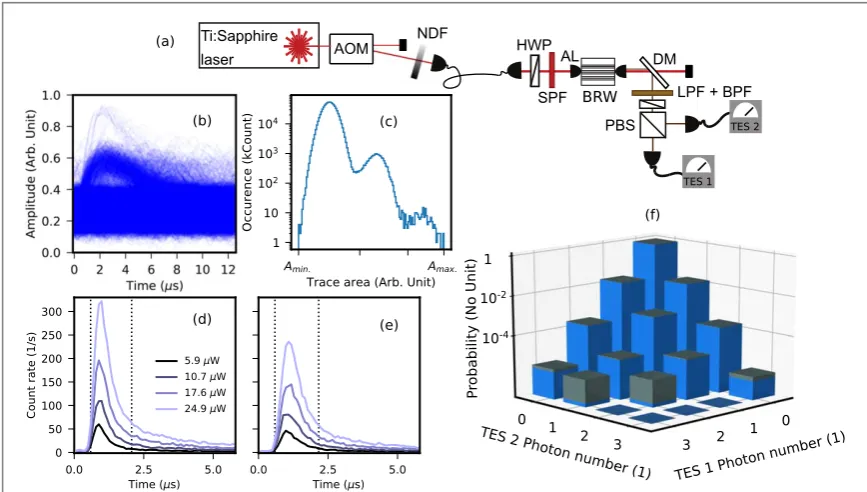
In our experiment depicted infigure4(a)we use approximately1.2 pslong Ti:Sapphire laser pulses with a central wavelength of771 nmand about0.5 nmfull-width-at-half-maximum as the pump for the PDC process. The pump beam is sent through an acusto-optic modulator(AOM)in order to reduce its repetition rate to
78 kHzand the pump power is controlled with a variable neutral densityfilter(NDF). Thereafter, the pump beam is sent through a polarization-maintaining single-modefiber to the BRW setup. We use a half-wave plate
(HWP)and a removable sheet polarizer(not shown)for selecting the proper pump beam polarization. After passing through a short-passfilter(SPF), the pump beam is coupled to the BRW for producing PDC with an aspheric lens(AL)having a focal length of approximately3 mm.
Another AL collimates the PDC emission from our BRW, after which the pump beam is separated from the beam path with a dichroic mirror(DM). Thereafter, the PDC emission is sent through a long-passfilter(LPF)as well as a12 nmbroad bandpassfilter(BPF)centered close to the degeneracy wavelength of1542 nm, which we previously measured via the second-harmonic generation. Signal and idler then pass through another HWP and get separated in a polarizing beam splitter(PBS). Finally, we couple the individual twin beams into single-mode fibers with ALs having about16 mmfixed focus, with which we achieve50% coupling efficiency near 1550 nm. After that signal and idler are recorded with two TESs optimized for photodetection in the
telecommunication wavelength range[25].
[image:6.595.118.552.61.307.2]The two-channel photon-number-resolving detector system includes two TESs as the light-sensitive detector elements. Each TES consists of a thinfilm of tungsten embedded in a multilayer structure, in which the individual photons are absorbed[42]. Our TESs are kept in a demagnetization refrigerator close to100 mKwith a holding time of about 25 h[26]. The individual TESs reach detection efficiencies above 60% and 70%, which were measured with a modulated continuous-wave laser in the telecommunication wavelengths. Finally, the TESs’responses are amplified with superconducting quantum interference devices[43]before the detected
Figure 4.(a)Experimental setup for measuring the joint photon-number distribution of twin beams from a BRW with TESs, (b)graphic presentation of 30 000 raw traces collected in about0.38 sand measured at a pump power of17.6 Wm by an individual TES,(c)histogram of the area of the raw TES traces measured in10.4 sat the pump power of17.6 Wm ,(d)–(e)counting rates of the two TESs with respect to time elapsed from the trigger at different pumping powers gained by post-processing the TES traces like in(b) by discriminating them with a level just above the vacuum base line and(f)the complete measured joint photon-number distribution at17.6 Wm . The horizontal ticks in(c)between the minimum and maximum trace area,Amin.andAmax.respectively, calculated from
traces are digitized with an analog-to-digital converter as shown infigure4(b). A histogram of the raw events detected by an individual TES infigure4(c)clearly shows vacuum, one- and two-photon contributions in a twin beam. Further, we utilize time gates of about1.5 sm as illustrated infigures4(d)–(e)to reduce background events from the rather strong photoluminescence coming from the BRW wafer material(seefigure4(b)). The electrical trigger from the AOM is delivered for the synchronization of the measured traces. In order to acquire the joint photon statistics as illustrated infigure4(f)we record(6.6−9.8)×106traces corresponding to effective measurement times from 84 to125 sand resulting up to about 5 GB of raw binary data.
4. Results
Due to the strong spectral correlation between signal and idler our BRW produces by definition MM PDC emission[33,44]. As we are only interested in the photon-number degree of freedom, our BRW is suitable for the investigations, and we measure the joint photon statistics of the PDC emission by varying the pump power. To prove that photon-pair generation takes place, wefirst investigate the signal-idler correlation with the coincidences-to-accidentals ratio(CAR), which can be extracted independently from the measured loss-degraded joint photon statistics(see appendixA). Our results infigure5(a)show, as expected, a decreasing photon-pair correlation with increasing pump power. Indeed, a value CAR>2 is required to verify that the correlation between signal and idler is stronger than that of a thermal light source. We achieve a maximum of CAR=8.2(3)that is well above this limit. Moreover, the photon-pair correlation provides a direct loss-independent access to the mean photon number of the PDC emission, which can be estimated in the MM case viaCAR= +1 1 á ñn˜ [33,45]. This is shown for our data in the inset infigure5(a)delivering
n 0.139 5 ... 2.13 9
á ñ =˜ ( ) ( )for the range of the measured pump powers and providing in our case the lower limit for the mean photon number of the PDC emission.
We then investigate the characteristics of the higher-photon number contributions of the heralded target states gained from the joint photon statistics when conditioned on measuring one photon with the TES in the heralding arm. Infigure5(b)we illustrate the evaluatedg(2)-values of the heralded states both in signal and idler in terms of the extracted mean photon number of the PDC emission. As expected, at low heralding efficiencies
(see inset infigure5(b)), the extracted values ofg(2)increase quickly with respect to the growing mean photon number of the PDC emission. Moreover, the measured values agree well with the theoretical prediction in the MM case. In our case the preparation of high quality heralded states is strongly limited to the low values ofá ñn˜, i.e. to the low pump powers, due to the modest heralding efficiency achieved. To improve the heralding efficiency a better suppression of spurious counts via more stringent time-gating[46], a more efficient coupling of the total-internal reflection modes into the single-modefibers, and a reduction of the BRW’s internal losses is required[48]. Nevertheless, the preparation of single photons with close to the desired photon-number content is still possible in our case, if the mean photon number of the PDC emission is kept low.
[image:7.595.122.554.61.202.2]Therefore, in order to extract the photon-number parity of the heralded states via the moment generating function, we perform a second set of power dependent measurements of the joint photon statistics at low pump powers. Again, we evaluate the signal-idler correlation as shown infigure6(a). At the lowest pump power we
Figure 5.(a)Measured CAR(gray circles)with respect to the power of the pump beam measured right before being coupled to the BRW. If not shown, error bars are smaller than used symbols. The dashed line is afit, for whichCARµP-1.19 10( ). An exponent of−1
is expected for a well-behaved MM PDC process without spurious counts[46]. The dotted line highlights the value of unity expected for two completely independent photonfluxes. The inset in(a)shows the extracted mean photon number of the PDC emission versuspump power.(b)Evaluatedg(2)-values of the heralded states in terms of the mean photon number of the PDC emission for both signal(blue diamonds)and idler(red squares), when the other twin beam is used as herald. The solid line is the theoretical prediction forg(2)fromfigure3(b). The inset in(b)shows the Klyshko efficiencies of signal and idler[47], which are evaluated as the ratio of coincidence counts to singles counts in the other twin beam, and are used as an estimate for the heralding efficiency.
6
achieve a CAR of 12.6(2)limiting the mean photon number of the PDC emission toá ñ =n˜ 0.086 2( ). In figure6(b)we illustrate the extractedg(2)-values for the heralded target states with respect the pump power and mark their loss-corrected mean photon numbers(see appendixB). At the lowest pump power we reach the values ofg(2)=0.21(3)andá ñ =n 1.086 2( ). Indeed, both of thesefigures of merit reflect the existing higher photon-number content in the heralded state.
Due to the low yield of heralded state preparation and the limited acquisition time in our experiment, we have at the lower pump powers experimentally access only to the second-order normalized factorial moment of the heralded states. In order to loss-tolerantly evaluate their photon-number parity, we truncate the summation in equation(6)tom=2. This deliversM( )2 » - á ñ + á ñ1 2 n 2 n g2 ( )2,to which the data fromfigure6(b)is
plugged and the extracted values forM(2)are shown infigure6(c)with respect to the mean photon number of the PDC emission. Even if only the second-order normalized moment has been measured, a negative photon-number parity can be reconstructed up toá ñn˜ 0.4for well-behaved MM-PDC at low heralding efficiencies as shown by the dashed–dotted line infigure6(c)and our results nicely follow this tendency. At the lowest pump power we can reconstruct the photon-number parity of−0.68±0.08 for the heralded state. However, one clearly sees that the truncation of equation(6), which is necessary due to the experimental limitations, causes distortion from the theoretical expectation.
5. Conclusions
We measured the joint photon statistics of twin beams generated via parametric down-conversion in BRWs with TESs, which are true photon-number-resolving detectors. We showed that the normalized factorial moments of the photon number are expedient for providing an easy access to the heralded state characteristics in terms of the parameter space spanned by the mean photon number of the PDC emission and the heralding efficiency. By combining the measured second-order normalized moment of the heralded single photon with its mean photon number corrected for experimental imperfections, we were able to reconstruct its negative photon-number parity. We believe our experimental method can become powerful in order to loss-tolerantly investigate the characteristics of also more sophisticated states, like higher photon-number states. Additionally, our scheme is not limited to true photon-number-resolving detectors but can also be implemented with bucket detectors connected to cascaded optical beam splitter networks, which are also capable of measuring higher-order moments.
Acknowledgments
[image:8.595.120.553.62.185.2]We acknowledge support from the Austrian Science Fund(FWF): J-4125-N27 and I-2065-N27, the German Research Foundation(DFG): RE2974/18-1 and SCHN1376/2-1 and the State of Bavaria. The work reported in this paper was partially funded by project EMPIR 17FUN06 SIQUST. This project has received funding from the EMPIR programme cofinanced by the Participating States and from the European Unionʼs Horizon 2020 research and innovation program.
Figure 6.Experimental values(symbols) (a)for the CAR and(b)forg(2)of the heralded target states with respect to the pump power as well as(c)for the loss-tolerantly reconstructed photon-number parity with respect to the mean photon number of the PDC emission. The dashed line in(a)isfitted withCARµP-1.34 11( )and the dotted line shows CAR=1. The dashed line in(b)is a linearfit and the
We gratefully thank F Gericke for laboratory support, A Wolf and S Kuhn for assistance during the sample growth and fabrication, M López from PTB Braunschweig for lending us a tunable telecom continuous-wave laser, and A E Lita and S W Nam from NIST, USA, for providing us the transition-edge sensor chips.
Appendix A. Extracting signal-idler photon-number correlation from the joint photon
statistics
The higher-order normalized moments can be extracted directly from the measured joint photon statistics of twin beams. We calculate them directly via[7]
g n n
n n
: :
, A.1
m n sm in
s m i n
, = á ñ
á ñ á ñ
ˆ ˆ
ˆ ˆ ( )
( )
in which(m,n)denotes the order of the correlation andnˆsandnˆiare the mean photon-number operators in the
signal and idler arms, respectively. We evaluate the moments in the photon-number basis, and therefore assume that the density matrix of the two-mode state can be written assi= å åk k, ¢ l l,¢ck k l l, , ,¢ ¢∣kñ á ¢ Ä ñ á ¢s s k∣ ∣li i l ∣. The joint photon statistics can then be expressed asP k l( , )=Tr{si∣kñ ás s k∣Ä ñ á∣li i l∣ }=ck k l l, , , =c˜k l,. Due to the normalizationåk l,P k l( , )=c˜k l, =1.
We can evaluate the higher-order moments by re-writingnˆs=a aˆ ˆ† andnˆi=b bˆ ˆ †
withaˆ(aˆ†)andbˆ(bˆ† )
being the photon annihilation and creation operators in signal and idler arms. The expectation values involved in equation(A.1)can the be evaluated with the help of
n n a b b a
c k a a k l b b l
c k k k m l l l n
k c l
: : Tr
1 ... 1 1 ... 1
, A.2
sm in si m n n m
k k l l
k k l l s m m s i n n i k l k l k l k l k l , , , , , , ,
å å
å å
å å
á ñ =
= á ¢ ñ á ¢ ñ
= - - + - - + = ¢ ¢ ¢ ¢ = =
ˆ ˆ { ˆ ˆ ˆ ˆ }
∣ ˆ ˆ ∣ ∣ ˆ ˆ ∣
˜ ( ) ( ) ( ) ( )
( ) ˜ ( ) ( )
†
† †
( ) ( )
thefinal form of which can be evaluated as a matrix multiplication. In section4we utilize the signal-idler correlationg(1,1), which corresponds to the well-known CAR.
Appendix B. Accessing the mean photon number of heralded state
The signal-idler correlations can be very helpful in characterizing the properties of heralded target states and indeed, they are useful for estimating the mean photon number of the heralded states in a loss-tolerant manner. Because of the low detection efficiency, we can make use of coincidence counting for approximating it. Thus, the ratio of coincidence countsCto single countsSξ(ξ=s,i)for signal(s)and idler(i)provides a good approximation for the loss-degraded mean photon number of the heralded state, which is given by ns i, C Si s
lossy
,
á ñ » . The loss-inverted mean photon number can be extracted as ns i, ns i, s i
lossy , h
á ñ = á ñ ¢ withh¢ =s i, (C-A) Si s, being theeffectiveKlyshko efficiency of signal and idler, which accounts for the effect of higher photon-number contributions since the accidental countsA
are subtracted from the measured coincidences. Therefore, the loss-tolerantly determined mean photon number of
the heralded state can be estimated with the help of the CAR denoted asC/Avia ns i SC 1 S
C A C A
, 1 1 i s i s , ,
á ñ » =
-(
)
.ORCID iDs
K Laiho https://orcid.org/0000-0003-3090-8629
S Höfling https://orcid.org/0000-0003-0034-4682
G Weihs https://orcid.org/0000-0003-2260-3008
S Reitzenstein https://orcid.org/0000-0002-1381-9838
References
[1]Hong C K and Mandel L 1986 Experimental realization of a localized one-photon statePhys. Rev. Lett.5658
[2]Lvovsky A I, Hansen H, Aichele T, Benson O, Mlynck J and Schiller S 2001 Quantum state reconstruction of the single-photon Fock-statePhys. Rev. Lett.87050402
[3]Ourjoumtsev A, Tualle-Brouri R and Grangier P 2006 Quantum homodyne tomography of a two-photon Fock-statePhys. Rev. Lett.96213601
[4]Waks E, Diamanti E and Yamamoto Y 2006 Generation of photon number statesNew J. Phys.84 8
quantum statesPhys. Rev.A85063835
[9]Laiho K, Christ A, Cassemiro K N and Silberhorn C 2011 Testing spectralfilters as Gaussian quantum optical channelsOpt. Lett.361476
[10]Wakui K, Eto Y, Benichi H, Izumi S and Yanagida T 2014 Ultrabroadband direct detection of nonclassical photon statistics at telecom wavelengthSci. Rep.44535
[11]Harder G, Bartley T J, Lita A E, Nam S W, Gerrits T and Silberhorn C 2016 Single-mode parametric-down-conversion states with 50 photons as a source for mesoscopic quantum opticsPhys. Rev. Lett.116143601
[12]Sperling Jet al2017 Detector-independent verification of quantum lightPhys. Rev. Lett.118163602
[13]Perina J Jr., Michalek V and Haderka O 2017 Higher-order sub-Poissonian-like nonclassicalfields: theoretical and experimental comparisonPhys. Rev.A96033852
[14]Helt L G and Steel M J 2017 Effect of dark counts on single-photon heralding with quasi-number-resolving detection schemesOpt. Lett.424792
[15]Chesi G, Malinverno L, Allevi A, Santoro R, Caccia M and Bondani M 2019 Measuring nonclassicality with silicon photomultipliers
Opt. Lett.441371
[16]Hanbury-Brown R and Twiss R Q 1956 Correlation between photons in two coherent beams of lightNature17727
[17]Kimble H J, Dagenais M and Mandel L 1977 Photon antibunching in resonancefluorescencePhys. Rev. Lett.39691
[18]Bocquillon E, Couteau C, Razavi M, Laflamme R and Weihs G 2009 Coherence meausures for heralded single-photon sourcesPhys. Rev.A79035801
[19]Heindel Tet al2017 A bright triggered twin-photon source in the solid stateNat. Commun.814870
[20]Barnett S M and Randmore P M 1997Methods in Theoretical Quantum Optics(Oxford: Oxford University Press)
[21]Beenakker C W J and Schomerus H 2001 Counting statistics of photons produced by electronic shot noisePhys. Rev. Lett.86700
[22]Wasilewski W, Radzewicz C, Frankowski R and Banaszek K 2008 Statistics of multiphoton events in spontaneous parametric down-conversionPhys. Rev.A78033831
[23]Laiho K, Avenhaus M and Silberhorn C 2012 Characteristics of displaced single photons attained via higher order factorial moments
New J. Phys.14105011
[24]Barnett S M, Ferenczi G, Gilson C R and Speirits F C 2018 Statistics of photon-subtracted and photon-added statesPhys. Rev.A98013809
[25]Lita A E, Miller A J and Nam S-W 2008 Counting near-infrared single-photons with 95% efficiencyOpt. Express163032
[26]Schmidt M, von Helversen M, López M, Gericke F, Schlottmann E, Heindel T, Kück S, Reitzenstein S and Beyer J 2018 Photon-number-resolving transition-edge sensors for the metrology of quantum light sourcesJ. Low. Temp. Phys.1931243
[27]Zhai Y, Becerra F E, Glebov B L, Wen J, Lita A E, Calkins B, Gerrits T, Fan J, Nam S W and Migdall A 2013 Photon-number-resolved detection of photon-subtracted thermal lightOpt. Lett.382171
[28]Schlottmann Eet al2018 Exploring the photon-number distribution of bimodal microlasersPhys. Rev. Appl.9064030
[29]von Helversen M, Böhm J, Schmidt M, Gschrey M, Schulze J-H, Strittmatter A, Rodt S, Beyer J, Heindel T and Reitzenstein S 2019 Quantum metrology of solid-state single-photon sources using photon-number-resolving detectorsNew J. Phys.21035007
[30]Förtsch Met al2015 Near-infrared single-photon spectroscopy of a whispering gallery mode resonator using energy-resolving transition edge sensorsJ. Opt.17065501
[31]Brida G, Ciavarella L, Degiovanni I P, Genovese M, Lolli L, Mingolla M G, Piacentini F, Rajteri M and Taralli E 2012 Quantum characterization of superconducting photon countersNew J. Phys.14085001
[32]Horn R, Abolghasem P, Bijlani B J, Kang D, Helmy A S and Weihs G 2012 Monolithic source of photon pairsPhys. Rev. Lett.108153605
[33]Günthner T, Pressl B, Laiho K, Geßler J, Höfling S, Kamp M, Schneider C and Weihs G 2015 Broadband indistinguishability from bright parametric down-conversion in a semiconductor waveguideJ. Opt.17125201
[34]Belhassen J, Baboux F, Yao Q, Amanti M, Favero I, Lemaitre A, Kolthammer W S, Walmsley I A and Ducci S 2018 On-chip III–V monolithic integration of heralded single photon sources and beamsplittersAppl. Phys. Lett.112071105
[35]D’Auria V, Morin O, Fabre C and Laurat J 2012 Effect of the heralding detector properties on the conditional generation of single-photon statesEur. Phys. J.D66249
[36]Rohde P P, Helt L G, Steel M J and Gilchrist A 2015 Multiplexed single-photon-state preparation using afiber-loop architecturePhys. Rev.A92053829
[37]Vasilyev M, Choi S-K, Kumar P and D’Ariano G M 2000 Tomographic measurement of joint photon statistics of the twin-beam quantum statePhys. Rev. Lett.842354
[38]Haderka O, Perina J Jr., Hamar M and Perina J 2005 Direct measurement and reconstruction of nonclassical features of twin beams generated in spontaneous parametric down-conversionPhys. Rev.A71033815
[39]Cahill K E and Glauber R J 1969 Density operators and quasiprobability disrtributionsPhys. Rev.1771882(and references therein)
[40]Lütkenhaus N and Barnett S M 1995 Nonclassical effects in phase spacePhys. Rev.A513340
[41]Abolghasem P, Han J, Bijlani B J, Arjmand A and Helmy A S 2009 Highly efficient second-harmonic generation in monolithic matching layer enhanced AlxGa1-xAs Bragg reflection waveguidesIEEE Photon. Technol. Lett.211462
[42]Lita A E, Calkins B, Pellouchoud L A, Miller A J and Nam S 2010 Superconducting transition-edge sensors optimized for high-efficiency photon-number resolving detectorsProc. SPIE76817681D
[43]Drung D, Aßmann C, Beyer J, Kirste A, Peters M, Ruede F and Schurig T 2007 Highly sensitive and easy-to-use squid sensorsIEEE Trans. Appl. Supercond.17699
[44]Laiho K, Pressl B, Schlager A, Suchomel H, Kamp M, Höfling S, Schneider C and Weihs G 2016 Uncovering dispersion properties in semiconductor waveguides to study photon-pair generationNanotechnology27434003
[45]Christ A, Laiho K, Eckstein A, Cassemiro K N and Silberhorn C 2011 Probing multimode squeezing with correlation functionsNew. J. Phys. 13033027
[46]Chen Het al2018 Invited article: Time-bin entangled photon pairs from Bragg-reflection waveguidesAPL Photonics3080804
[47]Klyshko D N 1977 Utilization of vacuumfluctuations as an optical brightness standardSov. J. Quantum Electron.7591