Munich Personal RePEc Archive
Conditional Punishment
Kamei, Kenju
Bowling Green State University
21 May 2014
Online at
https://mpra.ub.uni-muenchen.de/56128/
1
Conditional Punishment
Kenju Kamei
Department of Economics, Bowling Green State University Email: [email protected],[email protected]
Abstract: We elicit human conditional punishment types by conducting experiments. We find that their punishment decisions to an individual are on average significantly positively
proportional to other members’ punishment decisions to that individual.
Keywords: cooperation, punishment, experiments JEL codes: C91, C92, D70, H41
1. Introduction
Cooperation problems are one of the most common and important features of our modern society. During the recent few decades, economists have devoted efforts to understanding
people’s cooperation behavior in dilemma situations; and have found that peer-to-peer
punishment opportunities can be effective in promoting cooperation under some conditions (e.g., Fehr and Gächter 2000, Nikiforakis and Normann 2008). They have also demonstrated that neither people’s cooperation decisions nor punishment decisions are homogeneous. It is now known that there are multiple human types with regards to cooperation and punishment. Regarding cooperative types, it has been known that some people have preferences for cooperation in dilemmas. Moreover, many researchers have proposed that there exist some people that conditionally cooperate dependent upon decisions of others (e.g., Fischbacher et al.
2
(e.g., Nikiforakis 2008). Some people engage in punishment of non-punishers or that of anti-social punishers (e.g., Denant-Boemont et al. 2007). However, surprisingly little attention has been paid to how people’s punishment decisions to a person may depend on punishment decisions of others to that person.
Studying people’s conditional punishment behaviors is important especially for three reasons. First, understanding a person’s punishment decisions in relation to others’ contributes to an advancement in the economic theory as it gives us more micro-level data regarding people’s punishment behaviors. Second, if multiple types of punishers are present, then, incorporating the task of eliciting the punisher types in experiments, likewise cooperative types elicited in other past studies, would allow us to interpret subjects’ decisions more easily and precisely (e.g., by studying the relation between conditional punishment types and their institutional choices). Third, providing evidence on the prevalence of heterogeneous conditional punishment types would stimulate both theoretical and experimental research on the roles of conditional punishment types in the evolution of cooperation norms. For instance, Szolnoki and Perc (2013) theoretically show that what they call conditional punishers – those who impose a fine with a strength proportional to the number of punishers in their own groups – can play an important role in promoting cooperation.1
This paper elicits people’s conditional punishment types by conducting experiments using a strategy method. We find that subjects on average punish a non-cooperator at a strength positively proportional to the punishment by other members. We find, however, that subjects’ individual conditional punishment decisions are heterogeneous and that around half of the
subjects do not punish a person, no matter how many punishment points other members assign to that person. We call this punishment type the free-rider. Moreover, our data indicates that the classification of conditional punishment types helps us explain people’s unconditional altruistic as well as anti-social punishment decisions.
The rest of the paper proceeds as follows: Section 2 describes our experimental design. Section 3 reports results, and Section 4 concludes.
1
3 2. Experimental Design
The basic game frame we use in the experiment is voluntary contribution mechanism. Each subject is randomly assigned to a group of four, is given an endowment of 10 points, and decides whether they allocate the 10 points to either their private account or public account. When a subject allocates it to her private account, she will obtain 10 points as her payoff. By contrast, when the subject allocates it to her group’s public account, all group members, including her, obtain 5 points each as their payoffs. In other words, the MPCR (Marginal Per-Capita Return) is 0.5. We call those who allocate their endowment to their public (private) account the cooperators (non-cooperators) in this paper.
Once all subjects make their allocation decisions, they subsequently make conditional punishment decisions. Each subject can assign up to four punishment points to each member. The punishment points must be integer. For each punishment point he assigns to a member, he loses one point from his payoff, and the punished loses three points from her payoff. In the conditional punishment stage, each subject makes 18 (= 2 9) decisions, contingent on whether the target is a cooperator or a non-cooperator (2 possibilities), and also on how many punishment points on average the other two members in his group assign to the target (= {0.0, 0.5, 1.0, 1.5, 2.0, 2.5, 3.0, 3.5, 4.0}), of which there are nine possibilities. We refer to this list of 18
punishment decisions as the “conditional punishment schedule.” Once all subjects complete their conditional punishment schedules, they move on to the unconditional punishment stage. In this stage, they are informed of the allocation decisions made by the three other members in their groups and then make unconditional punishment decisions to each member. The conditional punishment decision is incentive-compatible as follows: once everyone makes their
unconditional punishment decisions, one schedule out of the four in each group is randomly selected to be used as the conditional punishment schedule.2 The instructions are available on-line as a supplementary content.
Standard theory predictions are straightforward: all allocate their endowments to their private accounts, and no one penalizes others. However, social preference models such as Fehr and Schmidt (1999) predict that some allocate their endowments to the public account, and some punish non-cooperators. Assuming cooperator j is only concerned about the income inequality
2
4
with non-cooperator i, the income inequality-averse model predicts more punishment from j to i
when the other two members punish i less, because otherwise the income inequality between i
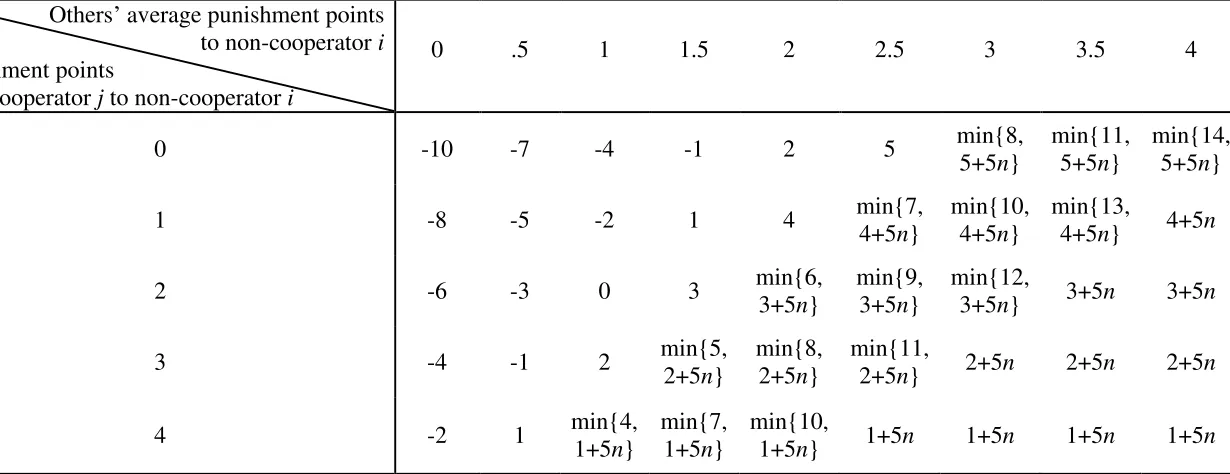
and j would be large (See Appendix Table B.1).
3. Results
We conducted experiments at University of Michigan in February 2014. All experiments were neutrally framed. 52 undergraduate students participated in the experiments. No subject participated in more than one session. The experiments lasted around 45 minutes on average. The average per-subject payment (including a participation fee of $5) was $17.35.
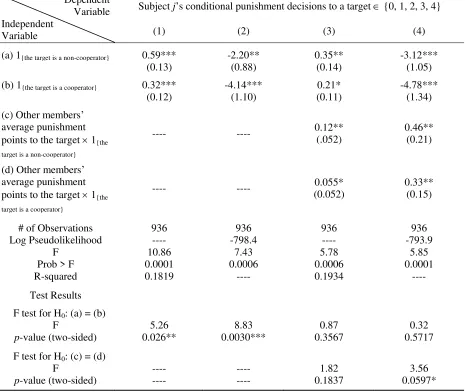
Fig.1 reports the total average conditional punishment schedule in our experiment.3 The total average conditional punishment decisions to a non-cooperator are significantly increasing in the amount of the other members’ average punishment to the non-cooperator. This pattern cannot be rationalized if we assume that a decision-maker is only concerned about the income inequality between her and the punished (See predictions based on inequality-averse models in Section 2). This instead suggests that (a) she does not care how small a payoff the non-cooperator obtains but (b) she does care about the income inequality between her and other punishers.
Moreover, intriguingly, we find that the total average conditional punishment decisions to a cooperator are also significantly increasing in the others’ punishment toward the cooperator, although the strength of punishment is significantly less than that to a non-cooperator. This pattern cannot be explained by reciprocity or income inequality models since the cooperator behaves nicely to his group members and his payoff cannot be any higher than theirs. This pattern can be, however, explained by Levine (1998) which assumes some individuals have spiteful preferences.
Result 1: The total average conditional punishment decisions are positively proportional to the
other members’ punishment decisions, whether the target of punishment is a cooperator or
non-cooperator.
Fig.1 also shows the average conditional punishment schedules for each of cooperators and non-cooperators. The total average punishment schedules of both cooperative types resemble
3
5
the one of all subjects, but the strength of punishment differs by cooperative type. We find that on average non-cooperators conditionally punish both cooperative types at a statistically similar strength, whereas cooperators conditionally punish a non-cooperator more strongly.4
Result 2: Non-cooperators on average conditionally punish both cooperative types at a
statistically similar strength, but cooperators on average conditionally assign significantly
larger punishment points to a non-cooperator than to a cooperator.
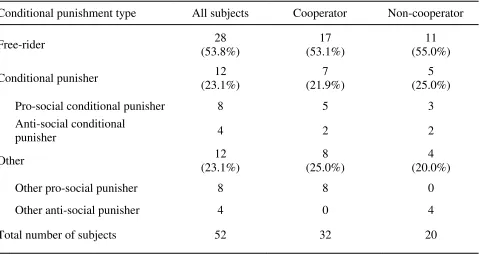
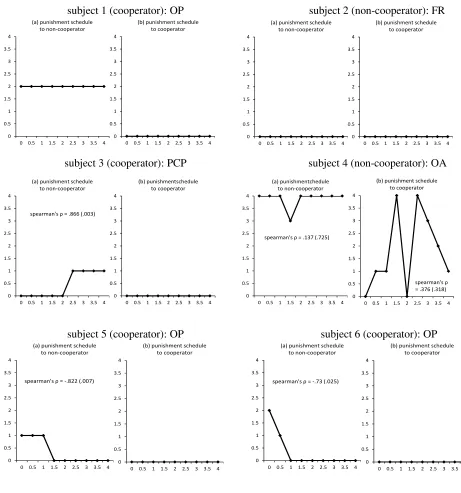
A closer look at our data reveals that individuals’ conditional punishment schedules are heterogeneous. Appendix Fig. B.1 shows individual punishment schedules. The majority of subjects, around 53.8% of them, are free-rider types. This is not surprising because punishment activities fall under a second-order free-riding problem.
The second largest type, which accounts for around 23.1% of the subjects, is the conditional punisher. We define that a subject is a conditional punisher if the Spearman’s between his conditional punishment points to a non-cooperator and the remaining others’
average punishment points to the non-cooperator is significantly positive at the 5% level. These conditional punishers can be further classified into the “pro-social conditional punishers” (15.4% of the subjects) and the “anti-social conditional punishers” (7.7% of them). The pro-social
conditional punishers punish a non-cooperator at a strength positively proportional to the other members’ punishment toward the non-cooperator, but do not conditionally punish a cooperator. The anti-social conditional punishers punish non-cooperators in the same manner as the pro-social conditional punishers do, and they also conditionally punish cooperators in some way unlike pro-social conditional punishers.5 Recent theoretical research has indicated that anti-social punishment can be evolutionary favored (e.g., Rand et al. 2010). Our finding that some may conditionally, anti-socially punish cooperators is new and adds a more detailed schedule of anti-social punishers, as the punishment schedule of the pro-social conditional punishers, to the existing literature. Studying the evolutionary advantage of the anti-social conditional punishers, along with that of the pro-social conditional punishers, in a theoretical model would be an interesting area for future research.
4
See Appendix Table B.2(2). 5
Some authors call those who punish both cooperators and non-cooperators the “spiteful” punishers, unlike our
6
We also find that four cooperators punish a non-cooperator with a strength significantly negatively proportional to others’ punishment toward the non-cooperator. This suggests that some cooperators make their punishment decisions mainly considering the income inequality between themselves and the target.
Result 3: Individual conditional punishment schedules are heterogeneous. 53.8% of subjects are
free-riders. The second largest category is the conditional punisher (23.1% of subjects). 66.7%
of the conditional punishers do not conditionally punish cooperators, but 33.3% of them
conditionally punish them as well.
Lastly, the elicited conditional punishment schedules of individuals are useful in
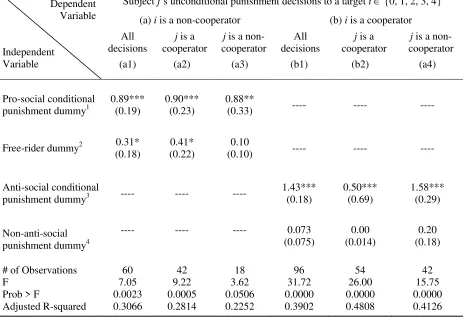
predicting people’s unconditional punishment decisions, either altruistic (e.g., Fehr and Gächter 2000) or anti-social (e.g., Herrmann et al. 2008). We find that those who at least once
conditionally assign positive punishment points to a non-cooperator (all conditional punishment types except free-riders) on average impose significantly positive fines on non-cooperators in the unconditional punishment stage. By contrast, those who conditionally assign positive punishment points at least once to a cooperator (anti-social conditional punishers or other anti-social
punishers) on average impose significantly positive fines on cooperators in that stage (see Appendix Table B.3).
Result 4: Those who conditionally assign positive punishment points at least once to a
non-cooperator (non-cooperator) punish non-non-cooperators (non-cooperators) significantly in the unconditional
punishment stage.
4. Conclusion
non-7
cooperator if others do so, and they do not care about how small a payoff the punished receives. The threat of being “severely” punished by coordinated conditional punishers might be an important factor of the observed success of punishing institutions in dilemma situations.
Acknowledgement: I thank Yan Chen for her hospitality in letting me conduct the experiments at University of Michigan.
References
Boyd, R., Gintis, H., Bowles, S., 2010. Coordinated Punishment of Defectors Sustains Cooperation and Can Proliferate When Rare, Science 328: 617-620.
Cinyabuguma, M., Page, T., Putterman, L., 2006. Can Second-Order Punishment Deter Perverse Punishment? Experimental Economics 9: 265-279.
Denant-Boemont, L., Masclet, D., Noussair, C., 2007. Punishment, Counter-punishment and Sanction Enforcement in a Social Dilemma Experiment. Economic Theory 33: 145-167.
Fehr, E., Gächter, S., 2000. Cooperation and Punishment in Public Goods Experiments,
American Economic Review 90: 980-994.
Fehr, E., Schmidt, K., 1999. A theory of fairness, competition, and cooperation, Quarterly Journal of Economics 114: 817-868.
Fischbacher, U., Gächter, S., Fehr, E., 2001. Are people conditionally cooperative? Evidence from a public goods experiment, Economics Letters 71: 397-404.
Herrmann, B., Thöni, C., Gächter, S., 2008. Antisocial Punishment Across Societies, Science
319: 1362-1367.
Kurzban, R., Houser, D., 2005. Experiments investigating cooperative types in humans A complement to evolutionary theory and simulations, Proceedings of the National Academy of Sciences 102: 1803-1807.
8
Nikiforakis, N., 2008. Punishment and counter-punishment in public good games: Can we really govern ourselves? Journal of Public Economics 92: 91-112.
Nikiforakis, N., Normann, H.-T., 2008. A Comparative Statics Analysis of Punishment in Public Goods Experiments, Experimental Economics 11: 358-369.
Rand, D., Armao, J., Nakamaru, M., Ohtsuki, H., 2010. Anti-social punishment can prevent the co-evolution of punishment and cooperation, Journal of Theoretical Biology 265: 624-32.
9 Fig.1: Average Conditional Punishment Schedules
(a) Conditional Punishment Decisions (b) Conditional Punishment Decisions
to a Non-cooperator to a Cooperator
0 0.2 0.4 0.6 0.8 1 1.2 1.4
0 0.5 1 1.5 2 2.5 3 3.5 4
The other members' average punishment points non-cooperators
cooperators
all subjects Punishment Points
0 0.2 0.4 0.6 0.8 1 1.2 1.4
0 0.5 1 1.5 2 2.5 3 3.5 4
The other members' average punishment points non-cooperators
cooperators
10
Table 1: Classification of Conditional Punishment Types
Conditional punishment type All subjects Cooperator Non-cooperator
\
Free-rider 28
(53.8%)
17 (53.1%)
11 (55.0%)
Conditional punisher 12
(23.1%)
7 (21.9%)
5 (25.0%)
Pro-social conditional punisher 8 5 3
Anti-social conditional
punisher 4 2 2
Other 12
(23.1%)
8 (25.0%)
4 (20.0%)
Other pro-social punisher 8 8 0
Other anti-social punisher 4 0 4
Total number of subjects 52 32 20
1
Supplementary Online Appendix for Kamei, 2014,
“Conditional Punishment”
Kenju Kamei
Department of Economics, Bowling Green State University, Bowling Green, OH 43403,
USA. Email: [email protected], [email protected].
Table of Contents
Appendix A: Instructions . . . p. 2
Appendix B: Additional Tables and Figures . . . . . . p. 8
2 Appendix A: Instructions
Instructions
You are now taking part in a decision-making experiment. Depending on your decisions and the decisions of other participants, you will be able to earn money in addition to the $5 guaranteed for your participation. Please read the following instructions carefully.
During the experiment you are not allowed to communicate with other participants. If you have questions, raise your hand. One of us will come to answer your question.
During the experiment your earnings will be calculated in points. At the end of the experiment your points will be converted to U.S. dollars at the following rate:
1 point = $1
(or each point will be exchanged for 1 dollar of real money). At the end of the experiment your total earnings (including the $5 participation fee) will be paid out to you in cash.
The experiment consists of two phases.
In the experiment, participants are randomly divided into groups of 4. This means that you are in a group with 3 other participants. You will be part of the same group throughout the entire experiment. No one knows which other participants are in your group, and no one will be informed who was in which group after the experiment.
Phase 1
Each group member, yourself included, will be given an endowment of 10 points. In this phase, you and the other 3 group members simultaneously decide how to use the endowment. There are two possibilities:
1. You can allocate 10 points to a group account. 2. You can allocate 10 points to a private account.
3
How to calculate your earnings:
Your earnings from your private account are equal to the number of points you allocated to the private account. That is, if you decide to allocate 10 points to the private account, you get 10 points as your earnings. The points you allocate to your private account do not affect the earnings of the other group members.
Your earnings from the group account equal the sum of points allocated to the group account by all 4 group members multiplied by 0.5. When you allocate 10 points to the group account, you and all other group members each get 5 points as earnings. For example, suppose that two members decide to allocate 10 points to the group account. Then, the sum of points in the group account is 20. The earnings of yours and each of the other group members from the group account are equal to 10 (= 20 0.5) points.
In summary, your earnings are calculated with the following formula:
(a) When you allocate 10 points to the private account:
10 + 0.5 (sum of points allocated by 3 other group members to the group account) (b) When you allocate 10 points to the group account:
0 + 0.5 (10 + sum of points allocated by 3 other group members to the group account) Note that you get 10 points as earnings when you allocate your endowment to your private account. If you instead allocate 10 points to your group account, your earnings from your allocation is 0.5 10 = 5 points. However, by allocating 10 points to the group account, the earnings of the other 3 group members also increase by 5 points. Therefore, the total group earnings are 5 4 = 20 points. Note that you also obtain earnings from points allocated to the group account by other 3 members. You obtain 0.5 10 = 5 points if another member allocates 10 points to the group account.
Example:
4
private account, and 0.5 20 = 10 points from the group account; therefore their earnings are each 10 + 10 = 20 points.
Please note that your earnings may be reduced after you make your allocation decision
depending on the other members’ decisions. We will explain the reduction procedure more in
detail in the instruction of Phase 2.
---
If you have any questions so far, please raise your hand. When all questions are answered, we will move on to comprehension questions.
Comprehension questions
Please answer the following questions. Raise your hand if you need help. A member of the experiment team will come to help you and will check your answers when you are done.
1. Suppose all four group members allocate 10 points to the private account. a) How much do you earn? _______________
b) How much do the other group members earn? _______________
2. Suppose all four group members allocate 10 points to the group account. a) How much do you earn? _______________
b) How much do the other group members earn? _______________
3. Suppose one group member allocate 10 points to the group account and two group members allocate 10 points to the private account. Answer the following:
a) How much do you earn if you allocate 10 points to the private account? _______________
5
Instructions for Phase 2:
In Phase 2, you will be shown the amount allocated to the group account by each of the other members in your group. In a box set at the right of the allocation information screen, you will be asked to enter an integer that you wish to use to reduce the earnings of the individual who made
that allocation decision. Each point you allocate to reduce someone’s earnings reduces your own earnings by 1 point and reduces that individual’s earnings by 3 points. You can assign reduction points from {0, 1, 2, 3, 4}. These decisions are unconditional. Your own earnings can be reduced in the same way by the decisions of others in your group. You are free to leave any
or all others’ earnings unchanged by entering 0’s in the relevant boxes.
An example of your screen:
Note: Numbers shown are for illustration only.
Your earnings are calculated as:
(i) Your earnings in Phase 1 minus reduction amounts due to your received reduction points
minus
6
Here, “the reduction amounts due to your received reduction points” are three times the total
reduction points you received from the other three members. In case that your earnings become negative, you will only receive the participation fee of $5 as your payment today.
There is another decision you are asked to make in this phase. Before you are informed of other
members’ allocation decisions and make your reduction decisions for them, you will be asked to
enter numbers, from {0, 1, 2, 3, 4}, into a form shown below. This form is called the
“conditional reduction schedule.” In this form, you will conditionally indicate how many reduction points you would like to assign to a member, assuming that the two remaining members in your group on average assign the reduction amount shown to that member. For example, in the screen image below in the top-left box, you’ll enter the number of reduction points you would like to assign if two other members do not assign any reduction points to a member (not you) that allocated 10 points to his or her private account; in the bottom-right box, the number of reduction points you want to assign if the other two assign an average of 4 reduction points (thus, 8 points in total) to a member (not you) that allocated 10 points to the group account in the allocation stage.
An example of your screen:
The reduction amounts you enter in this form will affect your earnings in the following way: at the onset of Phase 2, after you and the others in your group fill in this conditional reduction
decision form and click the “Continue” button, you are informed of Phase 1 allocation decisions
by other members. Then, all members make unconditional reduction decisions as mentioned
7
selected to be used. The three members’ unconditional reduction decisions andthe one member’s
conditional reduction decision will determine their earnings in the way already described.
For example, suppose that you (Subject 1) and Subject 2 allocate 10 points to the group account and that Subjects 3 and 4 in your group allocate 10 points to the private account. Suppose also that you are the group member who is randomly selected as the individual whose conditional reduction schedule is used. Suppose that Subjects 2 and 4 each assign reduction points of 0 point and 2 points, respectively, to Subject 3. Suppose that your conditional reduction schedule says that if other two assign on average reduction points of 1 point to a participant who allocates 10 points to the private account, you will assign 2 reduction points. Then, you shall assign 2 reduction points to Subject 3. As a result, 2 points will be deducted from your earnings, and 6 points (= 23) will be deducted from the earnings of Subject 3. Together with the reduction points made by subjects 2 and 4 to Subject 3, 12 points will be deducted from the earnings of Subject 3. Your reduction decisions to Subjects 2 and 4 are determined in the same manner.
Comprehension Questions:
1. When you assign 1 reduction point to another member, how many points will be deducted from the member?
[ ]
2. How many individuals’ conditional reduction schedules in a group are randomly selected to be
used to determine their reduction decisions?
8 Appendix B: Additional Tables and Figures
Table B.1: The Conditional Punishment Decision of Cooperator j to Non-cooperator i, and the Difference in Payoffs between i and j
Others’ average punishment points to non-cooperator i
Punishment points
from cooperator j to non-cooperator i
0 .5 1 1.5 2 2.5 3 3.5 4
0 -10 -7 -4 -1 2 5 min{8,
5+5n}
min{11, 5+5n}
min{14, 5+5n}
1 -8 -5 -2 1 4 min{7,
4+5n}
min{10, 4+5n}
min{13,
4+5n} 4+5n
2 -6 -3 0 3 min{6,
3+5n}
min{9, 3+5n}
min{12,
3+5n} 3+5n 3+5n
3 -4 -1 2 min{5,
2+5n}
min{8, 2+5n}
min{11,
2+5n} 2+5n 2+5n 2+5n
4 -2 1 min{4,
1+5n}
min{7, 1+5n}
min{10,
1+5n} 1+5n 1+5n 1+5n 1+5n
Notes: Each number in the table is the payoff of cooperator j minus that of non-cooperator i, assuming that j does not receive any punishment points from his or her group members. min{a, b} = a (b) if a ≤ b (a > b). If the number of cooperators except j is n {0, 1, 2}, then, the payoff of j before the punishment stages is 5+5n and that of i is 15+5n. If i receives in total more than punishment points, then, the payoff of i is 0, and the difference in payoffs between i and j becomes 5+5n−c, where c is the punishment points from j to i.
9
Table B.2: The Total Average Conditional Punishment Schedules for Each Target (a cooperator or a non-cooperator)
(1) The total average conditional punishment schedules
Dependent Variable Independent
Variable
Subject j’s conditional punishment decisions to a target {0, 1, 2, 3, 4}
(1) (2) (3) (4)
(a) 1{the target is a non-cooperator} 0.59*** -2.20** 0.35** -3.12***
(0.13) (0.88) (0.14) (1.05)
(b) 1{the target is a cooperator} 0.32*** -4.14*** 0.21* -4.78***
(0.12) (1.10) (0.11) (1.34)
(c) Other members’ average punishment points to the target 1{the target is a non-cooperator}
---- ---- 0.12**
(.052)
0.46** (0.21)
(d) Other members’ average punishment points to the target 1{the target is a cooperator}
---- ---- 0.055*
(0.052)
0.33** (0.15)
# of Observations 936 936 936 936
Log Pseudolikelihood ---- -798.4 ---- -793.9
F 10.86 7.43 5.78 5.85
Prob > F 0.0001 0.0006 0.0006 0.0001
R-squared 0.1819 ---- 0.1934 ----
Test Results
F test for H0: (a) = (b)
F 5.26 8.83 0.87 0.32
p-value (two-sided) 0.026** 0.0030*** 0.3567 0.5717
F test for H0: (c) = (d)
F ---- ---- 1.82 3.56
p-value (two-sided) ---- ---- 0.1837 0.0597*
Notes: Linear regressions with no constant terms and with robust standard errors clustered by subject ID in columns (1) and (3), and Tobit regressions with no constant terms and with robust standard errors clustered by subject ID in columns (2) and (4). The numbers of left-(right-) censored observations are 729(41) in columns (2) and (4). 1{the target is a cooperator} =1 if the target of punishment is a cooperator; = 0 otherwise.
1{the target is a non-cooperator} =1 if the target of punishment is a non-cooperator; = 0 otherwise.
*, **, and *** indicate significance at the 0.10 level, at the 0.05 level and at the 0.01 level, respectively.
10
(2) The average conditional punishment schedules by cooperative type (a cooperator or a non-cooperator)
Dependent variable Independent
Variable
Subject j’s conditional punishment decisions to a target
(1) (2) (3) (4)
(a) 1{the target is a non-cooperator
and subject j is a non-cooperator}
0.73*** (0.25)
-1.59 (1.09)
0.41 (0.27)
-2.83** (1.39)
(b) 1{the target is a non-cooperator
and subject j is a cooperator}
0.50*** (0.13)
-2.30** (0.93)
0.32** (0.16)
-2.93*** (1.08)
(c) 1{the target is a cooperator and
subject j is a non-cooperator}
0.69** (0.27)
-1.91* (1.13)
0.57** (0.27)
-2.32** (1.17)
(d) 1{the target is a cooperator and
subject j is a cooperator}
0.090 (0.064)
-6.17*** (1.81)
-0.0097 (0.0074)
-7.68 (1.84)
Other members’ average punishment points to the
target variable (a)
---- ---- 0.16**
(.069)
0.60** (0.27)
Other members’ average punishment points to the
target variable (b)
---- ---- 0.091
(0.073)
0.33 (0.29)
Other members’ average punishment points to the
target variable (c)
---- ---- 0.063
(0.053)
0.22 (0.17)
Other members’ average punishment points to the
target variable (d)
---- ---- 0.050
(0.036)
0.71** (0.15)
# of Observations 936 936 936 936
Log Pseudolikelihood ---- -767.7 ---- -761.8
F 6.14 3.20 3.63 6.13
Prob > F 0.0004 0.0127 0.0021 0.0000
R-squared 0.2223 ---- 0.2346 ----
Test Results
F test for H0: (a) = (b)
F 0.69 0.37 ---- ----
p-value (two-sided) 0.4093 0.5410 ---- ----
F test for H0: (c) = (d)
F 4.70 5.06 ---- ----
p-value (two-sided) 0.0349*** 0.0248** ---- ----
F test for H0: (a) = (c)
F 0.03 0.14 ---- ----
11
F test for H0: (a) = (c)
F 11.79 8.78 ---- ----
p-value (two-sided) 0.0012*** 0.0031*** ---- ----
Notes: Linear regressions with no constant terms and with robust standard errors clustered by subject ID in columns (1) and (3), and Tobit regressions with no constant terms and with robust standard errors clustered by subject ID in columns (2) and (4). The numbers of left-(right-) censored observations are 729(41) in columns (2) and (4).
1{the target is a non-cooperator and subject j is a non-cooperator} =1 if the target of punishment is a non-cooperator and j is a
non-cooperator; = 0 otherwise. 1{the target is a non-cooperator and subject j is a cooperator} =1 if the target of punishment is a
non-cooperator and j is a cooperator; = 0 otherwise. 1{the target is a cooperator and subject j is a non-cooperator} =1 if the target of
punishment is a cooperator and j is a non-cooperator; = 0 otherwise. 1{the target is a cooperator and subject j is a cooperator} =1 if
the target of punishment is a cooperator and j is a cooperator; = 0 otherwise.
*, **, and *** indicate significance at the 0.10 level, at the 0.05 level and at the 0.01 level, respectively.
12
Table B.3: Individual Conditional Punishment Decisions and Unconditional Punishment Decisions
Dependent Variable
Independent Variable
Subject j’s unconditional punishment decisions to a target i {0, 1, 2, 3, 4}
(a) i is a non-cooperator (b) i is a cooperator
All decisions
j is a cooperator
j is a non-cooperator
All decisions
j is a cooperator
j is a non-cooperator
(a1) (a2) (a3) (b1) (b2) (a4)
Pro-social conditional punishment dummy1
0.89*** (0.19)
0.90*** (0.23)
0.88**
(0.33) ---- ---- ----
Free-rider dummy2 0.31*
(0.18)
0.41* (0.22)
0.10
(0.10) ---- ---- ----
Anti-social conditional
punishment dummy3 ---- ---- ----
1.43*** (0.18)
0.50*** (0.69)
1.58*** (0.29)
Non-anti-social punishment dummy4
---- ---- ---- 0.073
(0.075)
0.00 (0.014)
0.20 (0.18)
# of Observations 60 42 18 96 54 42
F 7.05 9.22 3.62 31.72 26.00 15.75
Prob > F 0.0023 0.0005 0.0506 0.0000 0.0000 0.0000
Adjusted R-squared 0.3066 0.2814 0.2252 0.3902 0.4808 0.4126
Notes: Linear regressions with no constant terms. 1 The pro-social conditional punishment dummy equals 1 if j
conditionally assigns positive punishment points at least once to a non-cooperator in the conditional punishment
stage (i.e., all conditional punishment types but free-riders); 0 otherwise. 2 The free-rider dummy equals 1 if j is a
free-rider; 0 otherwise. 3 The anti-social conditional punishment dummy equals 1 if j conditionally assigns positive
punishment points at least once to a cooperator in the conditional punishment stage (i.e., an anti-social conditional
punisher or an other anti-social punisher); 0 otherwise. 4 The non-anti-social punishment dummy equals 1 if j is
neither an anti-social conditional punisher nor an other anti-social punisher; 0 otherwise. *, **, and *** indicate significance at the 0.10 level, at the 0.05 level and at the 0.01 level, respectively.
13
Fig. B.1: Individual Conditional Punishment Schedules and Classification Results
We define a free-rider as a subject who does not punish a person, no matter how many punishment points the other two members assign to that person. We define a pro-social (anti-social) conditional punisher as a subject whose Spearman’s ρ between his conditional
punishment points to a non-cooperator and the remaining members’ average punishment points to the non-cooperator is significantly positive at the 5% level and whose conditional punishment decisions to a cooperator are (are not) always 0. As for the rest of the subjects, we define an other pro-social (anti-social) punisher as a subject who conditionally punishes a non-cooperator but whose Spearman’s ρ is not significantly positive at the 5% level unlike conditional punishers and whose conditional punishment decisions to a cooperator are (are not) always 0.
subject 1 (cooperator): OP subject 2 (non-cooperator): FR
subject 3 (cooperator): PCP subject 4 (non-cooperator): OA
subject 5 (cooperator): OP subject 6 (cooperator): OP 0 0.5 1 1.5 2 2.5 3 3.5 4
0 0.5 1 1.5 2 2.5 3 3.5 4 (a) punishment schedule
to non-cooperator 0 0.5 1 1.5 2 2.5 3 3.5 4
0 0.5 1 1.5 2 2.5 3 3.5 4 (b) punishment schedule
to cooperator 0 0.5 1 1.5 2 2.5 3 3.5 4
0 0.5 1 1.5 2 2.5 3 3.5 4 (a) punishment schedule
to non-cooperator 0 0.5 1 1.5 2 2.5 3 3.5 4
0 0.5 1 1.5 2 2.5 3 3.5 4 (b) punishment schedule
to cooperator 0 0.5 1 1.5 2 2.5 3 3.5 4
0 0.5 1 1.5 2 2.5 3 3.5 4 (a) punishment schedule
to non-cooperator
spearman's ρ= .866 (.003)
0 0.5 1 1.5 2 2.5 3 3.5 4
0 0.5 1 1.5 2 2.5 3 3.5 4 (b) punishmentschedule to cooperator 0 0.5 1 1.5 2 2.5 3 3.5 4
0 0.5 1 1.5 2 2.5 3 3.5 4 (b) punishment schedule
to cooperator
spearman's ρ = .376 (.318) 0 0.5 1 1.5 2 2.5 3 3.5 4
0 0.5 1 1.5 2 2.5 3 3.5 4 (a) punishmentchedule
to non-cooperator
spearman's ρ= .137 (.725)
0 0.5 1 1.5 2 2.5 3 3.5 4
0 0.5 1 1.5 2 2.5 3 3.5 4 (b) punishment schedule
to cooperator 0 0.5 1 1.5 2 2.5 3 3.5 4
0 0.5 1 1.5 2 2.5 3 3.5 4 (a) punishment schedule
to non-cooperator
spearman's ρ= -.822 (.007)
0 0.5 1 1.5 2 2.5 3 3.5 4
0 0.5 1 1.5 2 2.5 3 3.5 4 (b) punishment schedule
to cooperator 0 0.5 1 1.5 2 2.5 3 3.5 4
0 0.5 1 1.5 2 2.5 3 3.5 4 (a) punishment schedule
to non-cooperator
14
subject 7 (non-cooperator): FR subject 8 (cooperator): PCP
subject 9 (cooperator): FR subject 10 (cooperator): OP
subject 11 (cooperator): FR subject 12 (cooperator): FR
subject 13 (cooperator): ACP subject 14 (cooperator): PCP 0 0.5 1 1.5 2 2.5 3 3.5 4
0 0.5 1 1.5 2 2.5 3 3.5 4 (b) punishmentschedule to cooperator 0 0.5 1 1.5 2 2.5 3 3.5 4
0 0.5 1 1.5 2 2.5 3 3.5 4 (a) punishmentschedule to non-cooperator 0 0.5 1 1.5 2 2.5 3 3.5 4
0 0.5 1 1.5 2 2.5 3 3.5 4 (b) punishment schedule
to cooperator 0 0.5 1 1.5 2 2.5 3 3.5 4
0 0.5 1 1.5 2 2.5 3 3.5 4 (a) punishment schedule
to non-cooperator
spearman's ρ= .983 (.000)
0 0.5 1 1.5 2 2.5 3 3.5 4
0 0.5 1 1.5 2 2.5 3 3.5 4 punishment scheule to cooperator 0 0.5 1 1.5 2 2.5 3 3.5 4
0 0.5 1 1.5 2 2.5 3 3.5 4 punishment schedule to non-cooperator 0 0.5 1 1.5 2 2.5 3 3.5 4
0 0.5 1 1.5 2 2.5 3 3.5 4 punishment schedule to cooperator 0 0.5 1 1.5 2 2.5 3 3.5 4
0 0.5 1 1.5 2 2.5 3 3.5 4 punishment schedule
to non-cooperator
spearman's ρ= .518 (.154)
0 0.5 1 1.5 2 2.5 3 3.5 4
0 0.5 1 1.5 2 2.5 3 3.5 4 (b) punishment schedule
to cooperator 0 0.5 1 1.5 2 2.5 3 3.5 4
0 0.5 1 1.5 2 2.5 3 3.5 4 (a) punishment schedule
to non-cooperator 0 0.5 1 1.5 2 2.5 3 3.5 4
0 0.5 1 1.5 2 2.5 3 3.5 4 (b) punishment schedule
to cooperator 0 0.5 1 1.5 2 2.5 3 3.5 4
0 0.5 1 1.5 2 2.5 3 3.5 4 (a) punishment schedule
to non-cooperator 0 0.5 1 1.5 2 2.5 3 3.5 4
0 0.5 1 1.5 2 2.5 3 3.5 4 (b) punishment schedule
to cooperator
spearman's ρ= .983 (.000)
0 0.5 1 1.5 2 2.5 3 3.5 4
0 0.5 1 1.5 2 2.5 3 3.5 4 (a) punishment schedule
to non-cooperator
spearman's ρ= .983 (.000)
0 0.5 1 1.5 2 2.5 3 3.5 4
0 0.5 1 1.5 2 2.5 3 3.5 4 (b) punishment schedule
to cooperator 0 0.5 1 1.5 2 2.5 3 3.5 4
0 0.5 1 1.5 2 2.5 3 3.5 4 (a) punishment schedule
to non-cooperator
15
subject 15 (cooperator): FR subject 16 (non-cooperator): FR
subject 17 (non-cooperator): FR subject 18 (non-cooperator): OA
subject 19 (non-cooperator): PCP subject 20 (non-cooperator): FR
subject 21 (non-cooperator): FR subject 22 (cooperator): PCP 0 0.5 1 1.5 2 2.5 3 3.5 4
0 0.5 1 1.5 2 2.5 3 3.5 4 (b) punishment schedule
to cooperator 0 0.5 1 1.5 2 2.5 3 3.5 4
0 0.5 1 1.5 2 2.5 3 3.5 4 (a) punishment schedule
to non-cooperator 0 0.5 1 1.5 2 2.5 3 3.5 4
0 0.5 1 1.5 2 2.5 3 3.5 4 (b) punishment schedule
to cooperator 0 0.5 1 1.5 2 2.5 3 3.5 4
0 0.5 1 1.5 2 2.5 3 3.5 4 (a) punishment schedule
to non-cooperator 0 0.5 1 1.5 2 2.5 3 3.5 4
0 0.5 1 1.5 2 2.5 3 3.5 4 (b) punishment schedule
to cooperator 0 0.5 1 1.5 2 2.5 3 3.5 4
0 0.5 1 1.5 2 2.5 3 3.5 4 (a) punishment schedule
to non-cooperator 0 0.5 1 1.5 2 2.5 3 3.5 4
0 0.5 1 1.5 2 2.5 3 3.5 4 (a) punishment schedule
to cooperator
spearman's ρ= -.138 (.723)
0 0.5 1 1.5 2 2.5 3 3.5 4
0 0.5 1 1.5 2 2.5 3 3.5 4 (a) punishment schedule
to non-cooperator
spearman's ρ= -.339 (.373)
0 0.5 1 1.5 2 2.5 3 3.5 4
0 0.5 1 1.5 2 2.5 3 3.5 4 (b) punishment schedule
to cooperator 0 0.5 1 1.5 2 2.5 3 3.5 4
0 0.5 1 1.5 2 2.5 3 3.5 4 (a) punishment schedule
to non-cooperator
spearman's ρ= .725 (.027)
0 0.5 1 1.5 2 2.5 3 3.5 4
0 0.5 1 1.5 2 2.5 3 3.5 4 (b) punishment schedule
to cooperator 0 0.5 1 1.5 2 2.5 3 3.5 4
0 0.5 1 1.5 2 2.5 3 3.5 4 (a) punishment schedule
to non-cooperator 0 0.5 1 1.5 2 2.5 3 3.5 4
0 0.5 1 1.5 2 2.5 3 3.5 4 (b) punishment schedule
to cooperator 0 0.5 1 1.5 2 2.5 3 3.5 4
0 0.5 1 1.5 2 2.5 3 3.5 4 (a) punishment schedule
to non-cooperator 0 0.5 1 1.5 2 2.5 3 3.5 4
0 0.5 1 1.5 2 2.5 3 3.5 4 (b) punishment schedule
to cooperator 0 0.5 1 1.5 2 2.5 3 3.5 4
0 0.5 1 1.5 2 2.5 3 3.5 4 (a) punishment schedule
to non-cooperator
16
subject 23 (non-cooperator): FR subject 24 (non-cooperator): OA
subject 25 (non-cooperator): PCP subject 26 (cooperator): FR
subject 27 (non-cooperator): ACP subject 28 (cooperator): OP
subject 29 (non-cooperator): ACP subject 30 (non-cooperator): FR 0 0.5 1 1.5 2 2.5 3 3.5 4
0 0.5 1 1.5 2 2.5 3 3.5 4 (b) punishment schedule
to cooperator 0 0.5 1 1.5 2 2.5 3 3.5 4
0 0.5 1 1.5 2 2.5 3 3.5 4 (a) punishment schedule
to non-cooperator 0 0.5 1 1.5 2 2.5 3 3.5 4
0 0.5 1 1.5 2 2.5 3 3.5 4 (b) punishment schedule
to cooperator 0 0.5 1 1.5 2 2.5 3 3.5 4
0 0.5 1 1.5 2 2.5 3 3.5 4 (a) punishment schedule
to non-cooperator 0 0.5 1 1.5 2 2.5 3 3.5 4
0 0.5 1 1.5 2 2.5 3 3.5 4 (b) punishment schedule
to cooperator 0 0.5 1 1.5 2 2.5 3 3.5 4
0 0.5 1 1.5 2 2.5 3 3.5 4 (a) punishment schedule
to non-cooperator
spearman's ρ= .730 (.025)
0 0.5 1 1.5 2 2.5 3 3.5 4
0 0.5 1 1.5 2 2.5 3 3.5 4 (b) punishment schedule
to cooperator 0 0.5 1 1.5 2 2.5 3 3.5 4
0 0.5 1 1.5 2 2.5 3 3.5 4 (a) punishment schedule
to non-cooperator 0 0.5 1 1.5 2 2.5 3 3.5 4
0 0.5 1 1.5 2 2.5 3 3.5 4 (b) punishment schedule
to cooperator
spearman's ρ= .983 (.000)
0 0.5 1 1.5 2 2.5 3 3.5 4
0 0.5 1 1.5 2 2.5 3 3.5 4 (a) punishment schedule
to non-cooperator
spearman's ρ= .983 (.000)
0 0.5 1 1.5 2 2.5 3 3.5 4
0 0.5 1 1.5 2 2.5 3 3.5 4 (b) punishment schedule
to cooperator 0 0.5 1 1.5 2 2.5 3 3.5 4
0 0.5 1 1.5 2 2.5 3 3.5 4 (a) punishment schedule
to non-cooperator
spearman's ρ= -.274 (.476)
0 0.5 1 1.5 2 2.5 3 3.5 4
0 0.5 1 1.5 2 2.5 3 3.5 4 (b) punishment schedule
to cooperator 0 0.5 1 1.5 2 2.5 3 3.5 4
0 0.5 1 1.5 2 2.5 3 3.5 4 (a) punishment schedule
to non-cooperator
spearman's ρ= .725 (.027)
0 0.5 1 1.5 2 2.5 3 3.5 4
0 0.5 1 1.5 2 2.5 3 3.5 4 (b) punishment schedule
to cooperator 0 0.5 1 1.5 2 2.5 3 3.5 4
0 0.5 1 1.5 2 2.5 3 3.5 4 (a) punishment schedule
17
subject 31 (cooperator): FR subject 32 (cooperator): ACP
subject 33 (cooperator): FR subject 34 (non-cooperator): FR
subject 35 (cooperator): FR subject 36 (cooperator): FR
subject 37 (non-cooperator): OA subject 38 (cooperator): FR 0 0.5 1 1.5 2 2.5 3 3.5 4
0 0.5 1 1.5 2 2.5 3 3.5 4 (b) punishment schedule
to cooperator 0 0.5 1 1.5 2 2.5 3 3.5 4
0 0.5 1 1.5 2 2.5 3 3.5 4 (a) punishment schedule
to non-cooperator 0 0.5 1 1.5 2 2.5 3 3.5 4
0 0.5 1 1.5 2 2.5 3 3.5 4 (b) punishment schedule
to cooperator
spearman's ρ= .908 (.001)
0 0.5 1 1.5 2 2.5 3 3.5 4
0 0.5 1 1.5 2 2.5 3 3.5 4 (a) punishment schedule
to non-cooperator
spearman's ρ= .745 (.021)
0 0.5 1 1.5 2 2.5 3 3.5 4
0 0.5 1 1.5 2 2.5 3 3.5 4 (b) punishment schedule
to cooperator 0 0.5 1 1.5 2 2.5 3 3.5 4
0 0.5 1 1.5 2 2.5 3 3.5 4 (a) punishment schedule
to non-cooperator 0 0.5 1 1.5 2 2.5 3 3.5 4
0 0.5 1 1.5 2 2.5 3 3.5 4 (b) punishment schedule
to cooperator 0 0.5 1 1.5 2 2.5 3 3.5 4
0 0.5 1 1.5 2 2.5 3 3.5 4 (a) punishment schedule
to non-cooperator 0 0.5 1 1.5 2 2.5 3 3.5 4
0 0.5 1 1.5 2 2.5 3 3.5 4 (b) punishment schedule
to cooperator 0 0.5 1 1.5 2 2.5 3 3.5 4
0 0.5 1 1.5 2 2.5 3 3.5 4 (a) punishment schedule
to non-cooperator 0 0.5 1 1.5 2 2.5 3 3.5 4
0 0.5 1 1.5 2 2.5 3 3.5 4 (b) punishment schedule
to cooperator 0 0.5 1 1.5 2 2.5 3 3.5 4
0 0.5 1 1.5 2 2.5 3 3.5 4 (a) punishment schedule
to non-cooperator 0 0.5 1 1.5 2 2.5 3 3.5 4
0 0.5 1 1.5 2 2.5 3 3.5 4 (b) punishment schedule
to cooperator 0 0.5 1 1.5 2 2.5 3 3.5 4
0 0.5 1 1.5 2 2.5 3 3.5 4 (a) punishment schedule
to non-cooperator
spearman's ρ= .548 (.127)
0 0.5 1 1.5 2 2.5 3 3.5 4
0 0.5 1 1.5 2 2.5 3 3.5 4 (b) punishment schedule
to cooperator 0 0.5 1 1.5 2 2.5 3 3.5 4
0 0.5 1 1.5 2 2.5 3 3.5 4 (a) punishment schedule
18
subject 39 (cooperator): OP subject 40 (non-cooperator): FR
subject 41 (cooperator): OP subject 42 (cooperator): FR
subject 43 (cooperator): FR subject 44 (cooperator): OP
subject 45 (cooperator): FR subject 46 (cooperator): FR 0 0.5 1 1.5 2 2.5 3 3.5 4
0 0.5 1 1.5 2 2.5 3 3.5 4 (b) punishment schedule
to cooperator 0 0.5 1 1.5 2 2.5 3 3.5 4
0 0.5 1 1.5 2 2.5 3 3.5 4 (a) punishment schedule
to non-cooperator
spearman's ρ= -.822 (.007)
0 0.5 1 1.5 2 2.5 3 3.5 4
0 0.5 1 1.5 2 2.5 3 3.5 4 (b) punishment schedule
to cooperator 0 0.5 1 1.5 2 2.5 3 3.5 4
0 0.5 1 1.5 2 2.5 3 3.5 4 (a) punishment schedule
to non-cooperator 0 0.5 1 1.5 2 2.5 3 3.5 4
0 0.5 1 1.5 2 2.5 3 3.5 4 (b) punishment schedule
to cooperator 0 0.5 1 1.5 2 2.5 3 3.5 4
0 0.5 1 1.5 2 2.5 3 3.5 4 (a) punishment schedule
to non-cooperator
spearman's ρ= -.94 (.000)
0 0.5 1 1.5 2 2.5 3 3.5 4
0 0.5 1 1.5 2 2.5 3 3.5 4 (b) punishment schedule
to cooperator 0 0.5 1 1.5 2 2.5 3 3.5 4
0 0.5 1 1.5 2 2.5 3 3.5 4 (a) punishment schedule
to non-cooperator 0 0.5 1 1.5 2 2.5 3 3.5 4
0 0.5 1 1.5 2 2.5 3 3.5 4 (b) punishment schedule
to cooperator 0 0.5 1 1.5 2 2.5 3 3.5 4
0 0.5 1 1.5 2 2.5 3 3.5 4 (a) punishment schedule
to non-cooperator 0 0.5 1 1.5 2 2.5 3 3.5 4
0 0.5 1 1.5 2 2.5 3 3.5 4 (b) punishment schedule
to cooperator 0 0.5 1 1.5 2 2.5 3 3.5 4
0 0.5 1 1.5 2 2.5 3 3.5 4 (a) punishment schedule
to non-cooperator
spearman's ρ= -.52 (.152)
0 0.5 1 1.5 2 2.5 3 3.5 4
0 0.5 1 1.5 2 2.5 3 3.5 4 (b) punishment schedule
to cooperator 0 0.5 1 1.5 2 2.5 3 3.5 4
0 0.5 1 1.5 2 2.5 3 3.5 4 (a) punishment schedule
to non-cooperator 0 0.5 1 1.5 2 2.5 3 3.5 4
0 0.5 1 1.5 2 2.5 3 3.5 4 (b) punishment schedule
to cooperator 0 0.5 1 1.5 2 2.5 3 3.5 4
0 0.5 1 1.5 2 2.5 3 3.5 4 (a) punishment schedule
19
subject 47 (cooperator): FR subject 48 (cooperator): FR
subject 49 (cooperator): FR subject 50 (cooperator): PCP
subject 51 (non-cooperator): FR subject 52 (non-cooperator): PCP 0 0.5 1 1.5 2 2.5 3 3.5 4
0 0.5 1 1.5 2 2.5 3 3.5 4 (b) punishment schedule
to cooperator 0 0.5 1 1.5 2 2.5 3 3.5 4
0 0.5 1 1.5 2 2.5 3 3.5 4 (a) punishment schedule
to non-cooperator 0 0.5 1 1.5 2 2.5 3 3.5 4
0 0.5 1 1.5 2 2.5 3 3.5 4 (b) punishment schedule
to cooperator 0 0.5 1 1.5 2 2.5 3 3.5 4
0 0.5 1 1.5 2 2.5 3 3.5 4 (a) punishment schedule
to non-cooperator 0 0.5 1 1.5 2 2.5 3 3.5 4
0 0.5 1 1.5 2 2.5 3 3.5 4 (b) punishment schedule
to cooperator 0 0.5 1 1.5 2 2.5 3 3.5 4
0 0.5 1 1.5 2 2.5 3 3.5 4 (a) punishment schedule
to non-cooperator 0 0.5 1 1.5 2 2.5 3 3.5 4
0 0.5 1 1.5 2 2.5 3 3.5 4 (b) punishment schedule
to cooperator 0 0.5 1 1.5 2 2.5 3 3.5 4
0 0.5 1 1.5 2 2.5 3 3.5 4 (a) punishment schedule
to non-cooperator
spearman's ρ= .949 (.000)
0 0.5 1 1.5 2 2.5 3 3.5 4
0 0.5 1 1.5 2 2.5 3 3.5 4 (b) punishment schedule
to cooperator 0 0.5 1 1.5 2 2.5 3 3.5 4
0 0.5 1 1.5 2 2.5 3 3.5 4 (a) punishment schedule
to non-cooperator 0 0.5 1 1.5 2 2.5 3 3.5 4
0 0.5 1 1.5 2 2.5 3 3.5 4 (b) punishment schedule
to cooperator 0 0.5 1 1.5 2 2.5 3 3.5 4
0 0.5 1 1.5 2 2.5 3 3.5 4 (a) punishment schedule
to non-cooperator
spearman's ρ= .866 (.003)
Classification Results:
(a) FR (Free-rider: 53.8%): subjects 2, 7, 9,11, 12, 15, 16, 17, 20, 21, 23, 26, 30, 31, 33, 34, 35, 36, 38, 40, 42, 43, 45,46, 47, 48, 49, 51
(b) PCP (Pro-social conditional punisher: 15.4%): subjects 3, 8, 14, 19, 22, 25, 50, 52 (c) ACP (Anti-social conditional punisher: 7.7%): subjects 13, 27, 29, 32